
Paz Arquitectura Wraps a Guatemala City Mixed-Use Tower in Rotating Timber Fins
A five-story building in Guatemala City uses alternating wooden louvers and art collaborations to open up to its urban context.


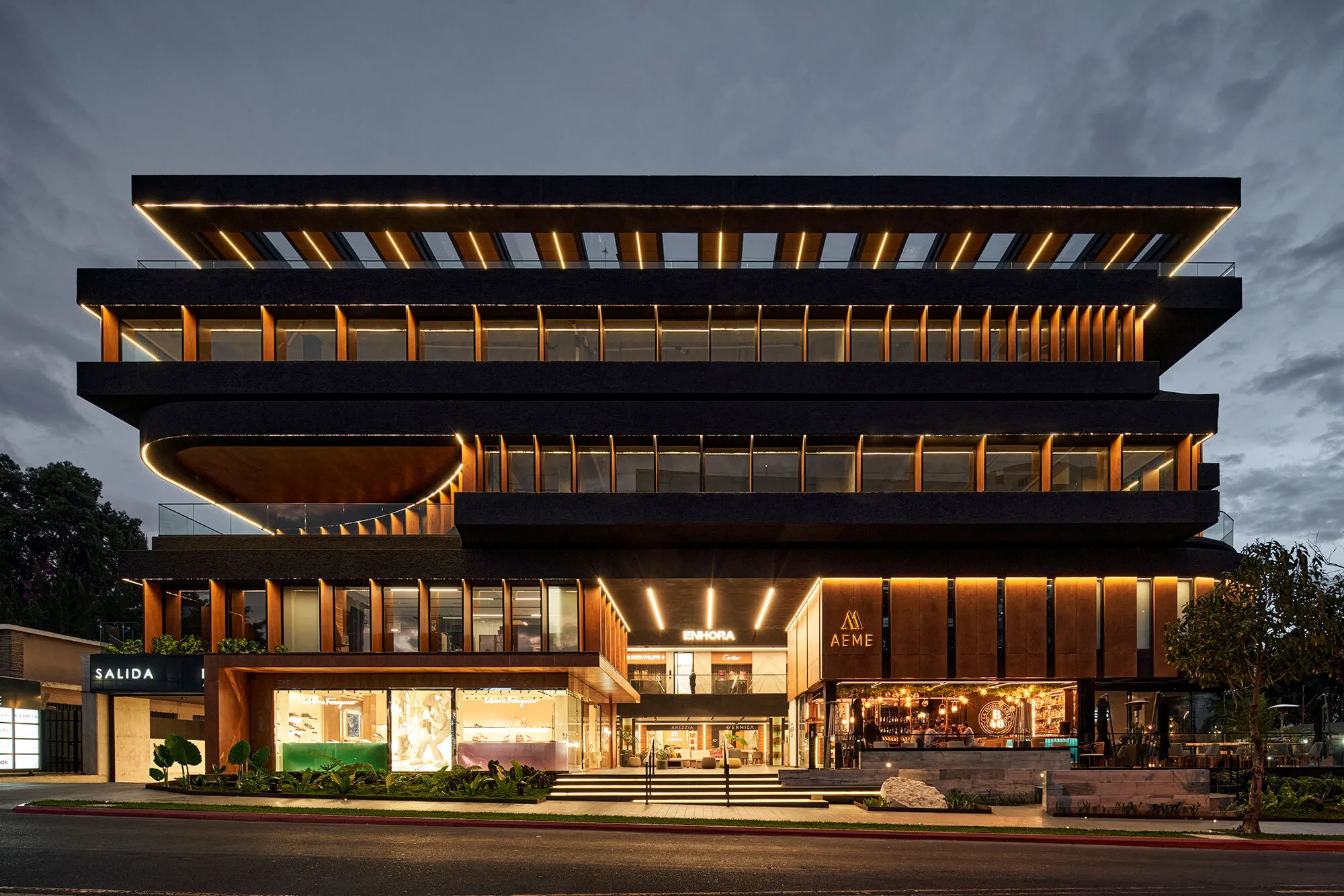
In a city where security concerns routinely produce fortress-like commercial buildings, Paz Arquitectura chose a radically different posture for the AEME Building. Rather than turning inward, the five-story mixed-use project in Guatemala City extends its ground floor as a continuation of public space, inviting pedestrians into a double-height commercial zone before funneling them upward through a sculptural atrium. The result is a building that participates in the street rather than defending against it.
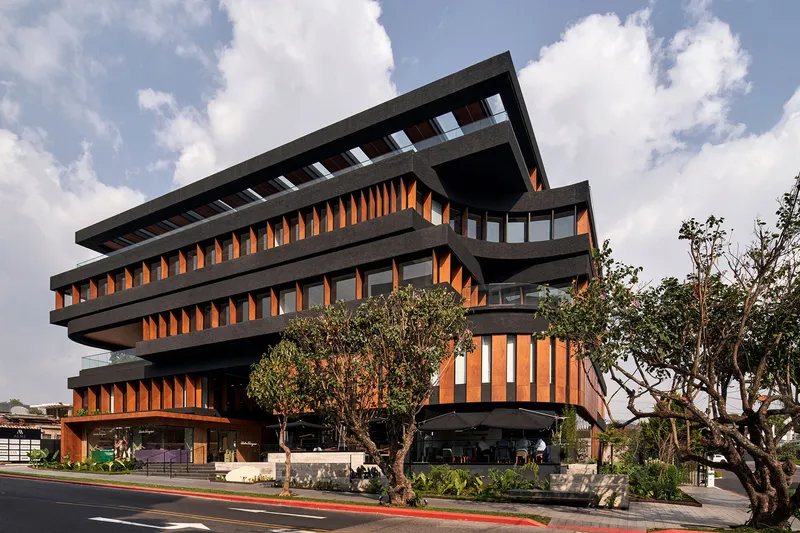
What makes AEME genuinely interesting, though, is its kinetic facade logic. Vertical timber fins wrap each floor plate, but they alternate direction: one level rotates clockwise, the next counterclockwise, producing a degradé effect that makes the building appear to shift depending on your vantage point. Combined with dark concrete bands that separate each level into a visually independent stratum, the facade reads as a stack of independent objects rather than a monolithic block. It is a strict geometric exercise threaded with constant movement, and it gives a 10,702-square-meter commercial building an uncommon sense of lightness.
A Facade in Rotation
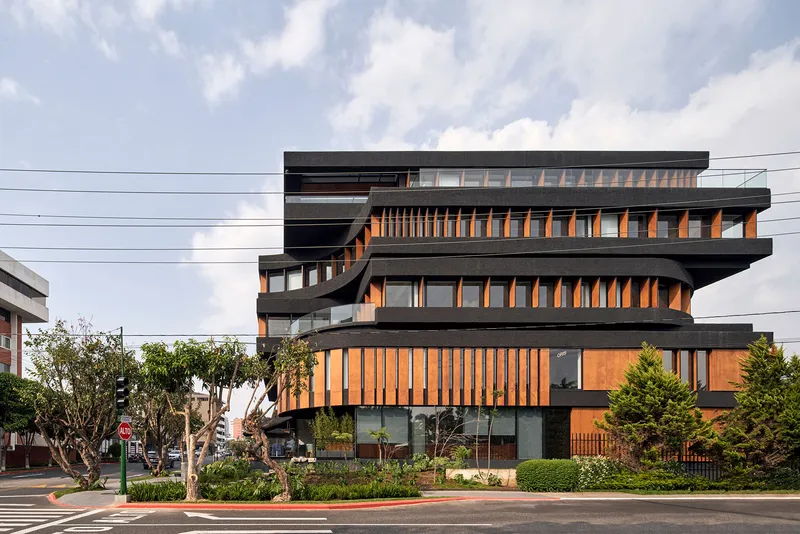
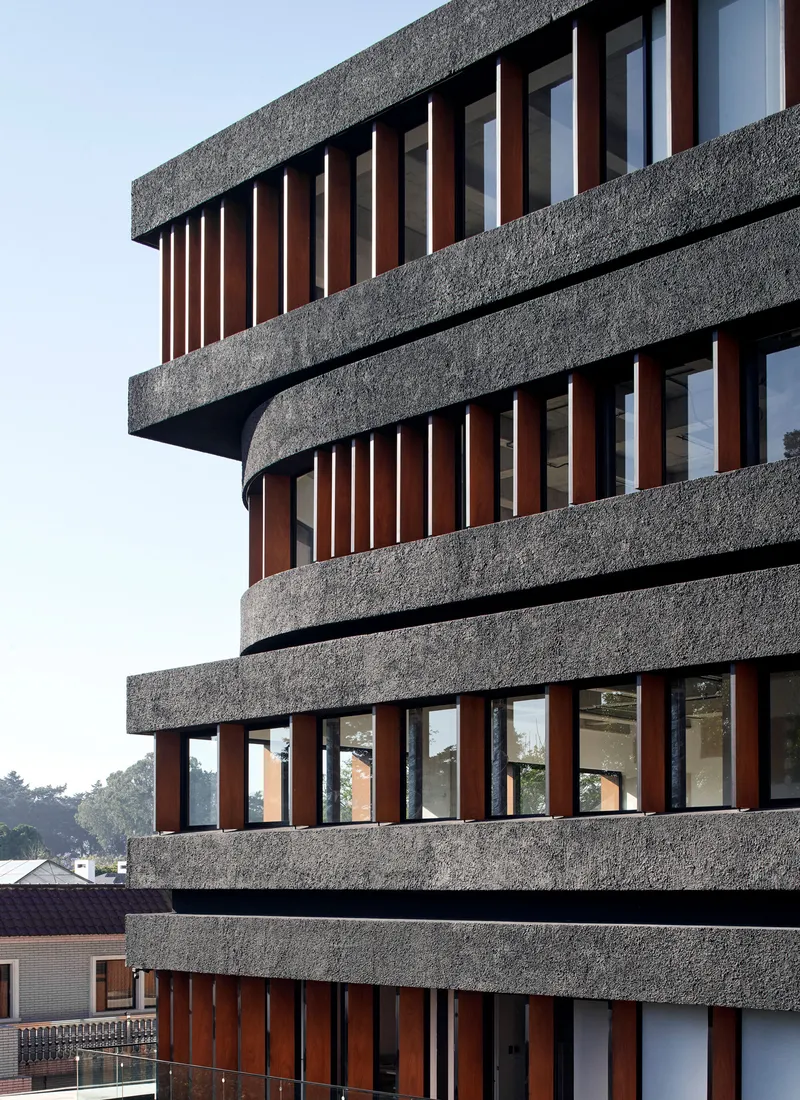
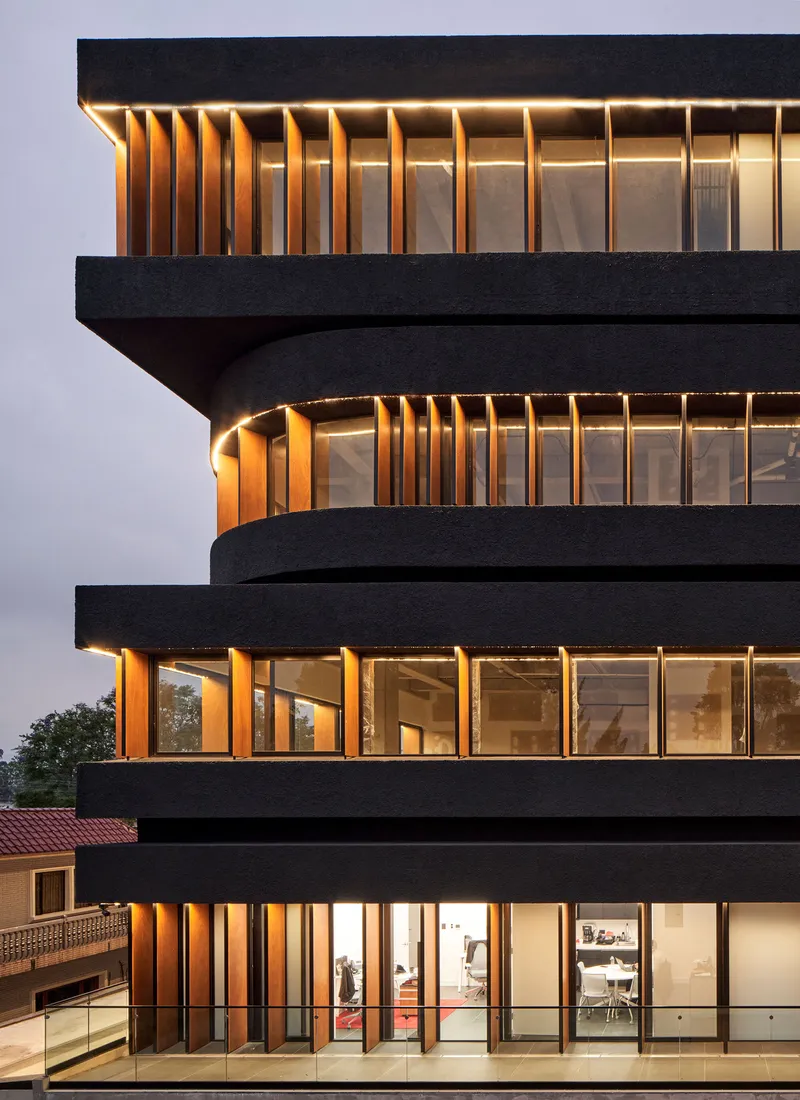
The timber fins do more than look good. Oriented to shield interior spaces from Guatemala City's predominant southern sun, they function as a passive climate screen, filtering light and heat while maintaining transparency. Up close, the texture of the wooden slats against the dark concrete slabs creates a rhythmic interplay. Pulled back to the street, the alternating rotation of each floor's fins generates a moiré-like shimmer. The building changes appearance continuously as you walk past it, which is a rare quality in commercial architecture.
Each floor plate is expressed as a cantilevered slab with an outer ring beam that doubles as structure, eliminating the need for columns at the perimeter and freeing the interior for open plans. The dark cladding on these slabs reads as a series of horizontal datums, stacking the timber-wrapped volumes into a composition that is both disciplined and dynamic.
Dusk and the Lantern Effect
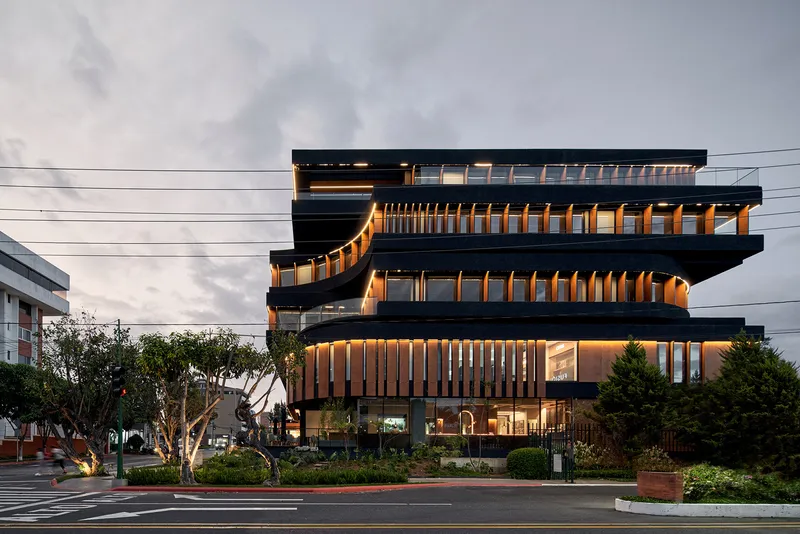
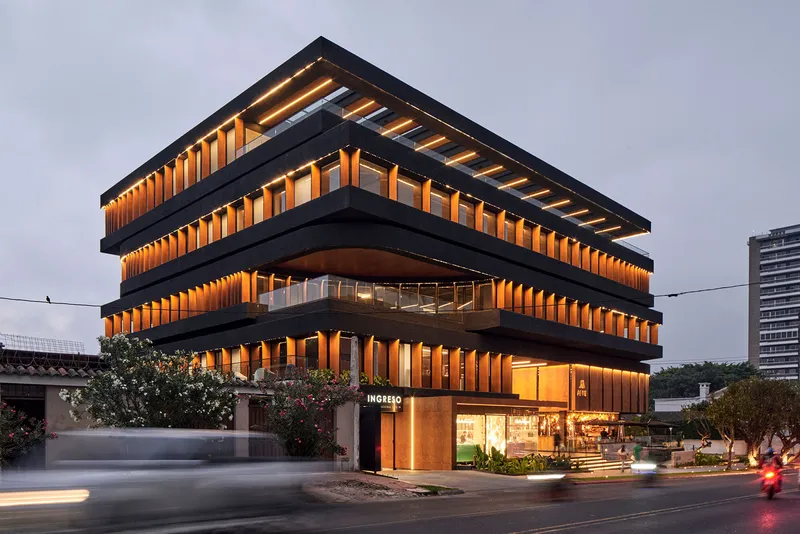
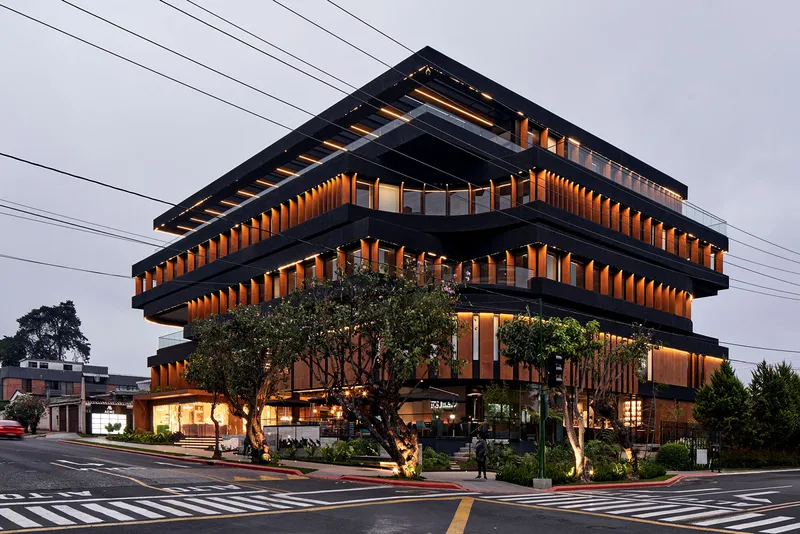
At twilight, the building transforms. Warm interior light floods through the timber louvers, turning each floor into a glowing lantern. The dark concrete bands disappear into shadow, and the fins become backlit screens. It is the kind of day-to-night transformation that proves the facade is not decorative appliqué but an integrated system: the same elements that manage solar gain by day become the building's primary visual identity after dark.
The corner condition is particularly well handled. The fins wrap continuously around curved edges, softening the building's geometry at street level and avoiding the dead corners that plague many commercial blocks. Mature trees along the sidewalk complete the picture, grounding the project in its neighborhood rather than floating above it.
The Central Atrium and Its Sculptural Core
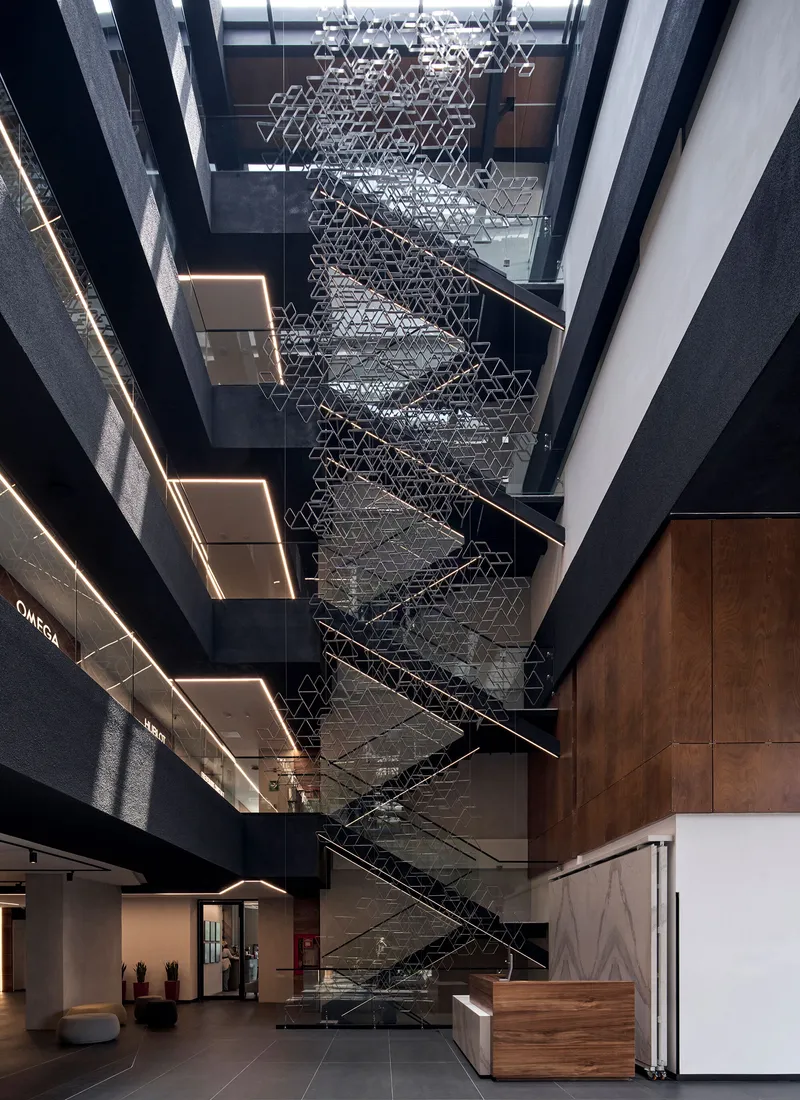
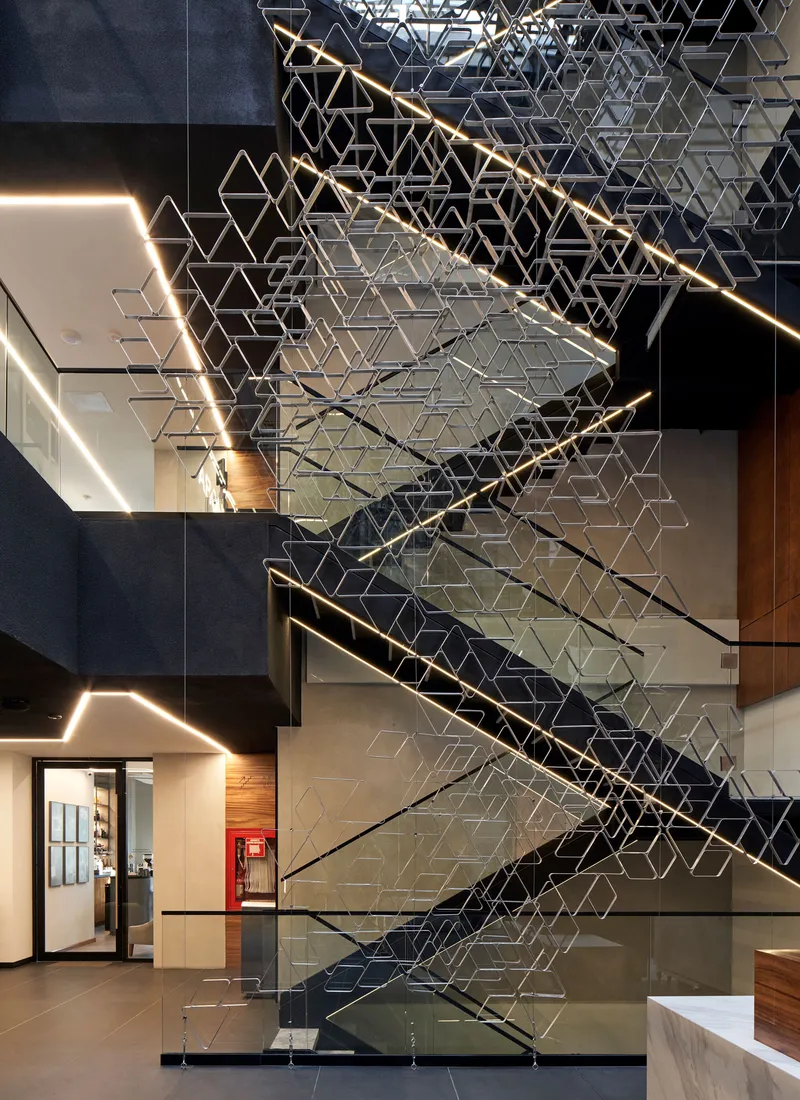
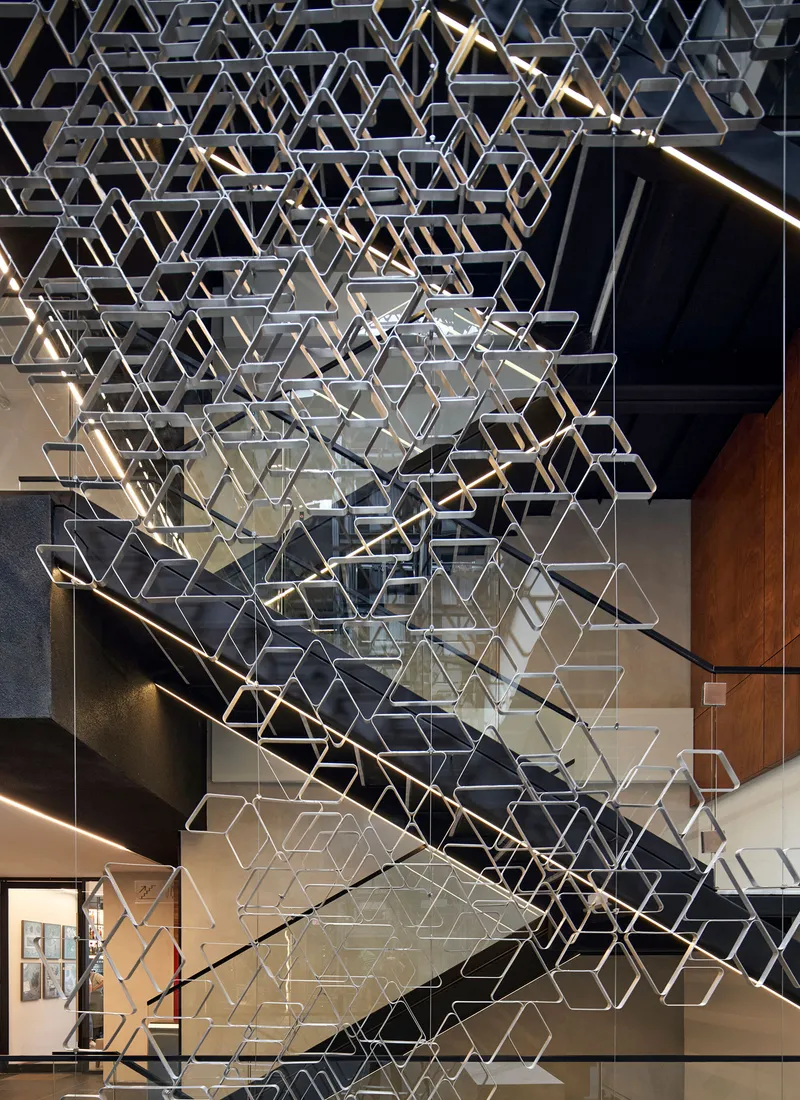
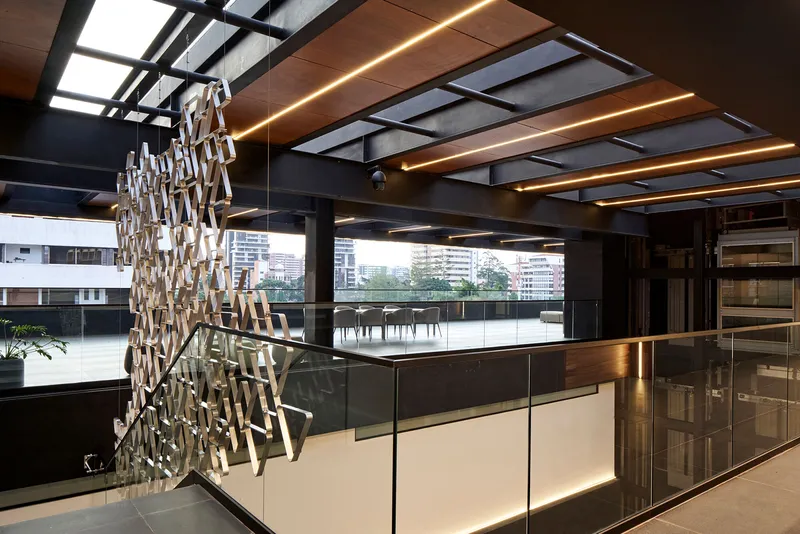
The interior revolves around a central atrium that rises through all five levels. Two panoramic elevators in glass shafts flank a suspended staircase, and the focal point is a monumental sculptural screen by artist Darío Escobar. The screen, a triangular lattice of polished metal, wraps around the staircase and hangs as a hexagonal canopy above the treads. It catches daylight from roof voids and redistributes it as shifting geometric patterns across the lobby walls.
The collaboration with Escobar is part of a broader program of artist partnerships that includes works by Luis González Palma, Andrea Monroy Palacios, Angel Poyón, and Gabriel Rodríguez. These are not afterthought acquisitions. They are integrated into the architecture: embedded in walls, suspended in voids, positioned at thresholds. The building treats art as spatial infrastructure, not decoration.
Art as Spatial Infrastructure
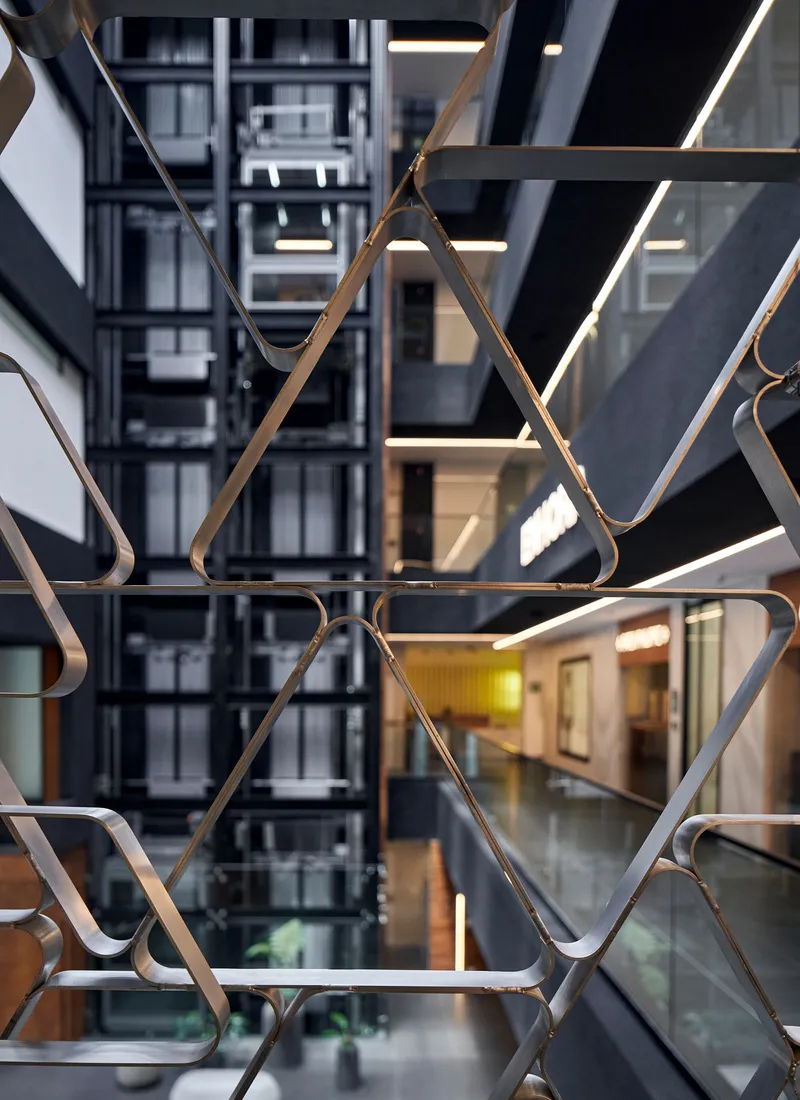
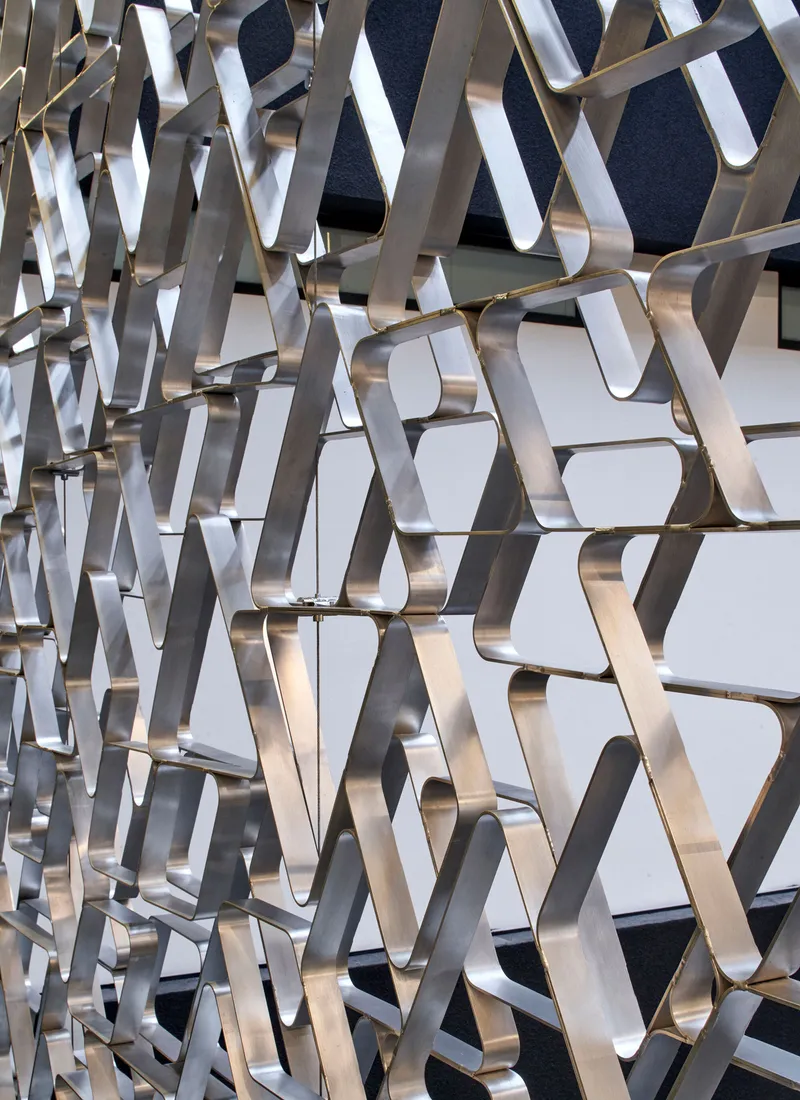
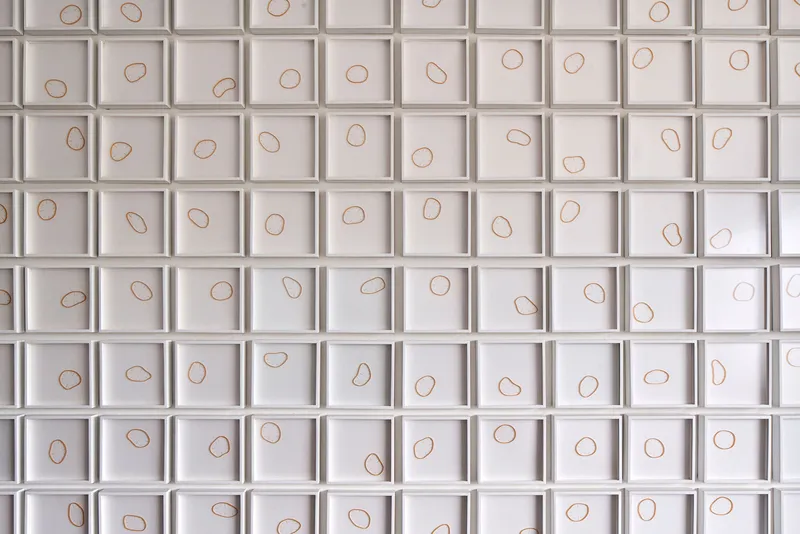
A closer look at the art installations reveals their material ambition. The triangular metal screen is not flat; its faceted surfaces catch light at different angles, producing a surface that reads differently from each floor of the atrium. Elsewhere, a white grid panel inset with copper wire loops occupies a corridor wall, its tactile quality a counterpoint to the building's otherwise smooth finishes. These pieces reward proximity in a way that the architecture itself encourages through its open circulation and generous sightlines.
Interior Details and Material Palette
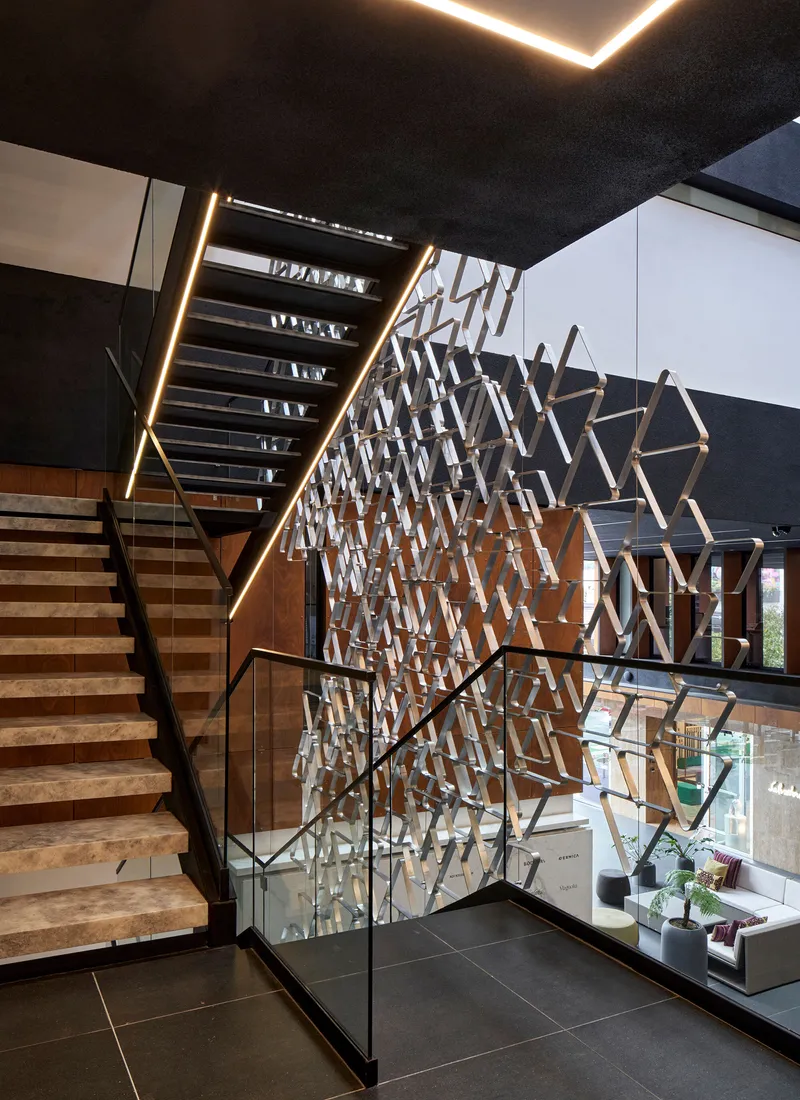
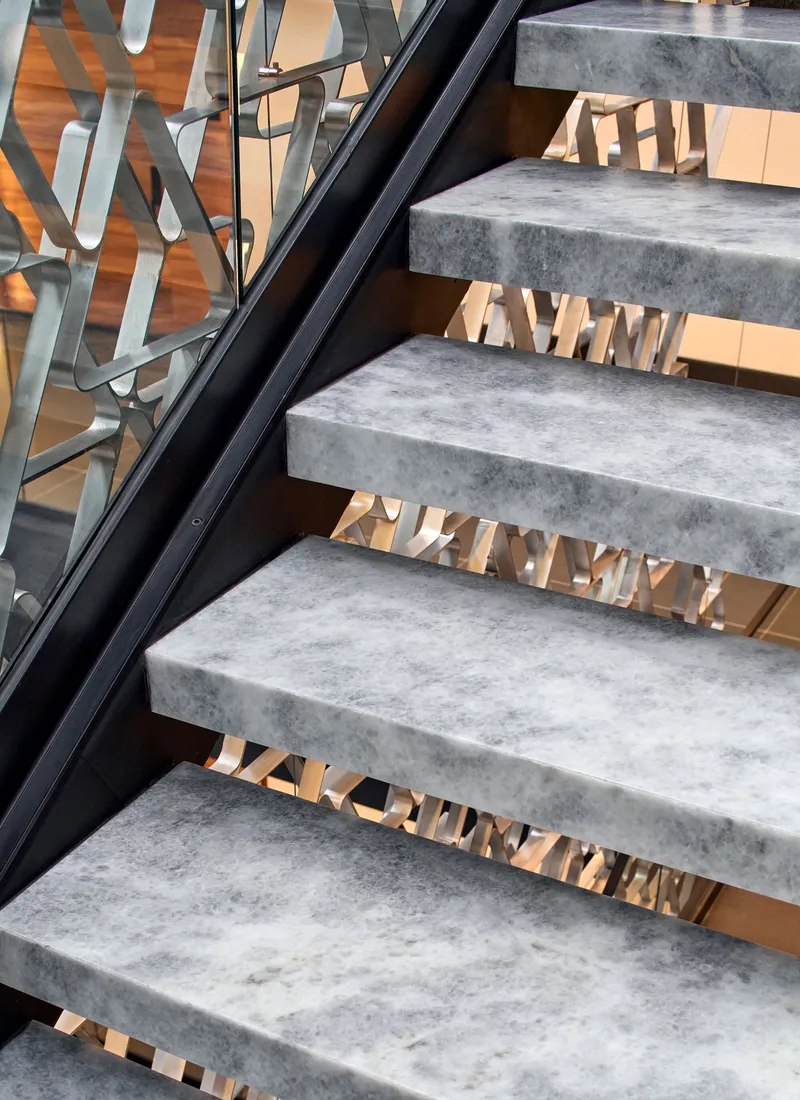
Inside, the material language tightens. White marble stair treads rest on black steel stringers with brass-textured risers, a combination that is luxurious without being ostentatious. Glass balustrades maintain visual continuity across levels, while recessed linear lighting traces the edges of circulation paths. The overall effect is precise and measured, each material earning its place.
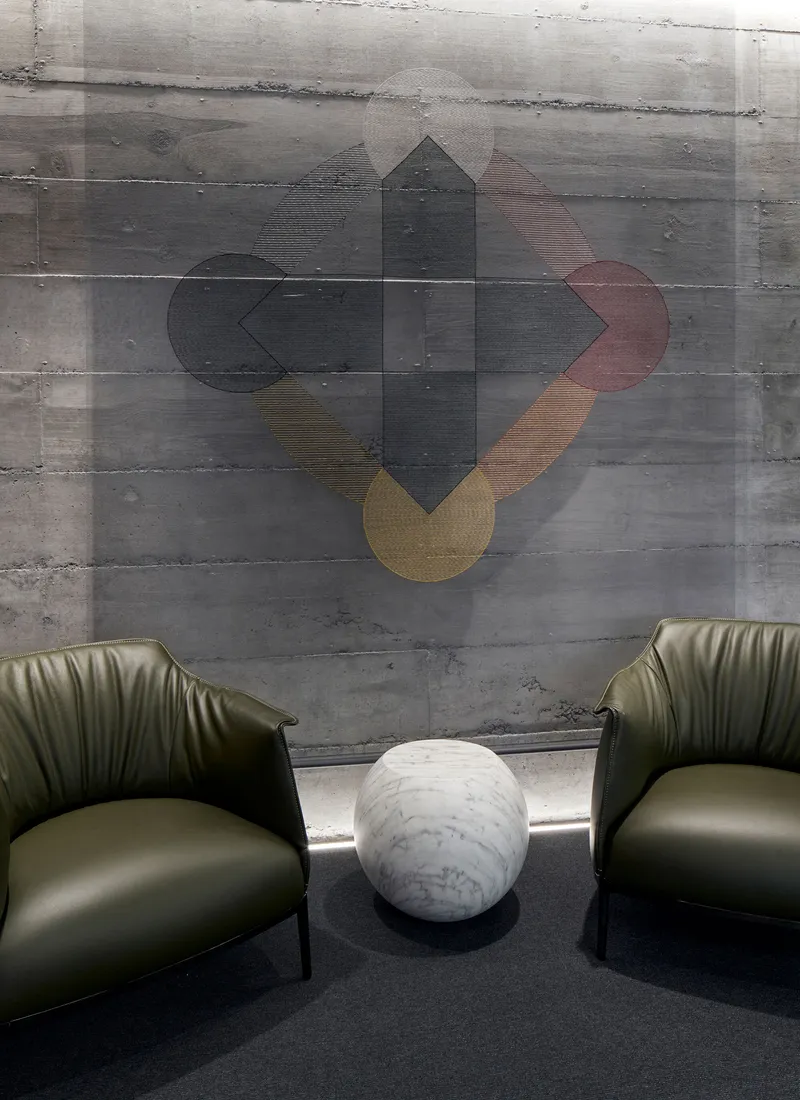
The lobby-level furnishings, including green leather chairs and a marble side table beneath a geometric artwork, suggest that the building's tenants have embraced its design ethos rather than overriding it. That kind of coherence between architecture and inhabitation is difficult to sustain in a rental building, and its presence here speaks to the clarity of the design language.
Vertical Circulation and Light Wells
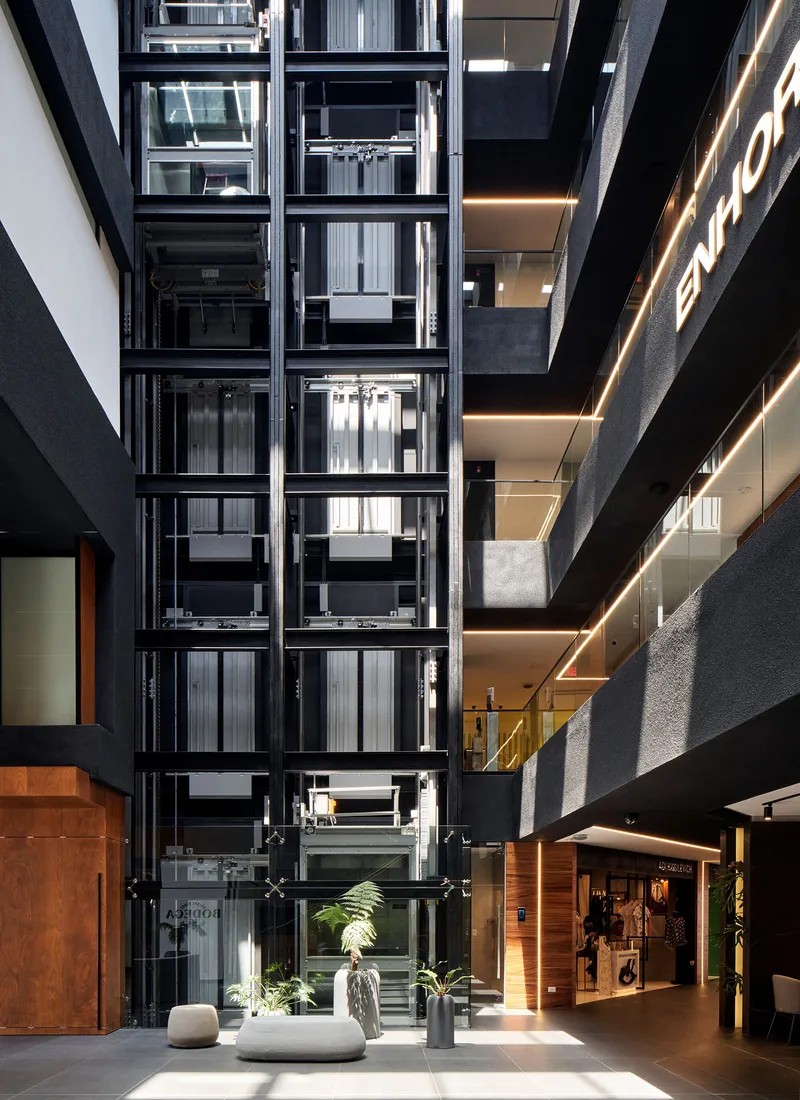
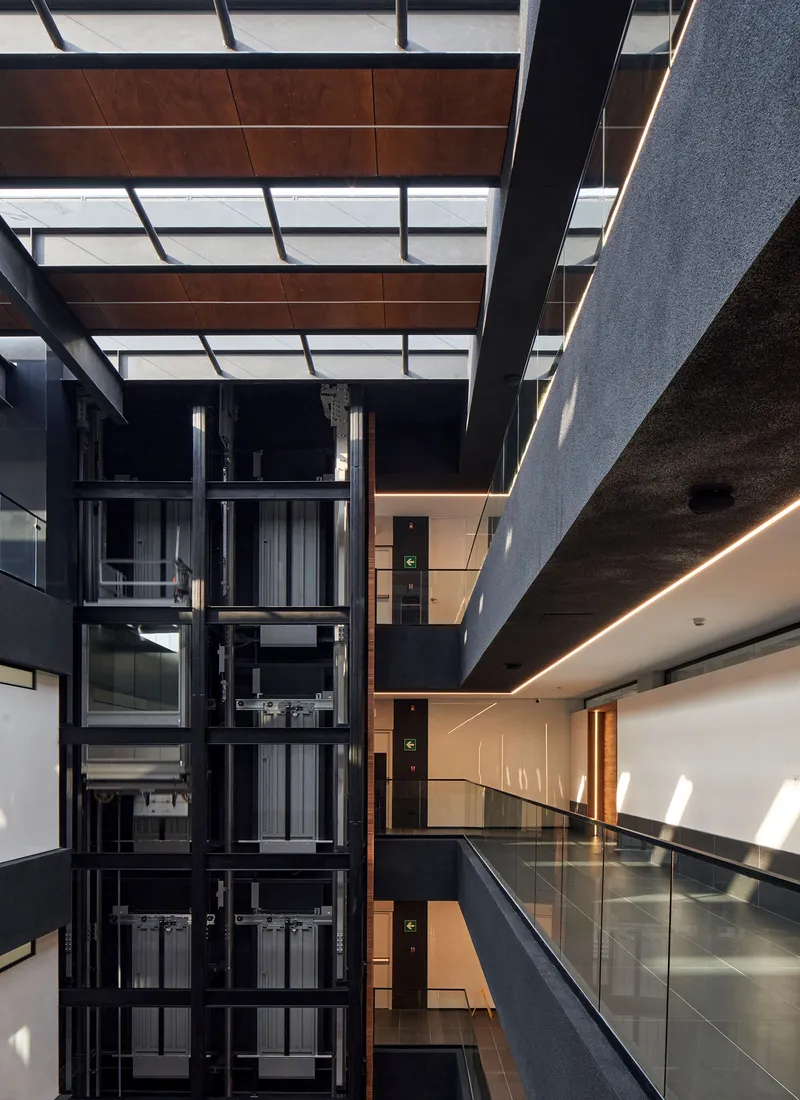
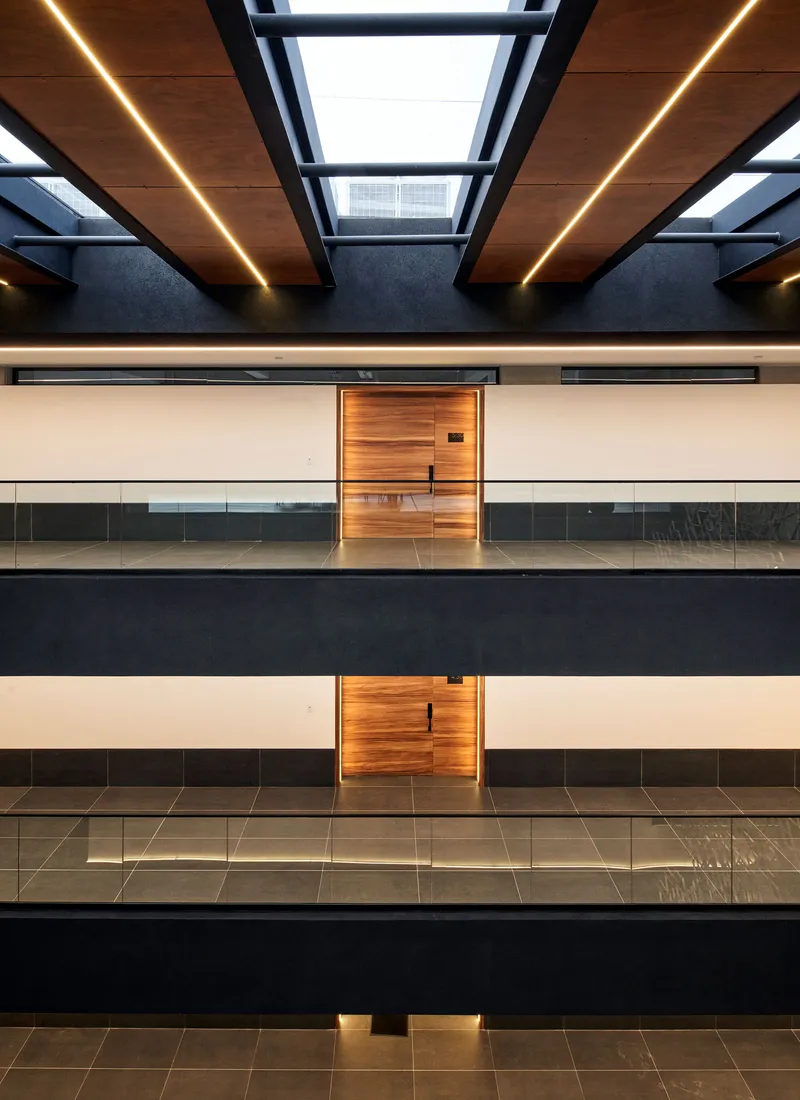
The atrium functions as both a light well and a social spine. Natural light enters through voids in the roof canopy and washes down through the glazed elevator shafts, reaching the ground floor without obstruction. Planted beds at the base of the atrium introduce greenery, softening the hard surfaces and reinforcing the first floor's ambition to feel like an extension of the city's public realm.
Looking straight up from the lobby, the symmetry of the timber ceiling panels and glass balustrades framing all four upper levels creates a vertiginous composition. It is a generous move in a building type that often minimizes shared space to maximize leasable area. Here, the atrium is the value proposition: it gives every tenant a relationship to the whole building, not just their own floor.
Ground Plane and Urban Interface
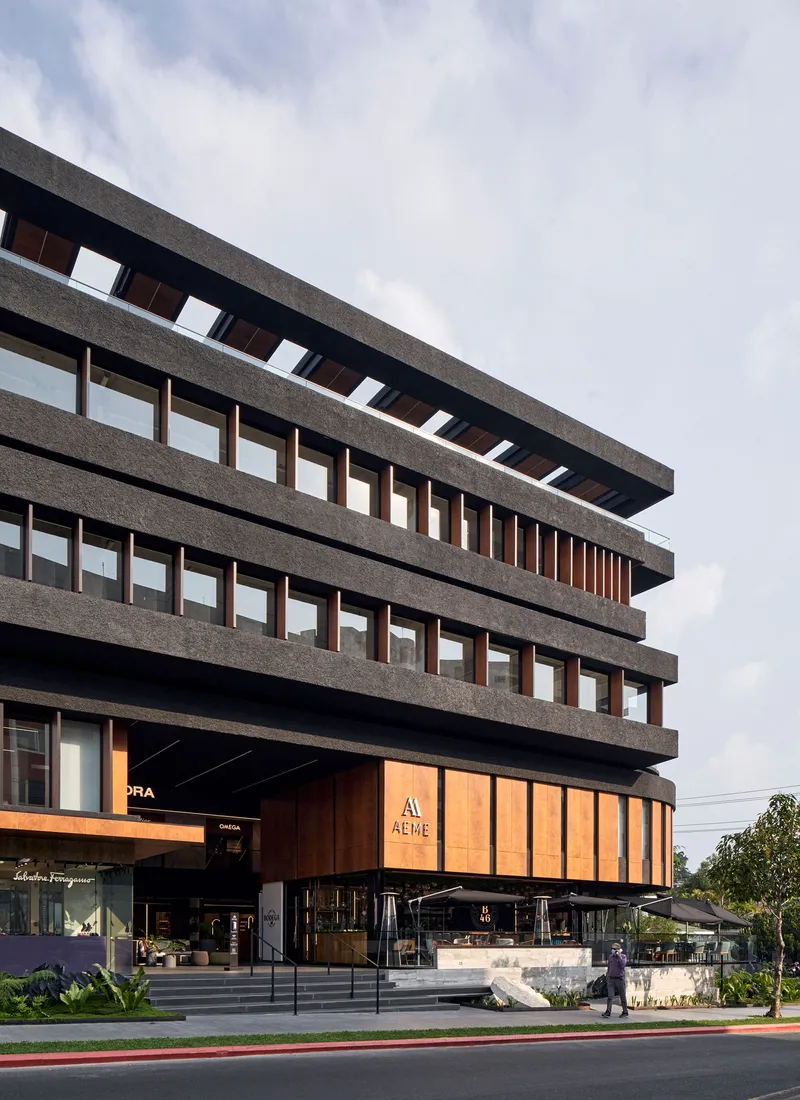
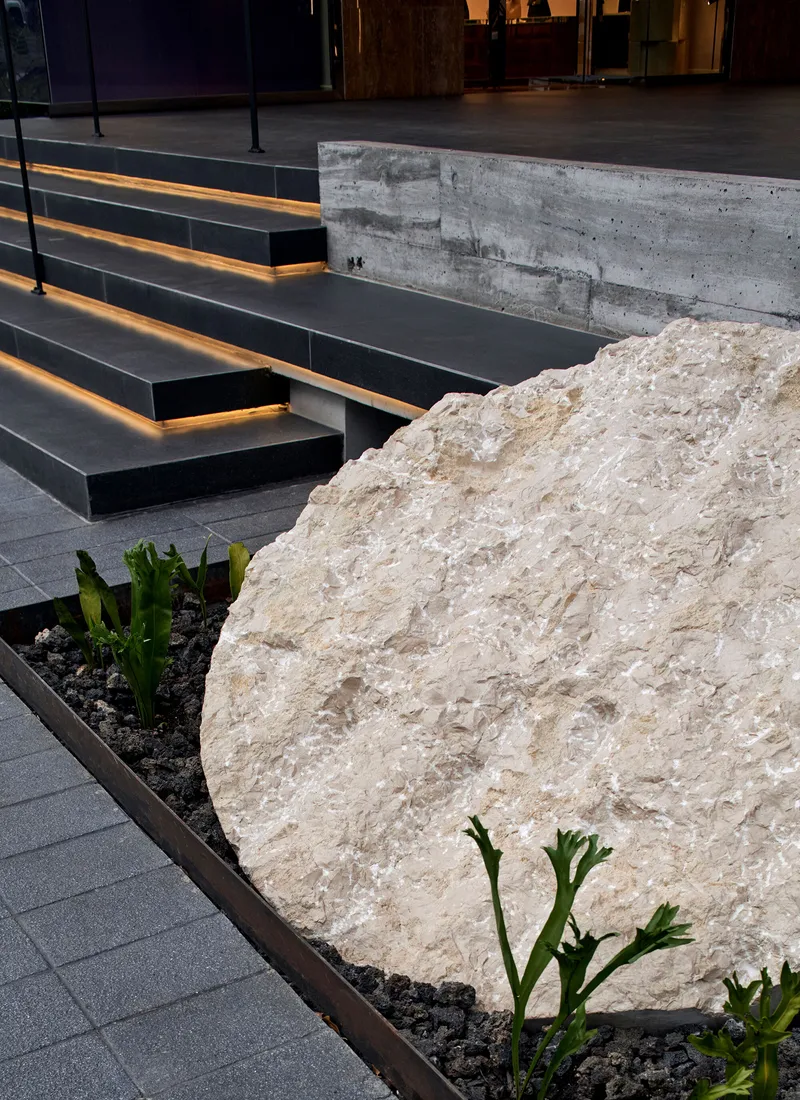
The ground floor is deliberately porous. Commercial shopfronts with timber cladding open directly to the street, while a landscaped entrance courtyard, designed by ENVERDECER under the direction of Giulliana Gobbato, provides a planted threshold between sidewalk and lobby. A limestone boulder beside a planted bed anchors the entry sequence, its rough texture a deliberate foil to the polished materials inside.
The programmatic stacking is straightforward: ground-floor commercial and restaurant spaces totaling roughly 16,700 square feet, a second floor that blends commerce with offices, and three upper levels of pure office space exceeding 44,000 square feet. The fifth floor includes a dedicated rental unit and parking for four vehicles. It is a pragmatic distribution made generous by the atrium's presence at its center.
Rooftop and Upper Levels
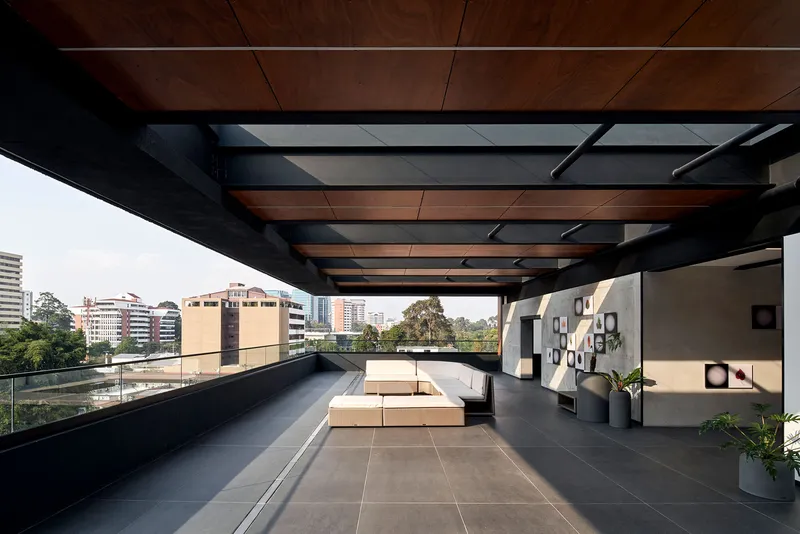
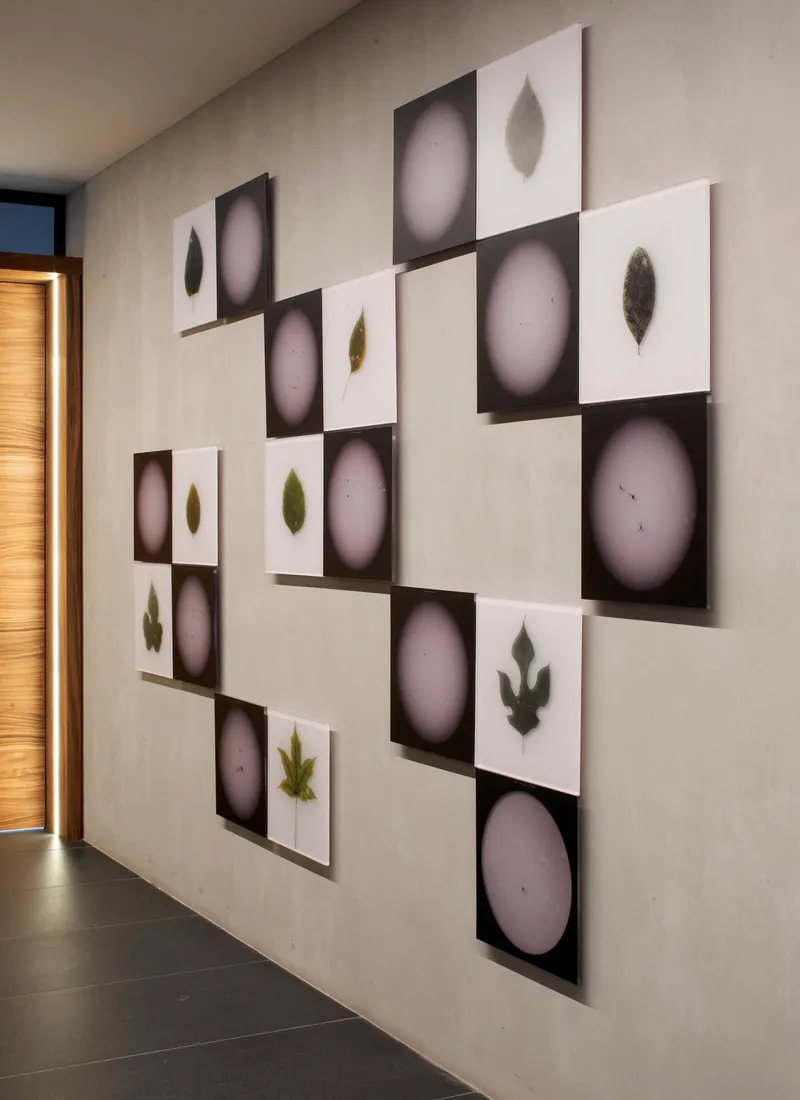
The rooftop terrace exposes the building's structural timber ceiling beams and dark steel framing, offering a raw counterpoint to the polished interiors below. Views extend across Guatemala City's urban fabric, and the exposed structure gives the space a workshop quality that feels appropriate for a building dedicated to productive work. A commercial kitchen with a backlit island and exposed ceiling beams suggests that the upper levels are equipped for hospitality as well as office use.
Plans and Drawings
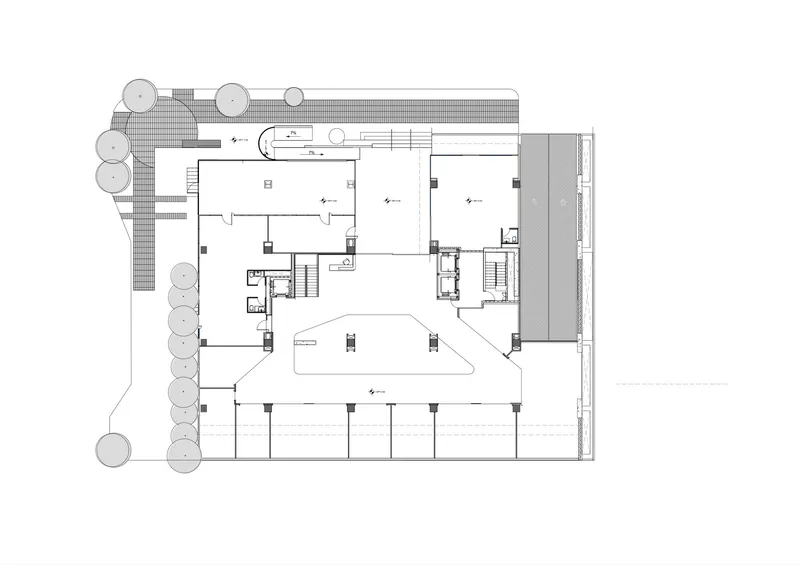
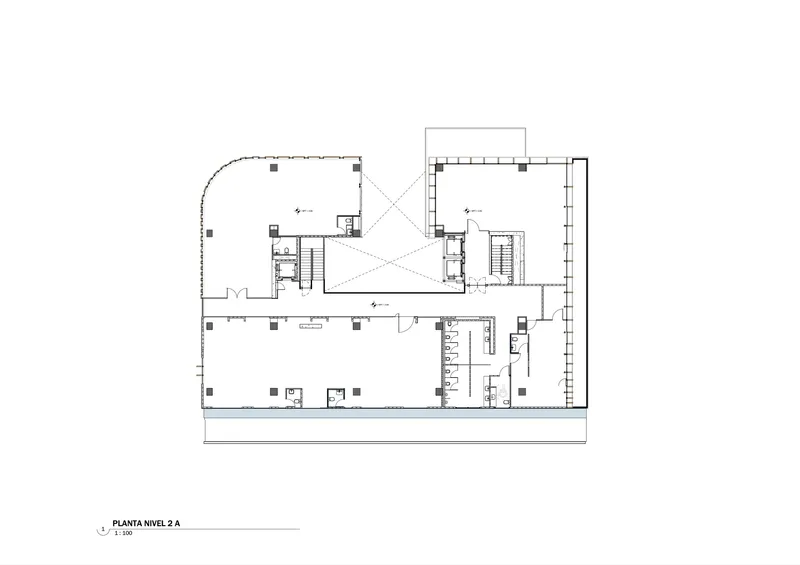
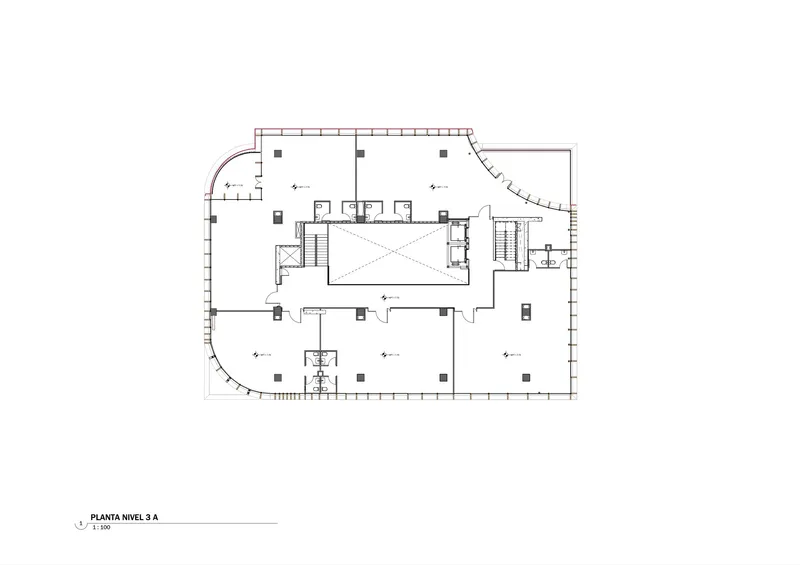
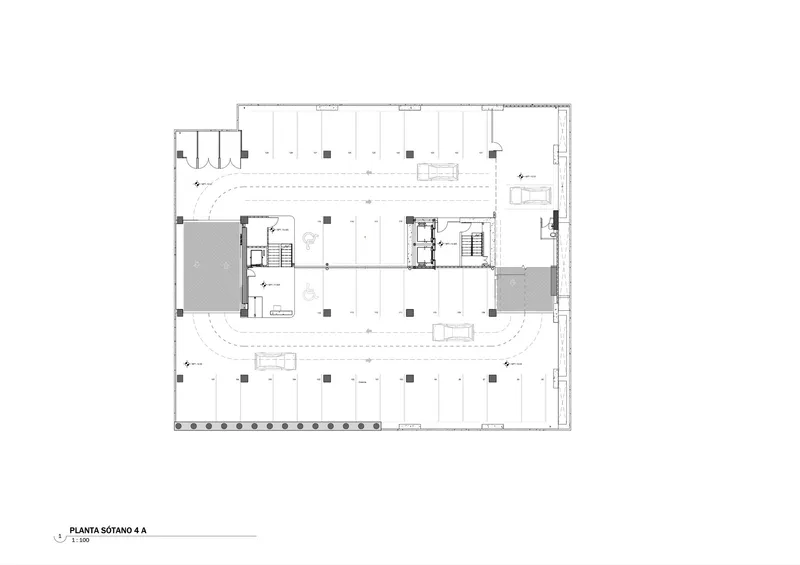
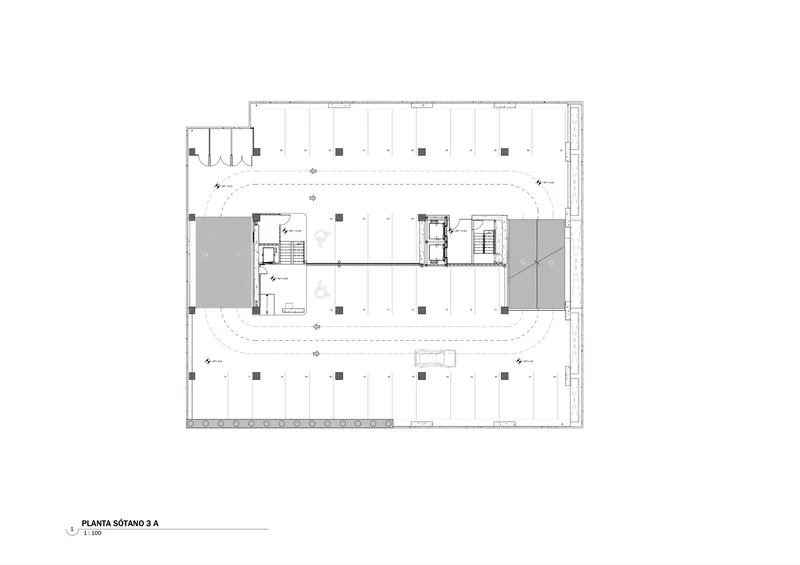
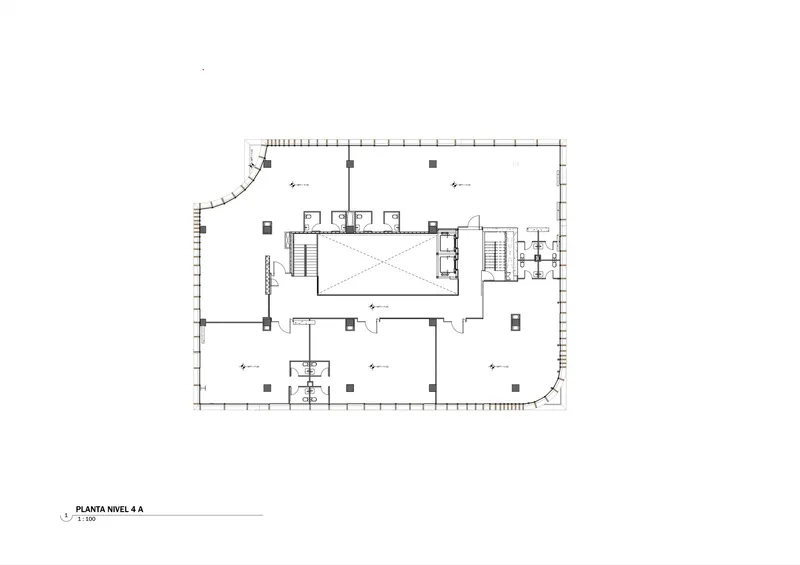
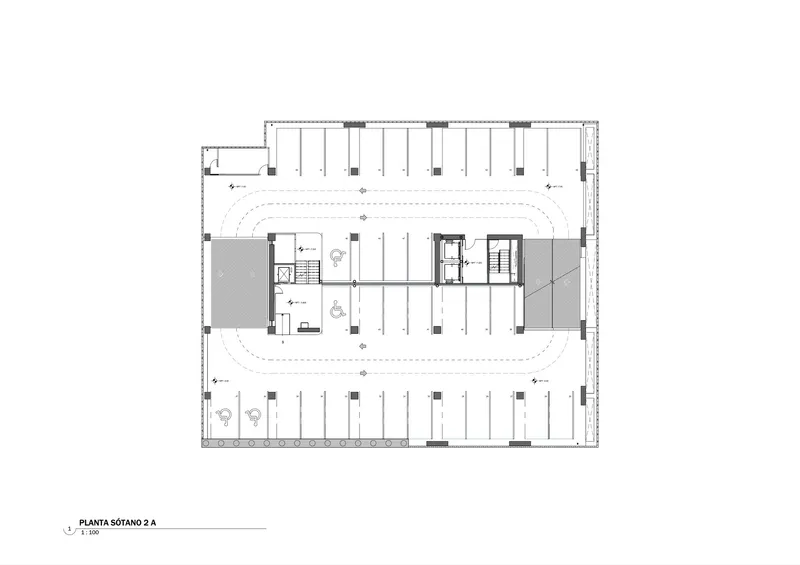
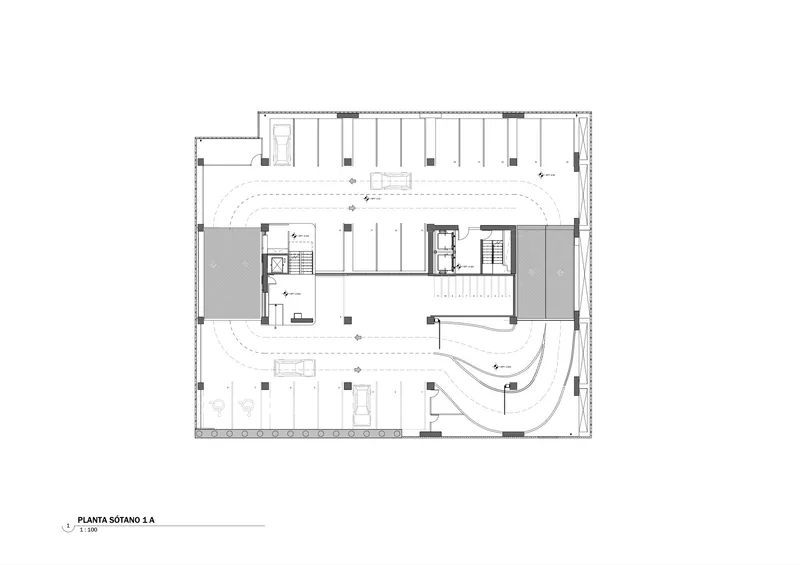
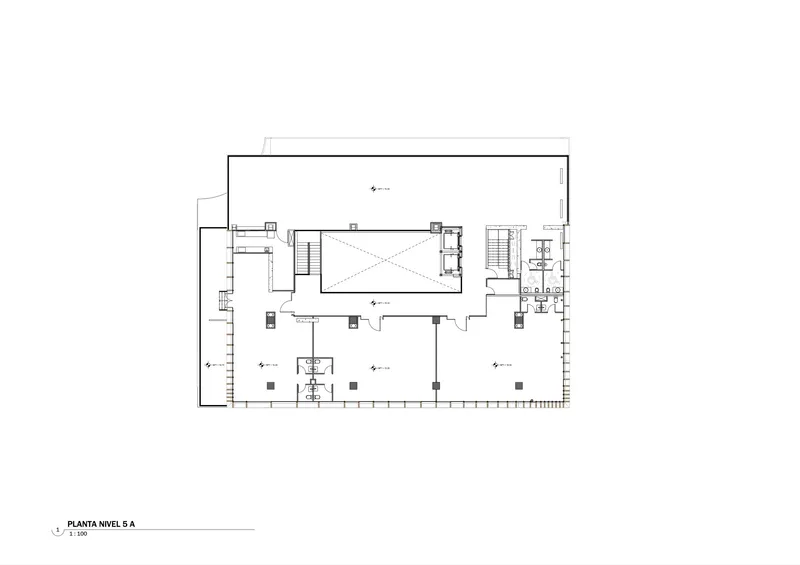
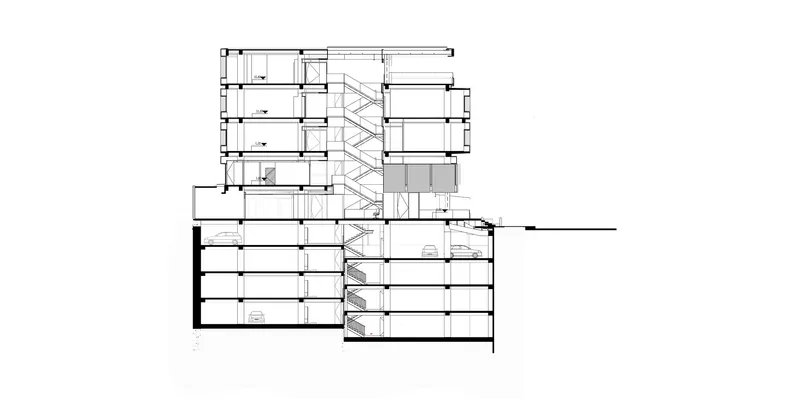
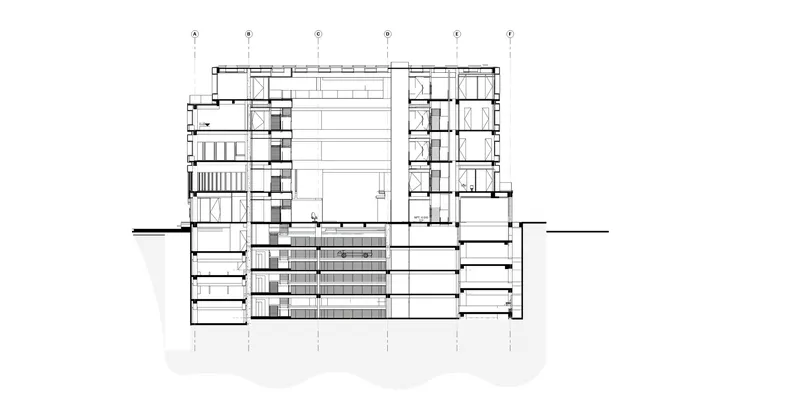
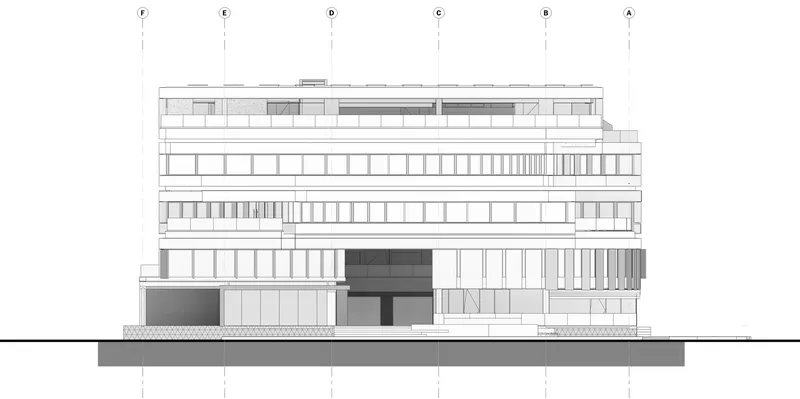
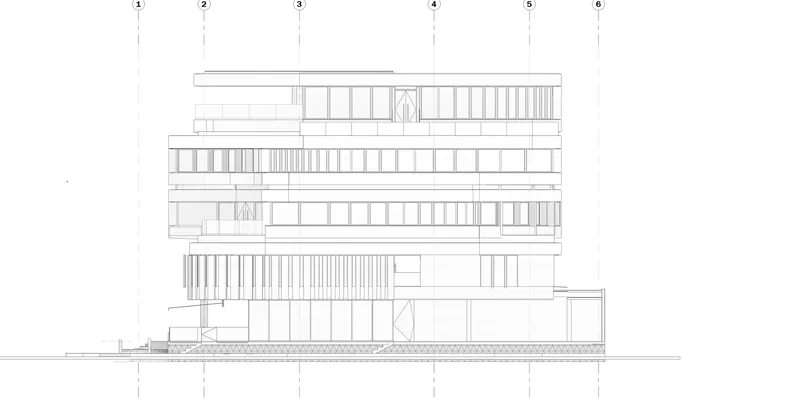
The plans reveal the logic behind the atrium's curving geometry and the perimeter column grid that enables open floor plates. Underground parking levels use curved ramps to navigate the tight site, while the central core with its two staircases and elevator bank anchors circulation vertically. The section drawings confirm the diagonal staircase's dramatic trajectory through the building and the depth of the underground levels. Elevation drawings make explicit what the photographs suggest: the timber fins and cantilevered slabs produce a facade that is simultaneously horizontal and vertical, layered and unified.
Why This Project Matters
The AEME Building is a corrective to the idea that commercial architecture in Central American cities must choose between security and urbanity. By treating the ground floor as public space, integrating art into the building's spatial structure, and deploying a facade system that manages climate while activating the street, Paz Arquitectura demonstrates that a mixed-use project can be simultaneously pragmatic and generous. The alternating timber fins are the headline move, but the real achievement is the coherence between exterior gesture and interior experience.
More broadly, AEME suggests a model for mid-rise commercial buildings in tropical cities where passive climate strategies and urban engagement can coexist without sacrificing leasable efficiency. The atrium is not wasted space; it is the mechanism that delivers daylight, orientation, and identity to every floor. In a market that rewards defensiveness, this building bets on openness, and the result is one of the more convincing pieces of mixed-use architecture to emerge from Guatemala in recent years.
AEME Building by Paz Arquitectura (Alejandro Paz), Guatemala City, Guatemala. 10,702 m². Completed 2021. Photography by Cristobal Palma / Estudio Palma. Landscape design by ENVERDECER (Giulliana Gobbato).
About the Studio
Share Your Own Work on uni.xyz
If projects like this are the kind of work you want to make, uni.xyz is a place to publish your own, find collaborators, and enter design competitions.


Popular Articles
Popular articles from the community


Play: Fragments of Their World
Familiar architecture becomes modular playground design, creating safe spaces where displaced children can learn, connect, imagine and play.

The Earth Pod: 3D Printed Homes for Resilient Refugee Communities
The Earth Pod reimagines refugee housing through 3D printed homes made from clay, combining resilience, self-sufficiency, and rapid shelter.

Lunar Spiral: Space Architecture Shaped by the Mathematics of the Universe
Lunar Spiral reimagines space architecture through Fibonacci geometry, lunar regolith, levitating habitats, and self-sustaining Moon living.

The Musturak Paradise: Senior Living Architecture for a Connected Future in Temara, Morocco
The Musturak Paradise reimagines senior living architecture in Temara via private homes, social spaces, culture, community, and shared care.

Similar Reads
You might also enjoy these articles

Bao Huynh Watercolor Atelier: A Serene Art Retreat in Hội An
Bao Huynh Watercolor Atelier in Hội An blends multifunctional art spaces, sustainable design, local materials, and family-friendly living in a serene environment.

Atelier Macri Concept Store Interior Design by CASE-REAL
Atelier Macri store features a "ko" counter, walnut wood details, cork displays, blending retail, gallery, and seamless customer experiences.

Manuel Vargas Izquierdo Stadium and High-Performance Sports Center: Architectural Excellence in Jalpa de Méndez
The Manuel Vargas Izquierdo Stadium blends sustainable design, inclusive sports facilities, and cultural-inspired architecture, revitalizing Jalpa de Méndez’s public spaces.
KAKR Buluh Awar Hall: Revitalizing Community and Ecology Through Bamboo Architecture
Community built bamboo hall revitalizes Buluh Awar village, empowering youth, restoring ecology, celebrating vernacular craftsmanship through sustainable architecture and culture.

Explore Power Generation Competitions
Discover active competitions in this discipline



Challenge to reimagine the Iron Throne


Photograph architecture without architects


Illustrate the lost glory of Angkor Wat - Render Challenge


Design challenge to reuse E-waste
Comments (0)
Please login or sign up to add comments
No comments yet. Be the first to comment!