
Peacock Hail Cafe Grows from Saudi Arabia's Rock
Movs Studio carves a café into the sandstone landscape of Ha'il, blurring the line between geology and hospitality architecture.


There is a particular kind of ambition in choosing to build not next to the landscape but into it. In Ha'il, a city in northern Saudi Arabia defined by dramatic sandstone formations and ancient trade routes, Movs Studio has completed a 480 square meter café that treats the geology of its site as both structure and ornament. Peacock Hail Cafe, designed by Ruben Movsisian and Catherine Tarasova, does not simply reference its context. It absorbs it, pulling raw stone boulders through polished concrete floors and pressing its planted rooftop against the cliff face behind.
What makes this project compelling is its refusal to choose between refinement and rawness. The interiors are precisely detailed: timber millwork, carefully suspended pendant lights, patterned rugs. But these elements exist in constant tension with fragments of unfinished stone, exposed concrete columns, and skylights that punch daylight into spaces that feel almost subterranean. The result is a café that operates as a kind of geological theater, where the act of ordering coffee is framed by the same forces that shaped the surrounding mountains.
Building Against the Cliff
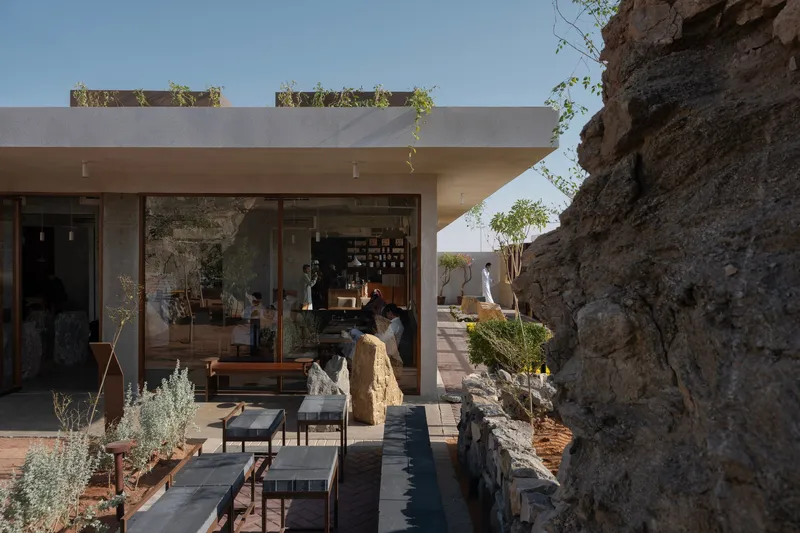
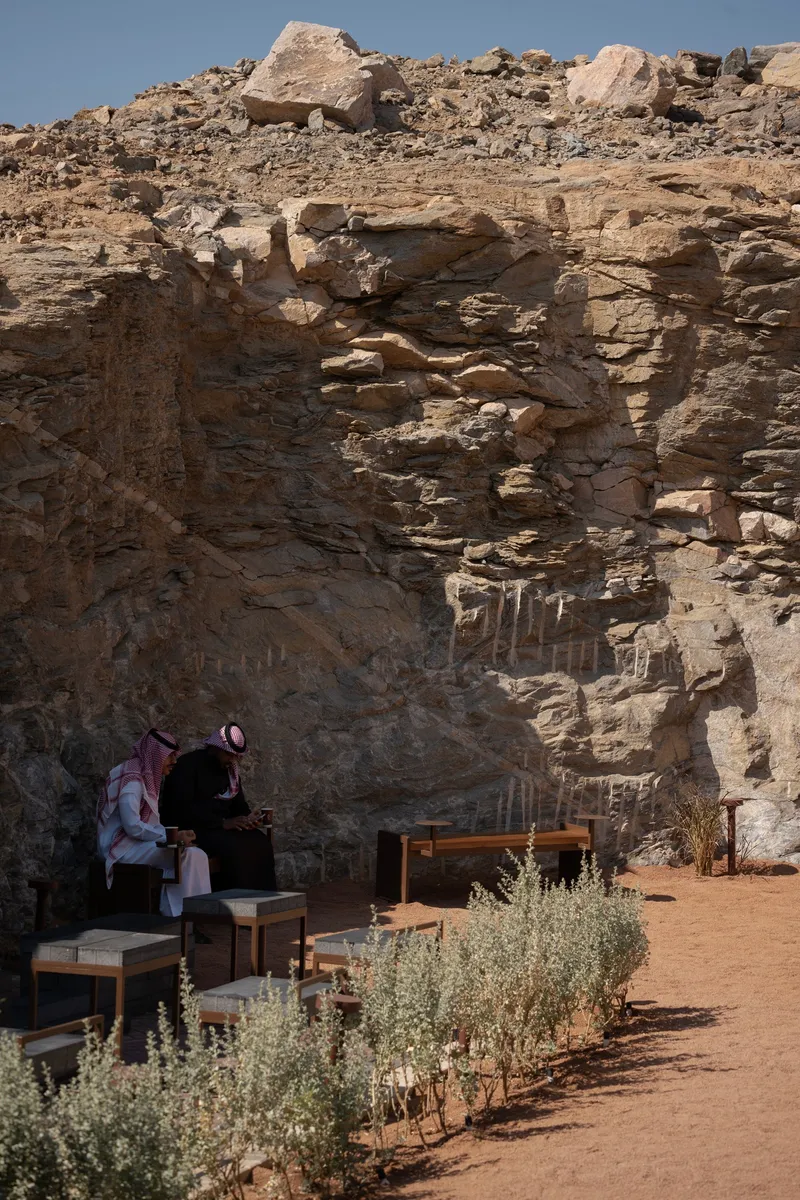
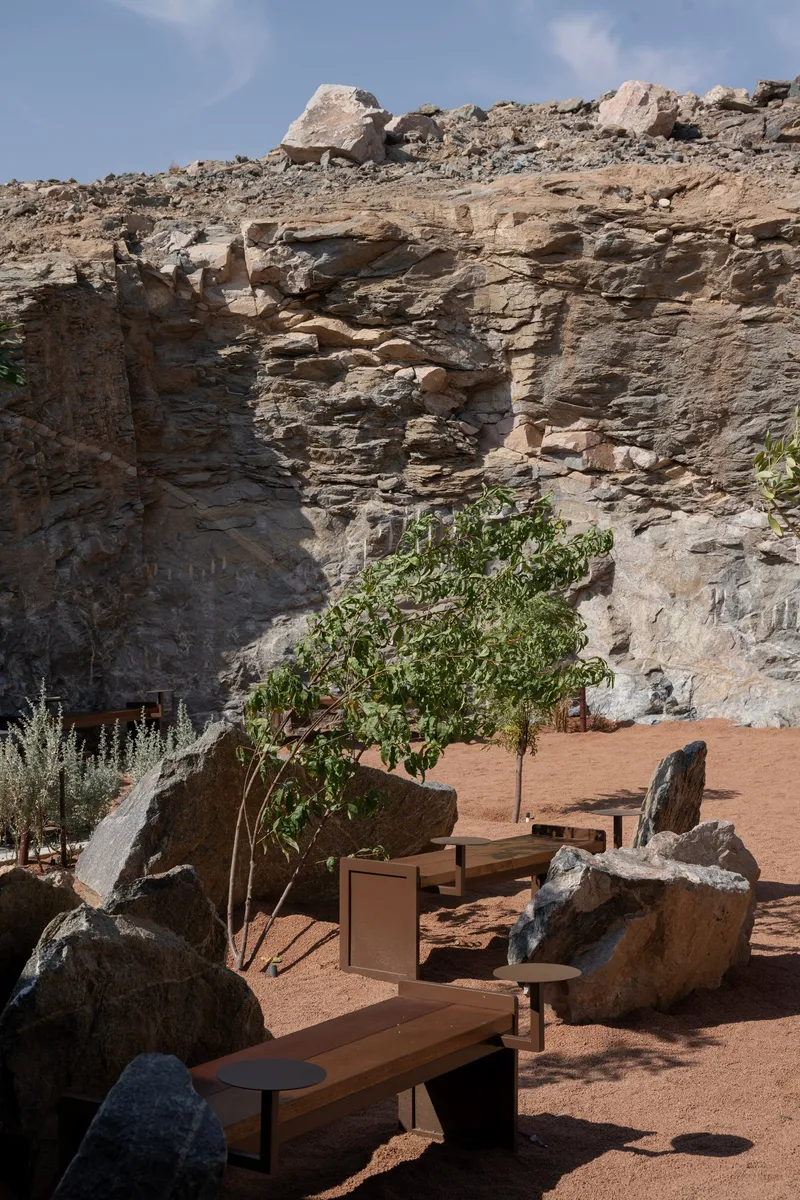
The most striking move in the project is how the building meets the hillside. Rather than excavating or terracing the rock to create a flat datum, Movs Studio lets the structure nestle directly against layered sandstone outcrops. Outdoor terraces with timber benches and planted beds sit at the base of the cliff, their reddish sand surfaces echoing the geology. The architecture becomes a threshold between human comfort and geological time.
Dark timber loungers on a covered patio read as deliberately understated beside the sheer mass of the rock wall above them. The planted edges of the roof blur the roofline into the landscape, a detail that works particularly well at distance but also rewards the seated guest with filtered views of sky and stone.
Stone as Interior Presence
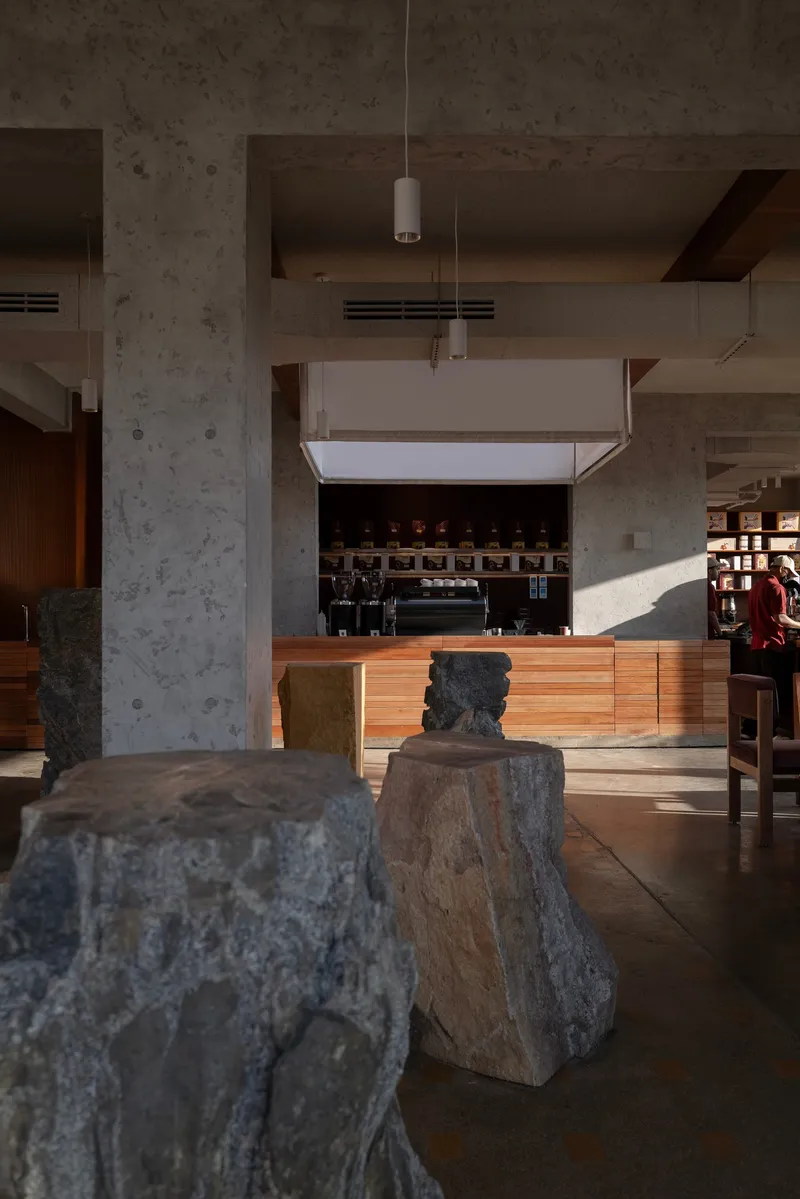
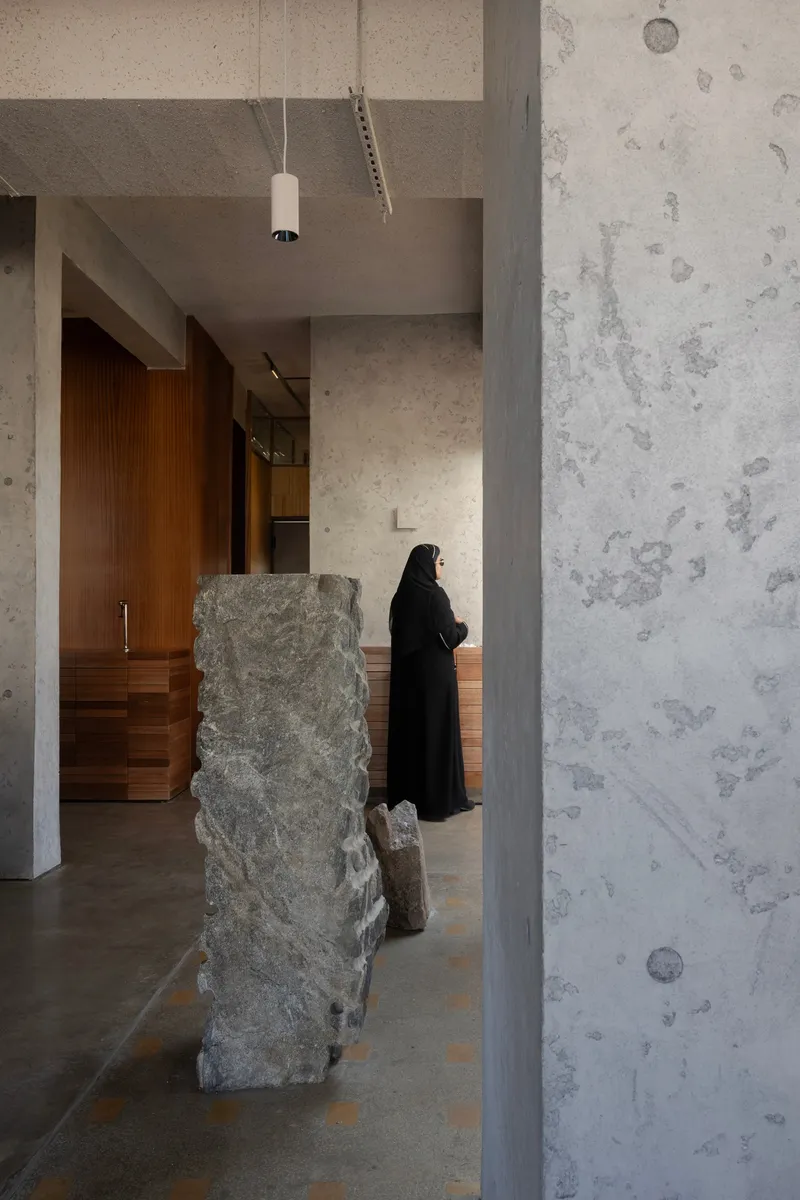
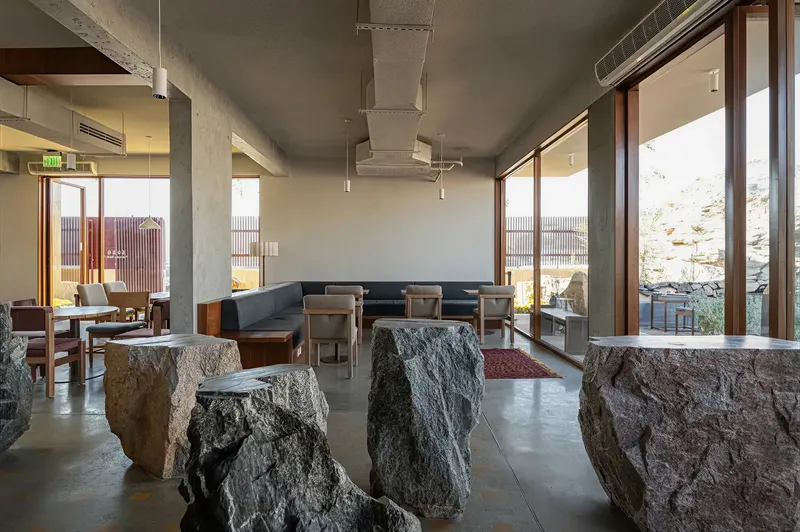
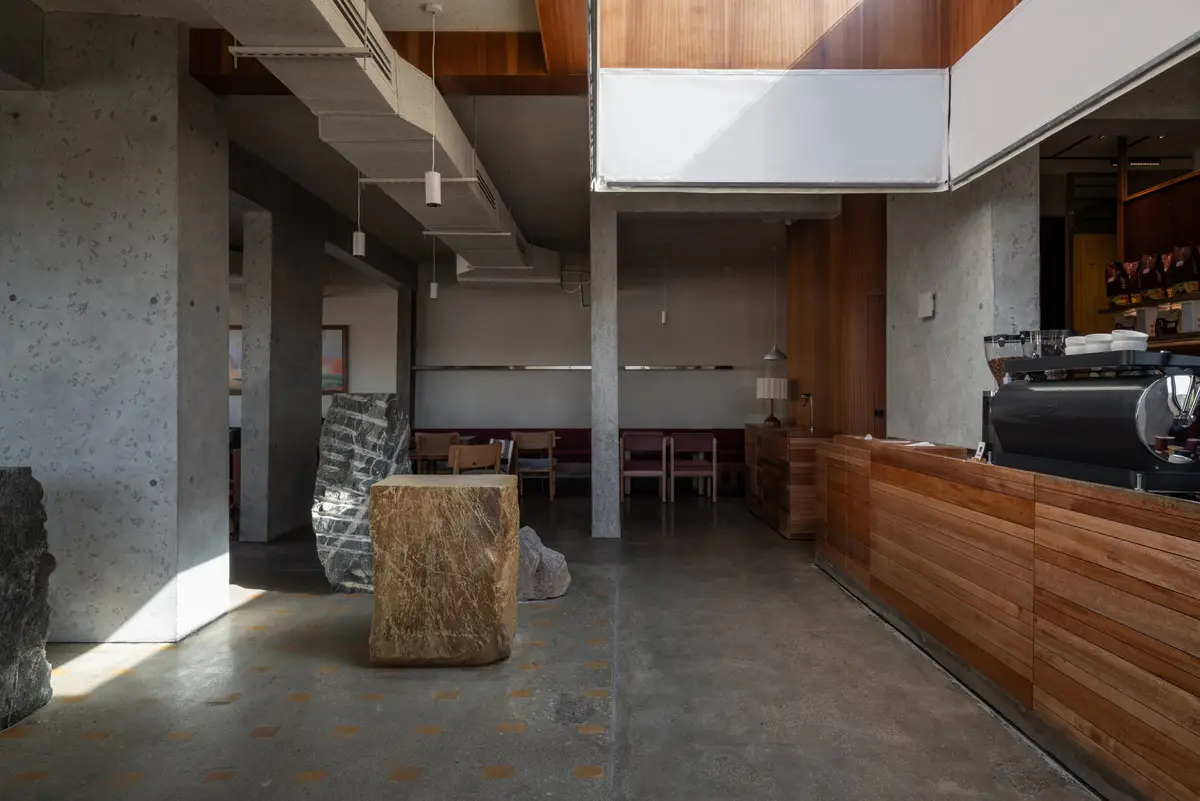
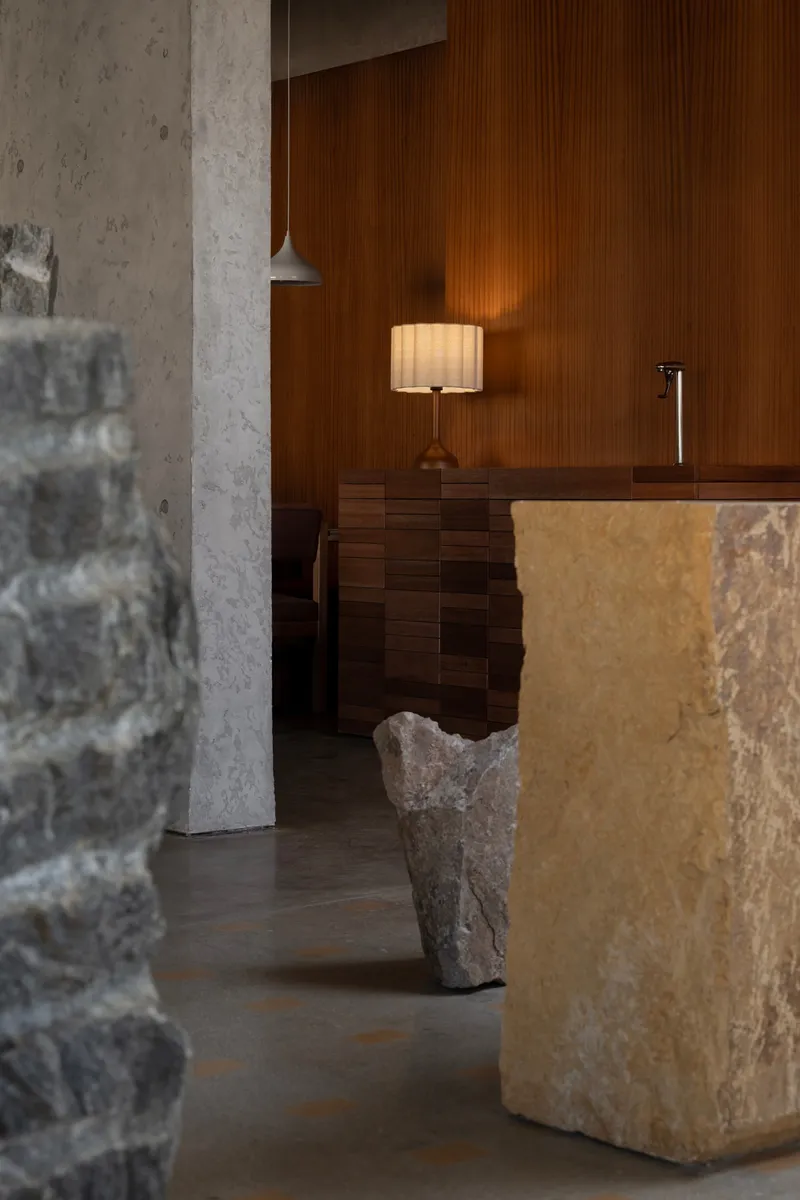
Inside, the most provocative gesture is the presence of raw stone blocks on the polished concrete floor. These are not decorative accents placed on plinths. They emerge from the ground plane as if the floor were poured around them, creating the impression that the building was assembled over an existing field of boulders rather than on a cleared site. Whether or not that is literally true matters less than the spatial effect: a café interior that feels partially excavated.
Column fragments wrapped in rough stone add to this reading. They suggest ruins or geological formations rather than structural elements, even as they clearly do structural work. A person standing beside one of these columns, as captured by photographer Ilya Ivanov, is scaled against something that predates any architectural intention.
Light from Above
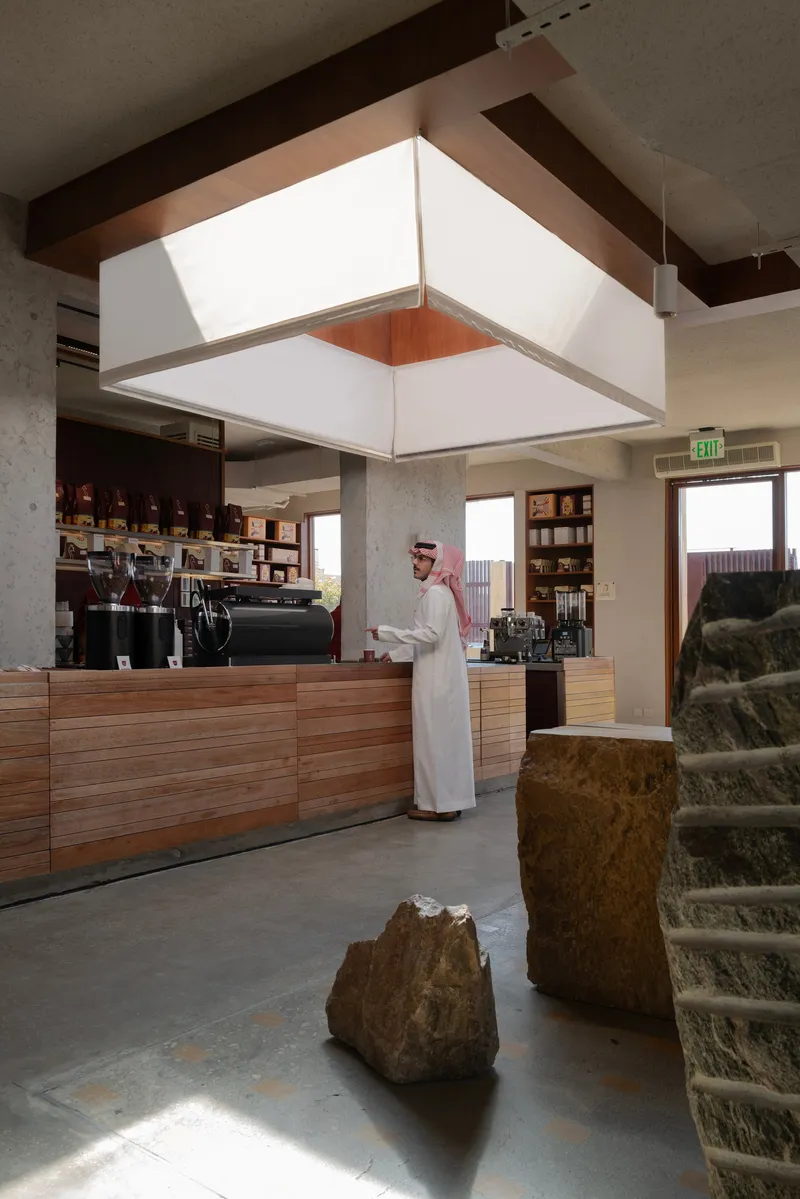
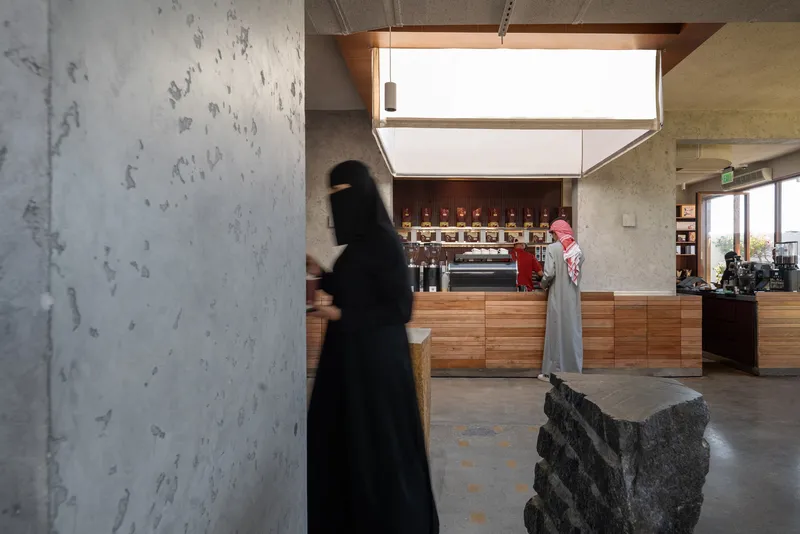
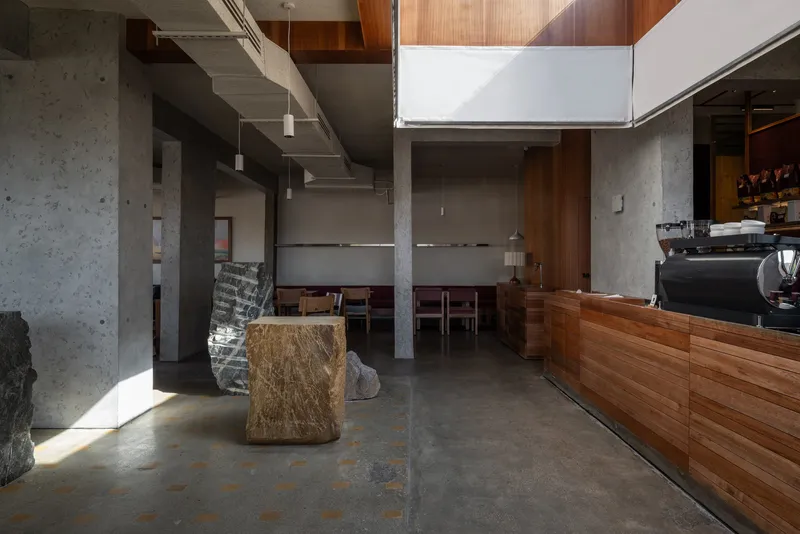
The skylights are arguably the project's most important architectural device. Large square openings in the ceiling, fitted with suspended light fixtures, bring controlled daylight into the deep floor plate. The central skylight above the coffee bar creates a column of light that shifts throughout the day, transforming what could be a dim interior into a space with genuine atmospheric variety.
Exposed timber beams around the skylight openings give the ceiling a tectonic legibility that the concrete alone would not provide. The combination of horizontal wood cladding at the bar and raw concrete overhead establishes a material hierarchy: warm and crafted at hand height, heavy and elemental above. It is a simple strategy executed with discipline.
The Dining Hall
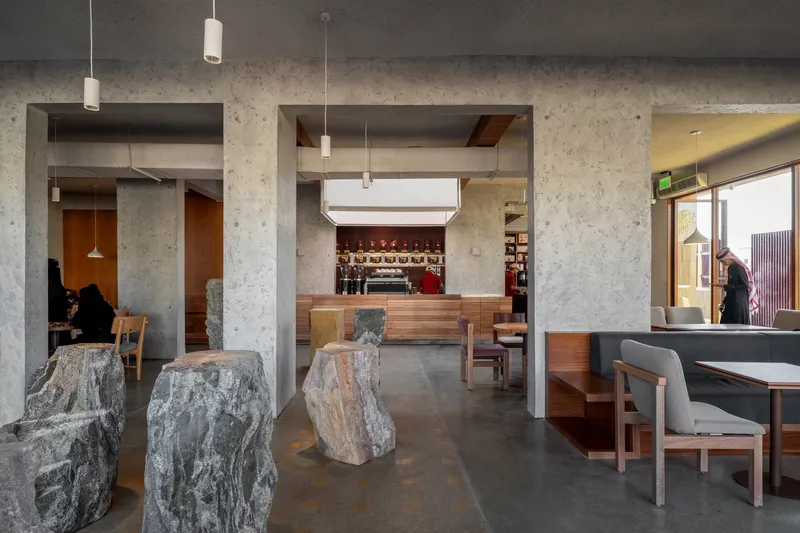
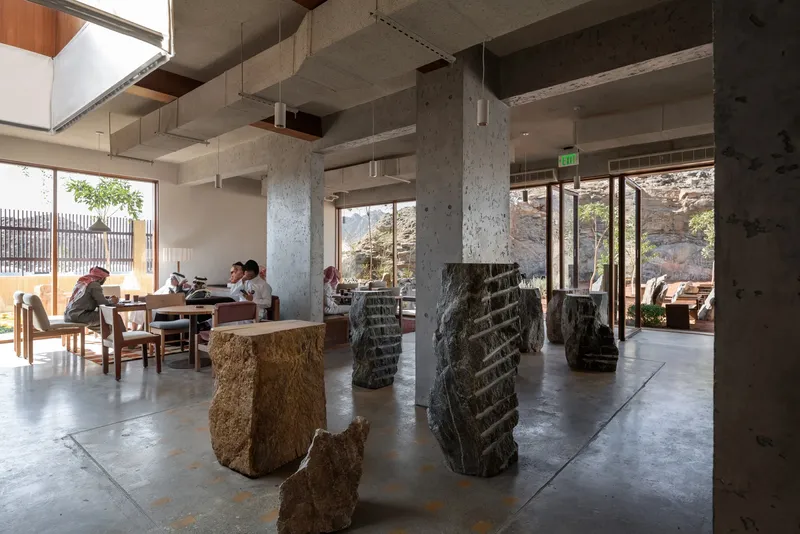
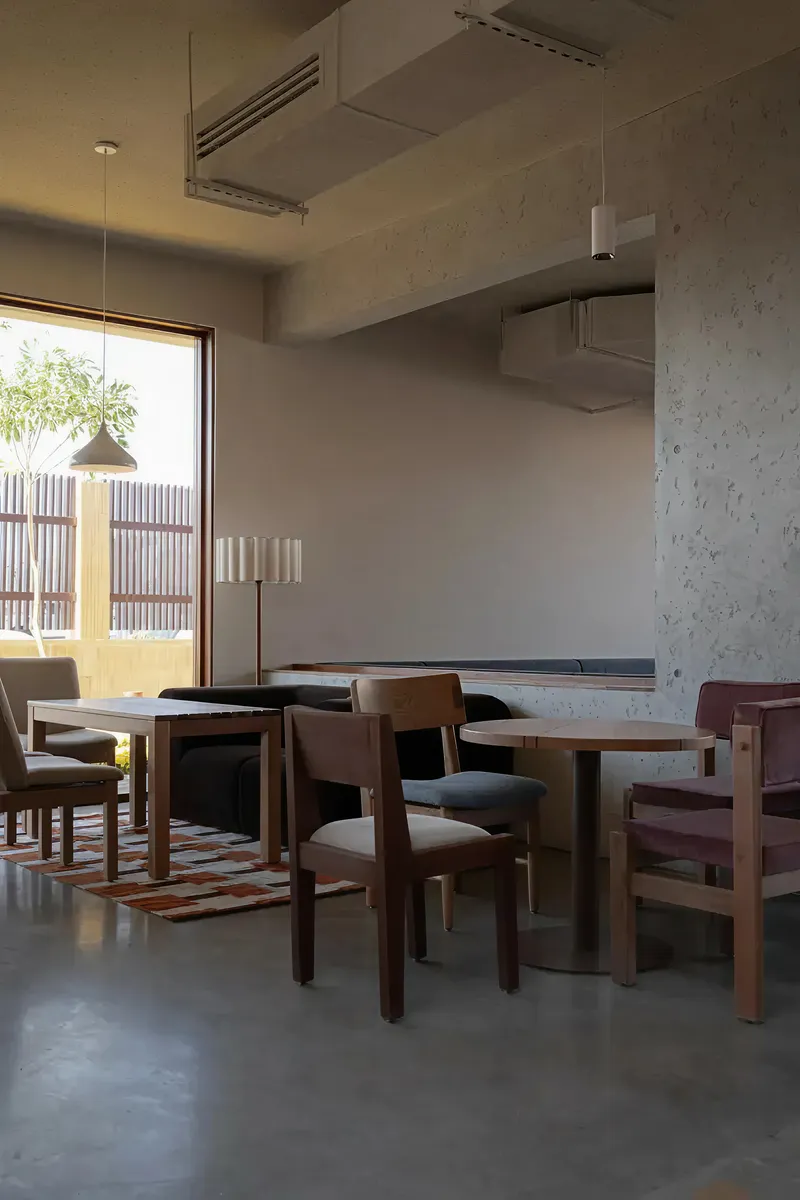
The main dining area is organized around a grid of exposed concrete columns with raw stone table bases, pendant lights, and window walls that frame the landscape on multiple sides. Carved stone wraps on some columns introduce a crafted texture that softens the industrial character of the concrete beams above. The room has the proportions of a hall rather than a boutique café, generous in height and open in plan.
A quieter seating zone near bamboo screening offers an alternative register. Here, timber tables and chairs on a patterned rug suggest a domestic scale within the larger volume. The contrast is deliberate: Peacock Hail offers both the communal energy of a public hall and the intimacy of a private sitting room, depending on where you choose to sit.
Terraces and Evening Life
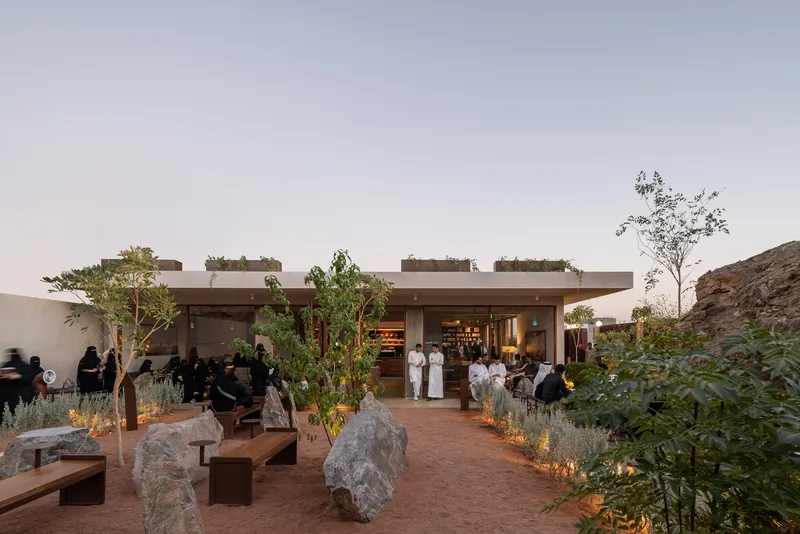
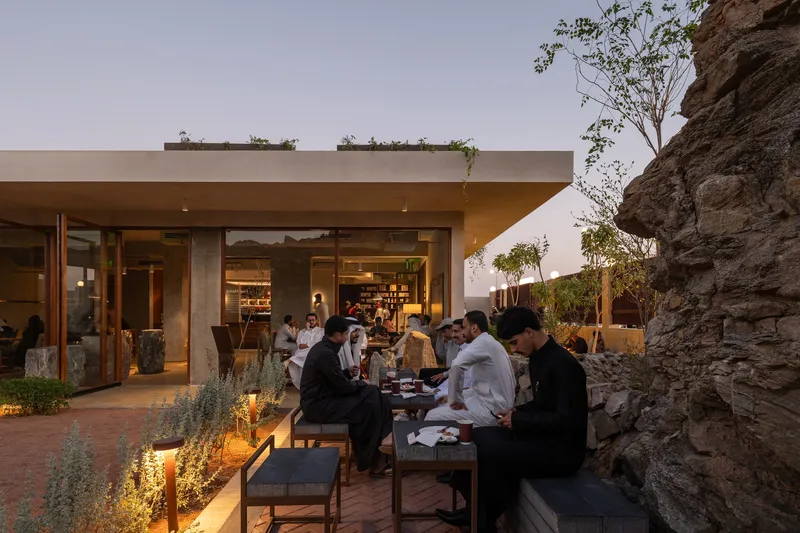
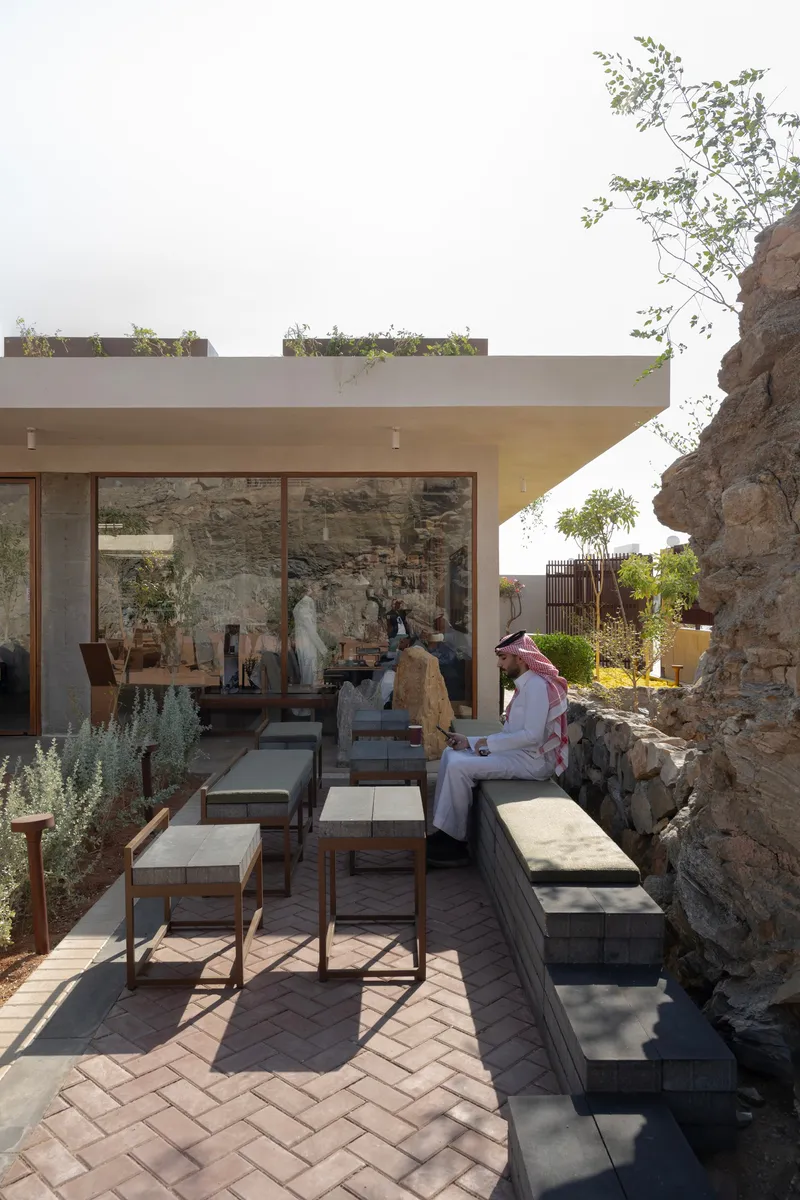
At dusk, the project reveals a second identity. The outdoor terrace with planted roof openings becomes a social gathering space, illuminated planting beds casting a warm glow against the rock wall. Herringbone brick paving at the entrance transitions to reddish sand further out, reinforcing the gradient from built to natural.
Diners seated along tables beside the rock wall are participating in a tradition of outdoor Arabian hospitality, but the setting is entirely contemporary. The lighting design is restrained, allowing the stone to remain the dominant presence even after dark. Glazed doors opening between inside and out ensure that the boundary stays porous, a critical move in a climate where evening hours are the most comfortable for outdoor dining.
The Planted Roof and Urban Context
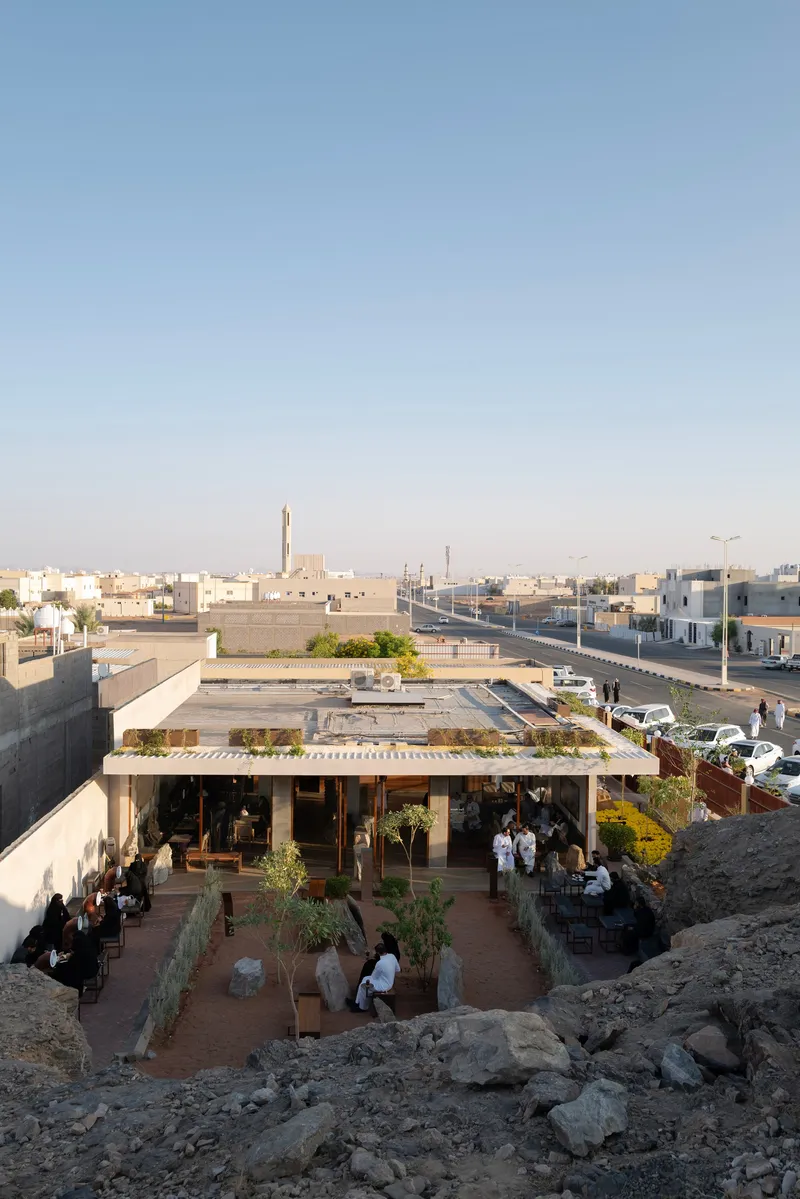
An elevated view of the café reveals its planted rooftop terraces, which read as an extension of the hillside rather than a conventional green roof. The building disappears into the landscape from above, its footprint absorbed by vegetation and stone. Below, the surrounding neighborhood of Ha'il stretches to the horizon, a reminder that this geological drama is embedded in a living city.
Interior details like vertical timber wall paneling behind a table lamp confirm the care taken at every scale. The material palette, concrete, timber, stone, and woven textiles, is narrow but deployed with enough variation to sustain interest across the full 480 square meters.
Plans and Drawings
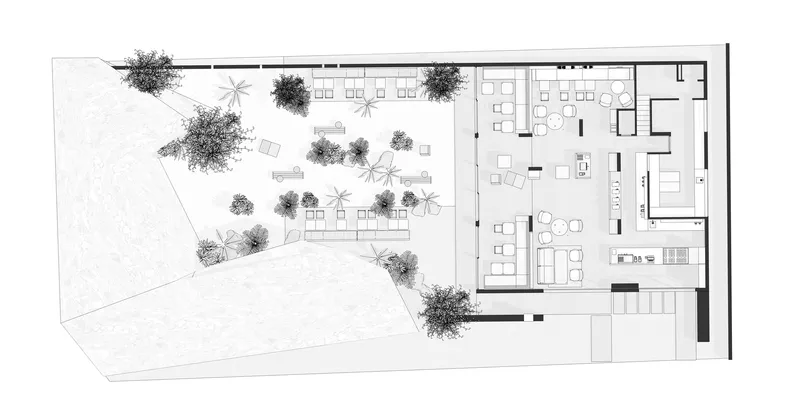
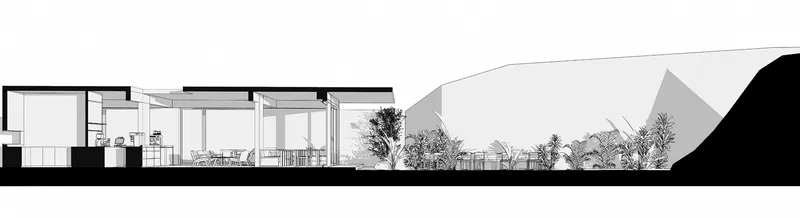
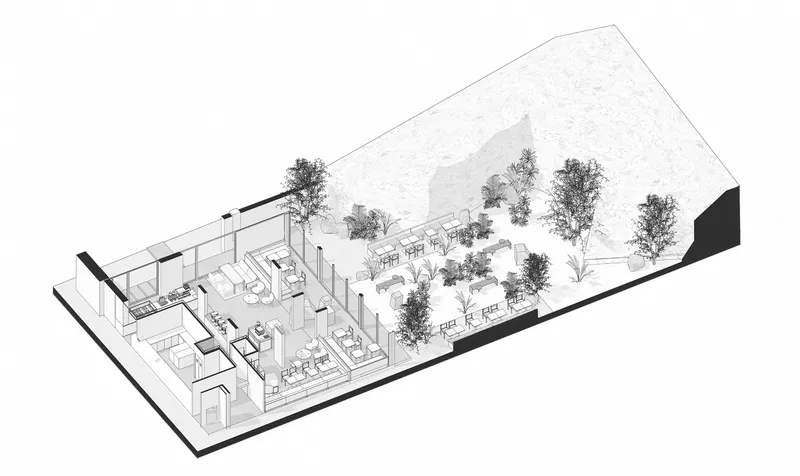
The floor plan reveals a loose organization: an outdoor courtyard with scattered trees feeds into an interior dining hall whose furniture layout follows the column grid. The section drawing is the most telling representation, showing how interior spaces and terraces step up toward the mountain backdrop, with trees mediating between architecture and geology. An axonometric drawing pulls the roof away to expose the planted courtyard and the sloped roof volume that channels views upward toward the cliff.
What these drawings make clear is that the project's apparent informality is the product of precise spatial planning. The courtyard is not leftover space; it is the hinge between the public face of the café and the private encounter with the rock face. The sloped roof is not stylistic; it directs sight lines and manages the transition in scale from human furniture to geological formation.
Why This Project Matters
Saudi Arabia's contemporary hospitality architecture is moving fast, and much of it leans on imported luxury codes that have little to do with the specificities of place. Peacock Hail Cafe pushes back against that tendency. By grounding every design decision in the material and topographic reality of Ha'il, Movs Studio has produced a café that could not exist anywhere else. The boulders on the floor, the cliff at the terrace edge, the reddish sand underfoot: these are not scenic backdrops but active participants in the spatial experience.
The lesson here is that refurbishment and contextual design need not be timid or nostalgic. Movsisian and Tarasova have created something assertively modern that also honors geological and cultural inheritance. For a 480 square meter café, Peacock Hail carries an outsized argument about what it means to build well in a landscape that already has everything it needs.
Peacock Hail Cafe by Movs Studio (Ruben Movsisian, Catherine Tarasova). Ha'il, Saudi Arabia. 480 m². Completed 2025. Photography by Ilya Ivanov.
About the Studio
Share Your Own Work on uni.xyz
If projects like this are the kind of work you want to make, uni.xyz is a place to publish your own, find collaborators, and enter design competitions.


Popular Articles
Popular articles from the community


Opera on the Sea: Driftwood Logic Shapes a Timber Opera House on Estonia's Coast
Trevor Orgill's opera house translates the entangled drift of floating timber into a civic building where wood, water, and music converge.

Cloaked Colonization: A Mobile Underwater Habitat That Moves Like a Fish
Micah Abaya's shortlisted EHC Pacific entry reimagines ocean settlement as a dispersed network of self-sustaining architectural organisms.

The Amber Palace Opera: A Geological Fiction Surfaces on Tallinn's Baltic Waterfront
Pierre Brillard reimagines a Baltic legend as a public landscape, opera house, and waterfront promenade rooted in Tallinn's coastal identity.
Extended Shell: Retrofitting Kolkata's Balconies as Living Urban Thresholds
A modular retrofit system recovers the social and environmental intelligence of Kolkata's historic verandas for contemporary Park Street residents.

Similar Reads
You might also enjoy these articles

Pixel Gardens: One Repeated Module Stacked Into a Terraced Social Housing Tower for Famagusta
Salem Bader's shortlisted housing tower builds a vertical neighbourhood from one repeated module, offsetting units to carve terraces, light and air.

Bao Huynh Watercolor Atelier: A Serene Art Retreat in Hội An
Bao Huynh Watercolor Atelier in Hội An blends multifunctional art spaces, sustainable design, local materials, and family-friendly living in a serene environment.

Atelier Macri Concept Store Interior Design by CASE-REAL
Atelier Macri store features a "ko" counter, walnut wood details, cork displays, blending retail, gallery, and seamless customer experiences.

Manuel Vargas Izquierdo Stadium and High-Performance Sports Center: Architectural Excellence in Jalpa de Méndez
The Manuel Vargas Izquierdo Stadium blends sustainable design, inclusive sports facilities, and cultural-inspired architecture, revitalizing Jalpa de Méndez’s public spaces.


Comments (0)
Please login or sign up to add comments
No comments yet. Be the first to comment!