
Pema Studio Carves a Fortress of Light from a Cramped Urban Plot in Santo Tirso
A subtractive patio house in northern Portugal channels Islamic spatial traditions to find sky, air, and privacy on a tight site.


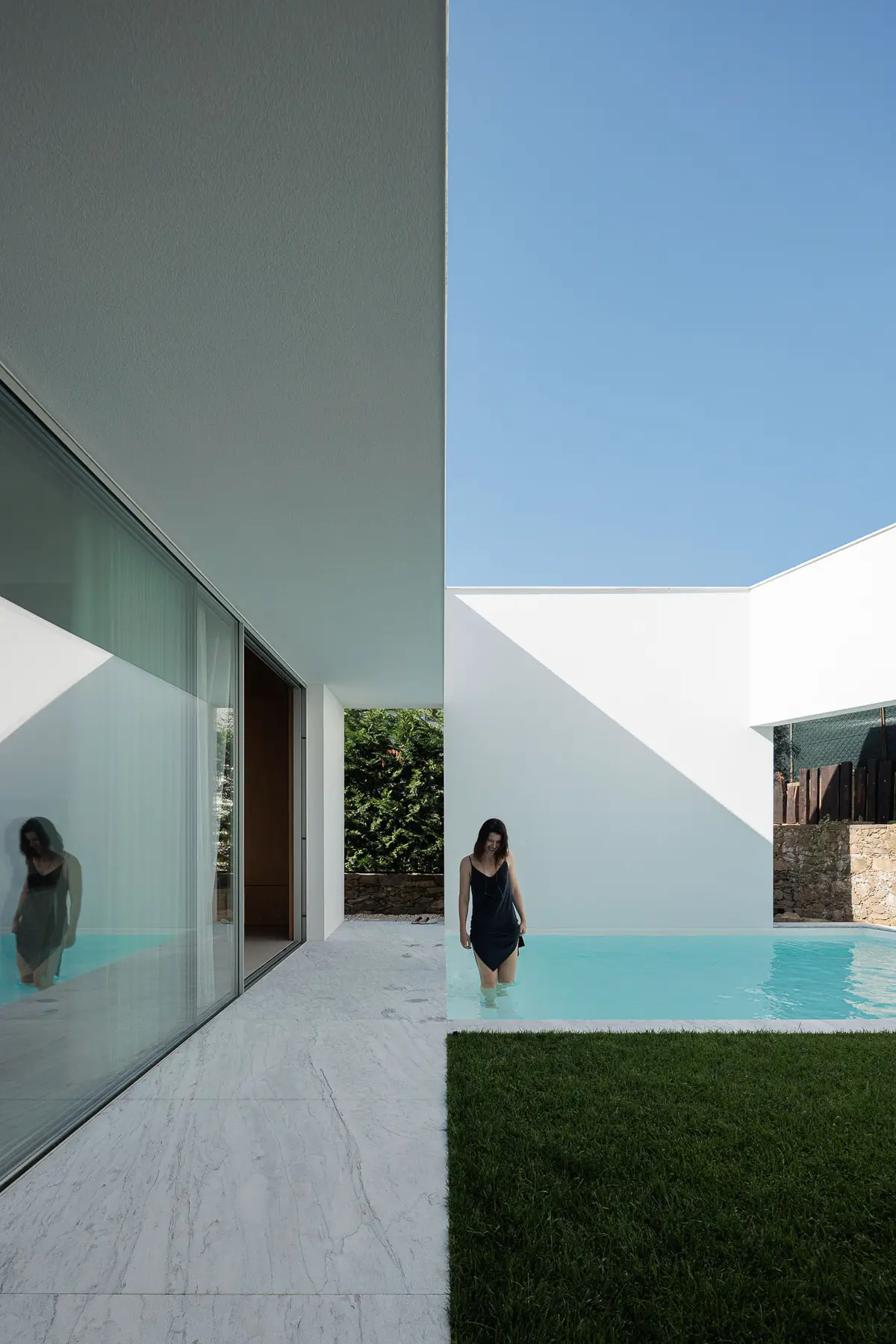
On a confined urban lot hemmed in by neighbors on every side, pema studio faced a question that resonates across the dense residential fabric of Iberian cities: how do you build a private world where there is almost no room to breathe? Forte House is their answer, and the name is apt. The project operates as both fortress and oasis, a monolithic white volume that turns its back on the street while opening upward to the sky through a sequence of carved-out courtyards, lightwells, and pools. Replacing a heavily degraded structure with little constructive value, the 280-square-meter house in Santo Tirso reads as a single massive block from which space has been subtracted rather than added.
What makes the project genuinely interesting is not the white-box-with-courtyard formula, which is well-traveled territory, but the precision with which light is treated as the primary building material. Every void, slot, and skylight is calibrated to pull daylight deep into plan while simultaneously generating passive ventilation. The architects cite Islamic spatial culture as an influence, and you can feel it: the procession from compressed threshold to bright open patio, the refusal of outward views in favor of intimate relationships with the sky, the gridded metal screens that fracture sunlight into geometric patterns on stone and brick paving.
A Street Facade That Reveals Nothing
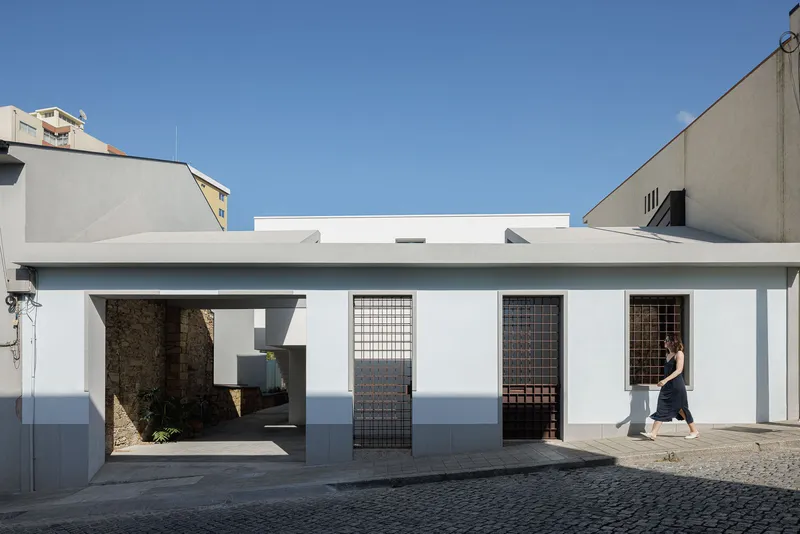
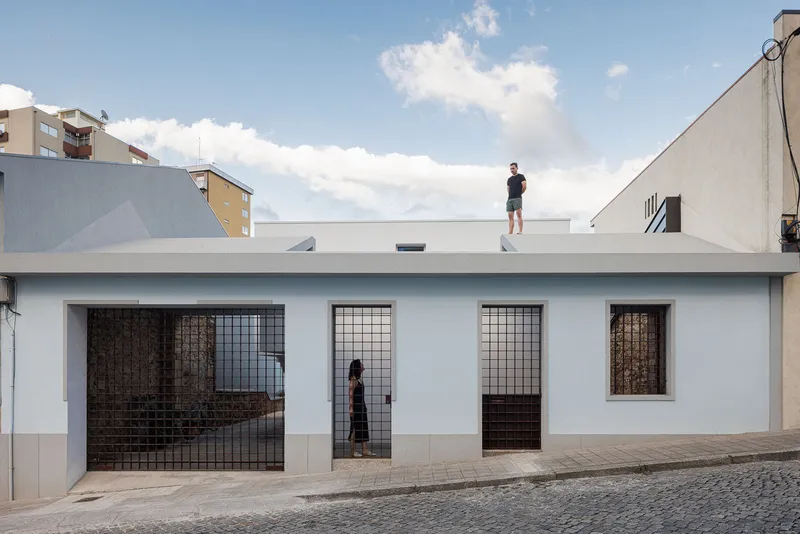
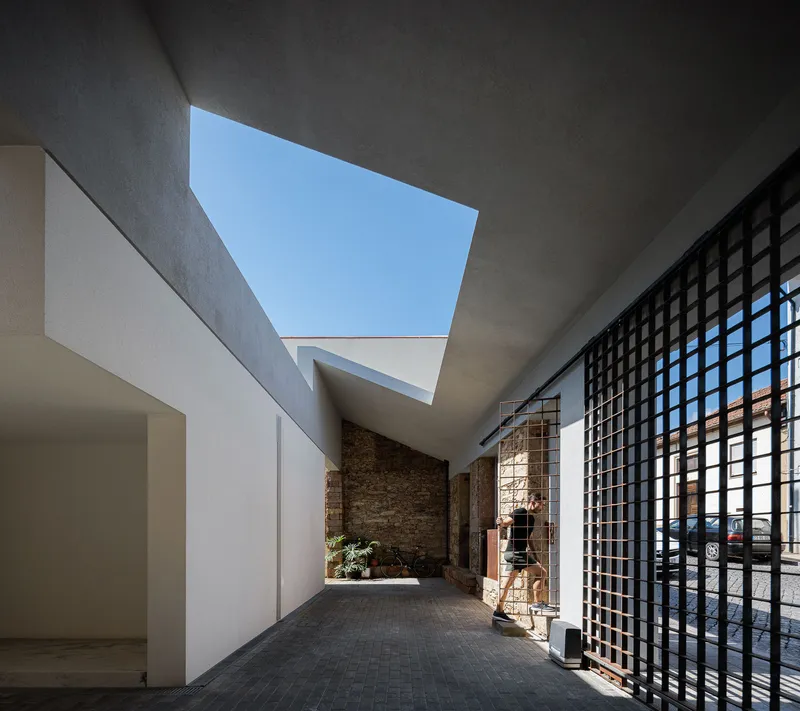
The street elevation is almost blank: white stucco, a restored stone base, and tall gridded metal doors that give nothing away. Pema studio deliberately preserved and rehabilitated the original facade as an act of urban stitching, maintaining the rhythm and grain of the residential block while concealing a completely new spatial order behind it. A figure on the rooftop terrace is the only hint that something unexpected is happening within.
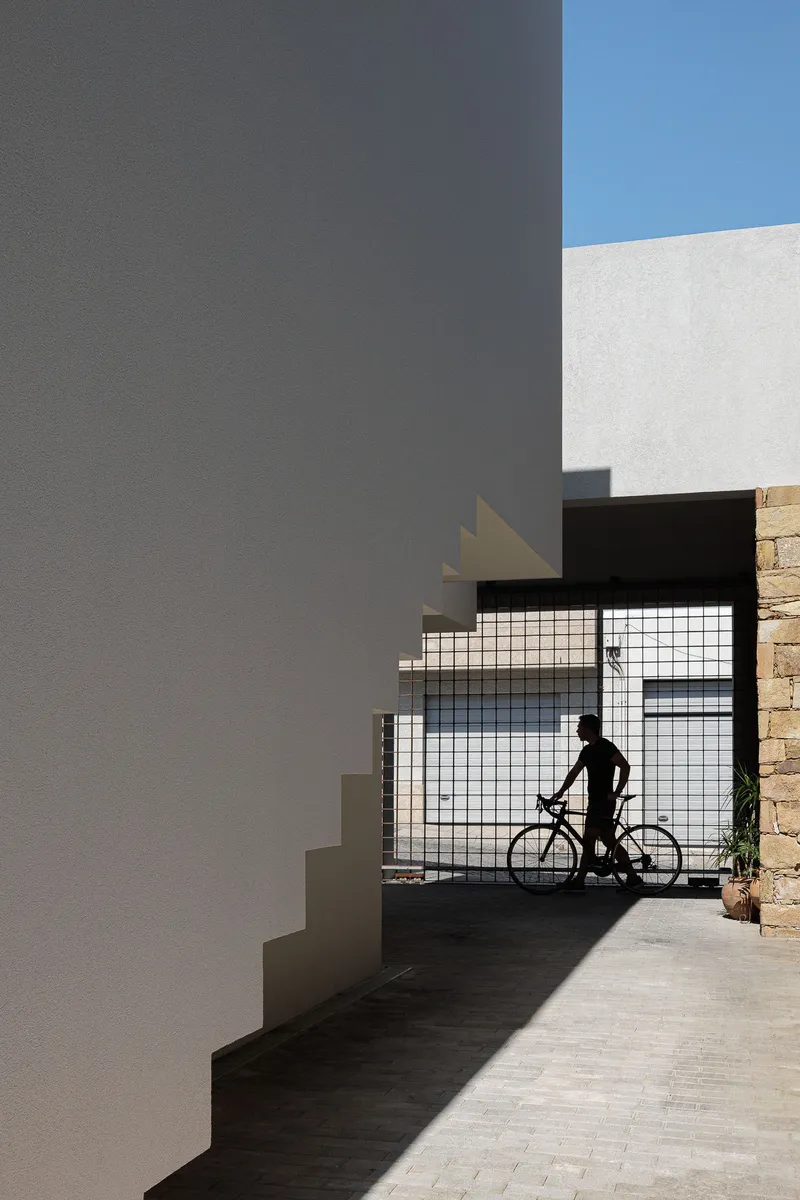
The entry sequence compresses the visitor through a covered passage where a cyclist's silhouette against bright daylight reads like a frame from a film. From the first step inside, the architecture deploys contrast as strategy: low ceilings before high voids, shadow before blinding courtyard light, old stone before crisp render.
Stone Memory and White Intervention
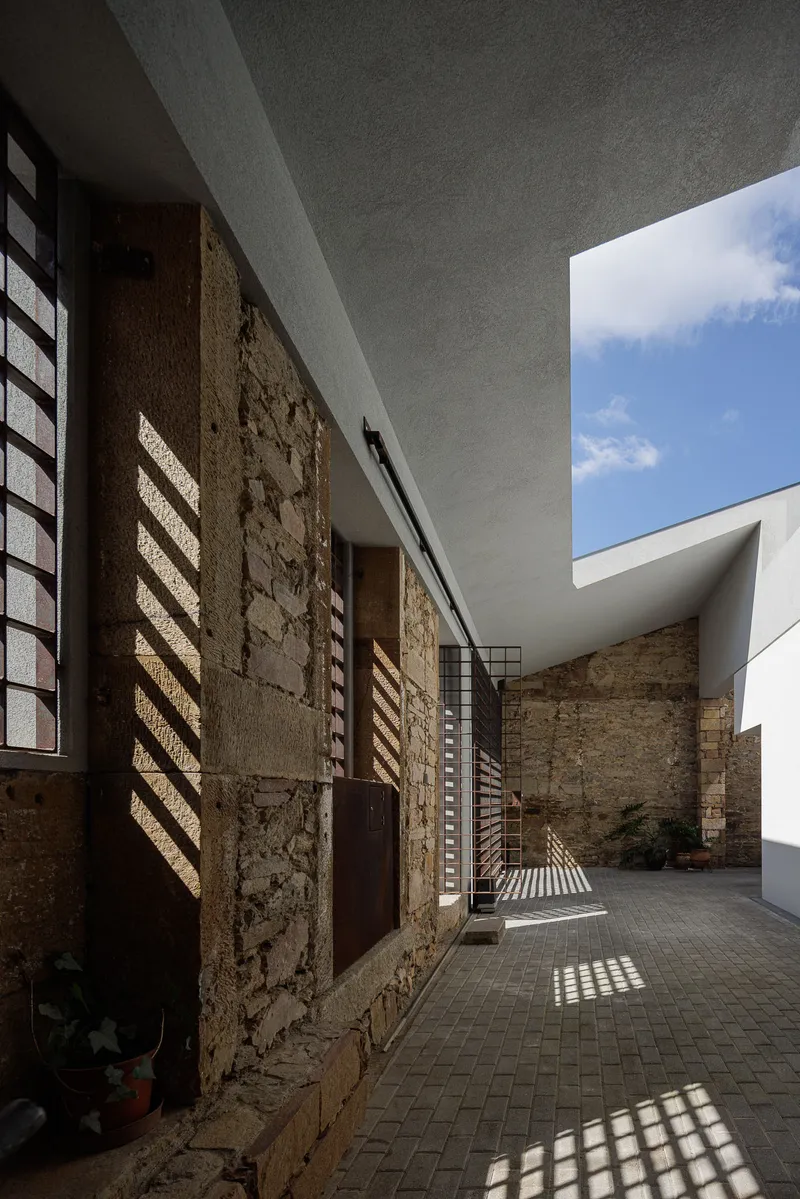
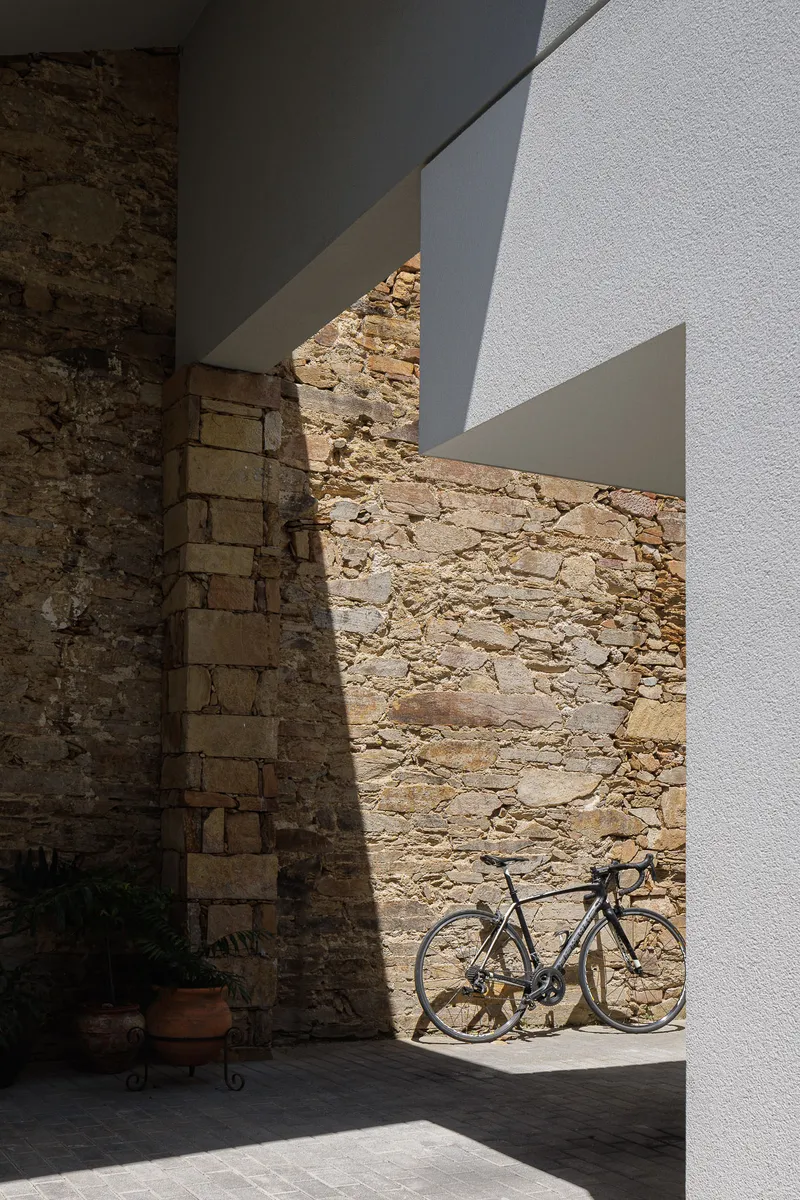
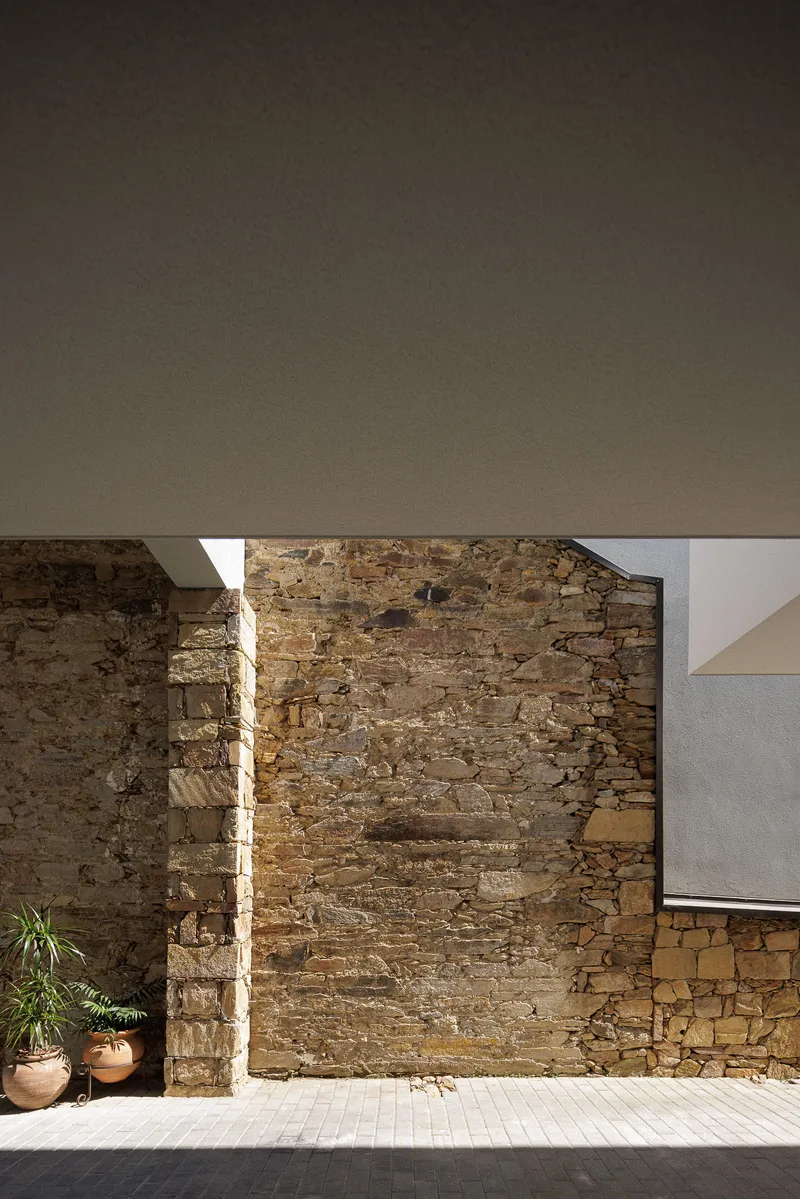
The retained perimeter stone walls are the project's conscience. Weathered, crumbling, spotted with lichen, they stand in deliberate tension against the razor-sharp white stucco of the new volumes. This is not restoration in any sentimental sense. The old masonry functions as a spatial buffer, creating narrow intermediate passages between the new house and the lot boundary that are neither fully inside nor fully outside.
These in-between strips are surprisingly rich. A bicycle leans against rough stone. Terracotta pots cluster at the base of a corner pier. A narrow vertical slot of daylight illuminates the ruin texture beneath a canopy. These moments accumulate into an experience that feels layered in time, even though the new construction is barely two years old. The stone does the work of decades.
Courtyards as Carved Voids
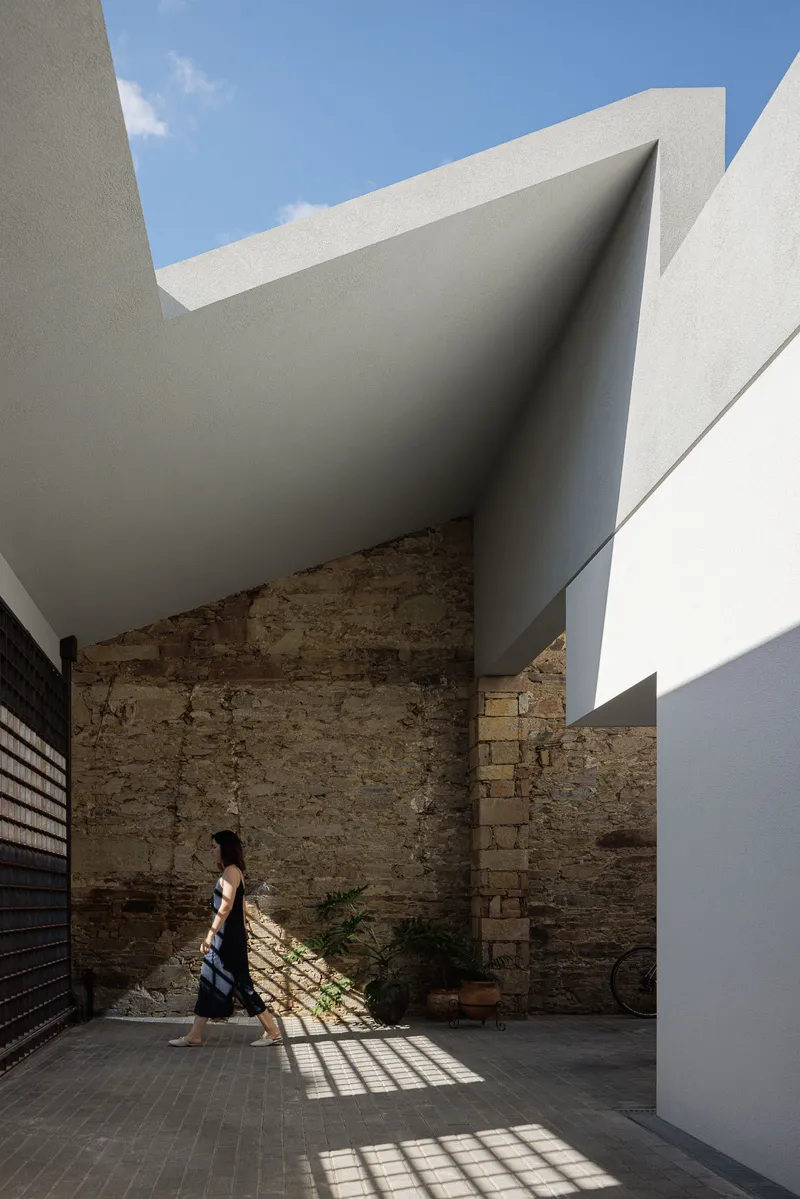
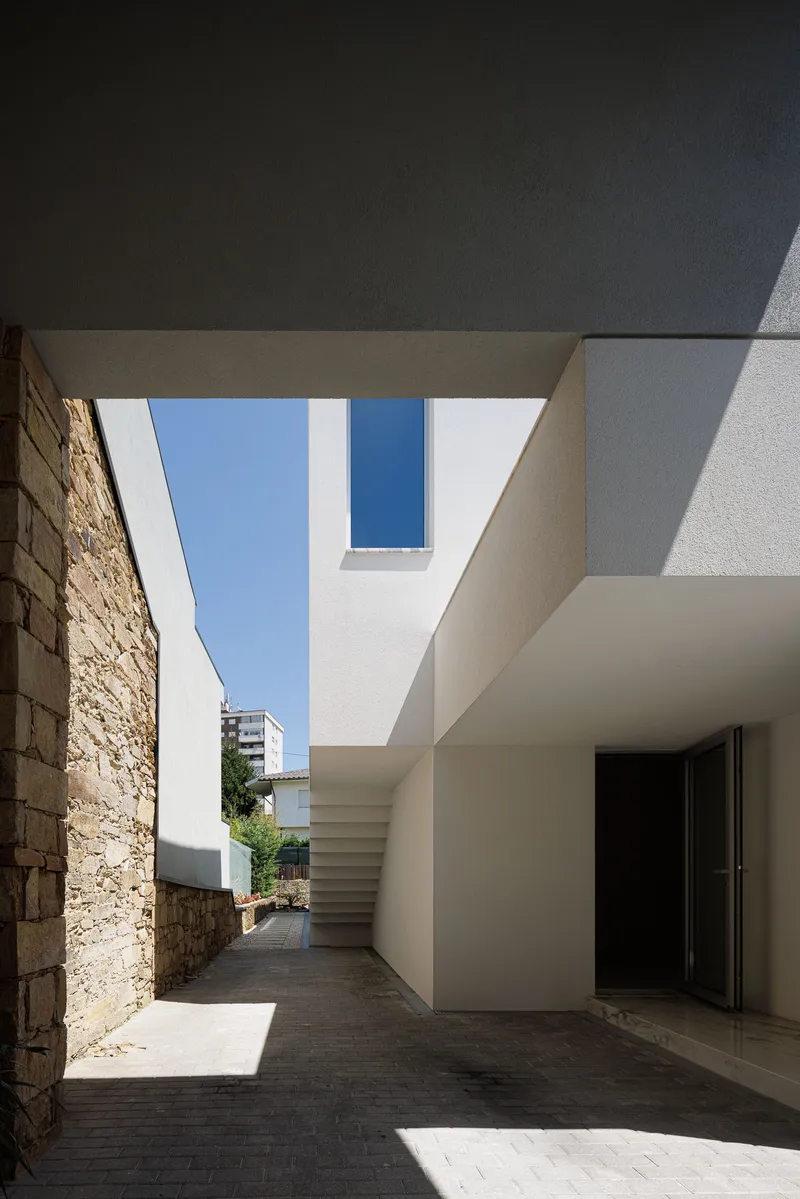
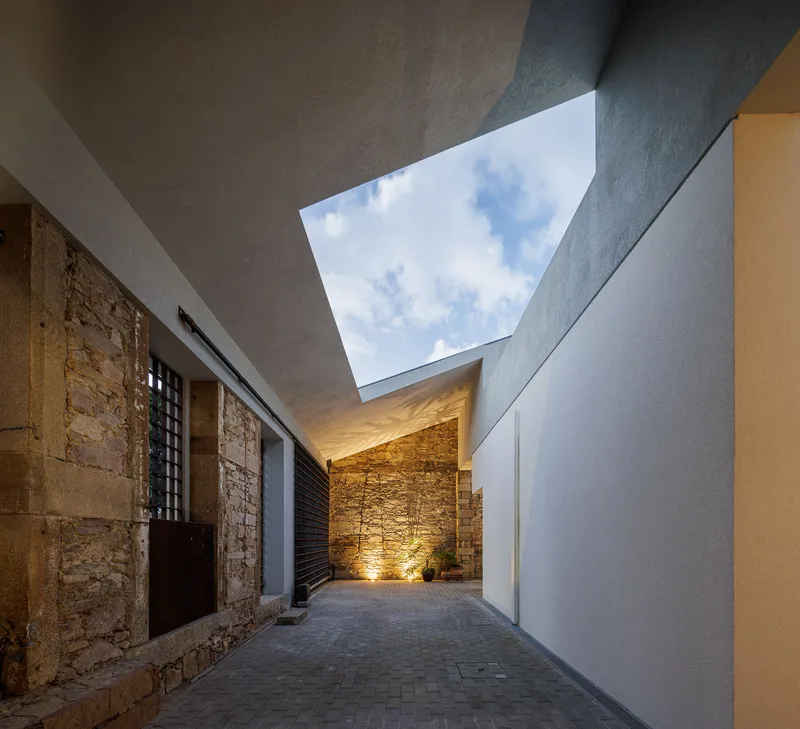
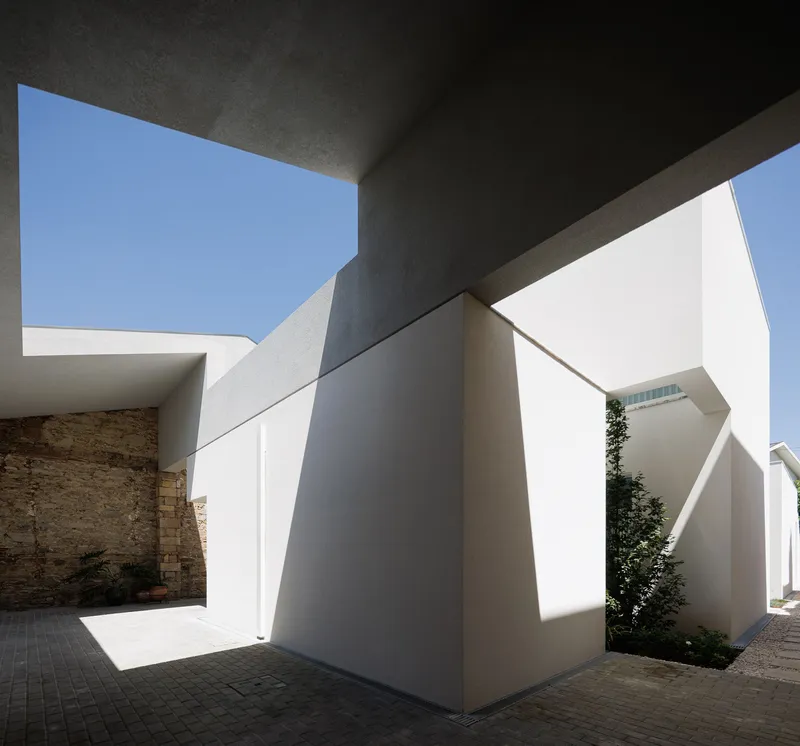
The subtractive logic of the design becomes legible in the courtyards. Rather than arranging rooms around a single central patio, pema studio has punched multiple voids into the block, each with its own character. One is a processional passage where a gridded screen casts geometric shadows onto brick paving. Another reveals the full height of the white volumes against exposed stonework and an external stair. At dusk, a rectangular skylight opening frames deep blue sky while uplighting washes the stone wall in warm amber.
The courtyards are not decorative. They solve the fundamental problem of the site. With privacy compromised on every side by adjacent buildings, the program is accommodated between patios that refuse any direct relationship with the exterior perimeter. Views are directed upward or inward, never outward. The result is a house that feels spacious and connected to nature despite being locked inside a dense urban block.
The Pool Courtyard as Social Core
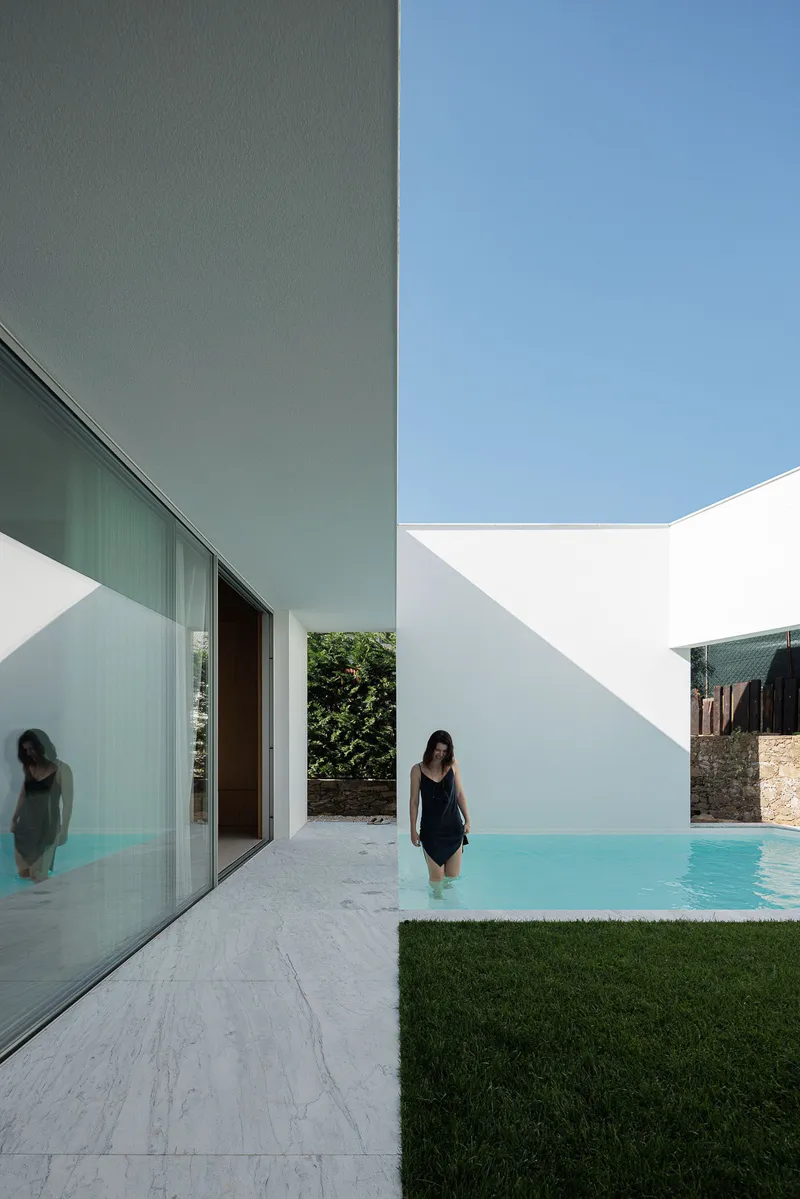
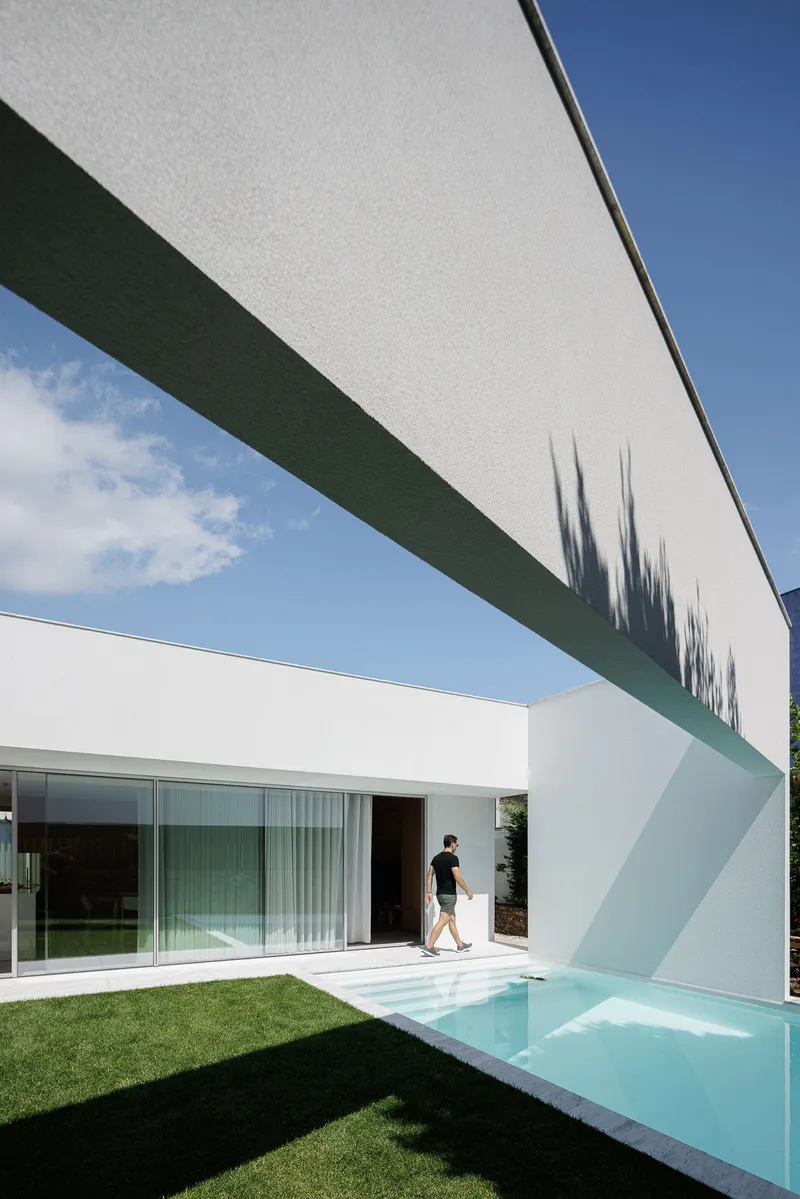
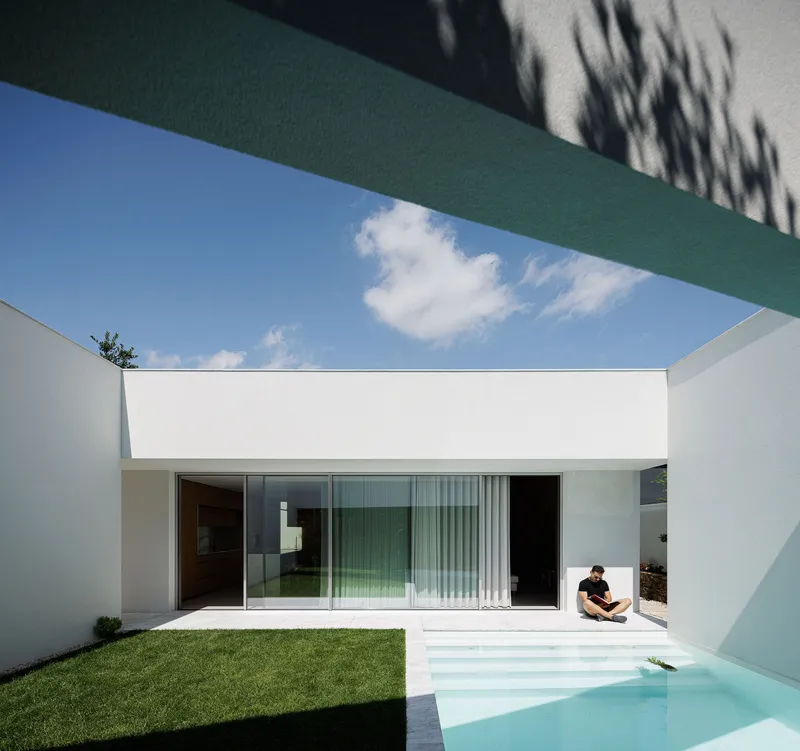
The rear courtyard, with its rectangular pool, is where the fortress relaxes. Sliding glass doors dissolve the boundary between living spaces and water. A cantilevered white beam crosses above the pool, casting a hard shadow line that shifts through the day. The green-painted soffit over one edge adds an unexpected note of color, cooling the light and giving the seating area a sheltered, grotto-like quality.
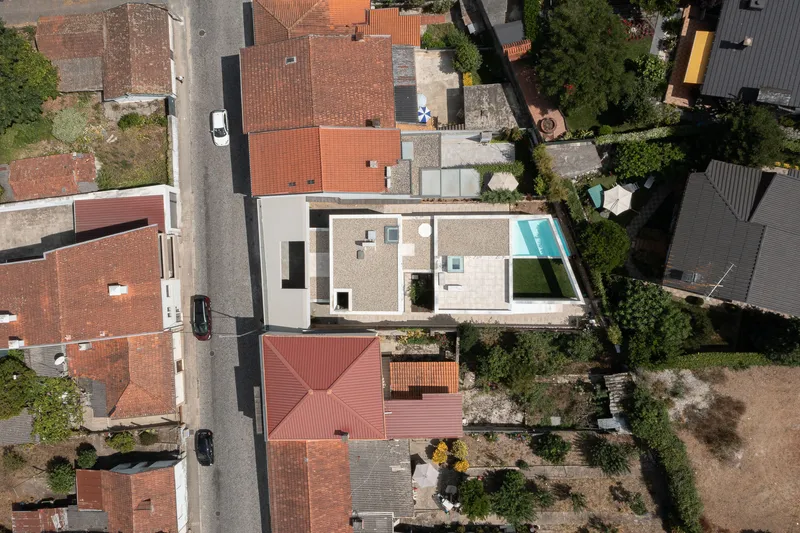
Seen from the aerial view, this courtyard is a secret garden entirely invisible from the street. Surrounded on all sides by terracotta-tiled roofs of neighboring houses, the pool and its white walls read as a jewel box dropped into the urban grain. The contrast with the traditional roofscape is stark and intentional.
Timber Interiors as Counterweight
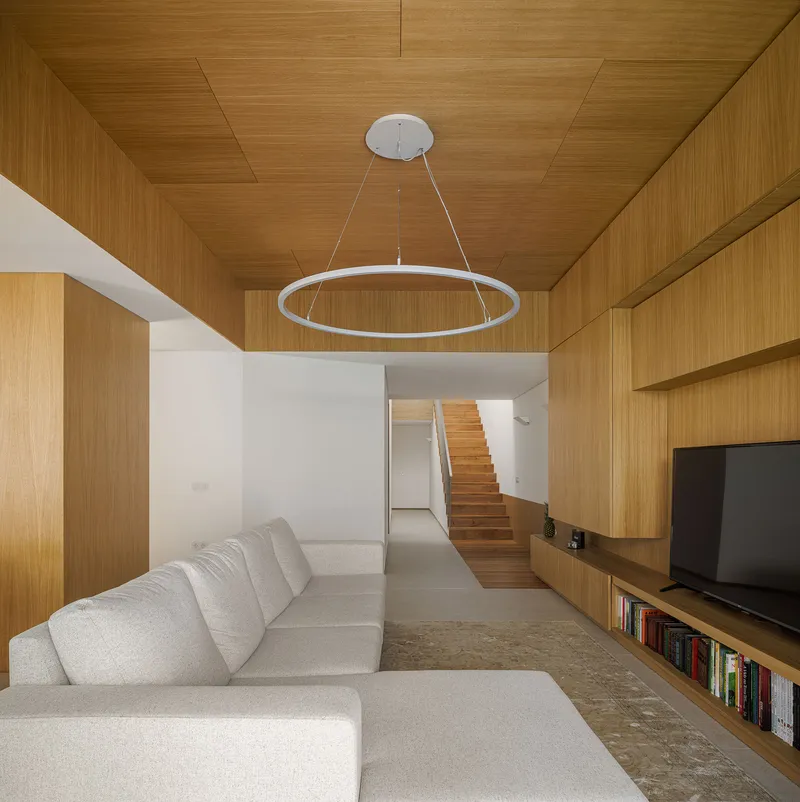
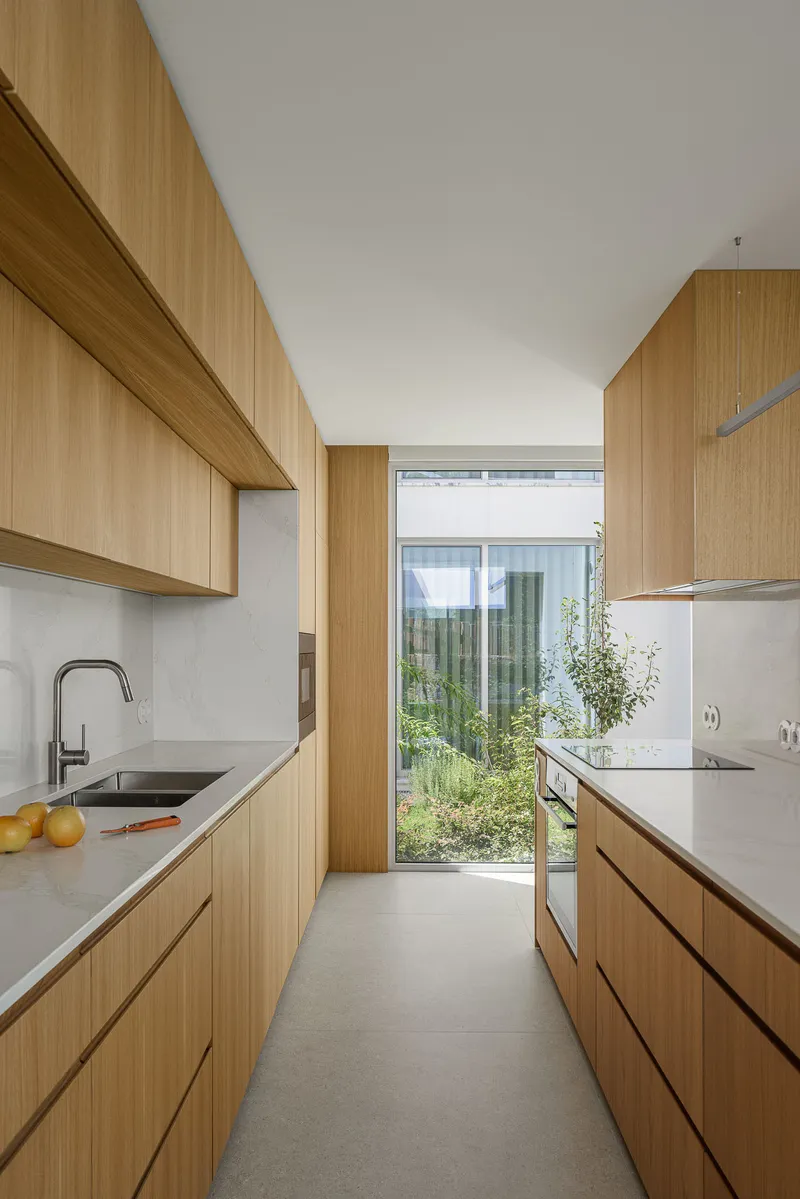
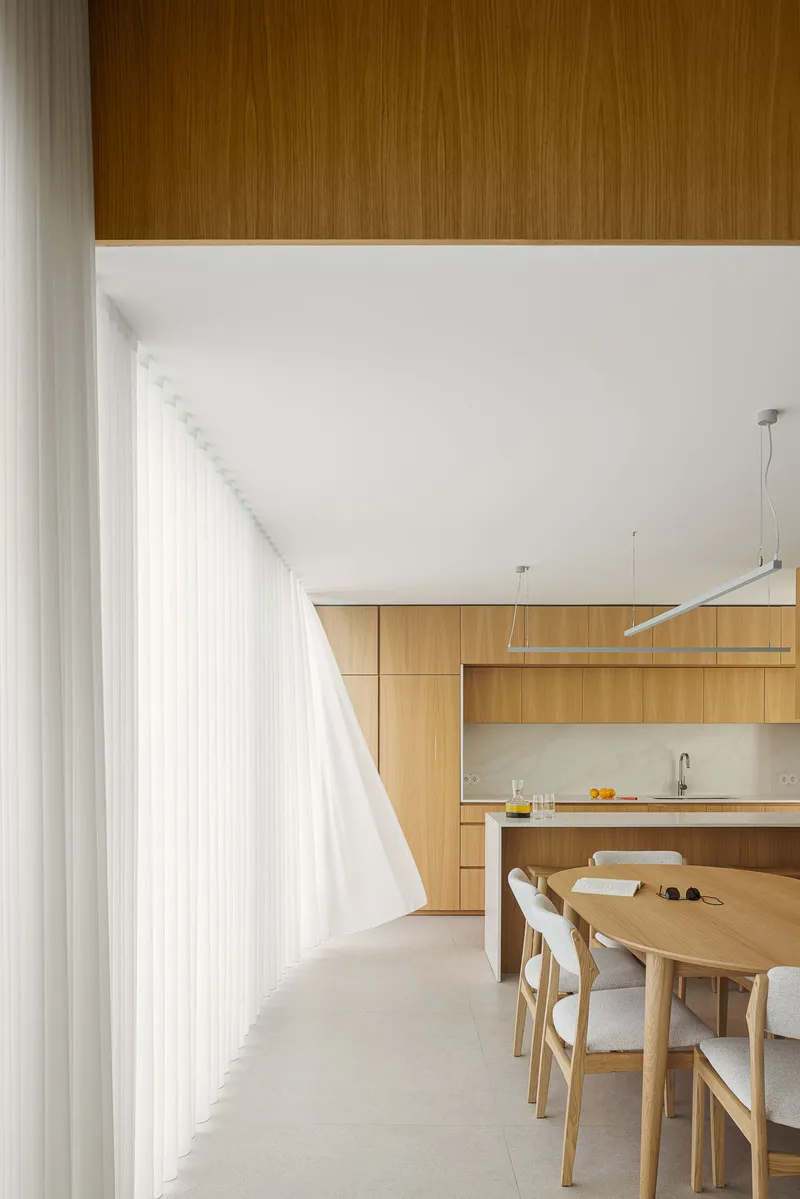
If the exterior is all mineral restraint, the interior swings toward warmth. Light timber paneling lines ceilings, walls, and cabinetry, creating a continuous wood envelope that softens the spatial severity. The galley kitchen overlooks a planted courtyard through full-height glazing, its stone countertops grounding the timber in material weight. In the dining area, a timber soffit runs above sheer curtains that filter and diffuse the harsh Portuguese sun.
The material palette is disciplined: wood, white render, stone, glass, and not much else. This restraint allows the architecture to remain legible. You always understand where the old structure ends and the new one begins, where inside becomes outside, where solid yields to void.
Corridors, Thresholds, and Controlled Sequences
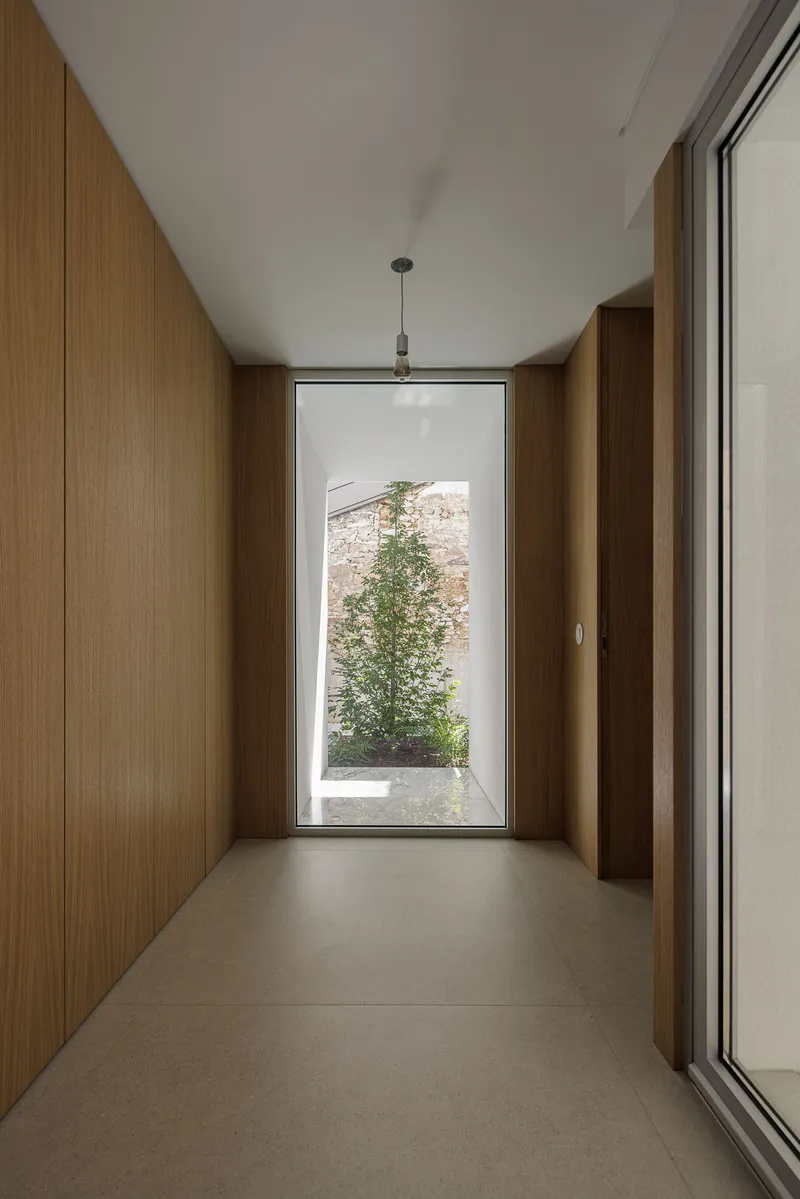
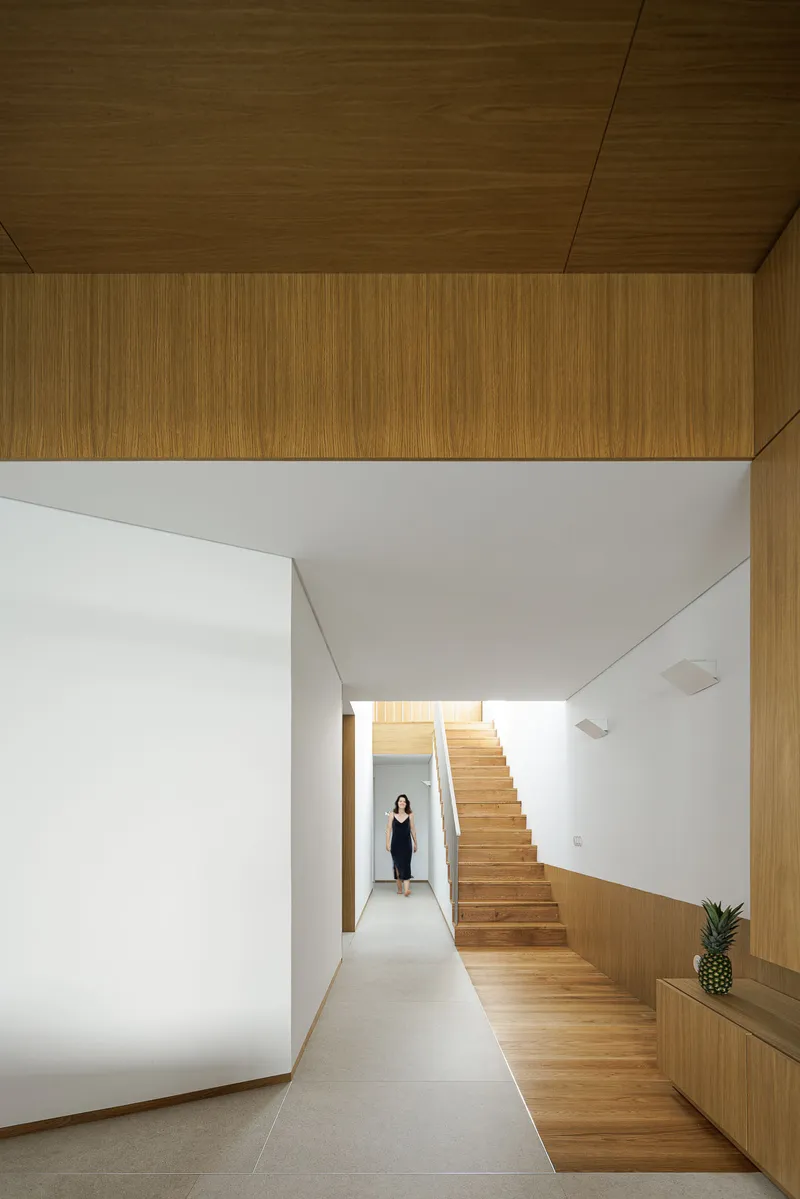
The house is organized longitudinally with two corridors, one interior and one exterior, giving access to the living room, kitchen, and dining room that open to the rear. These corridors are not mere circulation. They are carefully proportioned compression zones that heighten the release into daylit rooms and courtyards. A narrow wood-paneled hallway terminates at a glazed door with a potted tree visible beyond, turning a simple corridor into a view frame.
The covered passage with its exposed brick wall and angled skylight is one of the project's strongest moments. Daylight enters at a sharp angle, casting a diagonal wash across the paving that will track the sun's path through the day. It is architecture as sundial, and it reinforces the designers' stated intention to treat light as the main protagonist of the house.
Upper Floor: Light, Rest, and the Rooftop
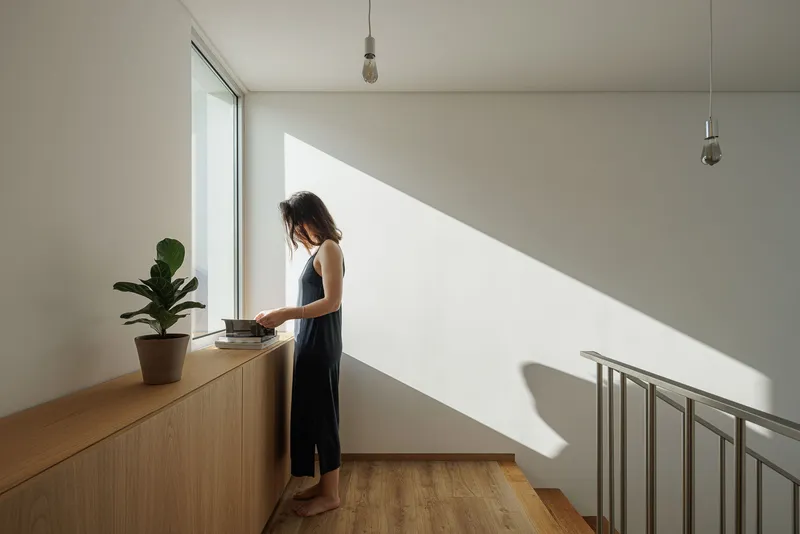
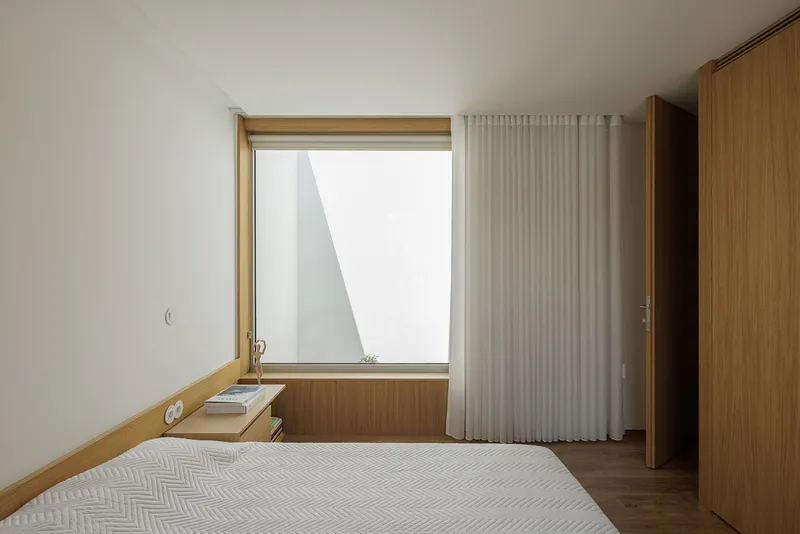
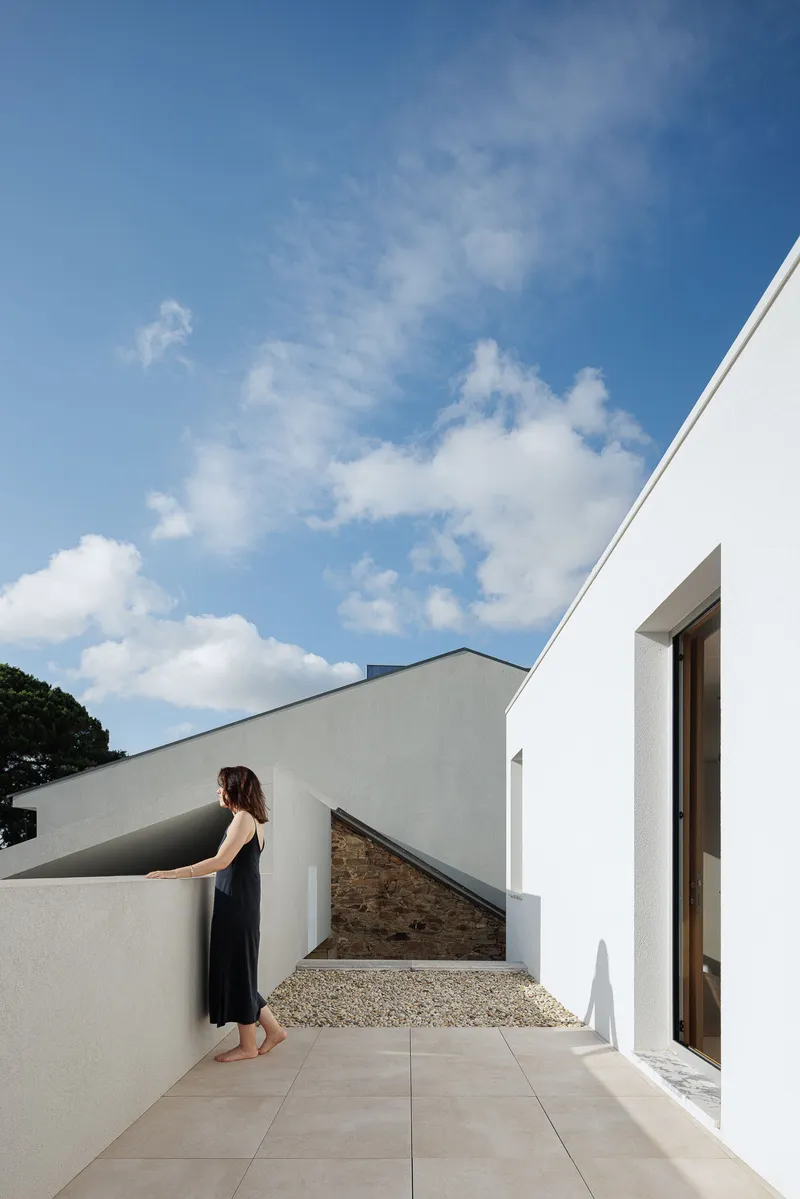
Upstairs, the material warmth continues. A timber-framed window in the bedroom admits light beneath a sloped ceiling. The upper landing features a low timber counter beside a window that casts a sharp diagonal of sunlight across the white wall, a detail that could be purely incidental but, given the discipline of the rest of the house, feels deliberate. The rooftop terrace, surfaced in gravel, offers the only place in the house where you can see beyond your own walls. After the interiority of every other space, standing up here under open sky feels like surfacing.
Plans and Drawings
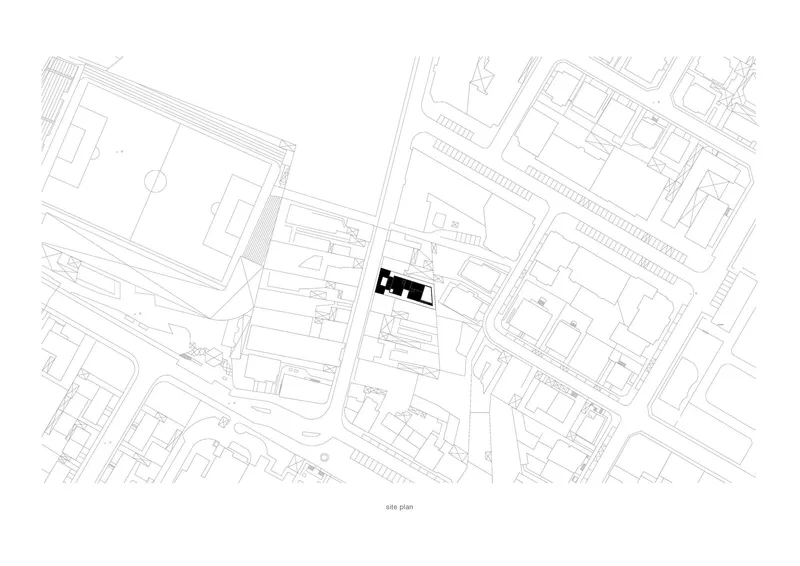
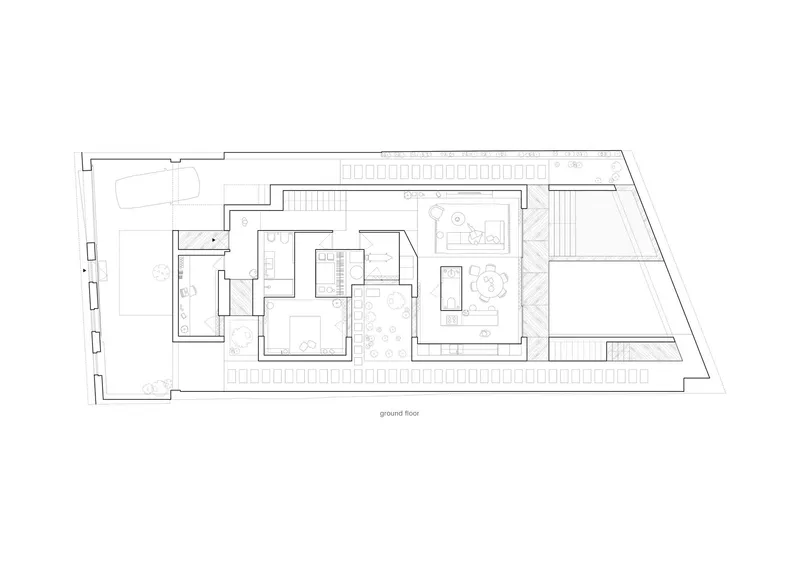
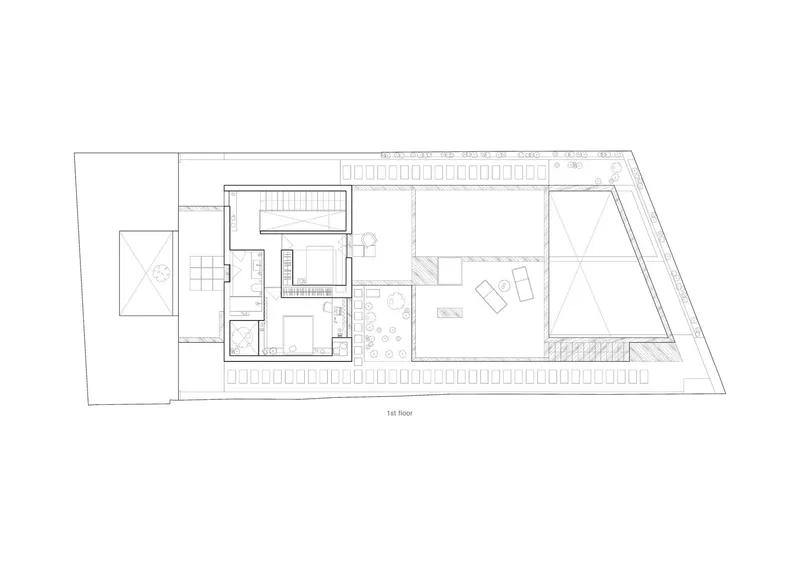
The site plan confirms the project's urban logic: a single black footprint occupying nearly the full extent of the lot, surrounded by the dense fabric of Santo Tirso's residential blocks. The ground floor plan reveals how the rectangular rooms are organized around multiple courtyards, with tree symbols indicating planted voids that bring nature into the section. At the first floor, an open living space with triangular skylights and a central staircase completes the spatial organization.
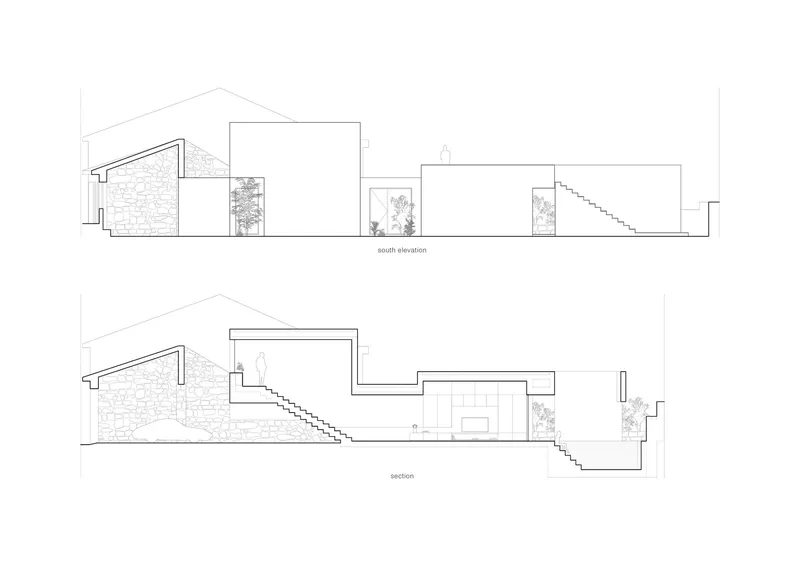
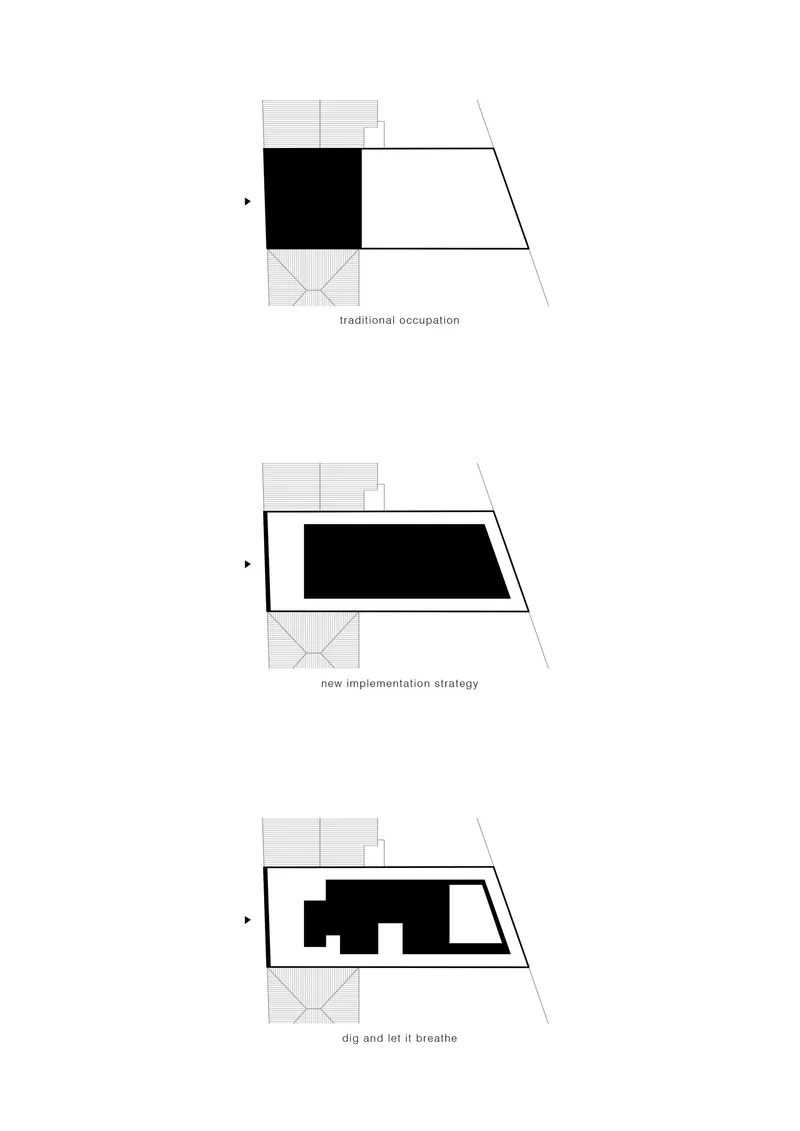

The section drawings show the pitched roof volumes that allow the house to sit comfortably within the streetscape while concealing the internal complexity. The three-step diagram is the most revealing drawing: it traces the design evolution from a conventional footprint to the final fragmented massing strategy, illustrating how subtraction from a massive block generates the sequence of voids. The solid-void diagram confirms the paired volumes separated by the central courtyard opening, with a diagonal stair element linking the two halves.
Why This Project Matters
Forte House is a convincing argument that density does not have to mean deprivation. On a plot where lesser designs would produce a dark, airless box, pema studio has created a house that is more connected to the sky, more ventilated, and more spatially rich than many freestanding villas on open sites. The subtractive method, carving courtyards from a monolithic block rather than assembling rooms around a void, produces a different kind of patio house: one that feels carved from stone rather than built from plans.
The project also demonstrates a thoughtful relationship with time. By retaining and celebrating the old perimeter walls while inserting a wholly contemporary intervention, pema studio avoids both pastiche and the arrogance of erasure. The result is a house where you are always aware of what came before, but never imprisoned by it. In the crowded residential blocks of northern Portugal, that balance between memory and invention is worth paying attention to.
Forte House by pema studio, Santo Tirso, Portugal. 280 m². Completed 2022. Photography by Ivo Tavares Studio.
About the Studio
Share Your Own Work on uni.xyz
If projects like this are the kind of work you want to make, uni.xyz is a place to publish your own, find collaborators, and enter design competitions.


Popular Articles
Popular articles from the community


Conexión: Biophilic Design Reimagines High-Rise Living in Hong Kong
Conexión reimagines high-rise living in Hong Kong through biophilic design, green facades, shared spaces, daylight, water and nature within.

Lunar Spiral: Space Architecture Shaped by the Mathematics of the Universe
Lunar Spiral reimagines space architecture through Fibonacci geometry, lunar regolith, levitating habitats, and self-sustaining Moon living.

The Ocean Hive: Sustainable Architecture for a Self-Sufficient Civilization at Sea
The Ocean Hive imagines sustainable architecture at sea, where modular habitats, algae, wave power and ocean waste sustain a growing colony.

ALGAL REALM: A Bio-Integrated Lunar Habitat Design for Life Beyond Earth
ALGAL REALM reimagines lunar habitat design with algae-powered life support, 3D-printed regolith, and vertical living for a lunar future.

Similar Reads
You might also enjoy these articles

Bao Huynh Watercolor Atelier: A Serene Art Retreat in Hội An
Bao Huynh Watercolor Atelier in Hội An blends multifunctional art spaces, sustainable design, local materials, and family-friendly living in a serene environment.

Atelier Macri Concept Store Interior Design by CASE-REAL
Atelier Macri store features a "ko" counter, walnut wood details, cork displays, blending retail, gallery, and seamless customer experiences.

Manuel Vargas Izquierdo Stadium and High-Performance Sports Center: Architectural Excellence in Jalpa de Méndez
The Manuel Vargas Izquierdo Stadium blends sustainable design, inclusive sports facilities, and cultural-inspired architecture, revitalizing Jalpa de Méndez’s public spaces.

KAKR Buluh Awar Hall: Revitalizing Community and Ecology Through Bamboo Architecture
Community built bamboo hall revitalizes Buluh Awar village, empowering youth, restoring ecology, celebrating vernacular craftsmanship through sustainable architecture and culture.


Comments (0)
Please login or sign up to add comments
No comments yet. Be the first to comment!