

People's Architecture Office Converts a Residential Tower into Offices for Beijing's Largest Sleeping City
In Tiantong Yuan, a neighborhood of 700,000 commuters, a vacant apartment building becomes a workplace you can walk to.


Tiantong Yuan is not a neighborhood in the usual sense. It is a dormitory district on the northern edge of Beijing, home to over 700,000 people who empty out each morning and commute south into the city center. During the day, the area is a ghost town. No one works here because there is nowhere to work. People's Architecture Office saw in this condition not just an urban problem but a design opportunity: take a vacant residential tower and convert it into the kind of mixed-use office building that could let at least some of those 700,000 residents walk to work.
The Home Office Tower, completed in 2021, is the first project of its kind under Beijing's Huitian Plan, a city-wide initiative to inject employment and services into residential-only satellite developments. At 22,210 square meters, the conversion is substantial, and its logic is persuasive. Rather than demolishing and rebuilding, the architects partially reinforced the existing structure and carved a ring-shaped circulation through former apartment units, creating a continuous loop around the building core. The result is an office building that still feels domestic in scale, paired with a conspicuous orange canopy at ground level that announces the building's new civic role.
The Orange Canopy as Urban Signal
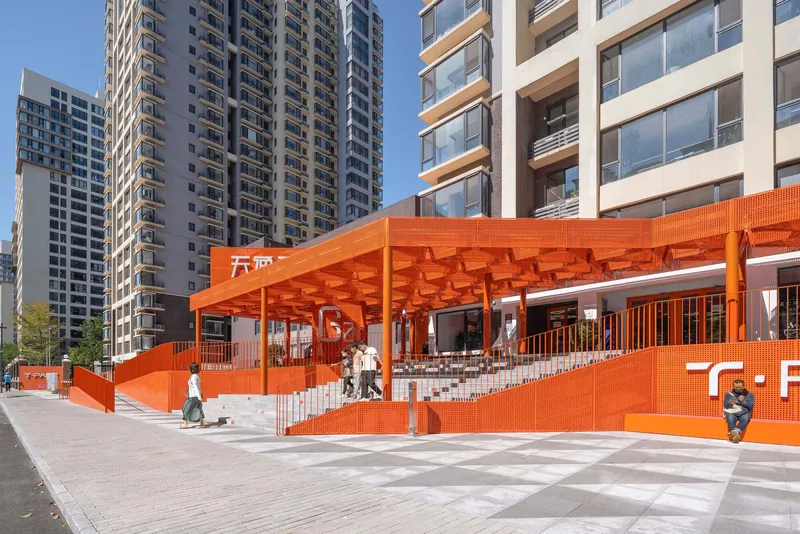
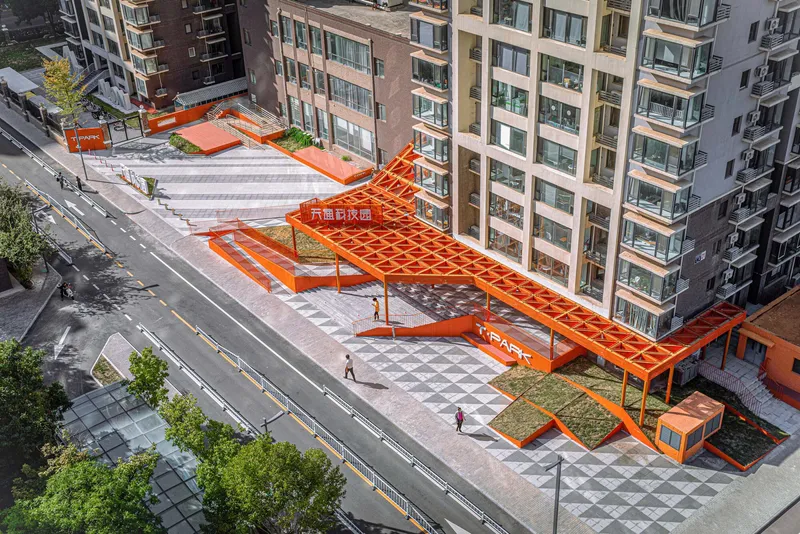
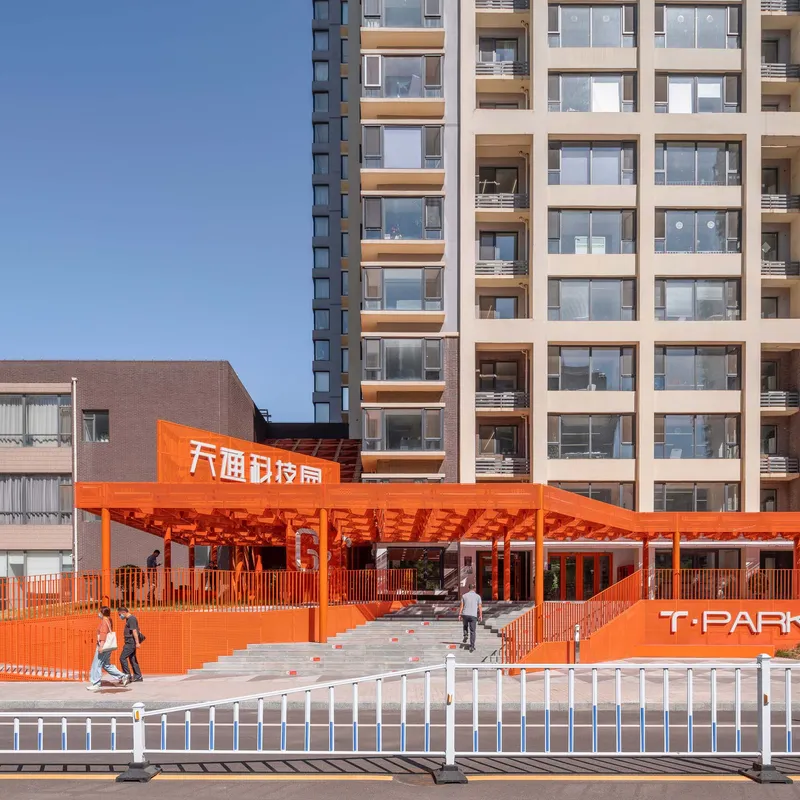
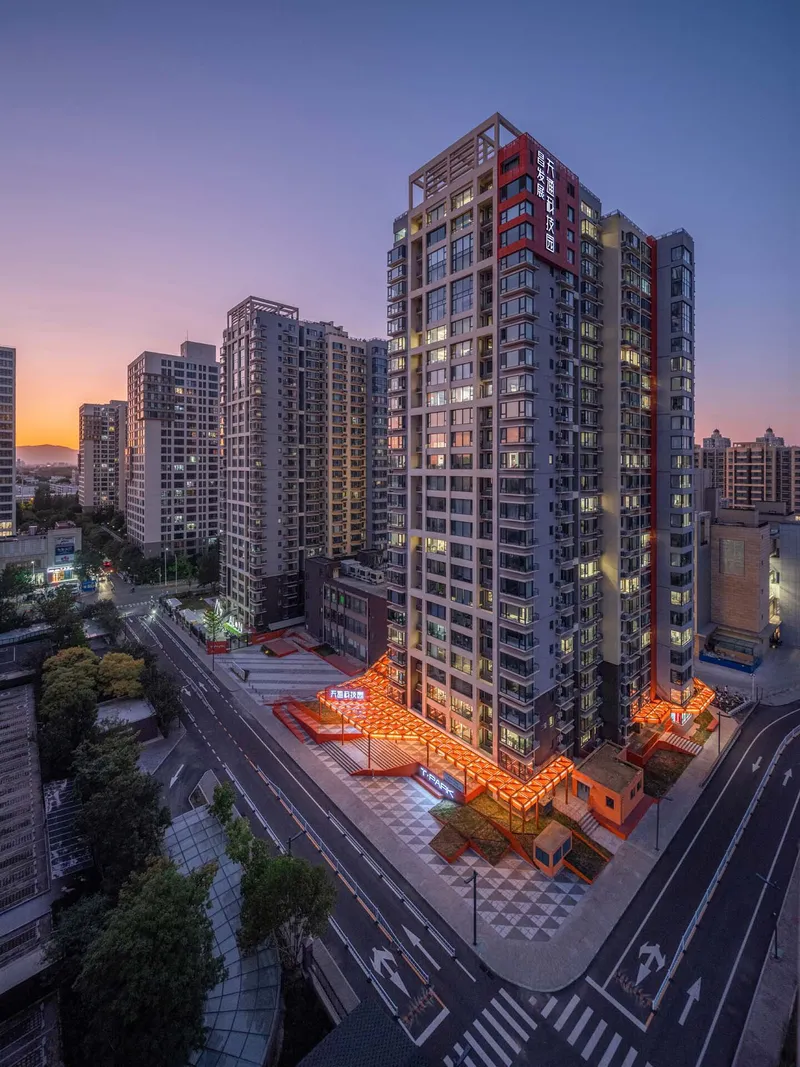
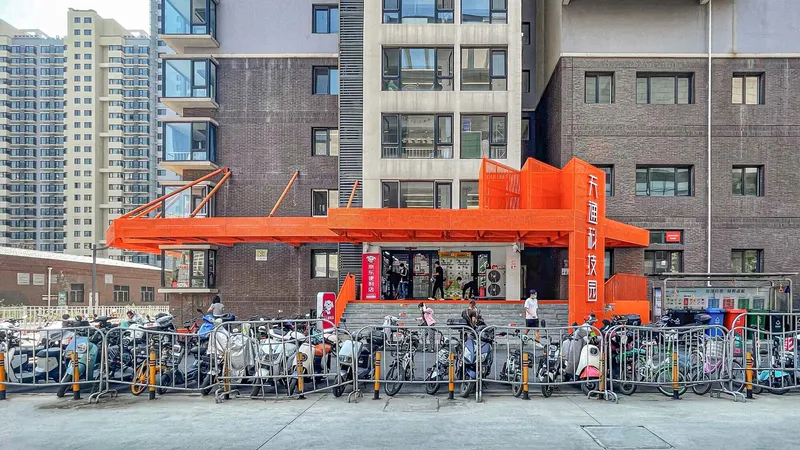
In a landscape of beige and grey residential slabs, color does real work. The angled orange steel canopy that wraps the base of the tower is the most visible intervention and the most strategic one. It shelters a new public plaza, marks the building entrance, and broadcasts from a distance that something here is different. The canopy is not decorative; it creates a covered threshold between the residential courtyards and the building's ground-floor amenities, functioning as a piece of urban infrastructure for a neighborhood that has almost none.
The geometry is deliberately angular, cutting diagonally across the paved forecourt and stepping over a bicycle parking area. It reads less like a corporate gesture and more like a neighborhood pavilion, which is exactly the tone the project needs to strike in a context where residents might otherwise resist a commercial intrusion.
Filtered Light and Shadow Play
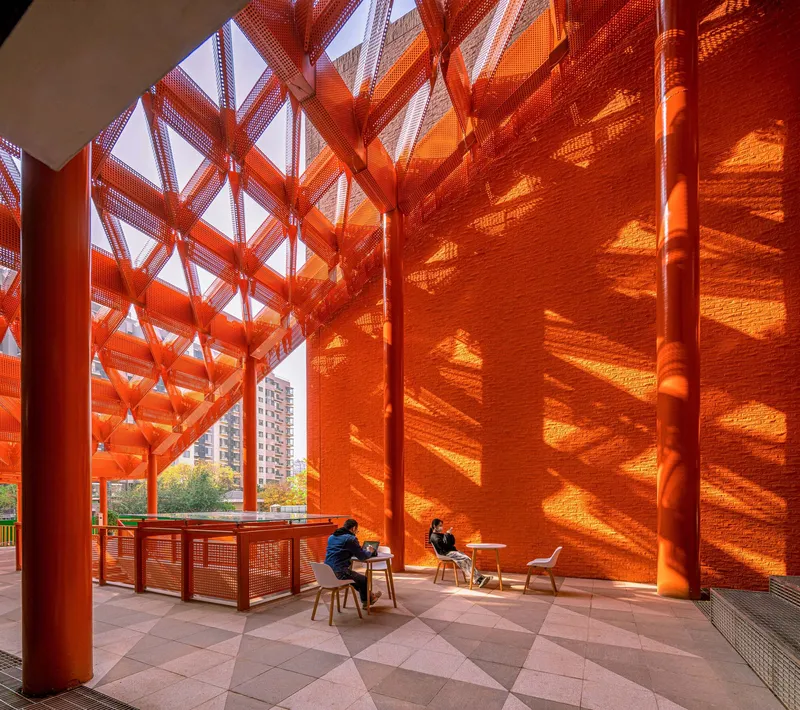
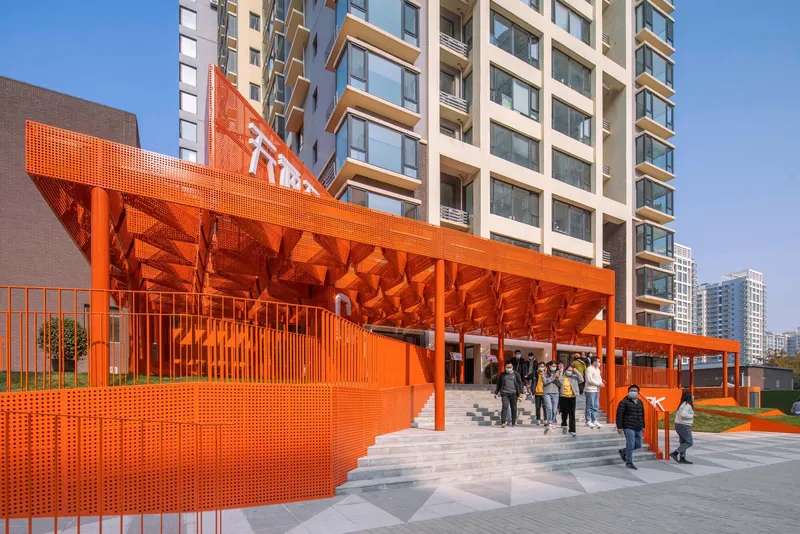
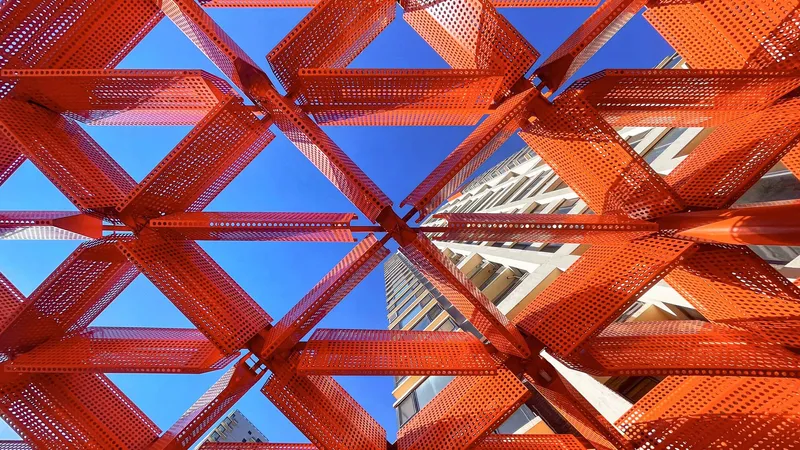
The perforated steel panels that form the canopy's skin produce a constantly shifting field of shadow on the ground plane. In direct sun, the coffered underside casts geometric patterns across the tiled floor and the people beneath it. The effect is both practical, reducing solar gain at the building's base, and atmospheric, giving the plaza a quality of dappled enclosure. It is a simple move, but it transforms what would otherwise be leftover hardscape into a space people actually linger in.
Looking straight up through the lattice framework reveals the canopy's structural clarity: a grid of steel members supporting panels with varying perforation densities. The orange finish is consistent but the light it transmits is not, creating depth where there might only be flatness.
Before and After: Reading the Existing Condition
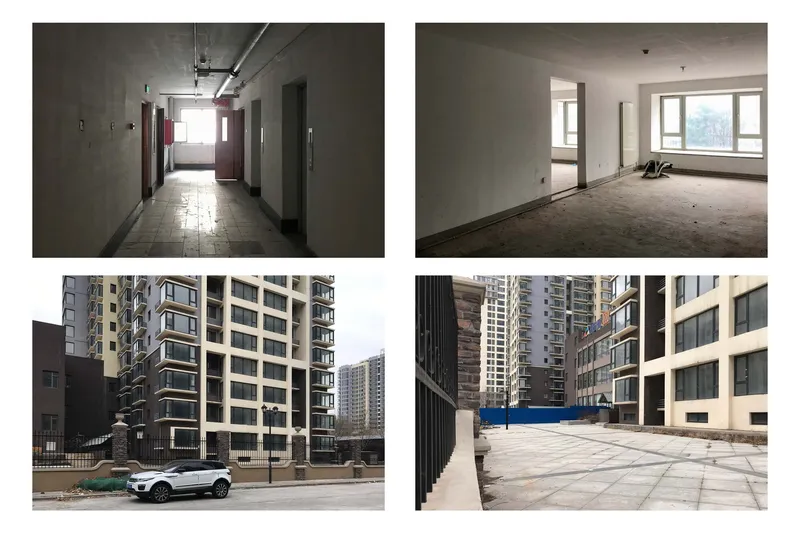
The pre-renovation photographs are telling. Bare concrete corridors, empty rooms, residential facades repeating endlessly: this is the raw material People's Architecture Office had to work with. The building was structurally sound but spatially monotonous, organized around the cellular logic of apartment units sized for individual families. Converting that into flexible office space required not just removing walls but rethinking how people move through the building altogether.
The dusk view of the completed tower reveals how little the exterior massing has changed. The orange canopy at the base is the only significant volumetric addition visible from outside. The real transformation is internal, which is both the project's constraint and its argument: you do not need to demolish and rebuild to radically change a building's purpose.
The Interior: Domestic Scale, Office Program
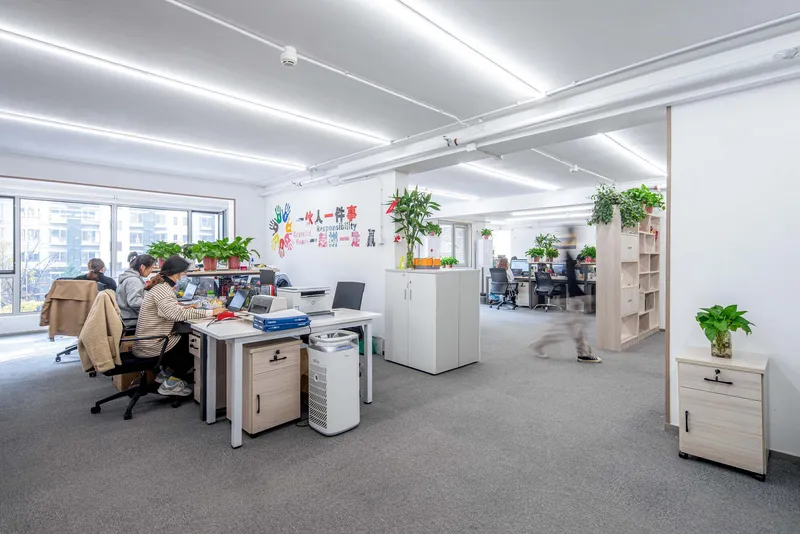
The typical office floors retain something of the residential tower's grain. Ceiling heights are modest, structural beams are left exposed, and the open-plan workspaces are broken up by generous potted plants that domesticate the environment. There is no attempt to pretend this is a purpose-built commercial building. Instead, the design leans into the intimacy of the original structure, creating workspaces that feel more like a co-working loft than a corporate floor plate.
Ground-floor and basement levels house shared amenities: meeting rooms, a cafeteria, a gym, a market, and a cafe. These are conceived as community resources, not just tenant perks. The idea is that the building serves the neighborhood even for residents who do not work inside it, blurring the line between office and public facility in a district that desperately needs both.
The Urban Argument
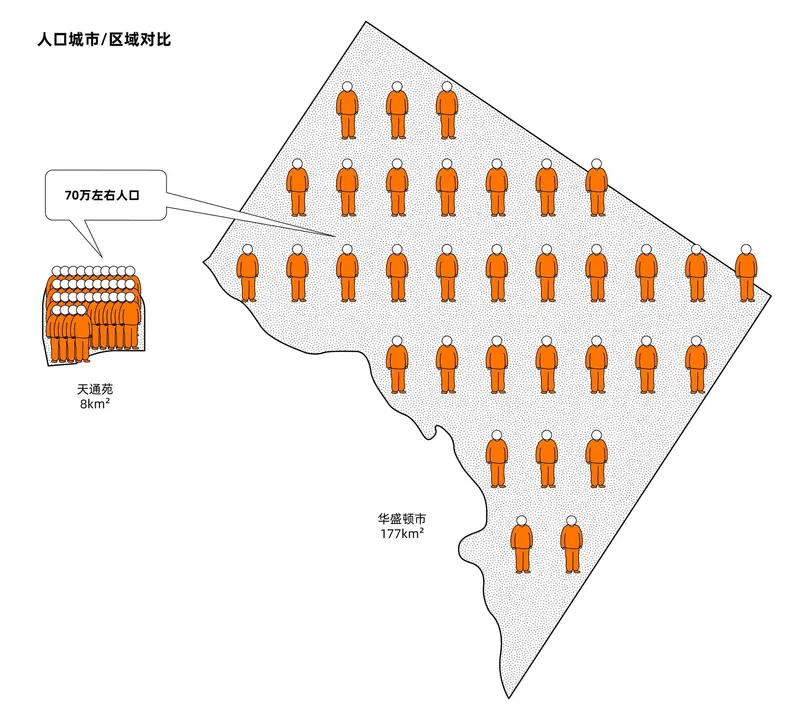
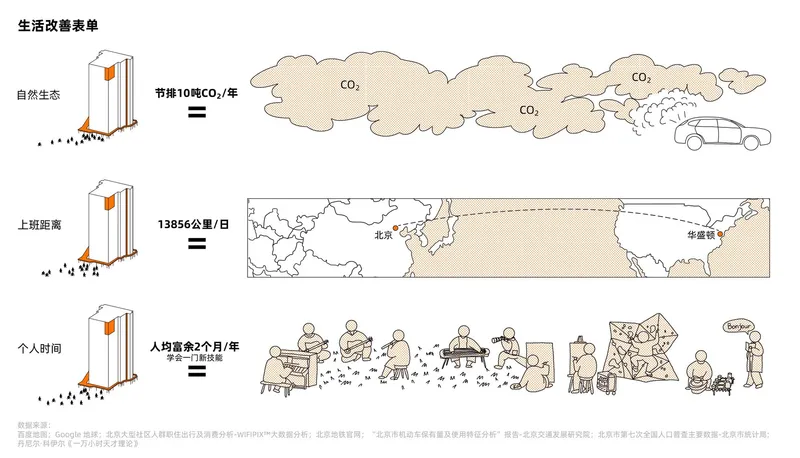
People's Architecture Office presents a clear diagrammatic case for the conversion. The population density comparison illustrates the absurdity of Tiantong Yuan's condition: hundreds of thousands of residents packed into a district with virtually no employment. The carbon emissions diagram goes further, comparing three scenarios of building occupancy and arguing that enabling local work reduces commuting pollution and activates dormant community life during daytime hours.
These diagrams are not decorative. They reveal the project's ambition to be a model, not a one-off. If vacant residential buildings across Beijing's sleeping cities can be converted rather than demolished, the environmental and social payoff scales quickly. The Home Office Tower is a proof of concept, and People's Architecture Office is explicit about wanting it replicated.
Plans and Drawings
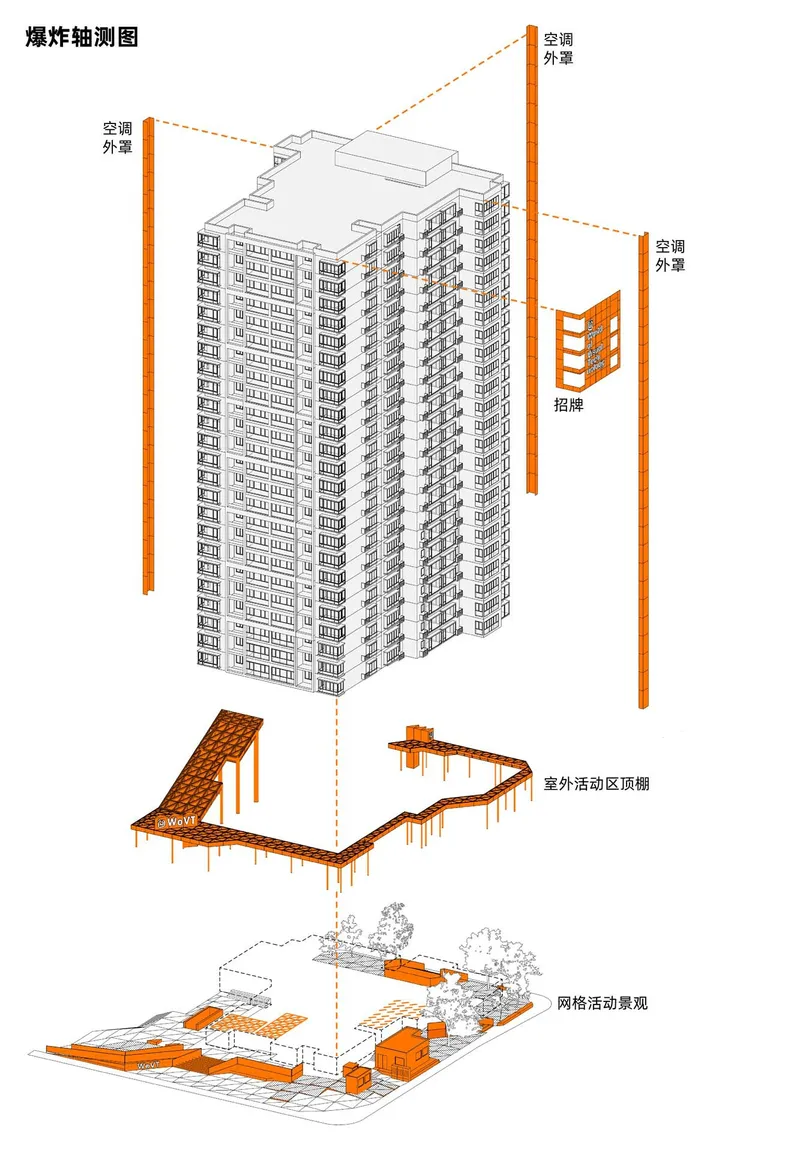
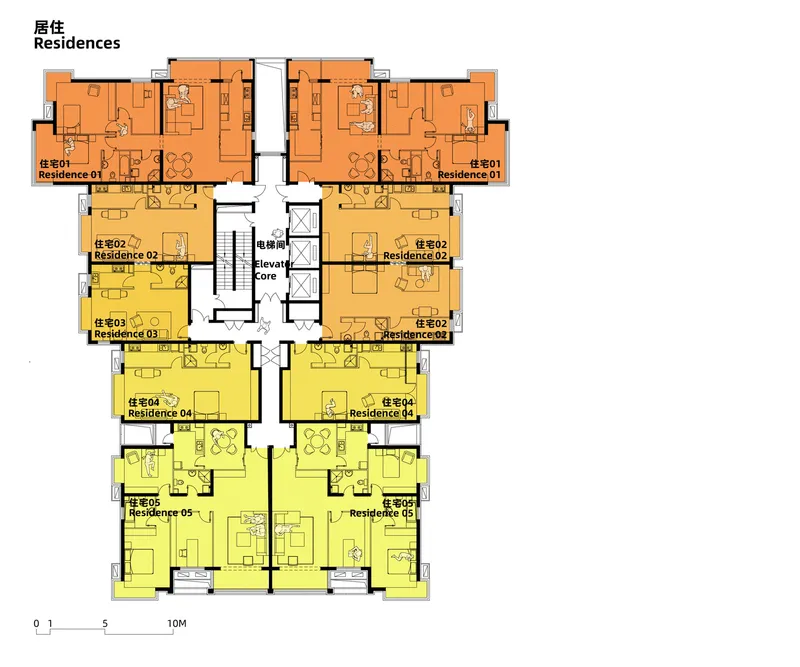
The axonometric drawing reveals the project's spatial strategy in section: the structural cores remain intact while the podium base and surrounding landscape receive the most intensive redesign. The original floor plan shows the familiar logic of residential units clustered around a central elevator core, with color-coded unit types that underline the repetitive cellular organization the architects had to work against.
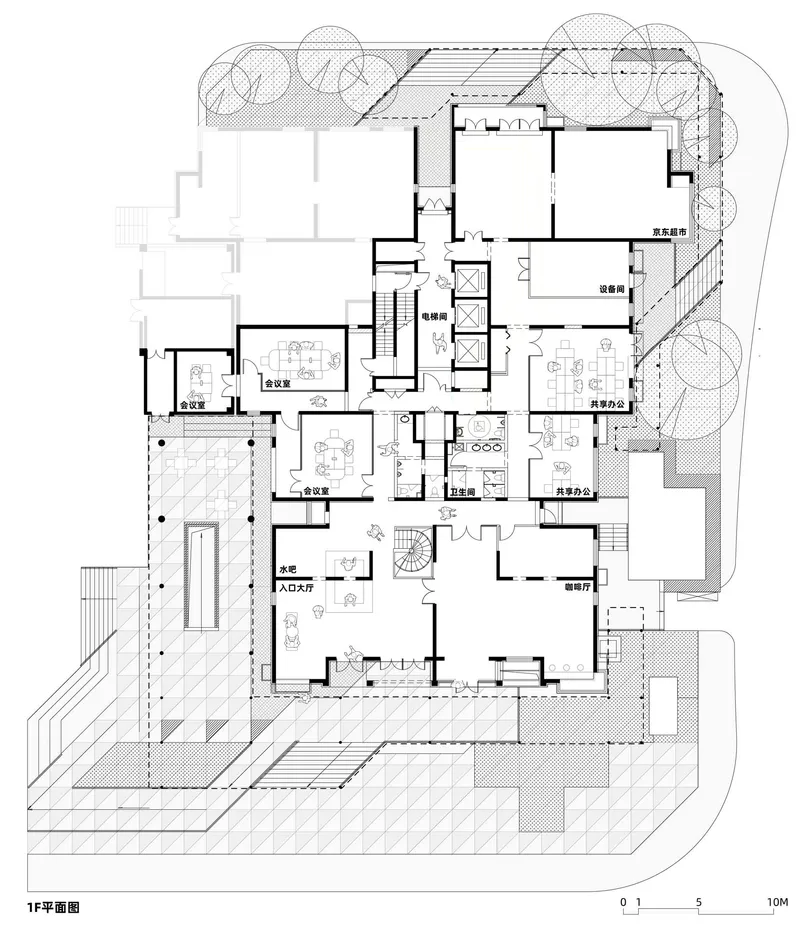
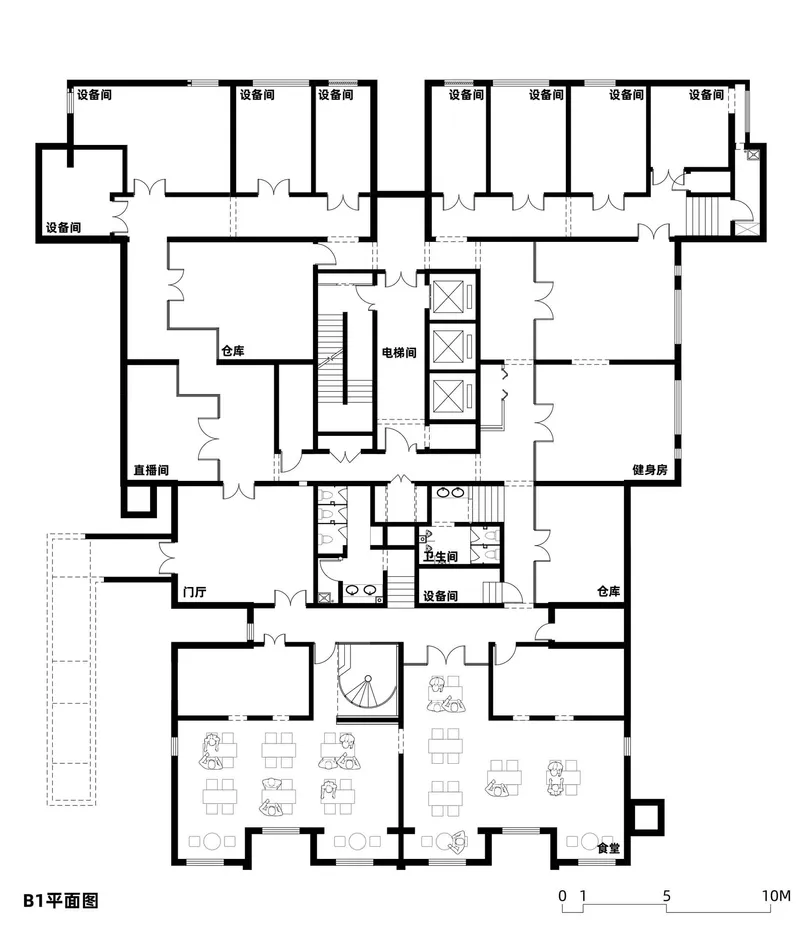
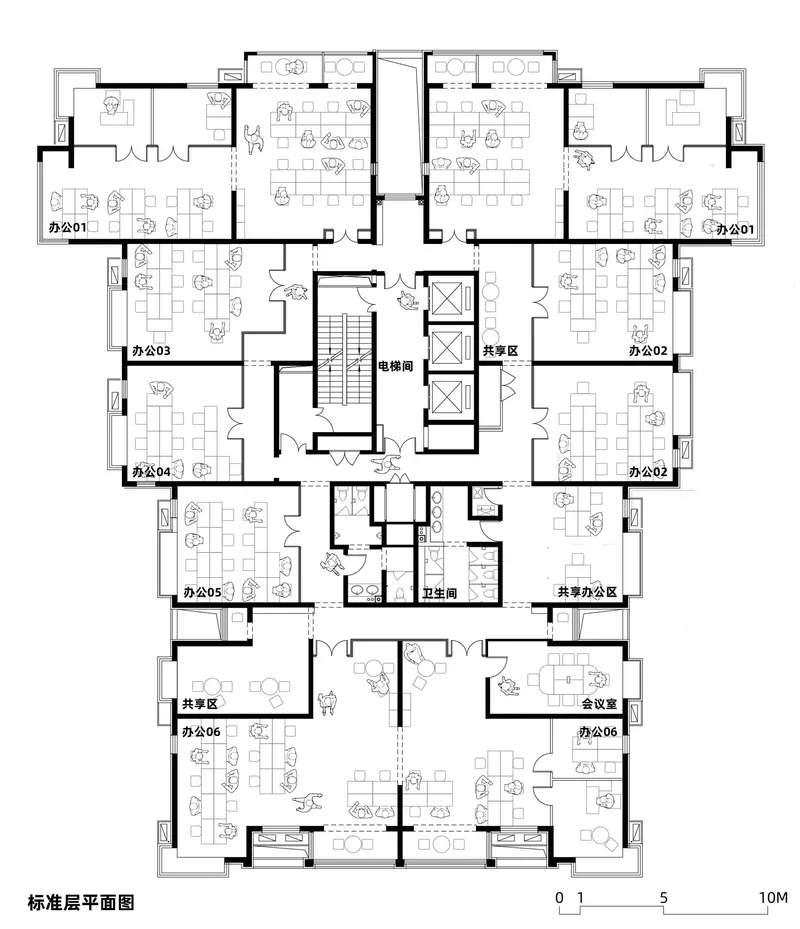
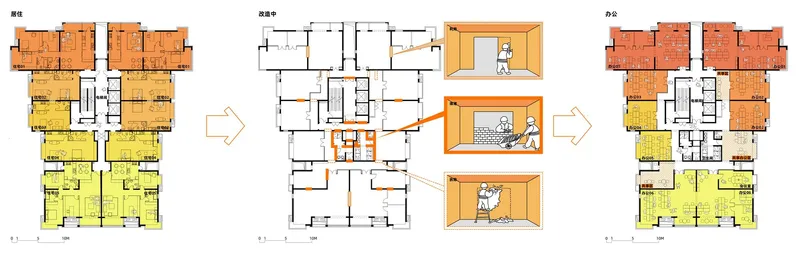
The transformation sequence from apartments to flexible shared spaces is the project's most instructive drawing. Walls are selectively removed to create the ring-shaped circulation loop, while shared restrooms and common areas are carved from enclosed spaces that were formerly private. The basement plan shows the amenity program clearly: shared workspaces, equipment rooms, and gathering areas organized around the central core. On typical upper floors, office units with furniture layouts demonstrate how the residential module is reinterpreted at a slightly larger grain.
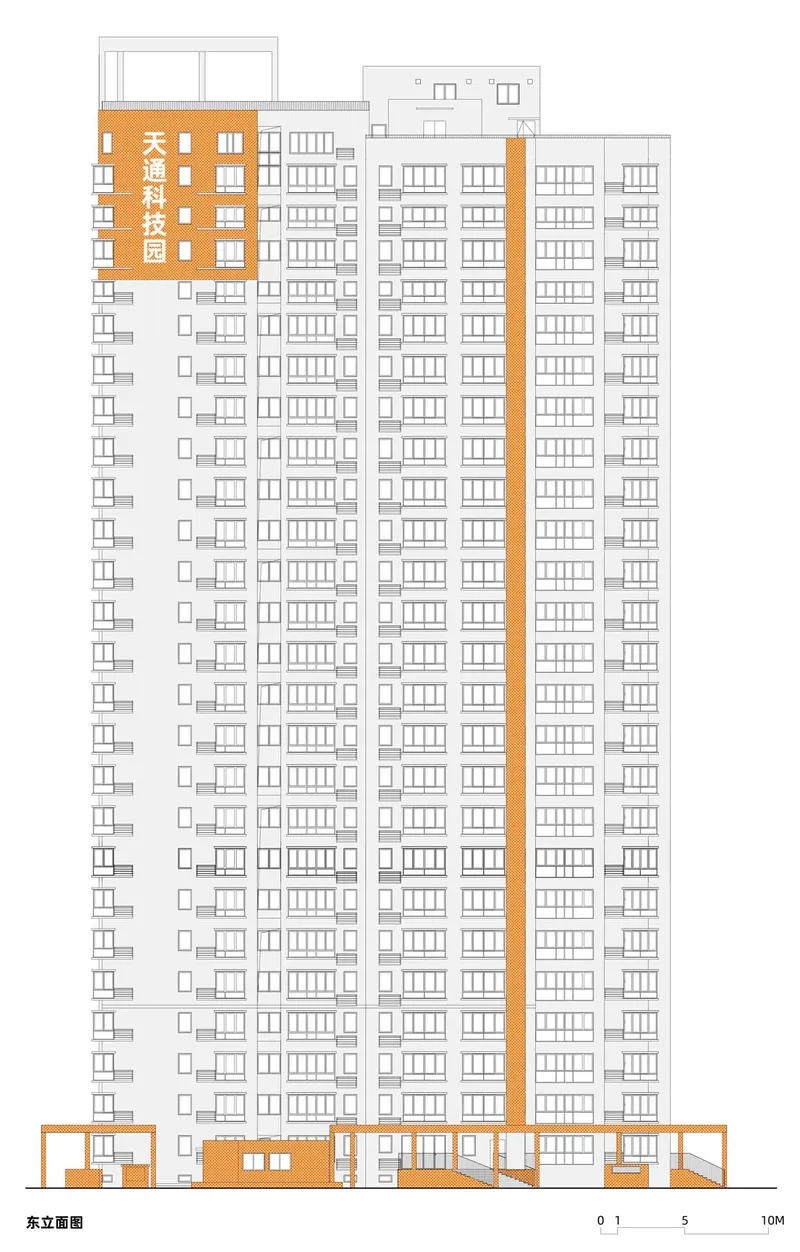
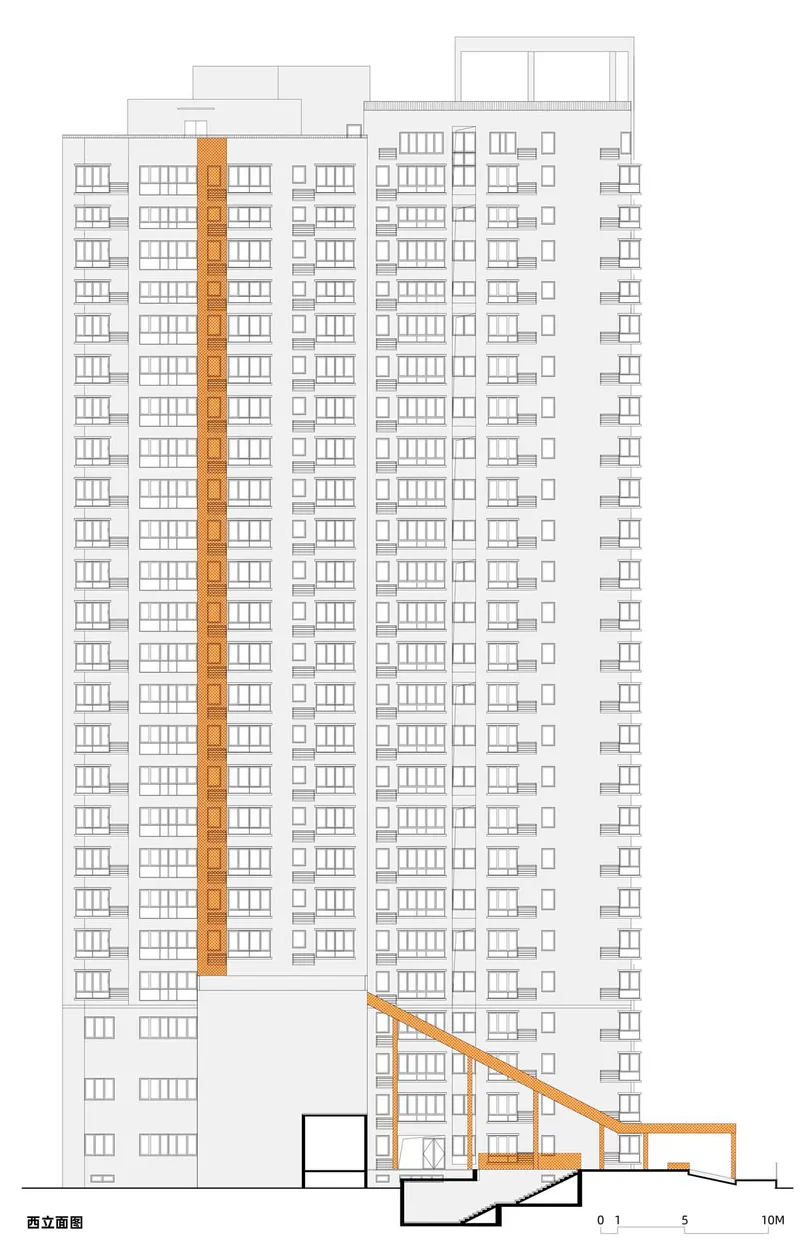
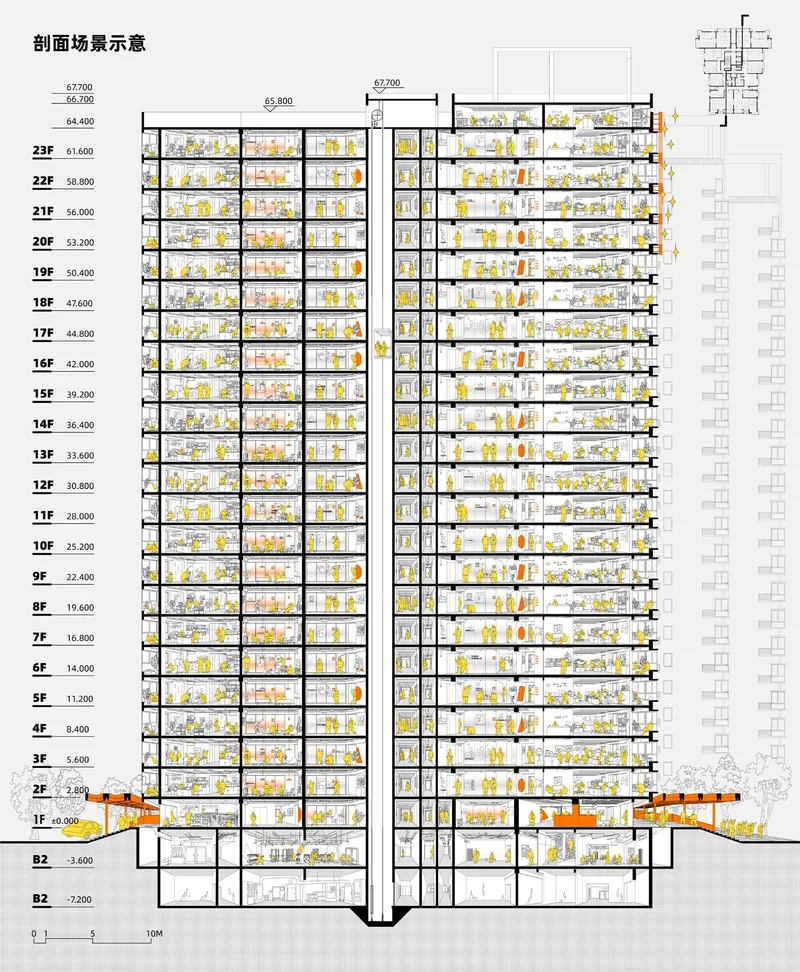
The elevation drawings highlight the ground floor and rooftop interventions in orange, making visible how restrained the external modifications actually are. The section is the most revealing: floor plates remain at their original residential heights, while yellow-accented amenity spaces are distributed vertically through the tower, and a diagonal orange circulation element connects the lower floors to the podium. The building reads as a residential tower with strategic insertions rather than a wholesale transformation, which is precisely the point.
Why This Project Matters
The Home Office Tower matters because it addresses a problem that most architecture avoids. Beijing's sleeping cities are not a design failure in the aesthetic sense; they are a planning failure in the systemic sense. Millions of people live in neighborhoods with no employment, generating enormous commuting burdens and leaving vast tracts of built area idle during the day. People's Architecture Office did not solve this problem with a single building, but they demonstrated that the solution does not require demolition, new land, or heroic engineering. It requires rethinking what an existing building can become.
The project's most important contribution is its replicability. The conversion strategy is legible, the structural interventions are minimal, and the orange canopy provides a template for signaling civic identity without excessive cost. If Beijing's Huitian Plan produces more projects like this, the cumulative effect on commuting patterns, carbon emissions, and neighborhood vitality could be significant. The Home Office Tower is not a landmark. It is a prototype, and that is more useful.
Home Office Tower, designed by People's Architecture Office with interiors by Reigo & Bauer. Located in Tiantong Yuan, Beijing, China. 22,210 m². Completed in 2021. Photography by Weiqi Jin.
About the Studio
Share Your Own Work on uni.xyz
If projects like this are the kind of work you want to make, uni.xyz is a place to publish your own, find collaborators, and enter design competitions.


Popular Articles
Popular articles from the community


Cube Design Draws an Ecological Corridor Between Two Shenzhen Hills with the Nankai Building
Beside Shenzhen's container docks, the Nankai Building pairs stacked balconies with a climbing green screen to connect two hillsides across its height.


Aquadapt: An Underwater Habitat That Rewrites Its Rooms by the Hour
Curved modules ring the seabed while one shell shifts from breakfast room to cinema, farm and football pitch as residents' needs change.

Singing Woman: An Opera House That Performs Before the Curtain Rises
Ovidiu Cristian Pavel's conceptual opera house translates Estonia's choral identity into a sculpted waterfront landmark facing the Baltic Sea.

David Ortega Stacks a Two-Story Mexico City Penthouse Around a Steel Stair and a Pergola-Shaded Roof Terrace
In Colonia Roma, a 300 m² penthouse uses oak joinery, a planted steel stair and a slatted roof pergola to make a new-build apartment feel like a house.

Similar Reads
You might also enjoy these articles

LAVA Architecten Gives Vocational Education a Sawtooth-Roofed Face on a Mechelen School Campus
In Mechelen, Belgium, a 2,053 m² STEM school on a 6×6 m grid turns workshops and classrooms into rooms that can be rearranged as teaching changes.

KEMA Studio Turns a Derelict Marvila Attic into a 60 m² Lighthouse Apartment Above Lisbon
In Lisbon's Marvila district, a rebuilt roof, four skylights and two plywood volumes turn an unlivable attic into a bright home facing the Tagus.

Pixel Gardens: One Repeated Module Stacked Into a Terraced Social Housing Tower for Famagusta
Salem Bader's shortlisted housing tower builds a vertical neighbourhood from one repeated module, offsetting units to carve terraces, light and air.

Bao Huynh Watercolor Atelier: A Serene Art Retreat in Hội An
Bao Huynh Watercolor Atelier in Hội An blends multifunctional art spaces, sustainable design, local materials, and family-friendly living in a serene environment.

Explore Office Building Competitions
Discover active competitions in this discipline

Comments (0)
Please login or sign up to add comments
No comments yet. Be the first to comment!