
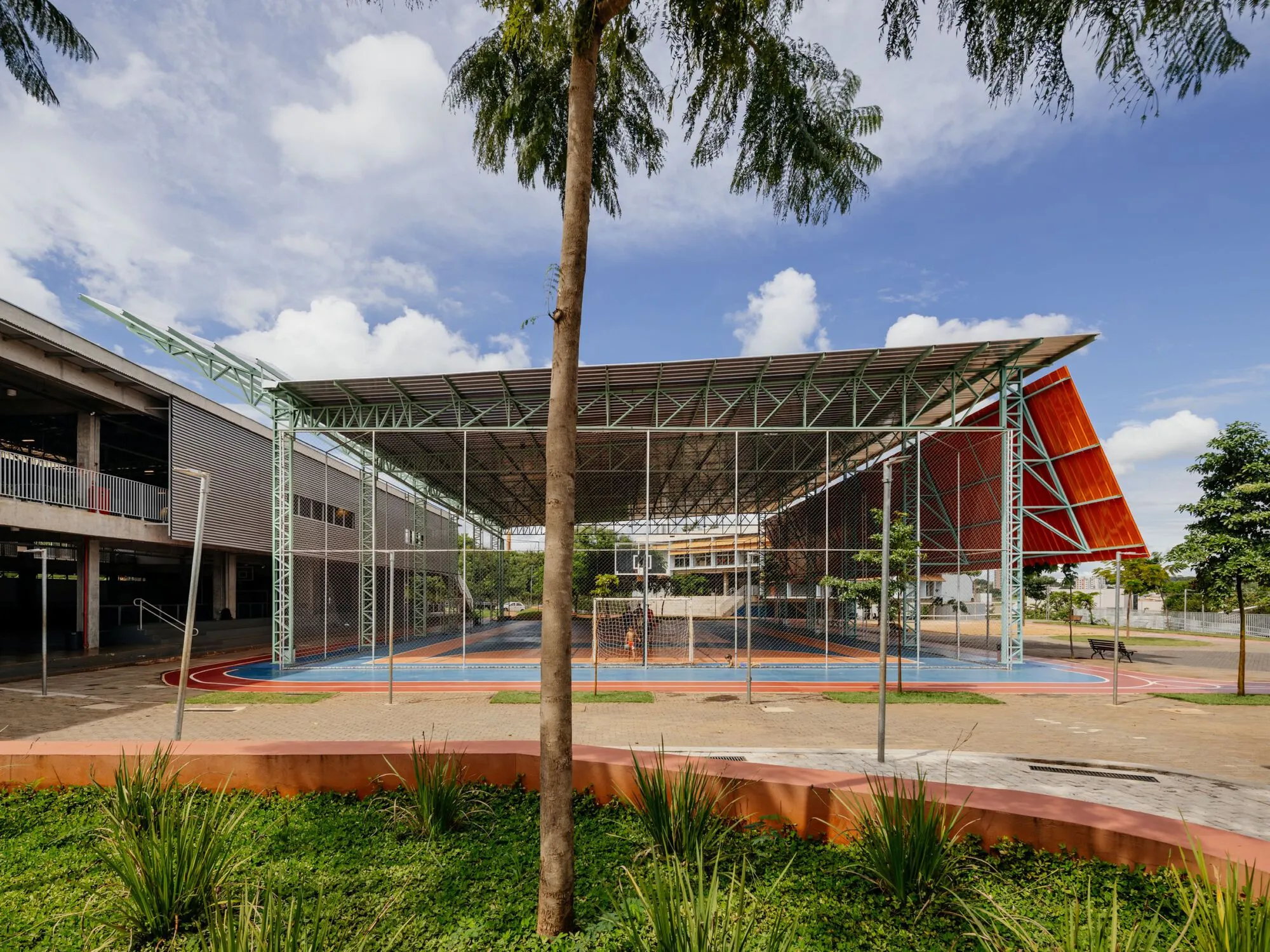
A Schoolyard Canopy That Holds Its Own Sky
Ricardo Gusmão Arquitetos wraps a sports court in orange steel and green trusses, giving a Ribeirão Preto campus a bold new civic heart.


Schools in Brazil's interior often grow incrementally, adding classrooms and corridors as enrollment rises, until the campus reads like a timeline of pragmatic decisions. What rarely gets the same investment is the space between buildings: the courts, gathering areas, and covered walkways that actually shape how students experience their day. At Pequeno Príncipe School in Ribeirão Preto, Ricardo Gusmão Arquitetos took the opportunity of an expansion to do exactly that, centering the project on a covered sports court and courtyard sequence that functions as the campus's new social and spatial anchor.
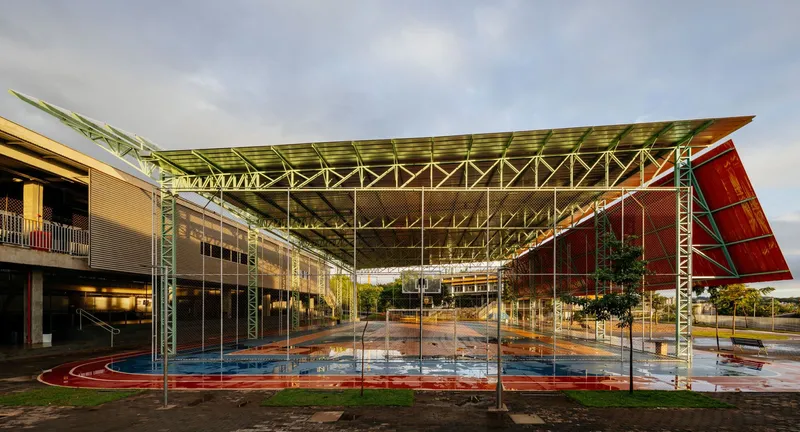
The result is an 835 square meter intervention that reads as both infrastructure and architecture. A large trussed canopy shelters the court without sealing it off from the sky, while an orange corrugated metal skin wraps the volume with enough visual punch to announce itself against the flat agricultural landscape surrounding the school. It is, at once, utilitarian and unapologetically expressive.
Orange Signal in a Green Field
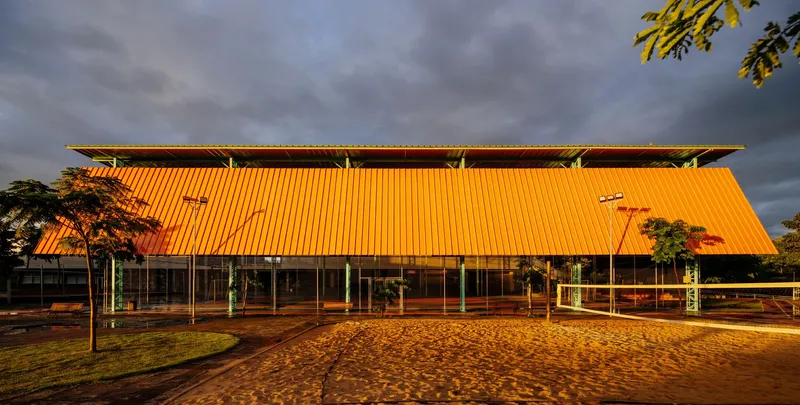
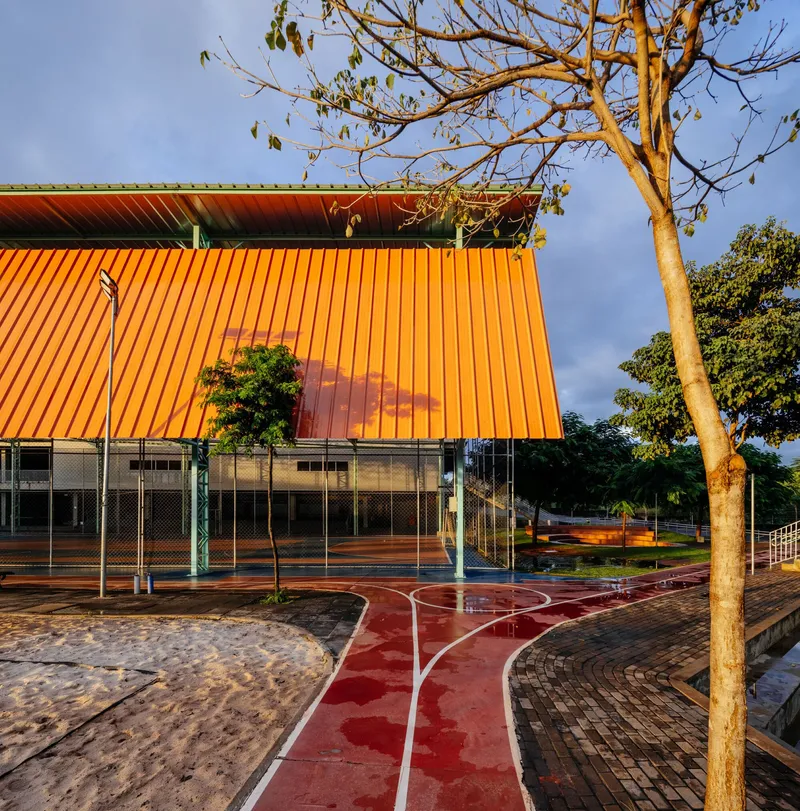
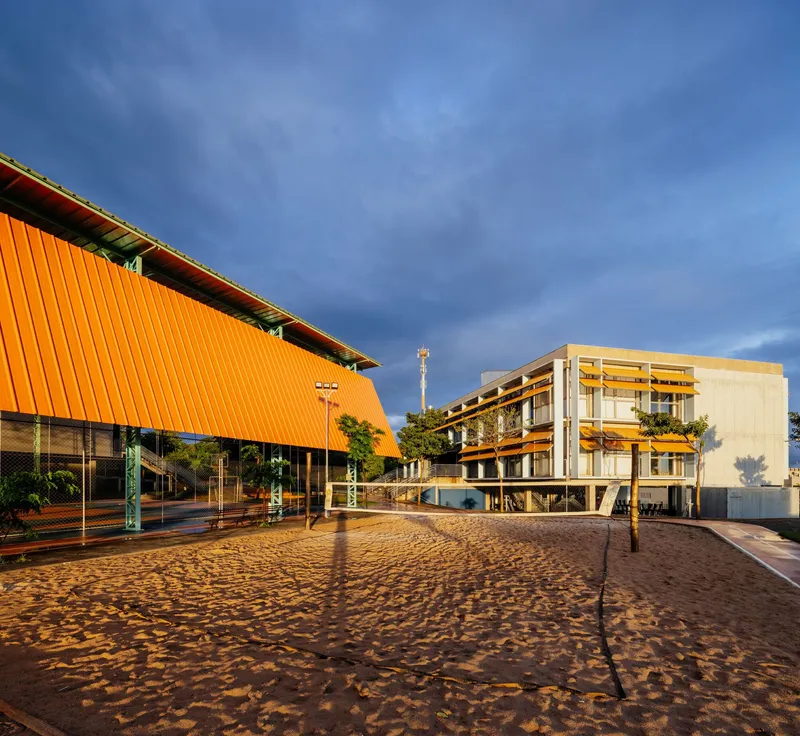
The most immediate thing the project does is declare itself. That orange corrugated facade is not a shy material choice. Against the pale concrete of the existing classroom blocks and the wide, flat farmland visible from above, it operates as a territorial signal: this is where the life of the campus concentrates. The color deepens at golden hour, when the metal catches low sun and the building glows like a lantern at the edge of the school grounds.
Mesh screens below the corrugated panels offer ventilation while filtering views and light, keeping the interior from overheating in Ribeirão Preto's subtropical climate. It is a practical move dressed in a bold finish, and it works precisely because the architects refused to separate those two concerns.
Structure as Spectacle
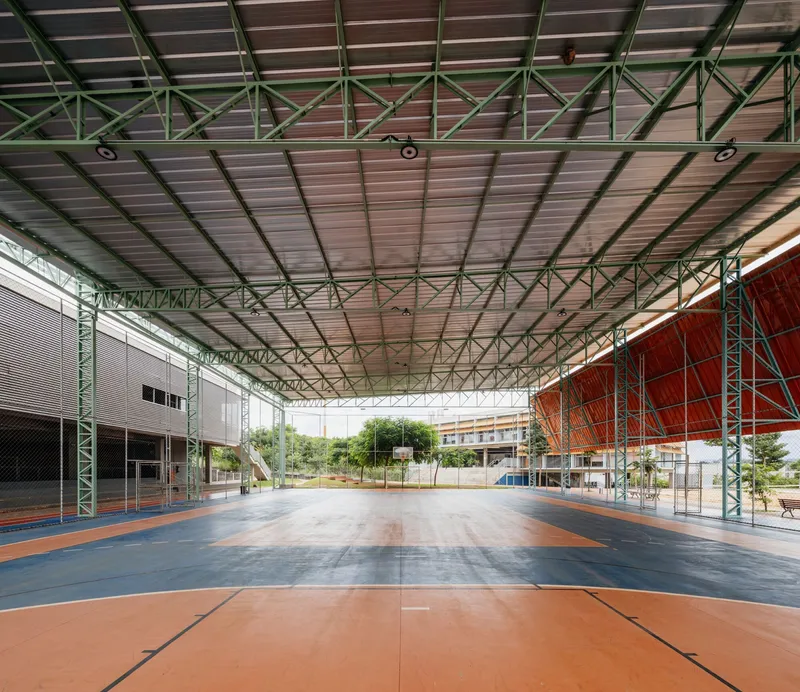
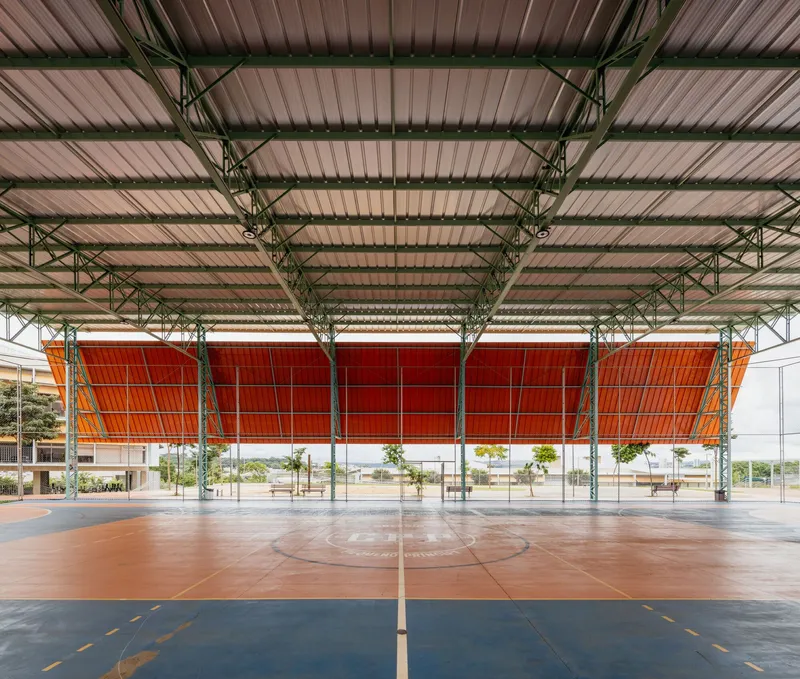
Look up inside the court and the structure tells you everything about how the building works. Green tubular steel trusses span the full width, carrying a metal deck roof with minimal visual clutter. The decision to leave the steelwork exposed and paint it a saturated green gives the canopy an almost festive legibility. Every beam, every diagonal, every connection is on display, turning the ceiling plane into an impromptu lesson in structural logic.
The columns are slender enough to keep sightlines open from the surrounding walkways and courtyard, which means the court never feels like a sealed box. On rainy days, when the paving is wet and the sky turns heavy, the underside of the canopy becomes a vast sheltered gathering space, something closer to a covered plaza than a gymnasium.
The Courtyard as Campus Core
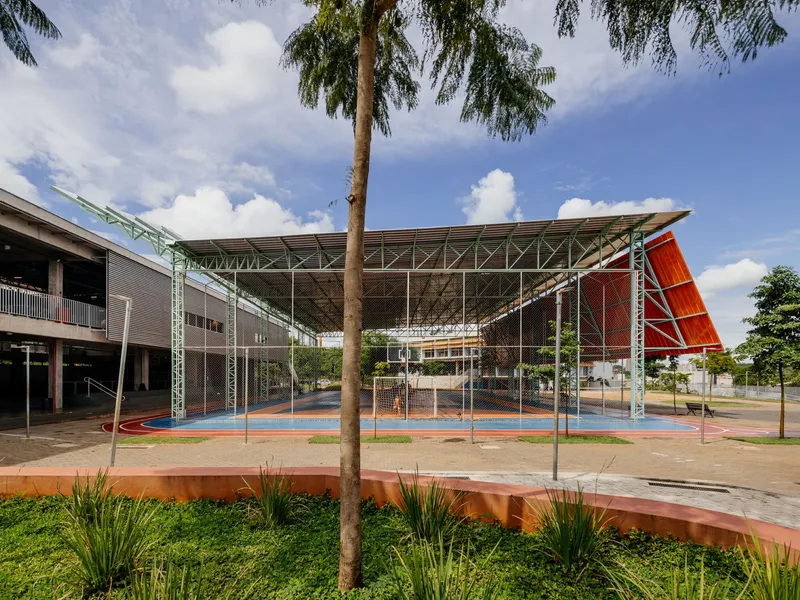
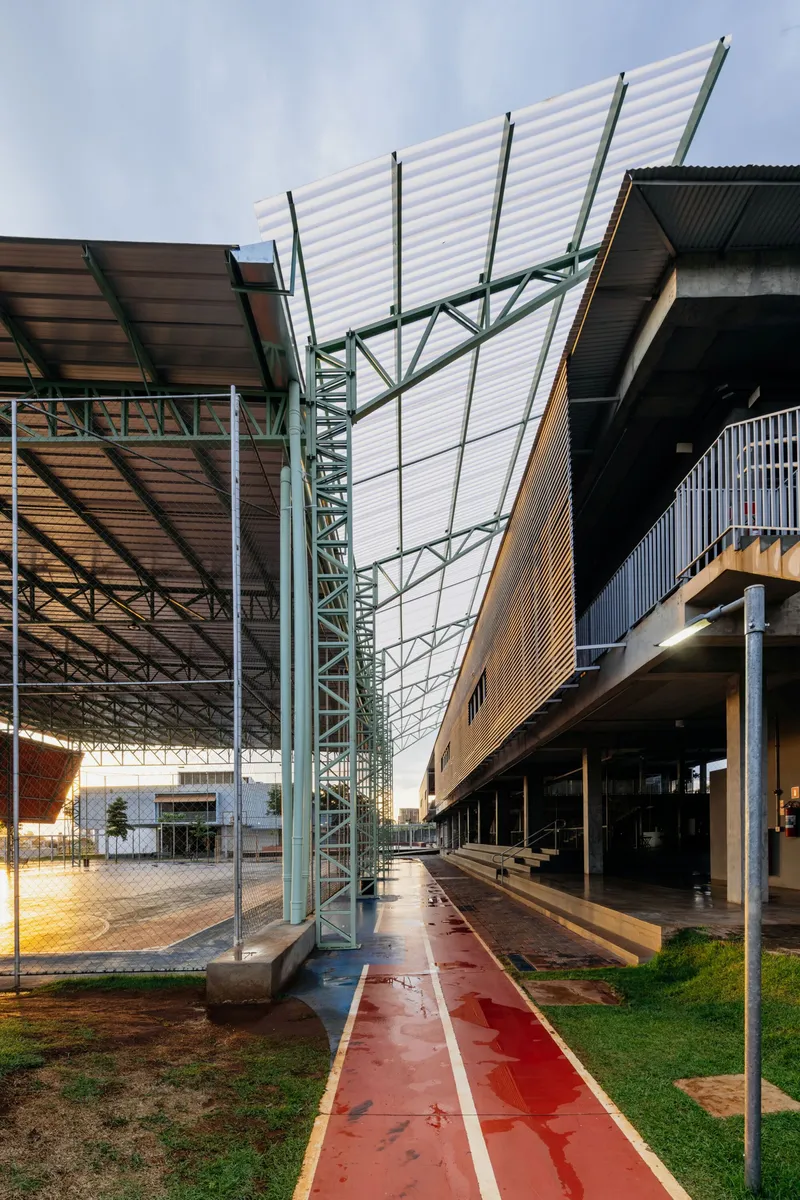
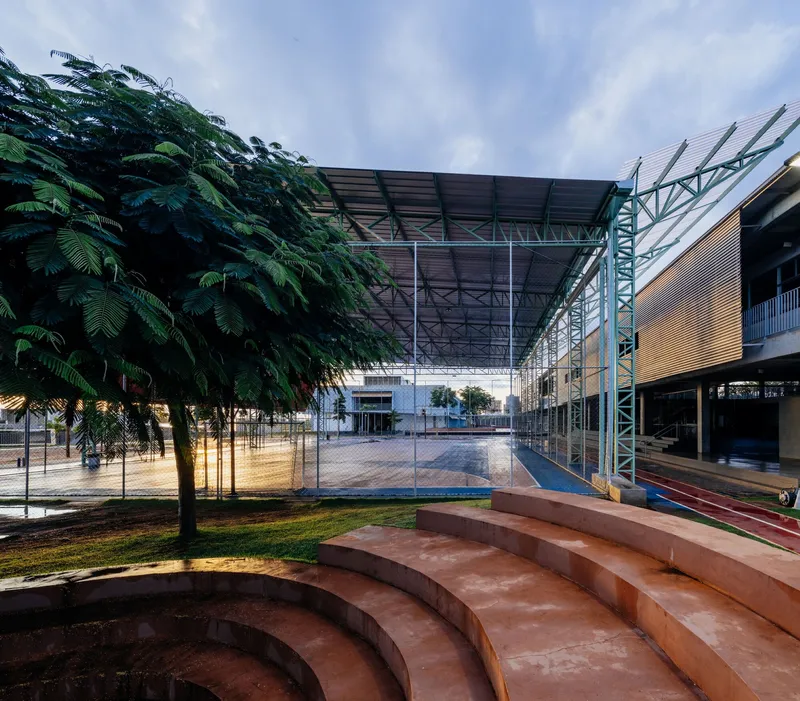
Beyond the court itself, the project reconfigures how circulation and pause happen across the campus. A central courtyard, framed by palm trees and planting beds, sits between the new canopy and the existing buildings. It is a decompression zone: shaded, planted, scaled for conversation rather than competition. The covered walkway alongside it, with its angled white corrugated canopy on green steel supports, connects old and new without forcing a single architectural language onto the whole.
At one edge, curved amphitheater steps in red-pigmented concrete step down toward the courtyard, creating informal seating that doubles as a threshold between levels. It is a simple topographic gesture, but one that gives students a reason to stop and gather rather than just pass through. The tropical planting softens the hard geometry and brings biological time into a composition otherwise defined by steel and concrete.
Campus in Context
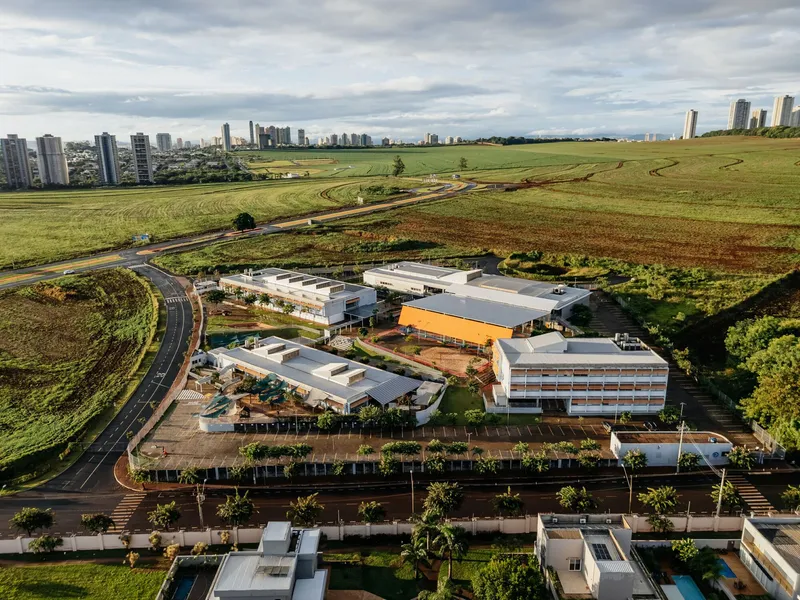
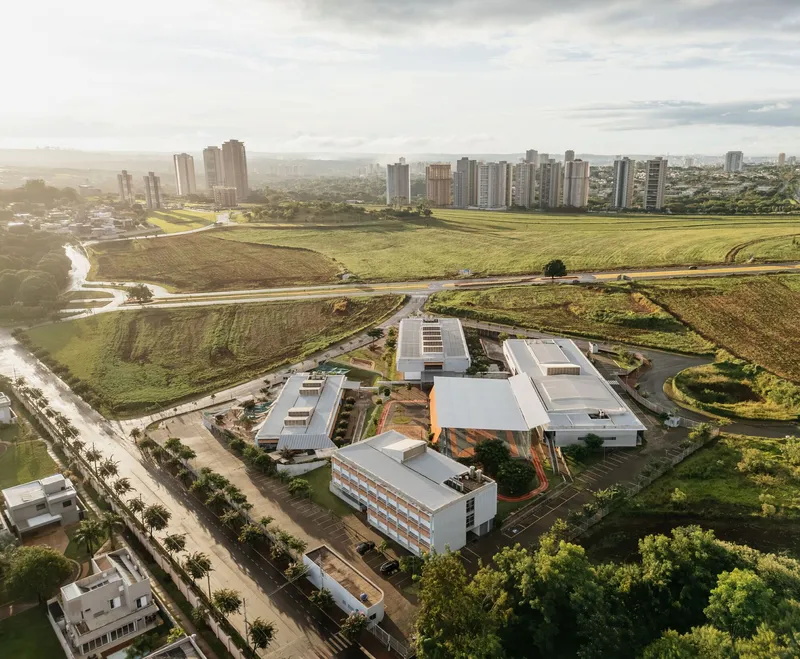
The aerial views reveal how isolated the campus is within its agricultural surroundings. White roofs stretch out in rectangular blocks, and the orange canopy reads as the single element of chromatic intensity in a landscape of green and beige. This is not a school embedded in a dense urban fabric; it has to generate its own sense of place. The court and courtyard do that work, creating a gravitational center that the rest of the campus organizes itself around.
From above, the arrangement is legible and rational. Buildings define edges, the sports field occupies the middle, and the new intervention stitches the composition together without competing with the existing structures for attention. The orange roof is a counterpoint, not a replacement.
Plans and Drawings
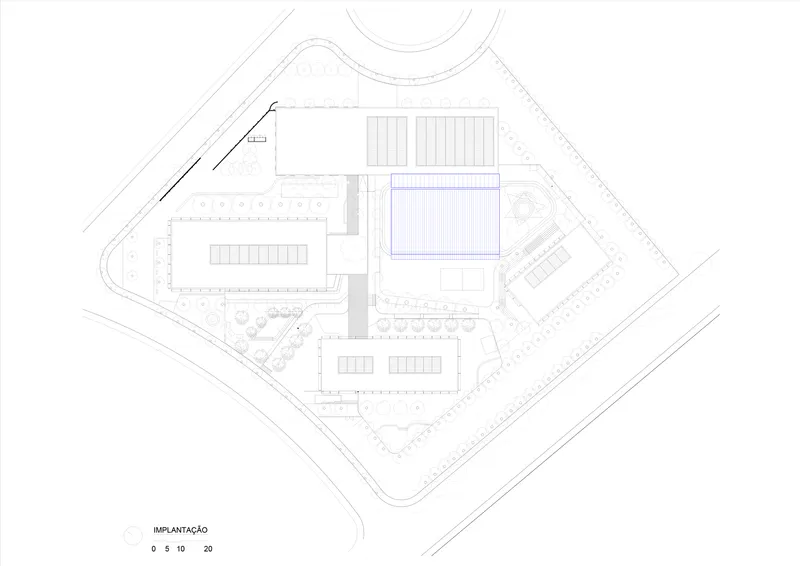
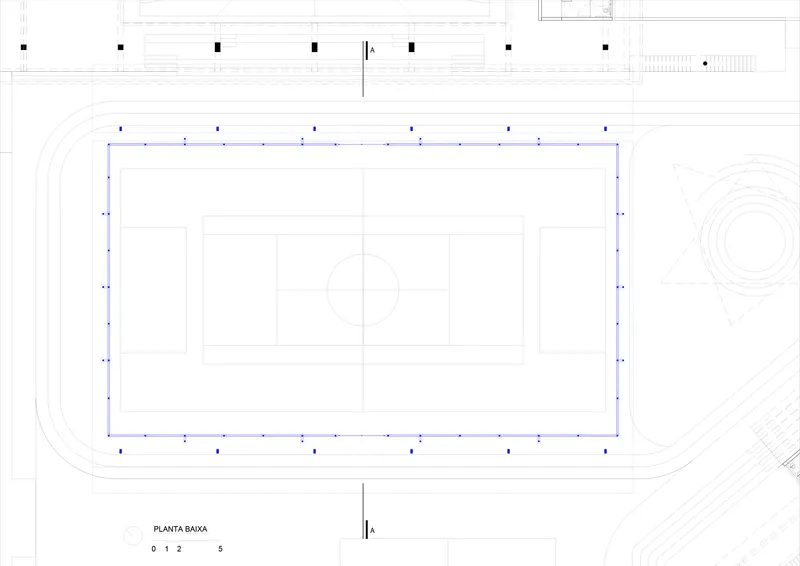
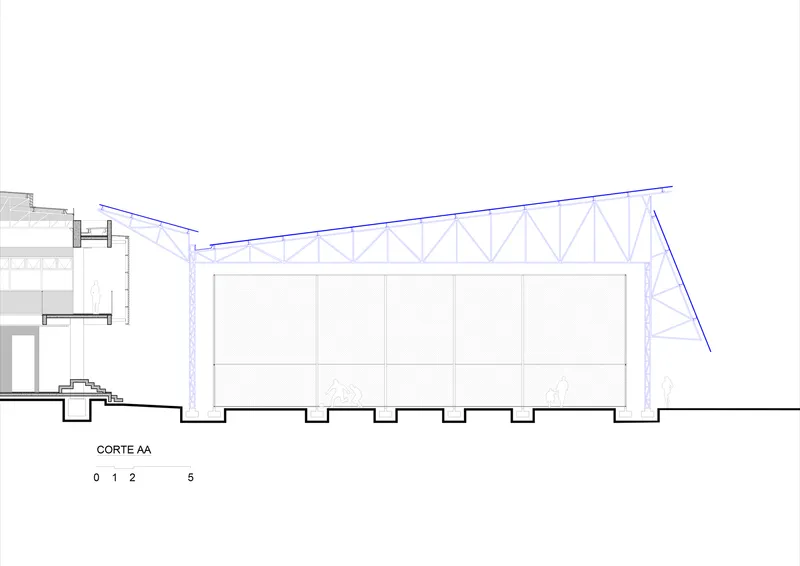
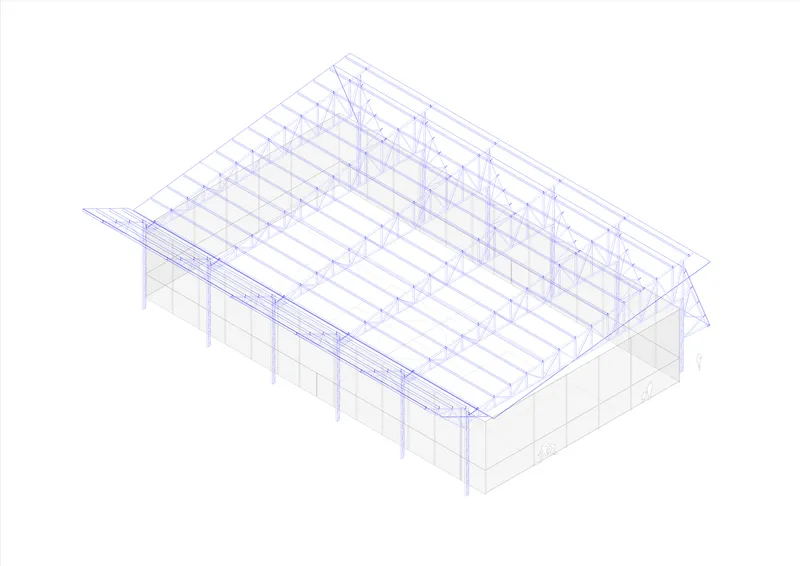
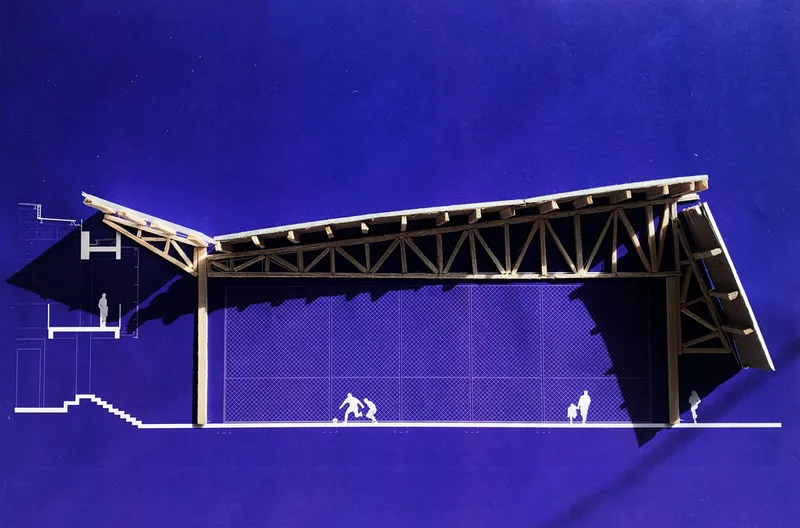
The site plan confirms the campus's orthogonal discipline, with rectangular volumes arranged around the central sports field. The floor plan shows the running track looping around the court, flanked by support spaces that tuck neatly against the perimeter. In section, the relationship between the multi-story classroom block and the single-height trussed hall becomes clear: the school steps down in scale as it approaches the court, allowing the canopy's generous span to dominate without being overshadowed by taller neighbors.
The axonometric drawing is particularly revealing, isolating the structural frame to show how timber trusses and a gridded roof support system distribute loads across the wide span. The rendered twilight section, with its purple field wall and silhouetted figures, does something more atmospheric: it captures the feeling of the space at the end of a school day, when the structure becomes a backdrop for informal occupation rather than organized sport.
Why This Project Matters
School sports courts are often treated as pure engineering problems: span the distance, keep the rain off, move on to the next line item. What Ricardo Gusmão Arquitetos accomplished here is a refusal of that logic. By treating the court as an architectural project rather than a construction task, they produced a space with genuine civic presence on a campus that needed exactly that kind of anchor. The color, the exposed structure, the courtyard sequence: none of it is strictly necessary, and all of it is what makes the project worth paying attention to.
For schools growing in Brazil's interior, the lesson is straightforward. The spaces between classrooms matter as much as the classrooms themselves. A covered court can be more than shelter. It can be the place where a campus finds its identity.
Pequeno Príncipe School Court by Ricardo Gusmão Arquitetos. Ribeirão Preto, Brazil. 835 m². Completed 2025. Photography by Manuel Sá.
About the Studio
Share Your Own Work on uni.xyz
If projects like this are the kind of work you want to make, uni.xyz is a place to publish your own, find collaborators, and enter design competitions.




Popular Articles
Popular articles from the community


Co-Life: Senior Housing Design That Reconnects Older Adults With the City
Co-Life reimagines senior housing design through healing gardens, shared streets, workshops, and a sustainable community across generations.

Conexión: Biophilic Design Reimagines High-Rise Living in Hong Kong
Conexión reimagines high-rise living in Hong Kong through biophilic design, green facades, shared spaces, daylight, water and nature within.

Co-life: Sustainable Architecture for Age-Friendly Community Living
Co-life reimagines sustainable architecture for seniors through courtyards, rammed earth, shared gardens, and spaces designed for belonging.

Lunar Spiral: Space Architecture Shaped by the Mathematics of the Universe
Lunar Spiral reimagines space architecture through Fibonacci geometry, lunar regolith, levitating habitats, and self-sustaining Moon living.


Similar Reads
You might also enjoy these articles

Bao Huynh Watercolor Atelier: A Serene Art Retreat in Hội An
Bao Huynh Watercolor Atelier in Hội An blends multifunctional art spaces, sustainable design, local materials, and family-friendly living in a serene environment.

Atelier Macri Concept Store Interior Design by CASE-REAL
Atelier Macri store features a "ko" counter, walnut wood details, cork displays, blending retail, gallery, and seamless customer experiences.

Manuel Vargas Izquierdo Stadium and High-Performance Sports Center: Architectural Excellence in Jalpa de Méndez
The Manuel Vargas Izquierdo Stadium blends sustainable design, inclusive sports facilities, and cultural-inspired architecture, revitalizing Jalpa de Méndez’s public spaces.

KAKR Buluh Awar Hall: Revitalizing Community and Ecology Through Bamboo Architecture
Community built bamboo hall revitalizes Buluh Awar village, empowering youth, restoring ecology, celebrating vernacular craftsmanship through sustainable architecture and culture.





Comments (0)
Please login or sign up to add comments
No comments yet. Be the first to comment!