

Perkins&Will Twists Two Volumes into a Gateway for Science at Western Washington University
A 55,000-square-foot interdisciplinary sciences building in Bellingham uses shifting floor plates and radical transparency to put STEM on display.


University science buildings tend to fall into one of two traps: they either look like sealed bunkers or try so hard to be iconic that the labs inside become afterthoughts. The Interdisciplinary Sciences Building at Western Washington University, designed by Perkins&Will, sidesteps both. Its four stories of teaching labs, active learning classrooms, and collaboration spaces are stacked as two volumes that rotate relative to each other, responding to the angle change between the older and newer campus grids. The twist is not decorative. It produces a cantilevered overhang at street level, creating a sheltered outdoor zone and framing a gateway between the sports and recreation precinct and the main campus.
What makes the project genuinely interesting is its insistence on visibility. Expansive glazing puts laboratory work on full display to passersby, corridors, and adjacent study nooks. Science is not hidden behind cinder block here; it is performed in a glass vitrine. That openness, paired with a rigorous environmental strategy involving green roofs, bioswales, and a stormwater habitat facility, makes the ISB one of the more thoughtful institutional STEM buildings completed in the Pacific Northwest in recent years.
Two Grids, One Twist

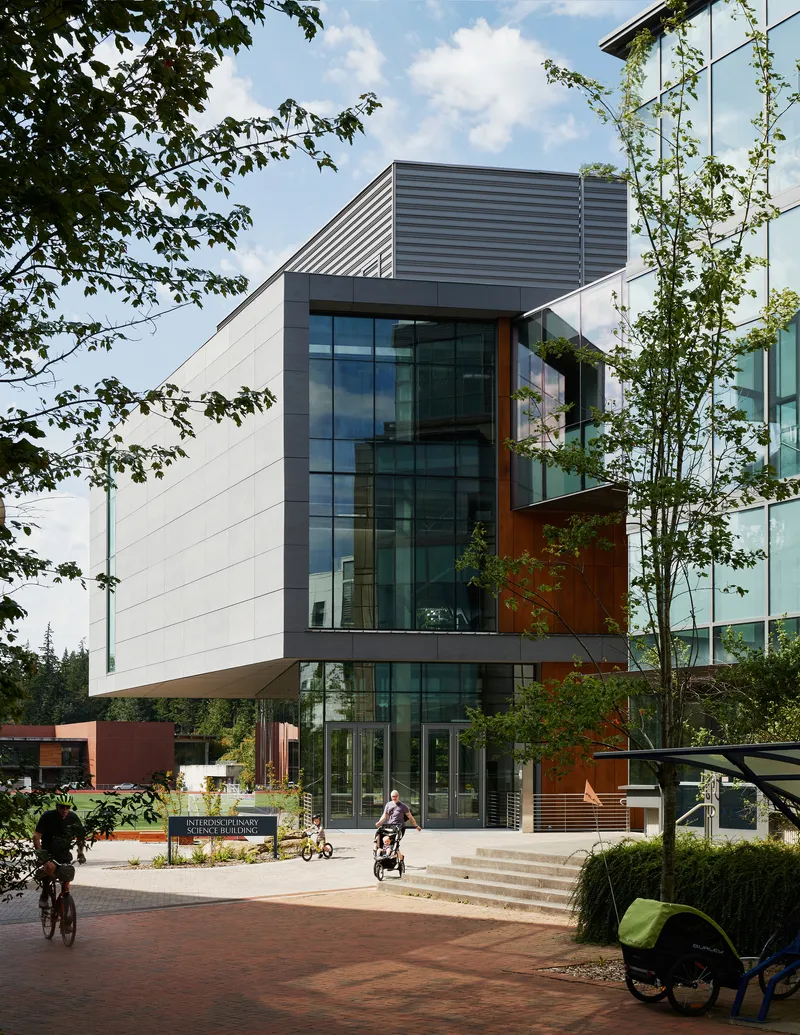
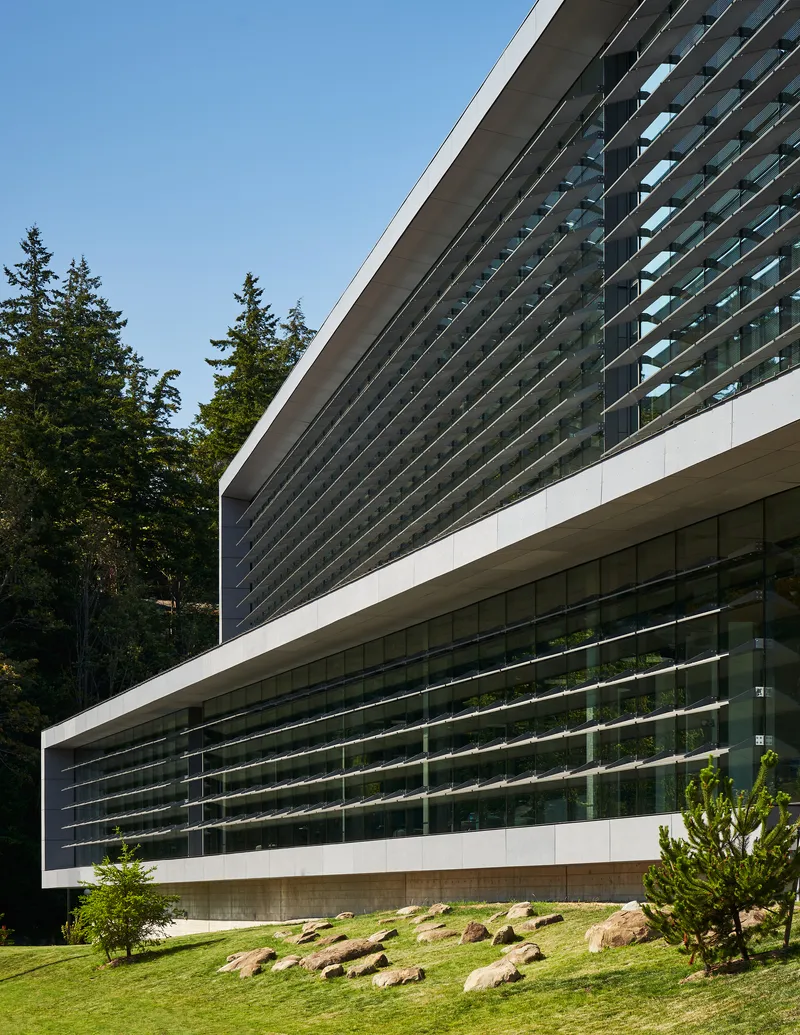
WWU's campus evolved over decades, so its older quadrangles and newer development parcels sit on slightly different axes. Rather than ignoring the discrepancy, Perkins&Will used it as the building's formal generator. The lower volume aligns with one grid, the upper volume pivots to align with the other, and post-tensioned concrete slabs shift at each level to negotiate the rotation. The result reads from the running track as a bold cantilever, from the entry plaza as a stacked composition of weathered steel and fiber cement panels, and from the hillside as a layered screen of horizontal louvers.
The shifting floor plates are not merely sculptural. Each level meets the sloping site at a different elevation, producing distinct thresholds. Students entering from the upper campus arrive at one experience; those coming from the recreation fields encounter another. The building is a hinge in the landscape as much as a container for classrooms.
Transparency as Pedagogy
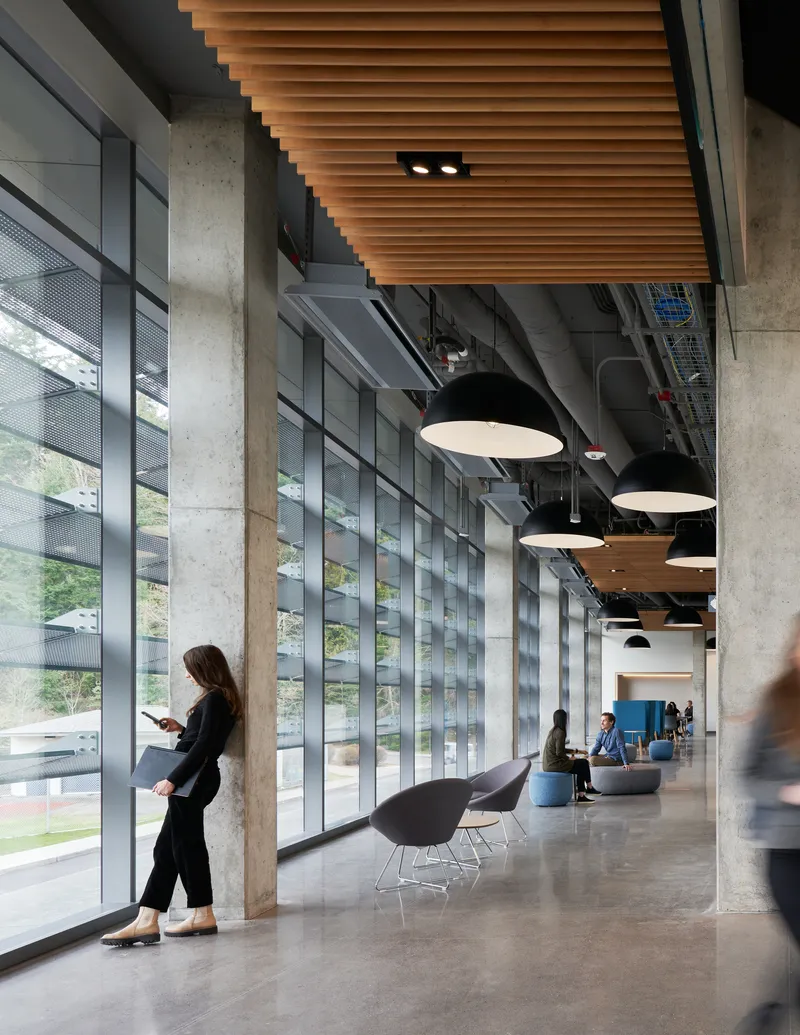

The most radical decision here is how much the architects chose to reveal. Teaching labs for biology, chemistry, environmental science, and marine and coastal science line the perimeter behind floor-to-ceiling glass. Walk down a corridor and you see students at microscope arms, their bench work legible through glazed partitions. That legibility extends outward: from the plaza, the building's interior life is plainly visible, turning routine lab sessions into an advertisement for interdisciplinary research.
Vertical and horizontal shading devices calibrate this openness. Southern exposures get horizontal louvers to cut solar gain, while other facades rely on vertical fins. All LED lighting fixtures supplement daylight that reaches deep into the floor plate, reducing electrical loads without compromising visual comfort. The shading is architecturally expressive, giving the elevations their layered, textured quality while doing real thermodynamic work.
Interior Atmospheres
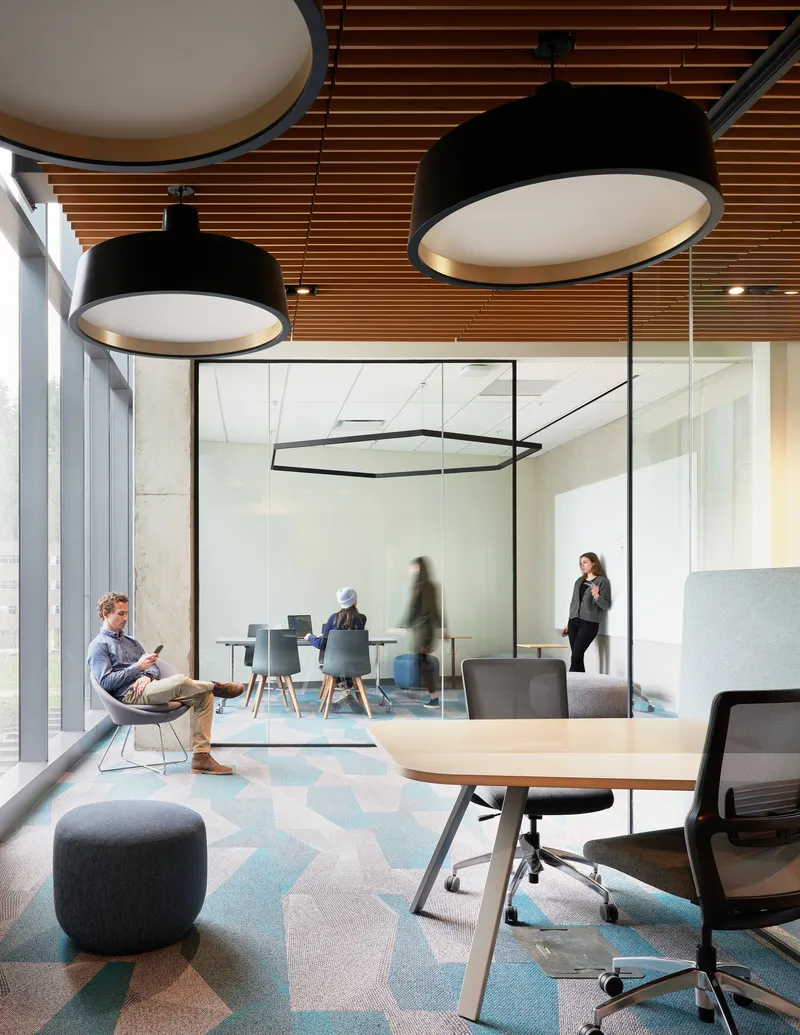
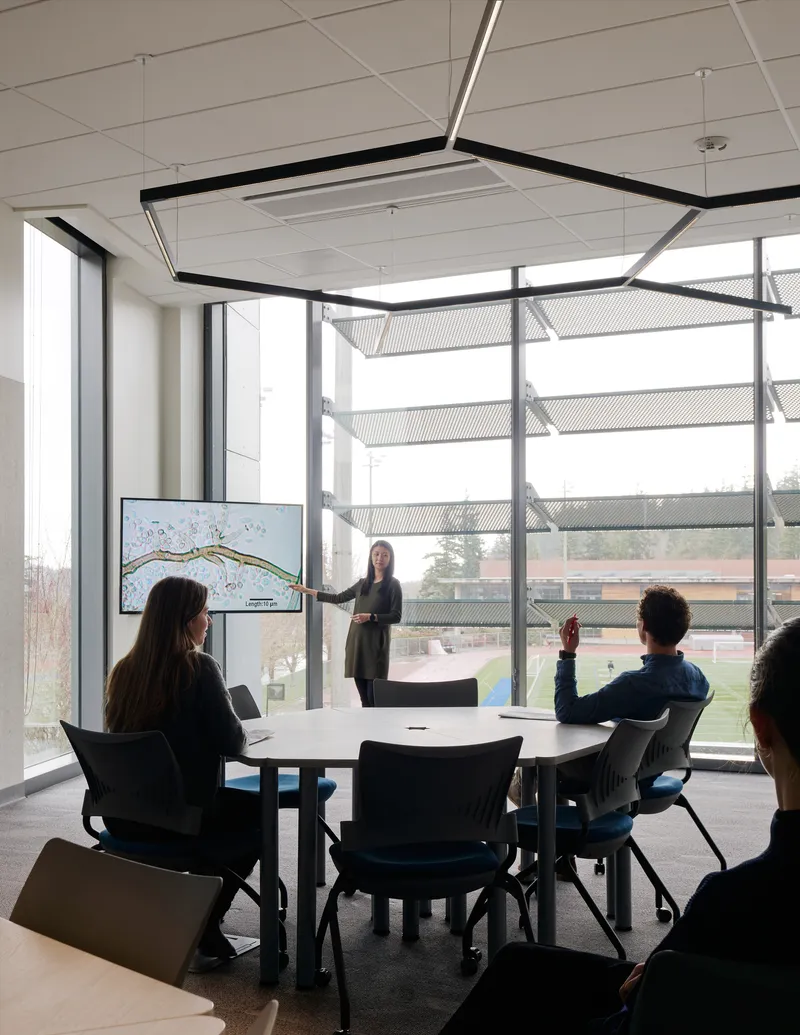
Inside, timber slat ceilings and warm pendant fixtures soften what could easily have been a clinical atmosphere. Breakout areas and study nooks appear along the diagonal circulation spine, giving students places to linger between formal lab sessions. A communicating stair links all four levels, encouraging the kind of casual, cross-departmental encounters that the word "interdisciplinary" promises but rarely delivers.
A meeting room on one of the upper levels captures the dual nature of the building nicely: inside, a hexagonal table and relaxed finishes; outside the window, perforated metal shading panels filter light into soft patterns. The building never lets you forget you are wrapped in a carefully calibrated envelope, even when the interior mood is deliberately informal.
Cladding and Materiality
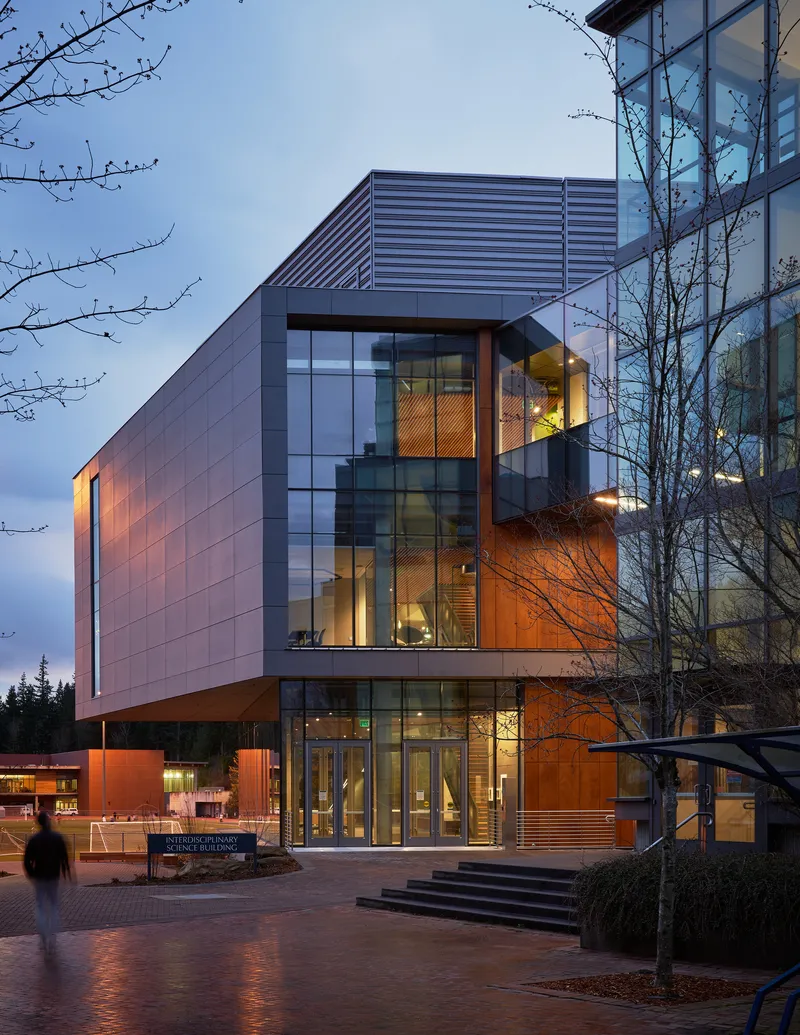

The palette reads as three materials in conversation. Cement-composite rainscreen panels provide the dominant surface, offering durability and a neutral backdrop. Weathered steel panels mark the cantilevered zones, signaling structural assertion with a material that changes character over time. Vertical timber slat cladding wraps portions of the upper volume and the skybridge connection to the adjacent Biology Building, introducing warmth and a finer grain that reads well at the pedestrian scale.
At dusk, the material hierarchy inverts. The timber and steel recede into shadow while the glazed volumes glow, broadcasting interior activity across the campus. The illuminated cantilever floating above the entry becomes the building's signature moment, a lantern for science visible from the track and the hillside path alike.
Water, Landscape, and Ecological Infrastructure
The building's relationship with water is unusually deliberate. Rainwater collected on the high roof is channeled down to a green roof that doubles as a visual display of stormwater management, then directed to a natively planted bioswale on the north side. That bioswale feeds a stormwater habitat facility designed to support pollinator species and local animals. Displaced trees from the construction site were re-used in the landscape, and scattered boulders along the planted slope suggest a Pacific Northwest riparian aesthetic rather than the generic campus lawn.
Pursuing LEED Gold certification, the project diverted 85 percent of construction waste from landfills and specified low-carbon construction materials. These are increasingly standard ambitions for institutional work, but the integration of ecological infrastructure with the building's formal expression, where the bioswale is not hidden behind the loading dock but celebrated as a design element, elevates the approach above checkbox sustainability.
Plans and Drawings
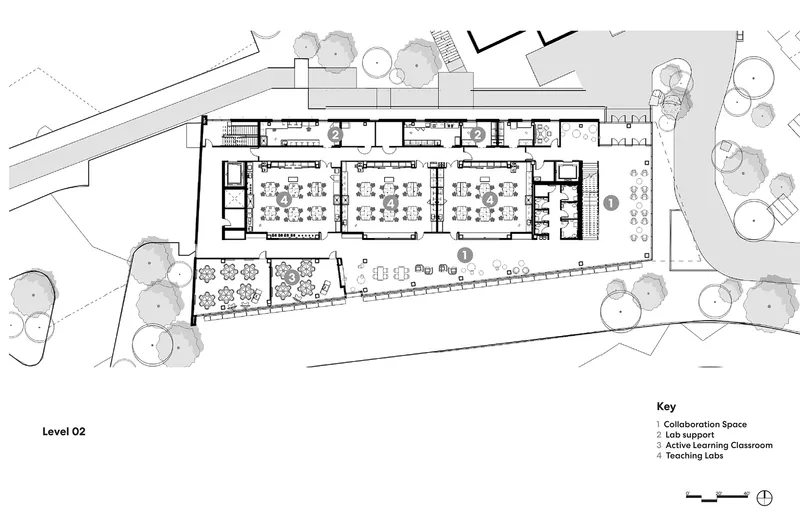


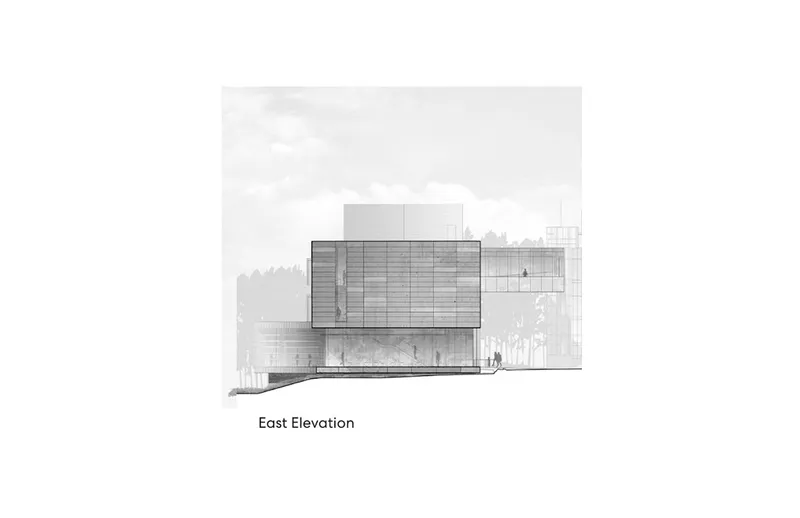
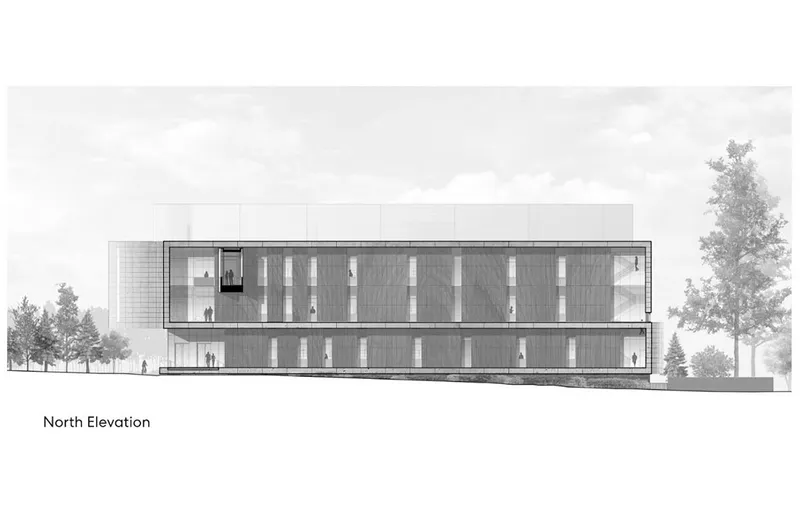
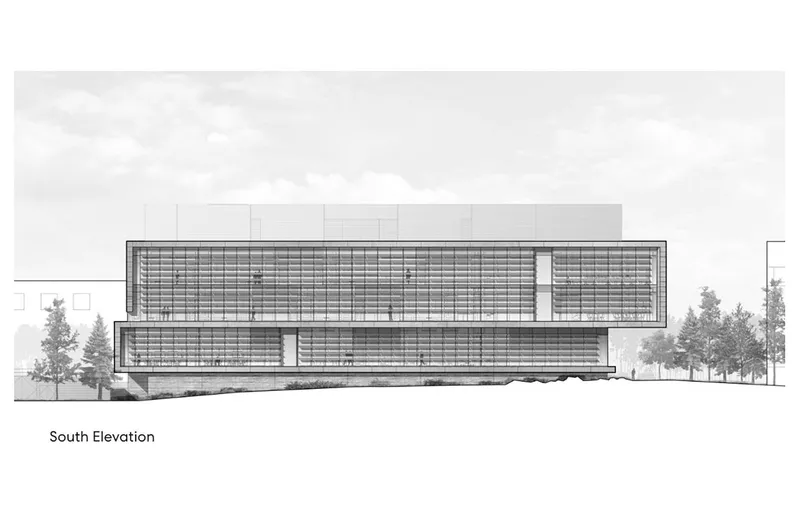

The floor plans reveal how the rotation between volumes plays out in section. At the entry level, a large open volume and central circulation core organize movement. Upper floors arrange three parallel laboratory bays with surrounding support rooms and outdoor terraces, while another level distributes classrooms along a diagonal spine. The elevations confirm the compositional logic: stacked boxes of differing widths and cladding types, with horizontal louvers on the south and east, vertical bays on the north, and slatted timber on the west. Figures sketched among trees on the elevation drawings reinforce the architects' intent to keep the building grounded in its campus landscape rather than posing as an autonomous object.
Why This Project Matters
The Interdisciplinary Sciences Building matters because it takes a program that is often treated as purely functional, ten teaching labs and three classrooms, and uses it to address campus urbanism, environmental performance, and the cultural status of science education simultaneously. The rotating volumes are not a formal gesture for its own sake; they negotiate two campus grids, create sheltered outdoor space, and establish a gateway between campus districts. The transparency is not mere aesthetic bravado; it makes pedagogy visible and invites non-science students into the world of lab work.
At 55,000 square feet, the ISB is modest by research-university standards. That modesty is part of the lesson. You do not need a mega-building to transform a campus edge. You need a building smart enough to read its site, honest enough to show its contents, and rigorous enough to manage its own rainwater. Perkins&Will delivered all three in Bellingham.
Interdisciplinary Sciences Building, designed by Perkins&Will, Bellingham, Washington, United States. 55,000 square feet. Completed 2021. Photography by Kevin Scott.
About the Studio
Share Your Own Work on uni.xyz
If projects like this are the kind of work you want to make, uni.xyz is a place to publish your own, find collaborators, and enter design competitions.


Popular Articles
Popular articles from the community


The Amber Palace Opera: A Geological Fiction Surfaces on Tallinn's Baltic Waterfront
Pierre Brillard reimagines a Baltic legend as a public landscape, opera house, and waterfront promenade rooted in Tallinn's coastal identity.


graciastudio Turns a Viewless Tijuana Lot Inward Around a Courtyard of Concrete, Timber and Trees
In Tijuana, Jorge Gracia's GA2 House stacks a timber-clad private floor over exposed concrete and replaces a missing view with a planted interior patio.

Singing Woman: An Opera House That Performs Before the Curtain Rises
Ovidiu Cristian Pavel's conceptual opera house translates Estonia's choral identity into a sculpted waterfront landmark facing the Baltic Sea.

David Ortega Stacks a Two-Story Mexico City Penthouse Around a Steel Stair and a Pergola-Shaded Roof Terrace
In Colonia Roma, a 300 m² penthouse uses oak joinery, a planted steel stair and a slatted roof pergola to make a new-build apartment feel like a house.

Similar Reads
You might also enjoy these articles

LAVA Architecten Gives Vocational Education a Sawtooth-Roofed Face on a Mechelen School Campus
In Mechelen, Belgium, a 2,053 m² STEM school on a 6×6 m grid turns workshops and classrooms into rooms that can be rearranged as teaching changes.

KEMA Studio Turns a Derelict Marvila Attic into a 60 m² Lighthouse Apartment Above Lisbon
In Lisbon's Marvila district, a rebuilt roof, four skylights and two plywood volumes turn an unlivable attic into a bright home facing the Tagus.

Pixel Gardens: One Repeated Module Stacked Into a Terraced Social Housing Tower for Famagusta
Salem Bader's shortlisted housing tower builds a vertical neighbourhood from one repeated module, offsetting units to carve terraces, light and air.

Bao Huynh Watercolor Atelier: A Serene Art Retreat in Hội An
Bao Huynh Watercolor Atelier in Hội An blends multifunctional art spaces, sustainable design, local materials, and family-friendly living in a serene environment.

Explore Academic Building Competitions
Discover active competitions in this discipline

Challenge to reimagine the Iron Throne

Photograph architecture without architects

Illustrate the lost glory of Angkor Wat - Render Challenge

Design challenge to reuse E-waste
Comments (0)
Please login or sign up to add comments
No comments yet. Be the first to comment!