
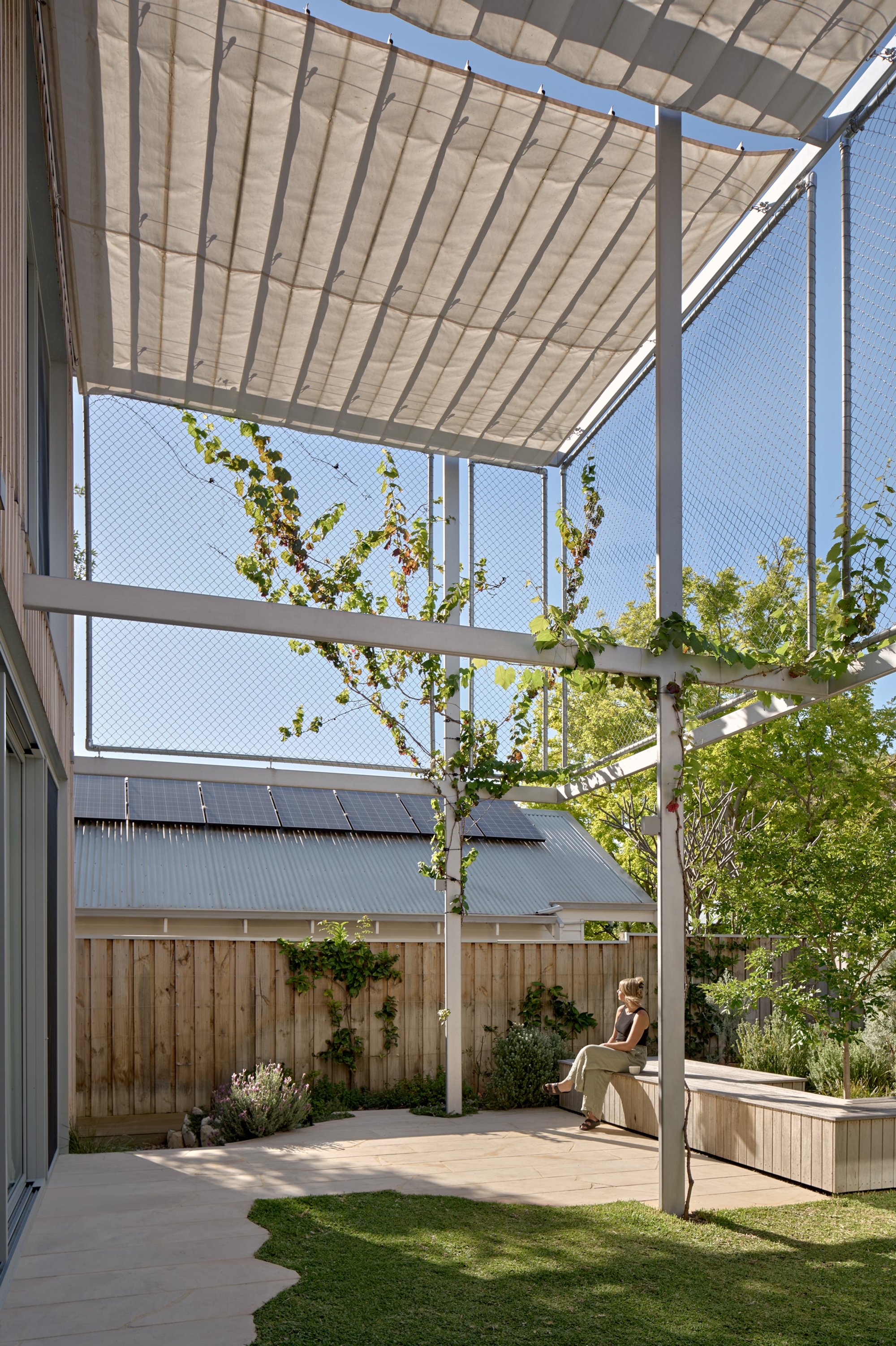
Philip Stejskal Architecture Stacks a Corrugated Iron Home Around a Central Courtyard in Fremantle
On a tight subdivided block hemmed in by four neighbours, a young family's house borrows from Fremantle's port vernacular.

Fremantle's working waterfront has always shaped the suburb's architecture. The warehouses, the cottages, the corrugated iron sheds that line its streets all carry the same unsentimental logic: build tough, build tight, let the sea breeze do the rest. Philip Stejskal Architecture took that inheritance seriously when designing Henville Street House, a two-storey home for a young family on a 300-square-metre subdivided lot at the end of a narrow street. Hemmed in by four neighbours and constrained by a sewer main running through the site, the project had to be surgically precise about every square metre it claimed.
What makes the house genuinely interesting is not just that it solves a difficult site, but how it solves it. The concept is a rectangular prism with a central outdoor room subtracted from it, creating an L-shaped plan that gathers living spaces around a double-height arbour. That void is the hinge of the entire design: it brings light into the deepest parts of the plan, captures the famous Fremantle Doctor sea breeze, and provides the family with a private outdoor room that feels far larger than its actual dimensions. The corrugated iron and steel mesh cladding, scaled to echo stacked shipping containers, is designed to be gradually consumed by climbing plants, so the house will look different in five years than it does today.
A Port Town Vernacular in Corrugated Iron
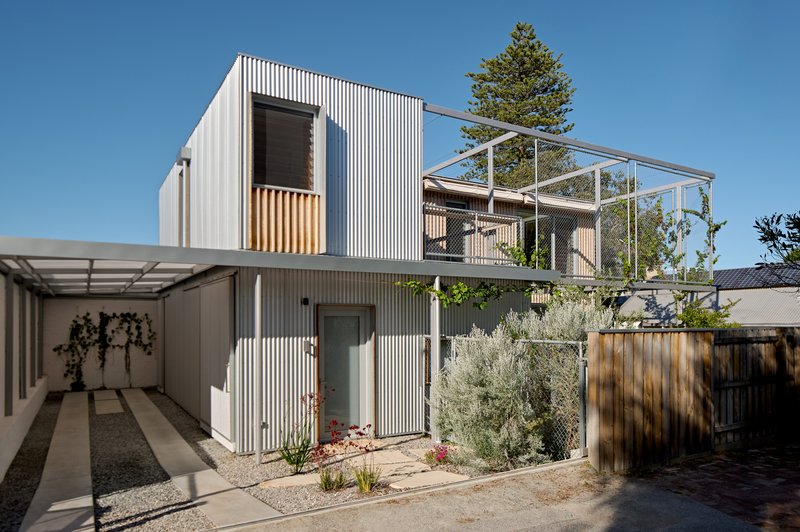
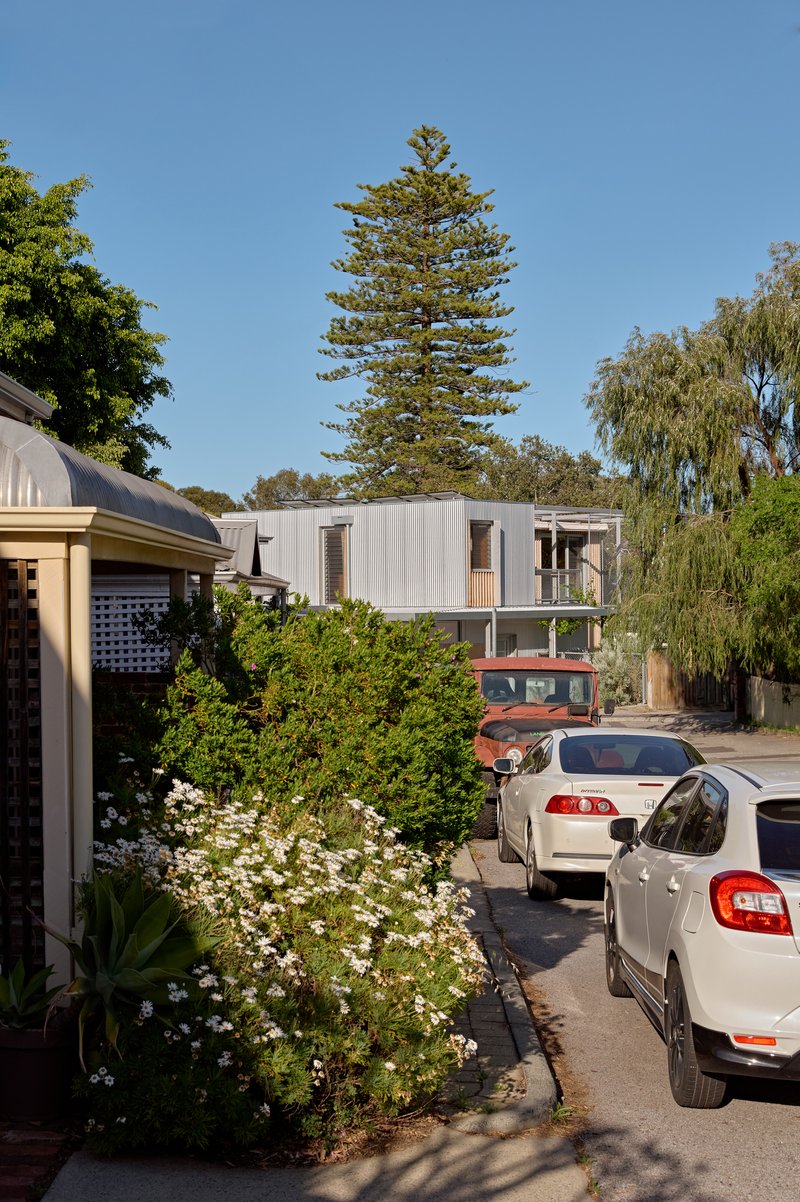
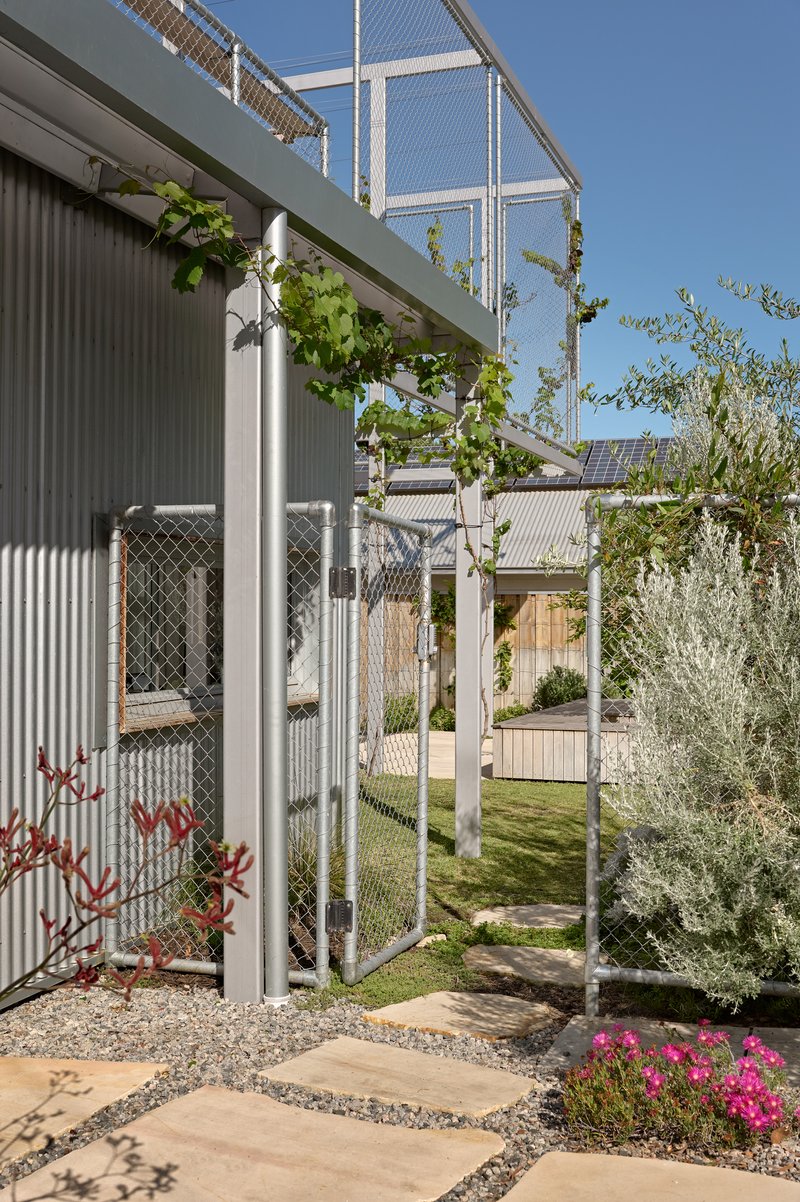
From the street, Henville Street House reads as a compact corrugated metal volume lifted above the ground plane on white steel columns. The material is deliberately industrial, a direct reference to Fremantle's port infrastructure and the workers' cottages that once defined this neighbourhood. The corrugated iron is not just an aesthetic choice: it weathers the harsh coastal climate without maintenance, an important consideration for a young family on a modest budget.
The facade's narrow frontage conceals the house's real complexity. A steel mesh canopy wraps the upper level, providing both privacy from neighbours and a framework for climbing vines. Over time, this armature will green over, softening the industrial edges and creating a living screen. A small but telling detail: bicycle storage is tucked behind the cladding beside the front door, treating the facade as functional furniture rather than pure surface.
The Subtracted Courtyard
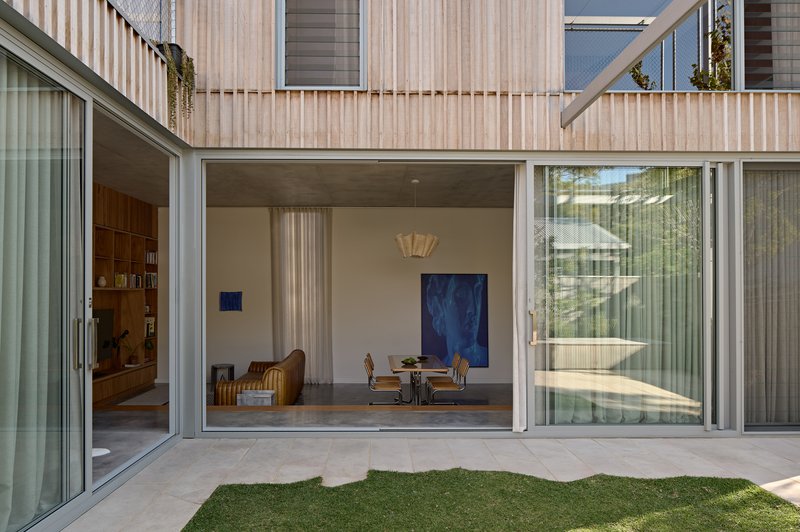
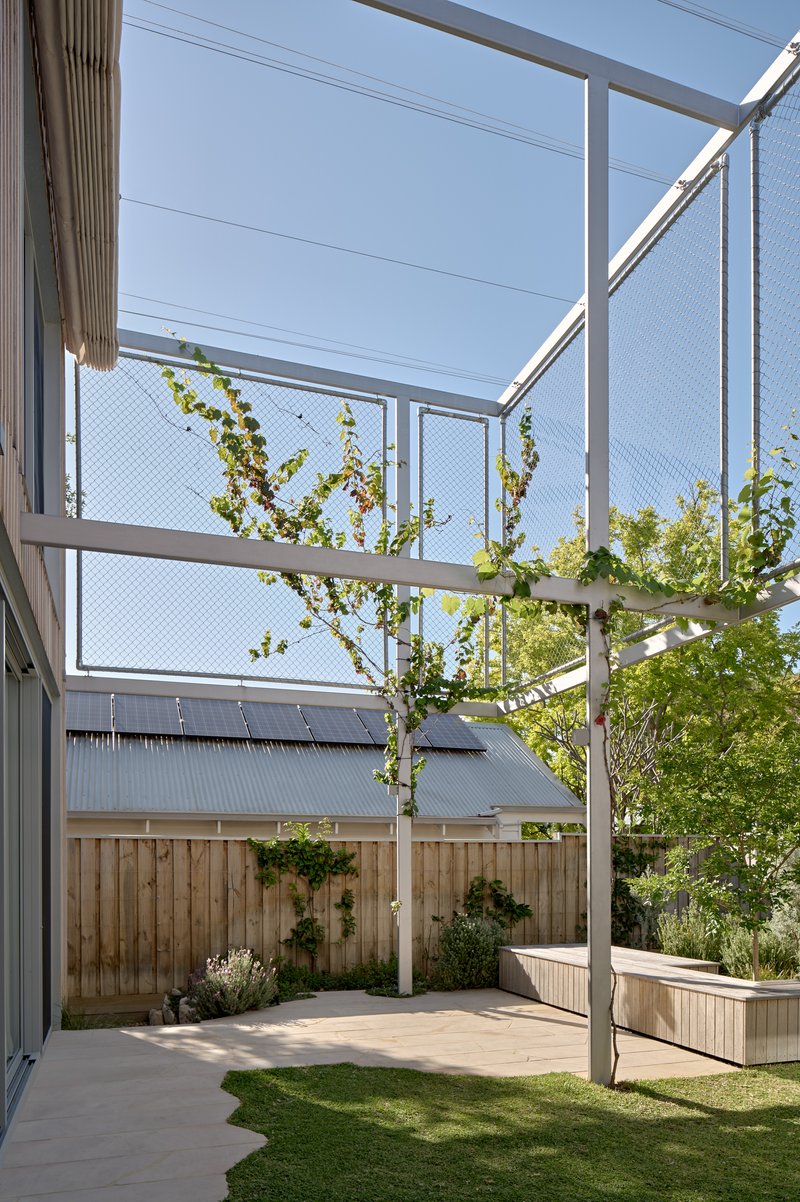
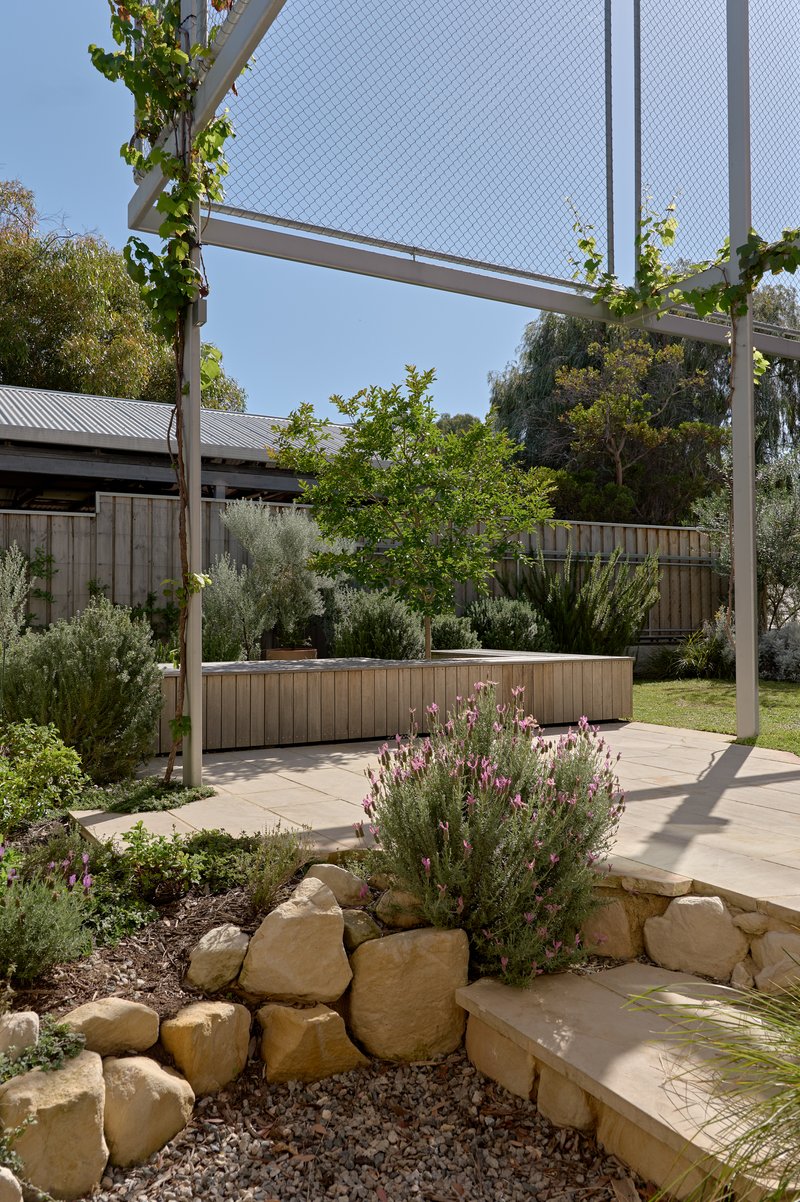
The central courtyard is the project's most consequential move. Defined by a double-height white steel arbour, it operates as an outdoor room that every ground-floor space opens onto through full-height sliding glass doors. The lawn, the young trees in stone planting beds, the climbing vines on the trellis: all of this creates a sense of openness that the tight 106-square-metre footprint would otherwise never achieve. The arbour frames borrowed views to the north, pulling sky and neighbouring tree canopies into the family's daily experience.
The site slopes one metre from north to south, and the architects exploited this by sinking the living spaces below the courtyard level. That level change does double duty as informal seating and as a psychological threshold between inside and outside. It is a small gesture with outsized spatial consequences, making the courtyard feel elevated and the living room feel sheltered without closing anything off.
Timber Joinery as Interior Architecture
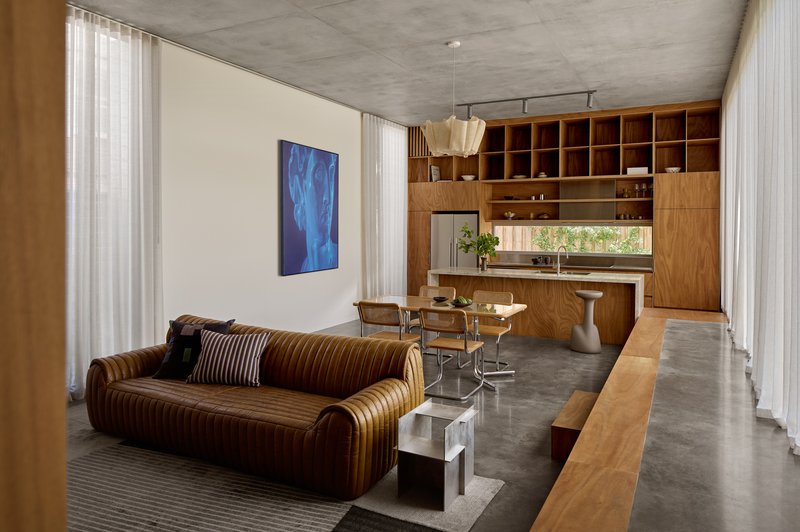
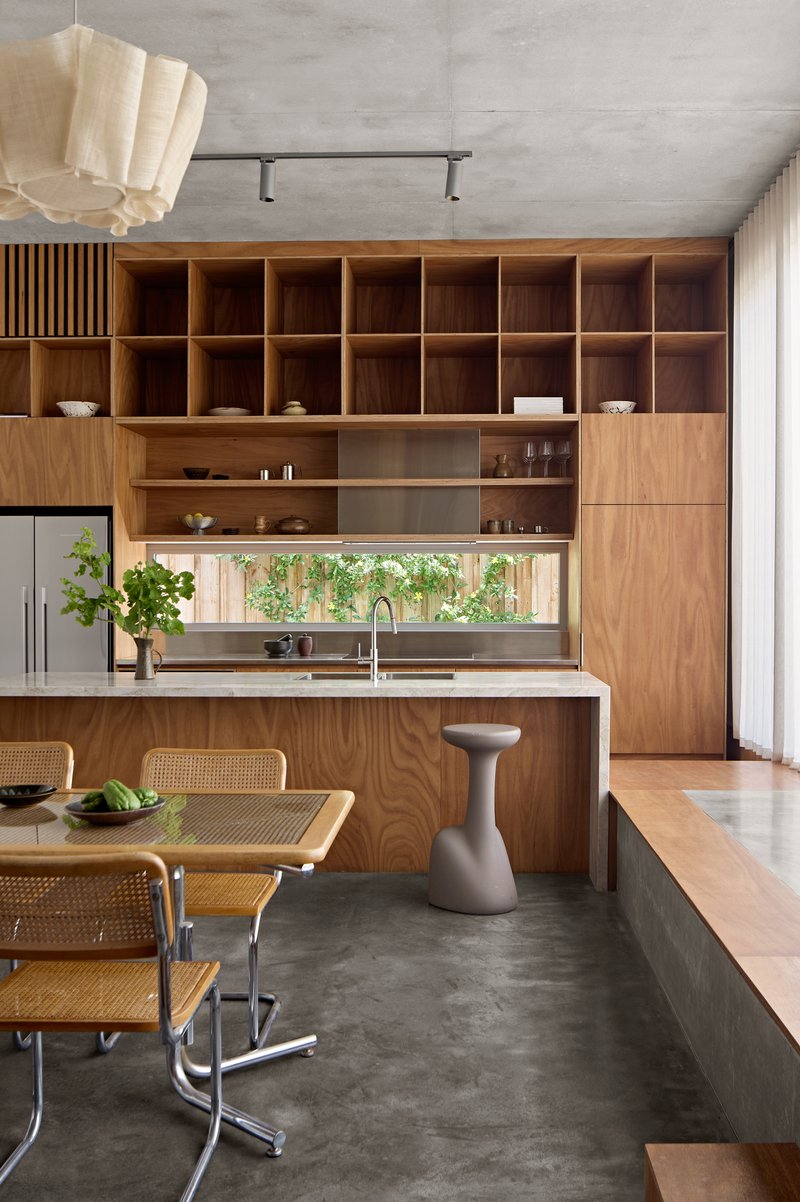
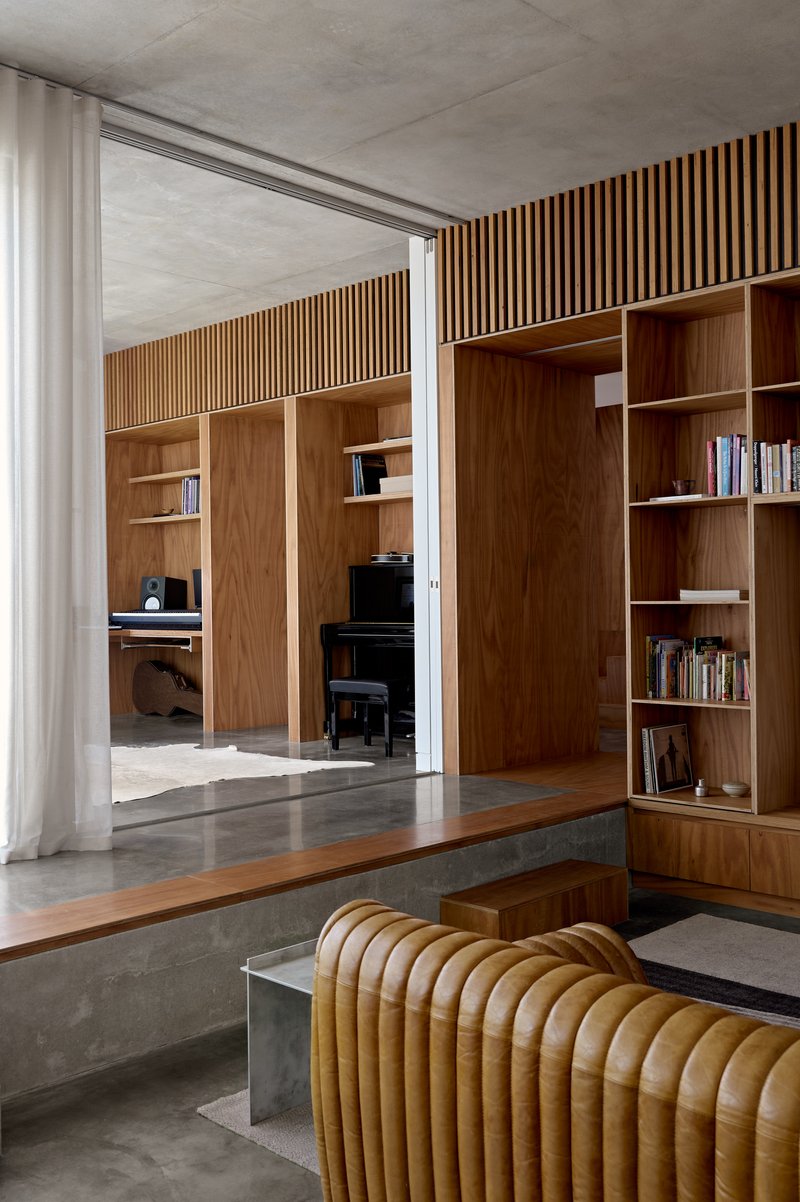
Inside, Australian hardwoods do most of the heavy lifting. The kitchen wall is a single continuous surface of timber cabinetry and open shelving, gridded precisely so that the horizontal window strip above the counter frames the planted courtyard beyond. Built-in storage, bookshelves, and wall linings are all treated as parts of the same joinery system, giving the compact interior a coherence that furniture alone could never provide.
The polished concrete floor anchors everything with thermal mass, absorbing winter sun and staying cool under summer breezes. Against this hard, neutral base, the warm timber walls feel intentional rather than decorative. A slatted timber partition separates the study from the living area while allowing light and air to pass freely between them, reinforcing the house's commitment to visual continuity even within tight spaces.
Flexible Ground Floor
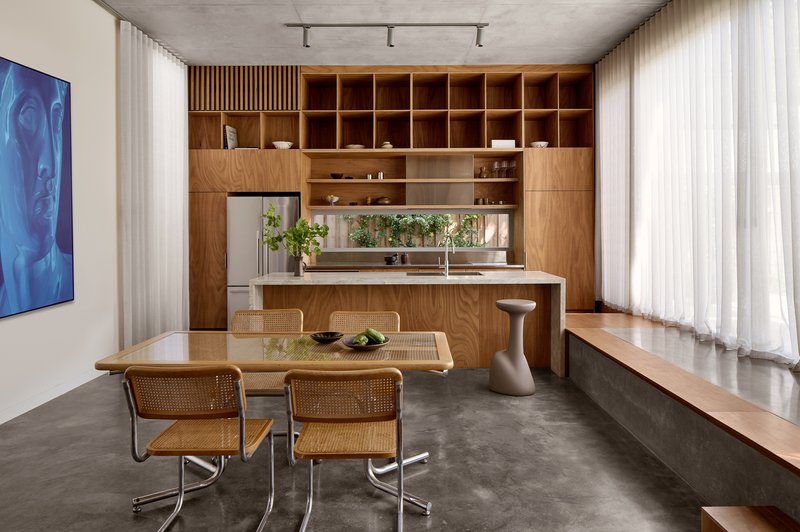
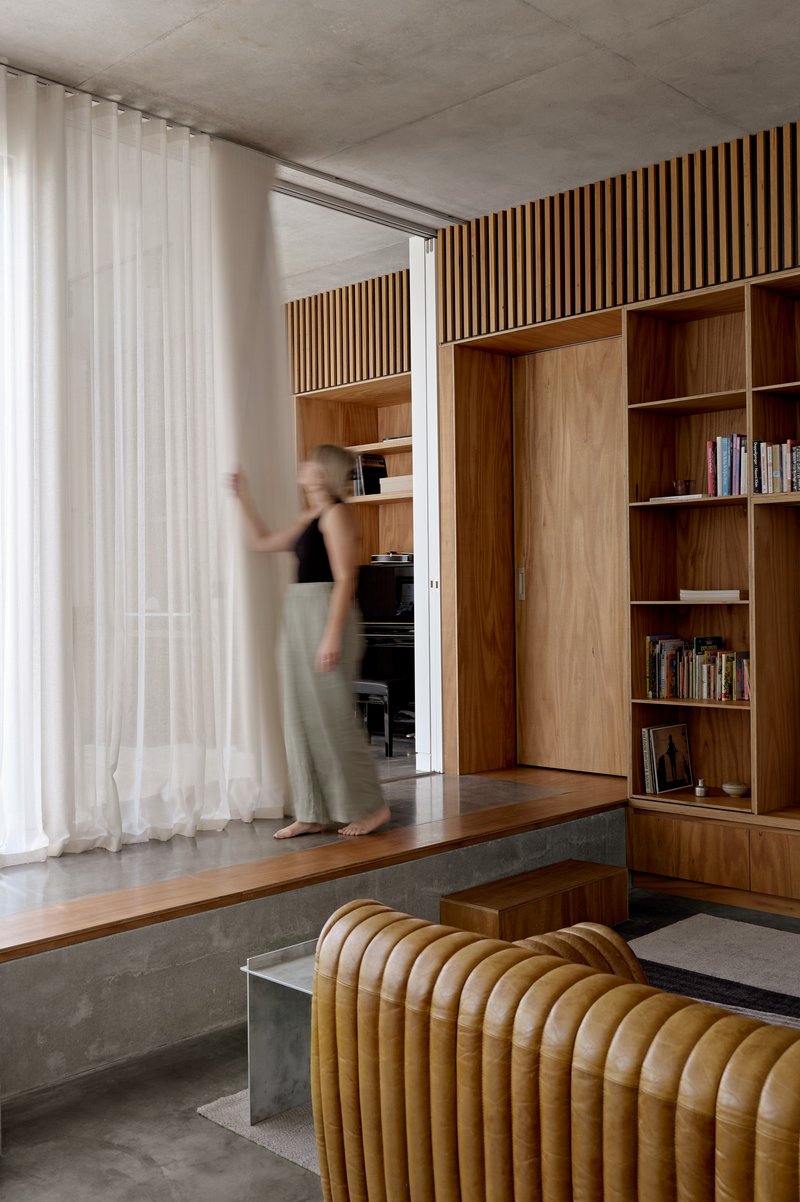
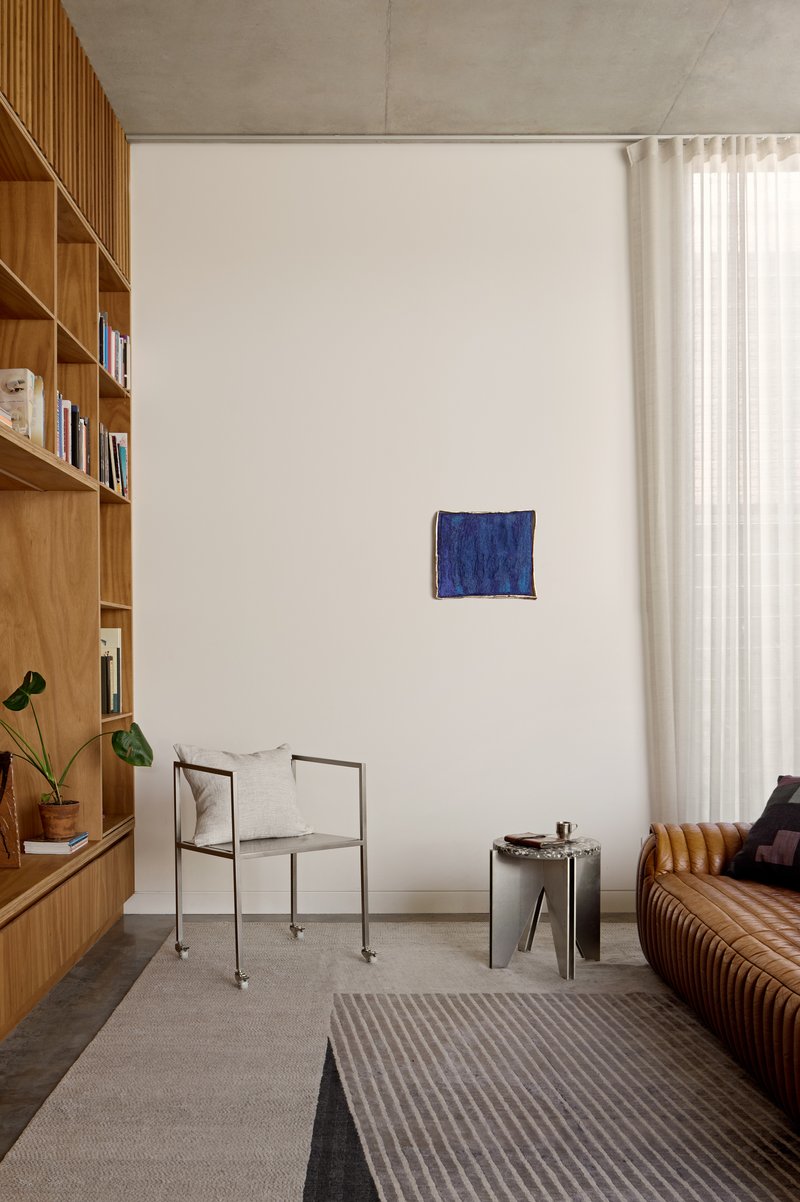
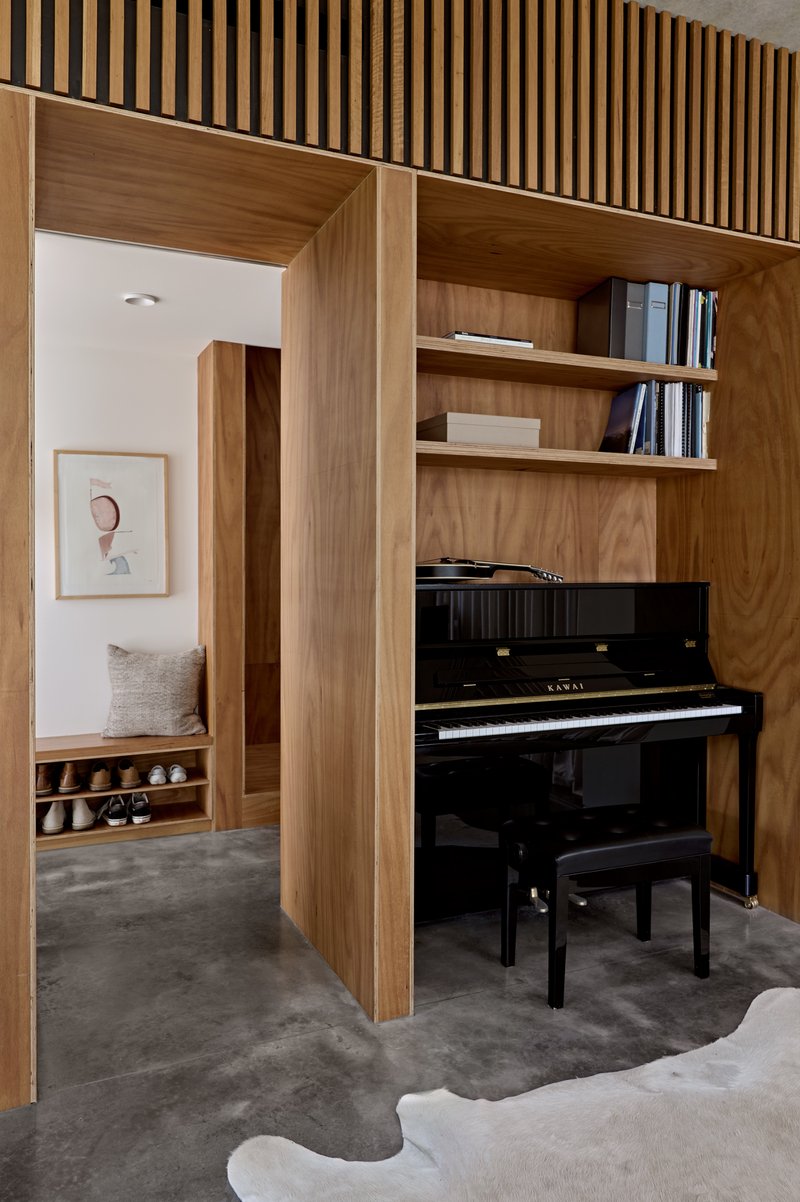
The ground floor is deliberately non-prescriptive. A multipurpose room behind the main living area can be closed off with sliding doors and floor-to-ceiling sheer curtains, transforming from open living space to guest room to children's play area depending on the moment. A music room, separated by the floor height change and another curtain, houses an upright piano within a timber joinery alcove. These are not rooms in the conventional sense; they are zones defined by soft thresholds rather than walls.
The curtains deserve particular attention. Running on ceiling tracks throughout the ground floor, they allow the family to modulate privacy, light, and spatial enclosure without permanent partitions. It is a strategy borrowed from loft living but applied here to a family house where needs shift constantly. The effect is a ground floor that feels larger than its footprint because no space is single-purpose.
Upstairs Rooms and the Rooftop
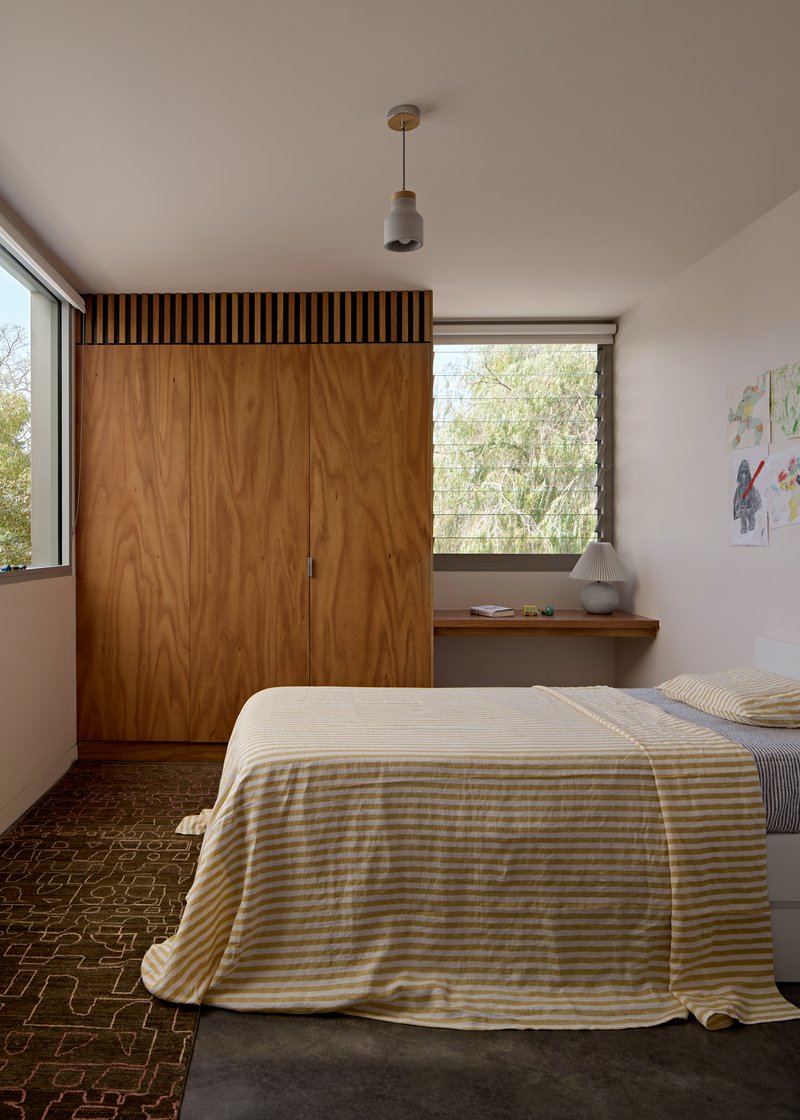
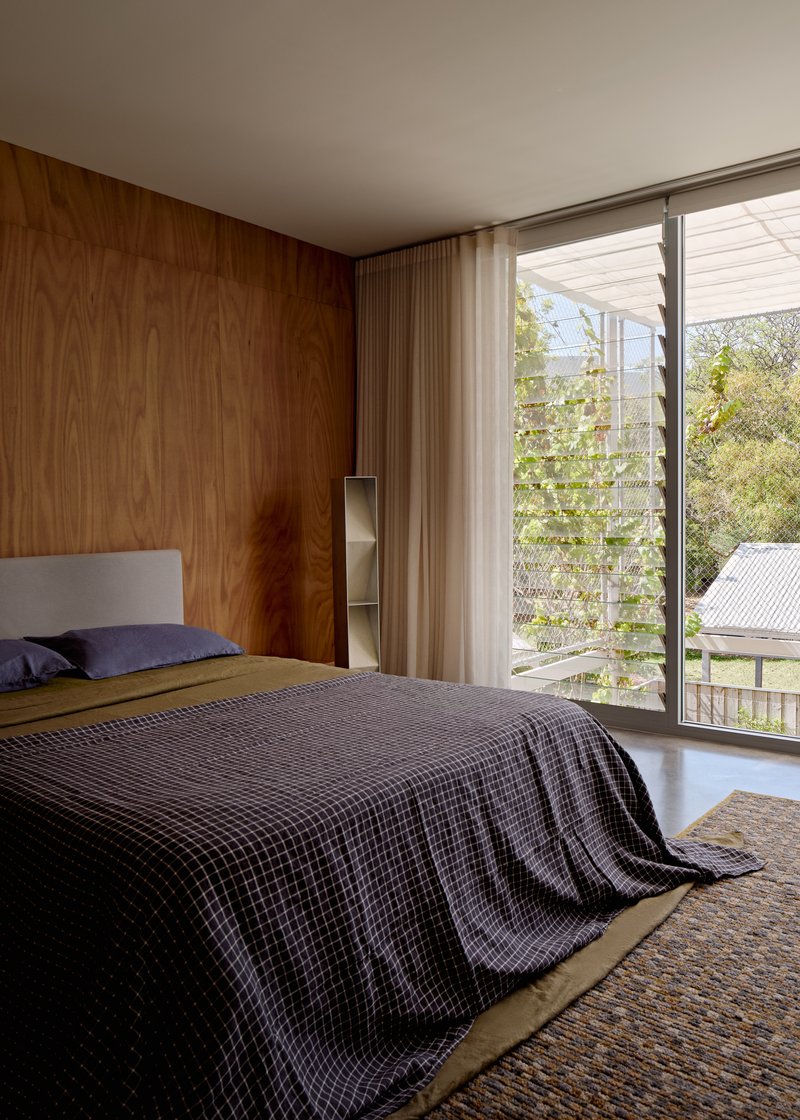
The first floor houses three bedrooms and two bathrooms, arranged compactly around the stairwell. Corner windows in the bedrooms frame the neighbouring tree canopy, turning what could feel like overlooked rooms into treetop retreats. Louvered windows on the north-facing bedroom provide ventilation while screening views of neighbouring rooftops, a practical solution to the tight urban condition.
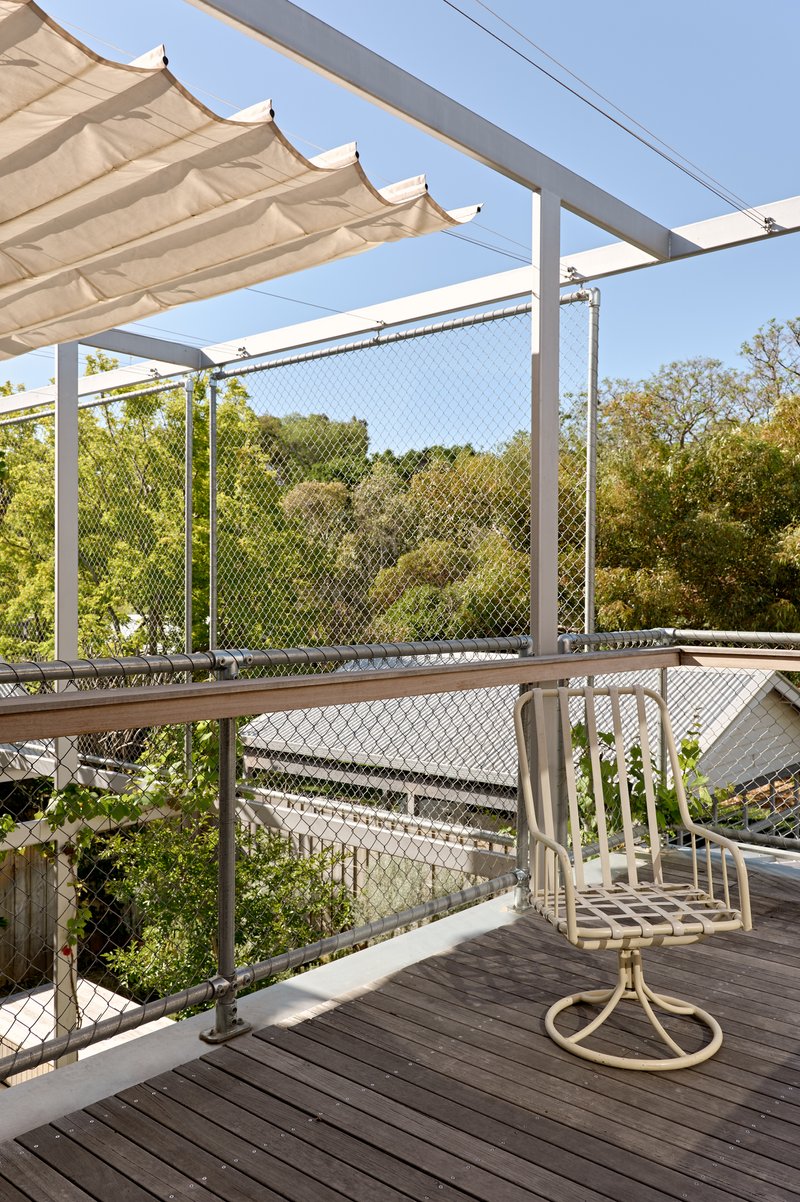
Above it all, a semi-private rooftop deck offers district views through a chain-link mesh balustrade. A retractable canvas shade and a single suspended chair suggest that this is a place for solitary retreat rather than entertaining. It is a small luxury, but on a block this constrained, claiming usable outdoor space on the roof is an act of spatial generosity that the site plan alone could never deliver.
Staircase, Bathrooms, and Material Details
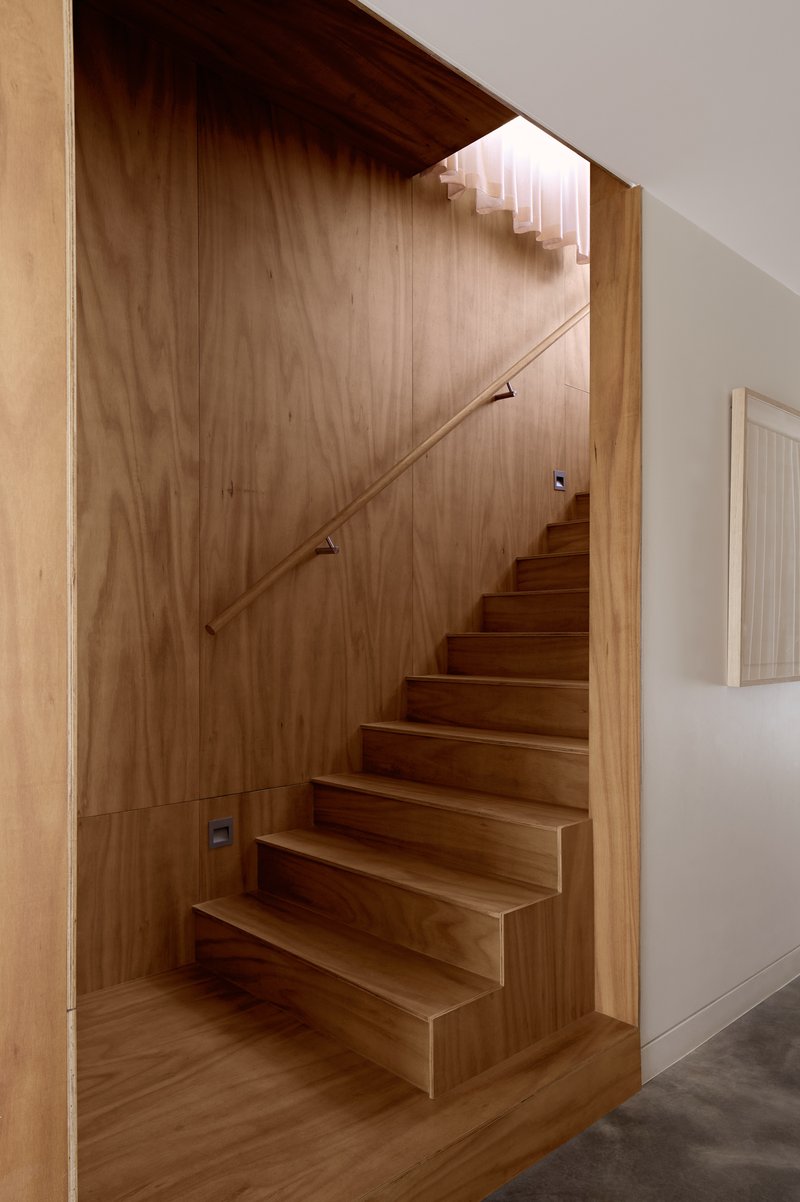
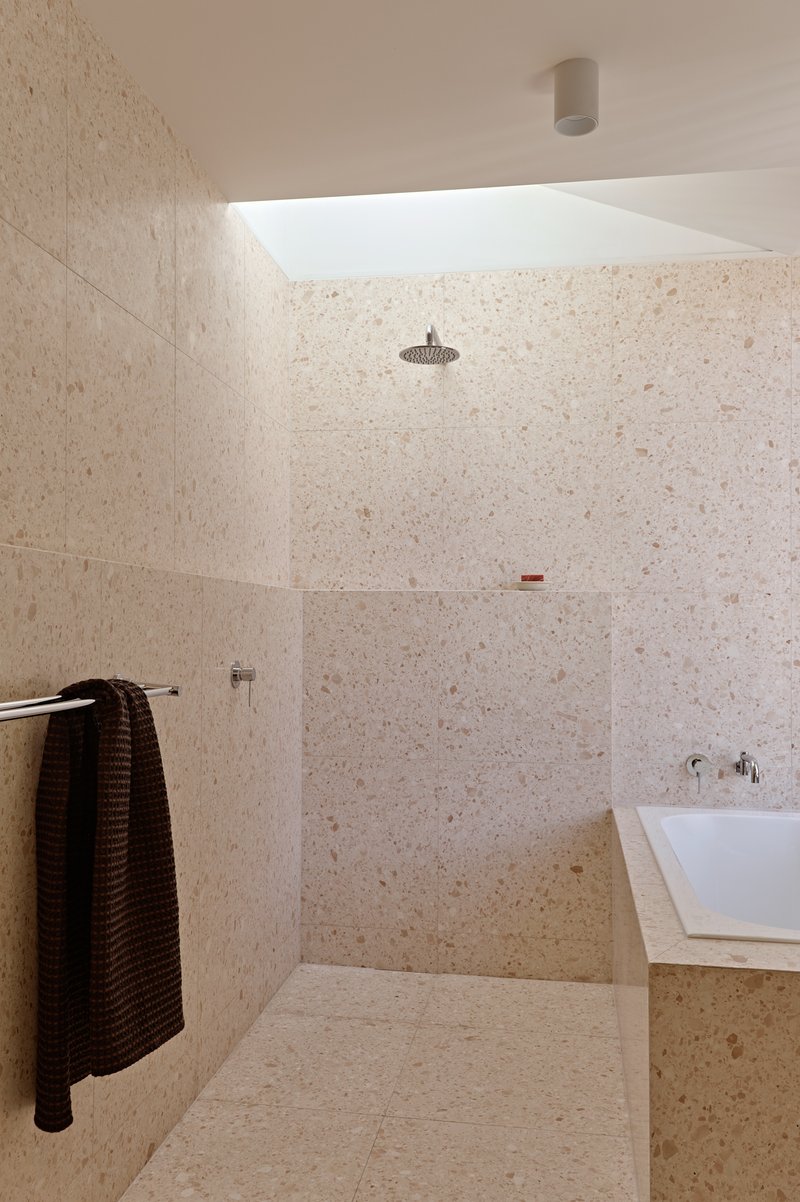
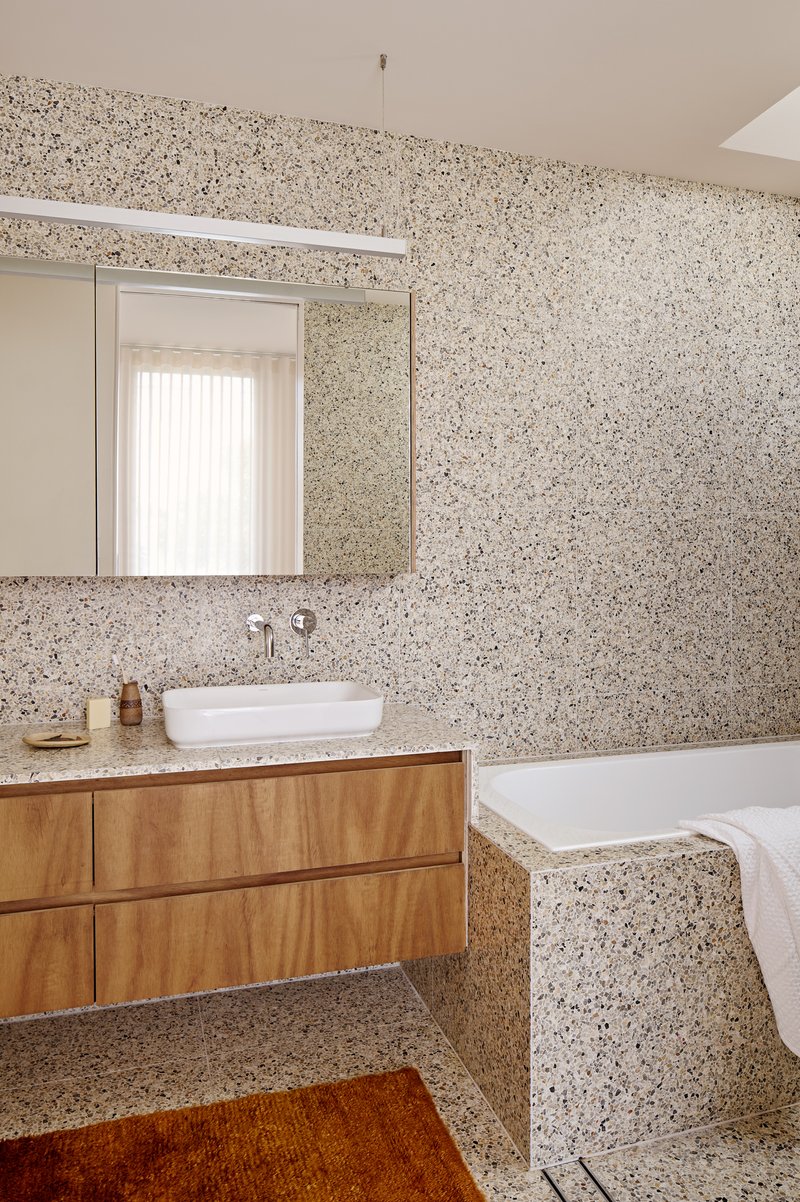
The timber-clad staircase is a compact sculptural element, with triangular wall-mounted handrails and a skylight that washes the landing in diffused light. It functions as a vertical light well, pulling daylight from the roof down into the centre of the plan. The bathrooms upstairs deploy terrazzo walls, recessed skylights above the shower, and timber vanities that maintain the material consistency of the rest of the house. A recessed bathtub with terrazzo surround treats the bathroom as a room worth spending time in, not just a service space.
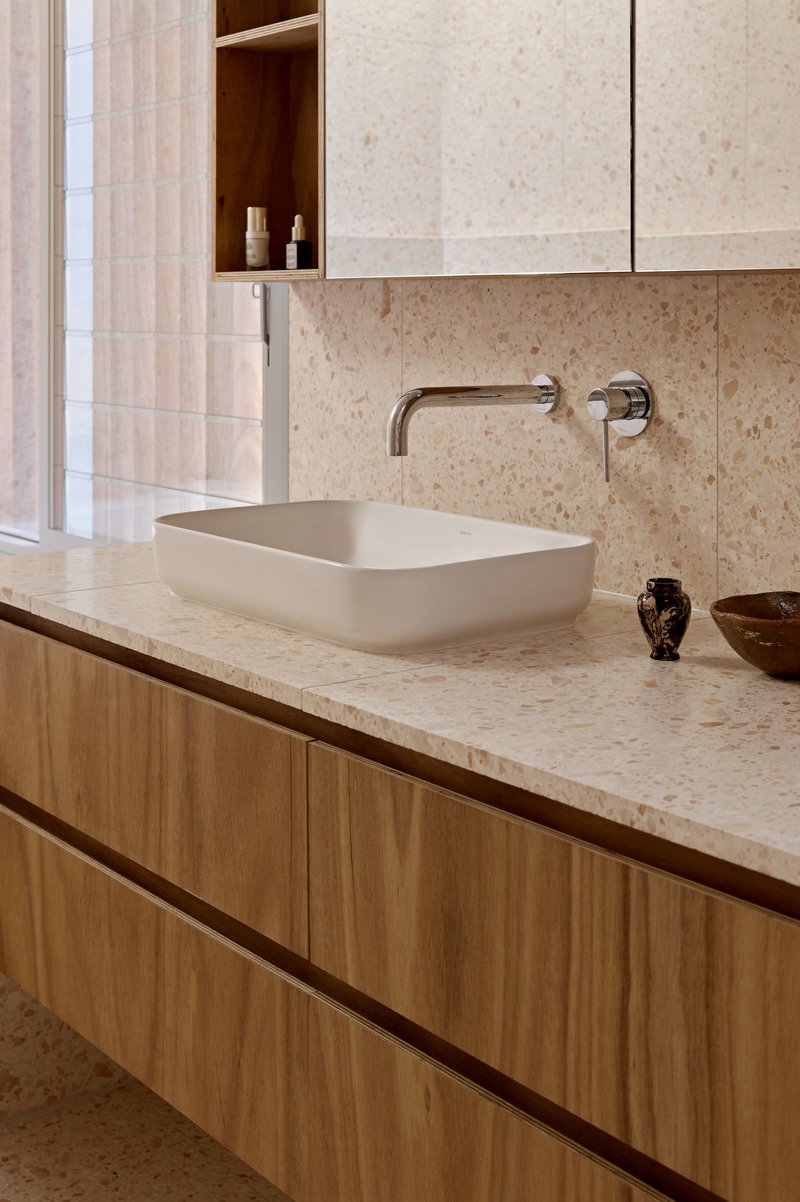
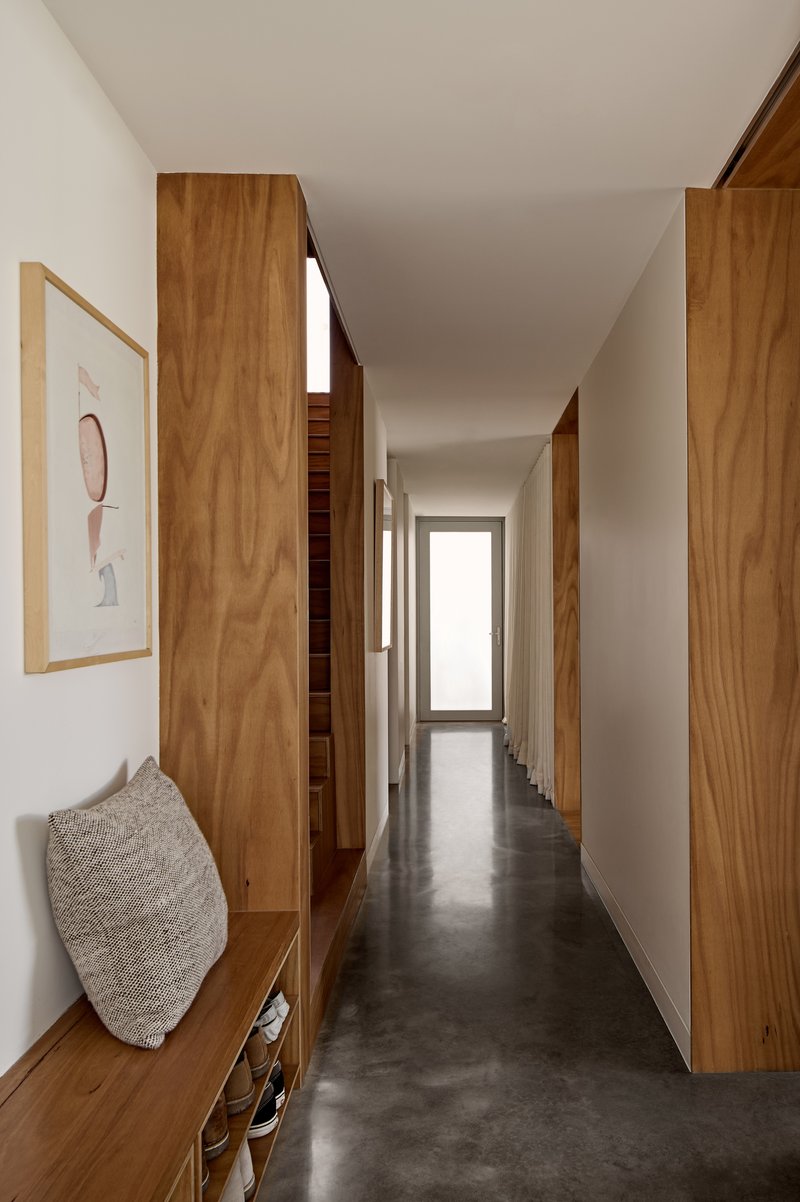
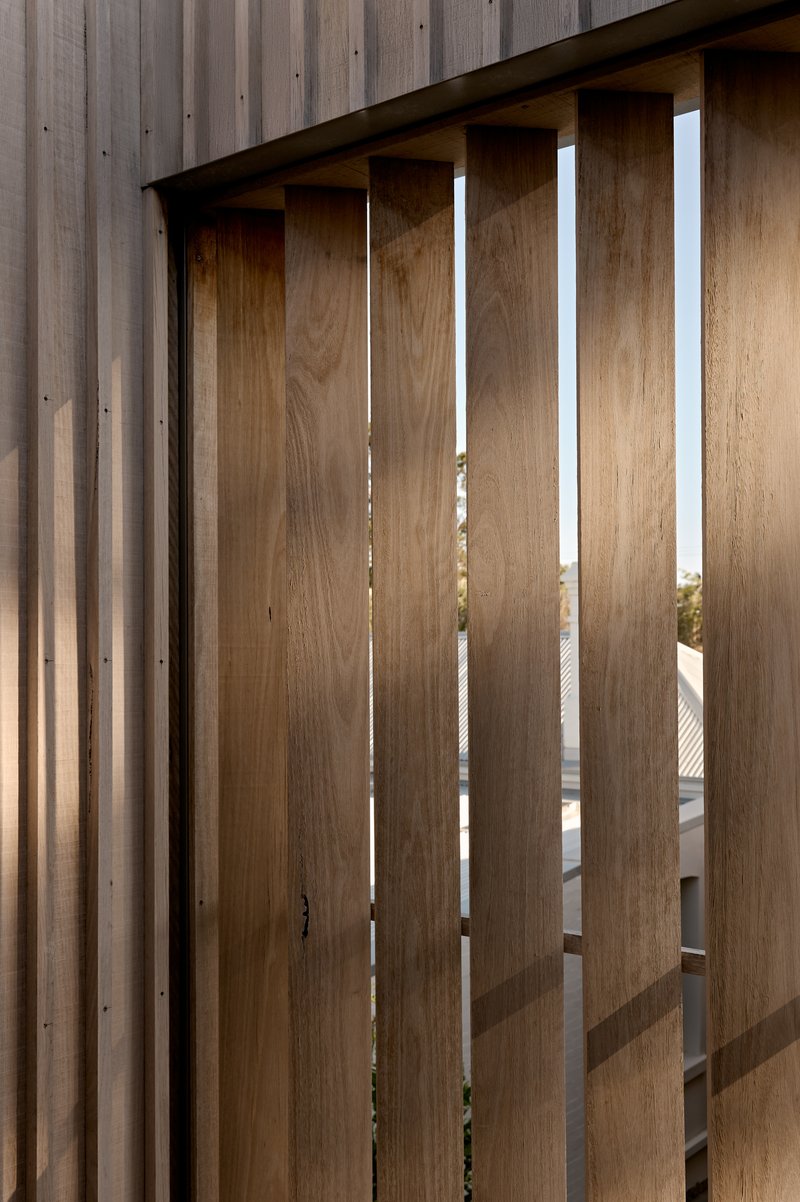
Throughout the house, the material palette stays disciplined: polished concrete, Australian hardwood, corrugated iron, and terrazzo. No surface is asked to be something it is not. Vertical timber screens filter light onto cladding, corridors terminate in windows, and every piece of cabinetry doubles as spatial definition. The result is an interior that feels crafted rather than merely finished.
Passive Design and the Fremantle Doctor
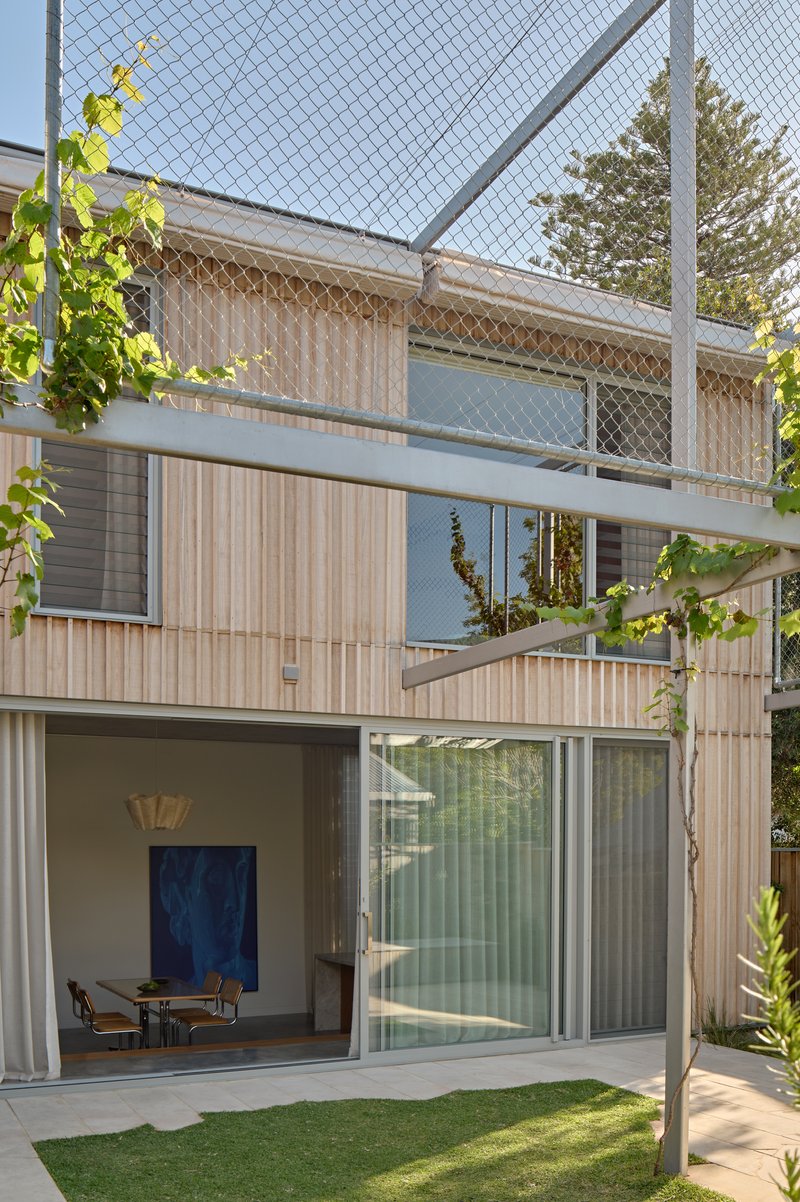
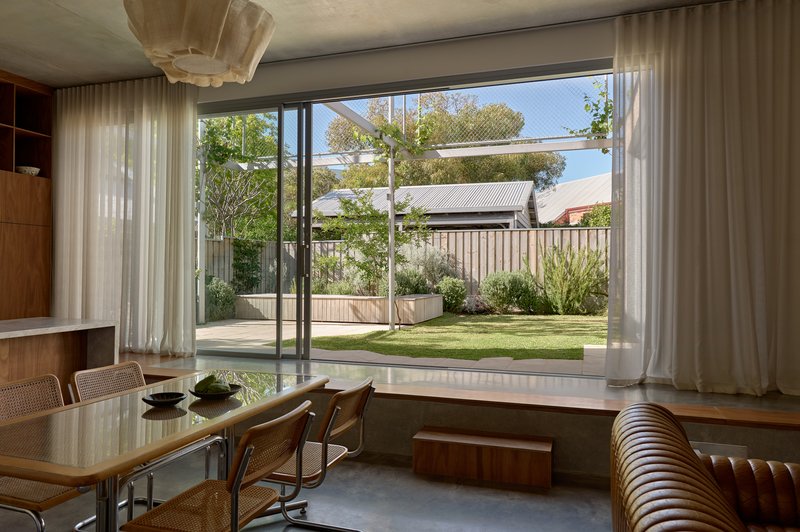
Fremantle's afternoon sea breeze, known locally as the Fremantle Doctor, is the house's primary cooling system. The L-shaped plan and central courtyard are oriented to capture and funnel this breeze through every room. Retractable shade sails over the courtyard, combined with deciduous climbing plants on the steel framework, create a layered system of summer shading that peels back in winter to admit low-angle sun. The polished concrete floors store thermal energy, and the level change between courtyard and living room creates a natural stack effect that draws warm air upward.
The landscape strategy is inseparable from the passive design. Metal grilles and mesh panels are intended to be progressively overtaken by vegetation, creating distinct microclimate zones around the house. Young grapevines along the rear fence, birch trees in the courtyard, and scattered flowering plants in stone beds all contribute to evaporative cooling and biodiversity. The house is designed to perform better as it ages, an uncommon quality in residential architecture.
Plans and Drawings
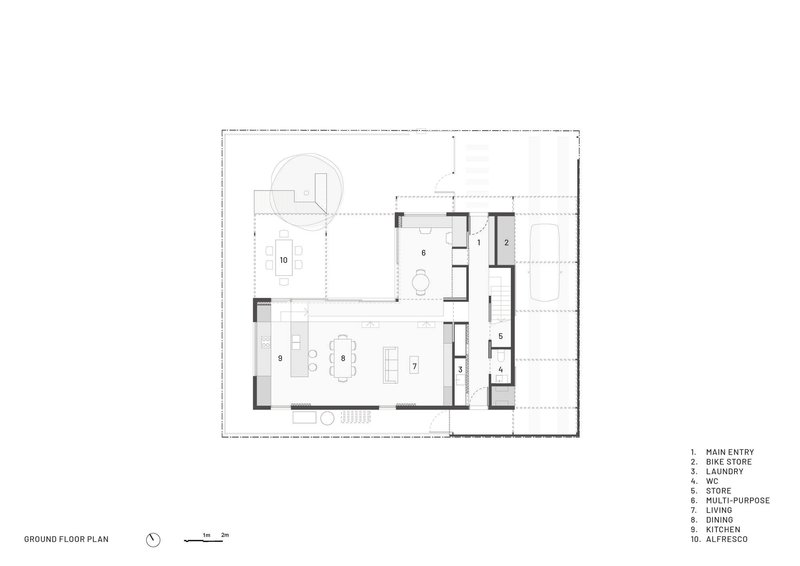
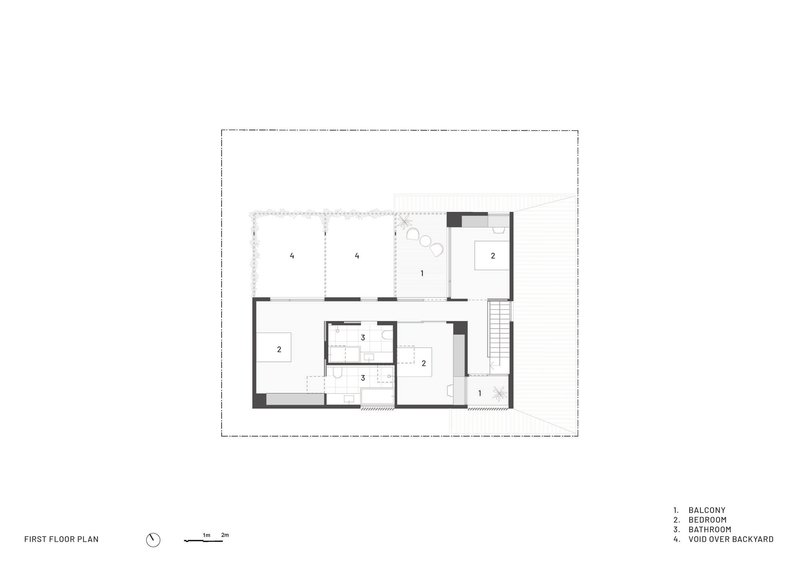
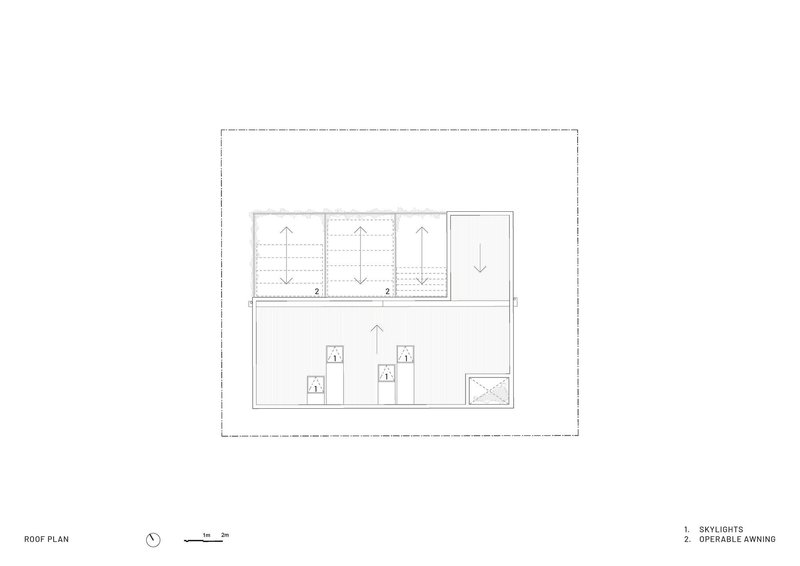
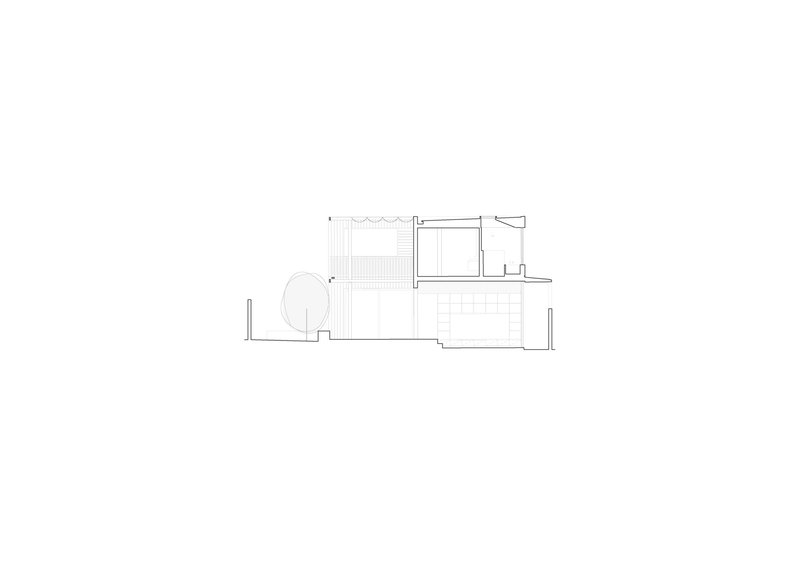
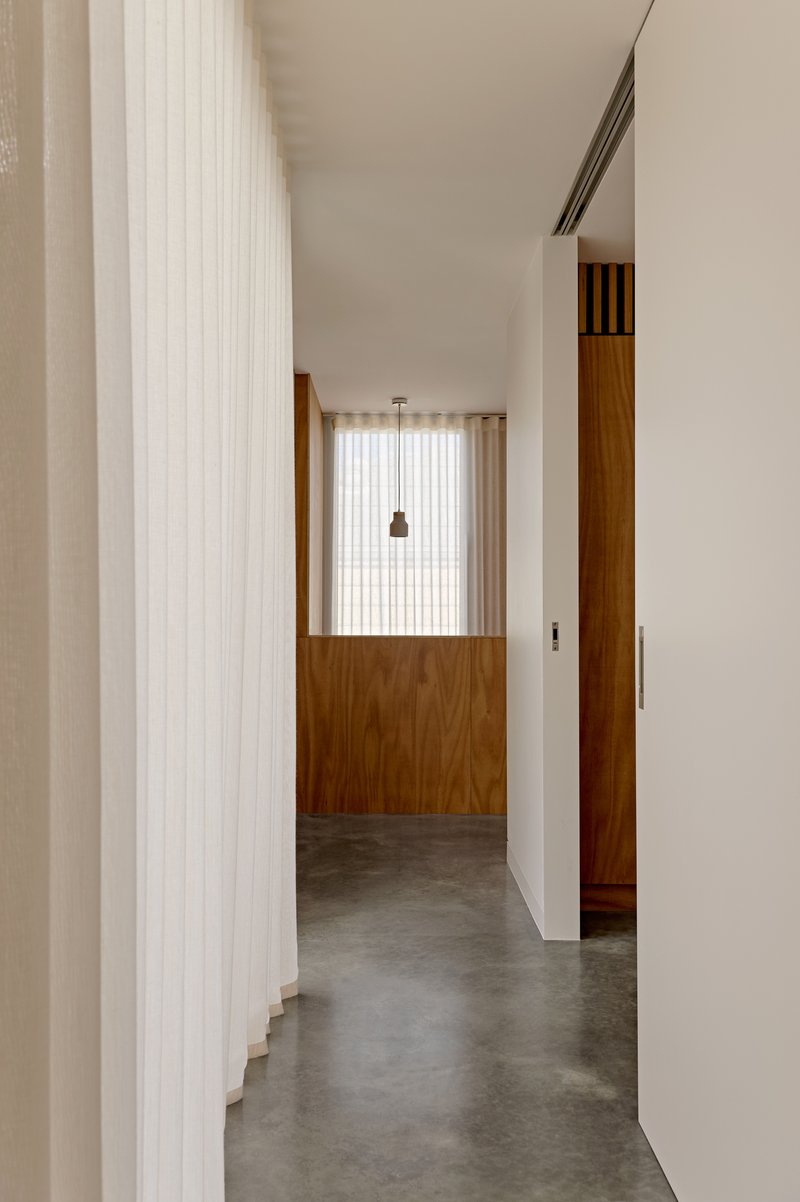
The drawings reveal the precision of the spatial strategy. The ground floor plan shows the L-shaped configuration clearly, with kitchen, living, and multipurpose spaces wrapping around the central courtyard. The first floor stacks bedrooms and bathrooms above, with a void over the backyard that preserves the courtyard's double-height volume. The roof plan indicates operable awning openings and skylights positioned to maximize daylighting and ventilation. The section drawing is particularly instructive, showing how the one-metre site slope is absorbed by the sunken living level, and how the double-height courtyard space creates vertical airflow through the entire house.
Why This Project Matters
Henville Street House matters because it refuses to treat a constrained suburban block as a limitation. Instead of cramming rooms into every available corner, Philip Stejskal Architecture carved out a generous void at the centre and let it organise everything else. The courtyard is not leftover space; it is the primary room of the house, the source of its light, air, and spatial character. On a 300-square-metre block with four close neighbours, that decision required genuine conviction.
The project also offers a compelling model for how suburban infill can engage with local climate and material culture without descending into nostalgia. The corrugated iron, the steel mesh, the climbing plants: these are Fremantle materials deployed with contemporary intelligence. The house does not look like a heritage cottage, but it thinks like one, orienting itself to the breeze, building with what is available, and trusting that time will improve what the architect started. As Australian cities continue to subdivide and densify, projects like this demonstrate that smaller lots do not have to mean smaller ambitions.
Henville Street House by Philip Stejskal Architecture. Fremantle, Australia. 106 m² (plus carport) on a 300 m² block. Completed 2021. Photography by Jack Lovel.
About the Studio
Share Your Own Work on uni.xyz
If projects like this are the kind of work you want to make, uni.xyz is a place to publish your own, find collaborators, and enter design competitions.




Popular Articles
Popular articles from the community

Guangzhou's Twin Towers Interiors Move Like Water
DuShe Architectural Design shapes the lobbies of a massive Guangzhou transit hub with undulating ceilings and deep geological materiality.
Art 1 Office Strips Athens Back to Its Bones
Neiheiser Argyros transforms a 40-year-old Athens office building into a vivid, materially rich workplace anchored by red steel, exposed concrete, and roof
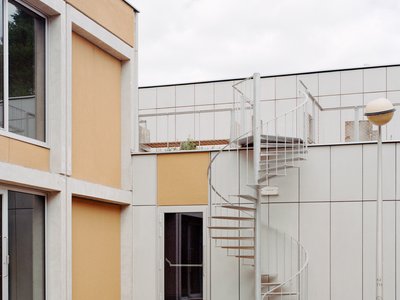
MAKER architecten Rewire a 1972 Brutalist Dormitory on the VUB Campus as a Living Lab
A modular renovation strategy in Belgium breathes new life into Willy Van Der Meeren's modernist student housing without erasing its concrete bones.

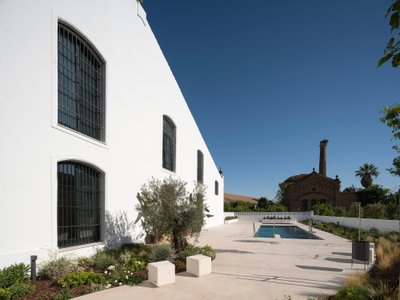
De la Riva Sherry Homes By Juan Vega Arquitectos
De la Riva Sherry Homes transform a historic winery into unique residences, blending industrial heritage, modern comfort, and community-focused courtyard living.


Similar Reads
You might also enjoy these articles
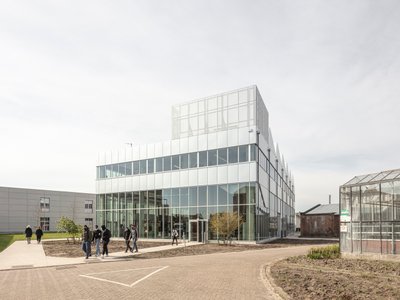
STEM School Mechelen by LAVA Architecten: A Future-Ready Educational Architecture in Belgium
Flexible, sustainable STEM school in Mechelen featuring modular classrooms, acoustic innovation, and energy-efficient design supporting future-focused collaborative learning environments.
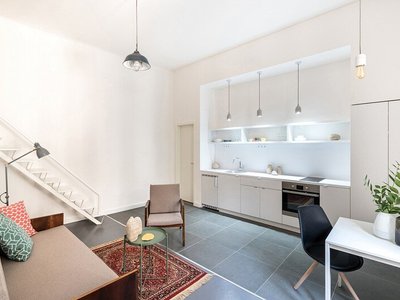
Marvila Apartment Renovation in Lisbon: A Bright Minimalist Attic Transformation by KEMA Studio
Bright attic transformed into minimalist Lisbon apartment with skylights, sustainable materials, open plan layout, and industrial-inspired interior design elements.

20 Most Popular Commercial Architecture Projects of 2025
From sustainable market concepts to heritage factories, the commercial buildings and proposals that drew the most attention on uni.xyz this year.
Mantiqueira House by SysHaus and M Magalhães Estúdio
A linear modular house embedded in Serra da Mantiqueira, integrating panoramic views, sustainable prefabrication, minimal terrain impact, and contemporary interiors.


Comments (0)
Please login or sign up to add comments
No comments yet. Be the first to comment!