

UPPER HOMES
Pocket Home competition

With the advancement and development of society, it is evident the impact that this has generated in communities and cities, affecting mainly the capacity of living space that cities have, so these cities have had to respond in an improvised way most of the time to meet the need for housing which is growing rapidly due to several factors such as quality of life, rural-urban migration and hope for personal development.
New York is one of the cities that is currently facing a housing deficit mainly due to two factors, on the one hand, due to its cultural interest, which annually brings to the city a large number of people both visitors and migrants. As a result of this and as proposed by the Pocket Home competition, the aim is to use the residual spaces of the city, which are the result of poor urban planning, as a result of this the project is to design a temporary modular system with the ability to provide habitability, which will be rented to a user or users for a maximum duration of six months because they will temporarily occupy these empty unused areas of the city, which at some point may cease to be unoccupied.
Therefore, to solve the problem of housing deficit in the city, the Upper Homes project seeks after studying the architectural culture of New York, to reinterpret the typical elevator present in the iconic skyscrapers, as a temporary habitable object, creating an analogy around this concept, the project has the ability to create a dynamic space in a small place giving the possibility to adapt to any vacant area of the city generating the opportunity for housing in constant displacement.
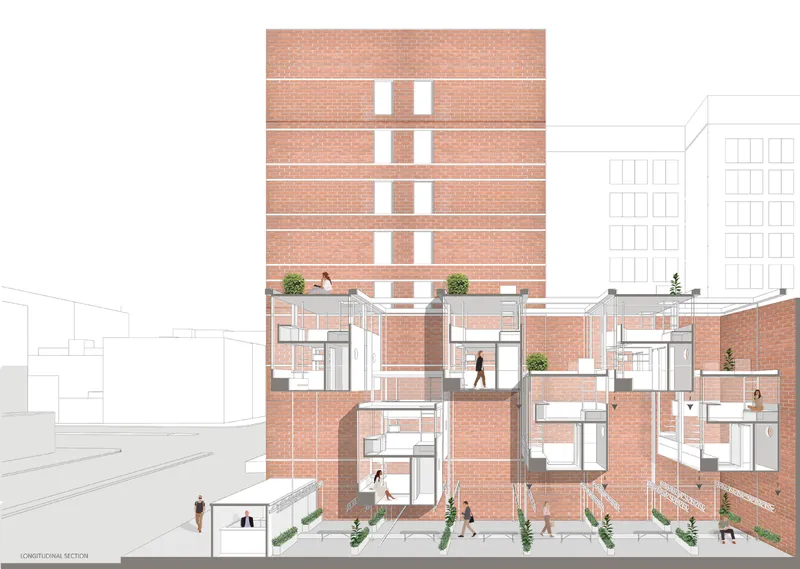
In consideration of the above, twelve double-height housing modules are proposed, which are arranged in two rows of six modules each, each module has the ability to rise and descend at the user's own will, generating the particular possibility of the user to seek their own natural light and allow a free vision for all inhabitants in the same way. For this same reason, the color white predominates in the design because this color, thanks to its reflective characteristic, enhances the little natural light that the modules receive given the morphology of the site. This module is located in a respective perimeter in which each modular housing is inscribed because it is designed to be implemented via a rail system that allows the vertical movement of the housing module. Likewise, a scaffolding system was designed on the first level that functions as a structural support to the modules located in the upper area, freeing the first level of large-scale interventions, to allow the creation of a common area that has the characteristic of generating multiple situations within this community as well as a personal space for each user.
As for the modular access, this is designed to enter the housing module through a hatch staircase located on the floor of the second floor, this second floor is designed to provide the basic services needed by one or two people target defined as working adults, therefore the services are composed of dishwasher, microwave and mini refrigerator, along with a mini refrigerator, A staircase is also used to provide access to the second floor of the module, where an area is designed that will have the capacity to function as a bedroom for one or two people, where there will be a folding bed to provide the necessary space. A semi-circular desk was also designed to reduce the loss of space in the work area, without sacrificing the comfort of the users on the respective floor, which will have the last access through a staircase to the fourth level where the roof garden is located.
In the roof garden a personal green space was designed for the user in the middle of the city, which has a strong psychological characteristic due to the possibility of creating a sense of permanence and belonging in the user.

Popular Articles
Popular articles from the community


Cube Design Draws an Ecological Corridor Between Two Shenzhen Hills with the Nankai Building
Beside Shenzhen's container docks, the Nankai Building pairs stacked balconies with a climbing green screen to connect two hillsides across its height.

GROUP A Strips a 1969 Rotterdam Harbor Headquarters to Its Frame and Wraps It in Timber Louvers
In Rotterdam's M4H harbor district, Ferro Offices reuses a 1969 frame, adds one timber storey and reaches BREEAM-NL Outstanding.

Jaramillo Van Sluys Arquitectura and Urbanismo Turn a Demolished Registry Lot in Quito into an Orchard Plaza
In Quito's Centro Histórico, a 2,800 m² plaza exposes the San Agustín convent wall and redraws its lost Augustinian orchard in volcanic stone.

David Macias Steps a Doorless Stone and Plaster House Down a Tropical Colombian Hillside
In the humid hills of Colombia, Threshold House replaces the front door with an open void and terraces its 850 m² down the slope instead of fighting it.

Similar Reads
You might also enjoy these articles


Vereda Arquitetos Renovates a 40-Square-Meter Apartment Inside Niemeyer's Copan Building
A compact unit in São Paulo's most iconic residential tower gets a material overhaul that pairs exposed concrete with bold blue Formica.

Shakur's House: Exposed Brick as an Interior Organiser in a 168 m² Mashhad Residence
Brick moves indoors in this Mashhad residence, where masonry walls, glass partitions and teal planes sequence a compact home without closing it off.

Day and Night Park: A Time-Based Urban Newsstand in Beijing
A temporary urban newsstand in Beijing blending travel, light, and reading through poetic colors, compact form, and community-focused design.

Modernist Patio Renovation in El Masnou, Barcelona by Oliver Segura Arquitectura + Cebrià Arquitectura
Modernist patio renovation blending tradition and innovation with a movable pool, leveled floors, and Catalan materials in El Masnou.

Explore Architectural Rendering Competitions
Discover active competitions in this discipline


Challenge to visualize a collision of the future and past

Challenge to visualize future spaces of waste

Challenge to visualize slums of 2080

Challenge to illustrate the ruins of Petra
Comments (0)
Please login or sign up to add comments
No comments yet. Be the first to comment!