

b720 Wraps a Madrid Office Block in Orientation-Tuned Concrete Fins That Think for Themselves
Polaris North replaces an obsolete phone-book headquarters in Hortaleza with a climate-responsive facade calibrated to four solar angles.


A phone book company's old headquarters is not the kind of building anyone fights to preserve. When b720 Fermín Vázquez Arquitectos took on the site at Avenida de Manoteras 12 in Madrid's Hortaleza district, they kept the foundations and ground-level structure as a concrete platform, then demolished everything above and started over. The result is Polaris North: five floors of open-plan office space sitting on a reused base like a new organism grafted onto old roots. At 14,400 square meters, it earned LEED Gold and WELL Silver certifications, but the numbers matter less than the thinking that produced them.
What makes this project genuinely interesting is a single idea executed with unusual rigor: the prefabricated concrete facade changes its geometry on every orientation. North gets more opacity. South gets a setback with a green buffer. East and west get angled mullions that throw longer shadows. Four angles, one material system, zero decorative posturing. It is an office building that treats its skin as a working instrument rather than a billboard.
A Facade That Reads the Compass
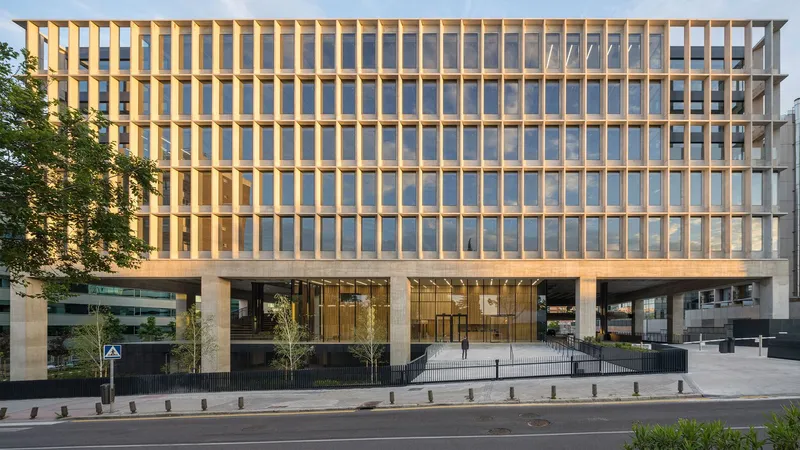
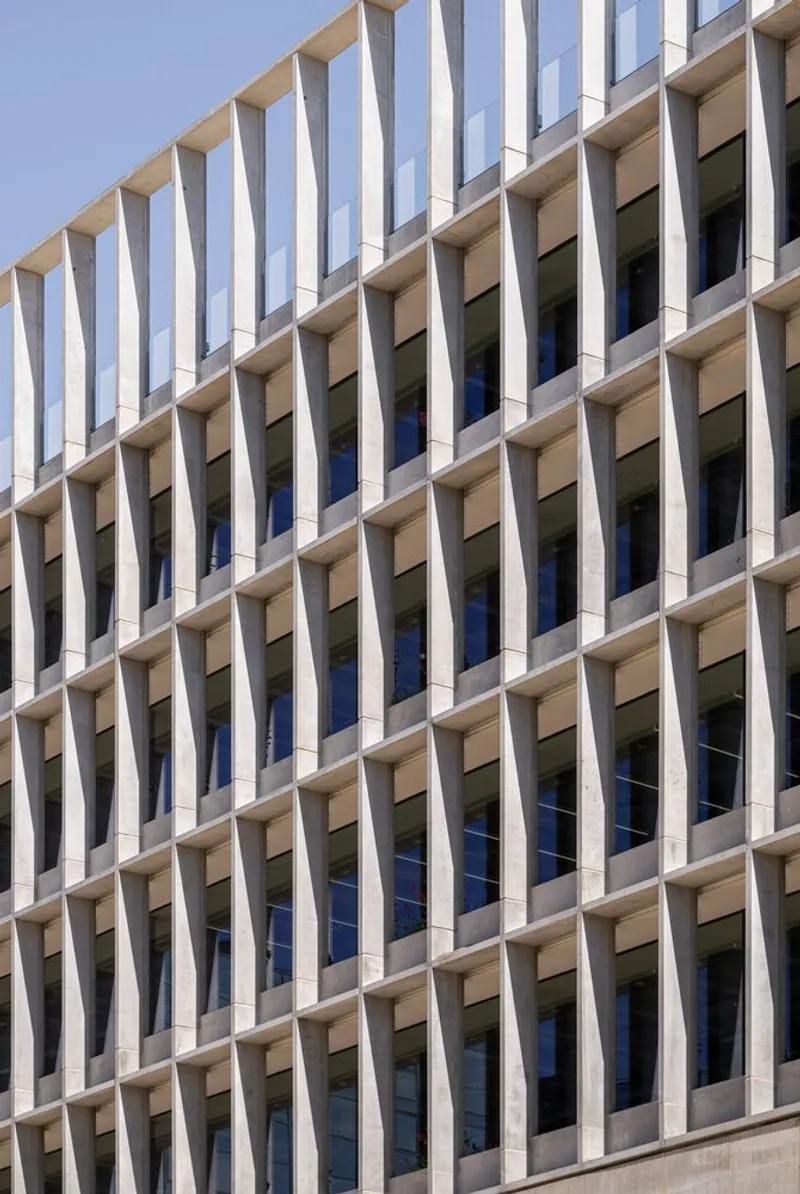
The defining move at Polaris North is the modular prefabricated facade, assembled from standardized concrete elements whose ribbed panels vary in geometry and inclination depending on where they sit on the building. The east and west elevations deploy concrete mullions tilted to maximize the shaded area during the hours when low-angle sun is hardest to control. On the south side, the enclosure steps back entirely to create a planted strip that functions as a living solar screen. The north facade, by contrast, favors opaque panels over glass to cut conductive heat loss during winter. It is a single architectural language spoken with four accents.
Crucially, the framework that supports these elements is designed to be either integrated with or separated from the building envelope. Where it detaches, climbing plants can colonize the gap, adding a biological layer of shading that will deepen over time. The building is designed to get better at its job as it ages.
The Concrete Table
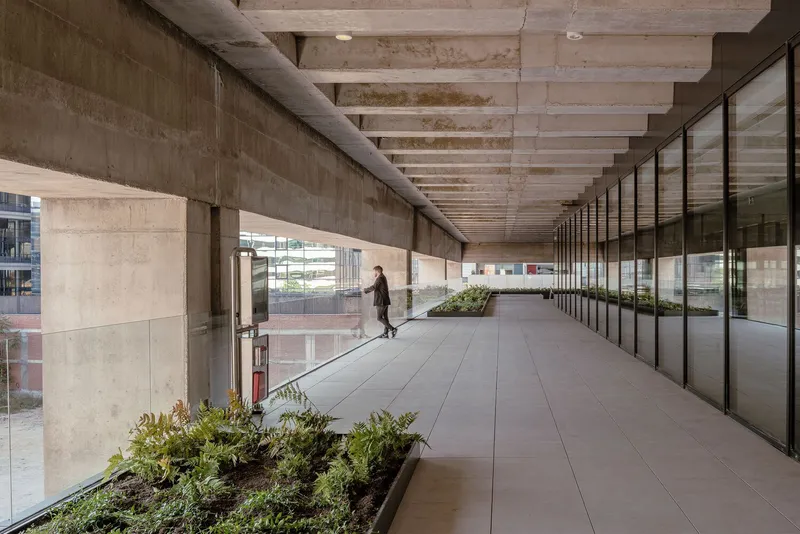
Rather than demolishing the entire pre-existing structure, b720 retained its foundations and lower levels to serve as a concrete "table top," a platform from which the new building rises. This is both pragmatic and conceptually clean. The ground level opens as a loggia: a deep, porticoed reception area stretching across 70 meters of frontage onto Manoteras. Ribbed concrete soffits run overhead, creating a covered walkway that filters light and shadow in equal measure.
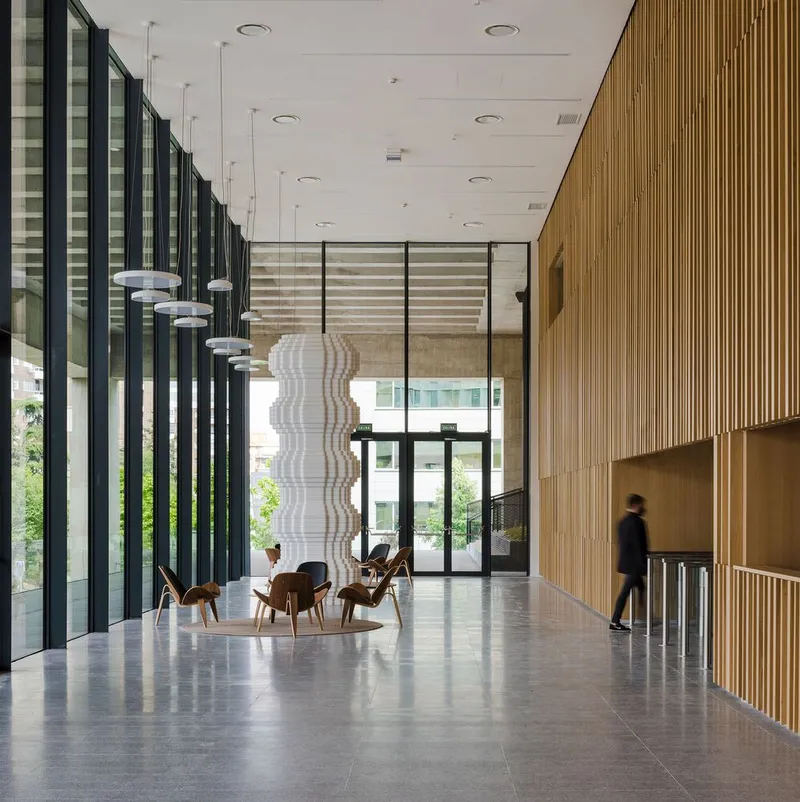
The lobby itself is restrained. Polished concrete floors, timber-slatted walls, and enough ceiling height to feel civic rather than corporate. There is no atrium spectacle here, just proportion and material honesty doing the work that marketing renders usually have to fake.
Courtyards and Light Wells
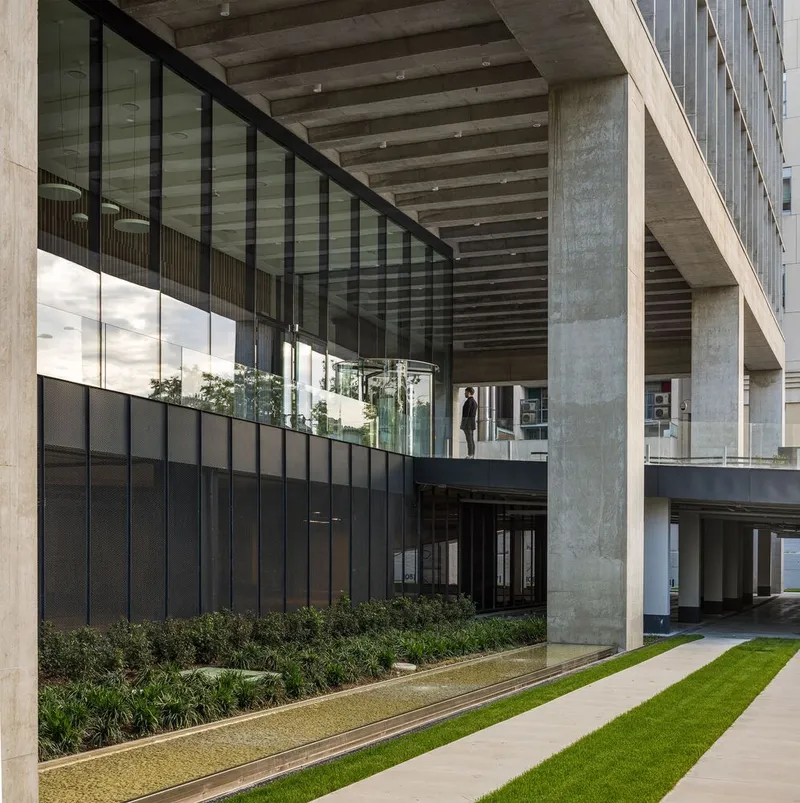
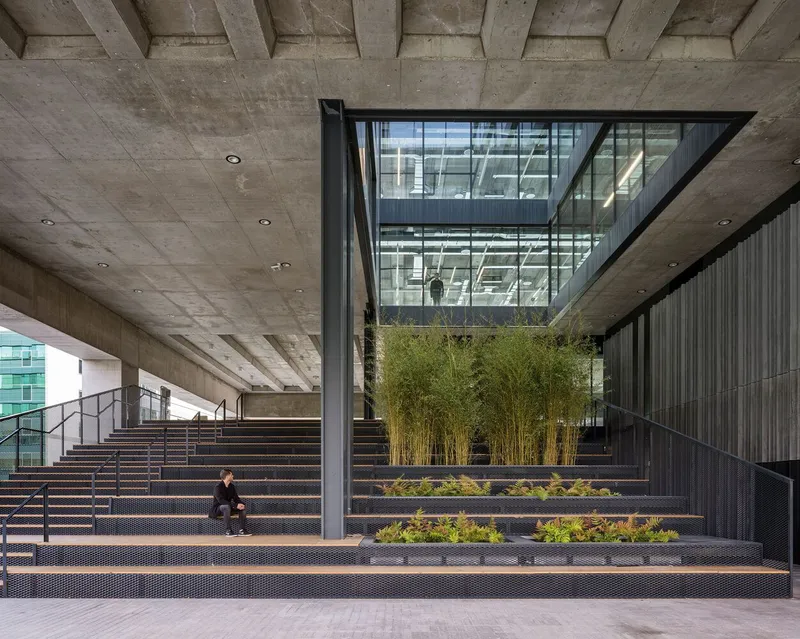
Two interior courtyards flank the central core, punching daylight deep into what would otherwise be a broad, dim floor plate. The courtyards do double duty: they bring natural light to the peripheral work areas while also creating intermediate outdoor rooms that break the monotony of continuous open-plan space. Planted beds and tiered seating steps occupy these voids, offering informal meeting and decompression zones that feel like they belong to the building rather than being bolted onto it.
The tiered seating at courtyard level, set beneath coffered concrete ceilings and flanked by bamboo, is the kind of space that earns a WELL certification honestly. It is not a wellness room with a motivational poster. It is architecture that makes sitting outside during a coffee break feel like a reasonable thing to do, even in a Madrid summer.
Open Floors, Central Core
Above the loggia, each of the five floors follows the same organizational logic: a central core containing services and vertical circulation, surrounded by column-free peripheral work areas. Post-tensioned slabs eliminate intermediate columns, giving tenants the freedom to configure the space however they need. The peripheral structural line is coordinated with the facade module, so structure and skin share a common rhythm. Nothing is fighting anything else.
A variable refrigerant volume (VRV) air conditioning system allows zone-by-zone climate adjustment, which matters when one side of a building is getting hammered by afternoon sun while the other is in shade. It is a mechanical complement to the passive strategies already embedded in the facade, and it means the building can respond to partial occupancy without wasting energy conditioning empty zones.
The Rooftop as Urban Room

The rooftop terrace extends the building's usable exterior space to its highest point, framed by a concrete privacy screen and planted beds that soften the edge between architecture and sky. From here the Madrid skyline spreads out under the kind of dramatic cloud cover the city delivers in autumn. It is not a penthouse amenity; it is a deliberately designed fifth elevation, finished with the same material discipline as the ground-level loggia.
Plans and Drawings
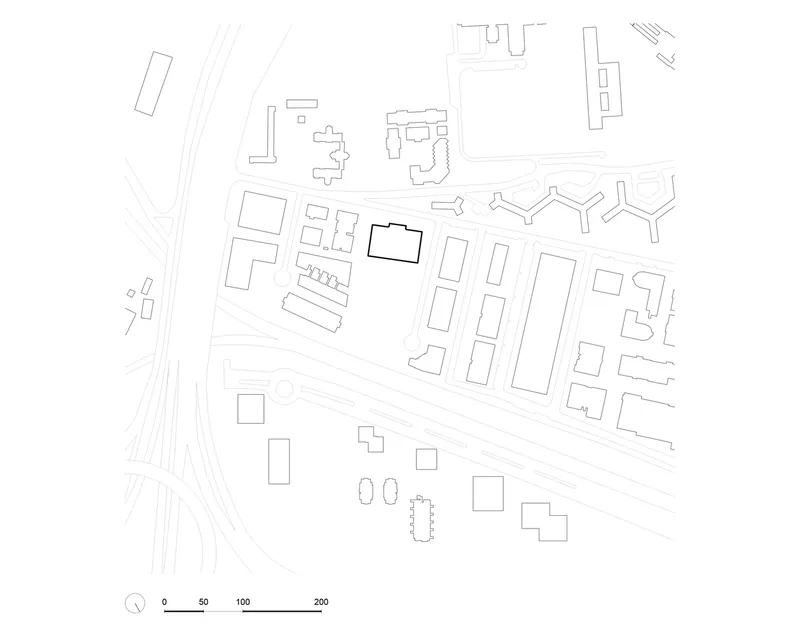
The site plan reveals how the building fills its urban block with a long bar oriented to maximize the 70-meter Manoteras frontage. The two courtyard voids are clearly legible as carved-out zones within the footprint, positioned symmetrically around the central core. This compact, rational geometry is what allows the facade strategy to work: because the plan is simple, each elevation can be treated as a distinct climatic problem with a distinct material response.
Why This Project Matters
Polaris North matters because it demonstrates that sustainable office architecture does not require exotic materials, complex geometries, or a manifesto. It requires discipline. b720 took a standard commercial brief, a tight urban site with an existing foundation, and a single material system, then calibrated every variable with enough precision to earn LEED Gold without resorting to technological spectacle. The facade is the argument: concrete fins doing the math of solar incidence so the HVAC system doesn't have to.
More broadly, the project represents a credible model for what happens when European cities need to replace their aging commercial stock. Rather than wiping the slate clean, b720 kept what worked, the foundation, the structural platform, and replaced what didn't. The result is an office building that is both a product of its site's history and a refusal to be limited by it. In a market flooded with glass-curtain-wall spec offices, that counts as a radical act.
Polaris North Offices by b720 Fermín Vázquez Arquitectos. Madrid, Spain. 14,400 m². Completed 2021. Photography by Imagen Subliminal (Miguel de Guzmán + Rocío Romero).
About the Studio
Share Your Own Work on uni.xyz
If projects like this are the kind of work you want to make, uni.xyz is a place to publish your own, find collaborators, and enter design competitions.


Popular Articles
Popular articles from the community


Cloaked Colonization: A Mobile Underwater Habitat That Moves Like a Fish
Micah Abaya's shortlisted EHC Pacific entry reimagines ocean settlement as a dispersed network of self-sustaining architectural organisms.

Manzana Morphosis: Stretching Barcelona's Grid into a Living Landscape for 2050
A radical reworking of the Eixample manzana turns density into a tool for generous public space, vertical ecology, and environmental performance.
Opera by the Sea Estonia: Three Shells Dissolving Architecture into Tallinn's Coastline
A winning opera house proposal replaces monumental form with interconnected shells that blur the boundary between building, park and Baltic Sea.
Extended Shell: Retrofitting Kolkata's Balconies as Living Urban Thresholds
A modular retrofit system recovers the social and environmental intelligence of Kolkata's historic verandas for contemporary Park Street residents.

Similar Reads
You might also enjoy these articles


Hodi-Mandai Geram
Project Function: Preservation and revitalization of the Intangible heritage and socio-spatial identity of the Hodi by Housing, Cultural Memory Center, Sacred Grove, landscape, local tourism economy


Olio Towers: A Mid-Rise for Performers That Fuses Housing, Rehearsal, and Stage
Located blocks from Houston's Theater District, this modular tower stacks living units around a central performance atrium.

Oasis: Modular Green Housing Carved into Dhaka's Urban Fabric
A shortlisted Plugin Housing entry reclaims unauthorized settlements in Dhaka with stepped concrete volumes, green roofs, and ventilation-driven design.

Black Hole: A Floating Megastructure for the Post-Physical Era
Emiliano Mazzarotto envisions a spherical, self-scaling arena where e-sports, digital hotels, and holographic stadiums replace traditional public space.

Explore Office Building Competitions
Discover active competitions in this discipline

Challenge to reimagine the Iron Throne

Photograph architecture without architects

Illustrate the lost glory of Angkor Wat - Render Challenge

Design challenge to reuse E-waste
Comments (0)
Please login or sign up to add comments
No comments yet. Be the first to comment!