
Ponomarenko Volodymyr Carves a Day-to-Night Café from Concrete Terraces in Central Warsaw
HOOD Café on Poznańska Street pairs raw materiality with surgical geometry across 108 square meters of split-level hospitality.


A ground-floor unit inside a restored 1904 tenement house on Poznańska Street is not the obvious site for a spatial experiment, yet Kyiv-based architect Ponomarenko Volodymyr has turned this 108-square-meter slot into something more than a coffee shop. HOOD Café in Warsaw's Śródmieście district is a space built on contradictions: cold steel against warm timber, terraced concrete against soft plaster, morning light against evening shadow. The café runs on a continuous cycle, flipping from a bright daytime coffee service to a moody evening venue, and the architecture does the heavy lifting for both identities.
What makes HOOD genuinely interesting is the decision to treat a compact hospitality fit-out as a topographic problem. Rather than laying out tables on a flat floor and calling it done, Ponomarenko introduces stepped concrete platforms that carve the room into distinct zones of speed and stillness. You can grab a coffee at the cantilevered counter and leave, or you can descend into the sunken seating and stay for hours. The material palette, built on a triad of polished concrete, raw white plaster, and dark timber, is deliberately restrained so that the architecture of the floor itself becomes the primary design gesture.
Inhabiting the Facade
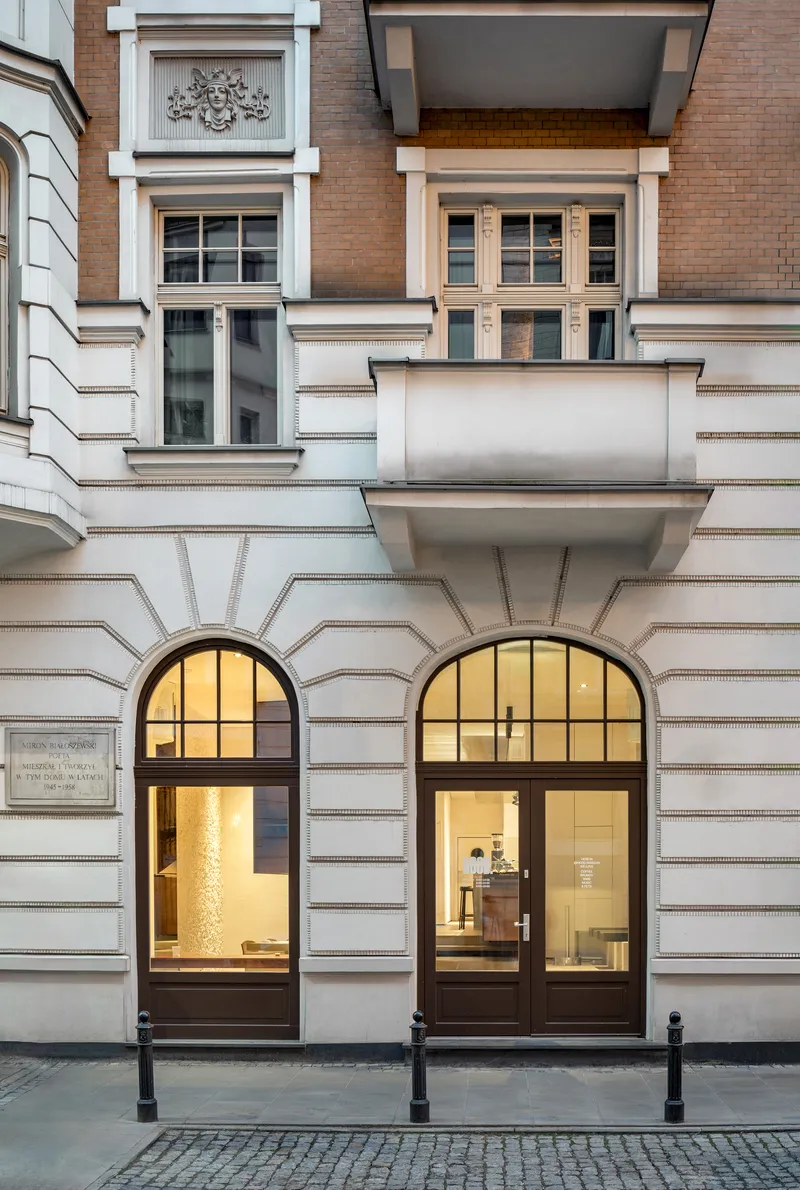
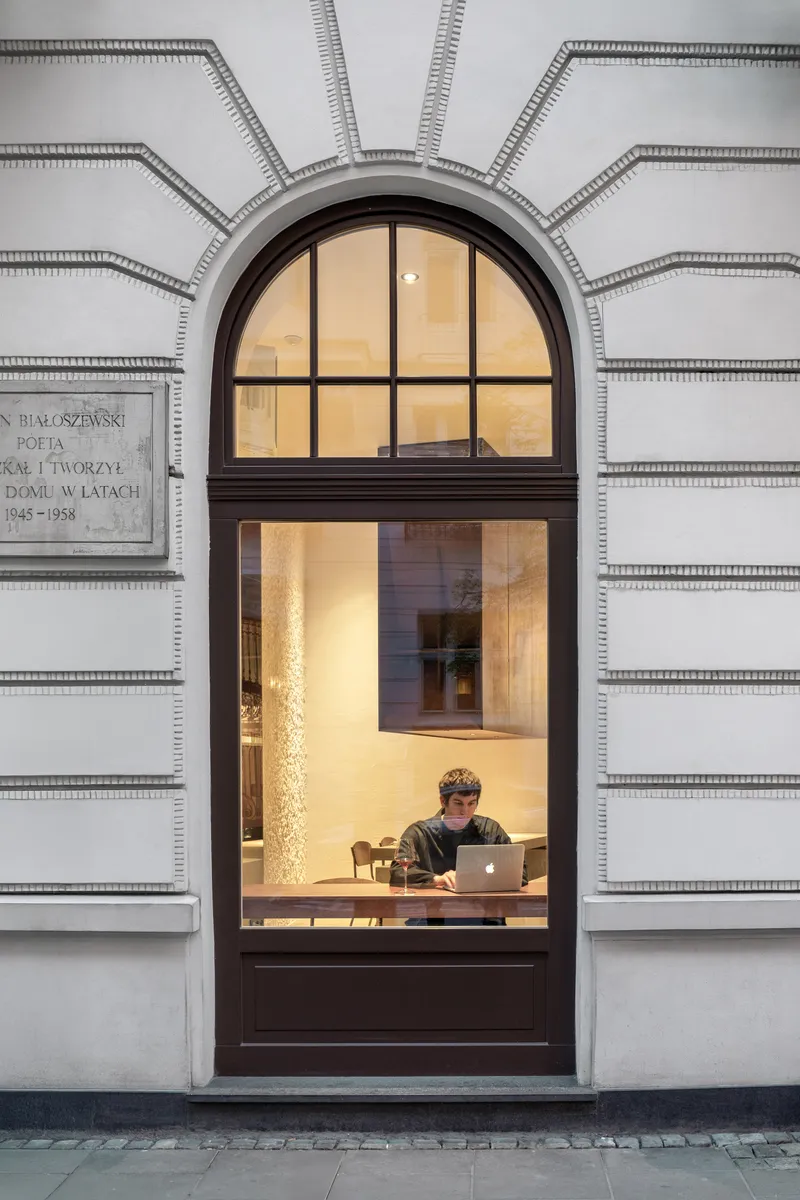
The building at 37 Poznańska Street has an ornate early-twentieth-century facade with rusticated stone arches and deep window reveals. HOOD occupies the base of this structure, and the relationship between old shell and new interior is handled with care. The arched entryways at street level are left intact, framing views into the café's illuminated interior at dusk. A person working inside, visible through the stone archway, collapses the distance between the historic streetscape and the stripped-back geometry within.
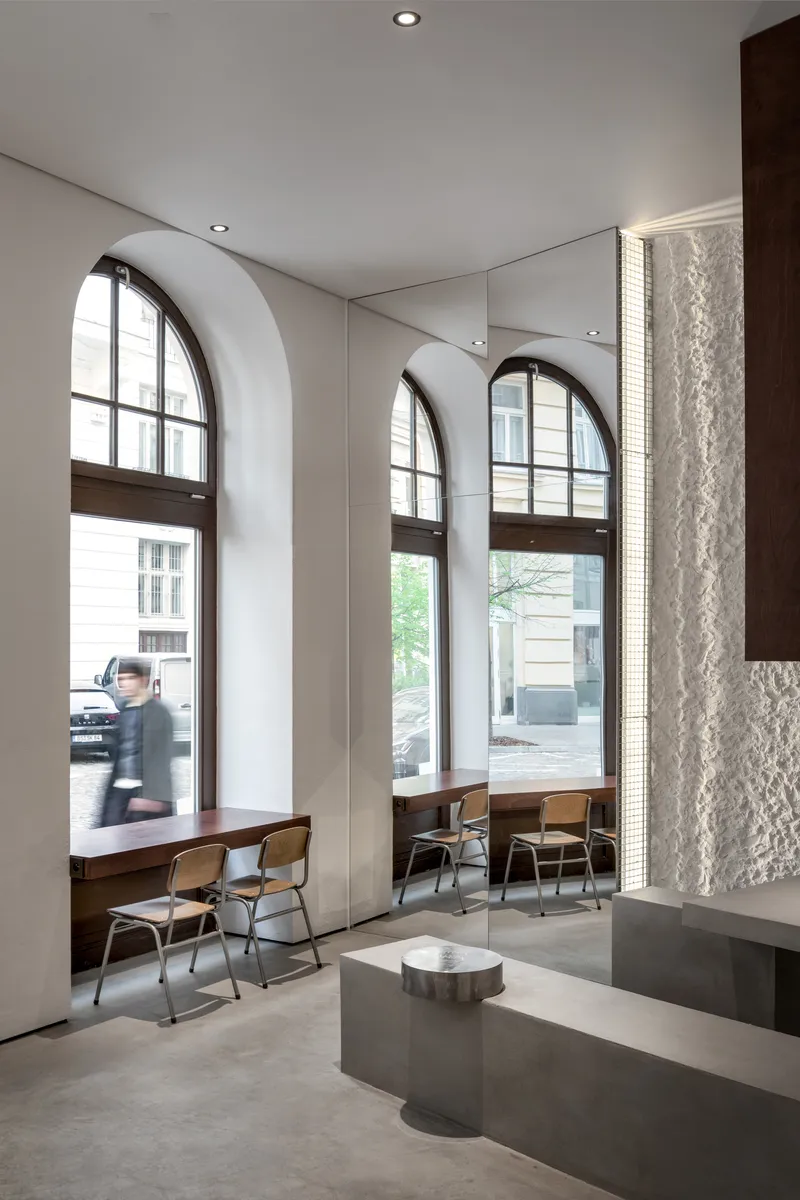
Tall arched windows flood the interior with daylight, which bounces off floor-to-ceiling mirrors and stainless steel surfaces to reach the deepest corners of the plan. The deep reveals of those windows double as informal seating niches, turning the facade's structural thickness into usable space rather than treating it as a neutral boundary.
Concrete as Topography
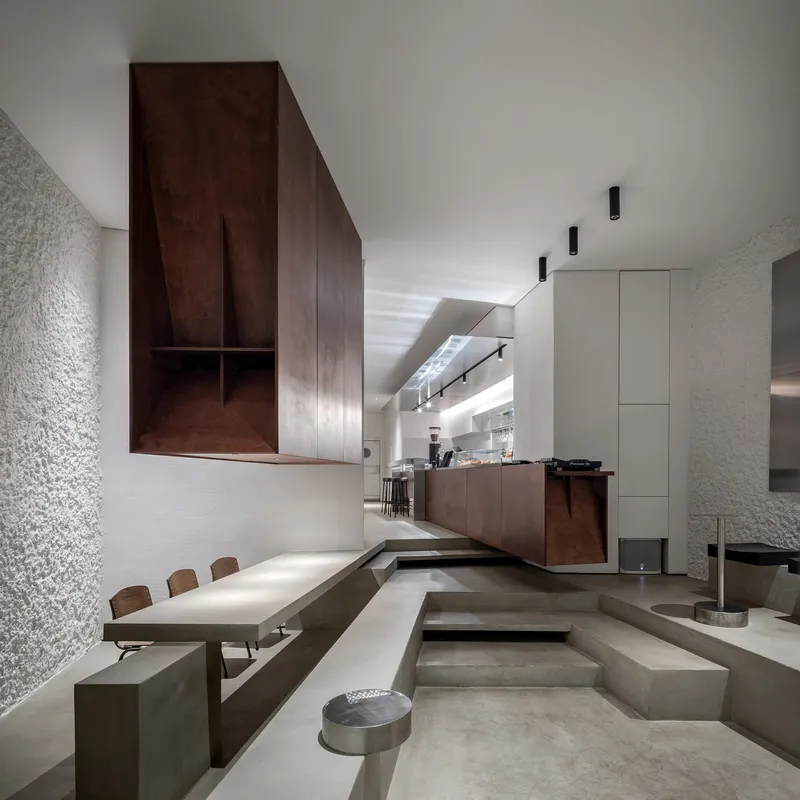
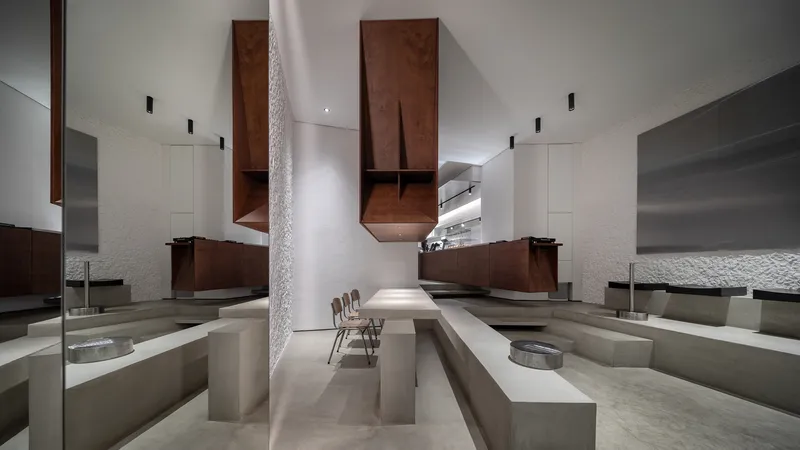
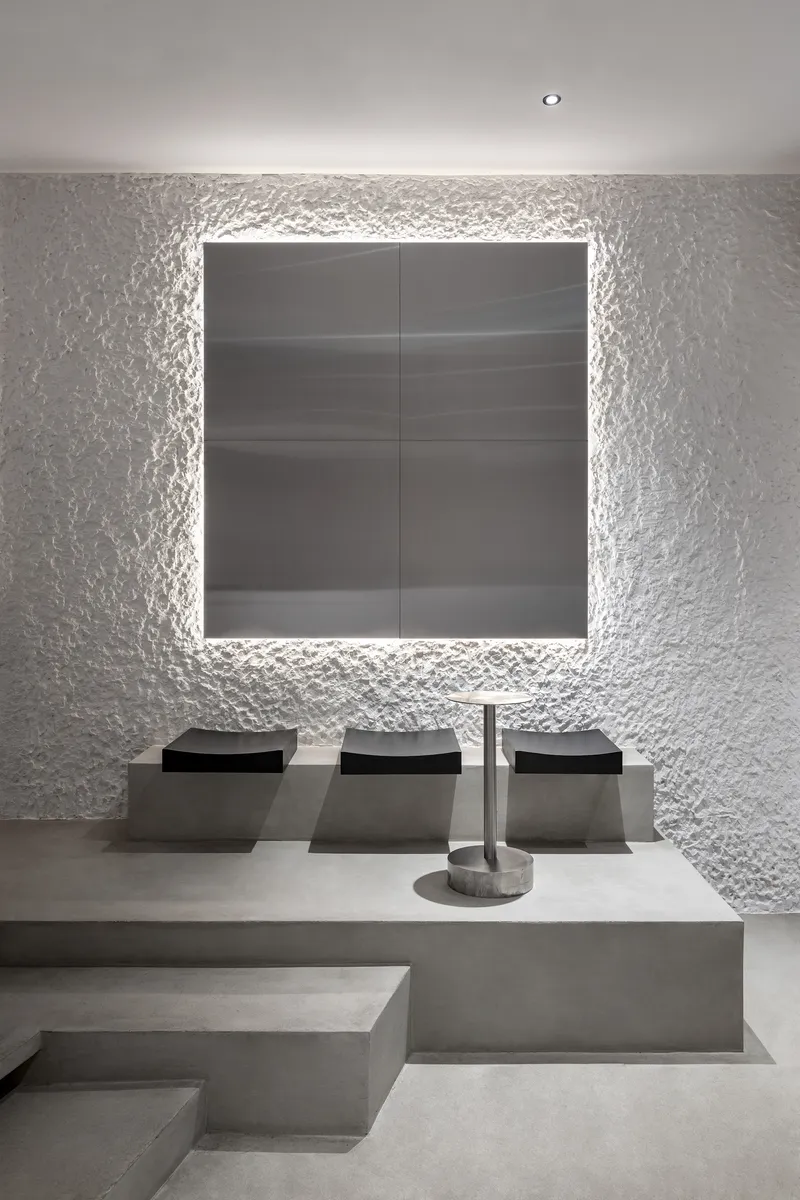
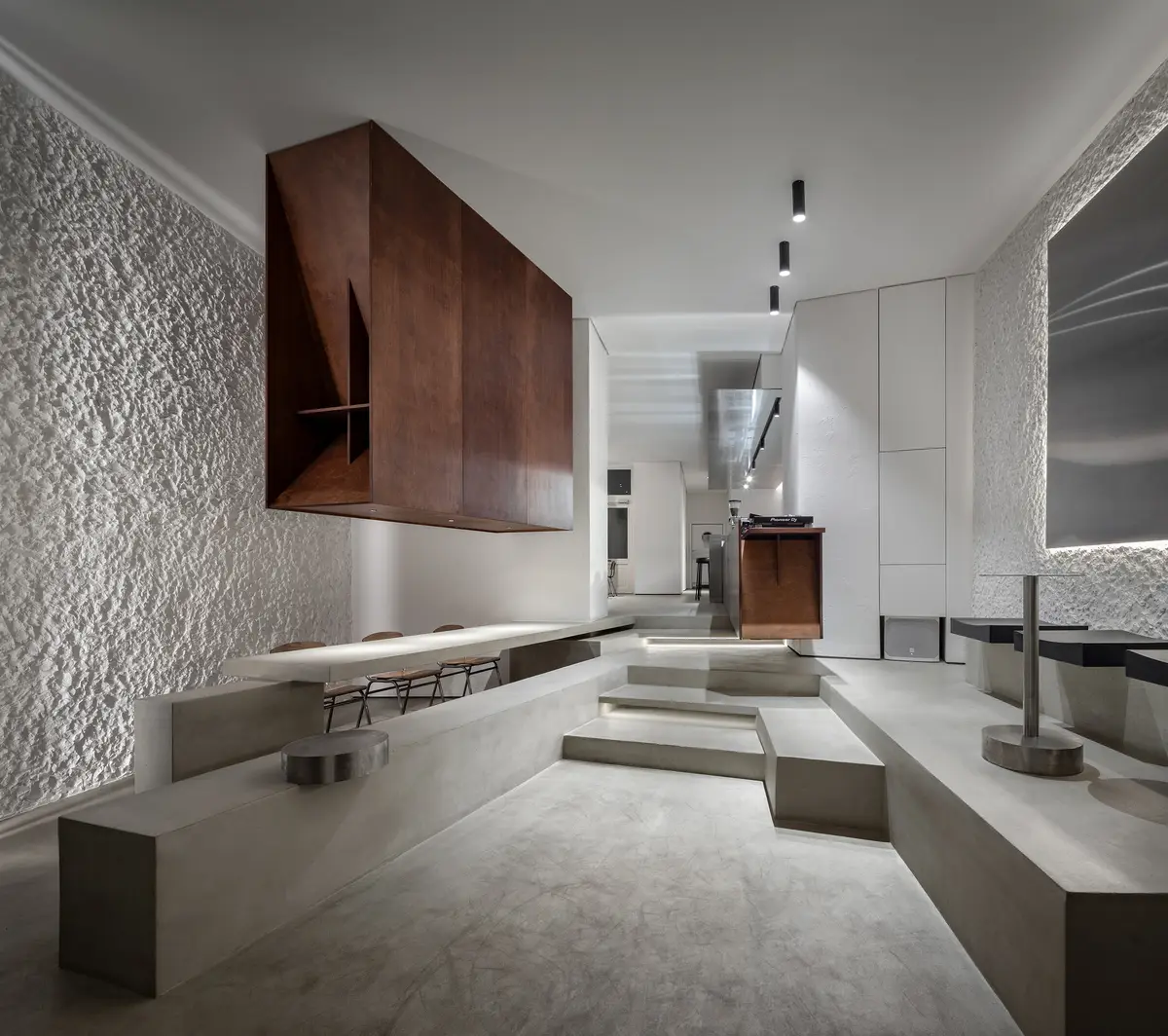
The stepped concrete seating is the defining move. Ponomarenko uses variance in floor level to separate rapid-transit zones from areas meant for slow dwelling, without a single partition wall. Upon entry, terraced platforms descend toward a lower seating area, creating a kind of miniature amphitheater. The communal concrete table aligns with the upper section's floor level, making the transition between standing and sitting feel continuous rather than abrupt.
The concrete is polished but not precious. It reads as infrastructure, closer to a public staircase than a piece of furniture. That bluntness is the point. In a city where café interiors tend toward either maximalist historicism or Scandinavian softness, HOOD's terraces feel genuinely alien, more archaeological excavation than interior design.
The Hovering Timber Volume
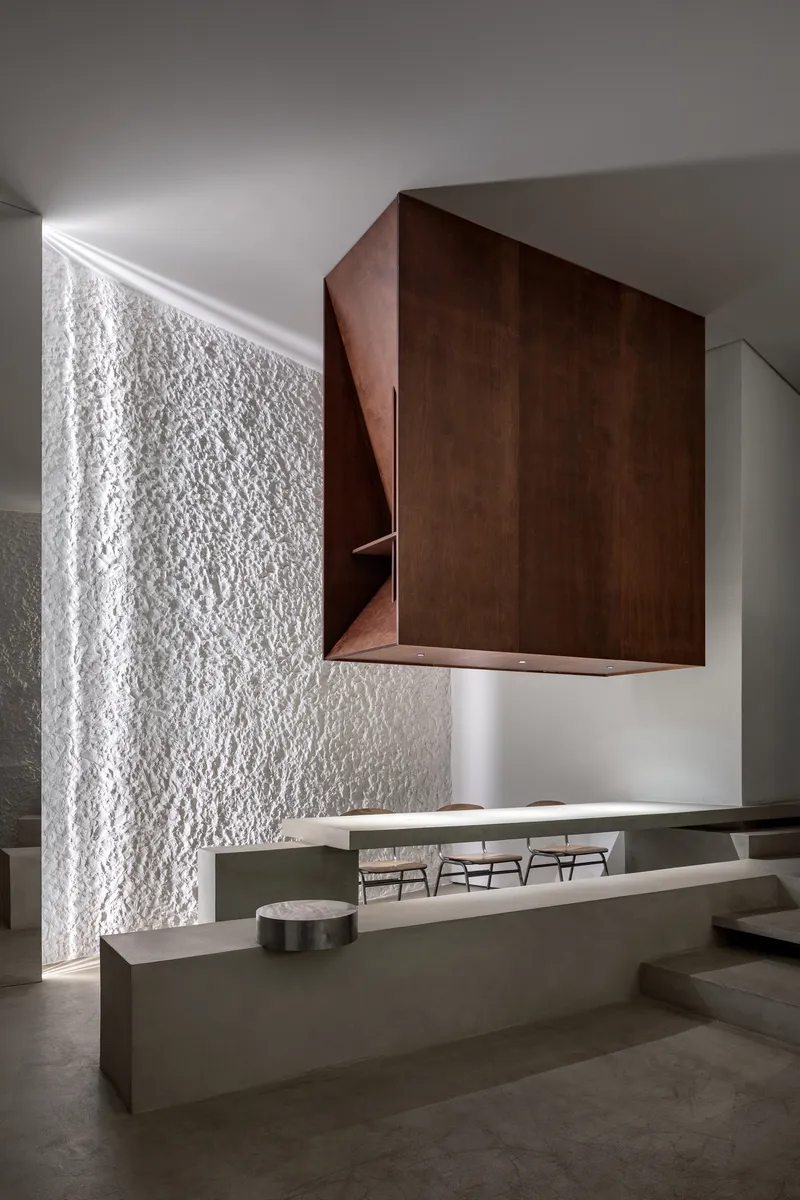
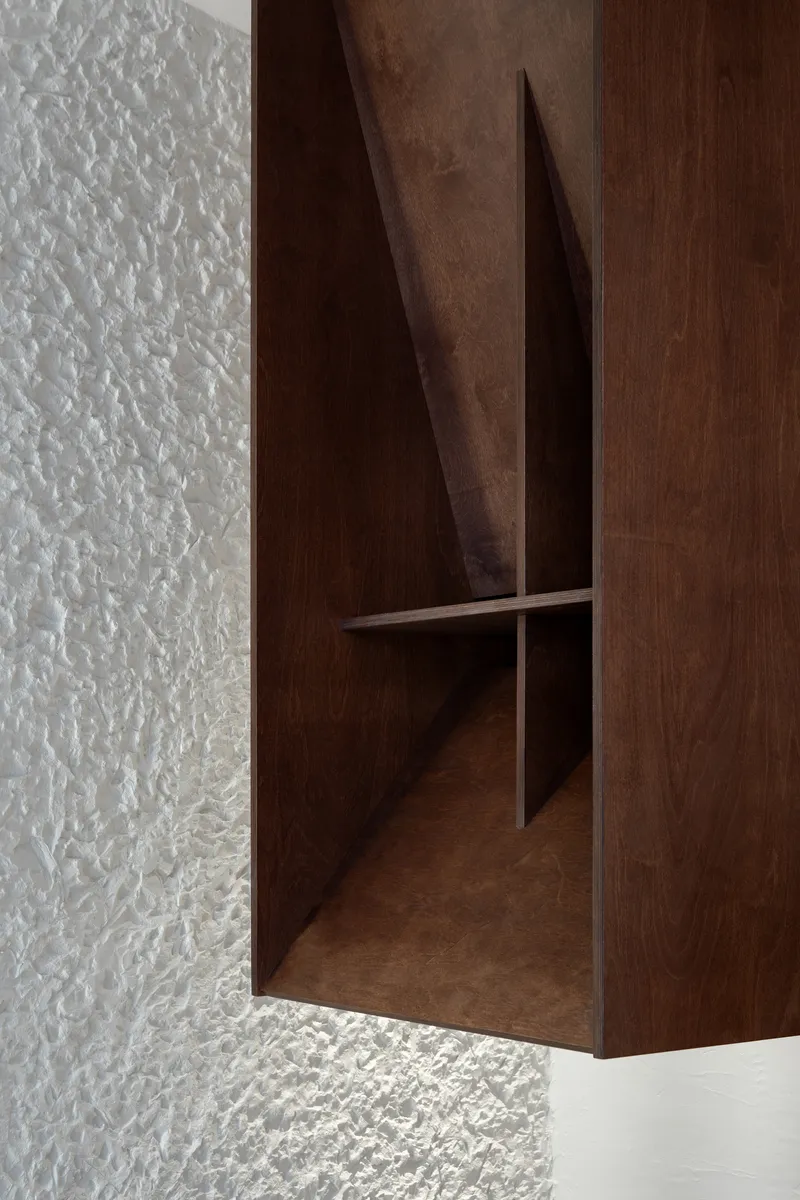
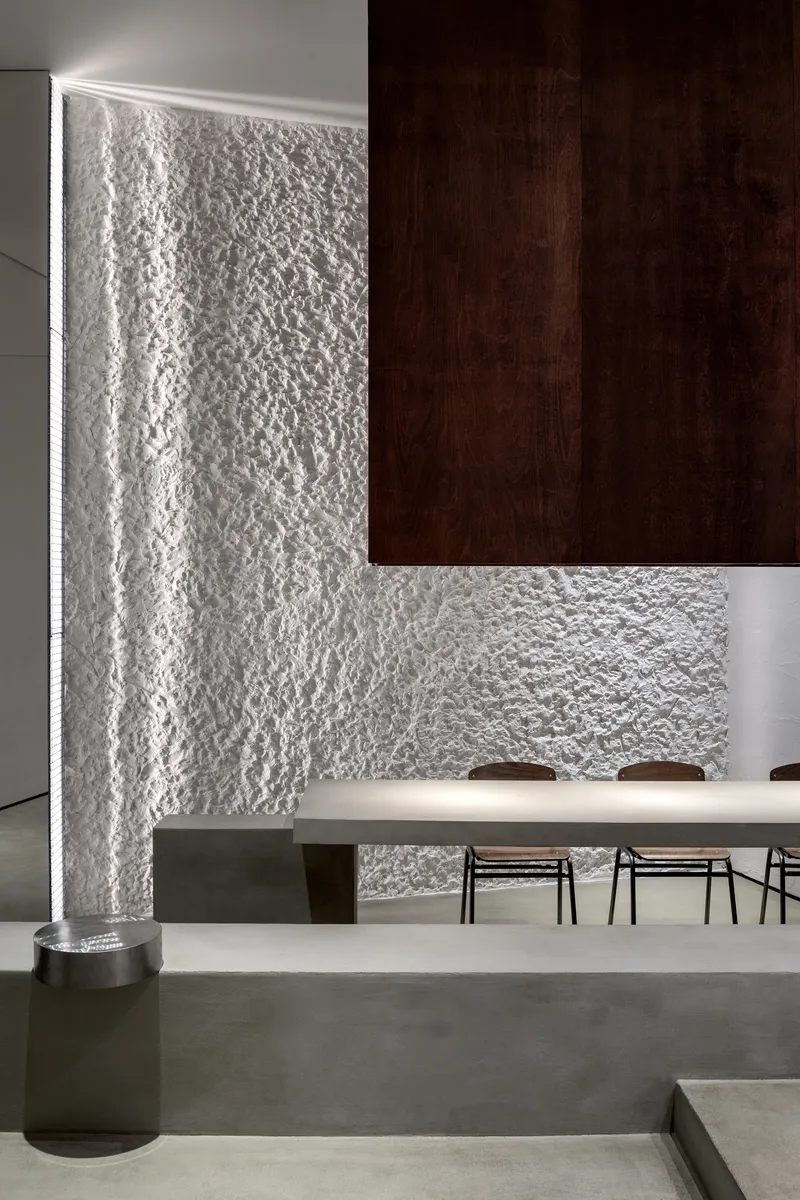
Suspended from the ceiling, a large dark timber volume floats above the concrete platforms like a piece of cabinetry scaled up to architectural proportions. It encases light fixtures and conceals storage, but its real purpose is tonal. Against the rawness of white plaster and grey concrete, the walnut introduces warmth and specificity. A triangular opening cut into the volume reveals interior shelving, giving the mass a sense of hollowness that keeps it from reading as oppressively heavy.
The cantilevered relationship between timber and concrete is precise. The volume never touches the walls, maintaining a shadow gap that emphasizes its object-like independence from the room's shell. It is the closest thing HOOD has to decoration, and it works because it earns its presence structurally rather than ornamentally.
Steel, Plaster, and the Logic of Three Materials
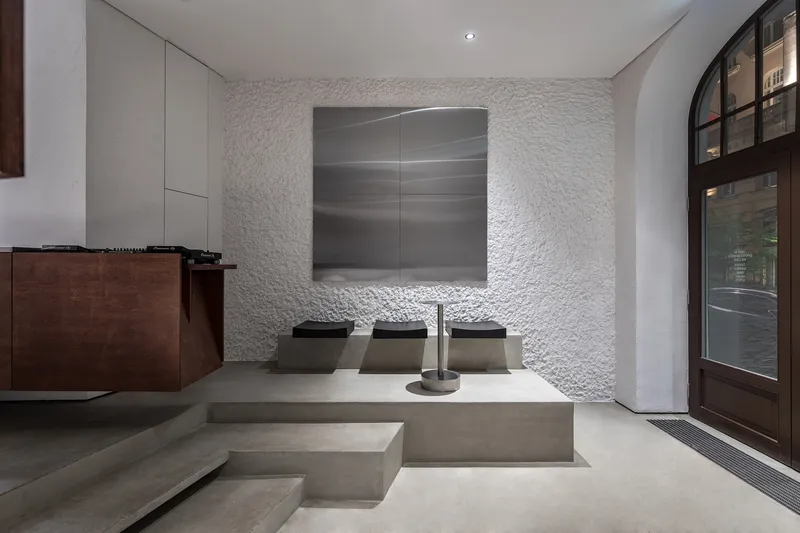
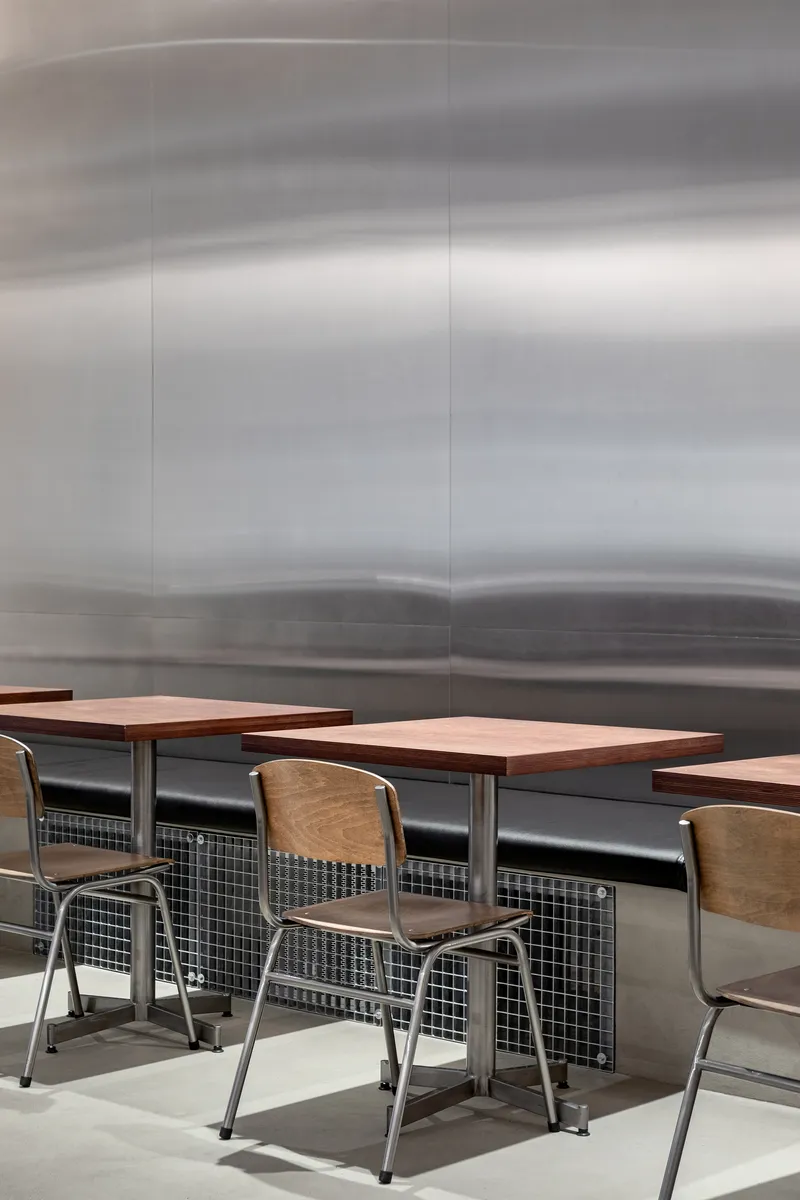
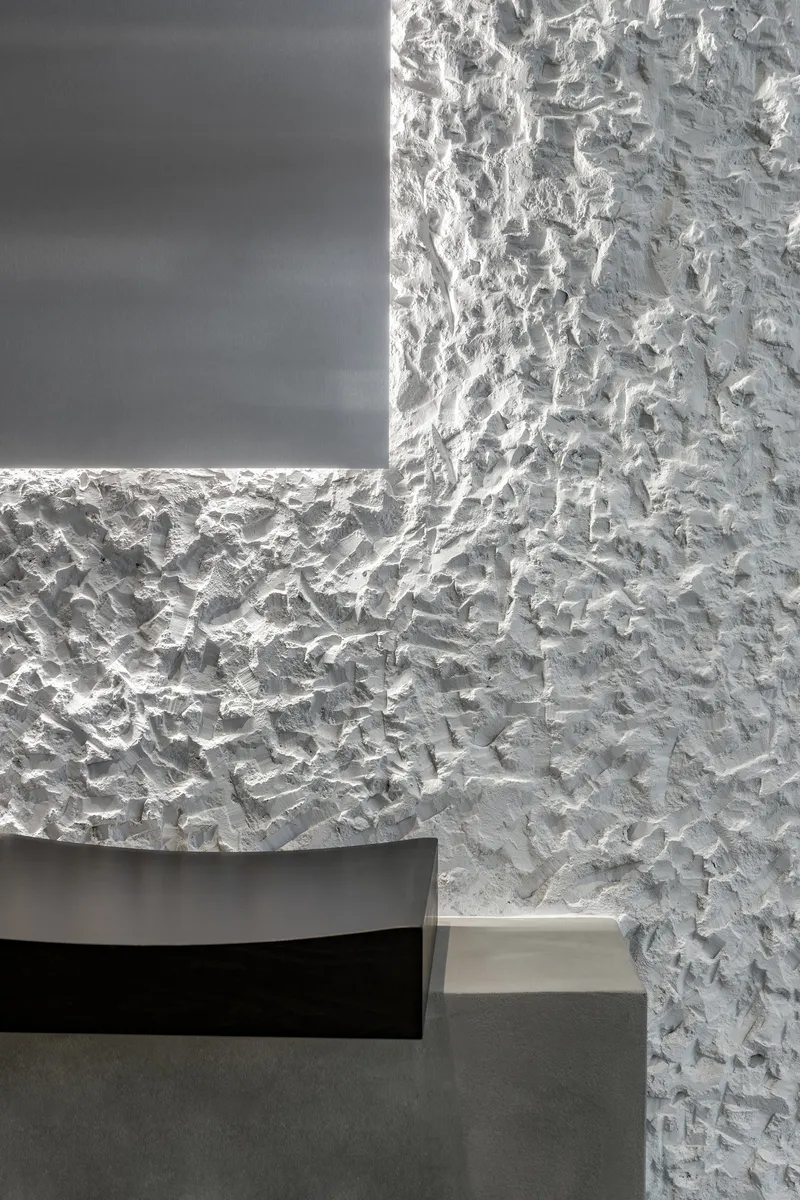
Ponomarenko's palette is a strict triad: polished concrete, raw white plaster, and stainless steel. The plaster walls have a coarse, almost geological texture that absorbs light and sound. Brushed steel panels appear as backlit landscape murals or reflective surfaces that optically expand the room. The contrast between the matte plaster and the mirrored steel creates a constant push and pull, with one surface swallowing light and the other throwing it back.
The corner detail where rough plaster meets a recessed dark panel with concealed lighting is a good example of how carefully these junctions are resolved. There is no trim, no transitional molding. The materials simply stop, and the gap between them becomes a light line. It is a detail language borrowed from gallery design, applied here with enough restraint to avoid preciousness.
The Service Counter and Bar
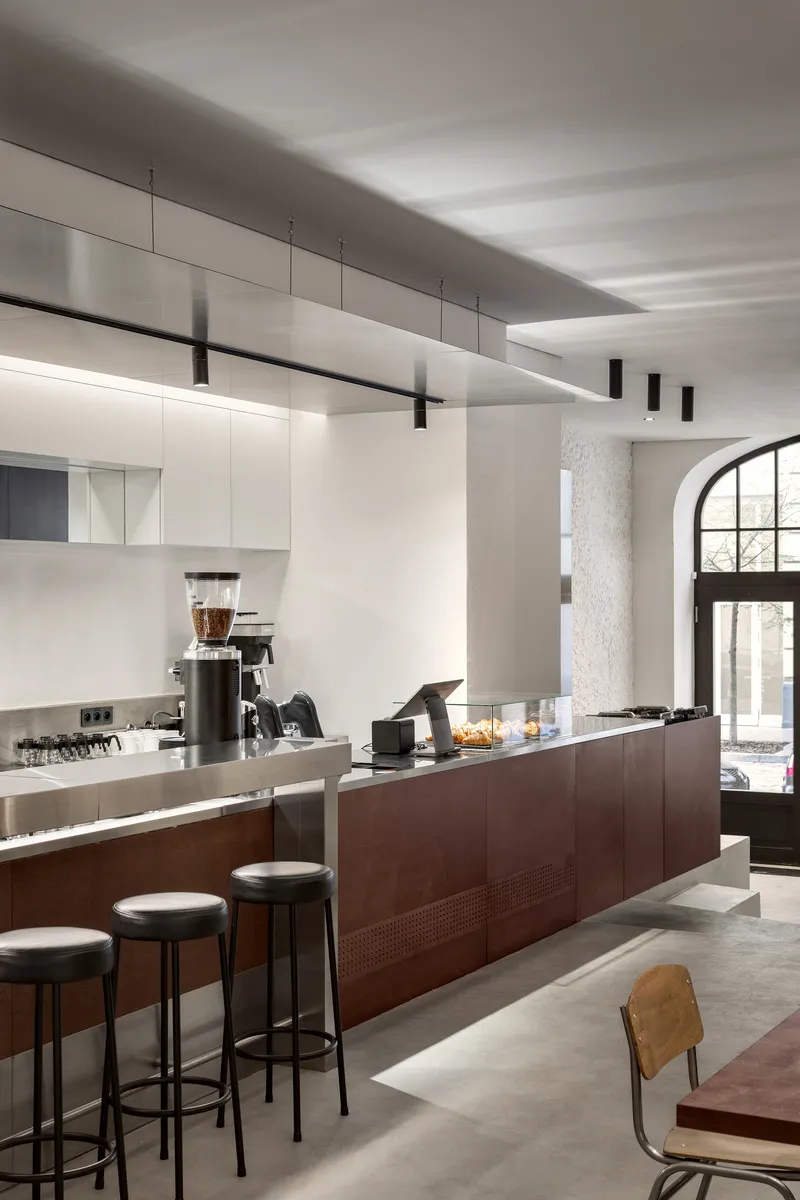
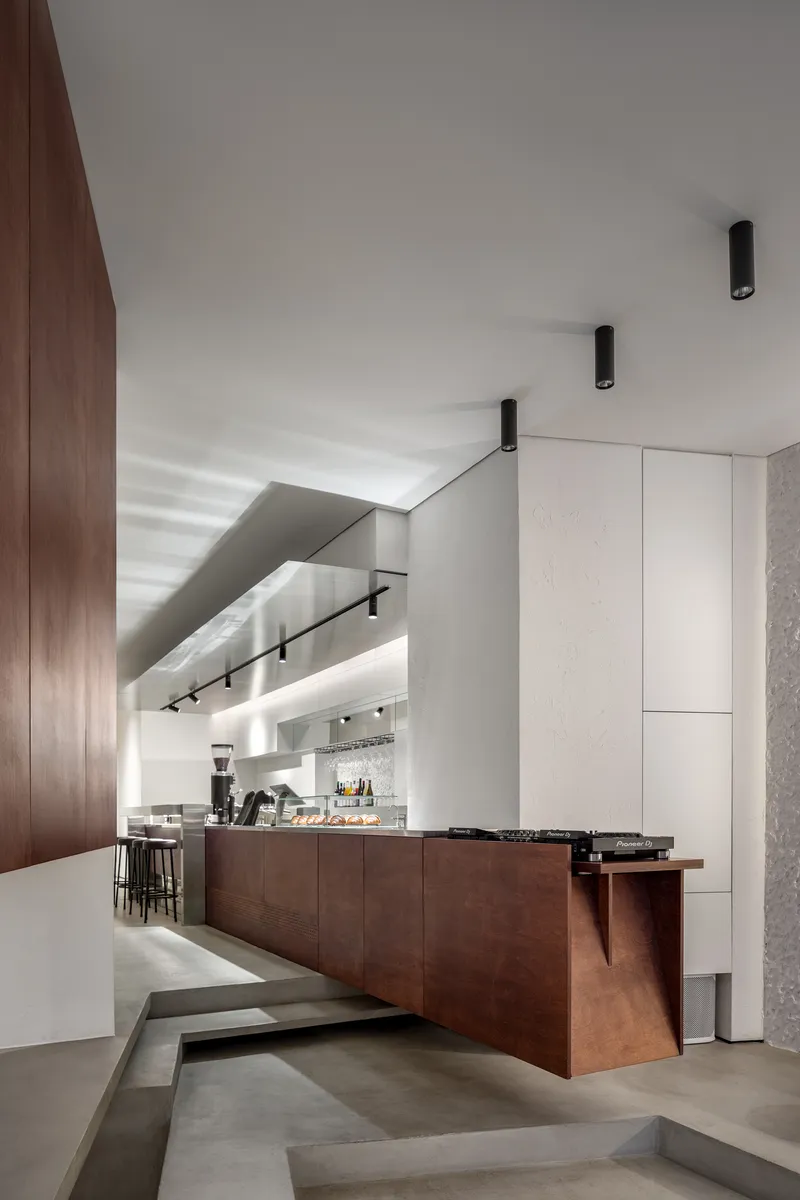
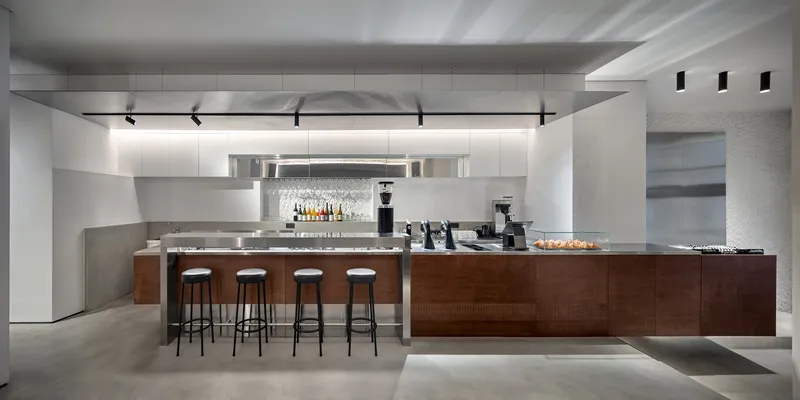
The coffee bar is compact and surgical. A dark timber base supports a working surface flanked by white overhead cabinetry and linear suspended lighting. Cylindrical black ceiling fixtures punctuate the white soffit above, giving the service zone a rhythm distinct from the seating areas. The bar stools at the counter are simple metal forms, consistent with the café's refusal to introduce any material outside its core vocabulary.
What the counter does well is establish a clear operational hierarchy. You approach it from one direction, order, and move on. The cantilevered overhang creates a threshold between the staff zone and the public room without requiring a physical barrier. It is hospitality architecture that respects the choreography of service.
Light as a Second Skin
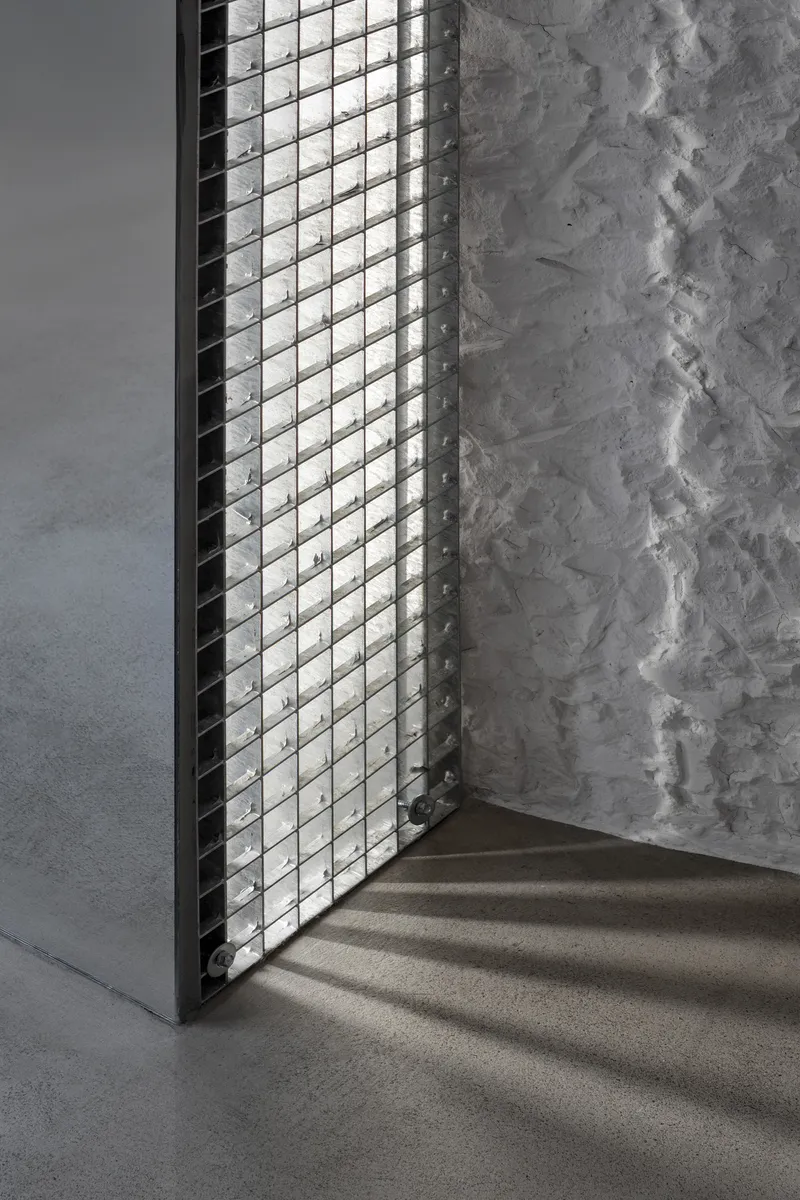
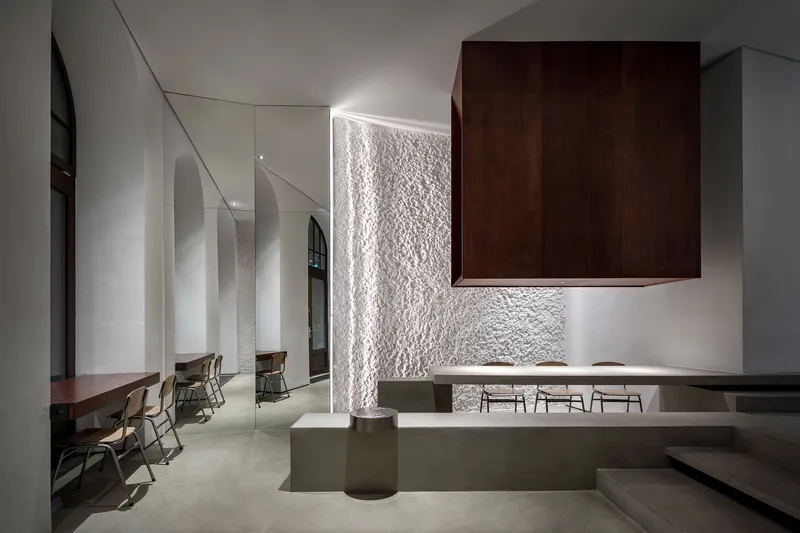
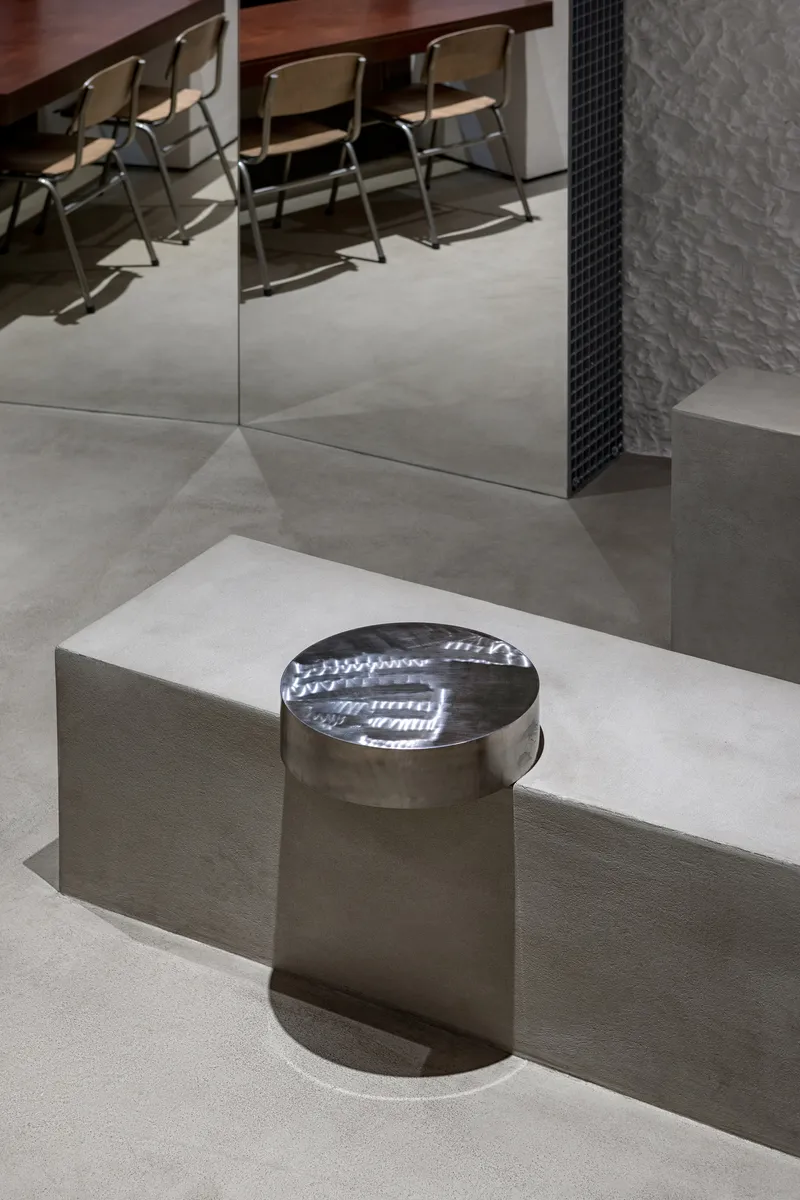
The lighting strategy is fundamental to HOOD's dual identity. During the day, natural light enters through the tall arched windows and the glass block panels, casting diamond-shaped shadows across the concrete floor. Mirrors amplify this effect, bouncing daylight deep into the plan. Morning light reflects off cold steel surfaces, maintaining a sharp, energetic atmosphere appropriate for a coffee service.
In the evening, the backlit plaster panels and concealed strip lighting shift the space toward a warmer, dimmer spectrum. The concrete softens under artificial light, and the walnut volume overhead glows against the surrounding white. The transformation is seamless because the architecture does not rely on decorative elements that would read as fixed in one mood. The materials themselves are neutral enough to accept both registers.
Incidental Details
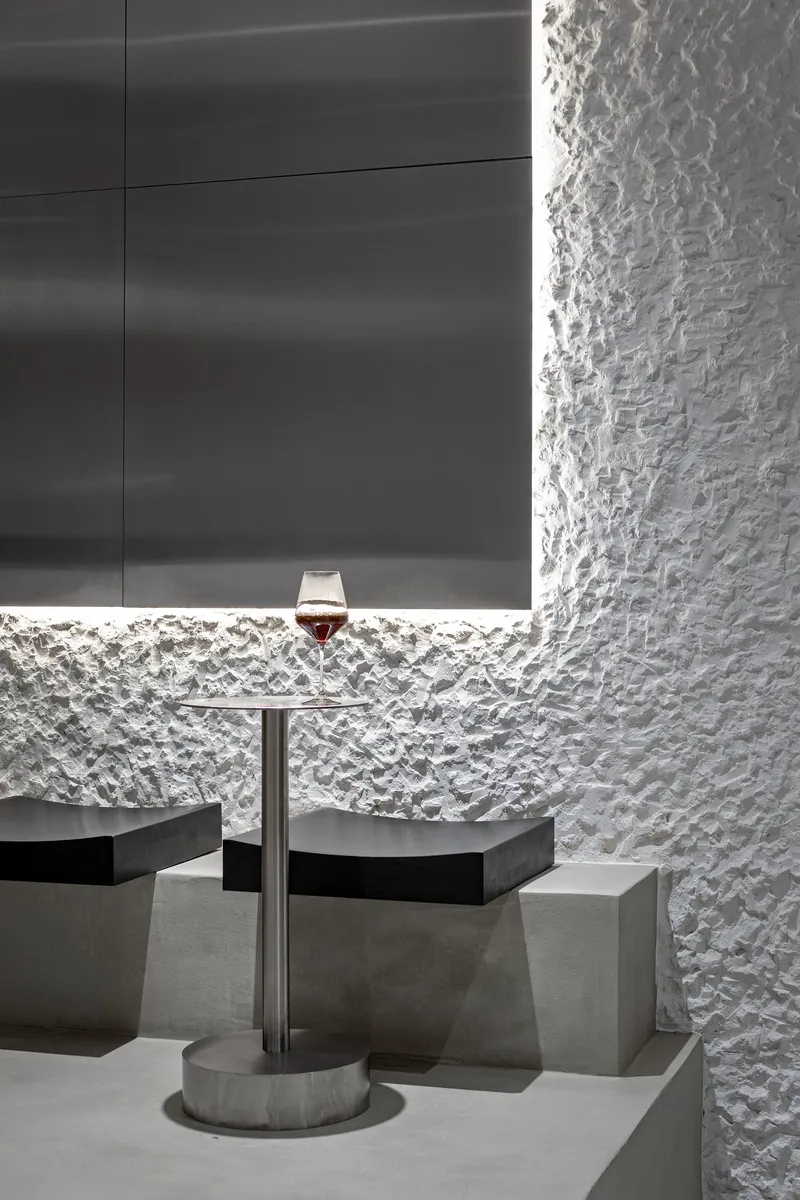
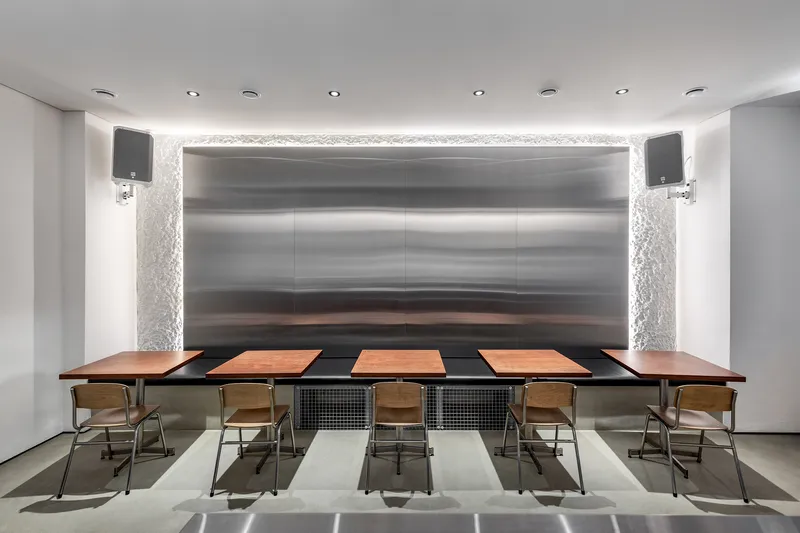
A wine glass on the concrete table against a textured white wall and a backlit horizontal niche tells you everything about HOOD's ambitions beyond morning espresso. The space wants to be taken seriously in the evening too, and the restraint of the palette gives it permission to shift registers without a costume change. A boardroom-like area with alternating stone floor tiles and horizontal banded metal panels suggests the space may serve multiple programmatic functions beyond café service, reinforcing the building's flexibility.
Plans and Drawings
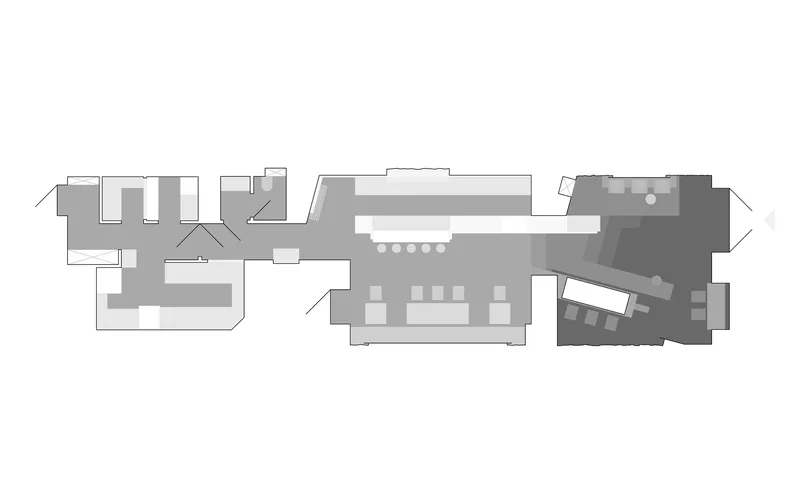
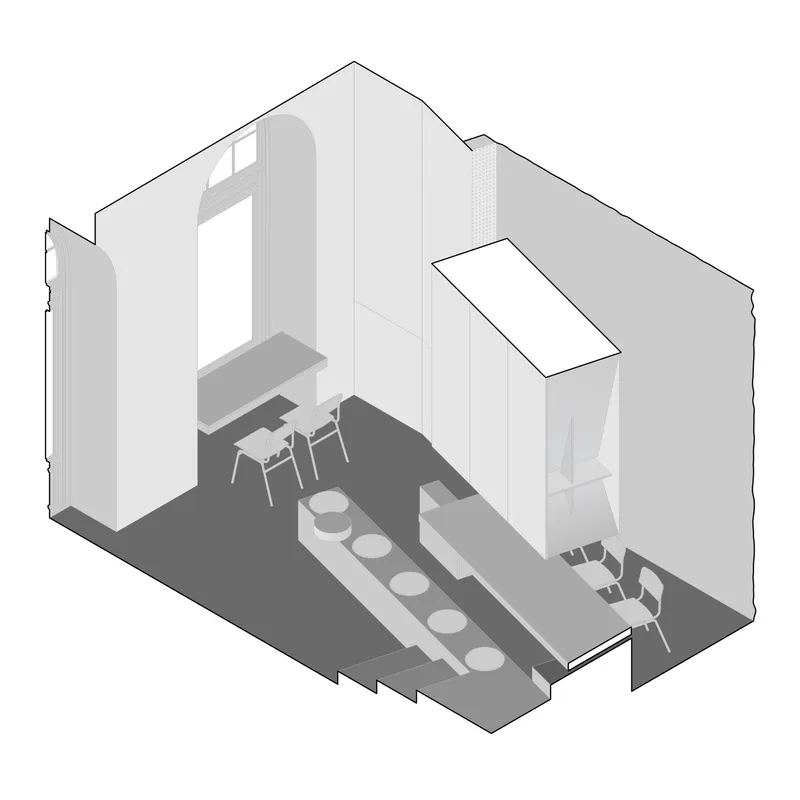
The floor plan reveals the elongated footprint with a central service core and an angled corner volume that mediates the transition between the street-facing windows and the deeper seating zones. The axonometric drawing clarifies the relationship between the stepped floor levels and the overhead timber element, showing how the skylight above the seating area introduces a second source of natural light independent of the facade windows. Read together, the drawings confirm that the section, not the plan, is the project's primary generator.
Why This Project Matters
HOOD Café matters because it takes the small-scale hospitality fit-out seriously as an architectural problem. In 108 square meters, Ponomarenko Volodymyr introduces genuine topographic complexity, a rigorous material logic, and a lighting strategy that allows the same room to serve two distinct programmatic identities. The project does not rely on furniture styling, branded graphics, or Instagram-friendly gimmicks to generate atmosphere. The atmosphere comes from the architecture itself: the weight of the concrete, the warmth of the timber, the sharpness of the steel.
For a Kyiv-based architect working in Warsaw, the project also demonstrates a productive dislocation. Ponomarenko brings a sensibility shaped by a different context to a city with its own design conventions, and the result feels neither borrowed nor imposed. HOOD sits comfortably on Poznańska Street precisely because it takes the 1904 building's material honesty as a starting point and extends it inward with contemporary means. It is a café that trusts its visitors to notice the architecture, and rewards them when they do.
HOOD Café by Ponomarenko Volodymyr, located at 37 Poznańska Street, Warsaw, Poland. 108 m². Completed 2025. Photography by Ivan Avdeenko.
About the Studio
Share Your Own Work on uni.xyz
If projects like this are the kind of work you want to make, uni.xyz is a place to publish your own, find collaborators, and enter design competitions.


Popular Articles
Popular articles from the community


The Ocean Hive: Sustainable Architecture for a Self-Sufficient Civilization at Sea
The Ocean Hive imagines sustainable architecture at sea, where modular habitats, algae, wave power and ocean waste sustain a growing colony.

Play: Fragments of Their World
Familiar architecture becomes modular playground design, creating safe spaces where displaced children can learn, connect, imagine and play.

Co-life: Sustainable Architecture for Age-Friendly Community Living
Co-life reimagines sustainable architecture for seniors through courtyards, rammed earth, shared gardens, and spaces designed for belonging.

The Musturak Paradise: Senior Living Architecture for a Connected Future in Temara, Morocco
The Musturak Paradise reimagines senior living architecture in Temara via private homes, social spaces, culture, community, and shared care.

Similar Reads
You might also enjoy these articles

Bao Huynh Watercolor Atelier: A Serene Art Retreat in Hội An
Bao Huynh Watercolor Atelier in Hội An blends multifunctional art spaces, sustainable design, local materials, and family-friendly living in a serene environment.

Atelier Macri Concept Store Interior Design by CASE-REAL
Atelier Macri store features a "ko" counter, walnut wood details, cork displays, blending retail, gallery, and seamless customer experiences.

Manuel Vargas Izquierdo Stadium and High-Performance Sports Center: Architectural Excellence in Jalpa de Méndez
The Manuel Vargas Izquierdo Stadium blends sustainable design, inclusive sports facilities, and cultural-inspired architecture, revitalizing Jalpa de Méndez’s public spaces.
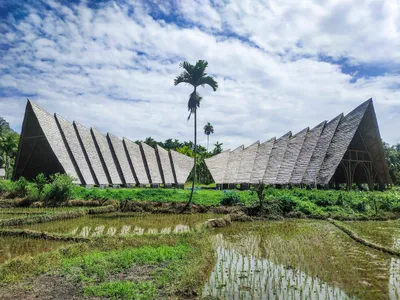
KAKR Buluh Awar Hall: Revitalizing Community and Ecology Through Bamboo Architecture
Community built bamboo hall revitalizes Buluh Awar village, empowering youth, restoring ecology, celebrating vernacular craftsmanship through sustainable architecture and culture.

Explore Interior Design Competitions
Discover active competitions in this discipline

Challenge to design luxury tourism on rails

VR headsets Storefront design competition

Designing a staircase for a client
Comments (0)
Please login or sign up to add comments
No comments yet. Be the first to comment!