
Powerhouse Company Builds Rotterdam's First Mass Timber Residential Tower on Cold War Foundations
In Pendrecht, a 12-story CLT housing block replaces a demolished post-war high-rise while standing on its original piles.


The original Valckensteyn, a concrete slab designed by architect J. Kranendonk, stood in Rotterdam's Pendrecht neighborhood from 1971 until its demolition in 2012. What Powerhouse Company has put in its place is a quiet provocation: an 82-unit, 40-meter-tall residential building made primarily of cross-laminated timber, resting on the very same foundations that held up its predecessor. The relative lightness of CLT made this structural inheritance possible, sidestepping the enormous cost and carbon expenditure of new deep foundations.
What makes Valckensteyn worth paying attention to is not simply that it is Rotterdam's first mass timber residential building. It is how seriously the project takes the idea of continuity: with the neighborhood's post-war planning logic, with the massing of the demolished tower, and with the material culture of Pendrecht itself. The two staggered rectilinear volumes deliberately echo Kranendonk's original composition, and travertine at the base references the stone finishes common to the area's mid-century housing. The gallery-access corridors on the east facade are a typological callback to the neighborhood's deck-access housing blocks. None of this is nostalgic. It is a demonstration that timber construction can operate within a highly specific urban context without defaulting to the pastoral or the experimental.
A Timber Building That Reads Like a Neighborhood
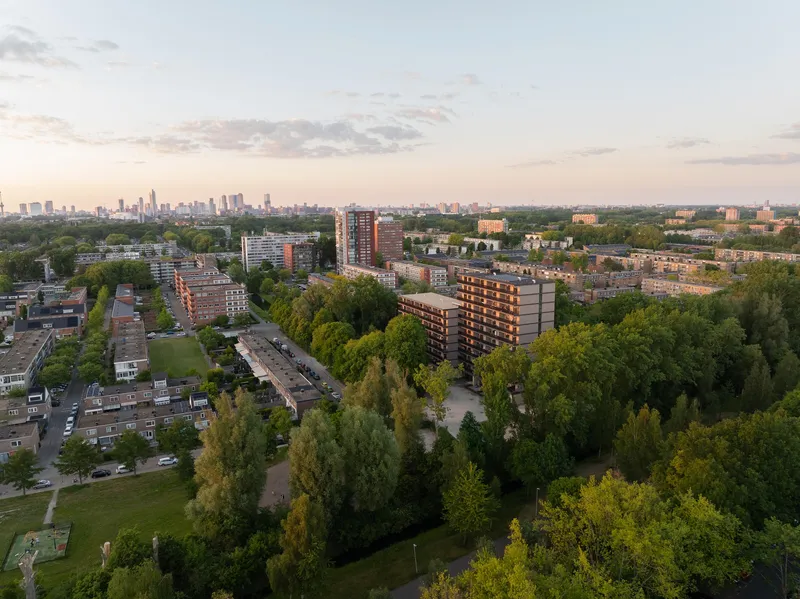
Pendrecht was planned by Lotte Stam-Beese according to a framework that carefully orchestrated high-rise and low-rise volumes around collective green spaces. Valckensteyn slots into this rhythm without forcing it. From above, the tower reads as two shifted bars set within a canopy of mature trees, its massing calibrated to match the proportions of what came before. The pair of volumes, one taller than the other, avoids the monolithic presence that a single 12-story block would have imposed on the surrounding low-rise fabric.
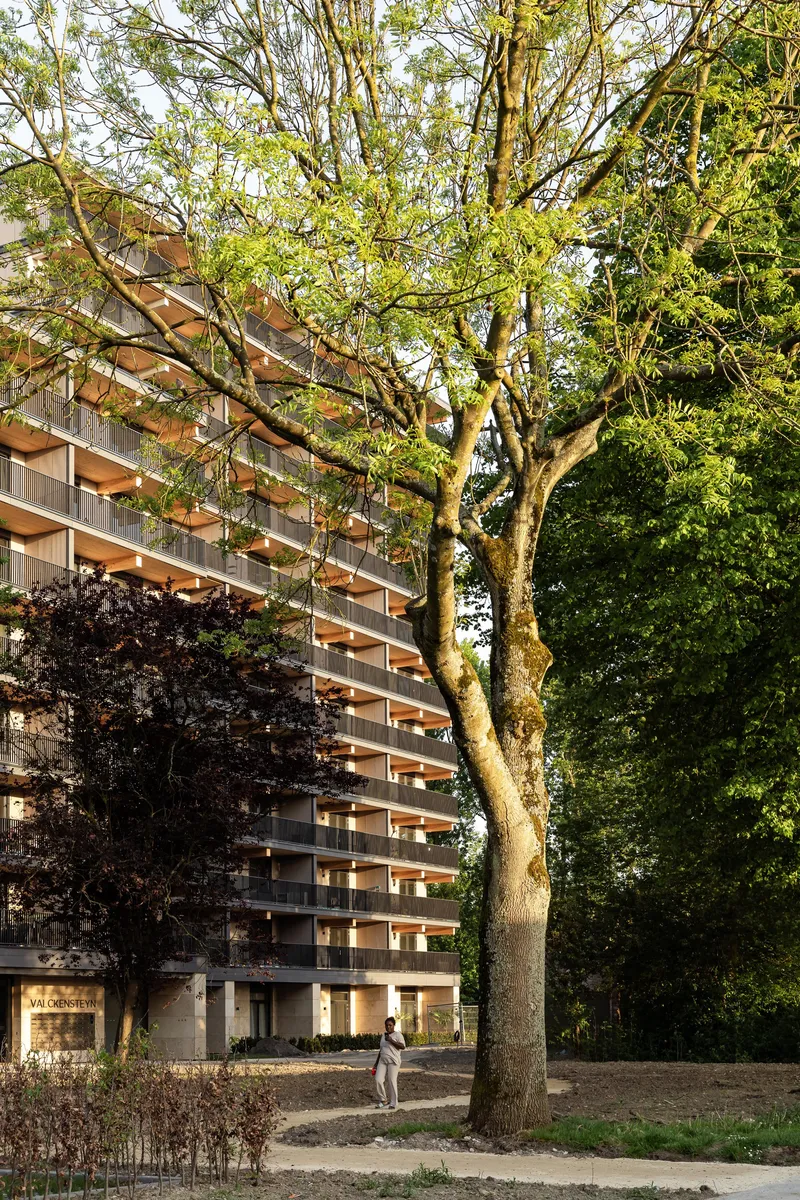
At street level the building recedes behind dense planting. LAP Landscape & Urban Design created a park-like garden around the base, with species selected to remain attractive to bees and insects year-round. The adjacent parking area uses permeable paving for stormwater filtration. The result is a tower that feels embedded in greenery rather than dropped onto a cleared site.
The West Facade: Balconies as Architecture
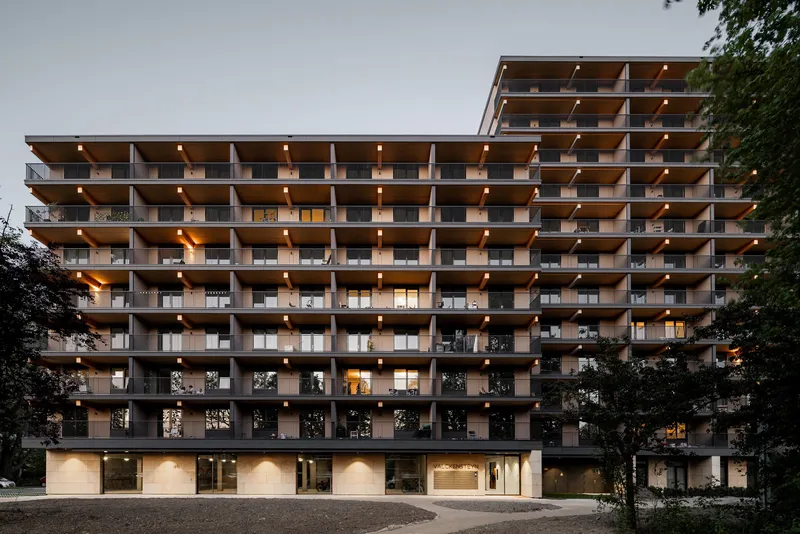
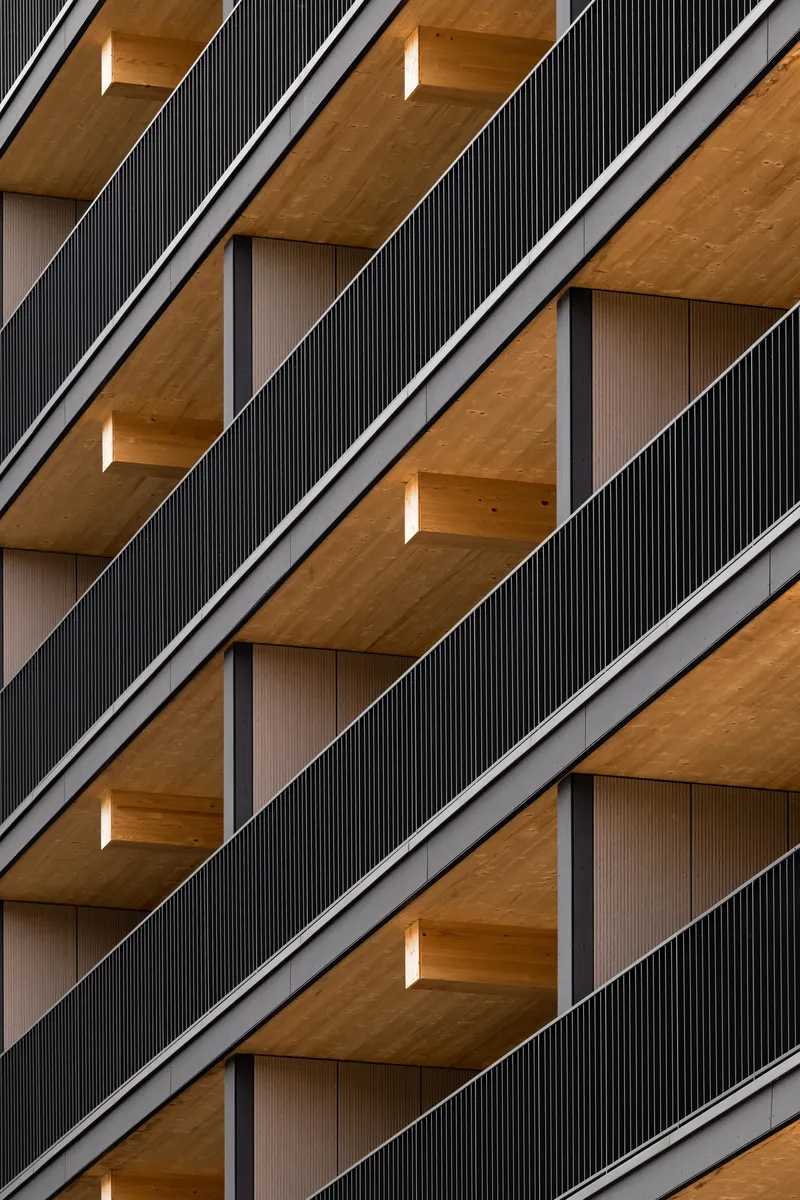
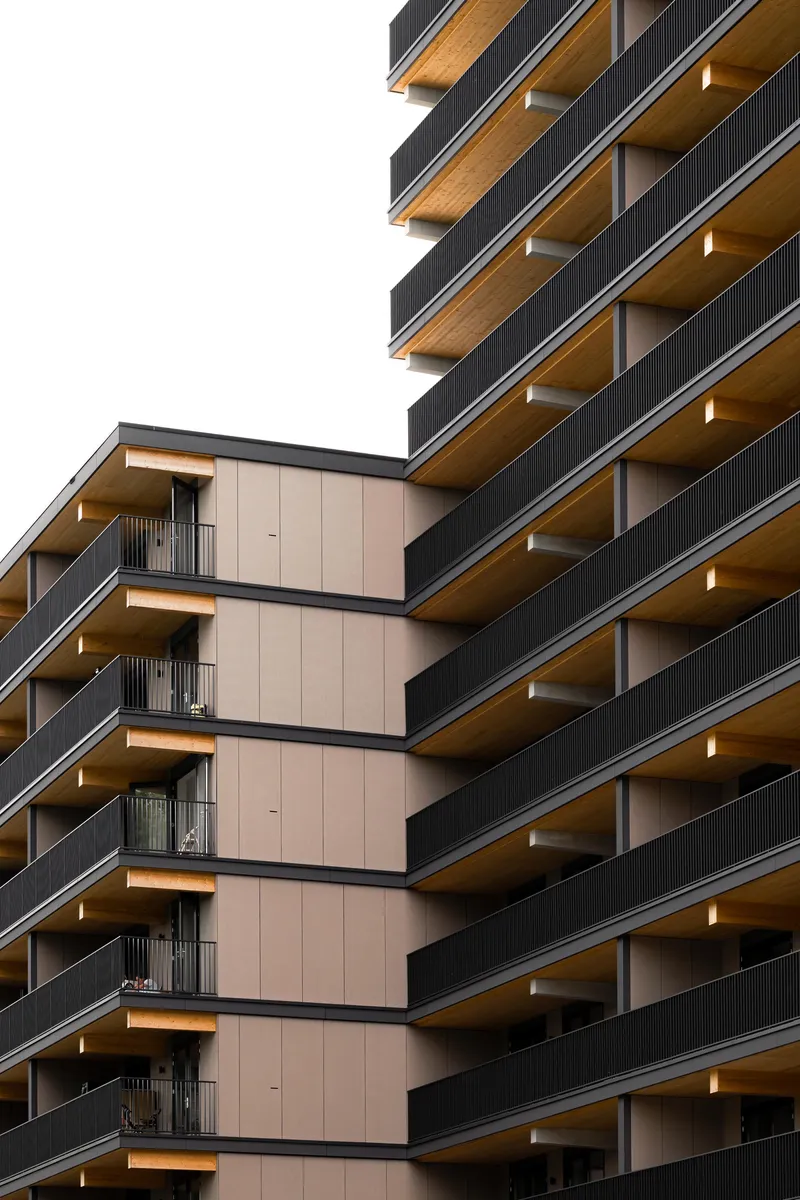
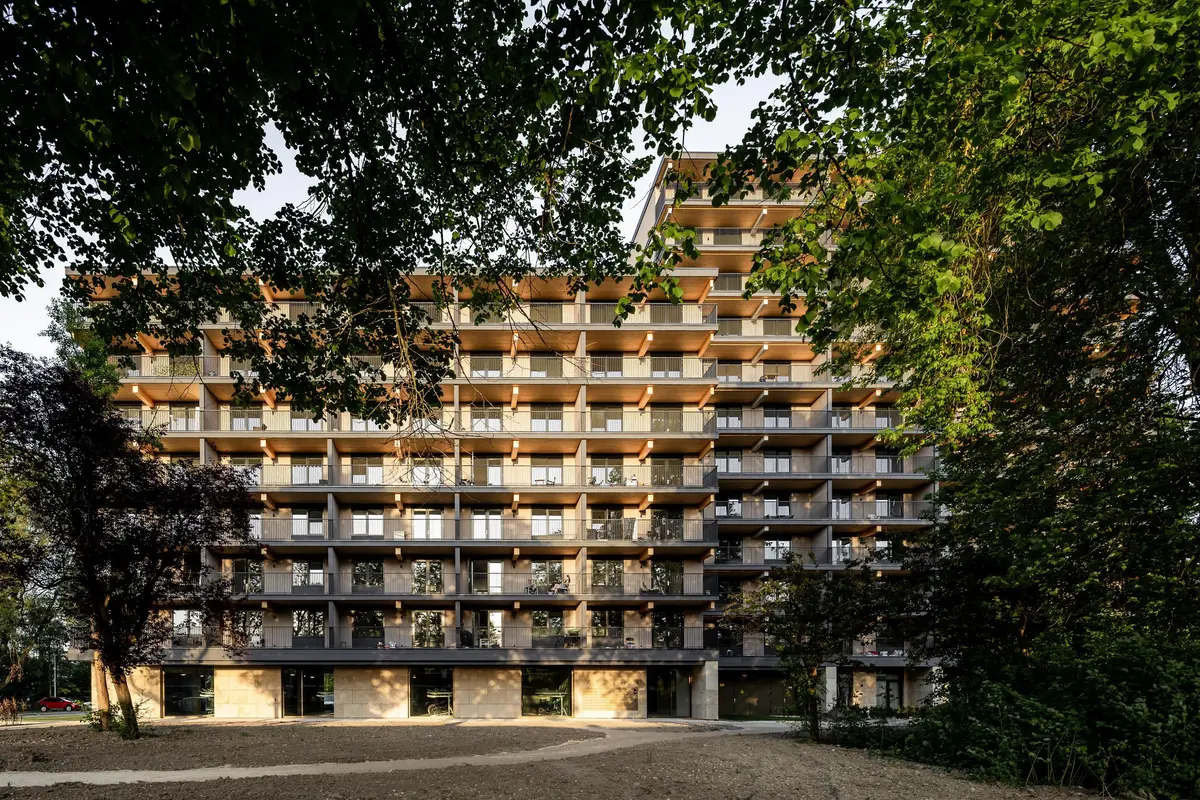
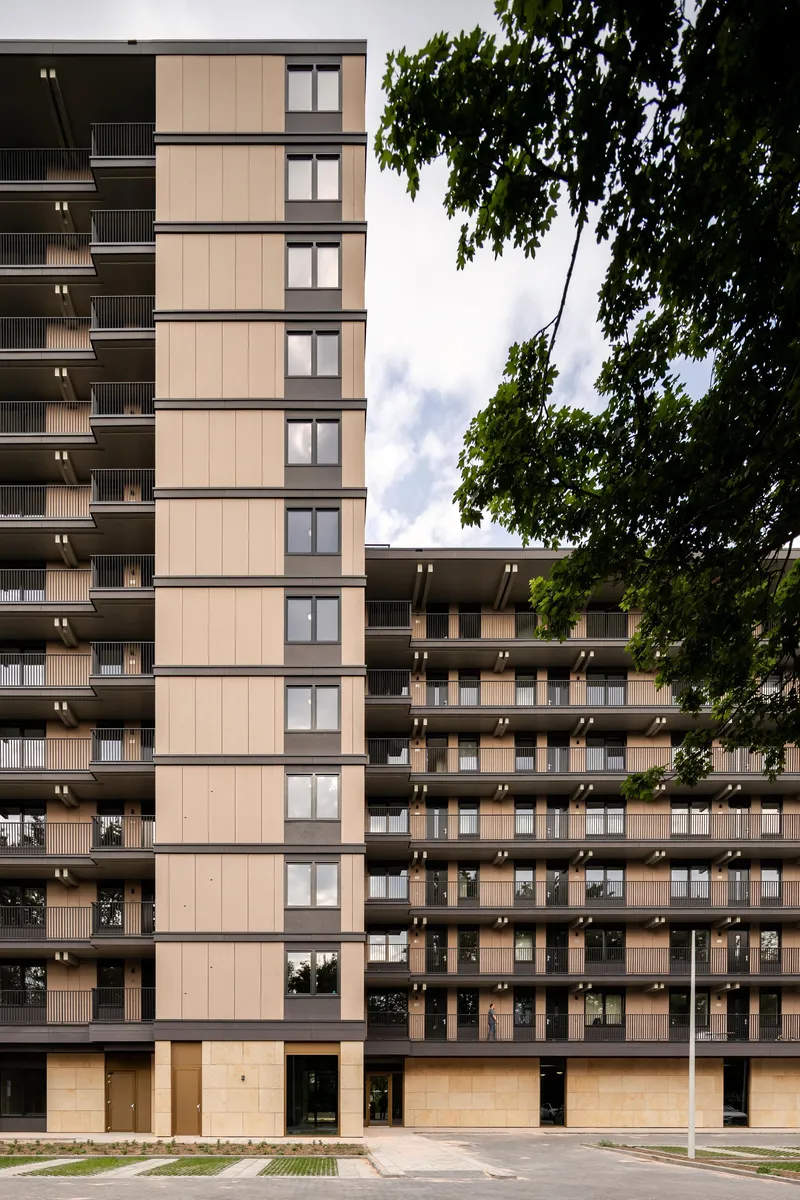
The western elevation is where Valckensteyn makes its strongest visual argument. Deep balconies, each roughly 14 square meters and nearly two meters in depth, project from every apartment, their soffits lined with exposed CLT. Dark corrugated metal screens serve as privacy dividers between units, creating a repeating diagonal rhythm that gives the facade its kinetic character. The interplay between warm timber, dark metal, and fiber cement panels in light brown and anthracite produces a layered composition that changes register depending on the angle of view.
These balconies are oriented to catch the evening sun, a deliberate move for a housing project where most residents will be home after working hours. The full width of each apartment opens onto the terrace through floor-to-ceiling glazing, collapsing the boundary between interior and exterior in a way that compensates for the building's compact, repetitive unit plans.
Gallery Access and the Eastern Elevation
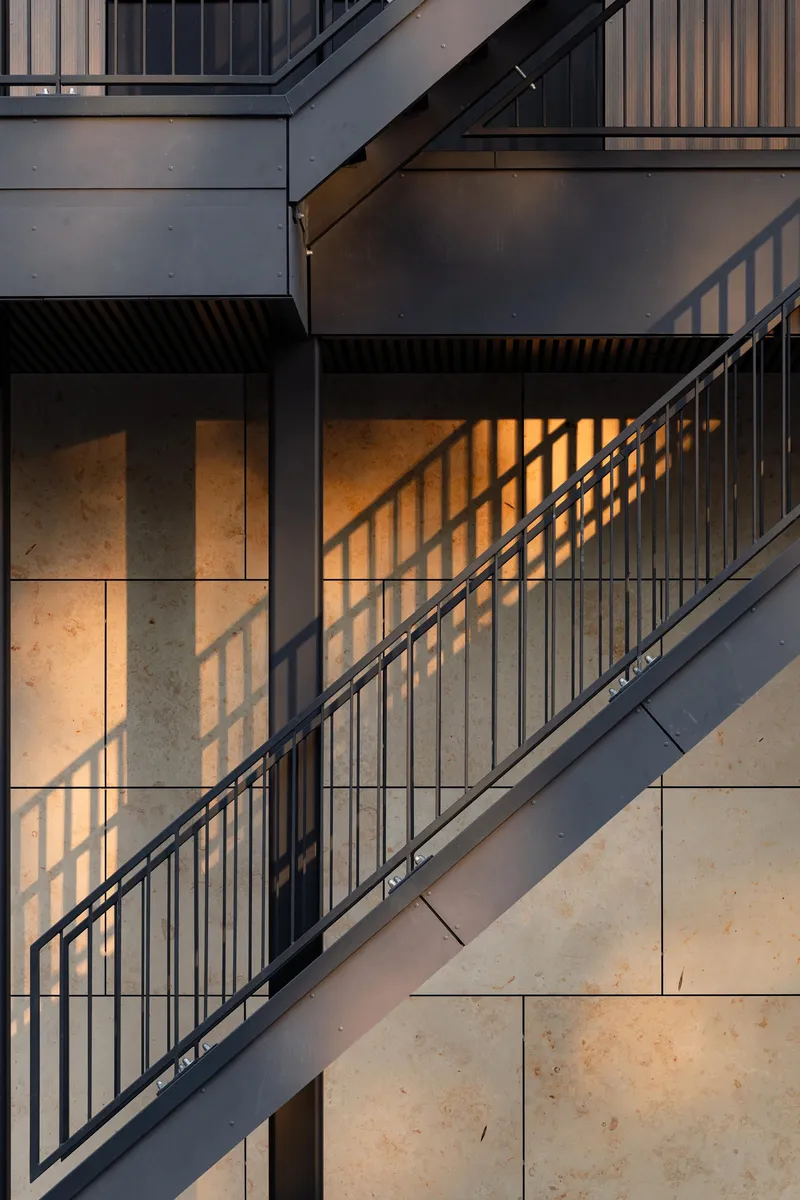
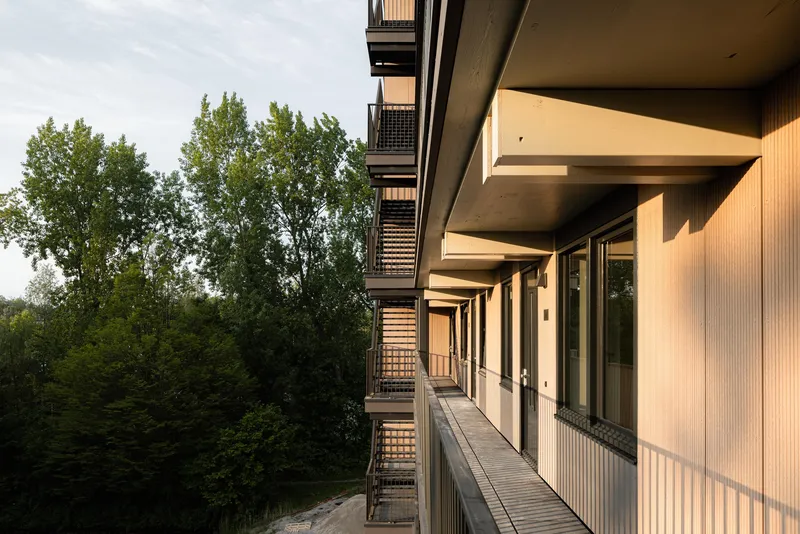
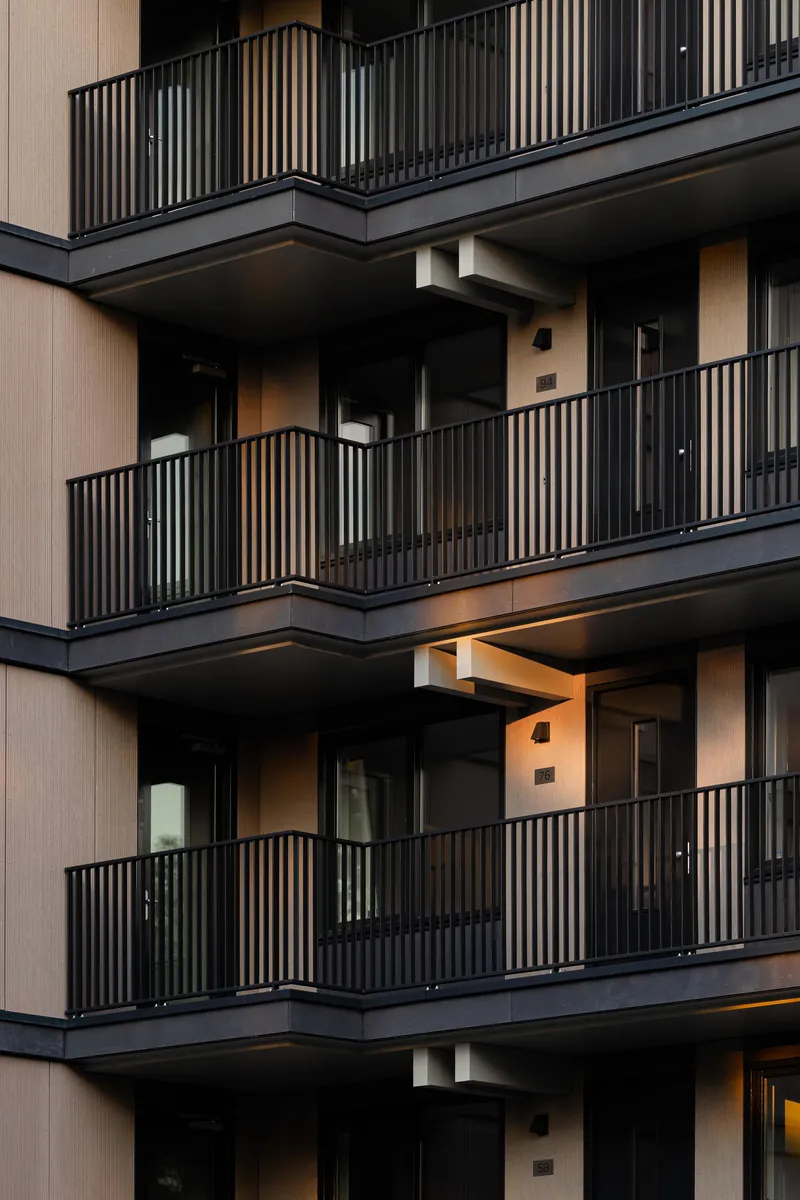
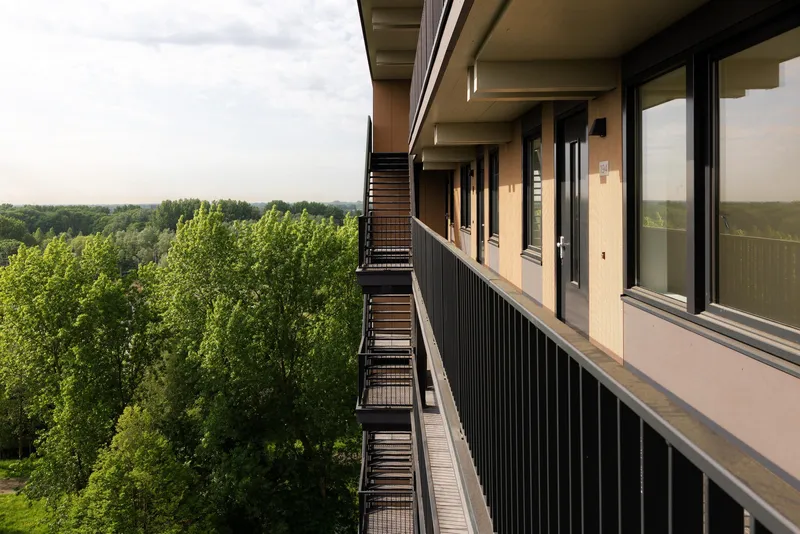
The east facade is the building's social spine. Black steel walkways provide gallery access to each apartment's front door, a circulation strategy borrowed directly from the deck-access blocks that define much of Pendrecht's housing stock. The walkways are open to the air, creating long horizontal lines of shadow and metal railing that give this side of the building an entirely different character from the west.
The decision to separate the generous private balconies (west) from the communal access corridors (east) is a clear organizational principle. It means every apartment has a dual orientation, with its public address on one side and its private outdoor room on the other. The central concrete cores that connect the two volumes handle vertical circulation, while the steel galleries handle the horizontal.
Timber on Display
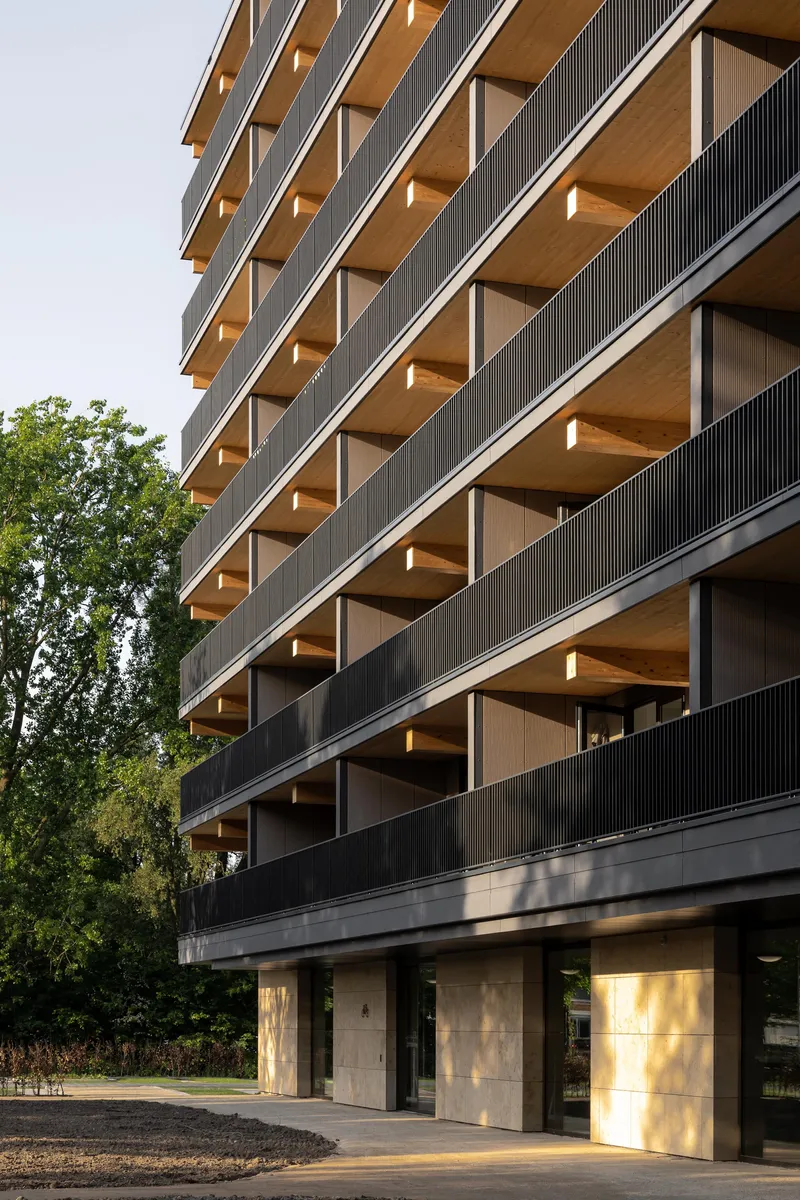
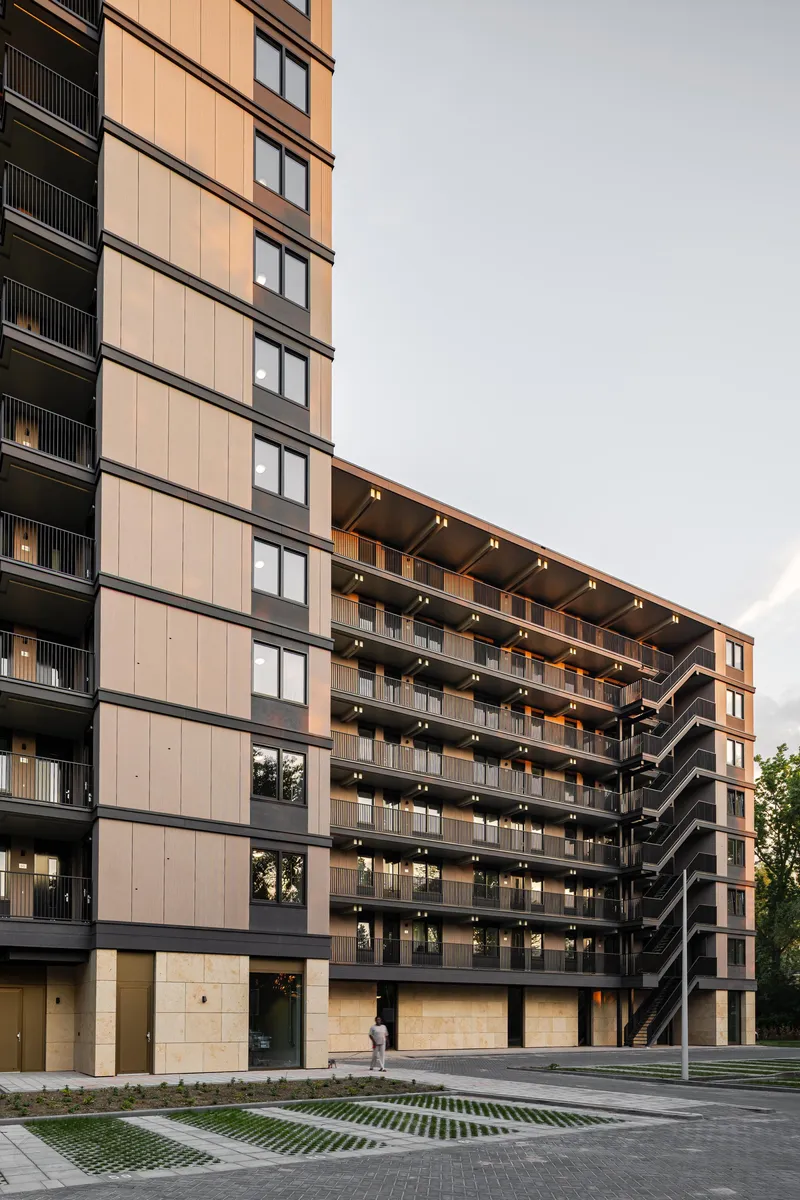
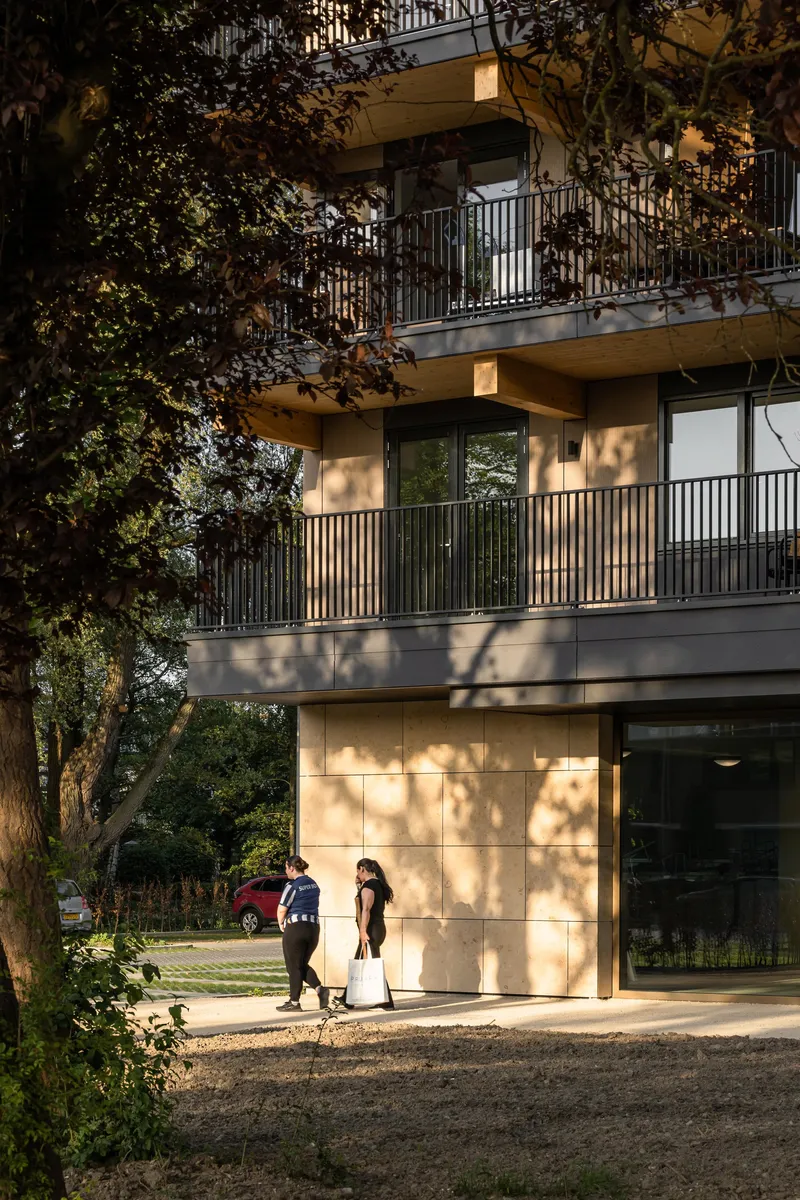
Valckensteyn does not hide its timber structure, but it does not fetishize it either. CLT beams and floor plates are left exposed above the balconies and walkways, where they can be read as the building's skeletal logic made visible. The warm grain of the wood contrasts with the cooler fiber cement panels that clad the main facade surfaces. It is a selective honesty: the timber appears where it does the most architectural work, while the cladding panels (themselves demountable for future reuse) handle the repetitive enclosure.
The 1,500 cubic meters of CLT and 250 cubic meters of glulam delivered by binderholz were dimensioned according to precise structural requirements, with CLT element thicknesses optimized to minimize waste. Powerhouse Company reports that the timber construction generated 40% less waste than a conventional concrete equivalent. Crucially, the building was assembled without adhesives, making it theoretically demountable. Whether that potential is ever exercised matters less than the discipline it imposed on the design process.
Ground Level and Threshold
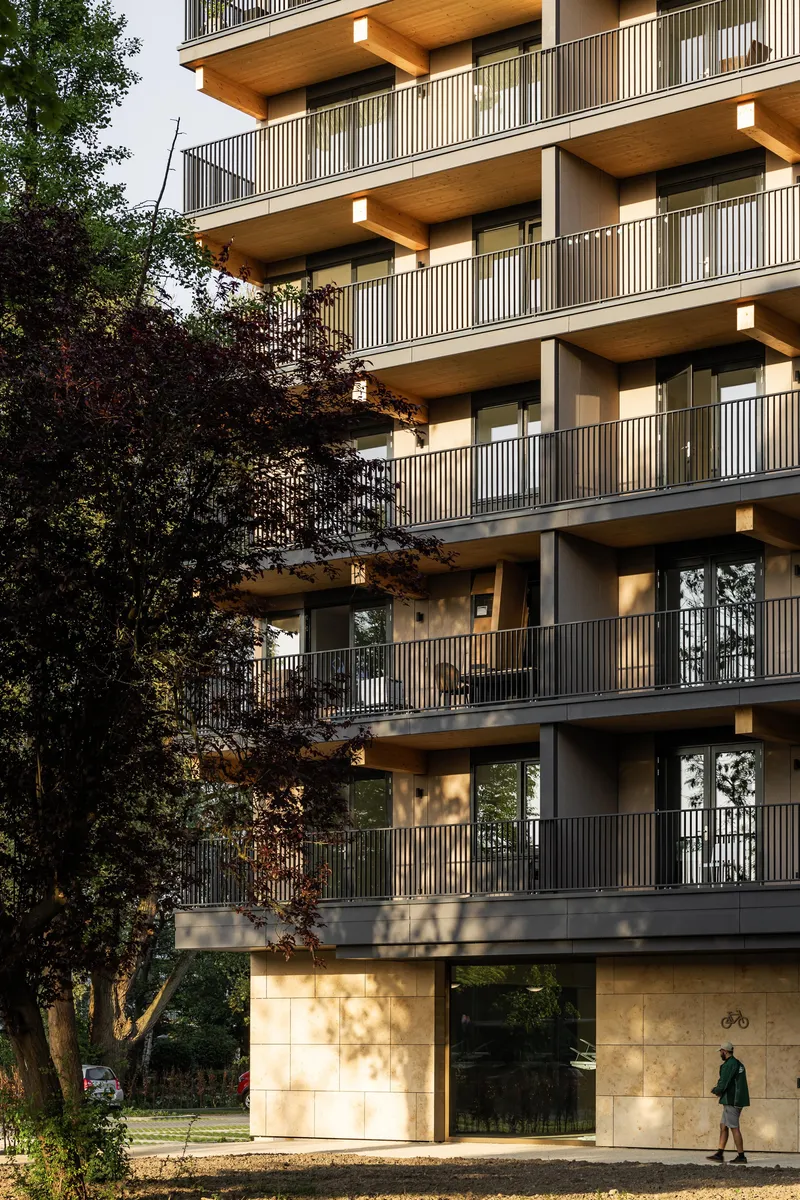
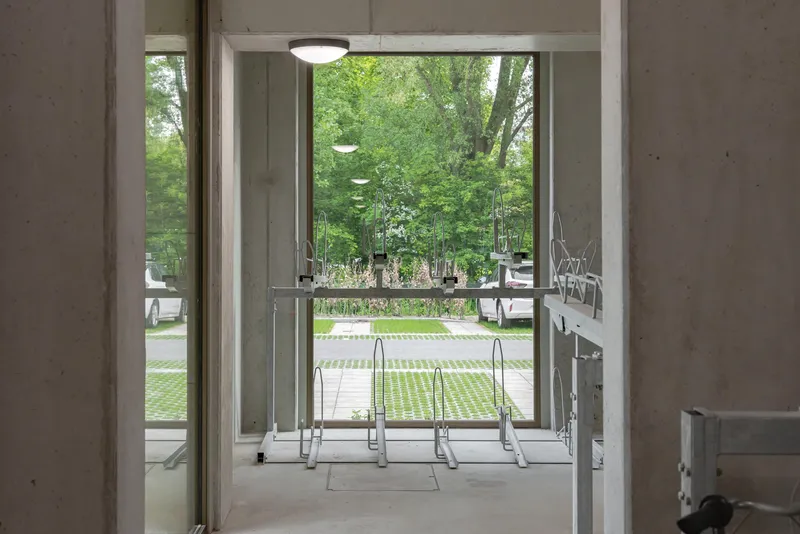
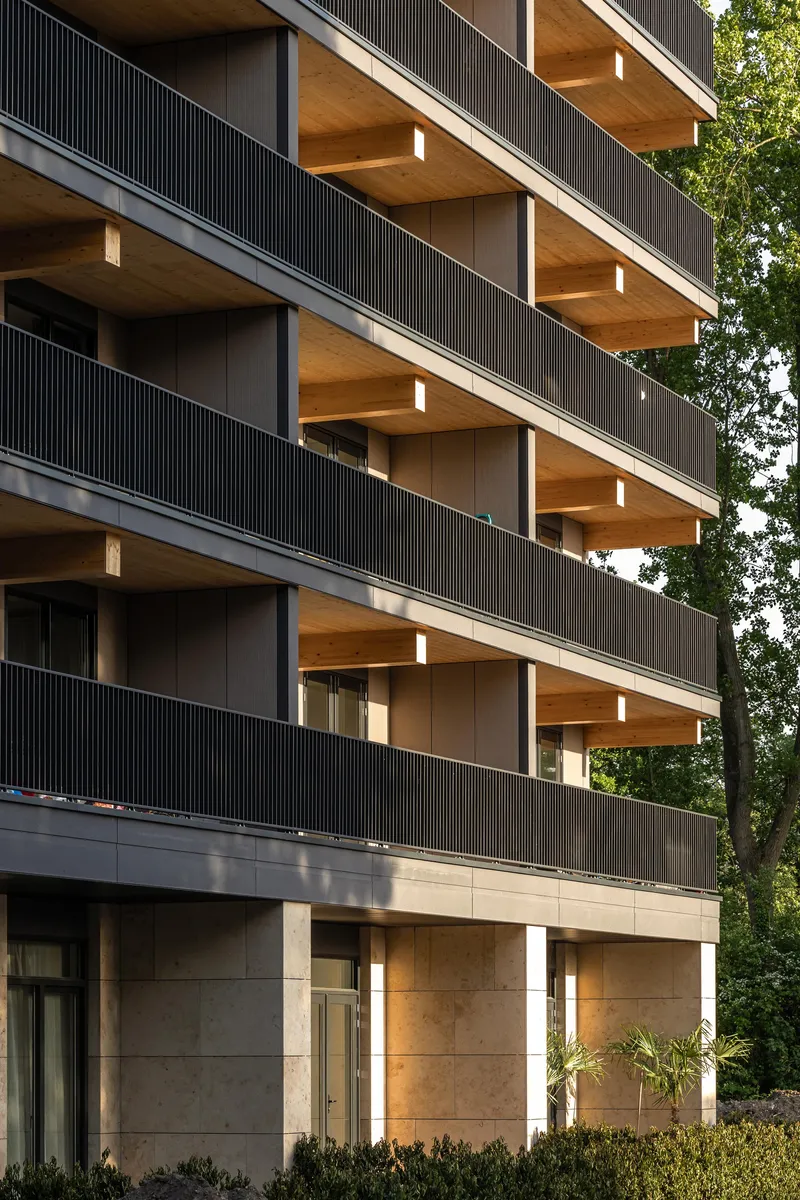
The concrete ground floor plinth, clad in travertine, anchors the building to its context. The stone is a deliberate material reference to post-war construction in Pendrecht, not an arbitrary choice. Above it, vertical timber slats frame the entrance and filter light across the lobby, which doubles as a communal space connected to the bicycle parking. The transition from stone base to timber structure above is handled cleanly: there is no ambiguity about where the concrete ends and the wood begins.
The interior courtyard visible from the lobby opens onto planted beds and a landscaped garden, reinforcing the sense that the building's communal life extends outward from its core. Bird and bat nest boxes are integrated into the facade, a small but telling detail that speaks to how thoroughly the ecological ambition runs through the project.
Dusk and the Canal
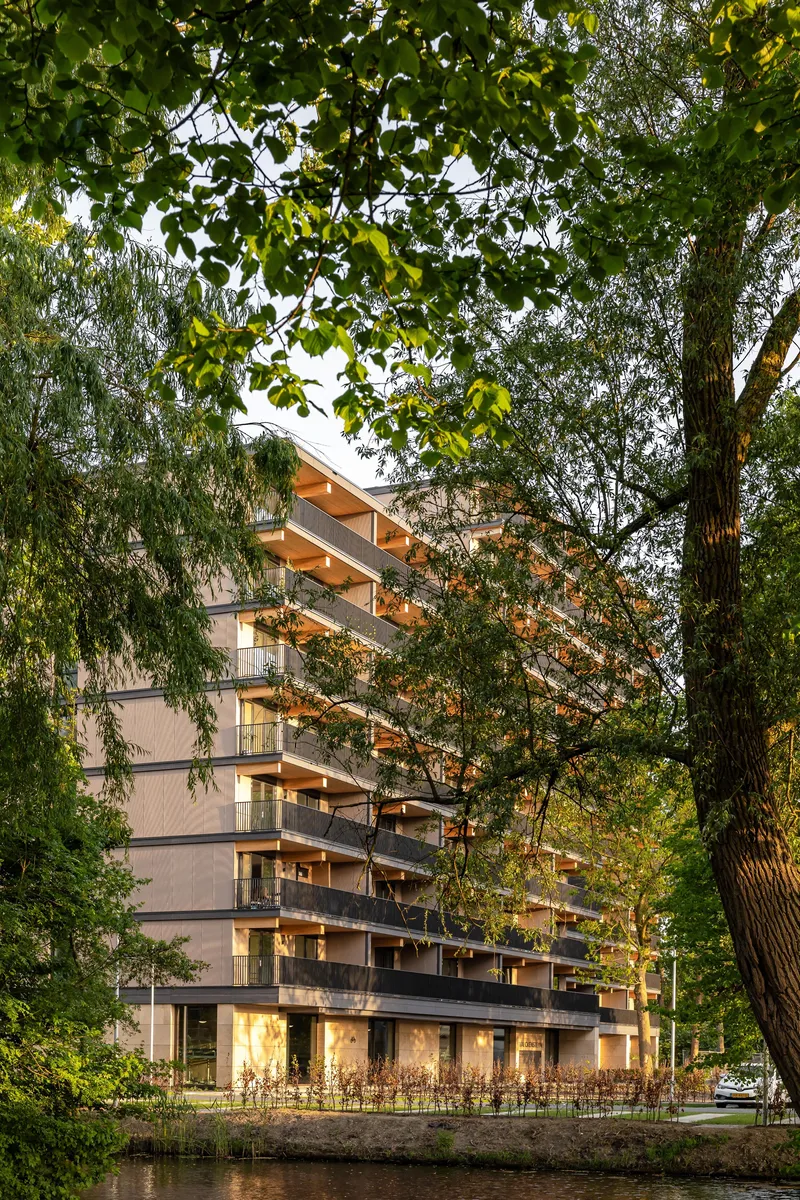
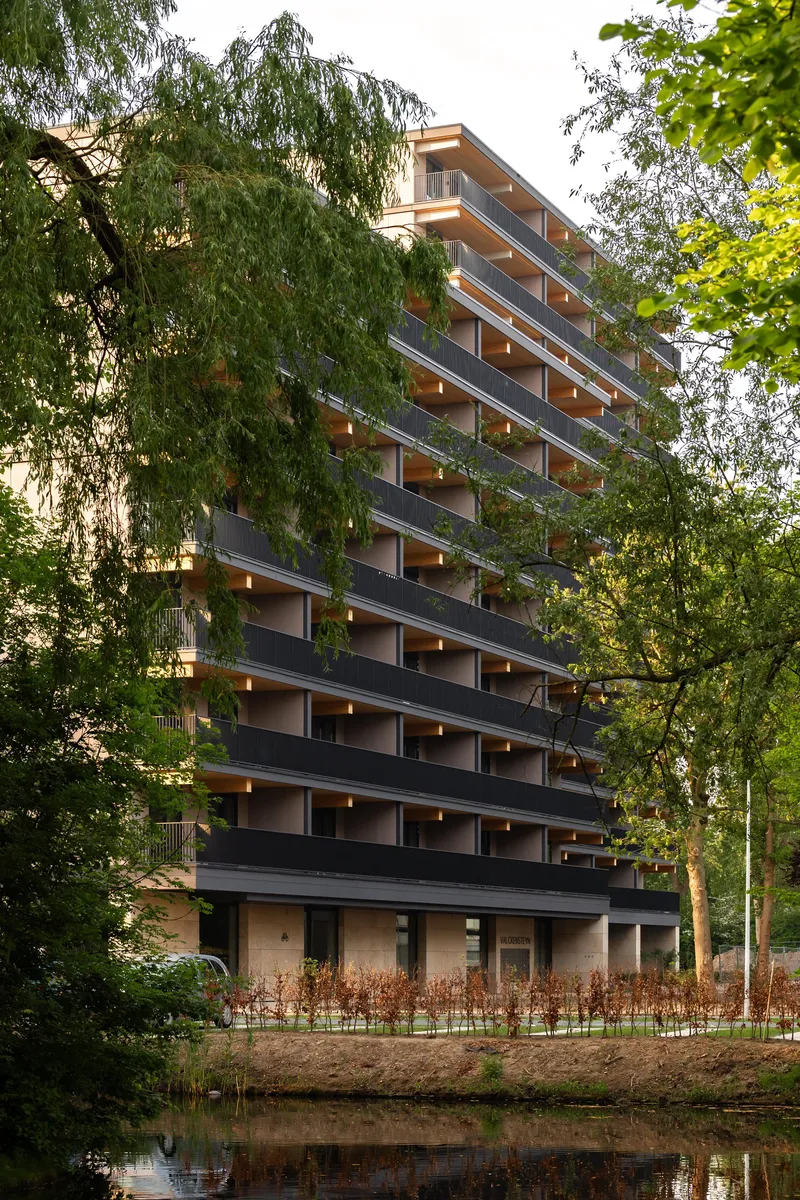
Several of the strongest images of Valckensteyn are taken at twilight, when the warm glow from the apartments lights up the timber soffits and the building reflects in the adjacent canal. The effect is not incidental. The western orientation of the balconies means the building catches the last light of the day, and the cantilevered timber beams cast long shadows across the facade. Through the screen of willows and deciduous trees that surround the site, the tower reads as a luminous presence rather than a solid mass.
From the upper balconies, the view extends over a dense green canopy. Rotterdam is not a city typically associated with forest views, but the mature trees of Pendrecht create exactly that illusion. The depth of the balconies and the height of the metal railings frame this landscape without obstructing it, turning each terrace into an elevated garden room.
Plans and Drawings
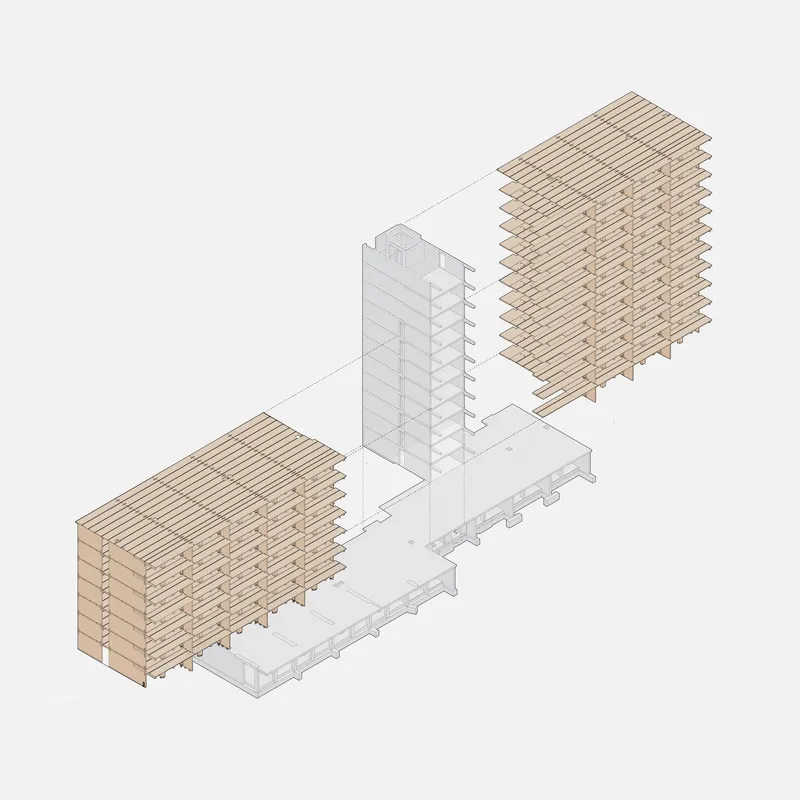
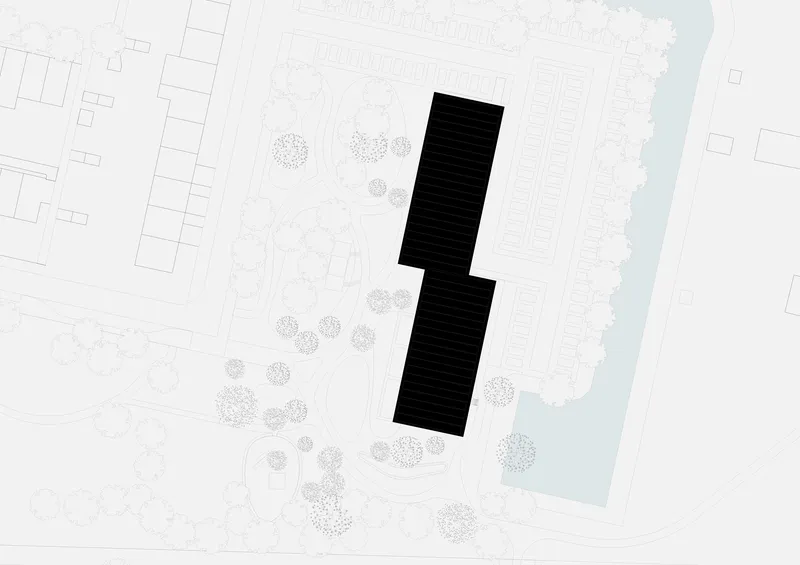
The exploded axonometric reveals the structural logic with clarity. CLT floor slabs and wall elements stack above the concrete ground floor, while the central concrete cores for stairs and elevators provide the lateral stability that timber alone cannot efficiently deliver at this height. The two offset volumes are legible as distinct structural bays connected by the cores. The site plan shows the building's placement within the green framework of Pendrecht, with the two tower footprints oriented to maximize the park-like garden and maintain distance from the adjacent canal and low-rise housing.
Why This Project Matters
Valckensteyn is not a prototype or a pavilion. It is 82 affordable rental homes, 40 meters tall, built in CLT, and delivered on time in a real neighborhood with real planning constraints. The project demonstrates that mass timber can work within the tight economics and regulatory complexity of social housing, not just in the bespoke commissions where it has typically appeared. The fact that it stands on the foundations of its demolished predecessor is both a practical solution and a powerful metaphor for what sustainable construction actually means: not starting from zero, but building on what already exists.
Powerhouse Company's deeper achievement here is contextual intelligence. The staggered massing, the gallery access, the travertine base, and the park-like landscape all respond to Pendrecht's specific post-war planning DNA. Too many timber buildings rely on material novelty alone to justify their existence. Valckensteyn makes the case that the real test for mass timber is whether it can be ordinary: a good building in a specific place, doing what housing is supposed to do, while also sequestering carbon and generating less waste. That is a harder argument to make than a spectacular one, and a more useful one.
Valckensteyn Timber Residential Building by Powerhouse Company. Located in Pendrecht, Rotterdam, The Netherlands. 7,970 m². Completed 2025. Landscape design by LAP Landscape & Urban Design. Photography by Sebastian van Damme and Koen Meershoek | Powerhouse Company.
About the Studio
Share Your Own Work on uni.xyz
If projects like this are the kind of work you want to make, uni.xyz is a place to publish your own, find collaborators, and enter design competitions.


Popular Articles
Popular articles from the community


ALGAL REALM: A Bio-Integrated Lunar Habitat Design for Life Beyond Earth
ALGAL REALM reimagines lunar habitat design with algae-powered life support, 3D-printed regolith, and vertical living for a lunar future.

Conexión: Biophilic Design Reimagines High-Rise Living in Hong Kong
Conexión reimagines high-rise living in Hong Kong through biophilic design, green facades, shared spaces, daylight, water and nature within.

Little Red Riding Hood: Architectural Design as a Journey Through Fear, Light, and Storytelling
Little Red Riding Hood reimagines the fairy tale through architectural design shaped by fear, light, scale, memory, uncertainty, and choice.

Hill & Cross Opera: Sculptural Opera House Architecture Shaped by Tallinn’s Landscape and Identity
Hill & Cross Opera reimagines opera house architecture in Tallinn through its sculptural hill, civic plaza, glass wave and a luminous cross.

Similar Reads
You might also enjoy these articles

Bao Huynh Watercolor Atelier: A Serene Art Retreat in Hội An
Bao Huynh Watercolor Atelier in Hội An blends multifunctional art spaces, sustainable design, local materials, and family-friendly living in a serene environment.

Atelier Macri Concept Store Interior Design by CASE-REAL
Atelier Macri store features a "ko" counter, walnut wood details, cork displays, blending retail, gallery, and seamless customer experiences.

Manuel Vargas Izquierdo Stadium and High-Performance Sports Center: Architectural Excellence in Jalpa de Méndez
The Manuel Vargas Izquierdo Stadium blends sustainable design, inclusive sports facilities, and cultural-inspired architecture, revitalizing Jalpa de Méndez’s public spaces.

KAKR Buluh Awar Hall: Revitalizing Community and Ecology Through Bamboo Architecture
Community built bamboo hall revitalizes Buluh Awar village, empowering youth, restoring ecology, celebrating vernacular craftsmanship through sustainable architecture and culture.

Explore Heavy Timber Competitions
Discover active competitions in this discipline

Bring back Drive In's

Design challenge to reuse E-waste
Comments (0)
Please login or sign up to add comments
No comments yet. Be the first to comment!