
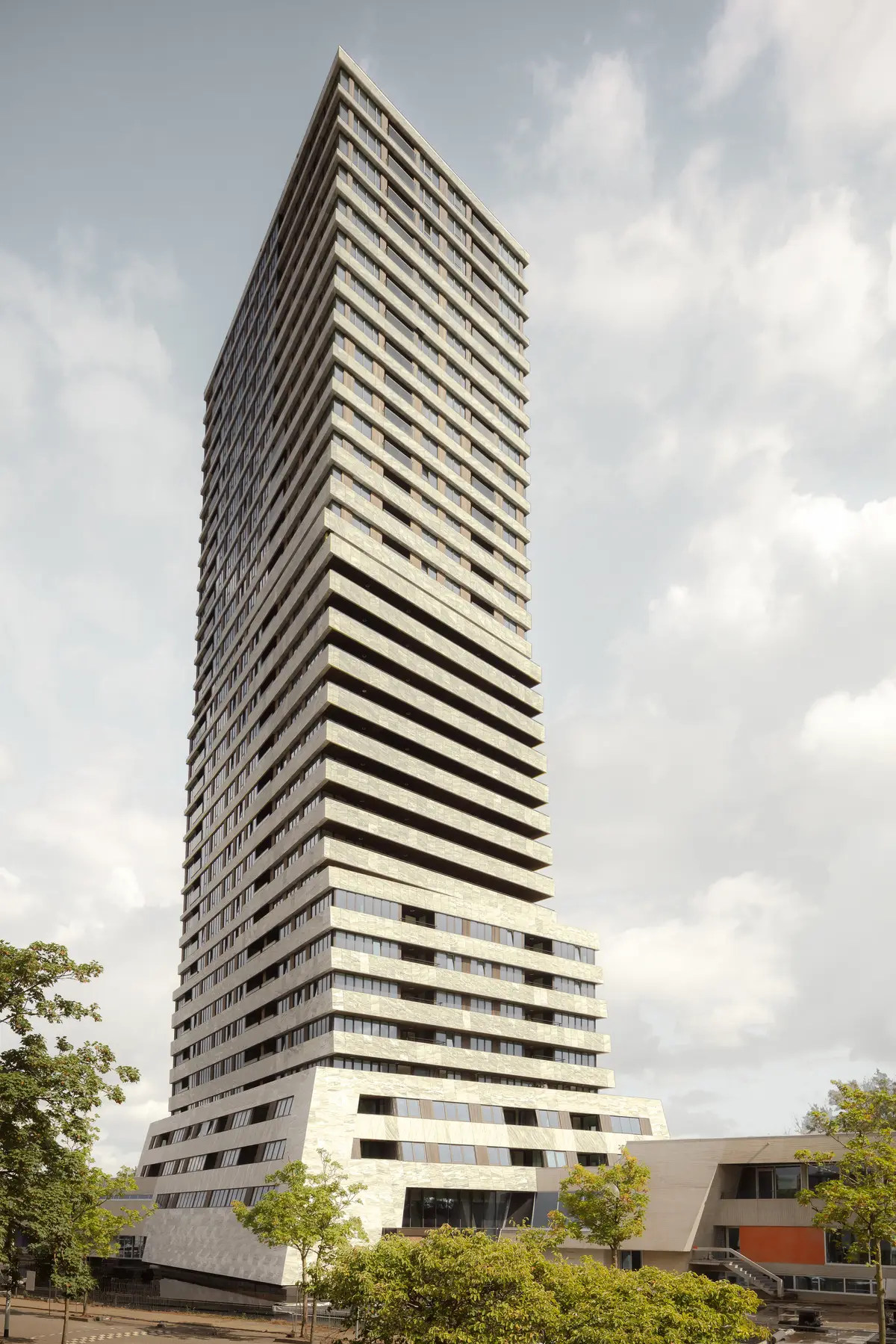
Powerhouse Company Twists a Wartime Bunker into Eindhoven's Most Defiant Residential Tower
A 32,640 square meter mixed-use tower in Eindhoven transforms a Second World War relic into a spiraling vertical neighborhood.


Eindhoven's skyline has long been defined by the horizontal logic of Philips-era industry and postwar pragmatism. Powerhouse Company, led by Nanne de Ru and Stijn Kemper, has planted something genuinely disruptive into that context: a residential tower that grows out of a wartime bunker, twisting as it rises so that each floor plate rotates against the one below it. The result, completed in 2022, is a 32,640 square meter mixed-use building that refuses to treat its historical inheritance as a problem to solve and instead treats it as a launch pad.
What makes Bunker Tower worth studying is not the twist itself. Rotating floor plates have been a parlor trick of computational design for two decades. The real achievement here is the relationship between the heavy, earthbound bunker base and the aspirational verticality above it. The podium is all angled concrete, circular portholes, and board-formed surfaces that feel like military archaeology. The tower is all stacked balconies, layered stone, and daylight. One reads as defense; the other reads as openness. The tension between those two registers is what gives the building its character.
A Podium That Remembers
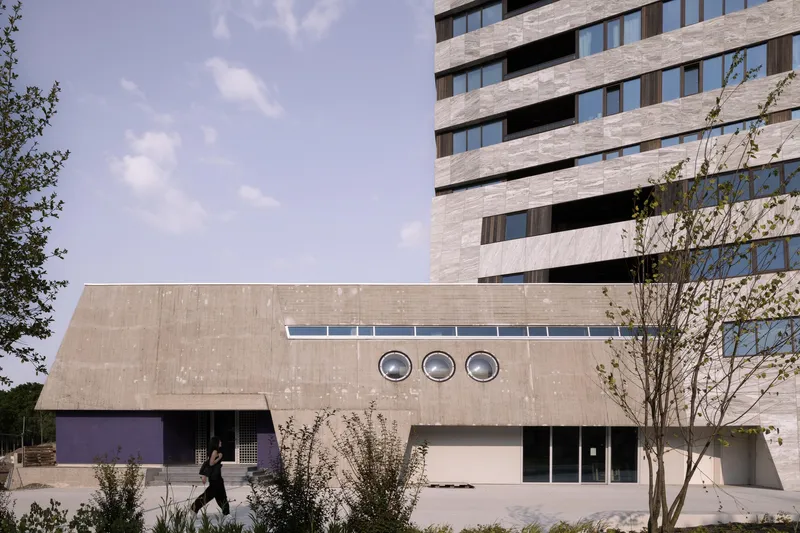
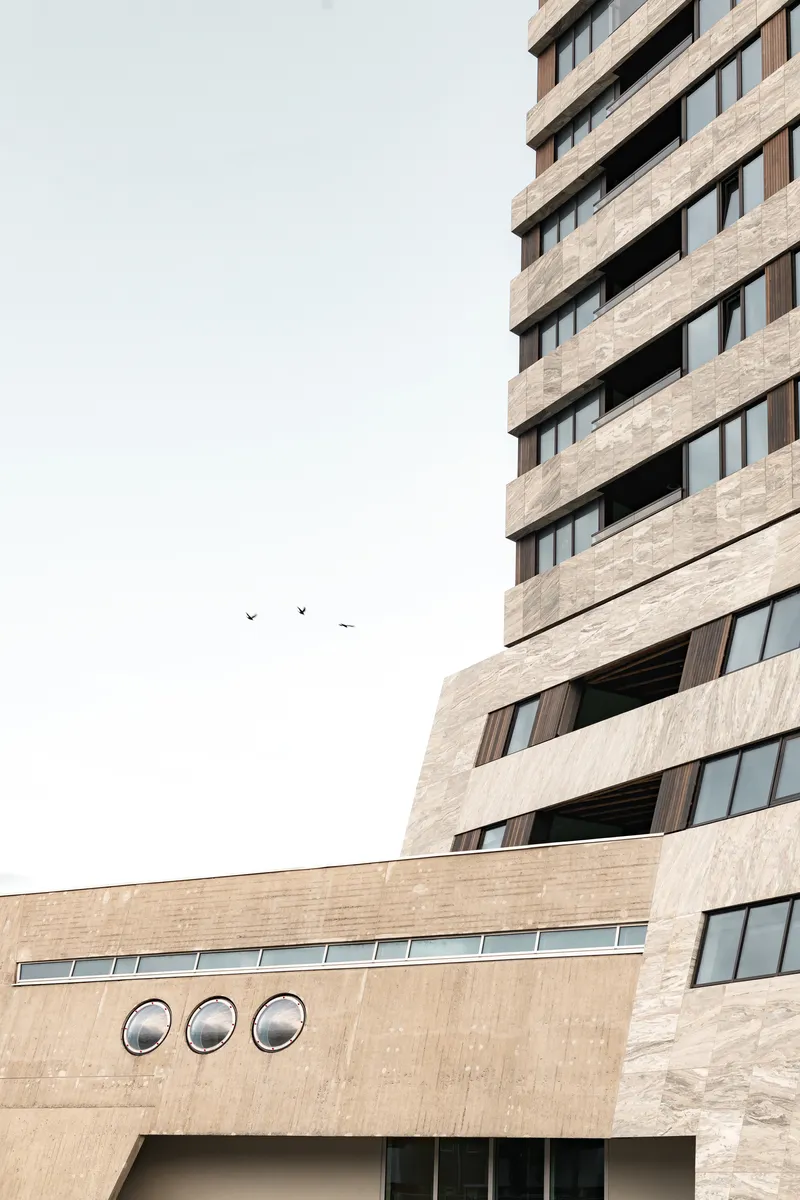
The base volume is the building's anchor, both structurally and conceptually. Clad in pale stone and punctuated by three large circular porthole windows, it reads as something between a coastal fortification and a brutalist museum. The circular openings are too precise to be bunker slits but too martial to be ordinary fenestration. They signal that the building has a memory, and that memory is not entirely comfortable.
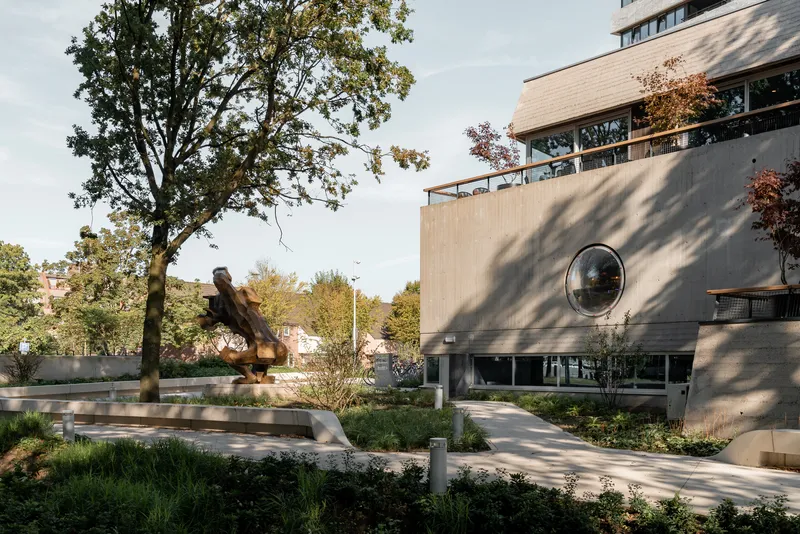
The planted courtyard at the entrance softens this message without erasing it. Sculpture, dappled shade from mature trees, and a low horizon line all work to make the ground plane inviting. But the concrete angles remain, the ribbon windows remain, and the proportions of the base still carry the weight of the program it inherits from. Powerhouse Company understood that authenticity here meant keeping the tension rather than resolving it.
Angled Concrete and the Language of the Ground
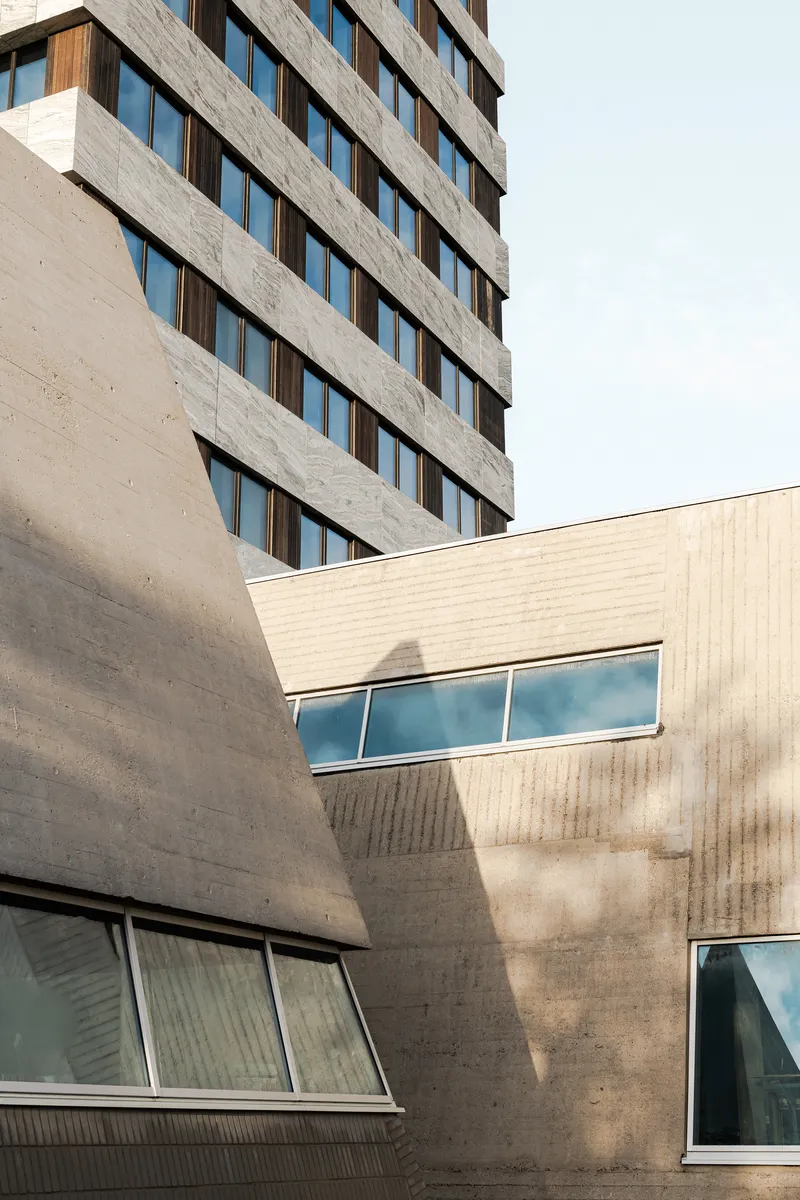
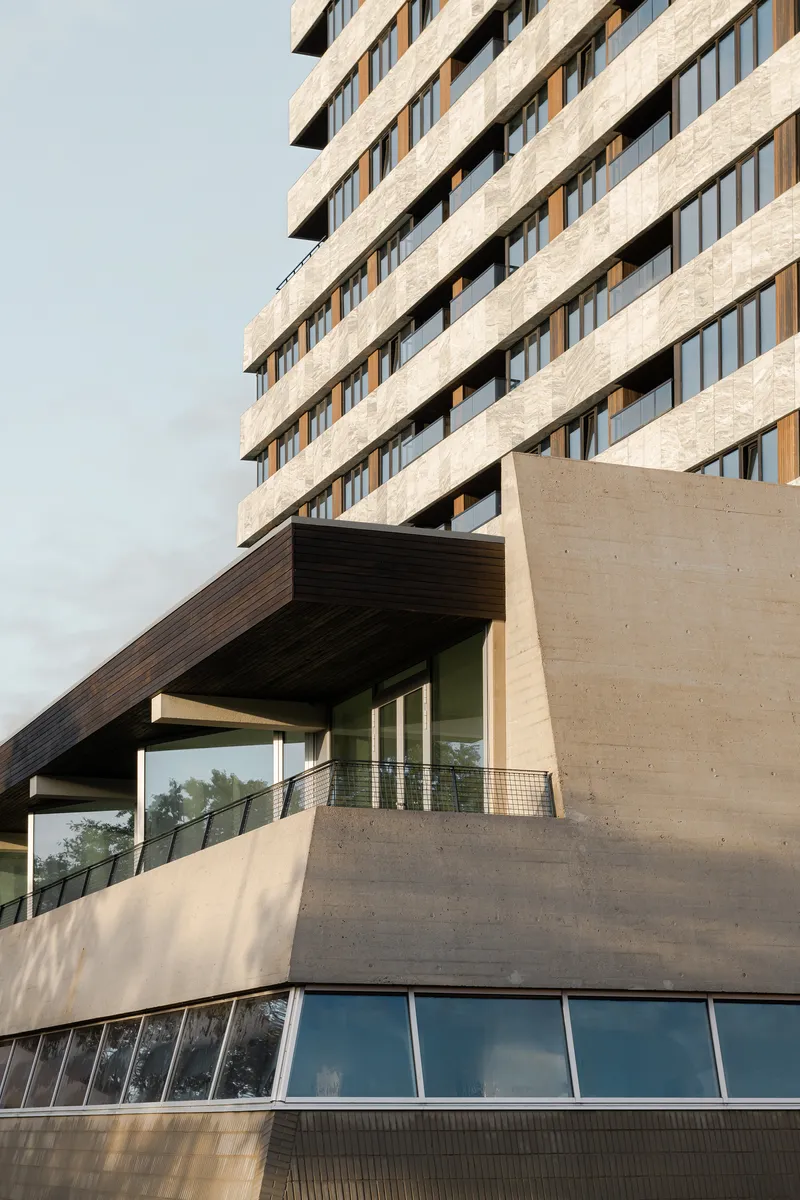
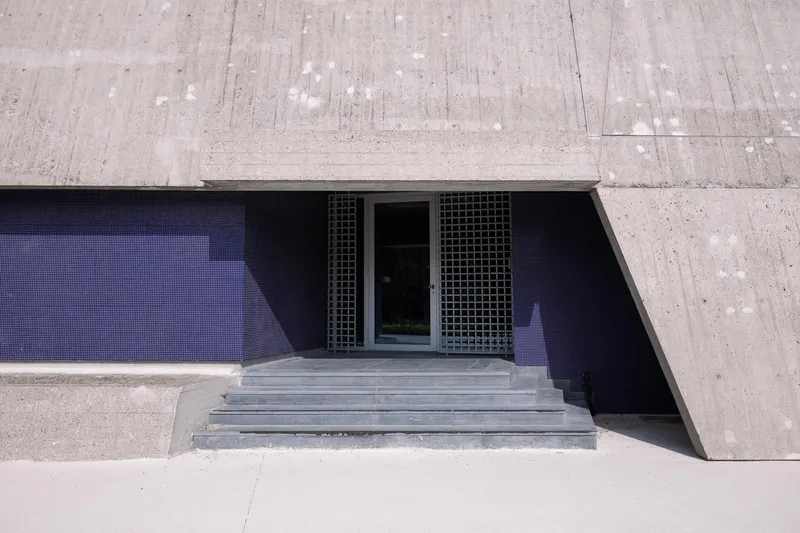
At ground level, the building's geometry gets aggressive. Angled walls, sunken entry stairs with metal grilles, and ribbon windows casting hard shadows all establish a vocabulary rooted in defense architecture. The timber-clad canopy and pedestrian ramp introduce a civic scale, but they do so within a framework that still feels fortified. The board-formed concrete is the hero material here, its texture honest and its edges sharp.
These moves are not decorative. The splayed walls direct foot traffic, manage level changes on a sloping site, and create sheltered microclimates at the base of the tower. The architecture does spatial work even as it performs historical work. That kind of double duty is rare in buildings that wear their references so openly.
The Twist as Structural Argument
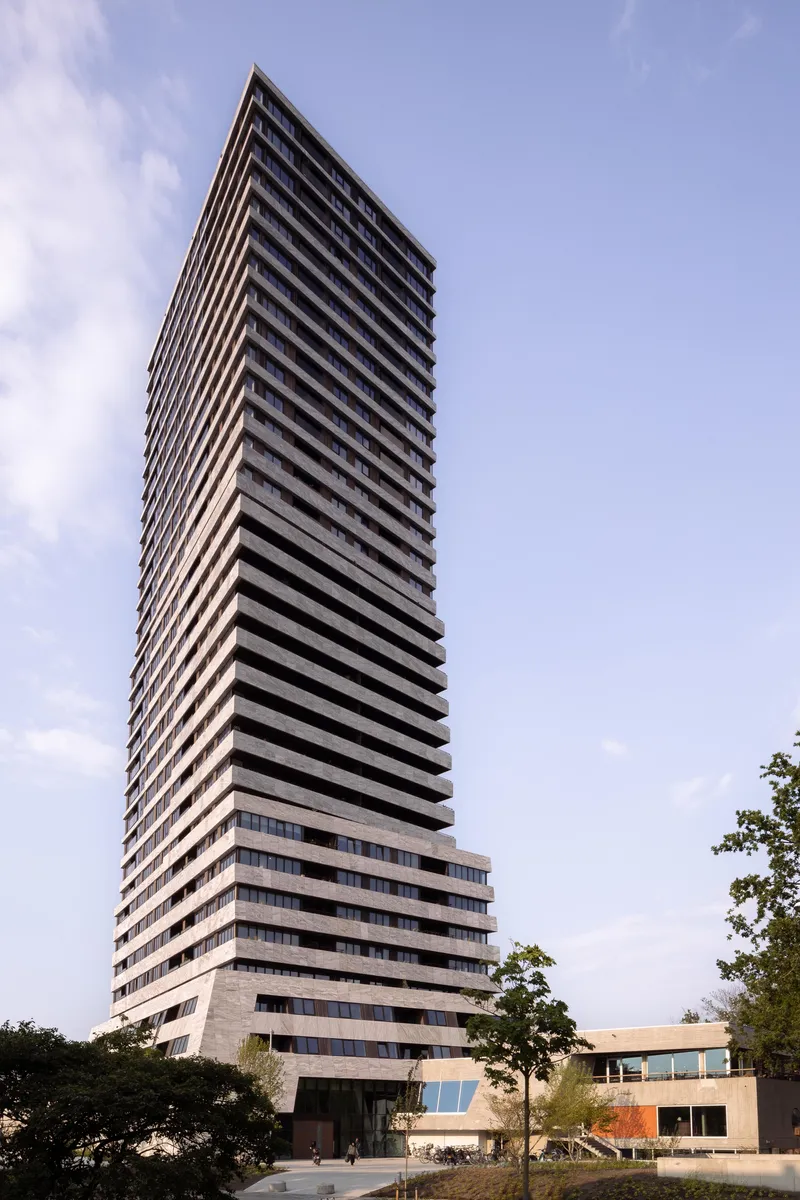
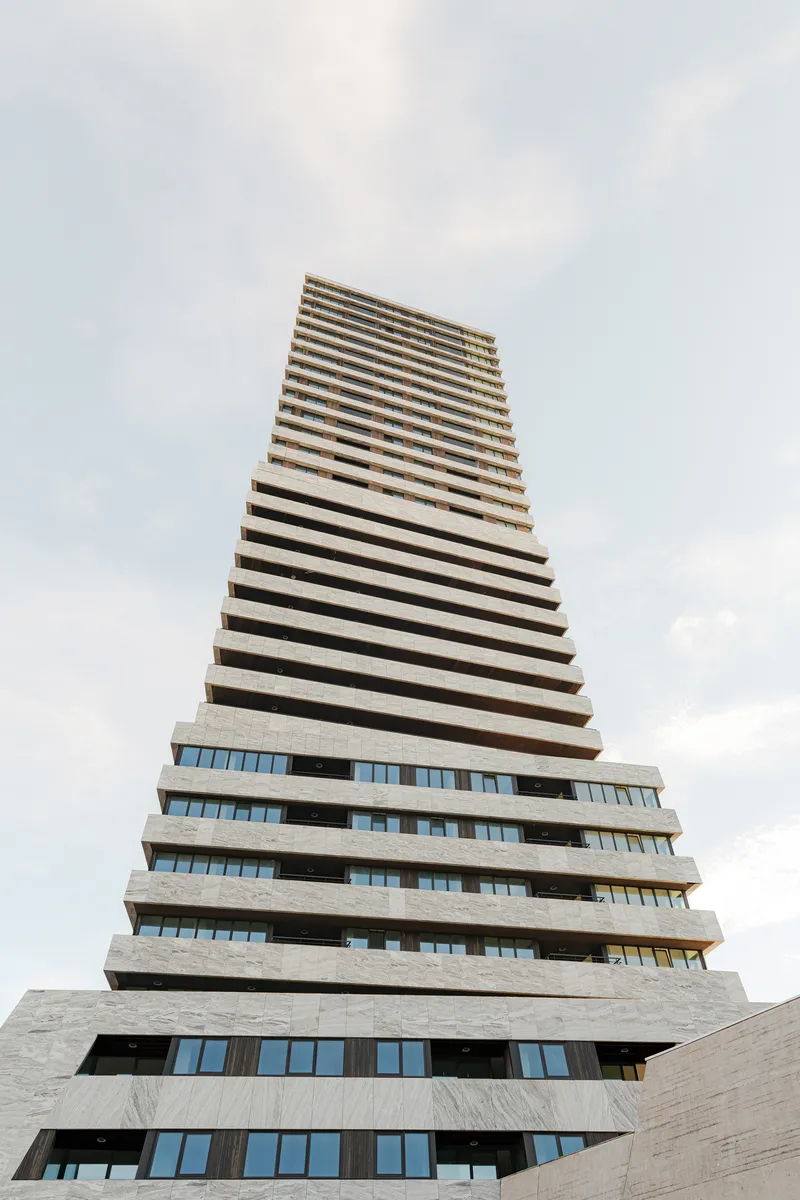
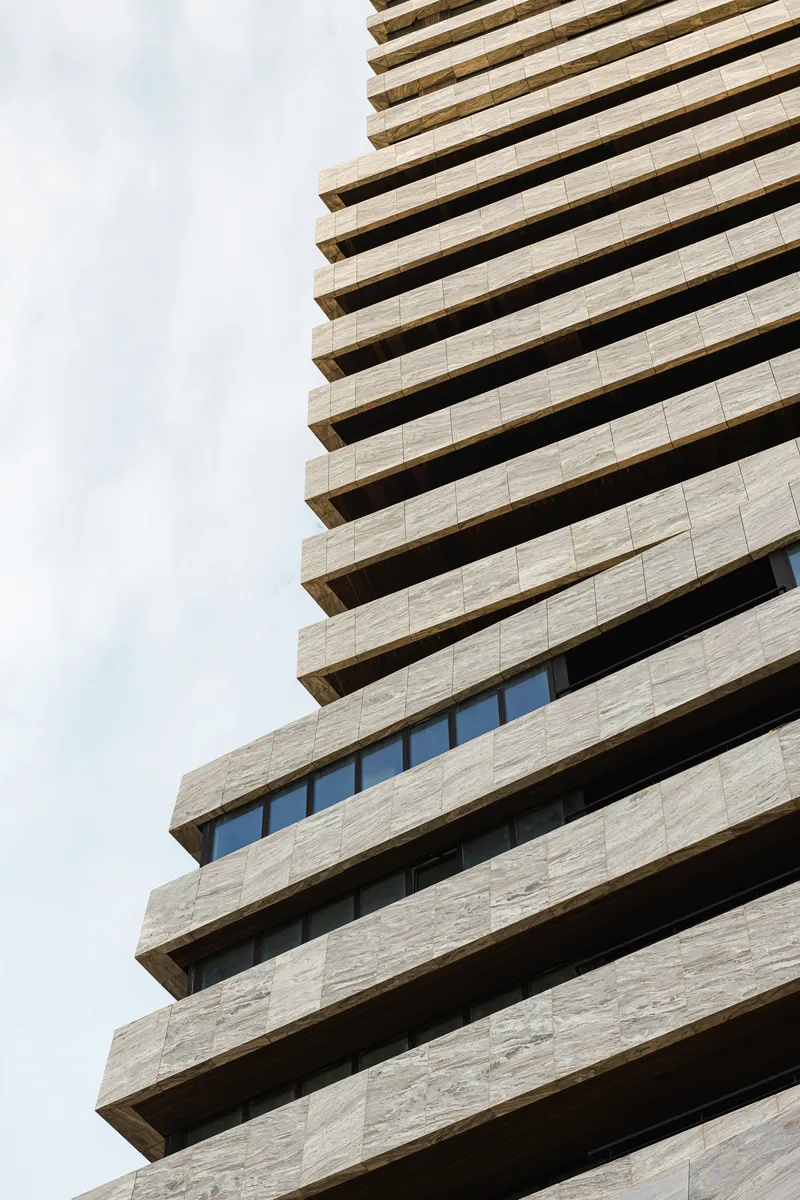
Seen from a distance, the tower's rotation is unmistakable. Each cantilevered floor plate shifts slightly from the one below, creating a slow spiral that produces deep, stepped balconies on every face. The horizontal stone cladding wraps each slab edge continuously, so the twist reads as a smooth geological formation rather than a stack of misaligned boxes.
Structurally, the rotation means that no two floors share exactly the same column grid, pushing loads through the core in ways that demand careful engineering. The payoff is that every unit gets a different orientation, different view lines, and different solar exposure. In a city where most residential towers offer the same apartment repeated forty times, that variety is a genuine amenity. The twist is not formal gymnastics; it is a plan-level strategy for livability.
Facade Layering and Material Warmth
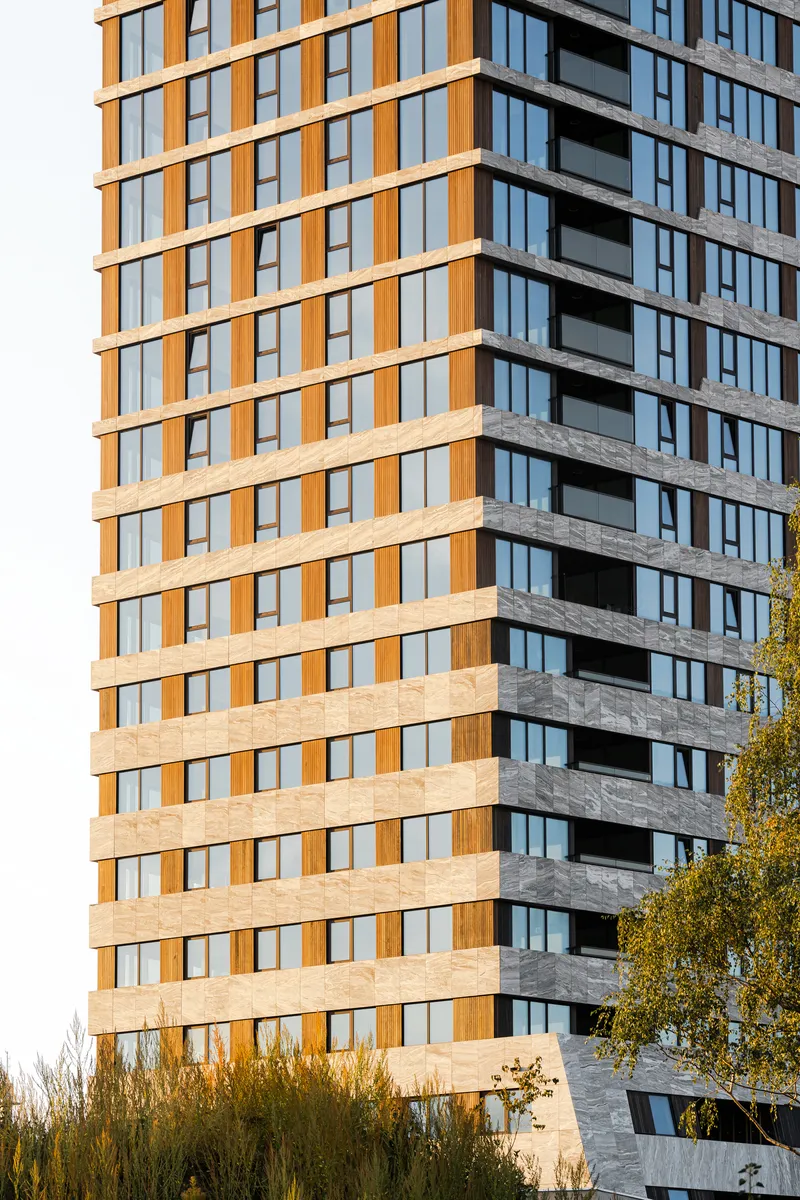
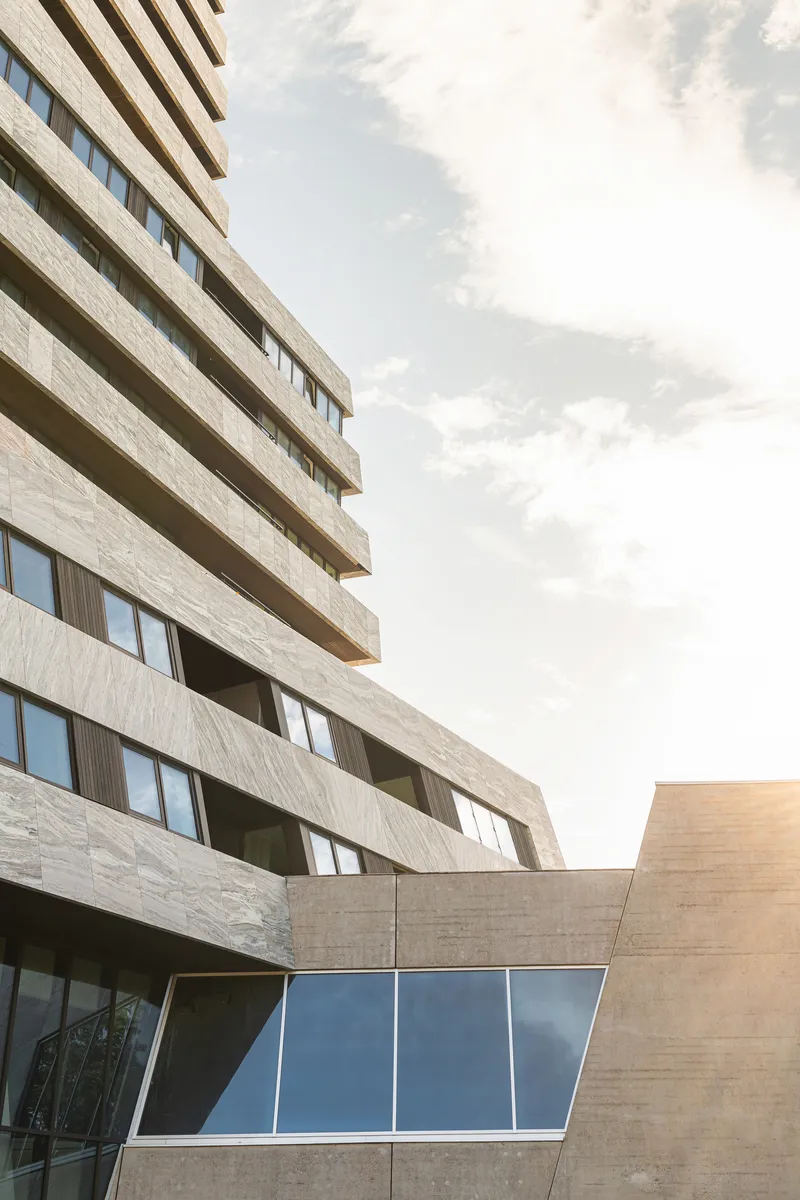
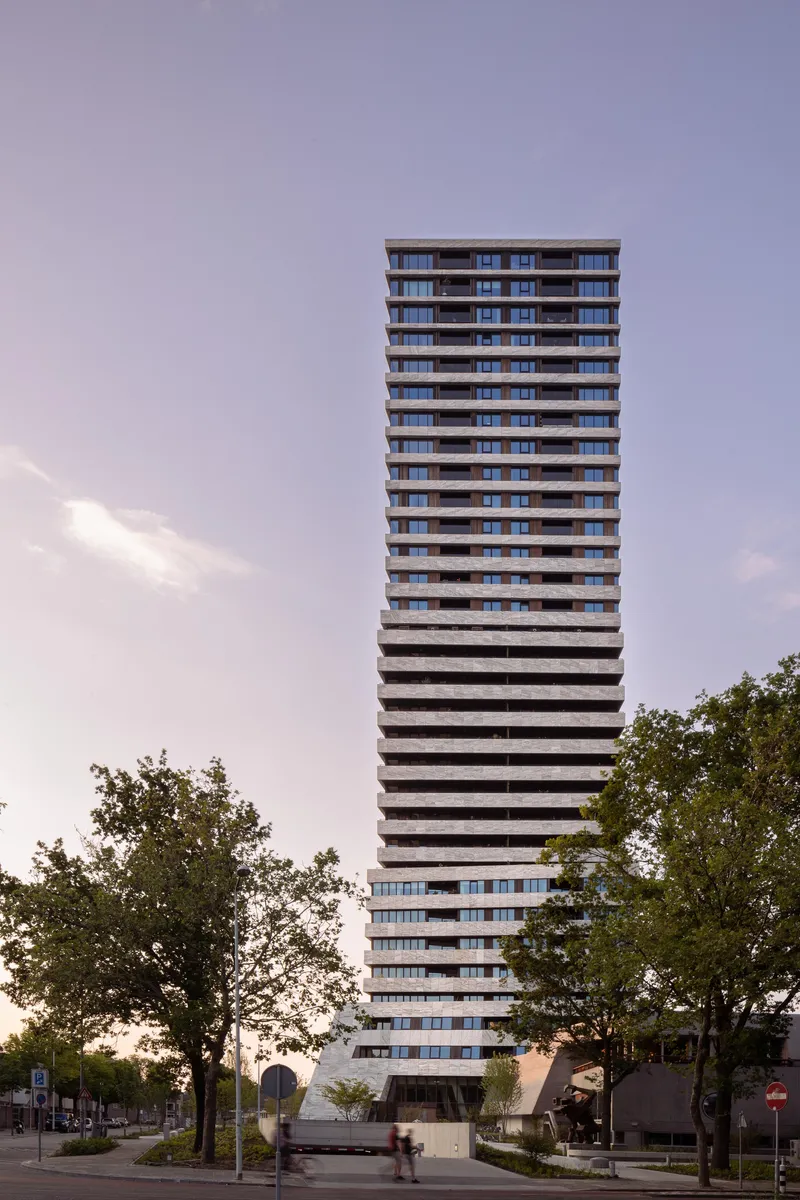
The tower's skin negotiates between the pale stone of the podium and the warmer registers of domestic life. Alternating beige and orange panels beside recessed balconies give the facade a quilted quality at close range while reading as a unified warm tone from across the city. The dusk photographs reveal how the glazed bands glow against the solid panels, turning the building into a lantern that marks Eindhoven's center.
At the podium junction, a glazed bay pushes outward at an angle, mediating between the heavy base and the lighter tower above. It is a clever hinge moment: the glass catches reflections of the surrounding trees while signaling that the program shifts from public and commercial to private and residential. The layered stone balconies above provide depth and shadow, preventing the facade from flattening into curtain-wall anonymity.
Interior Atmospheres: Concrete, Timber, and Color
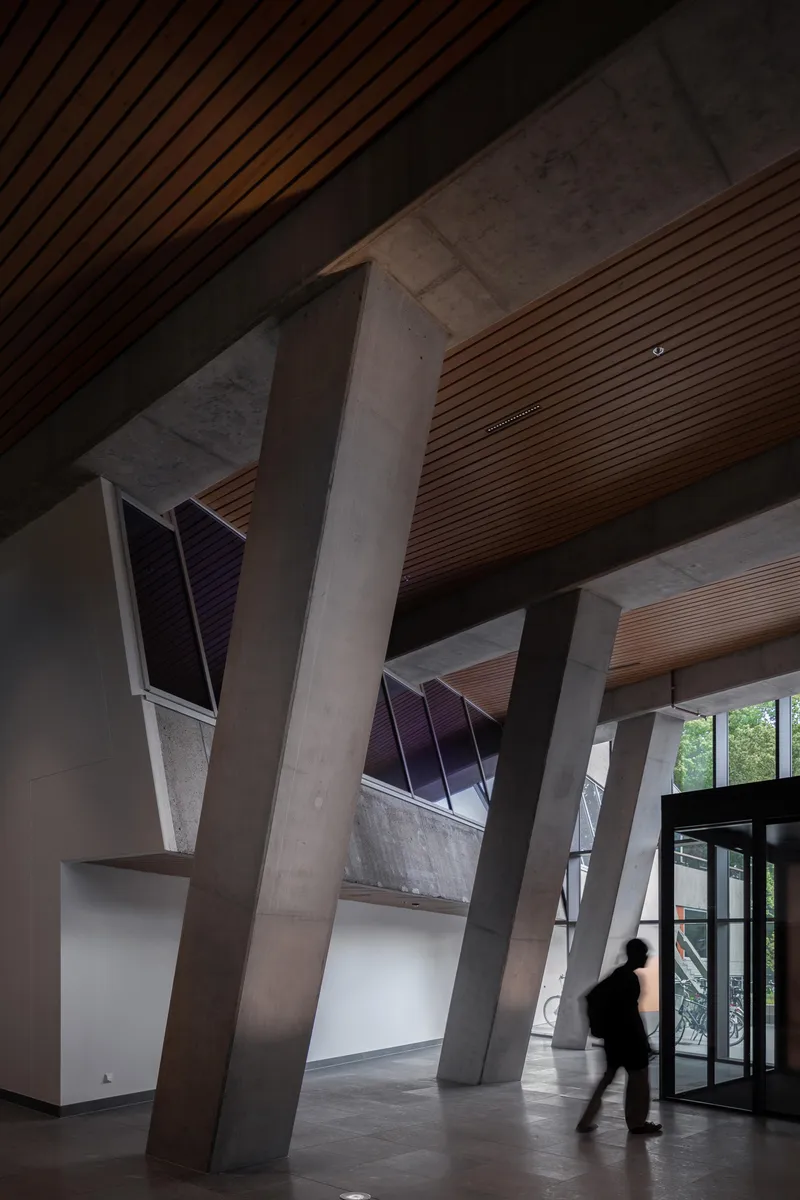
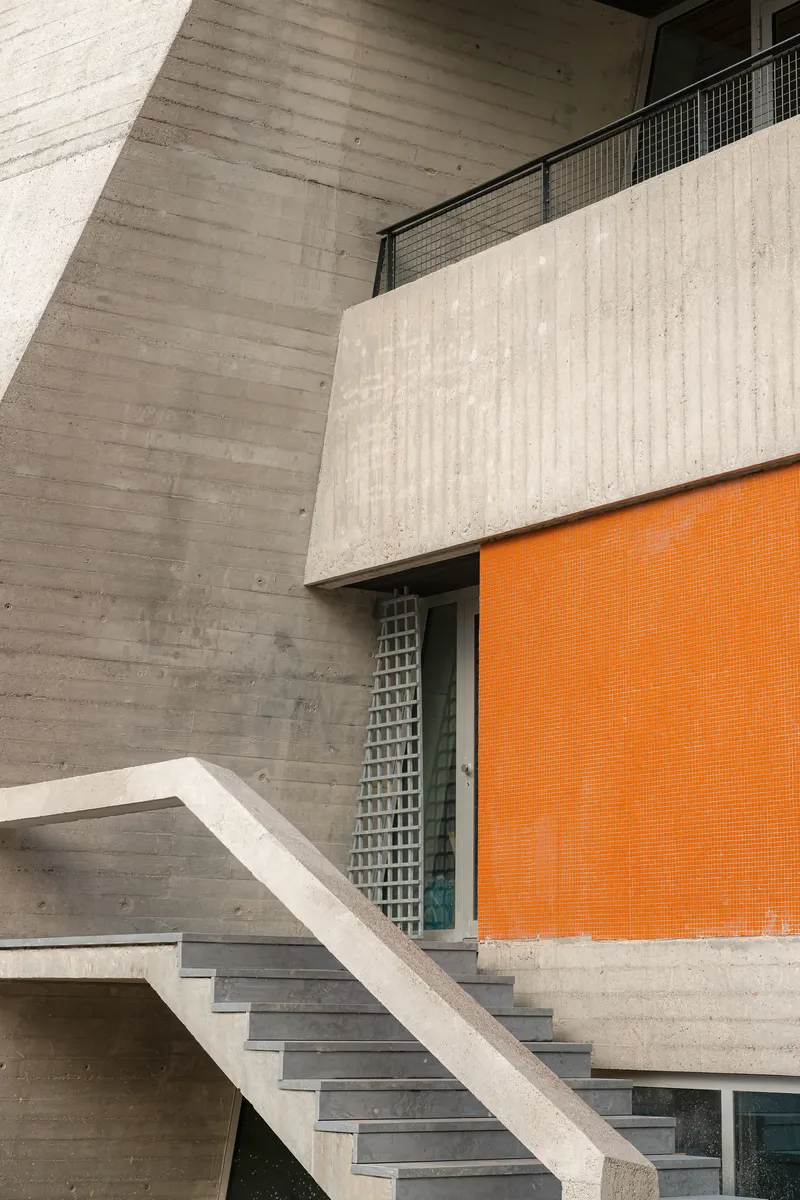
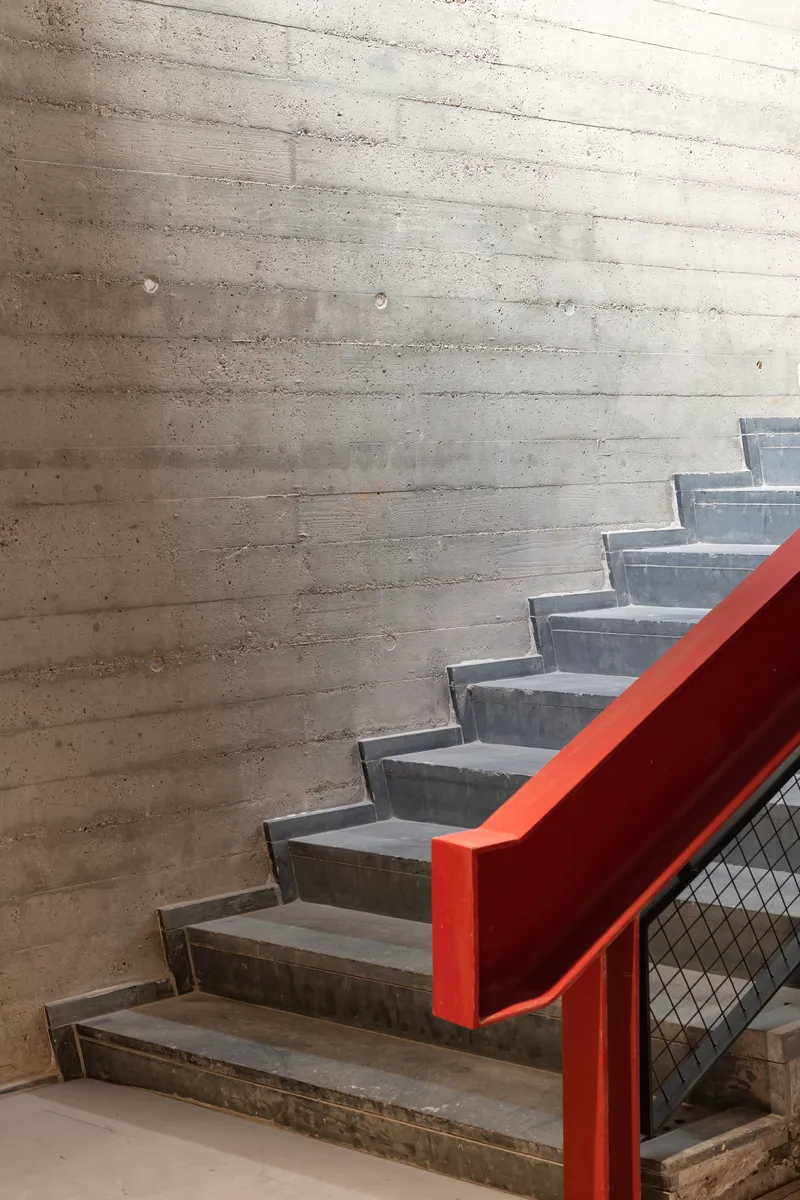
Inside the podium, the material palette intensifies. Angled concrete columns rise through timber-slatted ceilings in the lobby, establishing a rhythm that continues into the communal spaces. The board-formed concrete staircase and its red-painted steel handrail are a standout detail: the contrast between the raw texture of the formwork and the precise color of the handrail is the kind of controlled collision that good interiors depend on.
Orange tile walls in the atrium, metal mesh screens, and mezzanine railings all contribute to an interior language that is robust without being harsh. These are shared spaces designed for actual use, not for Instagram backdrops. The materials will age well, the proportions are generous, and the light quality varies dramatically as you move through the building.
Living at the Top
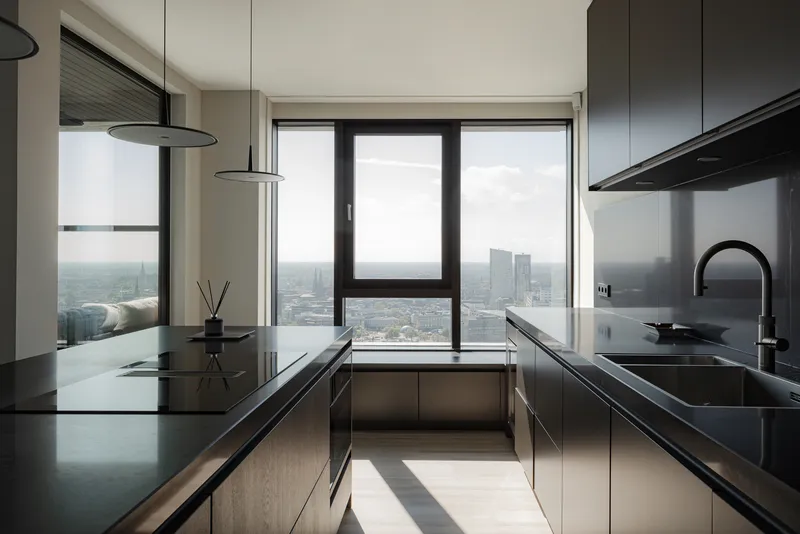
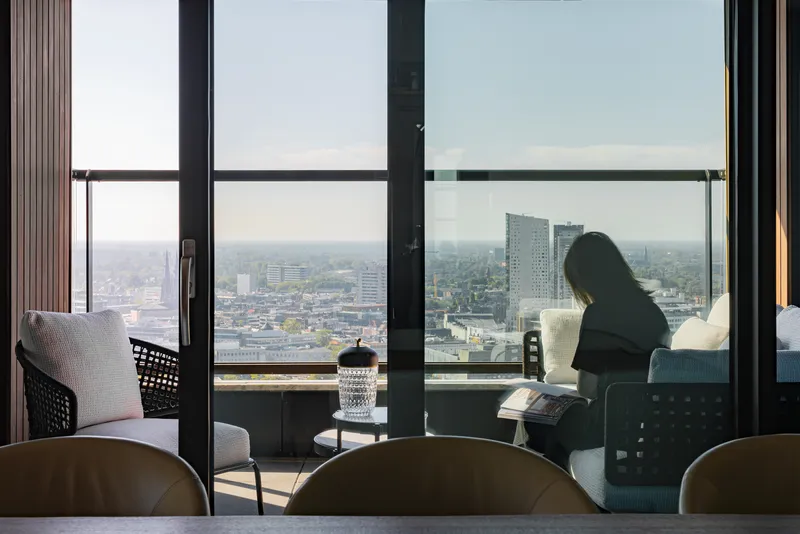
The residential units benefit directly from the tower's rotation. Floor-to-ceiling glazing frames panoramic views of Eindhoven's hazy cityscape, and deep balconies provide usable outdoor space at altitude. A kitchen with black cabinetry set against an expansive window wall demonstrates how the architecture creates moments of domestic drama without oversized apartments or luxury excess.
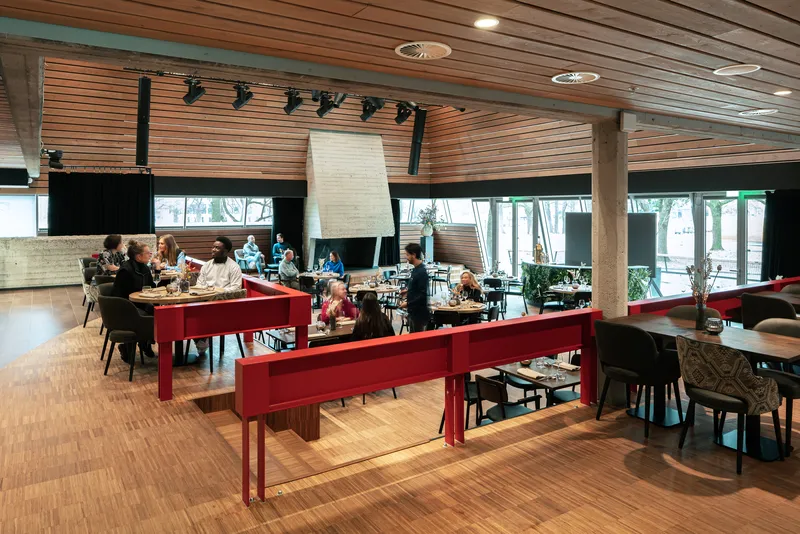
Communal dining spaces at lower levels, with red timber tables beneath slatted wood ceilings and exposed concrete columns, reinforce the building's ambition to be more than a stack of units. These shared amenities borrow the podium's material vocabulary, creating continuity between the public and private realms. It is a small but meaningful gesture that treats residents as a community rather than a collection of mortgage holders.
Urban Presence and Landscape
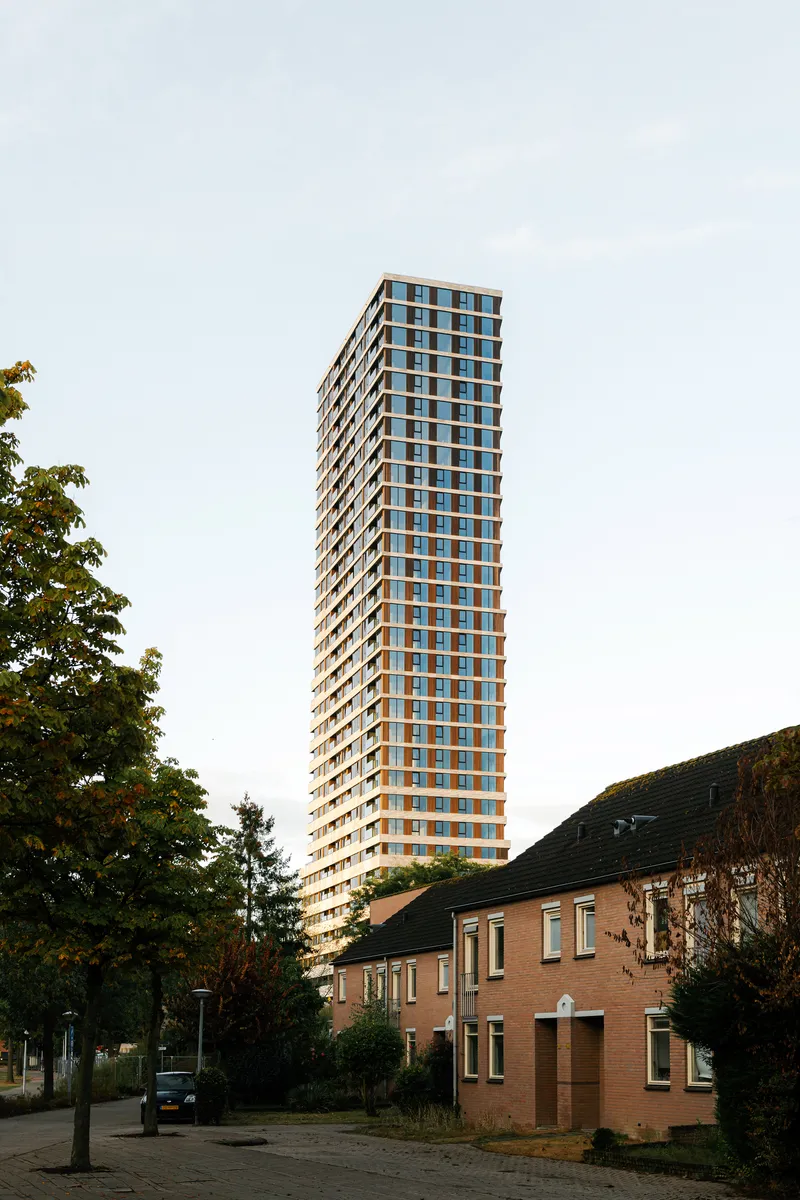
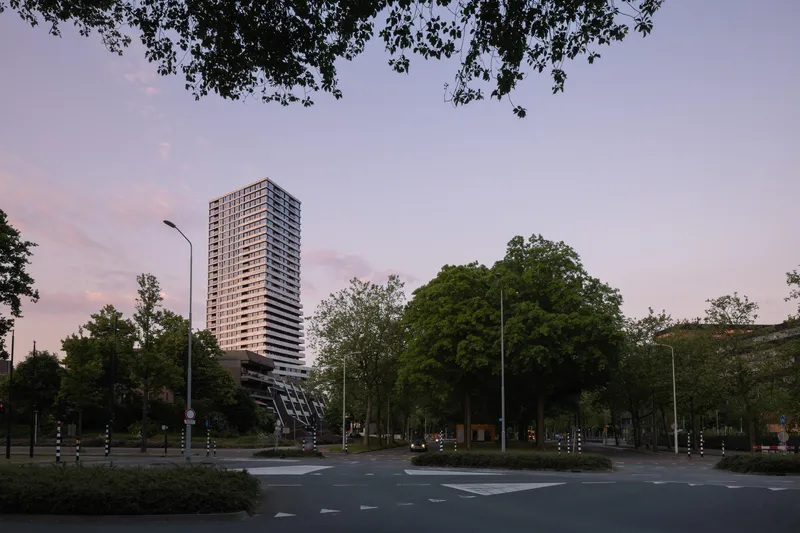
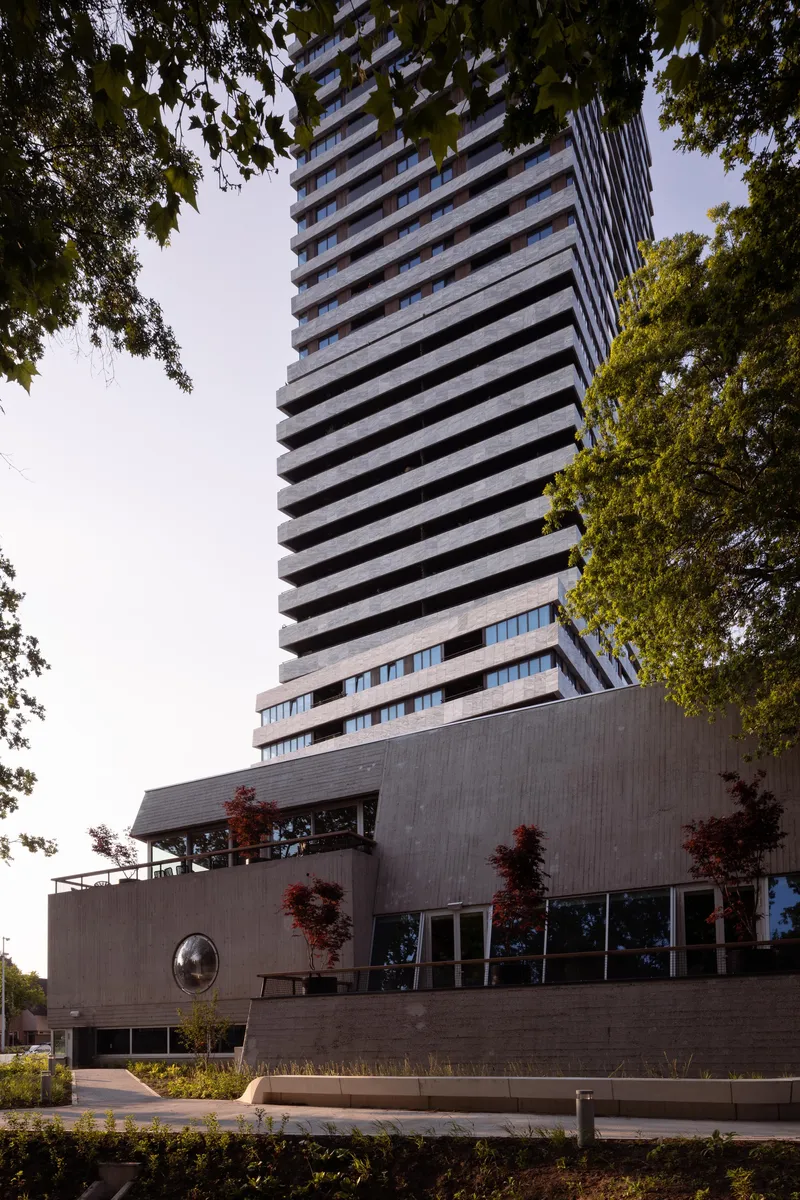
From the surrounding streets, the tower does something that few tall buildings in Dutch cities manage: it looks like it belongs. Rising above low-rise brick houses and mature street trees, it reads as a vertical extension of the neighborhood rather than an interloper parachuted in from a different planning regime. The landscaped terrace with red-leaved maples at the entrance grounds the building in seasonal change and local planting.
Twilight views across the nearby roundabout show the tower as a marker rather than a barrier, its silhouette legible against the evening sky. The surrounding trees, both existing and newly planted, have been calibrated to frame rather than screen the building. DELVA Landscape Architecture and Urbanism deserve credit for a landscape plan that treats the tower's base as a park edge rather than a plaza.
Plans and Drawings
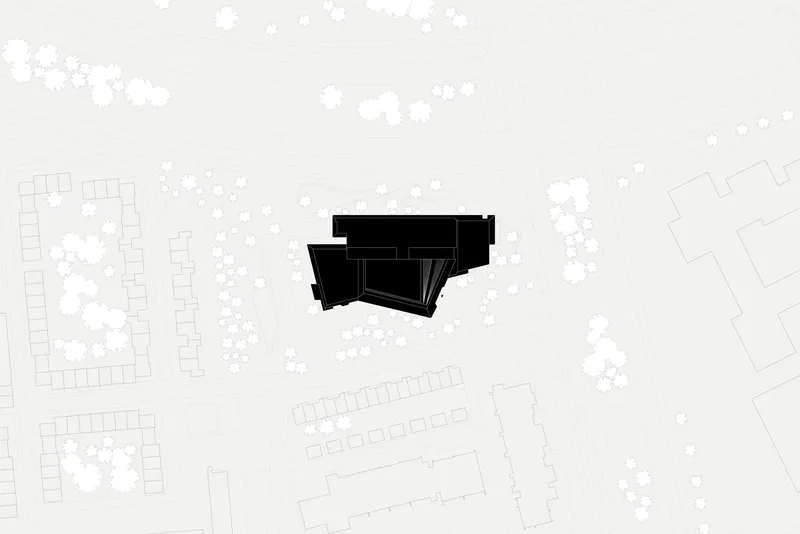
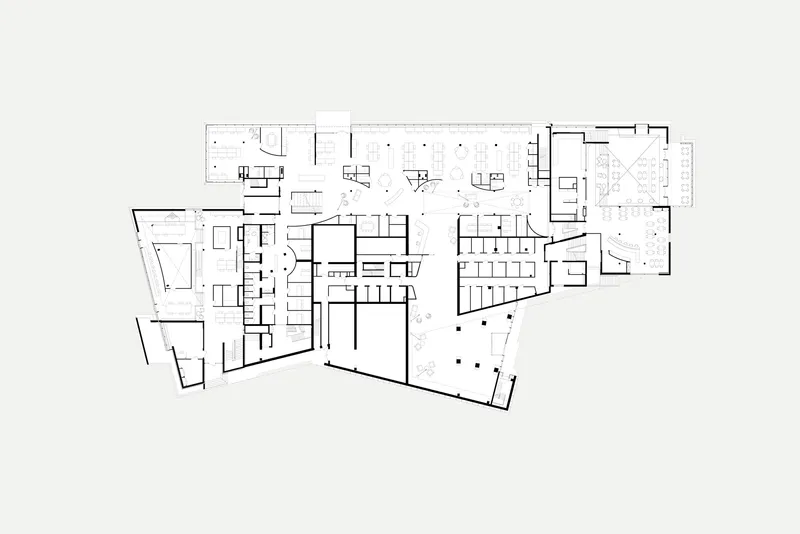
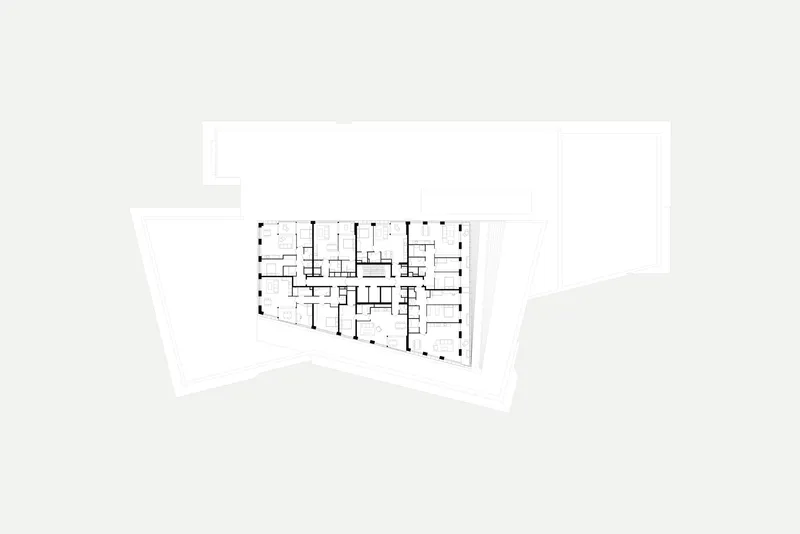
The site plan reveals the angular footprint of the podium, which splays outward to create sheltered courtyards and transition zones before meeting the surrounding streets. The residential floor plan shows units organized along a central corridor with exterior terraces that shift orientation at each level, a direct consequence of the tower's rotation. The podium-level plan exposes a large central hall flanked by smaller rooms and angled wings, confirming that the base operates as a civic volume rather than simply a parking plinth.
Why This Project Matters
Bunker Tower is a case study in how to make a tall building that is rooted in something other than a developer's spreadsheet. By starting with the physical and psychological weight of a wartime bunker, Powerhouse Company gave the project a narrative spine that disciplined every decision: the material palette, the structural twist, the relationship between base and tower, the way residents enter the building. That narrative is legible without a guidebook, which is the test of architectural storytelling.
More broadly, the project demonstrates that Eindhoven can absorb ambitious density without sacrificing its identity as a mid-scale, livable city. The twist gives every resident a unique relationship to the horizon. The podium gives the neighborhood a new public room. And the bunker gives the whole enterprise a reason to exist beyond square meter counts. In a European housing market that too often treats residential towers as extruded floor plates with marketing budgets, Bunker Tower insists that architecture can still carry meaning upward.
Bunker Tower, Eindhoven, The Netherlands. 32,640 m², completed 2022. Architects: Powerhouse Company (lead architects Nanne de Ru and Stijn Kemper), in collaboration with RED Company, Being Development, and DELVA Landscape Architecture & Urbanism. Photography by Anna Odulinska and Sebastian van Damme.
About the Studio
Share Your Own Work on uni.xyz
If projects like this are the kind of work you want to make, uni.xyz is a place to publish your own, find collaborators, and enter design competitions.


Popular Articles
Popular articles from the community


Manzana Morphosis: Stretching Barcelona's Grid into a Living Landscape for 2050
A radical reworking of the Eixample manzana turns density into a tool for generous public space, vertical ecology, and environmental performance.

Opera on the Sea: Driftwood Logic Shapes a Timber Opera House on Estonia's Coast
Trevor Orgill's opera house translates the entangled drift of floating timber into a civic building where wood, water, and music converge.

Extended Shell: Retrofitting Kolkata's Balconies as Living Urban Thresholds
A modular retrofit system recovers the social and environmental intelligence of Kolkata's historic verandas for contemporary Park Street residents.

Opera by the Sea Estonia: Three Shells Dissolving Architecture into Tallinn's Coastline
A winning opera house proposal replaces monumental form with interconnected shells that blur the boundary between building, park and Baltic Sea.

Similar Reads
You might also enjoy these articles

Pixel Gardens: One Repeated Module Stacked Into a Terraced Social Housing Tower for Famagusta
Salem Bader's shortlisted housing tower builds a vertical neighbourhood from one repeated module, offsetting units to carve terraces, light and air.

Bao Huynh Watercolor Atelier: A Serene Art Retreat in Hội An
Bao Huynh Watercolor Atelier in Hội An blends multifunctional art spaces, sustainable design, local materials, and family-friendly living in a serene environment.

Atelier Macri Concept Store Interior Design by CASE-REAL
Atelier Macri store features a "ko" counter, walnut wood details, cork displays, blending retail, gallery, and seamless customer experiences.

Manuel Vargas Izquierdo Stadium and High-Performance Sports Center: Architectural Excellence in Jalpa de Méndez
The Manuel Vargas Izquierdo Stadium blends sustainable design, inclusive sports facilities, and cultural-inspired architecture, revitalizing Jalpa de Méndez’s public spaces.


Comments (0)
Please login or sign up to add comments
No comments yet. Be the first to comment!