
5468796 Architecture Turns a 1906 Winnipeg Pumping Station into a Mixed-Use Urban Catalyst
After 17 failed revival attempts, the James Avenue Pumping Station finally finds new life as housing and commerce in the Exchange District.


Some buildings refuse to die. Winnipeg's James Avenue Pumping Station, built in 1906 to supply the city's water, was decommissioned in 1986 and endured 17 separate proposals to save it, all of which collapsed. That 5468796 Architecture finally cracked the problem says less about design ambition and more about the firm's willingness to let the site, the budget, and the zoning code do the talking. The result is a $22 million project that pairs adaptive reuse of the heritage pumping station with two new residential buildings, 160 units of attainable housing, and a handful of commercial spaces at grade, all threaded together by outdoor corridors, amphitheaters, and pedestrian lanes within the Exchange District National Historic Site.
What makes the Pumphouse genuinely interesting is not the preservation gesture itself but the operational logic behind every move. The firm describes its method as "creative opportunism," and the label fits. A zoning amendment allowed five stories on a 13-meter-deep sliver of land. A skip-stop corridor layout cut the building's total area by 10 percent. Nail-laminated timber, a century-old Canadian technique, was revived for floors and ceilings. Black steel studs halved embodied carbon in the glazing assemblies. None of these choices are flashy; all of them kept the project alive where 17 predecessors failed.
The Found Object

5468796 Architecture treated the pumping station as a "found object," a phrase that signals restraint rather than spectacle. The original brick structure remains legible, its mass and materiality left to speak for themselves while new construction defers in color and texture. The narrow gap between old brick and new corrugated metal cladding produces a compressed pedestrian lane that recalls the tight grain of the district's former railway lands. Walking through it, you register the shift from rough masonry to smooth metal as a shift in time, not in hierarchy.
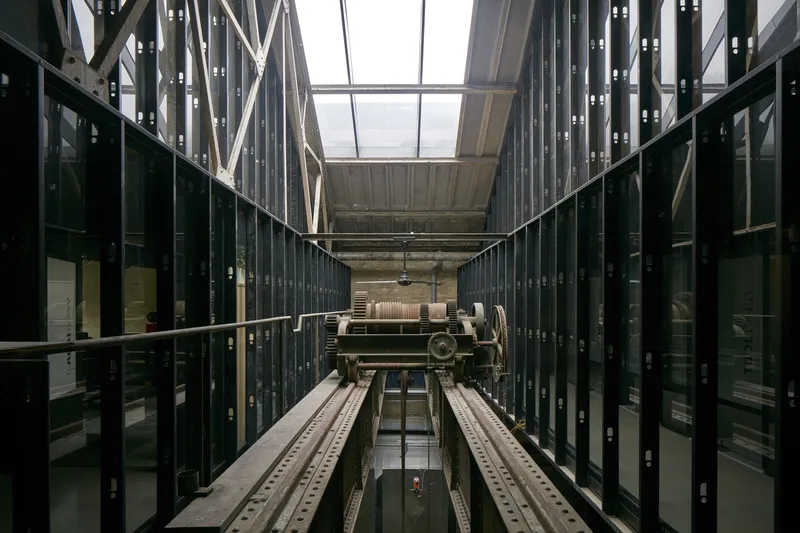
Inside the heritage building, the architects suspended a floating office floor from the original gantry crane structure, turning the crane's load capacity into a structural asset rather than a museum exhibit. Skylights punched into the roof bring daylight down to machinery that once sat 18 feet below grade. The pump hall equipment stays visible beneath the new floor, so the building's industrial biography is literally underfoot.
Elevated Housing on Steel Stilts

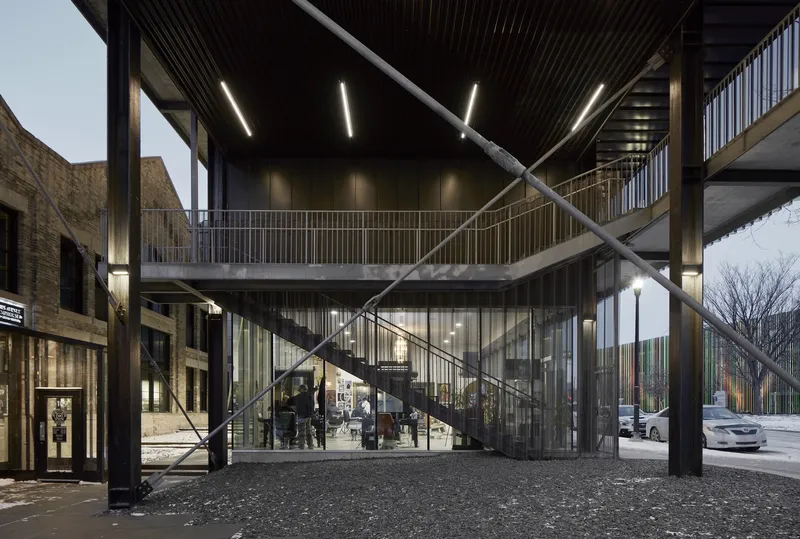
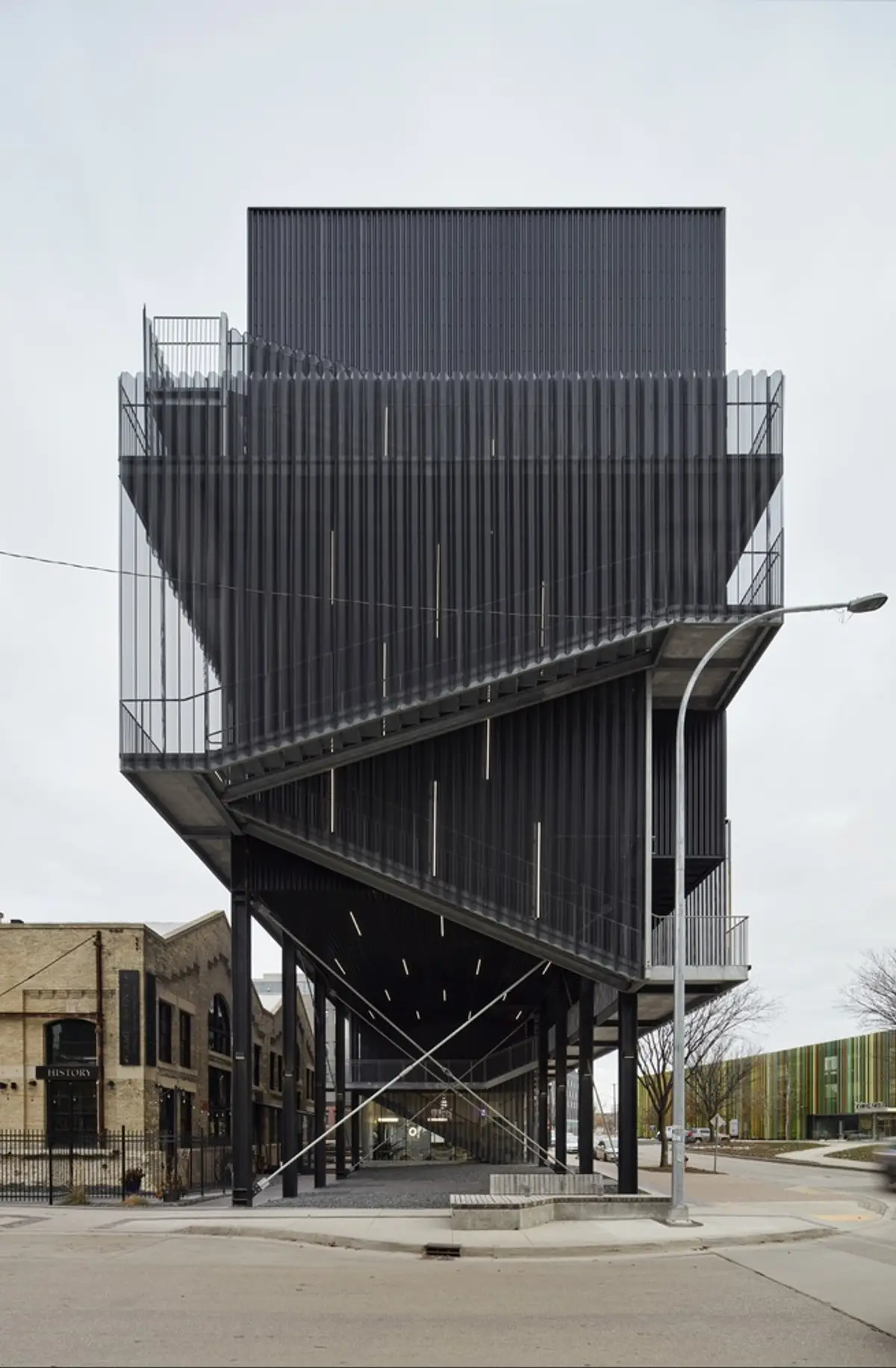
The two residential blocks flanking the pumping station are lifted 30 feet above the street on concrete plinths and steel stilts, their columns extending the grid of the original gantry crane. The elevation serves multiple purposes at once: it maintains sightlines to the historic building from the surrounding streets, relieves pressure on the pedestrian realm below, and opens ground-level space for public plazas and amphitheaters. The X-braced steel columns are left exposed, giving the underside of the buildings the frank, structural honesty of a rail viaduct.
Clad entirely in jet-black corrugated metal, the residential volumes read as industrial counterparts to the brick pumping station rather than polite contextual neighbors. The choice is deliberate: this part of Winnipeg was shaped by railways and warehouses, and the dark metal reinstates something of the original streetscape that once abutted the rail line. There is no pastiche here, just a material argument for continuity.
The Inside-Out Apartment


5468796 Architecture describes the residential layout as the typical Winnipeg apartment building turned "inside-out," and the corridors make the case. Instead of enclosed, artificially lit hallways, the circulation paths are open-air, running along the north and south elevations with criss-crossing outdoor staircases. Galvanized zinc, concrete, and aluminum line these corridors, materials chosen to weather Winnipeg's brutal climate cycle without pretending it does not exist.
The skip-stop configuration places corridors on every second floor, so each unit spans two levels with its own internal staircase in a railroad-style layout. The arrangement is not novel in housing theory, but it is uncommon in Winnipeg's market-rate development, and it delivers real performance gains: a 10 percent reduction in total building area, cross ventilation through exterior corridors that gives centrally placed bedrooms operable windows, and dual exposures that flood units with natural light. These are the kinds of decisions that only matter if you care about livability after the ribbon cutting.
Material Economy as Design Strategy

The project's material palette is disciplined to the point of austerity. Nail-laminated timber, a technique common in early 20th-century Canadian warehouses, was revived for the residential floors and ceilings. The choice is partly economic, partly ecological, and partly a quiet homage to the industrial construction traditions of the Exchange District. Black steel studs and stiffening bars reduce the thickness of glazing assemblies, cutting both material waste and cost while halving the embodied carbon compared to conventional curtain wall solutions.
Throughout, the firm used standard materials and standard workmanship, meeting a $22 million construction budget that would have been tight for a project half this ambitious. The glass-enclosed meeting room visible at dusk, with its red floor tile and minimal framing, captures the ethos: nothing precious, nothing wasted, everything working.
Public Space Between Old and New
The residential buildings are offset from the pumping station rather than attached to it, and the gaps between them become the project's most generous contribution to the neighborhood. These interstitial spaces form new pedestrian lanes that continue the winding road pattern of the historic area, connecting two outdoor amphitheaters and public plazas. The separation also ensures the heritage building is never swallowed by the new construction; you can always see it, always walk around it, always register it as a distinct presence.
From the open-air stairwells, residents get views of the city skyline, the adjacent river, and the park beyond. It is a form of urban generosity that costs almost nothing to build but pays compounding returns in quality of life. The project demonstrates that density and openness are not opposites; they are calibration problems.
Why This Project Matters
The Pumphouse matters because it finally answers a question that 17 previous proposals could not: how do you make heritage preservation pencil out? Not through public subsidy or cultural tourism alone, but by wrapping the old building in enough viable housing to carry the economics, then designing that housing well enough that it justifies its own existence. 5468796 Architecture did not save the pumping station by treating it as sacred. They saved it by treating it as useful.
More broadly, the project is a palimpsest of the firm's accumulated housing research: skip-stop sections, inside-out corridors, nail-laminated timber, exposed structure as ornament. Each idea has appeared in their earlier work; here they converge into a single building that is both a summary argument and a proof of concept. For cities sitting on decommissioned infrastructure and wondering what comes next, the Pumphouse offers a credible, replicable, and refreshingly unsentimental answer.
Pumphouse Commercial and Residential Building by 5468796 Architecture. Winnipeg, Manitoba, Canada. 7,108 square meters. Completed 2023. Photography by James Brittain.
About the Studio
Share Your Own Work on uni.xyz
If projects like this are the kind of work you want to make, uni.xyz is a place to publish your own, find collaborators, and enter design competitions.


Popular Articles
Popular articles from the community


Lunar Spiral: Space Architecture Shaped by the Mathematics of the Universe
Lunar Spiral reimagines space architecture through Fibonacci geometry, lunar regolith, levitating habitats, and self-sustaining Moon living.

Co-Life: Senior Housing Design That Reconnects Older Adults With the City
Co-Life reimagines senior housing design through healing gardens, shared streets, workshops, and a sustainable community across generations.

The Musturak Paradise: Senior Living Architecture for a Connected Future in Temara, Morocco
The Musturak Paradise reimagines senior living architecture in Temara via private homes, social spaces, culture, community, and shared care.

Play: Fragments of Their World
Familiar architecture becomes modular playground design, creating safe spaces where displaced children can learn, connect, imagine and play.

Similar Reads
You might also enjoy these articles


Hodi-Mandai Geram
Project Function: Preservation and revitalization of the Intangible heritage and socio-spatial identity of the Hodi by Housing, Cultural Memory Center, Sacred Grove, landscape, local tourism economy


Olio Towers: A Mid-Rise for Performers That Fuses Housing, Rehearsal, and Stage
Located blocks from Houston's Theater District, this modular tower stacks living units around a central performance atrium.

Oasis: Modular Green Housing Carved into Dhaka's Urban Fabric
A shortlisted Plugin Housing entry reclaims unauthorized settlements in Dhaka with stepped concrete volumes, green roofs, and ventilation-driven design.

Black Hole: A Floating Megastructure for the Post-Physical Era
Emiliano Mazzarotto envisions a spherical, self-scaling arena where e-sports, digital hotels, and holographic stadiums replace traditional public space.

Explore Housing Competitions
Discover active competitions in this discipline

Challenge to reimagine the Iron Throne

Photograph architecture without architects

Illustrate the lost glory of Angkor Wat - Render Challenge

Design challenge to reuse E-waste
Comments (0)
Please login or sign up to add comments
No comments yet. Be the first to comment!