
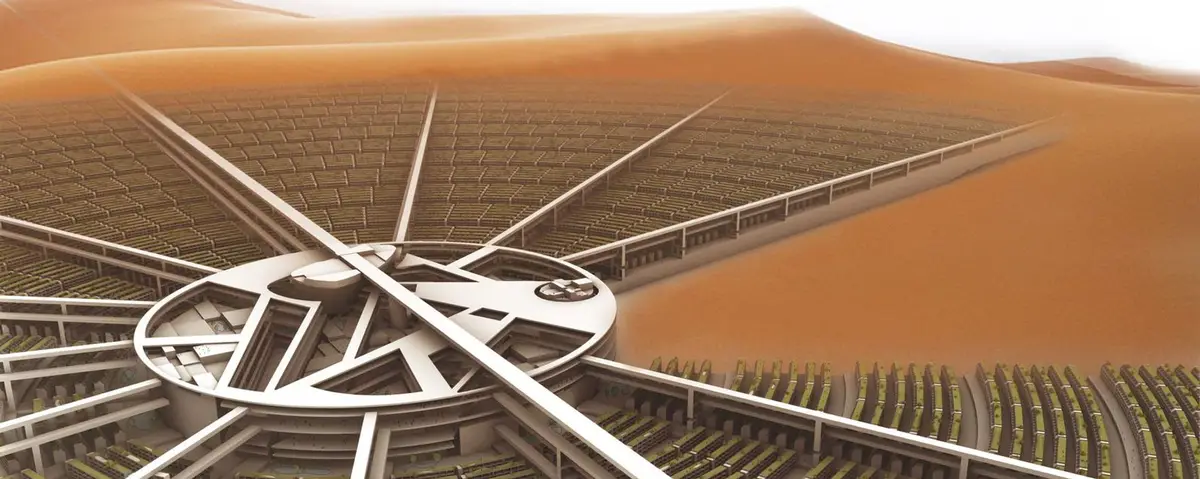
Q-City: Algorithmic Urbanism Designed to Scale Across the Sahara
A radial, car-free desert city that scales from 1,000 to 1 million residents using modular planning algorithms and climate logic.


What if a city could be scripted like software, tuned to the latitude, scaled with a slider, and deployed in one of the harshest climates on Earth? Q-City proposes exactly that: a radial urban model for the Sahara that replaces speculative form-making with algorithmic planning, passive climate strategies, and a total ban on private cars. The result is not an icon but a system, one that promises to grow from a village of 1,000 residents to a metropolis of 1 million without losing its internal logic.
Designed by Artyom Alimpiyev, Q-City was shortlisted in the EHC – Sahara competition, which challenged designers to envision livable settlements in extreme desert conditions. Rather than treating the Sahara as a backdrop for architectural spectacle, Alimpiyev treats it as a constraint set: intense solar radiation, minimal water, vast flatness, and the need for social cohesion among potential settlers. Every design decision, from the city's circular geometry to its ventilation corridors, is a direct response to those constraints.
Water Infrastructure as Foundation, Not Afterthought
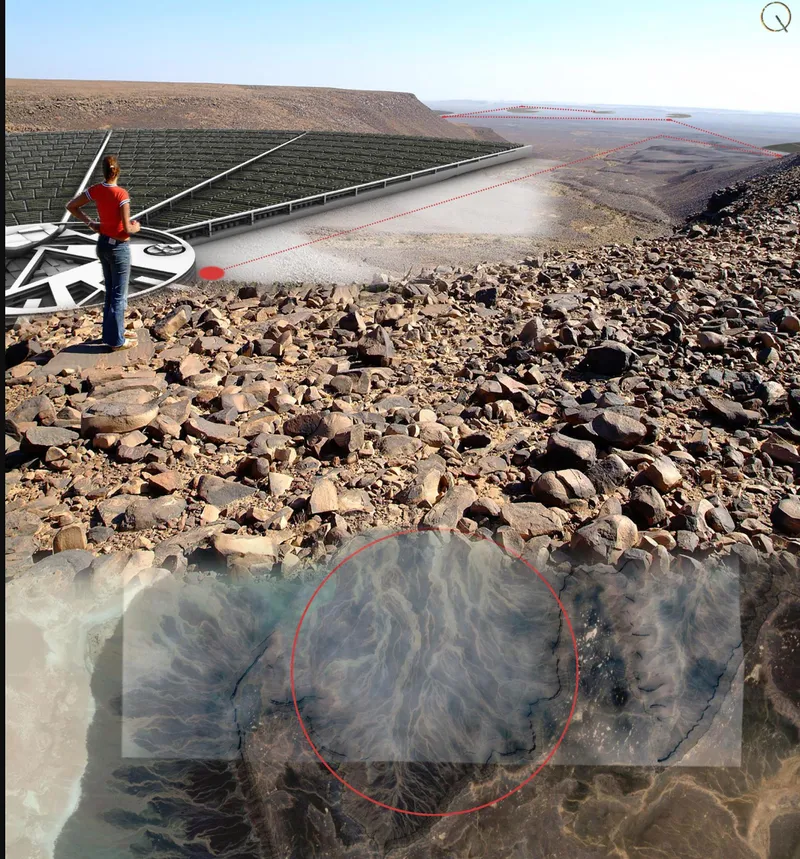
Before a single building rises, the landscape must be engineered for survival. The aerial view of Q-City's reservoir, contained by earth embankments and carved into the arid, rocky terrain, establishes a critical premise: water management is the first act of urbanism in the Sahara. This is not ornamental infrastructure. It is the precondition for everything that follows, from irrigating rooftop gardens to sustaining green corridors that thread through the radial plan. Positioning water storage prominently in the project's narrative signals that Q-City's priorities begin with survival, not aesthetics.
A Circular Plan Calculated for Efficiency
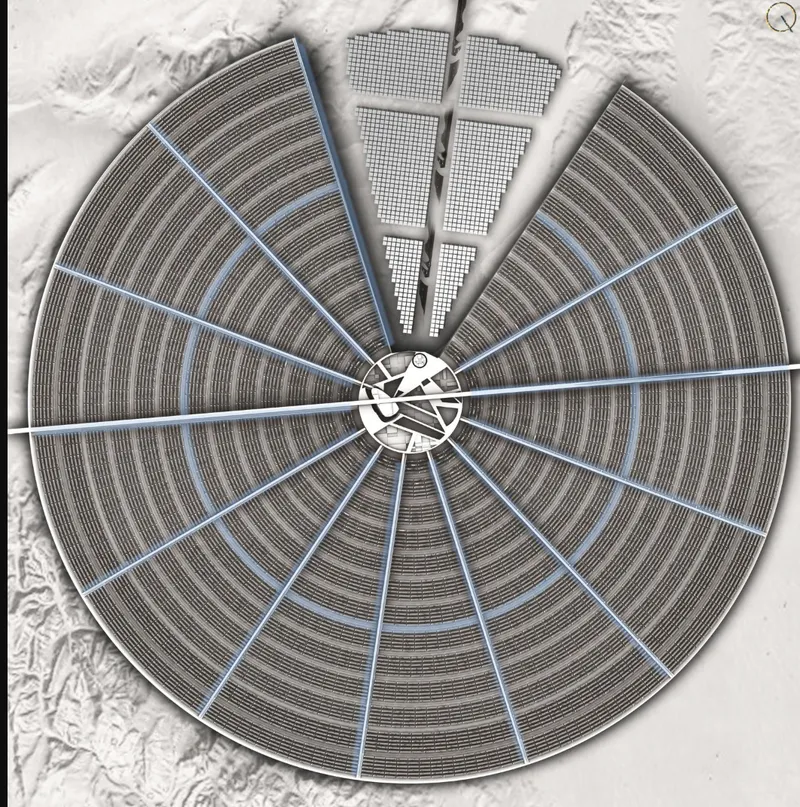

The radial plan is the engine of Q-City's logic. Divided into radiating sectors around a dense central core, the circular geometry is not a stylistic choice but a performance strategy. It minimizes the maximum distance from any residential block to the center, keeps all essential services within close reach, and discourages the kind of chaotic sprawl that plagues linear desert settlements. The plan drawing makes this hierarchy visible: housing, transportation, utilities, public services, and green infrastructure each occupy calculated positions, not arbitrary ones.
The diagram series illustrating six variations of the radial plan reveals the project's deeper ambition. By adjusting variables like green area percentage, building density, or sector layout, planners can reconfigure the city for different populations and demographic trends. This is where Q-City departs from most competition entries: it does not propose a single fixed design but a parametric framework. A digital planning script generates the urban form, making the model replicable in principle across different desert sites or even different climatic zones entirely.
Block-Level Climate Logic and Shared Social Space

Zooming into the residential scale, the exploded axonometric reveals how climate logic governs every block. Ventilation corridors channel airflow between buildings. Sun-responsive facades and thermal massing moderate interior temperatures passively. Rooftop gardens and shaded courtyards punctuate the compact residential fabric, creating the micro-communities that Alimpiyev considers essential to desert living. The highlighted public service spaces and trees embedded within the block are not decorative additions; they are the social glue of the design, placing shared amenities where daily interaction happens naturally rather than forcing it into a distant civic plaza.
The compact block arrangement also serves a transportation agenda. With private cars completely excluded from Q-City, the design relies on hyperloop networks, airtube escalators, and pedestrian-only paths. Dense, walkable neighborhoods make this feasible. When everything a resident needs, from healthcare to retail, is consolidated in the central HUB or distributed within the block, the car becomes genuinely unnecessary rather than merely discouraged.
The HUB as Vertical Nucleus
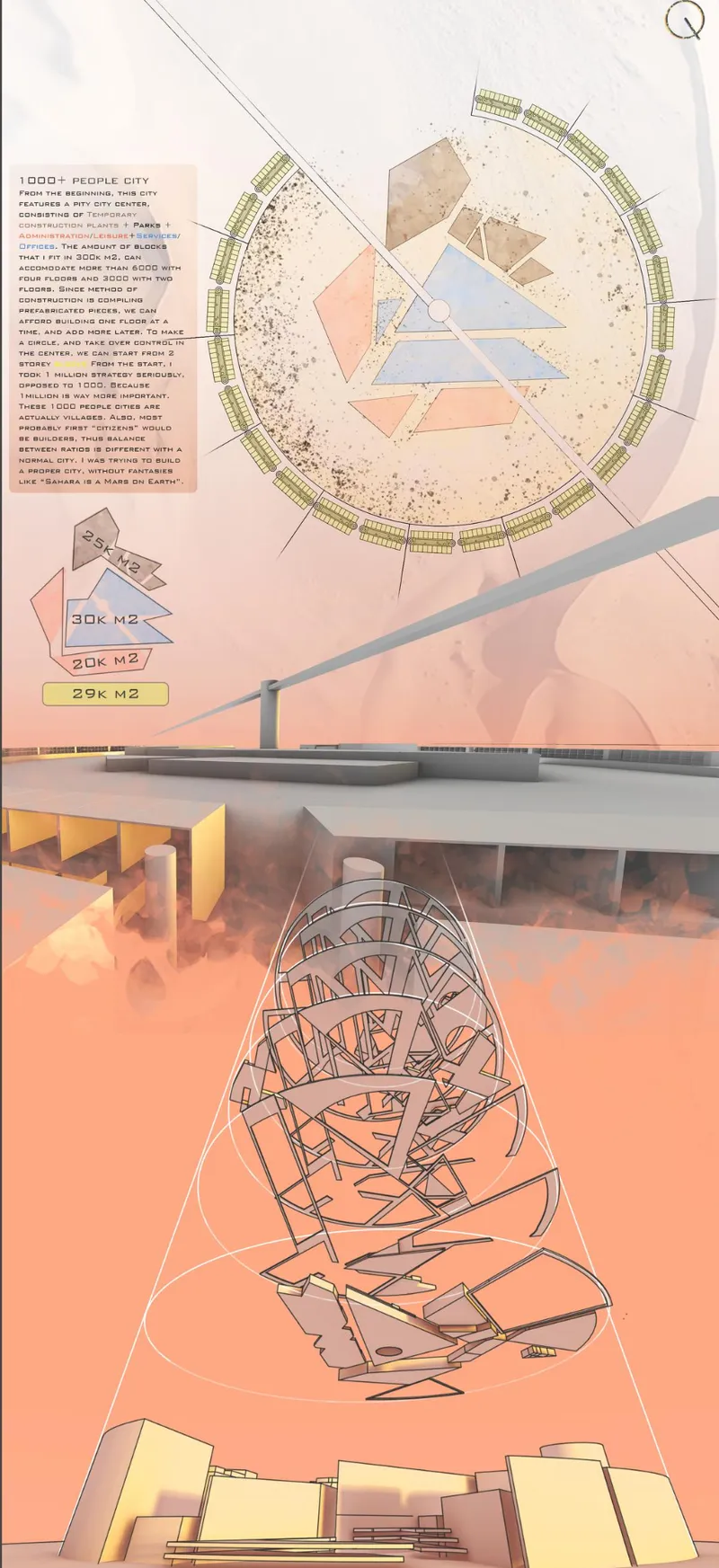
The composite rendering places Q-City's monumental HUB in context: a multi-level, centrally located structure that consolidates administrative offices, retail, healthcare, education, and civic institutions into a single vertical core. Rendered in orange haze with a skeletal spiral form, it reads as both anchor and beacon. The spatial strategy is deliberately anti-suburban: by stacking programs vertically at the city's geometric center, the HUB collapses commuting distances and creates an urban experience organized around collective access. Alimpiyev's founding belief, "build for people, not pomp," is most legible here, where convenience and civic life converge in a single structure.
Why This Project Matters
Q-City's most provocative contribution is not any single building or space but the idea that an entire city can be generated from a parametric script tuned to climate data, demographic projections, and sustainability targets. In a discipline that still fetishizes the singular gesture, proposing a replicable, adjustable urban system takes nerve. The car-free mandate, the radial efficiency, and the block-level passive cooling strategies are each defensible on their own; together, they form a coherent argument for how desert urbanism might actually function at scale.
The project's scalability claim, from 1,000 to 1 million residents, remains a hypothesis rather than a proven outcome, and the real test would lie in the messy politics and economics of implementation. But as a conceptual framework for extreme-climate settlement, Q-City earns its shortlisted status by refusing easy spectacle and insisting on systemic thinking. It suggests that the future of desert cities will not be designed from the outside in, but computed from the inside out.
View the Full Project
About the Designers
Designer: Artyom Alimpiyev
Enter a Design Competition on uni.xyz
uni.xyz runs architecture and design competitions year-round that reward proposals with spatial conviction and real site intelligence.
Project credits: Q-City EHC by Artyom Alimpiyev EHC – Sahara (uni.xyz).


Popular Articles
Popular articles from the community


The Ocean Hive: Sustainable Architecture for a Self-Sufficient Civilization at Sea
The Ocean Hive imagines sustainable architecture at sea, where modular habitats, algae, wave power and ocean waste sustain a growing colony.

Play: Fragments of Their World
Familiar architecture becomes modular playground design, creating safe spaces where displaced children can learn, connect, imagine and play.

The Musturak Paradise: Senior Living Architecture for a Connected Future in Temara, Morocco
The Musturak Paradise reimagines senior living architecture in Temara via private homes, social spaces, culture, community, and shared care.

Lunar Spiral: Space Architecture Shaped by the Mathematics of the Universe
Lunar Spiral reimagines space architecture through Fibonacci geometry, lunar regolith, levitating habitats, and self-sustaining Moon living.

Similar Reads
You might also enjoy these articles

Day and Night Park: A Time-Based Urban Newsstand in Beijing
A temporary urban newsstand in Beijing blending travel, light, and reading through poetic colors, compact form, and community-focused design.

Modernist Patio Renovation in El Masnou, Barcelona by Oliver Segura Arquitectura + Cebrià Arquitectura
Modernist patio renovation blending tradition and innovation with a movable pool, leveled floors, and Catalan materials in El Masnou.

Alto Residencial Coop: Cooperative Housing Development in Santiago de Compostela by Carbajo Barrios Arquitectos
A linear cooperative housing complex blending white volumes and perforated metal façades, enhancing community living, natural light, privacy, and urban integration.
Vil Genis School by BPA ARCHITECTURE – Massy, France
Vil Genis School in Massy, France, features sustainable design, south-facing classrooms, community integration, accessible spaces, and modern educational architecture.


Comments (0)
Please login or sign up to add comments
No comments yet. Be the first to comment!