

Qing Studio Builds a Glass and Metal Pavilion Over a Millennium of Jingzhou's City Wall Strata
A 330-square-meter exhibition canopy in Jingzhou, China, turns a living archaeological cross-section into a walkable public gallery.


Jingzhou's city wall is not a monument frozen in time. It is a palimpsest, a structure rebuilt, patched, and expanded by successive dynasties across more than a thousand years. When excavation along its southern rampart exposed distinct earthen and brick strata spanning the Eastern Zhou through the Ming and Qing periods, the question was not whether to protect the find but how to make it legible to the public without sealing it away. Qing Studio's answer is a 330-square-meter pavilion that floats a curved metal canopy and glass envelope directly over the exposed cross-section, turning the wall itself into the primary exhibit.
What makes this project genuinely interesting is its refusal to compete with its subject. The pavilion is a piece of infrastructure, not a sculptural statement. Its perforated metal skin, glass floors, and mesh walkways exist to control climate, manage visitors, and frame views of layered soil and crumbling brick. Every design decision, from the canopy's profile to the track lighting embedded in its ribs, is calibrated to one purpose: letting people walk through geological time without touching it. In a discipline saturated with heritage centers that overwhelm their contents, this is a rare case of architecture knowing when to recede.
A Canopy That Settles Among the Trees
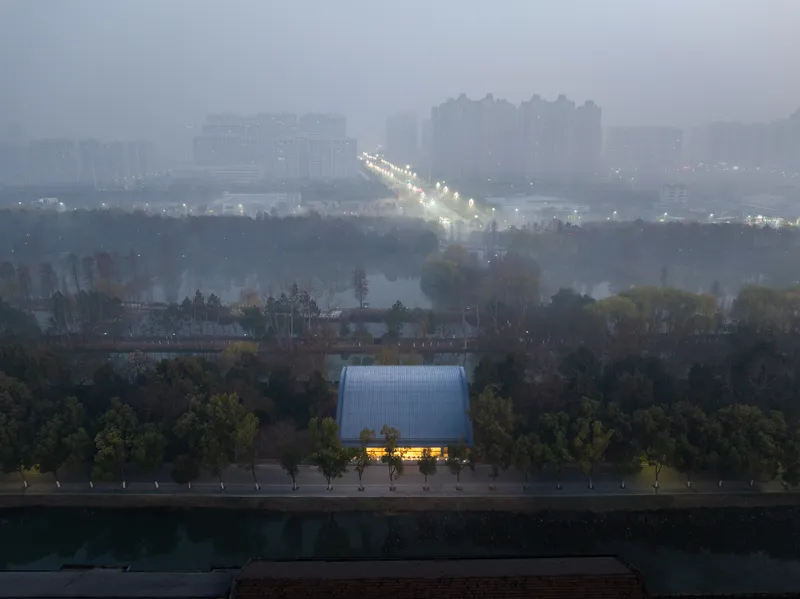
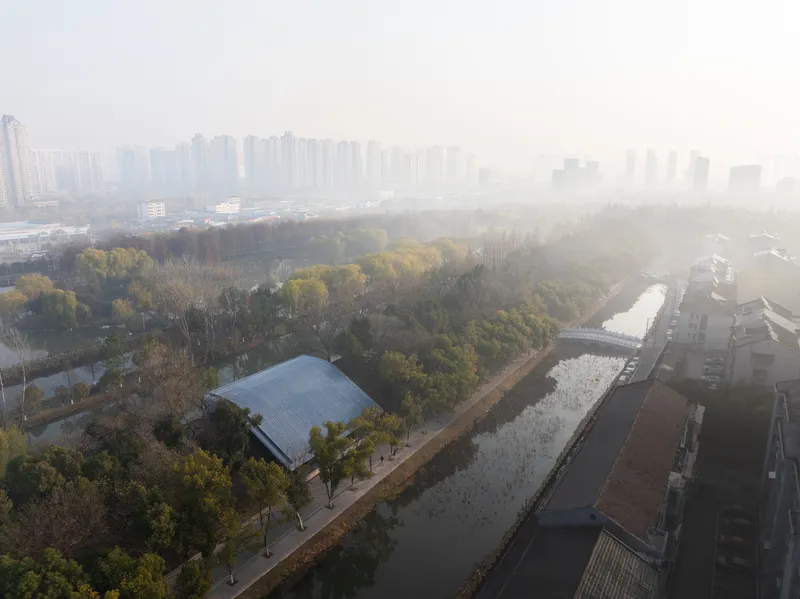
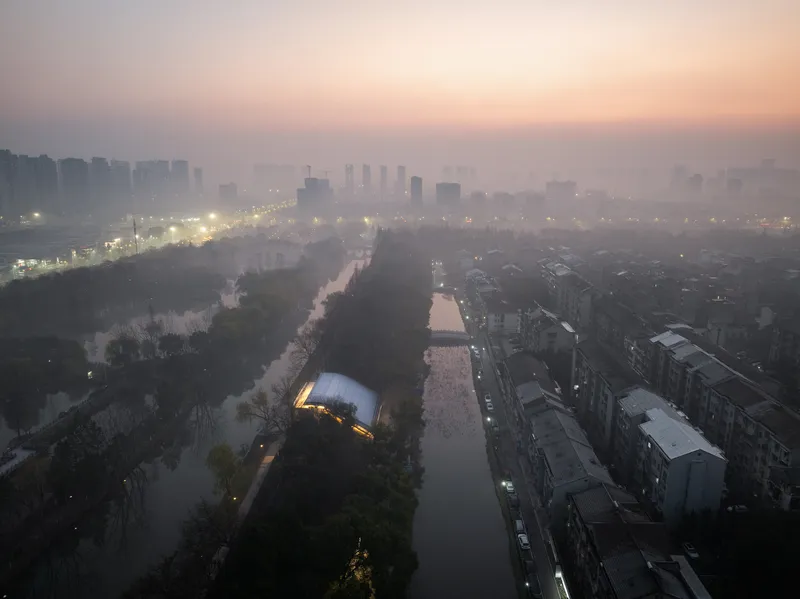
Seen from above, the pavilion reads less as a building and more as a long, folded leaf dropped into the canopy of bare winter trees along the canal. The arched metal roof hugs the contour of the rampart slope, keeping its ridgeline well below the surrounding treeline. In the heavy fog that blankets Jingzhou at dawn, the structure glows softly, its glass walls emitting a warm amber that makes the pavilion look almost bioluminescent against the grey water and mist.
The siting is precise. The canal edge, the adjacent urban block, and the historic fortification wall form a tight triangle of constraints, and the pavilion slots into the gap without consuming the public right-of-way. From the street, only the roof and a strip of illuminated facade announce its presence, inviting curiosity rather than commanding attention.
Perforated Skin, Filtered Light
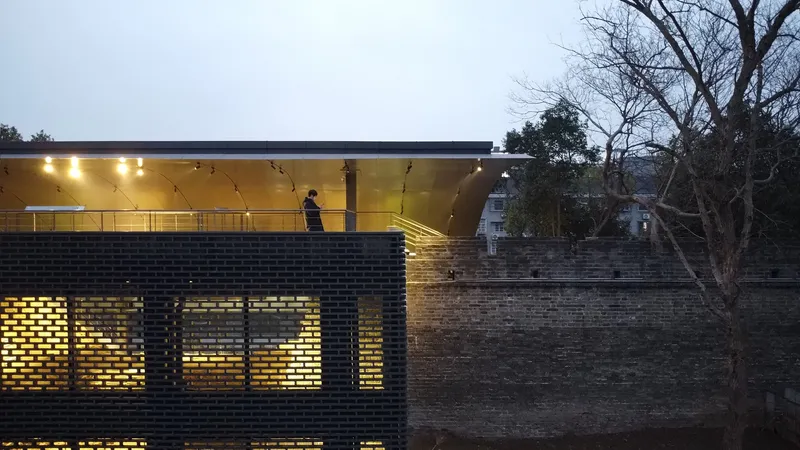
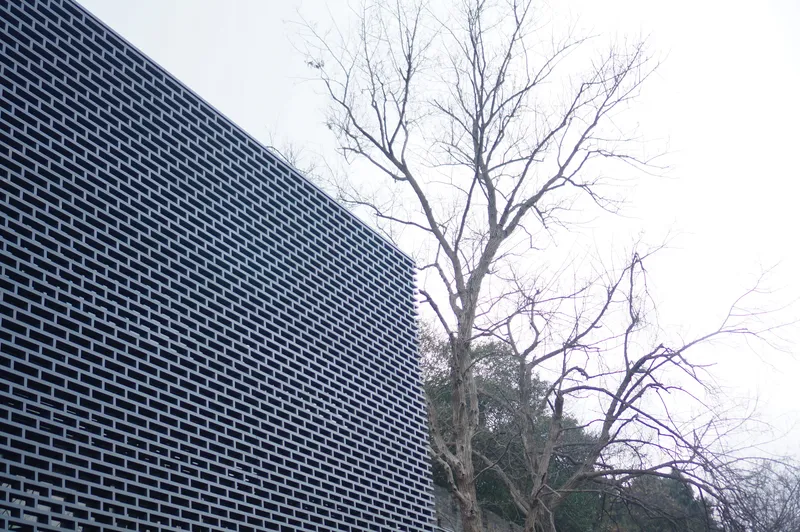
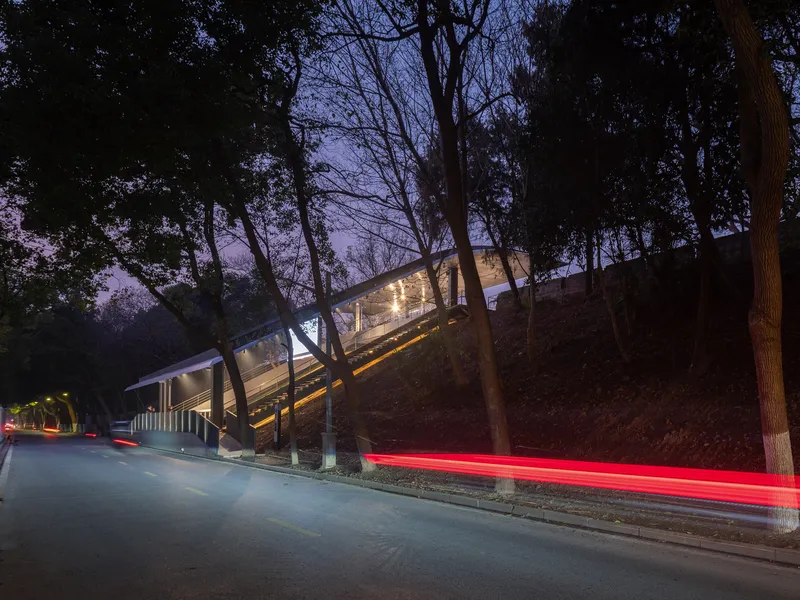
The facade strategy is deliberately restrained. Perforated brick and metal panels wrap the lower volume, creating a screen that admits daylight in controlled doses while keeping direct sun off fragile earthen strata. At night the logic inverts: interior track lighting leaks through the perforations, producing a lantern effect that outlines the pavilion's silhouette without flooding the streetscape. The nighttime view from the road, with car light trails streaking past the glowing structure, makes the temporal theme literal: modernity rushing by while centuries of construction sit quietly on display inside.
Walking Above the Evidence
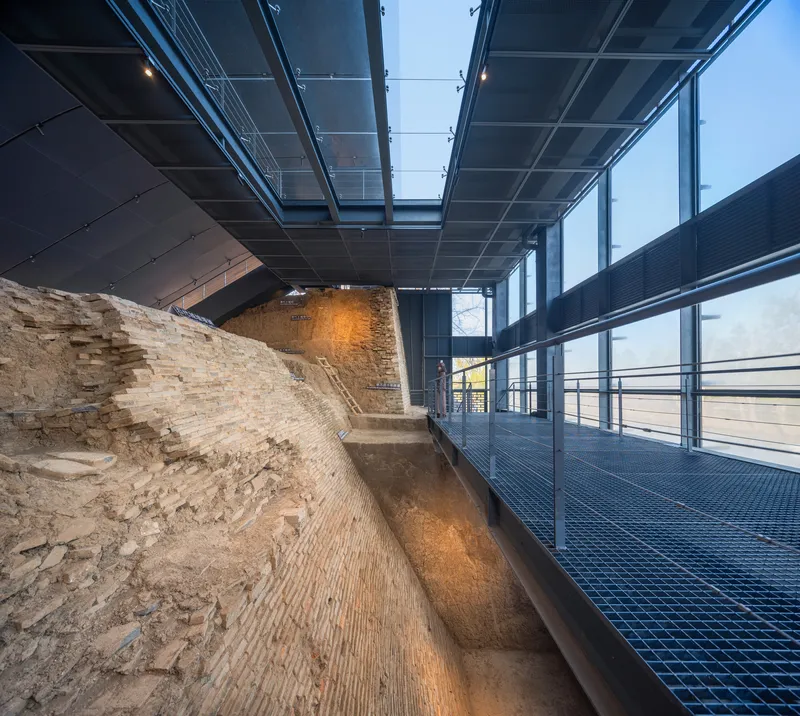
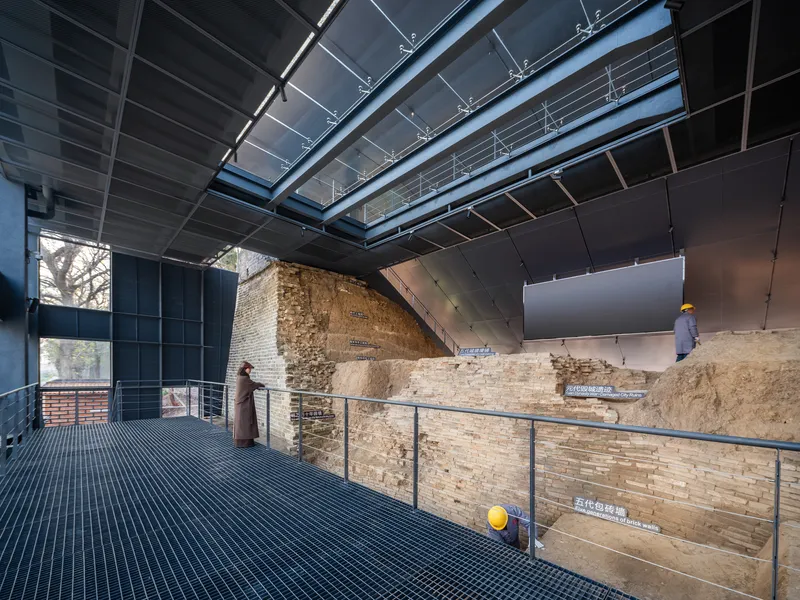
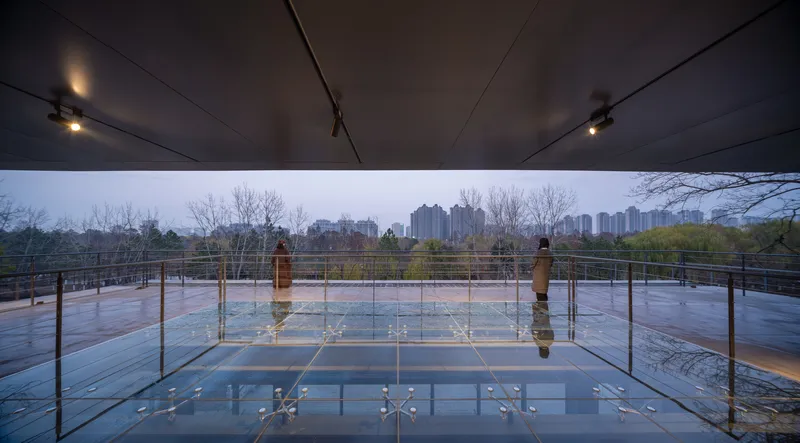
The interior circulation is the project's strongest move. Visitors traverse the excavation on perforated metal decking and glass floor panels suspended above the rampart layers. You look down through grating at compacted earth, brick courses, and voids left by centuries of repair, all separated from your feet by a few inches of air and a sheet of toughened glass. The sensation is closer to standing on a bridge over a canyon than walking through a museum.
Steel railings and mesh balustrades keep the visual field open. There are no opaque walls between you and the stratigraphy, no interpretive panels blocking sightlines. The architecture trusts the artifact. Track lighting mounted along roof ribs washes the exposed sections evenly, picking out color shifts between rammed earth and fired brick that communicate chronological depth more directly than any didactic label could.
Descending Into the Rampart
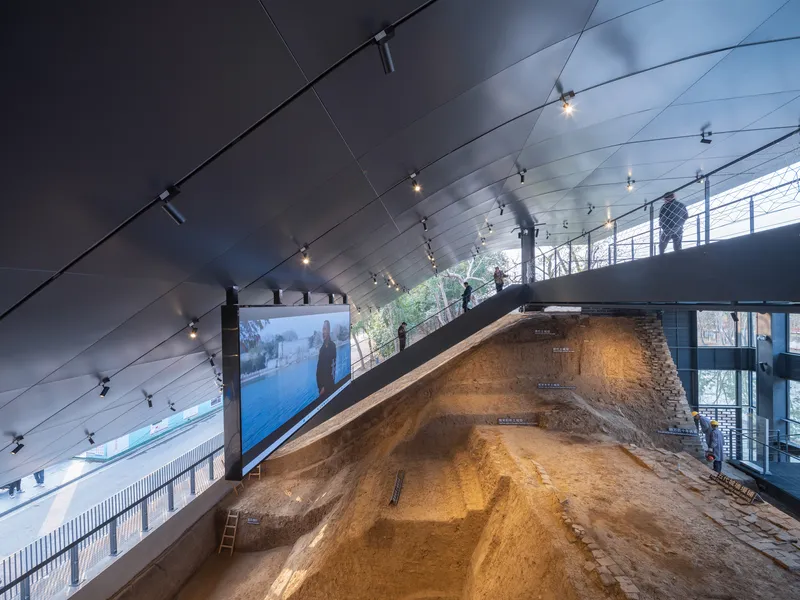
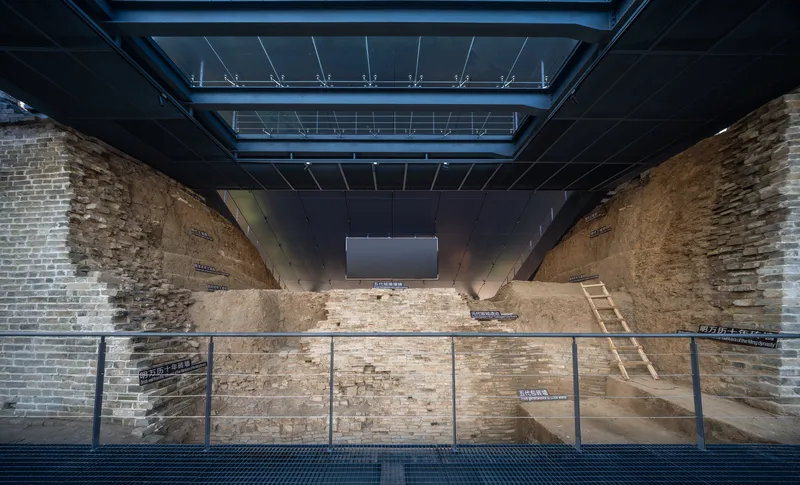
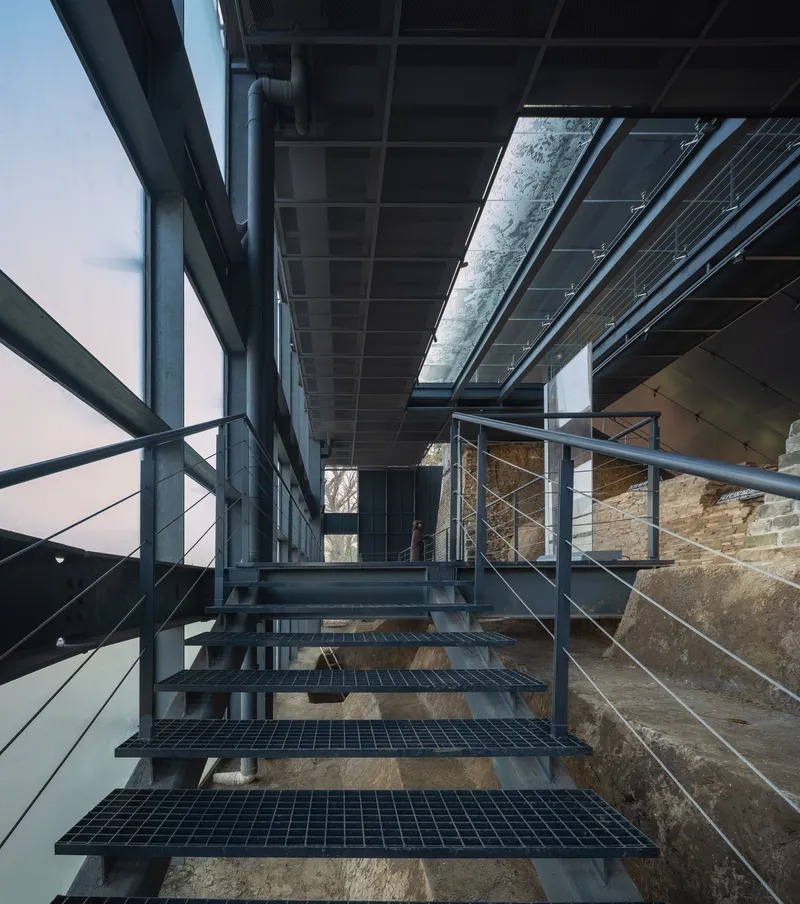
At the lower level, the relationship between structure and ruin tightens. Sloped metal ceiling panels follow the gradient of the original earthen ramp, compressing the visitor's experience as they move deeper into the excavation. Exposed brick foundation walls sit directly beneath a steel and glass ceiling, with overhead skylights washing them in natural light. The metal mesh staircase that connects levels threads between the protective canopy and the archaeological brickwork with minimal clearance, making the descent feel intimate and slightly precarious.
This section of the pavilion is the most materially honest. You can see the raw underbelly of the new roof structure, the bolted connections, the cable trays for lighting, all left exposed. There is no attempt to dress up the contemporary intervention. It simply does its job and gets out of the way.
Engaging the Ruin at Close Range
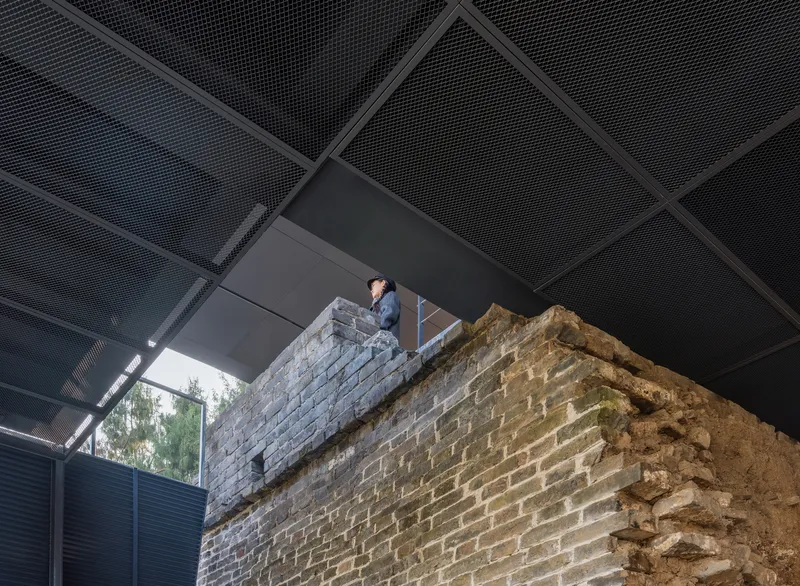
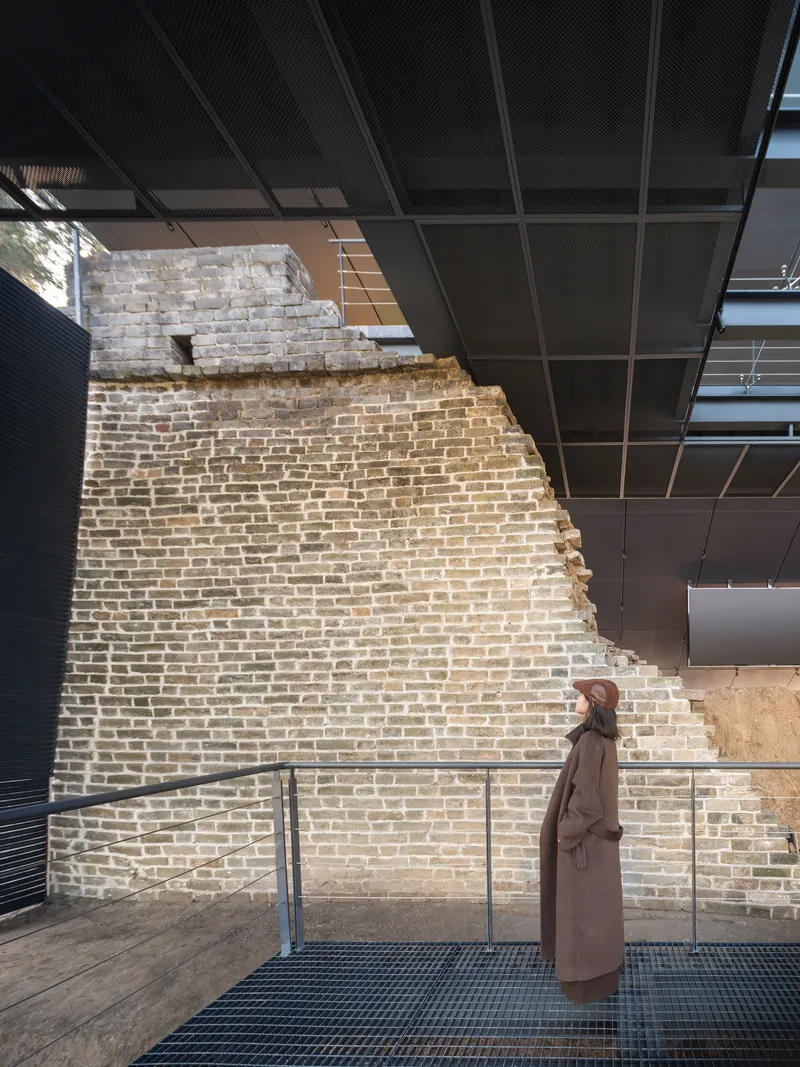
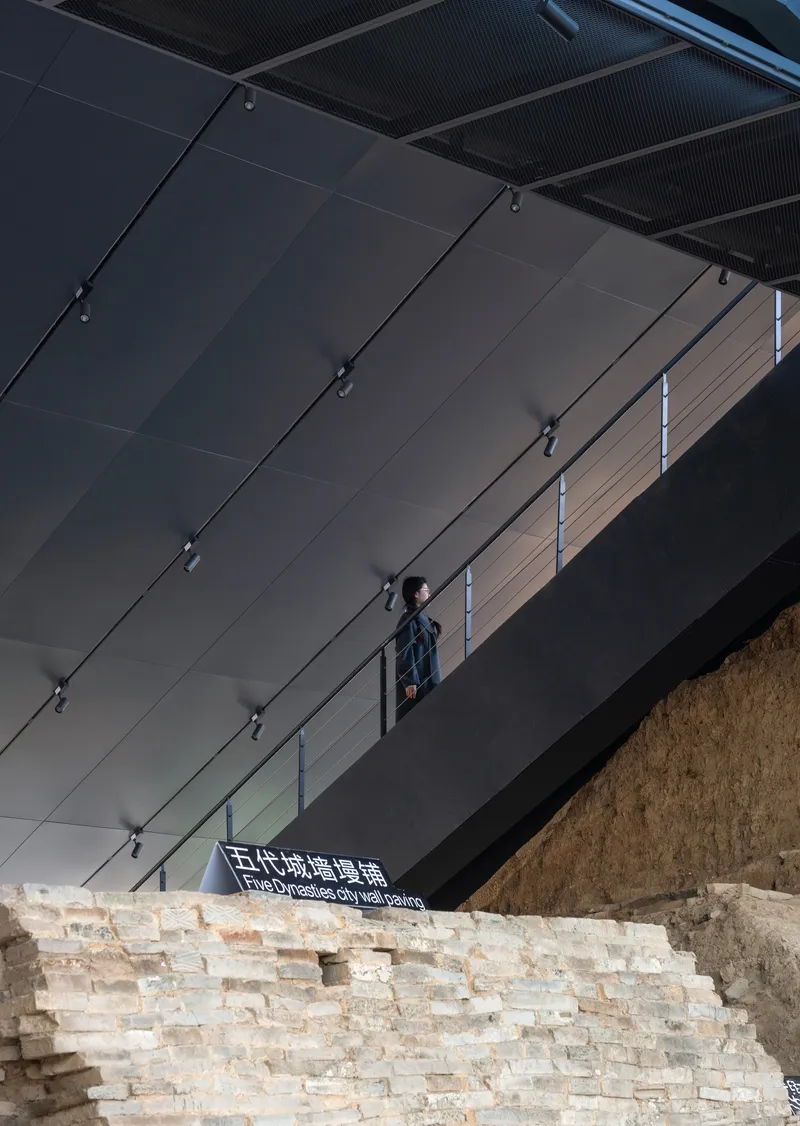
Several moments in the pavilion bring visitors to within arm's reach of preserved wall remnants. A person standing atop a brick stub under the perforated ceiling, or pausing alongside a deteriorated section punctuated by voids, experiences the wall not as a distant spectacle but as a physical presence with texture, weight, and the unmistakable smell of old masonry. The upper gallery positions visitors above a reconstructed cream brick wall beneath a dark ceiling studded with track lights, creating a dramatic section that reads like an architectural drawing brought to life.
Thresholds and Twilight
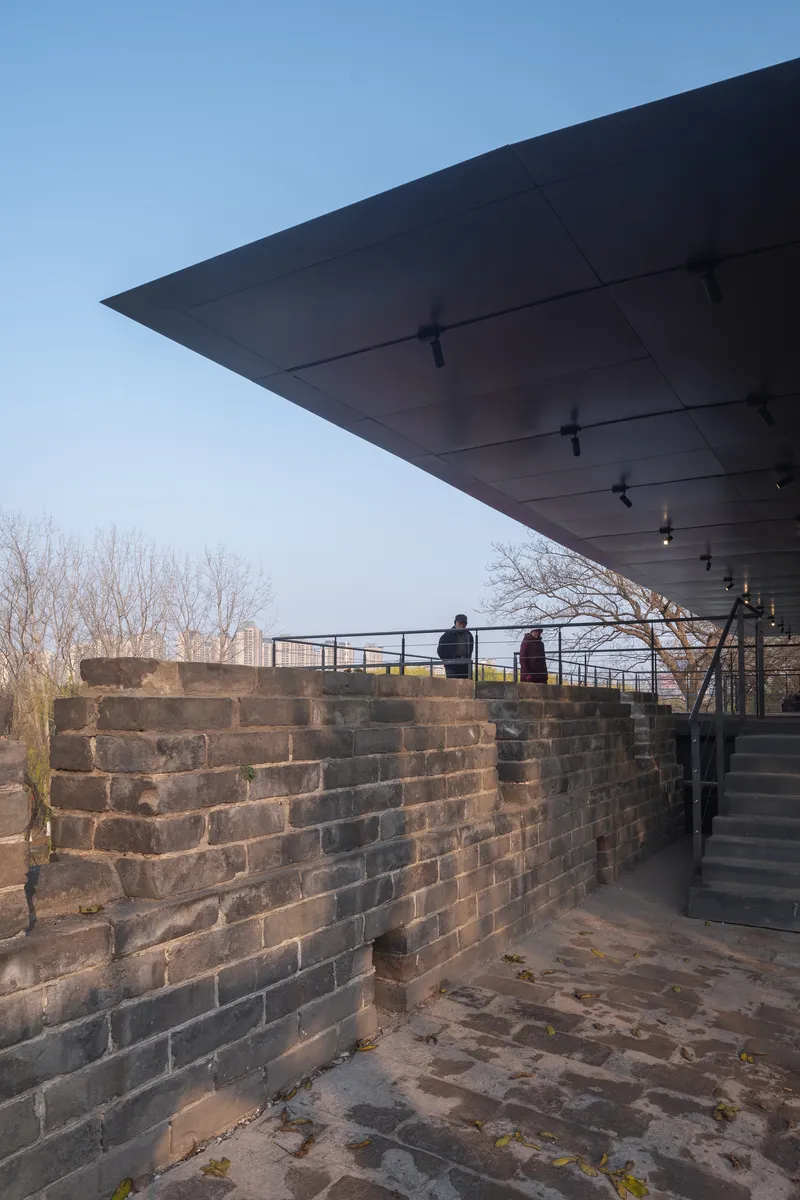
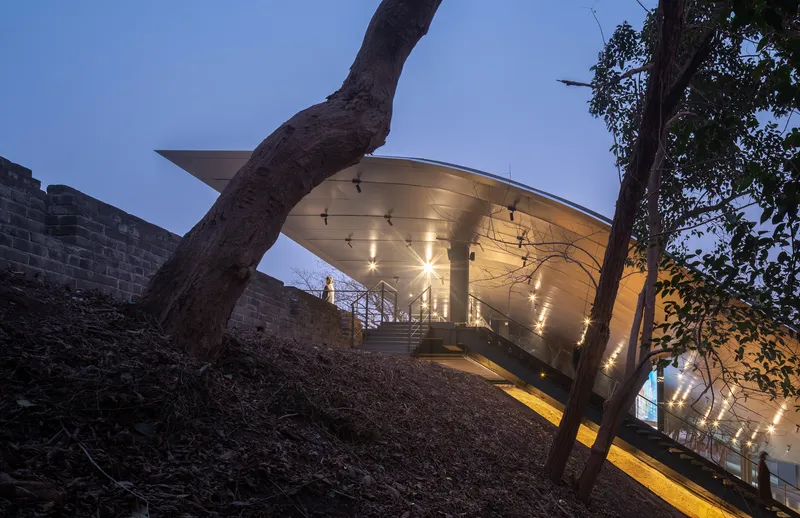
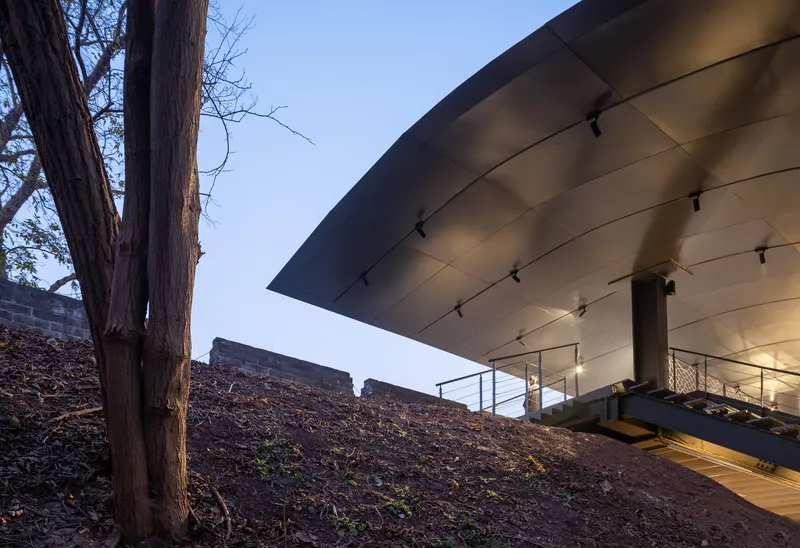
The canopy extends well beyond the enclosed gallery to shelter outdoor walkways and terraces that function as thresholds between the city and the excavation. At dusk these transitional zones come alive. The cantilevered roof hovers above a historic brick path, track lighting casting long parallel lines across the ground while two visitors stand in the warm glow. Elsewhere, the curved canopy shelters a glowing walkway beside an earthen slope where leaning trees push their bare branches into the lit volume.
These in-between spaces are critical. They slow visitors down, shift their attention from phone screens to masonry textures, and establish a mood before the interior galleries deliver their payload. The architecture choreographs a transition from the contemporary street to the archaeological interior without a single heavy door or gatehouse.
Stairs as Spectacle
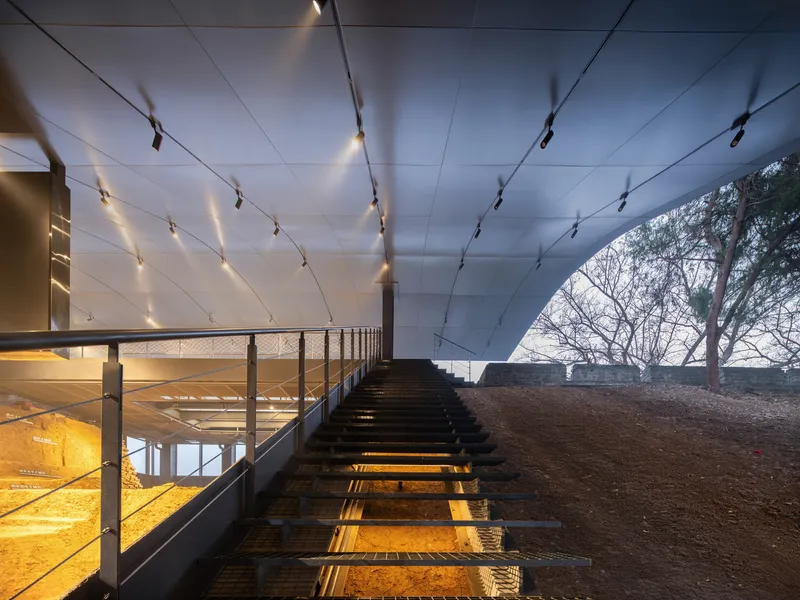
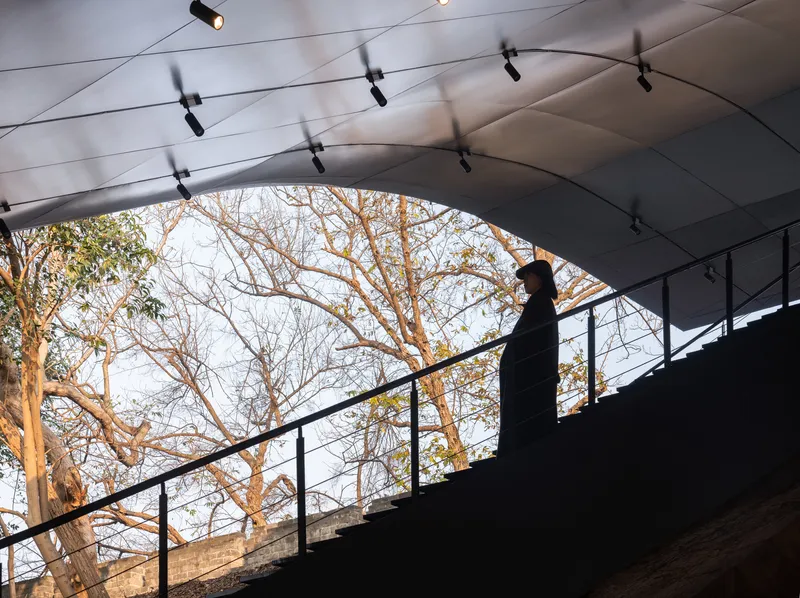
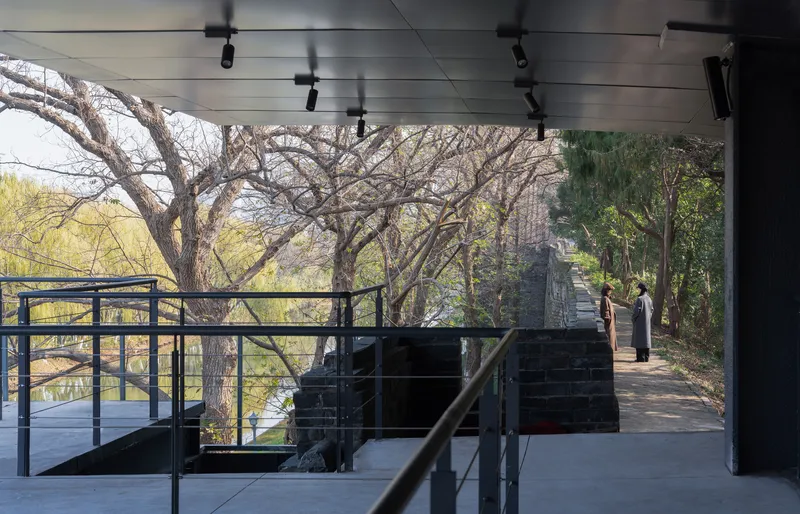
Circulation elements do a lot of work here. The timber staircase with metal mesh railings descending beneath a paneled ceiling is one of the pavilion's most photogenic moments, warm wood grain against industrial steel, soft dusk light filtering through the mesh. A figure ascending the interior staircase beneath a curved ceiling with bare branches visible beyond captures the dialogue between organic and constructed that runs through the entire project. Even the covered walkway framing views of brick ruins among winter trees serves as a calibrated optical device, turning each step into a new composition.
Plans and Drawings
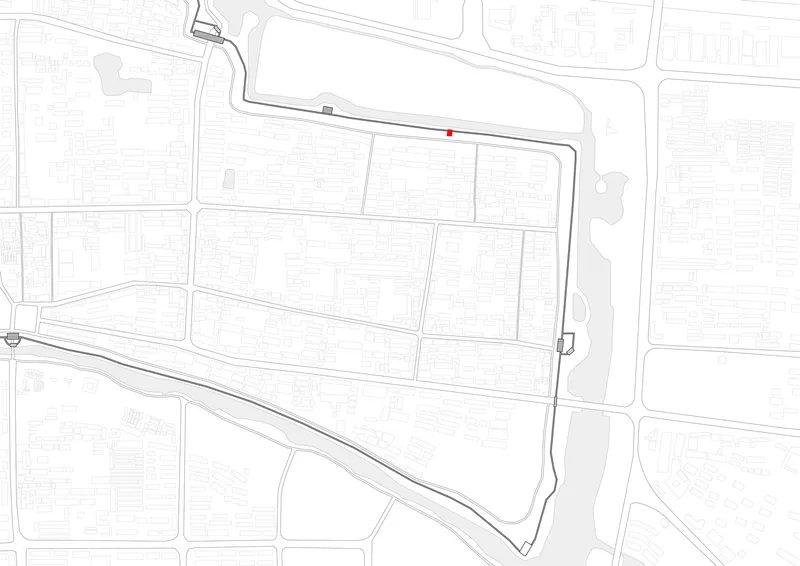
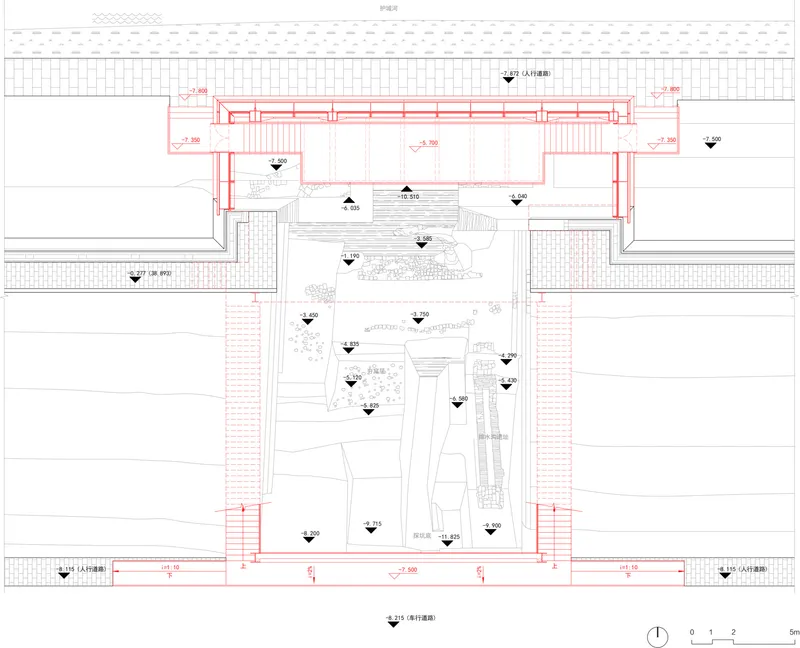
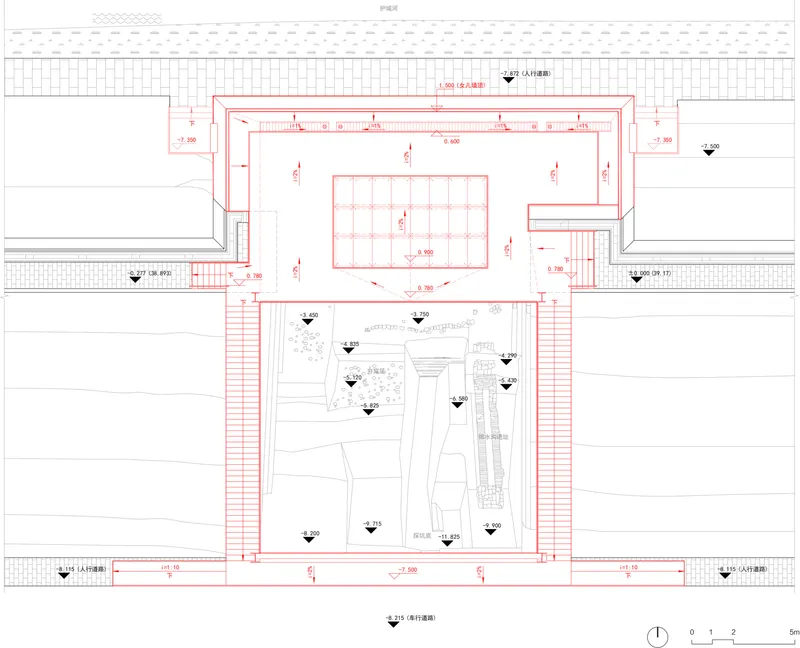
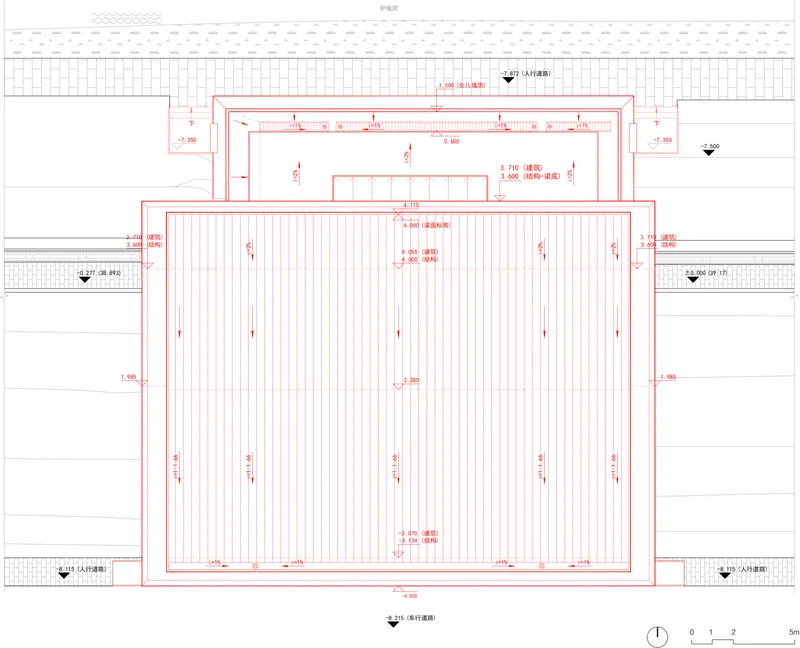
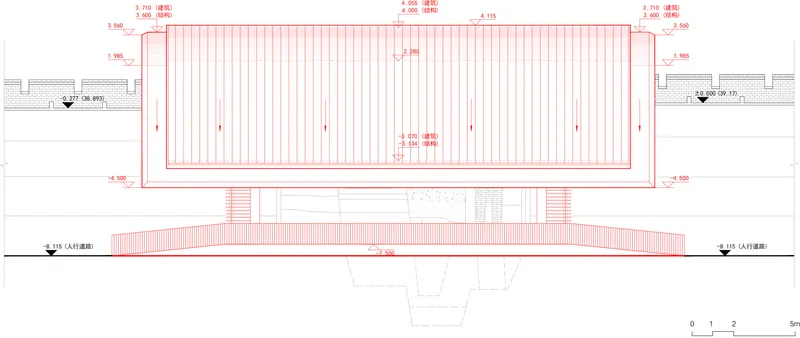
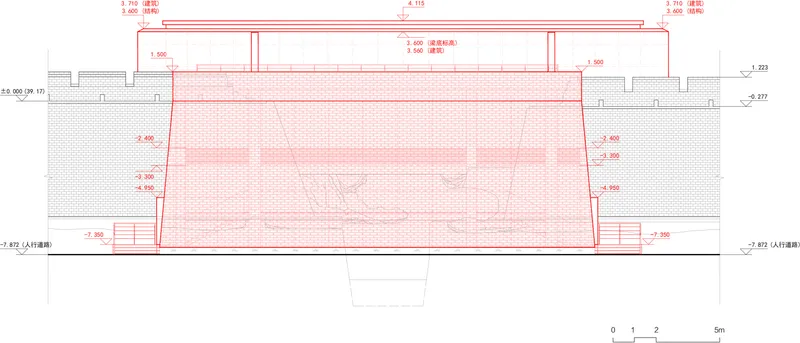
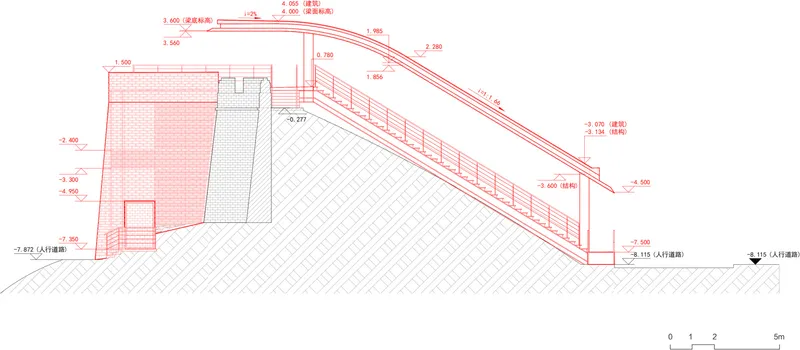
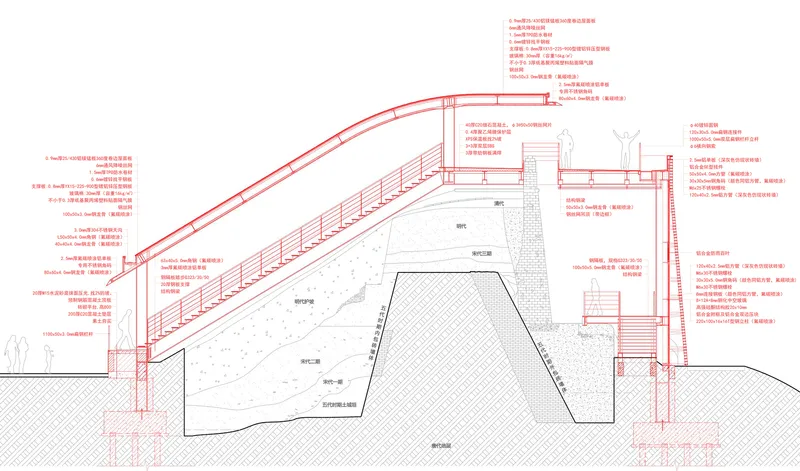
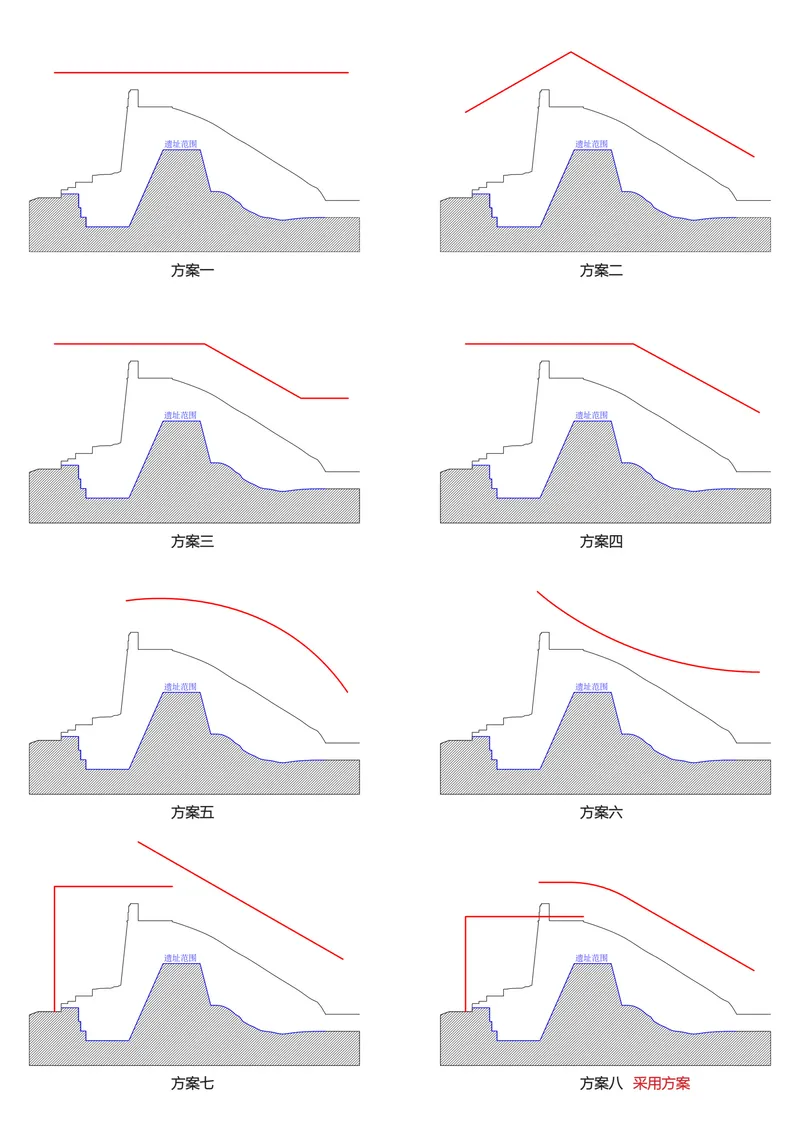
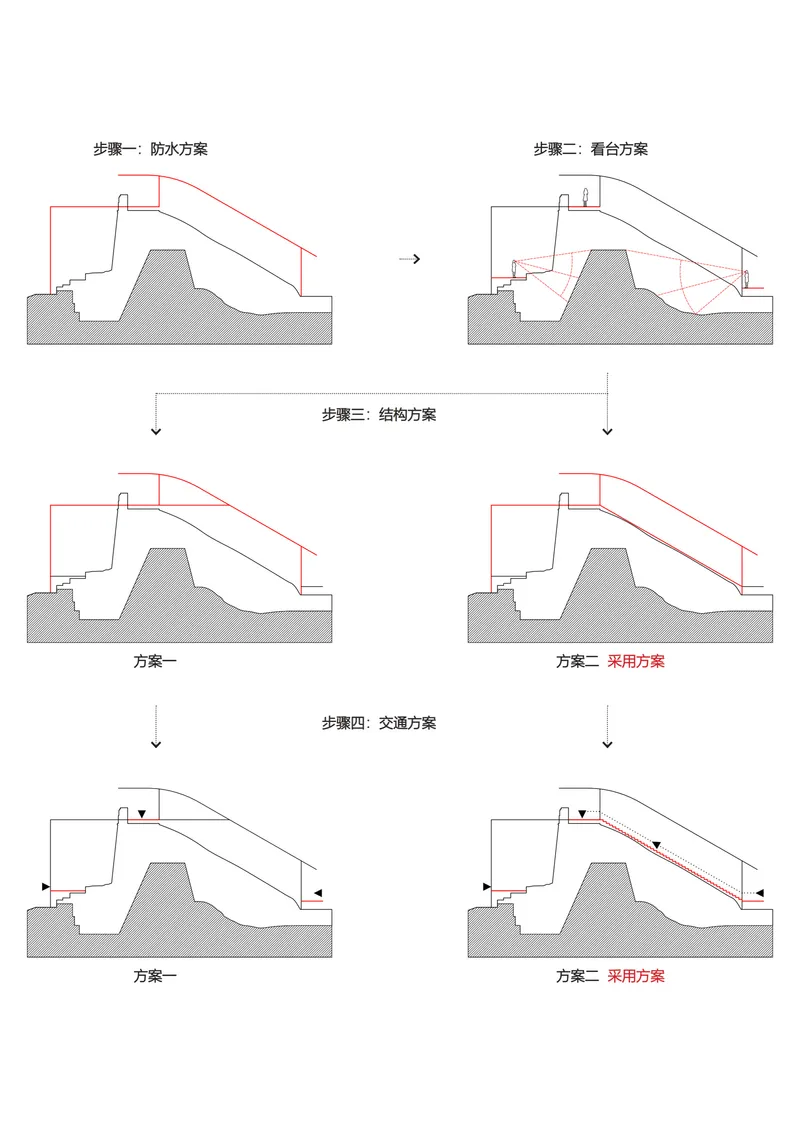
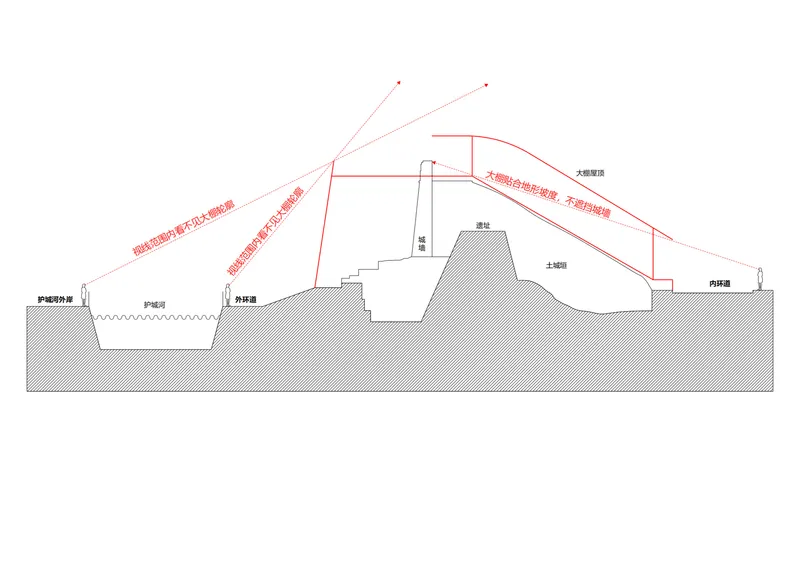
The drawing set reveals how thoroughly the design was tested before a single column was cast. The site plan shows the pavilion wedged into a narrow strip between the canal edge and the urban block, its red footprint almost modest in the larger context. Floor plans at multiple levels expose a clear organizational logic: enclosed gallery space wraps interior courtyards and landscaped zones, with a grid column layout on the upper level providing unobstructed views of the excavation below. The large rectangular hall with linear structural elements reads as a straightforward shed, its simplicity is the point.
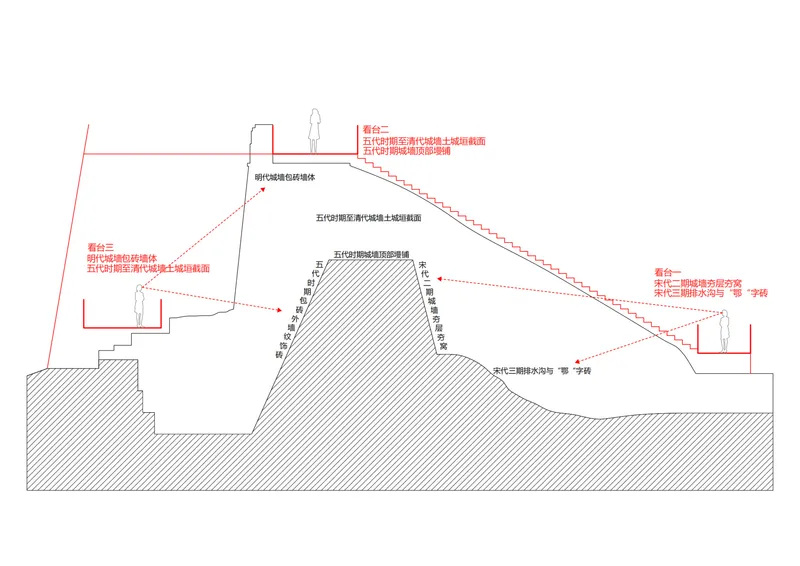
Sections are where the project's ambition becomes fully legible. The building embeds itself into the terrain, with lower levels carved out of the rampart slope and the canopy rising to meet grade at the street edge. The detailed annotated section shows how the multilevel interior spaces are threaded through existing archaeological material. Most revealing is the diagram series of eight alternative roof profiles and multiple design iterations, evidence that the final curved canopy was not a default gesture but the outcome of rigorous formal testing against a terraced landform that does not forgive arbitrary shapes.
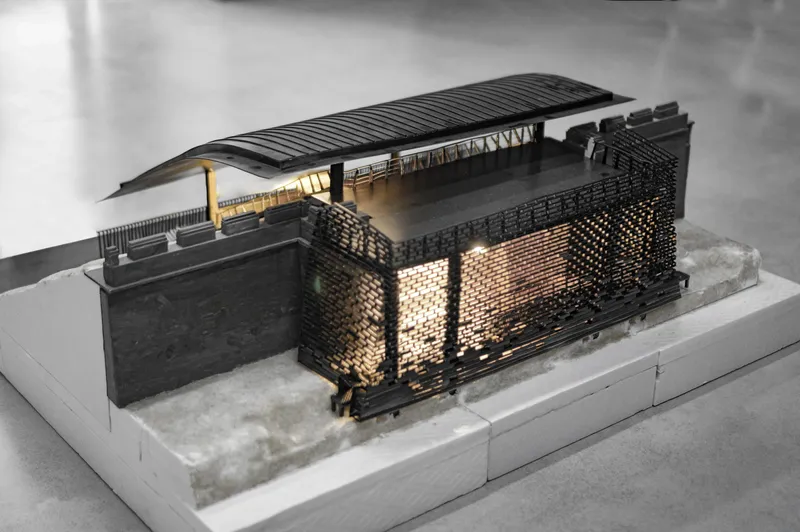
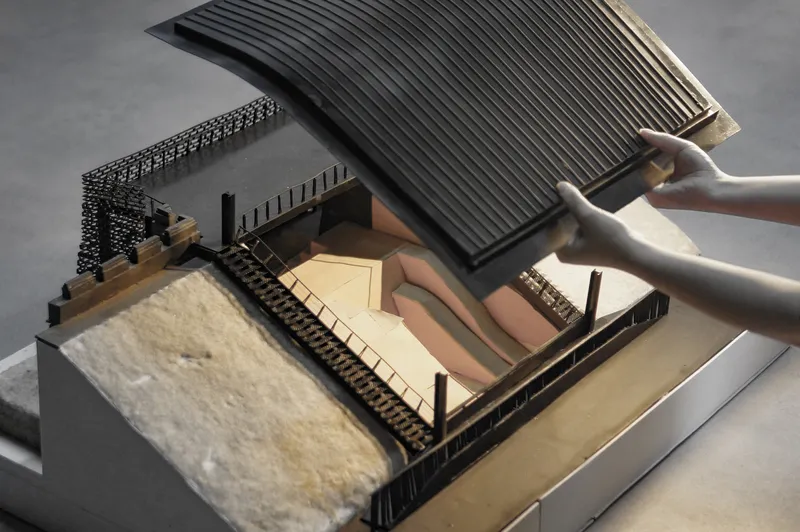
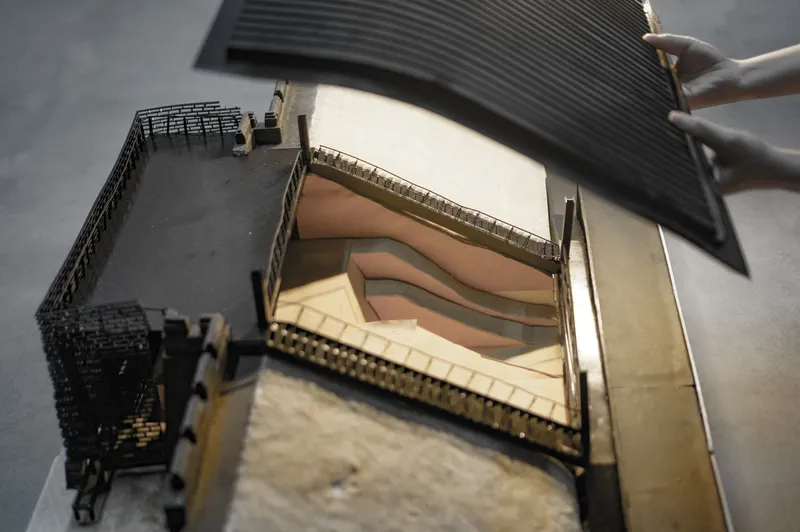
The physical models, with their perforated brick screen walls, ribbed arched roofs, and cutaway views showing terraced levels and curved balconies, confirm that the architects worked through the project three-dimensionally from the start. The sectional model in particular captures the spatial ambition: multiple floor levels wrap around a central void, each offering a distinct vantage point on the archaeological material that is, in every sense, the building's reason for being.
Why This Project Matters
Heritage architecture faces a persistent dilemma: protect too aggressively and the public never connects with the artifact; protect too lightly and the artifact disappears. Qing Studio's pavilion in Jingzhou threads the needle by treating transparency as a structural principle, not a metaphor. Glass floors, mesh railings, perforated screens, and cantilevered canopies all serve the same goal: making a thousand years of city wall construction visible, walkable, and emotionally immediate. The building's modesty is not a lack of ambition; it is the ambition.
At 330 square meters, this is a small project with outsized implications. It demonstrates that archaeological exhibition need not default to underground bunkers or grandiose cultural centers. A thin roof, honest materials, and precise siting can do the job with less material, less ego, and more respect for the thing that was already there. For cities across China and beyond that sit atop layered histories, the Jingzhou pavilion offers a replicable model: build lightly, reveal generously, and trust the ground beneath your feet to tell its own story.
Jingzhou City Wall Archaeological Site Exhibition Pavilion by Qing Studio. Jingzhou, China. Completed 2026. 330 m². Photography by Yilong Zhao.
About the Studio
Qing Studio
Share Your Own Work on uni.xyz
If projects like this are the kind of work you want to make, uni.xyz is a place to publish your own, find collaborators, and enter design competitions.


Popular Articles
Popular articles from the community


FCC Arquitectura Expands a Portuguese Granite House with a Board-Marked Concrete Wing
In Portugal, JV House pairs a cleaned-up whitewashed and granite dwelling with a timber-shuttered concrete extension, courtyards and a garden pool.

David Ortega Stacks a Two-Story Mexico City Penthouse Around a Steel Stair and a Pergola-Shaded Roof Terrace
In Colonia Roma, a 300 m² penthouse uses oak joinery, a planted steel stair and a slatted roof pergola to make a new-build apartment feel like a house.


Opera on the Sea: Driftwood Logic Shapes a Timber Opera House on Estonia's Coast
Trevor Orgill's opera house translates the entangled drift of floating timber into a civic building where wood, water, and music converge.

Cube Design Draws an Ecological Corridor Between Two Shenzhen Hills with the Nankai Building
Beside Shenzhen's container docks, the Nankai Building pairs stacked balconies with a climbing green screen to connect two hillsides across its height.

Similar Reads
You might also enjoy these articles

LAVA Architecten Gives Vocational Education a Sawtooth-Roofed Face on a Mechelen School Campus
In Mechelen, Belgium, a 2,053 m² STEM school on a 6×6 m grid turns workshops and classrooms into rooms that can be rearranged as teaching changes.

KEMA Studio Turns a Derelict Marvila Attic into a 60 m² Lighthouse Apartment Above Lisbon
In Lisbon's Marvila district, a rebuilt roof, four skylights and two plywood volumes turn an unlivable attic into a bright home facing the Tagus.

Pixel Gardens: One Repeated Module Stacked Into a Terraced Social Housing Tower for Famagusta
Salem Bader's shortlisted housing tower builds a vertical neighbourhood from one repeated module, offsetting units to carve terraces, light and air.

Bao Huynh Watercolor Atelier: A Serene Art Retreat in Hội An
Bao Huynh Watercolor Atelier in Hội An blends multifunctional art spaces, sustainable design, local materials, and family-friendly living in a serene environment.

Explore Exhibition Hall Competitions
Discover active competitions in this discipline

Challenge to design a portable theatre

Challenge to design a portable music platform

Challenge to design an open learning module for the elderly
Comments (0)
Please login or sign up to add comments
No comments yet. Be the first to comment!