

RAD+ar Builds a Low-Energy Shelter Prototype Beneath a Twisted Roof in Tangerang
Bernaung House reimagines tropical domesticity on the outskirts of Jakarta, using diagonal gardens and a chimney atrium to cool 400 square meters passively


On the western outskirts of Jakarta, developer housing marches in tight, repetitive rows. Most of it ignores orientation, seals itself with air conditioning, and treats the tropical climate as a problem to be defeated rather than leveraged. Bernaung House, designed by RAD+ar (Research Artistic Design + architecture) and completed in 2022, takes the opposite stance. Lead architect Antonius Richard and his team rotated the 400-square-meter plan to a strict north-south axis, subtracted the roof's center for a skylight chimney, and threaded diagonal micro-gardens through the interior so that every room looks into green. The name itself, Bernaung, translates as the act of sheltering, an idea the architects argue predates any formal notion of architecture in the tropical belt.
What makes the project genuinely interesting is not its environmental ambition alone but the spatial discipline required to deliver it on a packed suburban lot. The house is essentially single-story with a mezzanine, yet it reads as multilayered: split pitches, double-height voids, planted beds at ground level, and a cantilevered upper volume all stacked beneath one continuous roof. Passive ventilation is achieved through a combination of the central atrium's chimney effect, varying air openings at different pressures, and the louvered screens that filter direct sunlight into dappled patterns. The result is a low-energy residential prototype for Southeast Asia that actually feels generous, not austere.
The Street Edge: Timber, Louvers, and a Quiet Entrance


From the street, Bernaung House is legible as a gabled volume clad in warm timber panels, a deliberate contrast to the concrete and painted plaster of its neighbors. The cantilevered upper floor projects over the entry, creating a sheltered threshold that announces the house's central preoccupation with shade. A pivoting gate opens to a glimpse of the sculptural staircase beyond, giving just enough visual depth to suggest complexity without revealing the plan.
At dusk the timber cladding glows from interior light, turning the facade into a lantern. The effect is warm without being exhibitionist, a quality that suits its residential context. Horizontal louvered screens along the ground-floor edge serve double duty: they admit breeze while blocking sightlines from the street, keeping the planted terraces private.
Louvered Screens and the Art of Filtered Light
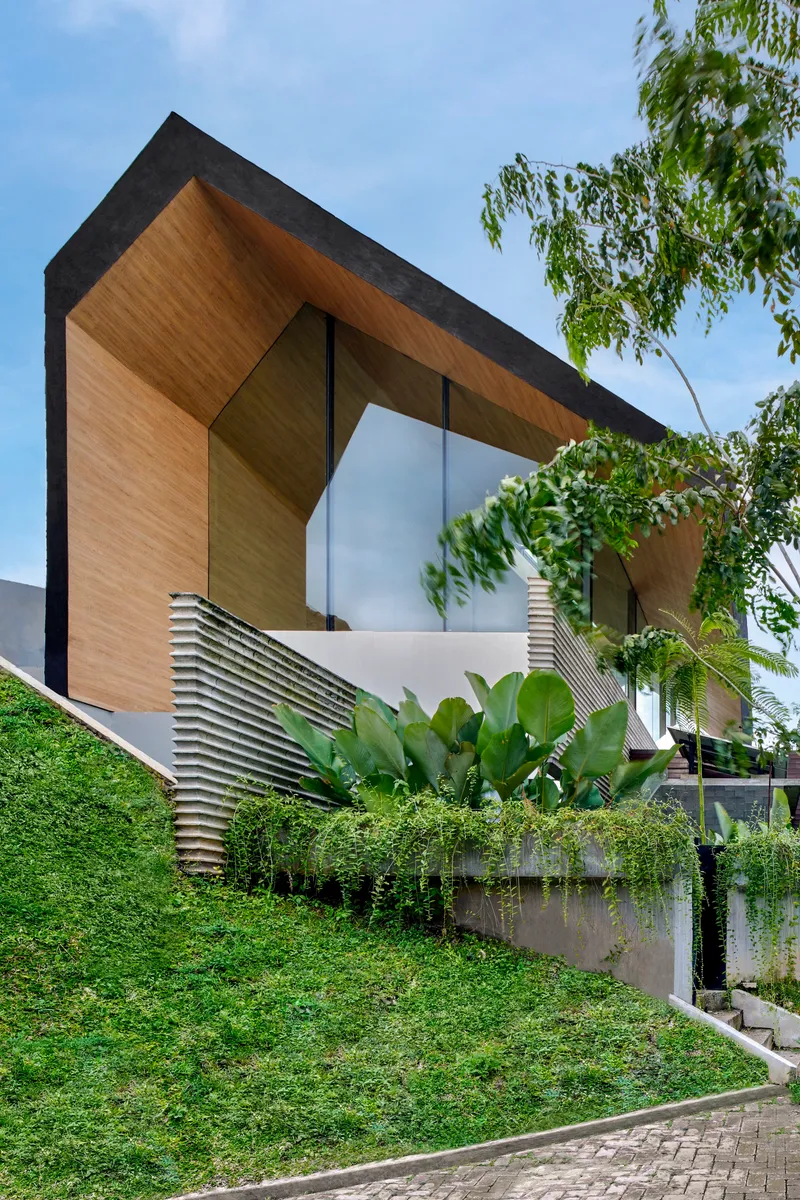


The horizontal concrete louvers that wrap portions of the facade are among the most tactile elements of the project. Where the plywood soffit meets the louvered screen, dappled shadows cascade across surfaces throughout the day, shifting with the sun's angle. It is a simple device, centuries old in tropical architecture, but RAD+ar executes it with enough precision that the shadow play becomes a deliberate interior event rather than an accident.
A timber deck walkway runs beneath the cantilevered volume, framed by the plywood soffit above and a green wall at the perimeter. Figures in the photographs are always in motion here, suggesting a threshold condition: not quite inside, not quite out, which is exactly the liminal space that good tropical design produces.
The Atrium as Chimney and Compass
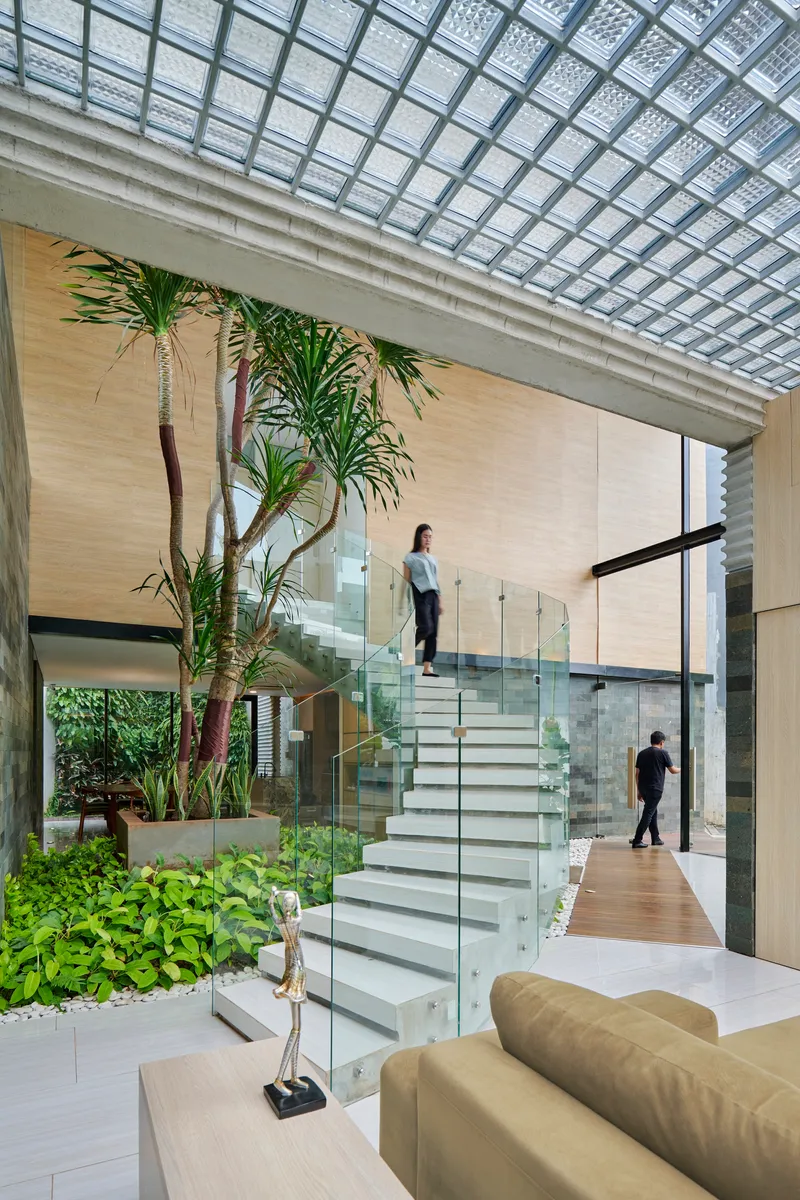
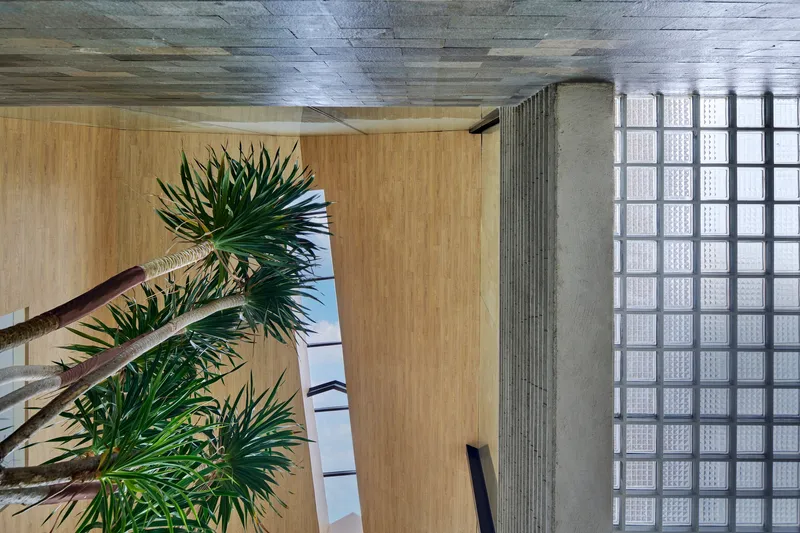
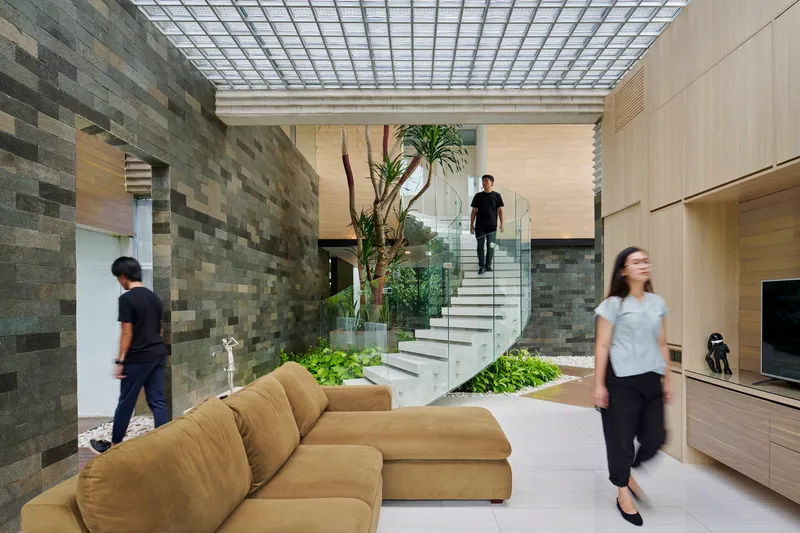
The central atrium does the heaviest lifting in the environmental strategy. Its gridded glass-block skylight sits at the subtracted center of the roof, pulling hot air upward and out through a chimney effect while drawing cooler air in from the planted perimeter. The roof's twist redirects northwest heat vertically into the atrium rather than letting it penetrate living spaces, a move that is easy to describe but difficult to execute in section.
Visually, the atrium functions as an interior compass. From almost any room you can look up to the gridded skylight or across to the palms that punctuate the double-height void. Ribbed ceiling panels radiate outward from the opening, reinforcing the idea that this single subtraction organizes everything around it. The variegated stone accent walls at the base anchor the composition in material weight, preventing the white surfaces and glass from feeling too ethereal.
Diagonal Gardens Stitching Interior to Landscape


RAD+ar describes the plan as layers of diagonal walls sandwiched within micro-gardens, and the photographs confirm that the greenery is not cosmetic. Planted beds run along diagonal axes through the interior, visually connecting the central courtyard to perimeter gardens. Banana plants, hostas, and palms all appear at ground level within the living spaces, erasing the line between inside and outside in a way that is native to Indonesian domestic tradition but rarely achieved in speculative developer housing.
The circular void to the courtyard garden in the open-plan living area is the most legible moment of this strategy. You stand inside the house looking through a glass wall at dense tropical planting, while a planted bed at your feet runs perpendicular to the view. The daily loop of movement the architects intended, circulating beneath the giant roof from garden to garden, becomes intuitive rather than prescribed.
Living Under the Wide Span

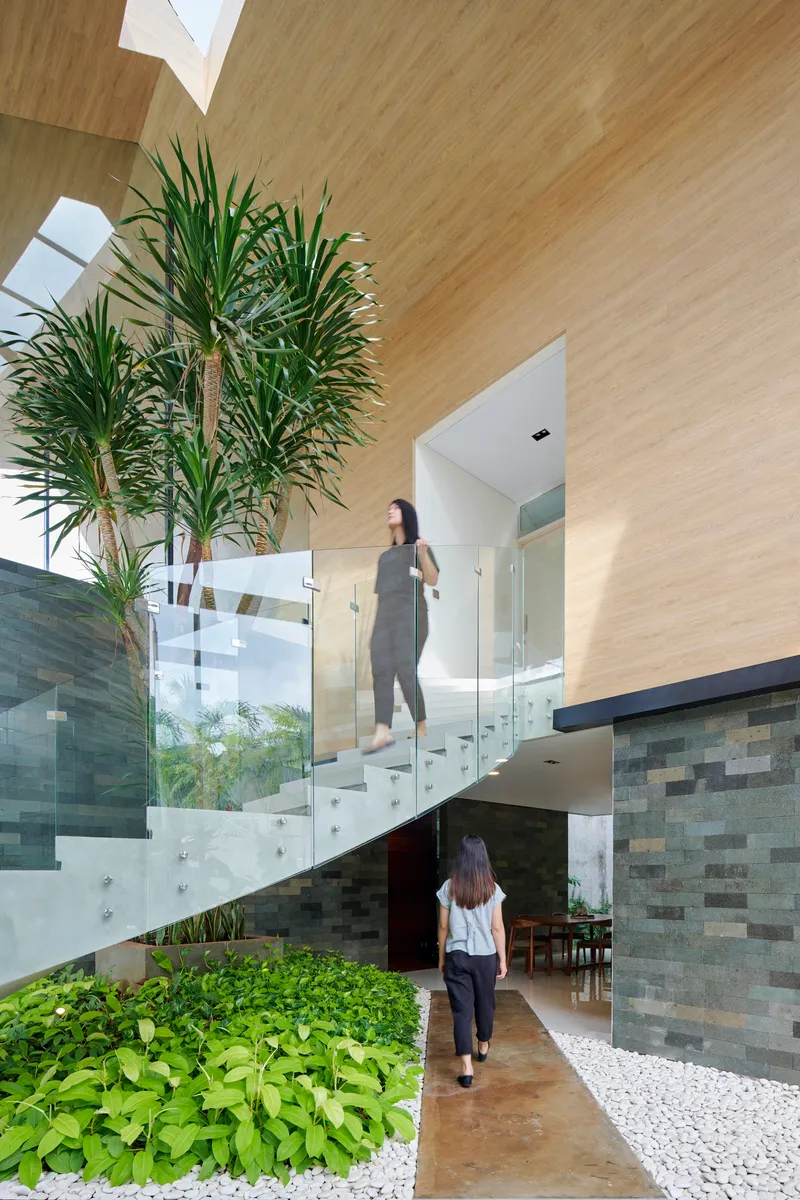

The wide-span structure allows the ground floor to flow without load-bearing partitions interrupting views or airflow. Black steel columns are expressed honestly, slim verticals that punctuate the plywood ceiling plane without competing with it. The combination of plywood overhead, glass balustrades at the mezzanine, and variegated stone block walls gives each surface a distinct texture, so the palette never registers as monochrome despite its restraint.
Residents appear throughout the images descending stairs, passing through doorways, opening curtains, always in motion. It is a house that seems designed for circulation rather than static occupation, which aligns with the architects' stated goal of making daily life a loop under one sheltering roof.
Private Rooms and Morning Light

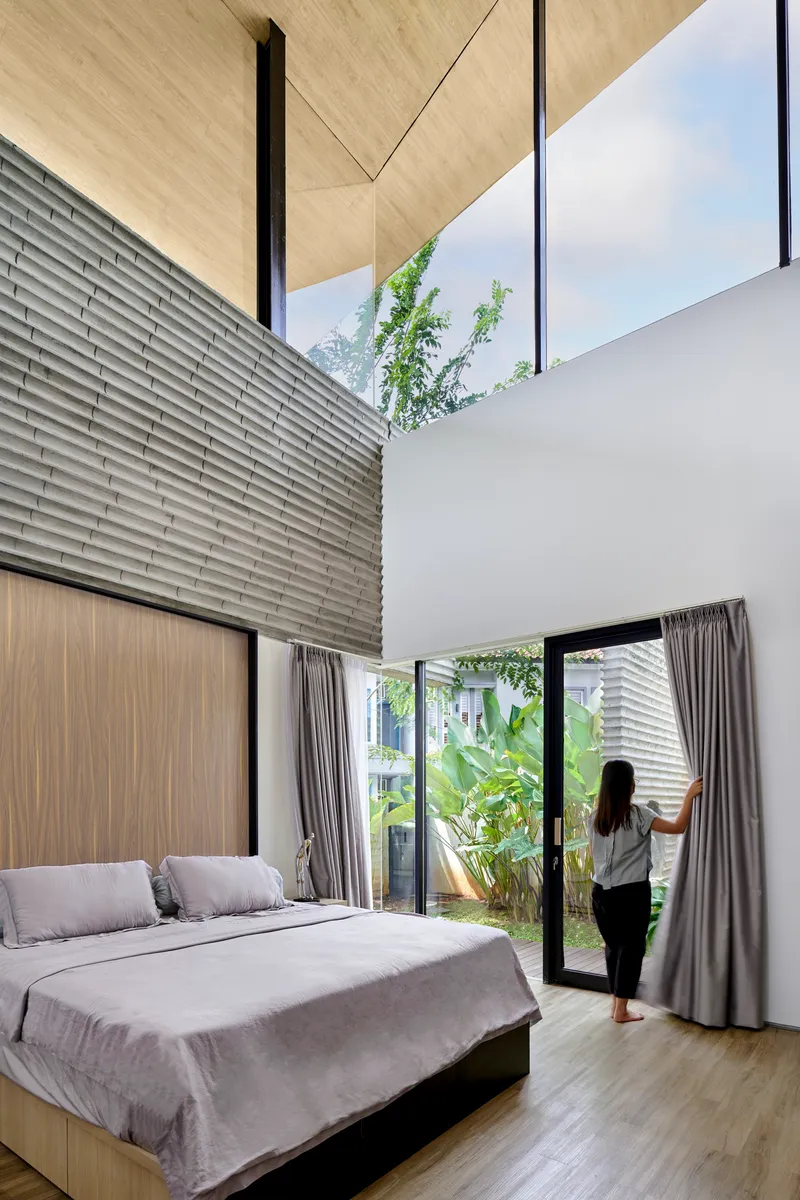

The bedrooms, tucked at the upper level, are quieter episodes within the larger spatial drama. Built-in timber cabinetry wraps the walls, and folded skylights bring controlled daylight in without the intensity of the central atrium. One bedroom opens through sliding glass doors directly to a garden, so the occupant wakes to filtered morning light and foliage at eye level. It is a small luxury, but in a dense suburban plot it transforms the experience of the house entirely.
The staircase that connects these private zones to the communal ground floor is itself a piece of architecture: a curving white form with glass railings that rises through the double-height atrium, catching light from the skylight above. It functions as the vertical spine around which everything else orbits.
The Roof from Above


An aerial view at dusk reveals the split-pitched roof with solar panels arrayed across its surface and the illuminated courtyard glowing at its center. The roof is the project's primary architectural gesture: it shelters, ventilates, generates energy, and defines the silhouette against the repetitive developer skyline. From the street, the cantilevered timber-paneled upper floor floats above planted terraces, making the ground plane feel porous and the mass above feel weightless.
At the interior threshold, timber-framed doorways punch through variegated stone block walls, and a slatted skylight washes the passage with striped light. These transitions between zones, marked by material shifts and changes in ceiling height, give the 400-square-meter house a spatial richness that belies its modest footprint.
Plans and Drawings

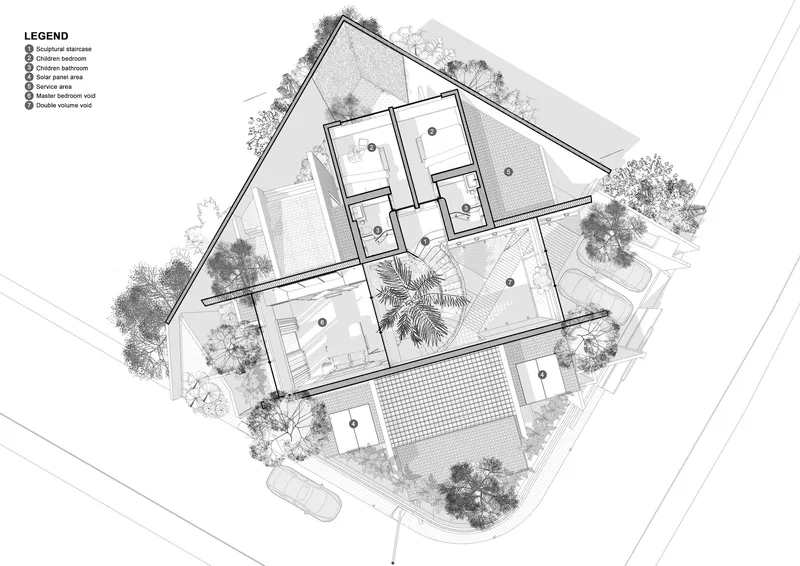


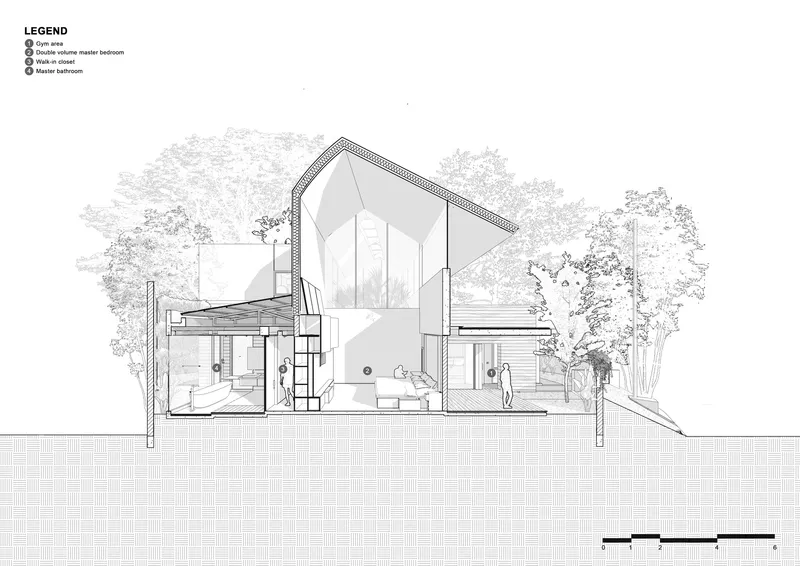

The ground floor plan makes the diagonal garden strategy explicit: planted zones cut across the orthogonal grid, pulling landscape deep into the plan and visually linking perimeter to core. The upper floor is tighter, consolidating bedrooms around the central courtyard void with its palm tree. Section drawings confirm the split-level logic beneath the pitched roof, showing how the mezzanine gains height from the atrium without adding a full second story. The axonometric drawing is particularly revealing: terraced outdoor spaces with angled shade structures suggest that the roof and ground plane are conceived as a single system of shelter, not as separate elements.
Why This Project Matters
Bernaung House matters because it treats passive design not as a constraint but as a generator of spatial quality. The chimney atrium, the diagonal gardens, the twisted roof, and the louvered screens are all environmental moves, yet they also produce the most compelling rooms in the house. In a region where air conditioning has become the default answer to thermal comfort, this project demonstrates that orientation, section, and material intelligence can deliver equivalent comfort at a fraction of the energy cost. That is not a new argument, but RAD+ar backs it up with a built prototype rather than a diagram.
More broadly, the house offers a counter-model to the developer housing that surrounds it. It proves that a 400-square-meter lot in Tangerang's suburban grid can support lush interior gardens, double-height volumes, and genuine cross-ventilation without exotic materials or heroic engineering. If the firm's ambition is to establish a low-energy residential prototype for Southeast Asia, Bernaung House is a credible first proof. The next test is whether its lessons can migrate from the bespoke commission to the repetitive fabric it sits within.
Bernaung House by RAD+ar (Research Artistic Design + architecture), Tangerang, Indonesia. 400 m², completed 2022. Lead architect: Antonius Richard. Project team: Daniel Susanto, Partogi Pandiangan, Leviandri, Felda Zakri. Photography by William Sutanto.
About the Studio
Share Your Own Work on uni.xyz
If projects like this are the kind of work you want to make, uni.xyz is a place to publish your own, find collaborators, and enter design competitions.


Popular Articles
Popular articles from the community


Opera on the Sea: Driftwood Logic Shapes a Timber Opera House on Estonia's Coast
Trevor Orgill's opera house translates the entangled drift of floating timber into a civic building where wood, water, and music converge.

Tsunami Convergenics: Turning Catastrophic Ocean Forces into Underwater Housing Infrastructure
A speculative underwater settlement off the coast of Onagawa, Japan, treats tsunamis and typhoons as energy sources rather than threats.

Singing Woman: Contemporary Architecture Inspired by Estonia’s Voice and the Sea
Singing Woman turns Estonia’s song culture into flowing opera house architecture, blending public life, landscape, sea, and national memory.
Faces of the Soviet Avant-Garde: Turning Moscow's Street Names into an Open-Air Museum
A network of sculptural installations across a Moscow residential district transforms forgotten architect names into spatial encounters with cultural memor

Similar Reads
You might also enjoy these articles

Bao Huynh Watercolor Atelier: A Serene Art Retreat in Hội An
Bao Huynh Watercolor Atelier in Hội An blends multifunctional art spaces, sustainable design, local materials, and family-friendly living in a serene environment.

Atelier Macri Concept Store Interior Design by CASE-REAL
Atelier Macri store features a "ko" counter, walnut wood details, cork displays, blending retail, gallery, and seamless customer experiences.

Manuel Vargas Izquierdo Stadium and High-Performance Sports Center: Architectural Excellence in Jalpa de Méndez
The Manuel Vargas Izquierdo Stadium blends sustainable design, inclusive sports facilities, and cultural-inspired architecture, revitalizing Jalpa de Méndez’s public spaces.

KAKR Buluh Awar Hall: Revitalizing Community and Ecology Through Bamboo Architecture
Community built bamboo hall revitalizes Buluh Awar village, empowering youth, restoring ecology, celebrating vernacular craftsmanship through sustainable architecture and culture.


Comments (0)
Please login or sign up to add comments
No comments yet. Be the first to comment!