
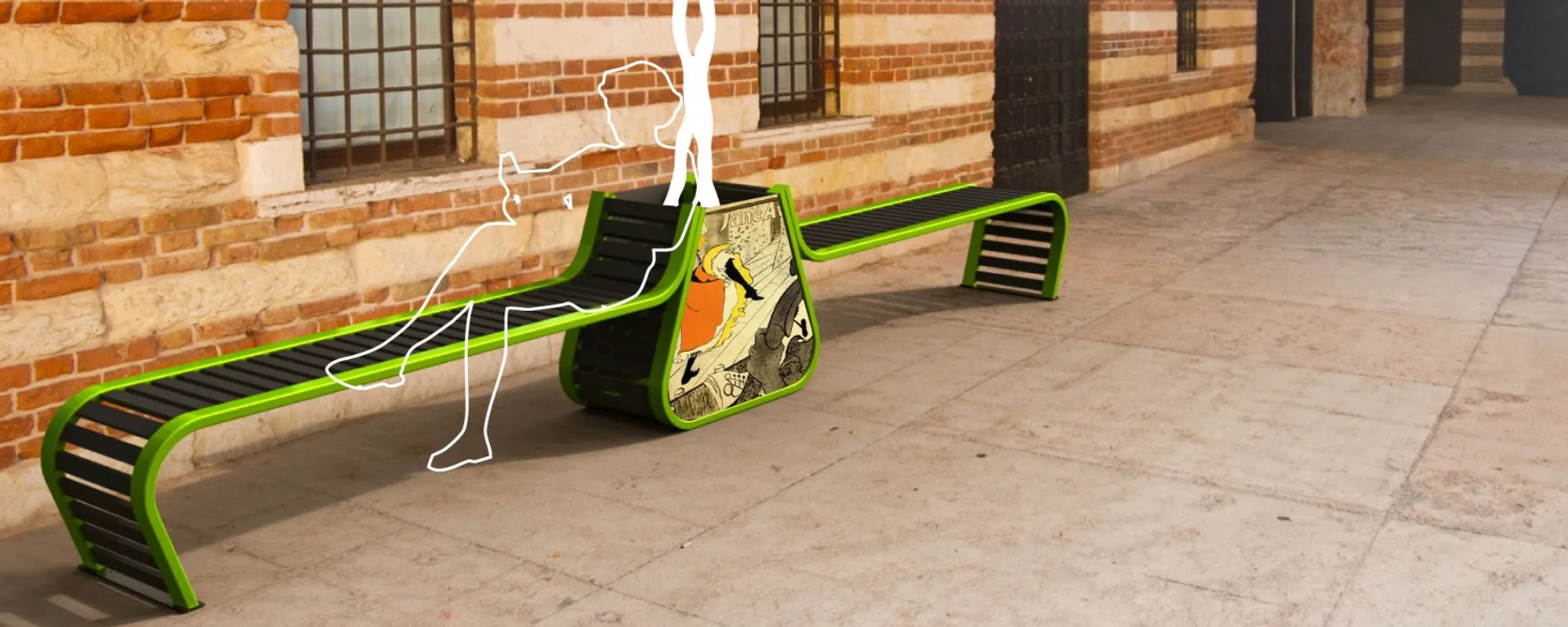
Rail Urban Furniture: Recycled Plastic and Steel Reshape the Public Bench
Alberto Benedetti's collection of urban furniture merges recycled plastic slats with tubular metal frames for weather-resistant, maintenance-free public se


The public bench is one of the most overlooked pieces of civic infrastructure. It rusts, splinters, gets tagged, and eventually gets replaced with something equally forgettable. Rail Urban Furniture starts from a different premise: what if the bench outlasted the budget cycle that funded it? Designed by Alberto Benedetti, the collection pairs tubular metal frames with recycled plastic slats to produce seating, tables, notice boards, flowerpots, and showcases that resist weathering, require almost zero maintenance, and share a single curving design language drawn from the geometry of rail structures.
The project, published on uni.xyz, spans a full product catalog aimed at city squares, parks, waterfronts, transit hubs, and commercial spaces. Rather than offering isolated objects, Benedetti proposes a cohesive family where every piece, from a Wi-Fi chair to a modular table-bench system, reads as part of the same vocabulary. Prototypes have already been tested in real-world conditions along lakeside promenades and urban parks, proving both structural resilience and the collection's ability to sit comfortably in radically different settings.
Tubular Curves on a Pebble Shore
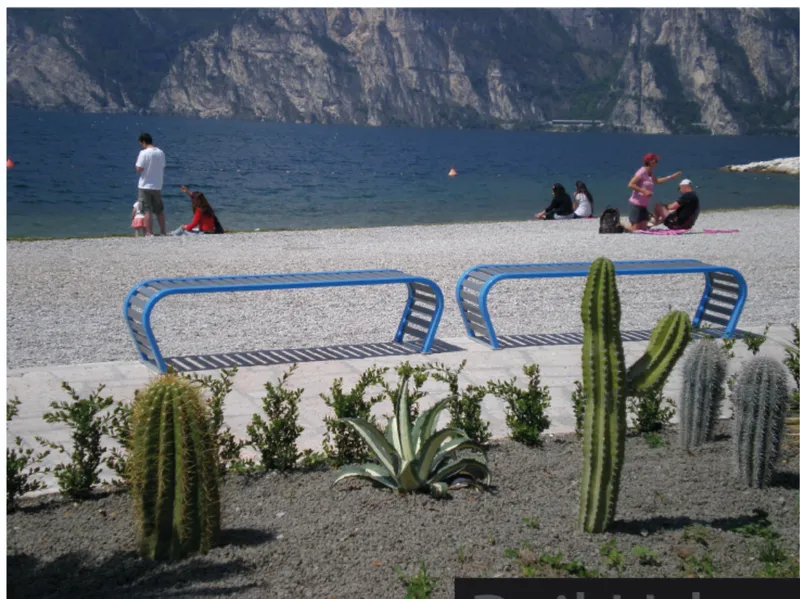
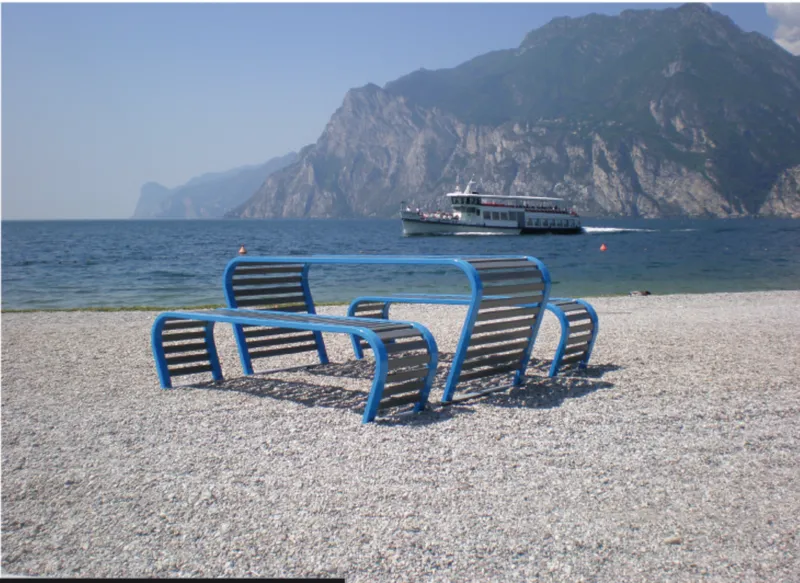
The blue tubular steel frames are the signature of the collection. Placed on a pebble beach beside cactus plantings, the benches demonstrate how a single continuous loop of metal can define the structural envelope while recycled plastic slats handle the seating surface. The curves are not decorative; they distribute load across the frame and eliminate sharp joints where corrosion typically begins. On a lakeside shore, the same bench profile holds its own against a broad panorama of water and mountains, proving that the proportions work at landscape scale without competing for visual attention.
One Form, Multiple Waterfront Contexts
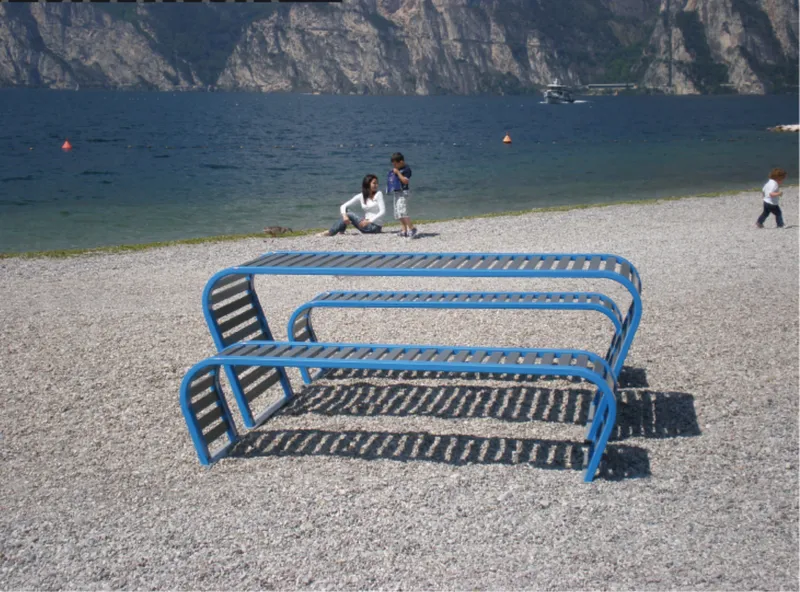

Paired on a gravel beach with families nearby, the undulating blue benches function as informal gathering points rather than rigid seating rows. The ribbon-shaped profile encourages people to sit at different angles and distances from one another, a subtle social calibration that fixed-back benches cannot offer. On a stone-paved promenade overlooking a mountain-ringed lake, a single bench demonstrates the opposite condition: solitary contemplation. The same product accommodates both modes because the form does not prescribe a single posture. This adaptability is central to Benedetti's argument that public furniture should serve the public, not the other way around.
From Blue to Red: Color as Contextual Signal
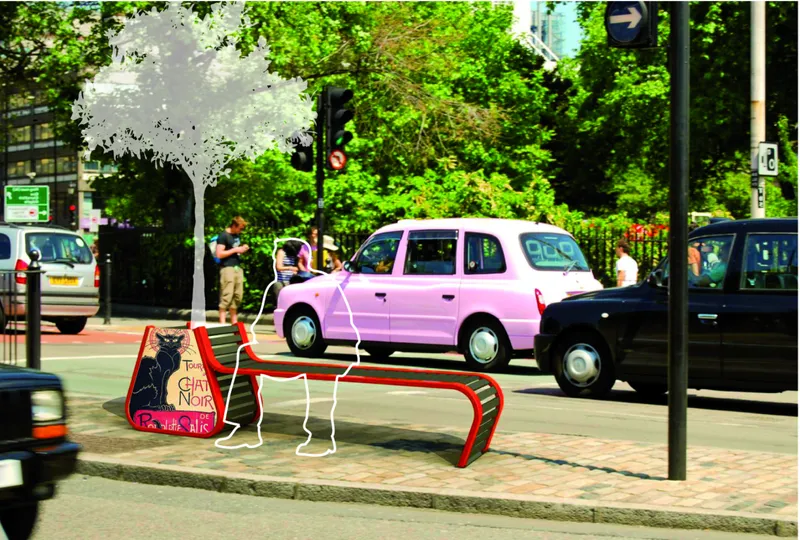

Switching from the lakeside palette to an urban one, a red tubular bench sits on a tree-lined sidewalk beside passing traffic. The color shift is more than cosmetic; it signals that the same structural system can adapt its visual identity to match different municipal branding or streetscape palettes. In a residential courtyard, a red and white slatted bench shows the collection scaling down from public infrastructure to semi-private amenity. The recycled plastic slats remain consistent across both settings, reinforcing the low-maintenance promise. No staining, no sealing, no seasonal refinishing.
Prototyping in the Park

A darker timber-toned bench installation in a park with bare willow trees and red outline figures hints at how the collection might integrate with public art or wayfinding systems. The prototype phase tested pieces like benches, Wi-Fi chairs, and modular table-bench assemblies under real atmospheric conditions. Atmospheric stability, weather resistance, and long lifespan were the benchmarks, and the combination of metal and recycled plastic delivered on all three. For municipalities managing hundreds or thousands of public assets, near-zero maintenance translates directly into freed-up budget that can be redirected toward other civic priorities.
Why This Project Matters
Rail Urban Furniture makes a straightforward case: replacing wood with recycled plastic in public seating is not a compromise, it is an upgrade. The material resists rot, UV degradation, and graffiti better than treated timber, and it diverts plastic waste from landfill in the process. Combined with tubular steel frames whose curves distribute stress efficiently, the result is a product line that can survive decades of public use with minimal intervention. The full catalog, spanning benches, tables, showcases, flowerpots, and notice boards, means a city can furnish an entire waterfront or plaza from a single coherent system.
What elevates Benedetti's work beyond a materials exercise is the attention to social behavior. The undulating profiles, the flexible seating orientations, and the modular combinations all point to a designer thinking about how people actually occupy public space rather than how a bench looks in a rendering. The prototypes on lakeshores and urban sidewalks confirm that the geometry holds up where it counts: under real bodies, real weather, and real civic budgets.
View the Full Project
About the Designers
Designer: Alberto Benedetti
Enter a Design Competition on uni.xyz
uni.xyz runs architecture and design competitions year-round that reward proposals with spatial conviction and real site intelligence.
Project credits: Rail Urban Furniture by Alberto Benedetti.



Popular Articles
Popular articles from the community


Riyadh For All: Intergenerational Urban Design for Active Aging in Rabat
Riyadh For All reimagines urban design in Rabat with intergenerational co-living, adaptive courtyards, and Moroccan cultural exchange today.

Co-life: Sustainable Architecture for Age-Friendly Community Living
Co-life reimagines sustainable architecture for seniors through courtyards, rammed earth, shared gardens, and spaces designed for belonging.

The Earth Pod: 3D Printed Homes for Resilient Refugee Communities
The Earth Pod reimagines refugee housing through 3D printed homes made from clay, combining resilience, self-sufficiency, and rapid shelter.

Conexión: Biophilic Design Reimagines High-Rise Living in Hong Kong
Conexión reimagines high-rise living in Hong Kong through biophilic design, green facades, shared spaces, daylight, water and nature within.


Similar Reads
You might also enjoy these articles

The Musturak Paradise: Senior Living Architecture for a Connected Future in Temara, Morocco
The Musturak Paradise reimagines senior living architecture in Temara via private homes, social spaces, culture, community, and shared care.

The Leaf Center: Cultural Center Architecture for Social Integration in Amsterdam
Cultural center architecture becomes a bridge at The Leaf Center, connecting international students with Amsterdam through art and exchange.
Conexión: Biophilic Design Reimagines High-Rise Living in Hong Kong
Conexión reimagines high-rise living in Hong Kong through biophilic design, green facades, shared spaces, daylight, water and nature within.

Wander to Wonder: Modular Playground Design for Children in Kutupalong Refugee Camp
Wander to Wonder uses modular playground design to create flexible, imaginative play spaces for children in Kutupalong refugee camp.


Explore Urban Furniture Competitions
Discover active competitions in this discipline



Challenge to merge furniture with learning


Design challenge to equip cities with modern furniture


Competition to design a workstation for architects


Packaging challenge - Design meets sustainability
Comments (0)
Please login or sign up to add comments
No comments yet. Be the first to comment!