

Realrich Architecture Workshop Stacks and Angles a Dense Jakarta Home Around Light and Air
Sarang Nest House uses protruding volumes and basketweave brick screens to create a micro-climate within a tight West Jakarta housing complex.


Dense residential neighborhoods in tropical cities tend to produce houses that seal themselves off: heavy walls, mechanical cooling, inward gazes. Realrich Architecture Workshop took a different position with Sarang Nest House in West Jakarta's Taman Buana Permata complex. Sitting at the hook of a street, the 600 square meter house stacks four storeys at protruding angles, deliberately pulling each floor plate away from its neighbors to force air and daylight into what would otherwise be a suffocated footprint. The result is a building that breathes through its skin, using perforated brick screens, skylights, interior gardens, and a series of private outdoor terraces to create a livable micro-environment in one of the city's most congested residential zones.
The project's real provocation is the claim that domesticity can grow organically from constraint. Rather than fight the site's west and south orientations, tight setbacks, and overlooking neighbors, the architects made every limitation into a generative condition. Angled walls create privacy between rooms while opening air channels around the perimeter. Traditional red brick, contemporized in a basketweave pattern, lets light filter through without sacrificing enclosure. The house is not a retreat from Jakarta; it is an argument about how to inhabit it.
A Facade That Filters

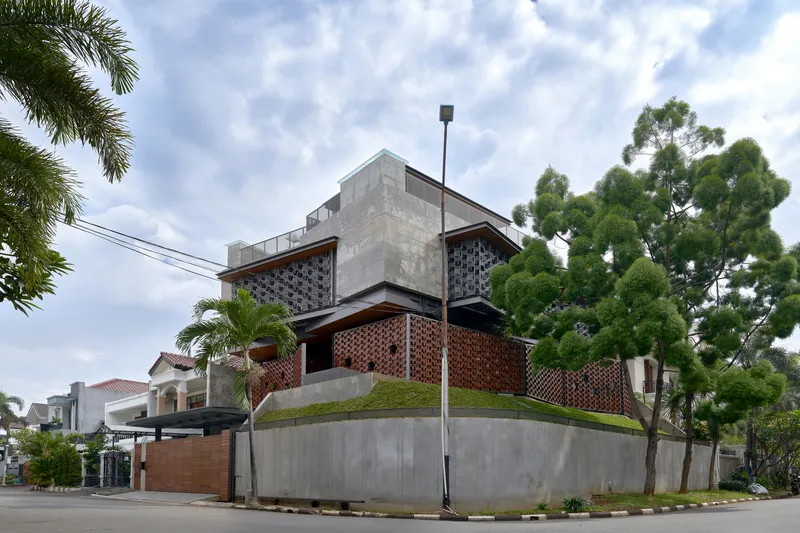

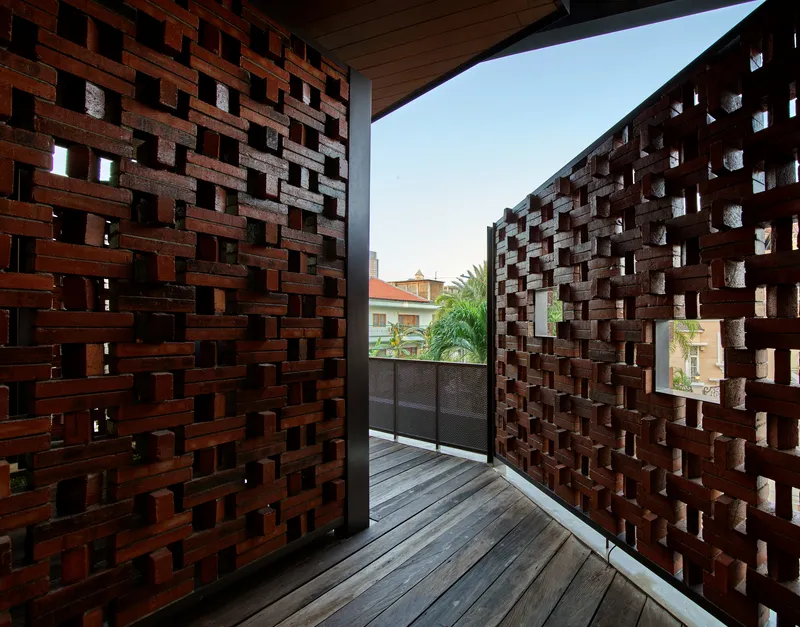
From the street, Sarang Nest House reads as a stack of heavy, shifted volumes wrapped in two distinct skins: solid concrete planes and perforated terracotta brick screens. The basketweave brickwork is the dominant material gesture. Its hollow sections allow views across the house, moderate solar gain from the punishing west and south exposures, and give the facade a textile-like depth that changes with the angle of light. At dusk the effect inverts entirely, with interior illumination turning the brick screens into lanterns.
The stacking of floors at protruding angles is not just formal play. Each offset creates a gap between the building's outer wall and adjacent structures, ensuring that air circulates freely around the full perimeter rather than being trapped in the narrow channels typical of row-house conditions.
Ground Level as Landscape
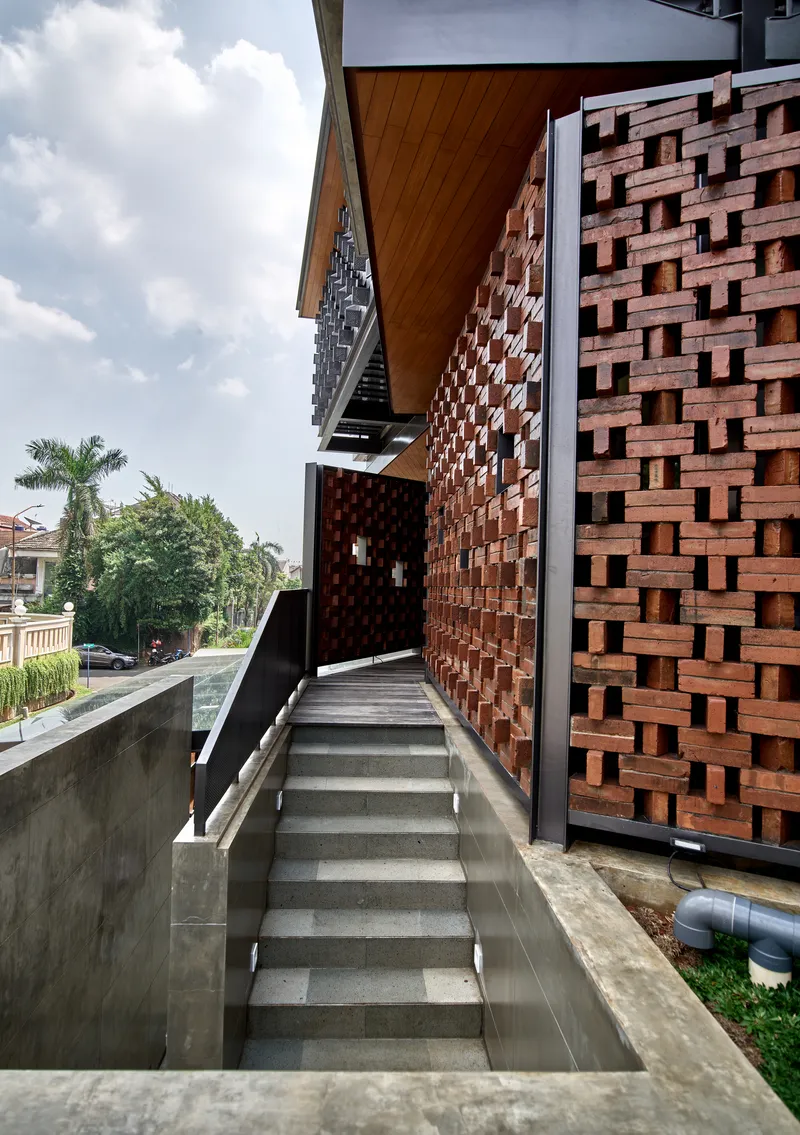


The ground floor is not really a floor at all in the traditional domestic sense. Of its 250 square meters, one third is filled with soil to serve as a garden for the storey above, with the remainder given over to parking and a service quarter. The move is radical for a city where every square meter of ground-level space typically gets paved. By surrendering buildable area to planting, the architects guarantee that the first-floor living spaces open directly onto greenery and a roof deck, collapsing the distance between domestic life and landscape.
Entry happens through a pivoting perforated brick screen that swings open to reveal the living space beyond a timber door frame. The threshold is deliberately compressed, narrow, and textured, so that arriving inside feels like decompression.
Living Within a Garden Void
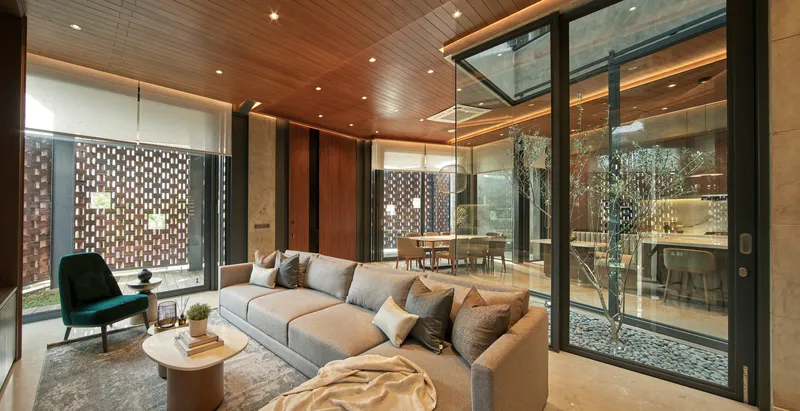


The first floor's 80 square meter open plan living and dining space orbits around a series of glazed courtyards. Trees grow from white pebble beds; glass partitions separate climate zones without blocking sightlines. At the center of the plan, a three-square-meter indoor garden void punches through the upper storeys, serving as both a light well and a convective chimney that pulls warm air upward through the house.
The timber ceiling over the living room is warm and low relative to the vertical ambition of the rest of the building. It grounds the social spaces, keeping them intimate while the courtyards inject scale and sky. Every room on this level has its own private outdoor space, a principle the architects applied consistently through all four storeys.
Vertical Circulation as Environmental Engine

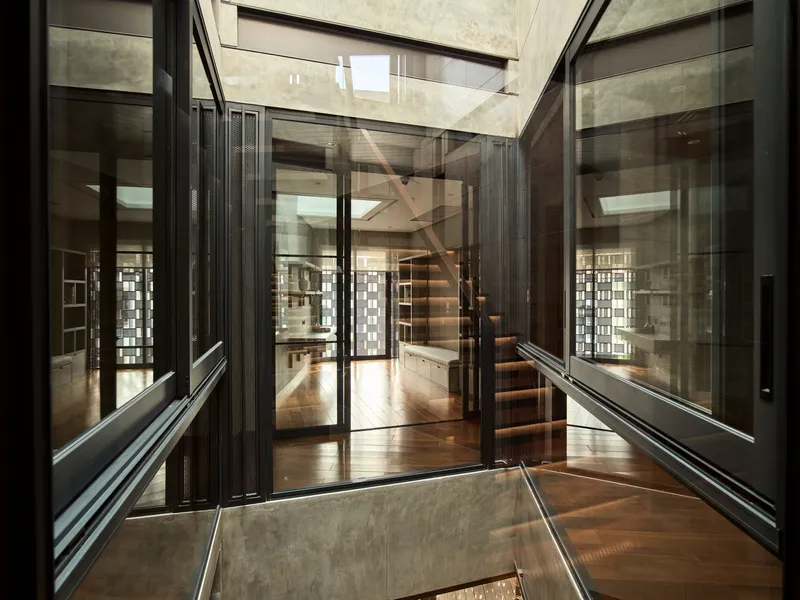

Sarang Nest House has two vertical spines: a perforated service stair at the corner of the plan, and a main staircase fitted with an active fan that drives air through a skylight at the top of the house. The service stair is perforated in both its structure and its enclosure, allowing light to wash through from the brick screen behind it. The main stair, by contrast, is a sculptural timber element cantilevered within a double-height volume, slotted with skylights that pour daylight down through the core.
These are not just movement corridors. They are the house's lungs. Warm air rises through the stairwell, is exhausted through the skylight fan, and cooler air is drawn in through the perforated brick screens at the lower levels. It is a straightforward stack-effect strategy, but the architects make it spatial rather than mechanical, visible rather than hidden.
Upper Floors and Rooftop Life
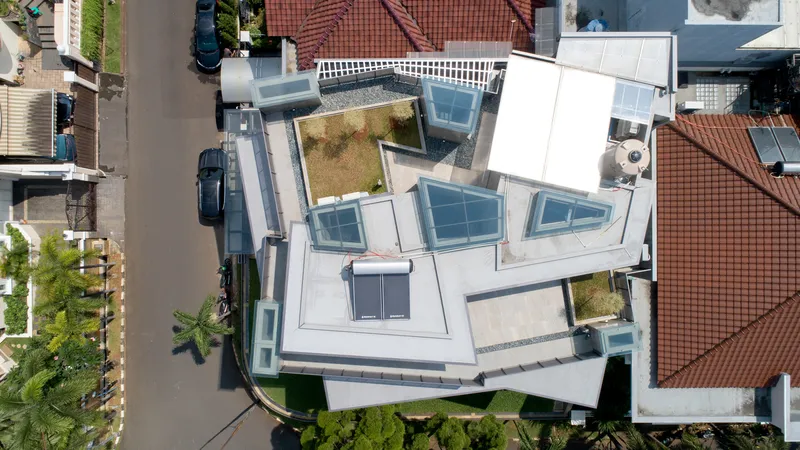
The second floor holds a 40 square meter main bedroom alongside smaller bedrooms and a playroom. Above that, the third floor is given over to communal outdoor living: a 48 square meter barbeque area, a small enclosed meditation pavilion, and a 20 square meter laundry zone separated by the main stair. The rooftop, visible in aerial view, is an angular white plane punctured by geometric skylights and small planted pockets that bring greenery to the top of the building.
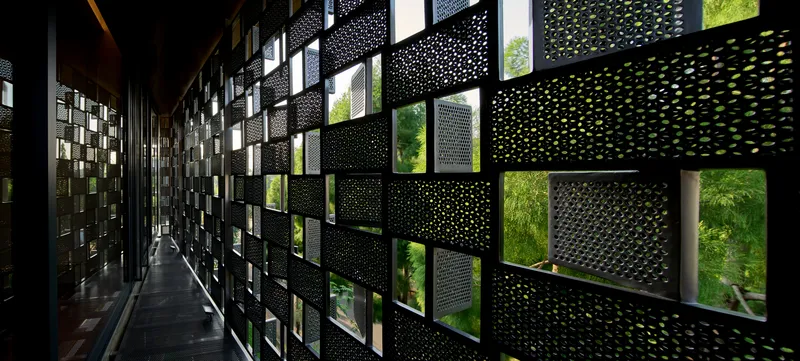
Upper-level balconies framed by the perforated brick screens offer controlled views out to palm trees and neighboring rooftops without full exposure. The metal screen panels, used alongside the brick, cast dappled shadows through corridors and filter green foliage into soft textures. The industrial finish of the exposed concrete and metal is tempered by these moments of light play, keeping the material palette from tipping into austerity.
Detail Systems


Realrich Architecture Workshop has documented the house's key assemblies with paired photographs and exploded axonometric drawings, and the detail work deserves attention. The basketweave brick facade is built from traditional red bricks arranged to create hollow perforated sections, contemporizing a local material without disguising its origins. The perforated metal screens use varied panel sizes to modulate daylight intensity across different rooms. Timber door assemblies combine perforated panels with tempered glass, and window units use hollow steel frames to minimize visual weight.

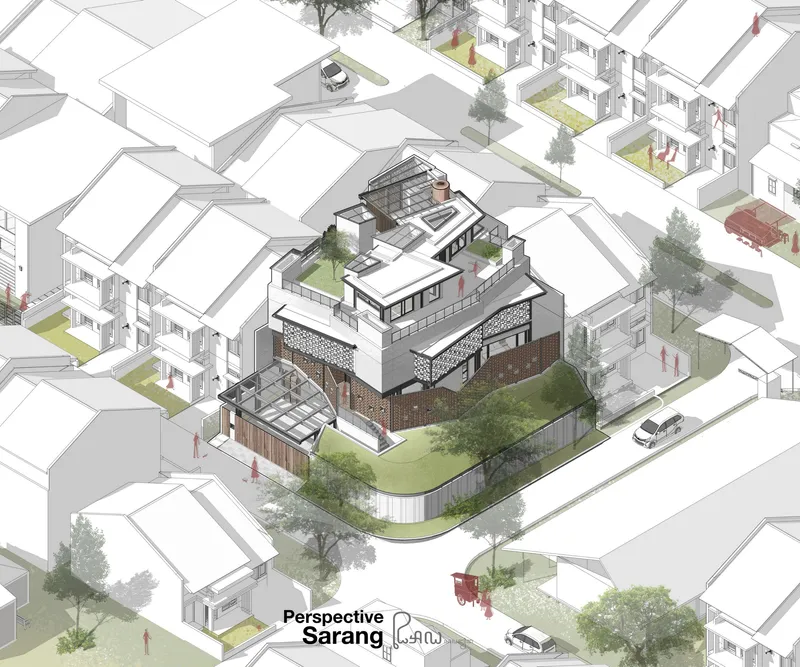

The isometric and axonometric context drawings reveal how deliberate the massing strategy is. Set among pitched-roof houses of uniform height, Sarang Nest House's stacked, rotated volumes occupy roughly the same footprint but reach higher and pull apart, creating gaps that would be impossible in a conventional extruded plan. Three stacked floor plates with a rooftop garden sit within the neighborhood like a geological formation among suburban tiles.
Plans and Drawings

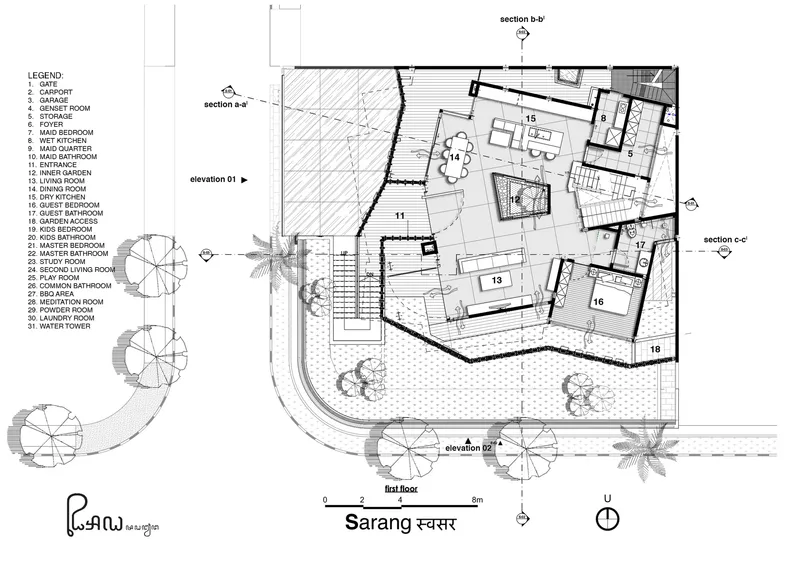


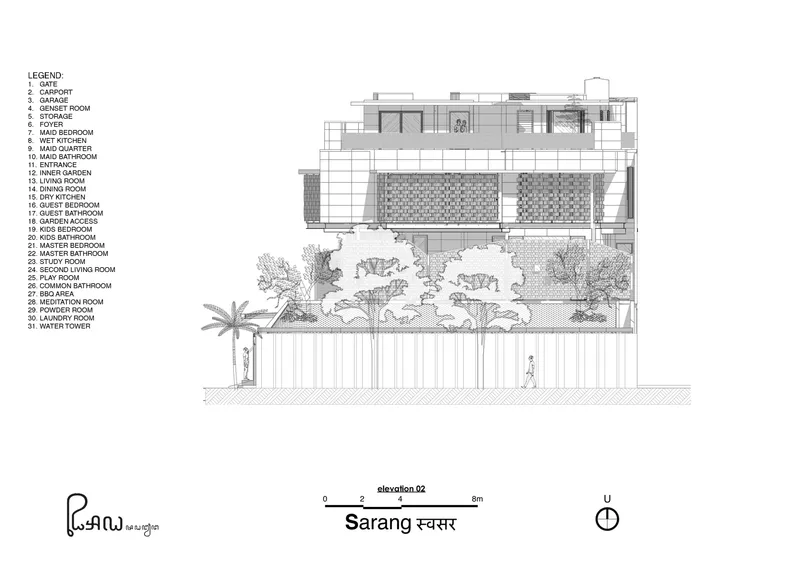


The floor plans confirm the angular logic: no two floors share the same orientation. The ground floor is dominated by parking and the soil garden; the first floor opens into its L-shaped living zone with flanking terraces; the second floor tightens around bedrooms; and the roof plan shows how angled volumes with varied surface treatments create a topographic roofscape rather than a flat lid. Sections reveal the double-height volumes, the stairwell's role as a light funnel, and the way the indoor garden void threads through three levels. Elevations document the layered facade in full, showing the interplay between solid concrete, patterned brick screen, and planted terraces.
Why This Project Matters
Sarang Nest House matters because it refuses the default response to dense tropical urbanism. Where most houses in Jakarta's residential complexes internalize their comfort through air conditioning and opaque walls, this house externalizes its climate strategy into the architecture itself. The perforated brick screens, the angled volumes, the garden voids, and the stairwell ventilation chimney are not decorative decisions; they are the building's operating system. That operating system is legible from the street, from the roof, and from every room inside.
The project also demonstrates that organic design thinking and rigorous environmental logic are not mutually exclusive. Realrich Architecture Workshop describes the house as growing from its base in reaction to site constraints, and the sections confirm this: each floor responds to a specific orientation problem, a specific privacy condition, a specific light opportunity. The house is not shaped by a singular geometric idea but by accumulated responses to real conditions. That is a harder kind of design to execute, and a more honest one.
Sarang Nest House by Realrich Architecture Workshop, West Jakarta, Indonesia. 600 m², completed 2022. Photography by Eric Dinardi.
About the Studio
Share Your Own Work on uni.xyz
If projects like this are the kind of work you want to make, uni.xyz is a place to publish your own, find collaborators, and enter design competitions.


Popular Articles
Popular articles from the community


Singing Woman: An Opera House That Performs Before the Curtain Rises
Ovidiu Cristian Pavel's conceptual opera house translates Estonia's choral identity into a sculpted waterfront landmark facing the Baltic Sea.


graciastudio Turns a Viewless Tijuana Lot Inward Around a Courtyard of Concrete, Timber and Trees
In Tijuana, Jorge Gracia's GA2 House stacks a timber-clad private floor over exposed concrete and replaces a missing view with a planted interior patio.

Cube Design Draws an Ecological Corridor Between Two Shenzhen Hills with the Nankai Building
Beside Shenzhen's container docks, the Nankai Building pairs stacked balconies with a climbing green screen to connect two hillsides across its height.

The Amber Palace Opera: A Geological Fiction Surfaces on Tallinn's Baltic Waterfront
Pierre Brillard reimagines a Baltic legend as a public landscape, opera house, and waterfront promenade rooted in Tallinn's coastal identity.

Similar Reads
You might also enjoy these articles

LAVA Architecten Gives Vocational Education a Sawtooth-Roofed Face on a Mechelen School Campus
In Mechelen, Belgium, a 2,053 m² STEM school on a 6×6 m grid turns workshops and classrooms into rooms that can be rearranged as teaching changes.

KEMA Studio Turns a Derelict Marvila Attic into a 60 m² Lighthouse Apartment Above Lisbon
In Lisbon's Marvila district, a rebuilt roof, four skylights and two plywood volumes turn an unlivable attic into a bright home facing the Tagus.

Pixel Gardens: One Repeated Module Stacked Into a Terraced Social Housing Tower for Famagusta
Salem Bader's shortlisted housing tower builds a vertical neighbourhood from one repeated module, offsetting units to carve terraces, light and air.

Bao Huynh Watercolor Atelier: A Serene Art Retreat in Hội An
Bao Huynh Watercolor Atelier in Hội An blends multifunctional art spaces, sustainable design, local materials, and family-friendly living in a serene environment.

Explore Residential Building Competitions
Discover active competitions in this discipline

Comments (0)
Please login or sign up to add comments
No comments yet. Be the first to comment!