
Refloat Kerala: Housing That Rises with the Water, Not Against It
A floating urban strategy for Aluva's flood-prone river basin, weaving elevated walkways, water channels, and 100 adaptive housing modules.


What if a neighborhood could operate in two modes, one for drought and one for flood, without losing connectivity in either? Refloat Kerala stakes its entire logic on that premise. Sited in Aluva, a river basin community in southwestern India battered by monsoon rains and periodic inundation, the project treats water not as a threat to be walled off but as a design parameter to be absorbed, redirected, and lived alongside. One hundred housing units sit elevated above anticipated flood levels, connected by raised pedestrian walkways and a water channel system that doubles as drainage infrastructure and transport corridor. The result is a settlement that toggles between dry-season neighborhood and flood-season archipelago without missing a beat.
The project was designed by Nacia Gutierrez and Diego Juárez Díaz as a shortlisted entry to the HEAL+ competition, which called for regenerative housing solutions tailored to Kerala's specific climatic and cultural conditions. Their response draws on the region's traditional dispersed settlement patterns while layering in territorial water management at a scale that moves well beyond the individual dwelling.
Timber Pavilions Along the Canal
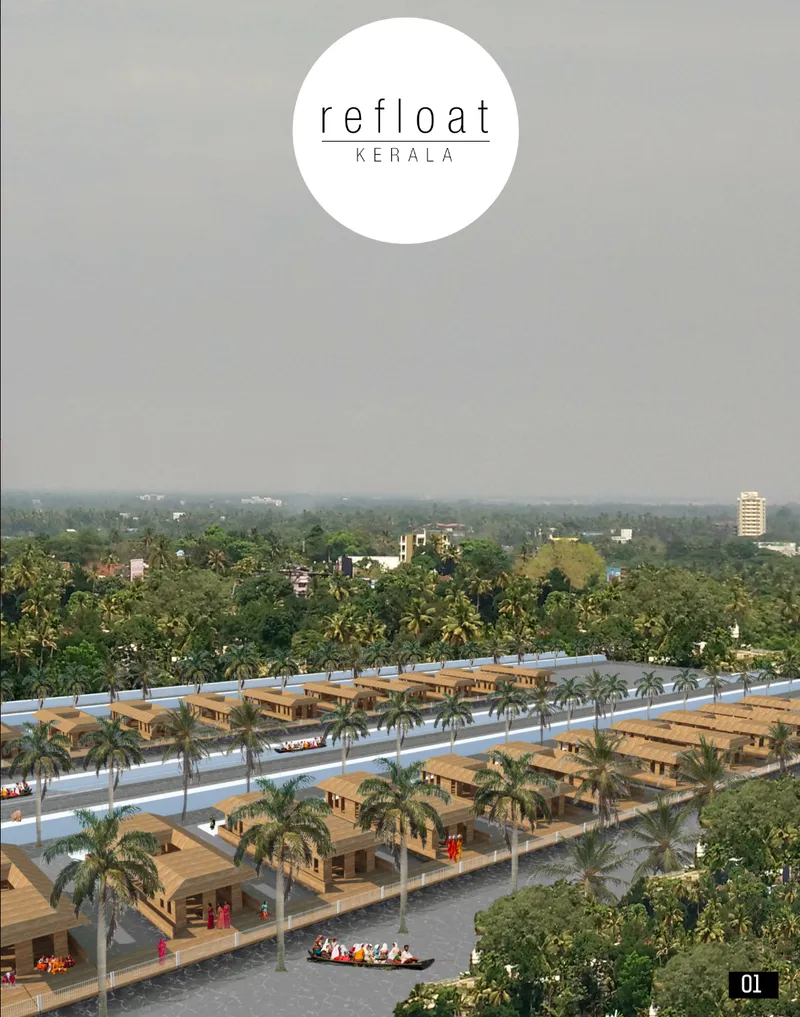
The aerial rendering reveals the core spatial proposition: clusters of timber pavilions with sloped roofs arrayed along a navigable waterway, framed by rows of palm trees. The architecture reads almost vernacular in its materiality and roofline, but the organizational logic is deliberately engineered. Structural systems lift each module above potential flood heights, allowing water to flow freely beneath during high rainfall events. In calm conditions, the ground plane activates as shared community space, with walkways linking clusters and reinforcing the social fabric that Kerala's traditional neighborhoods depend on.
Territorial Water Management at the Basin Scale
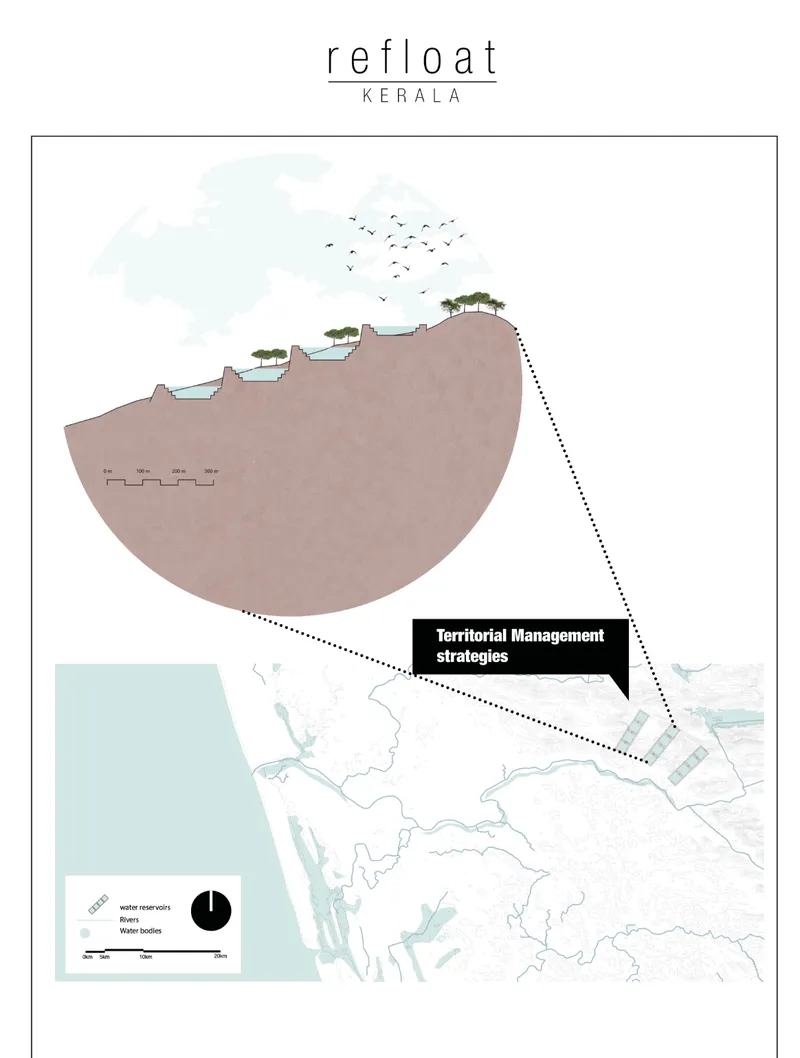
Before a single house is placed, the project intervenes at the territorial level. The diagram drawing maps out a strategy of reservoirs, canals, and natural catchment zones designed to absorb, store, and redirect seasonal floodwaters across the Aluva river basin. A cross-section detail shows planted rooftops hovering above water lines, suggesting that even the architecture itself participates in stormwater management. These are not decorative green roofs; they are part of a cascading system where water is intercepted at the highest point and slowed on its way to the channels below.
Working with the landscape rather than fortifying against it is a familiar principle in flood-resilient design, but Gutierrez and Juárez Díaz give it operational specificity here. The canals are not afterthoughts; they are the first move, establishing the corridors around which housing clusters, pedestrian infrastructure, and ecological buffers are then organized.
Dual Axes: Walking Above, Moving on Water Below
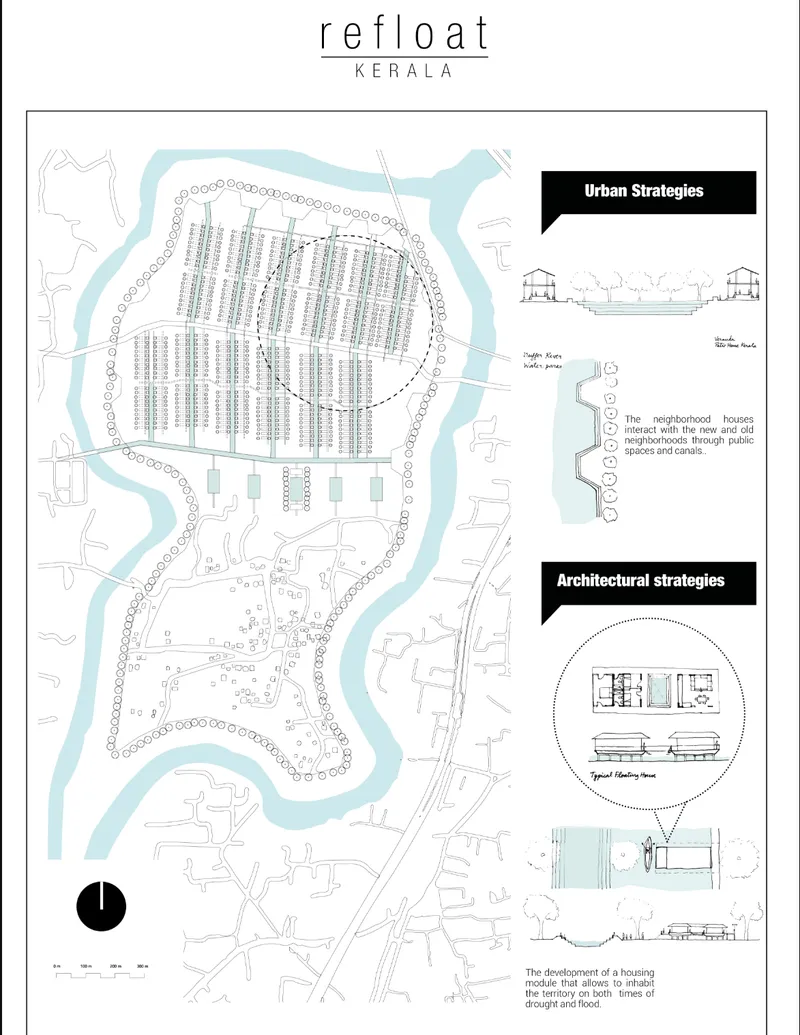
The site plan makes the dual-axis strategy legible. An elevated pedestrian walkway stitches communities together above flood levels, while a parallel water channel system serves as both drainage infrastructure and a transportation route. These two networks ensure year-round connectivity regardless of conditions. During dry months, the walkways double as social corridors and open community space. During floods, they become the primary circulation system while the channels handle the surge. The drawing also reveals how the 100 housing units are distributed in a dispersed pattern that echoes Kerala's historic settlement typology rather than imposing a dense urban grid.
Why This Project Matters
Refloat Kerala is compelling because it refuses to treat flooding as a singular engineering problem. Instead, it nests the response across three scales: territorial water management that tames the basin, an urban strategy that keeps people connected, and an architectural module that keeps them dry. Each layer depends on the others. The canals would be inadequate without the elevated walkways; the raised houses would be isolated without the connecting infrastructure. That interdependence is the project's real design intelligence.
For flood-prone regions beyond Kerala, the project offers a transferable framework: start with water, let it define the infrastructure, then build the community around it. Gutierrez and Juárez Díaz demonstrate that climate-responsive housing does not have to abandon cultural identity. By preserving the dispersed, low-rise character of Kerala's neighborhoods while upgrading them with adaptive infrastructure, the project argues that resilience and tradition can coexist, provided the architecture is willing to float.
View the Full Project
About the Designers
Designers: Nacia Gutierrez, Diego Juárez Díaz
Enter a Design Competition on uni.xyz
uni.xyz runs architecture and design competitions year-round that reward proposals with spatial conviction and real site intelligence.
Project credits: Refloat Kerala by Nacia Gutierrez, Diego Juárez Díaz HEAL+ (uni.xyz).


Popular Articles
Popular articles from the community


Lunar Spiral: Space Architecture Shaped by the Mathematics of the Universe
Lunar Spiral reimagines space architecture through Fibonacci geometry, lunar regolith, levitating habitats, and self-sustaining Moon living.

Co-Life: Senior Housing Design That Reconnects Older Adults With the City
Co-Life reimagines senior housing design through healing gardens, shared streets, workshops, and a sustainable community across generations.

The Musturak Paradise: Senior Living Architecture for a Connected Future in Temara, Morocco
The Musturak Paradise reimagines senior living architecture in Temara via private homes, social spaces, culture, community, and shared care.

Hill & Cross Opera: Sculptural Opera House Architecture Shaped by Tallinn’s Landscape and Identity
Hill & Cross Opera reimagines opera house architecture in Tallinn through its sculptural hill, civic plaza, glass wave and a luminous cross.

Similar Reads
You might also enjoy these articles

Bao Huynh Watercolor Atelier: A Serene Art Retreat in Hội An
Bao Huynh Watercolor Atelier in Hội An blends multifunctional art spaces, sustainable design, local materials, and family-friendly living in a serene environment.

Atelier Macri Concept Store Interior Design by CASE-REAL
Atelier Macri store features a "ko" counter, walnut wood details, cork displays, blending retail, gallery, and seamless customer experiences.

Manuel Vargas Izquierdo Stadium and High-Performance Sports Center: Architectural Excellence in Jalpa de Méndez
The Manuel Vargas Izquierdo Stadium blends sustainable design, inclusive sports facilities, and cultural-inspired architecture, revitalizing Jalpa de Méndez’s public spaces.
KAKR Buluh Awar Hall: Revitalizing Community and Ecology Through Bamboo Architecture
Community built bamboo hall revitalizes Buluh Awar village, empowering youth, restoring ecology, celebrating vernacular craftsmanship through sustainable architecture and culture.

Explore Kerala Floods Competitions
Discover active competitions in this discipline

Challenge to reimagine the Iron Throne

Photograph architecture without architects

Illustrate the lost glory of Angkor Wat - Render Challenge

Design challenge to reuse E-waste
Comments (0)
Please login or sign up to add comments
No comments yet. Be the first to comment!