
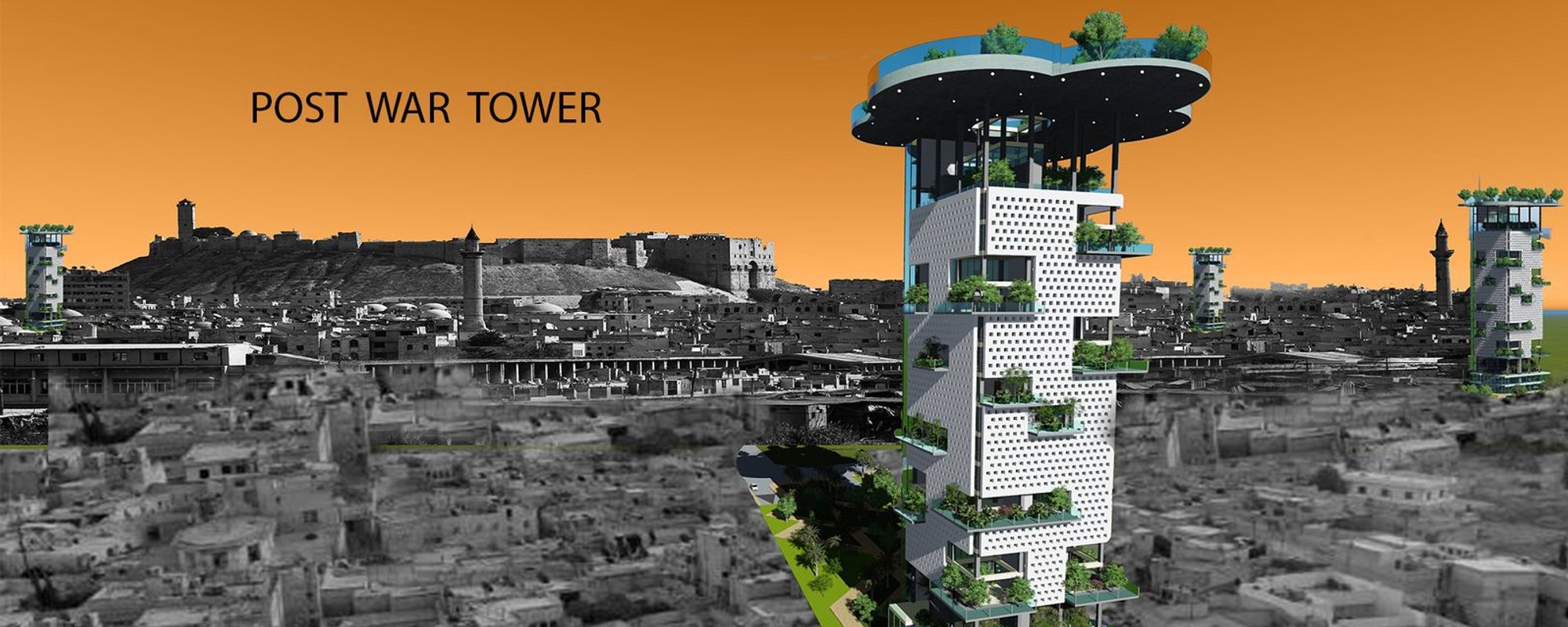
Reimagining Home Through Post-War Reconstruction Architecture in Aleppo
A visionary post-war reconstruction architecture proposal that transforms Aleppo’s memories into vertical homes, reviving community life and hope.

In the aftermath of war, architecture becomes more than physical construction—it becomes a vessel for memory, healing, and collective renewal. POST WAR TOWER, a visionary proposal by Hamudi M, stands as a bold exploration of post-war reconstruction architecture, offering a new typology for living in Aleppo. Inspired by the spatial logic and intimacy of old Arabic houses, the project transforms horizontal traditions into vertical living clusters that reconnect families, restore community rhythms, and symbolically rise from the ruins of conflict.
This architectural concept responds to the emotional weight of a city scarred by destruction, emphasising not only the act of rebuilding, but the act of remembering. By reinterpreting Aleppo’s vernacular architecture into a contemporary vertical form, the tower becomes a hopeful path forward—one that respects the past while envisioning a better future.
Context: Aleppo Before and After the War
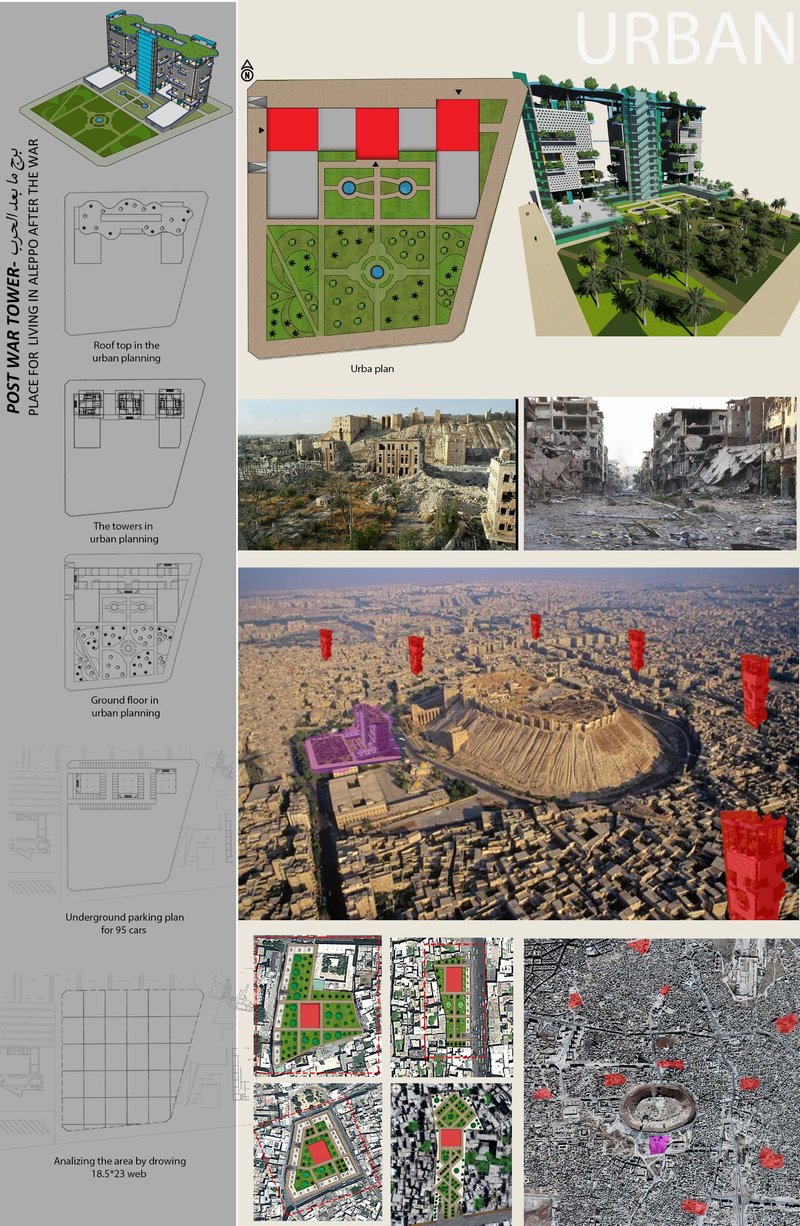
Aleppo’s urban fabric is a dense mosaic of courtyards, narrow passageways, and ancestral homes. These spatial forms historically nurtured strong social ties, privacy, and daily rituals. The war fractured this continuity, leaving behind vast areas of rubble and displaced communities.
The POST WAR TOWER project begins by analysing maps, street patterns, and the structural devastation across key districts. These visuals highlight:
- The old city’s dense patterns, once alive with cultural exchange
- Destroyed neighbourhood blocks, now unrecognisable
- Fragmented community relationships in need of reconnection
By overlaying traditional grid modules and identifying surviving spatial rhythms, the project reconstructs a new architectural system rooted in cultural memory.
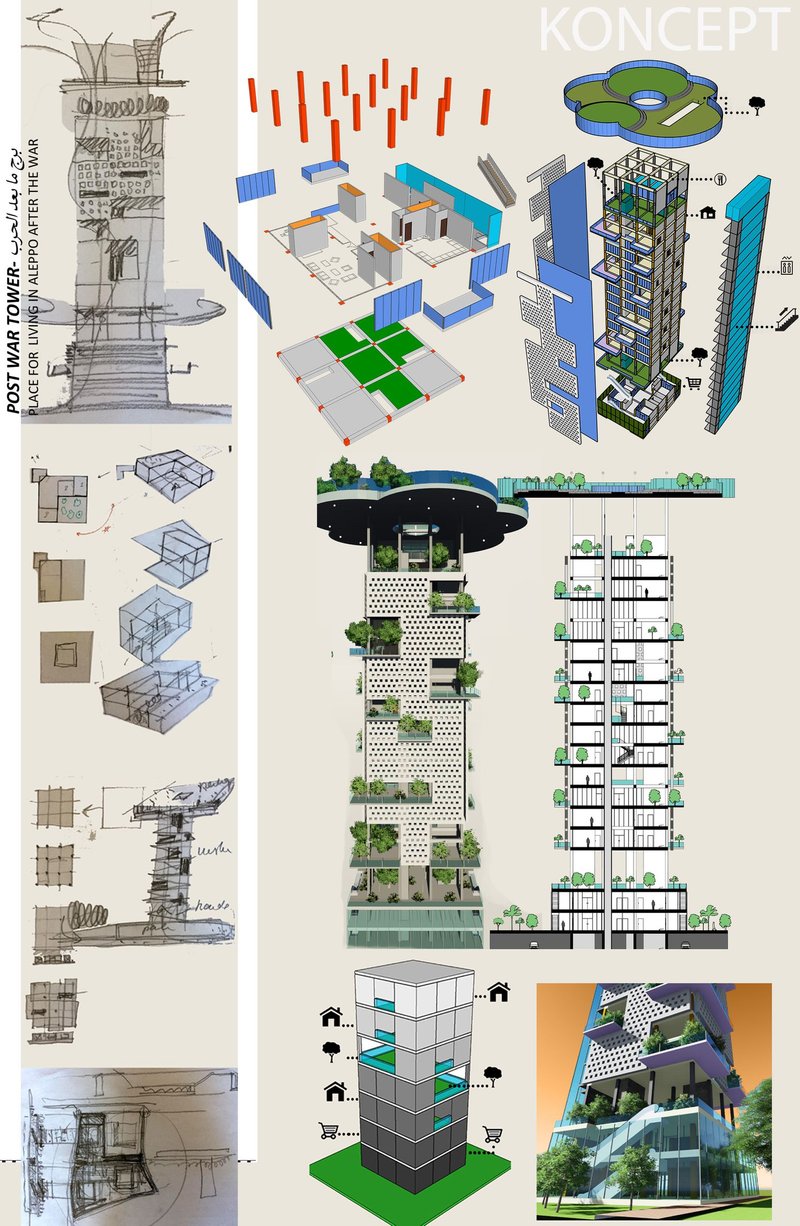
Concept: Verticalising the Old Arabic House
The core idea of the tower is simple yet profound:
To transform the traditional Arabic courtyard home into a vertical typology that preserves family intimacy and neighbourhood connectivity.
Key Conceptual Moves:
- Modular Courtyard Units: The tower is designed as stacked clusters of homes arranged around shared green voids—the vertical reinterpretation of the courtyard.
- Layered Community Spaces: Every few floors integrate semi-public areas that foster encounters, collective activities, and intergenerational interaction.
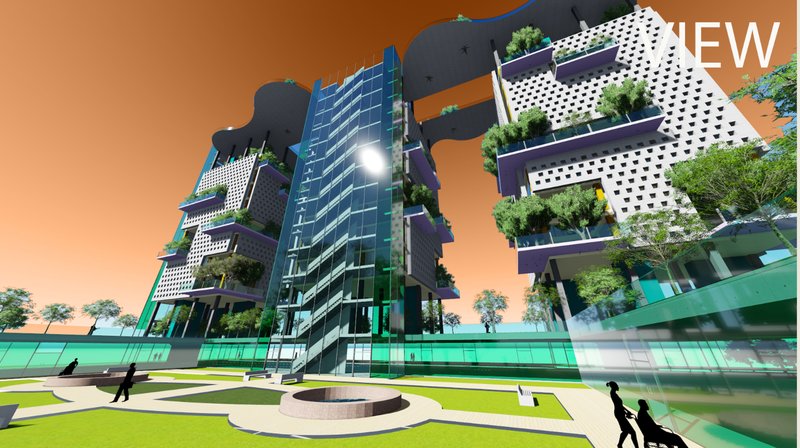
- Memory as Structure: The tower’s perforated façade echoes the patterns of Aleppo’s historic architecture, blending nostalgia with contemporary construction.
- Green Terraces & Urban Farming: These provide not only environmental benefits but also revive cultural habits of tending to gardens and sharing produce.
The project’s diagrams, sketches, and exploded views illustrate how traditional spatial principles were abstracted into a new architectural model—one that rises while remaining deeply grounded in heritage.
Urban Strategy: Stitching the City Back Together
More than a building, POST WAR TOWER proposes a new urban logic. The design reimagines derelict neighbourhoods as interconnected green districts, punctuated by multiple towers that serve as vertical villages.
Urban Design Features:
- Strategic Placement of Towers: Positioned across the destroyed urban grid to anchor regeneration zones.
- Green Waterfront and Courtyards: Restoring ecological balance and psychological wellbeing.
- Public Plazas and Cultural Nodes: Museum spaces, community centres, and walkable pathways re-establish cultural rhythm.
- Underground Parking: Efficiently freeing surface areas for communal use.
The urban diagrams also highlight a 18.5×23 grid analysis, ensuring that the design aligns with Aleppo’s historical block patterns, respecting both geometry and memory.
Functional Program: A Living Tower for Rebirth
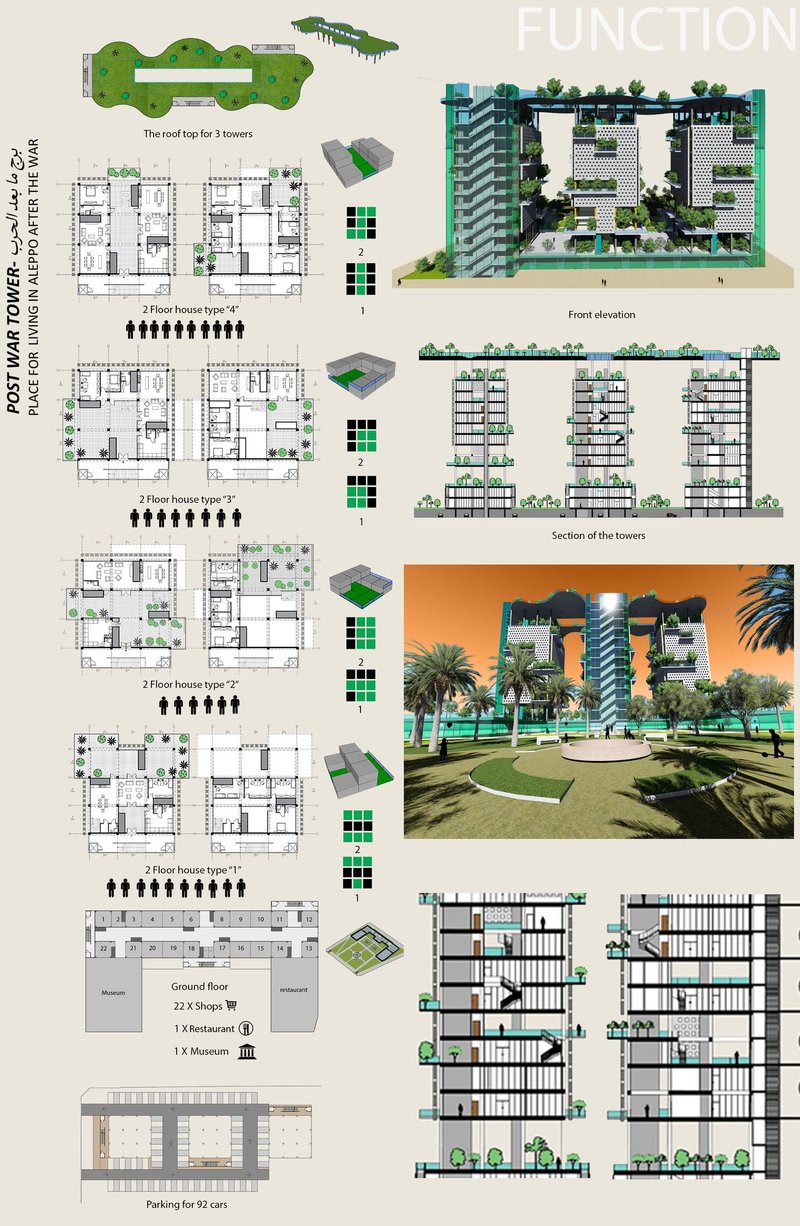
The tower includes varied residential typologies designed for families of different sizes. Each unit follows the principle of a two-floor home, mirroring the traditional vertical separation of public and private life.
Programme Breakdown:
- Residential Floors: Four house types, each with internal courtyards and terraces.
- Ground Floor: Includes 22 shops, a restaurant, and a museum—placing culture and commerce at the heart of everyday life.
- Rooftop: A landscaped public garden spanning all three towers, symbolising connection and openness.
- Vertical Circulation: A transparent central core that brings light through the entire height of the building.
- Parking: Space for 92 cars, integrated underground.
Sections and elevations reveal how the stacked courtyard homes align with circulation paths, terraces, and vertical greenery, creating a rhythm of solids and voids reminiscent of Aleppo’s architectural character.
Visual Experience: A Tower That Rises from Ruins
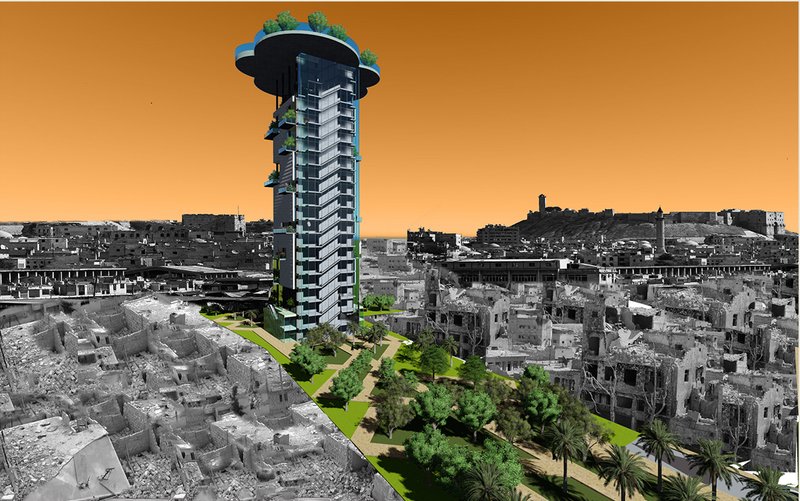
Rendered views depict the tower emerging from Aleppo’s once-destroyed skyline—a striking juxtaposition between devastation and regrowth.
Visual Highlights:
- Green terraces cascading down the façade reflect hope and renewal.
- The rooftop organic canopy forms a sculptural silhouette visible across the city.
- Walkable green platforms integrate nature into daily movement.
- Glass circulation spine provides transparency and symbolic clarity.
These images illustrate how architecture can become a testimony of resilience—an emblem of what the future can hold when communities reclaim their right to rebuild.
Architecture as a Tool for Healing
POST WAR TOWER stands as a powerful statement within the discourse of post-war reconstruction architecture. It transforms destruction into opportunity, memory into form, and community into structure. By learning from Aleppo’s cultural past and designing vertically for its future, the project by Hamudi M demonstrates how architecture can heal, empower, and inspire collective rebirth.
In a landscape where ruin still dominates, this project envisions a new horizon—one where homes rise again, relationships rebuild, and the city remembers itself while moving forward.




Popular Articles
Popular articles from the community

ure LLC Builds a Timber-Framed Suburban Office That Doubles as a Community Living Room in Hiroshima
KItoNOKO wraps sawtooth roofs and corrugated metal around an exposed timber frame to give a commercial district a new civic anchor.
MAKER architecten Rewire a 1972 Brutalist Dormitory on the VUB Campus as a Living Lab
A modular renovation strategy in Belgium breathes new life into Willy Van Der Meeren's modernist student housing without erasing its concrete bones.
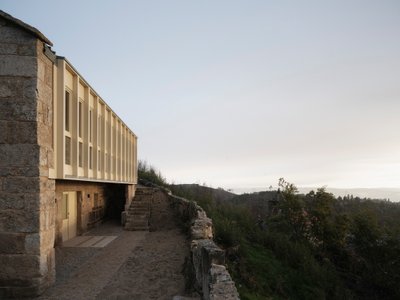
Three Architects Stitch a Social Center into a Crumbling Galician Hamlet
In Muimenta, Spain, timber and plywood volumes graft onto granite ruins to anchor a rural revitalization effort.
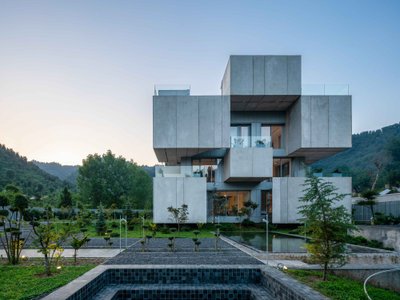
Bood Design Bureau Splits a Gilan Residence in Two to Let the Forest In
Double Side House negotiates privacy and openness through interlocking concrete volumes and planted courtyards in northern Iran's humid Caspian lowlands.


Similar Reads
You might also enjoy these articles

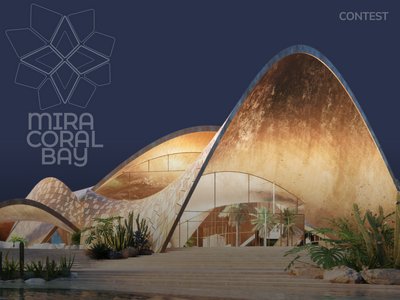
Architectural Competition: Create a Luxury Waterfront Community in the UAE!
Mira Developments announces an open competition for the pre-concept design of Mira Coral Bay in Ras Al Khaimah, UAE

Parametric Design: What Can You Learn from the 1st Workshop of Beegraphy?
Discover the Fundamentals and Advanced Techniques of Parametric Design

Feast of flight factory
A new ecological order with sustainable food resources-insects
Beyond Blueprints : How Architecture Presentation Boards Define The Design Narratives?
Unveiling the Art and Strategy Behind Architectural Storytelling





Comments (0)
Please login or sign up to add comments
No comments yet. Be the first to comment!