
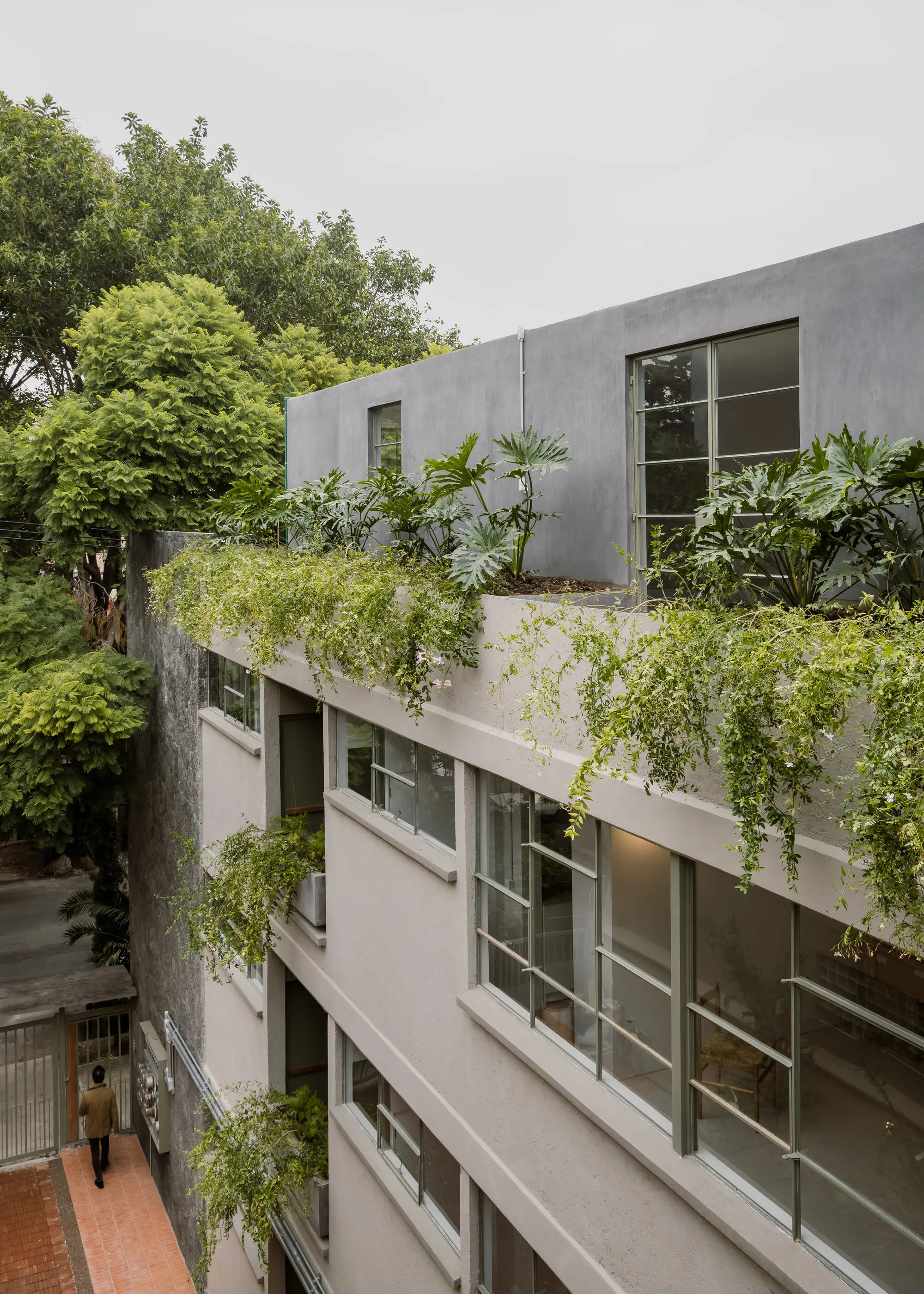
REIMS 502 Doubles the Density of a 1956 Mexico City Housing Block Without Losing Its Soul
In the Vértiz-Narvarte neighborhood, a forgotten mid-century multifamily building becomes 24 compact units for a new generation of urban dwellers.


In 1956, architect Enrique Hernández Camarena designed a modest multifamily housing block in Mexico City's Vértiz-Narvarte neighborhood. It was working-class housing, nothing monumental, but it carried the DNA of mid-century Mexican modernism: clean symmetry, ribbon windows, honest concrete. Sixty-five years later, the building had slipped into disrepair and obscurity. REIMS 502, led by Eduardo Reims, saw in it not a teardown candidate but a test case for something more urgent: proving that adaptive reuse can serve the economics of young urban life in one of the world's most pressurized housing markets.
The core move is deceptively simple. PETÉN takes the original 12 apartments and reconfigures them into 24 single-room units, doubling occupancy while preserving the structural skeleton and the architectural character of the original facade. The result is a building that reads from the street almost exactly as Hernández Camarena intended, but behind its concrete bands and planted terraces operates as something fundamentally contemporary: compact, flexible, transit-oriented housing calibrated to the socioeconomic reality of people who need a foothold in the city, not a sprawling family apartment.
Before and After
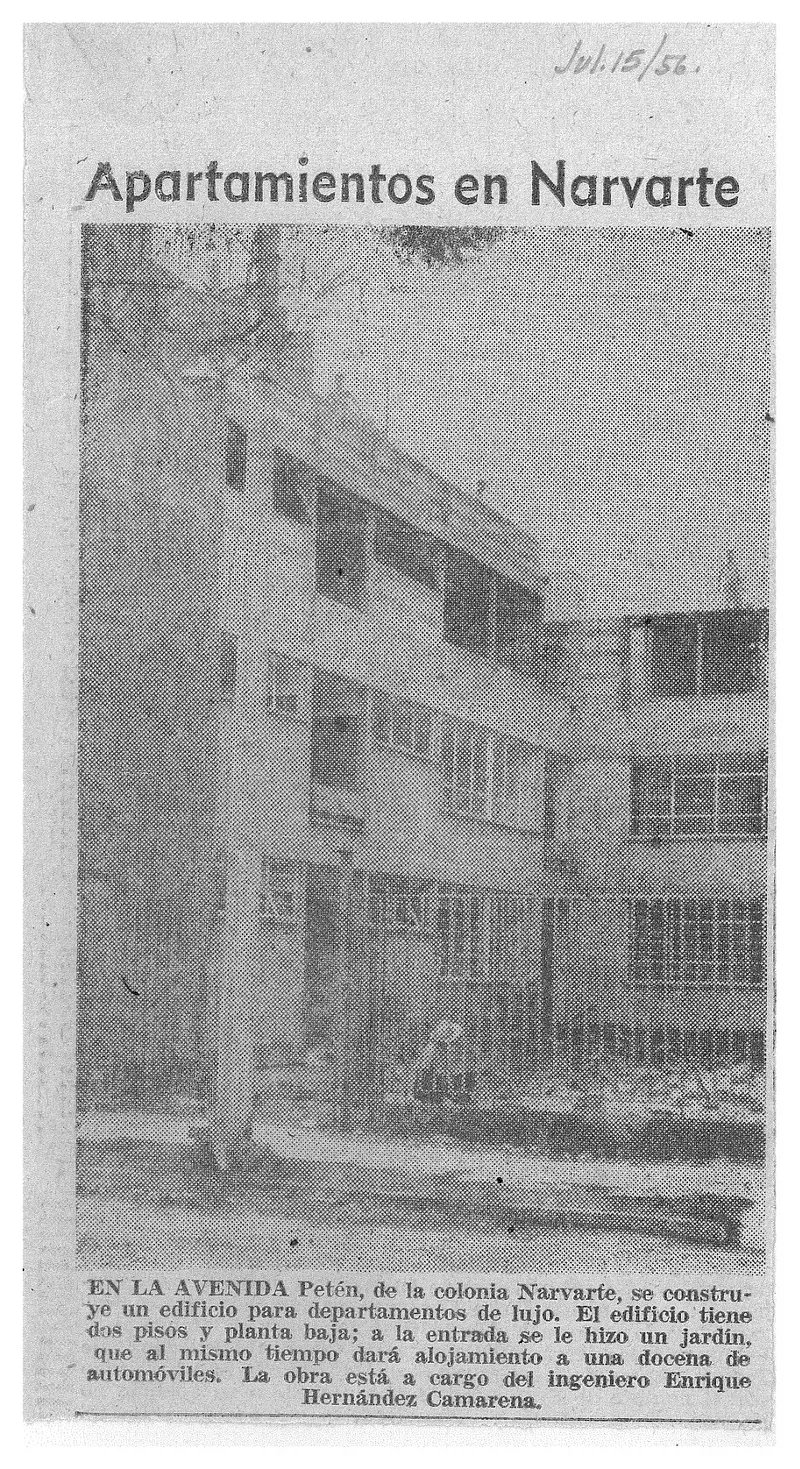
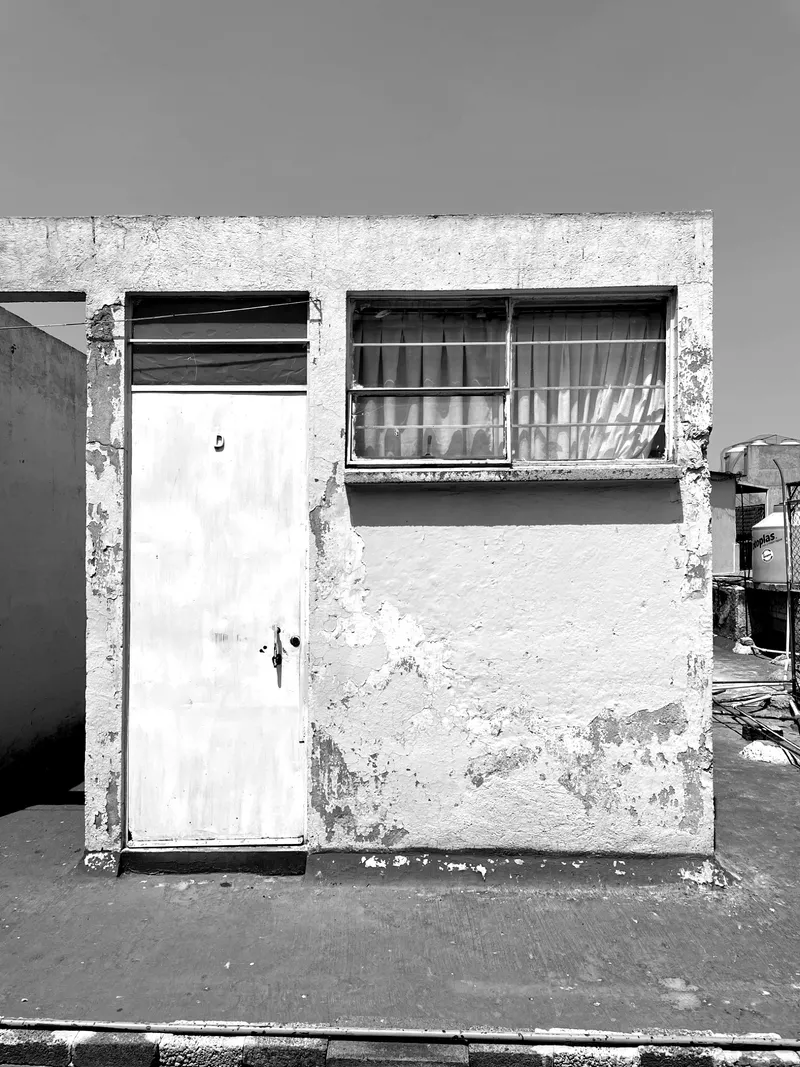
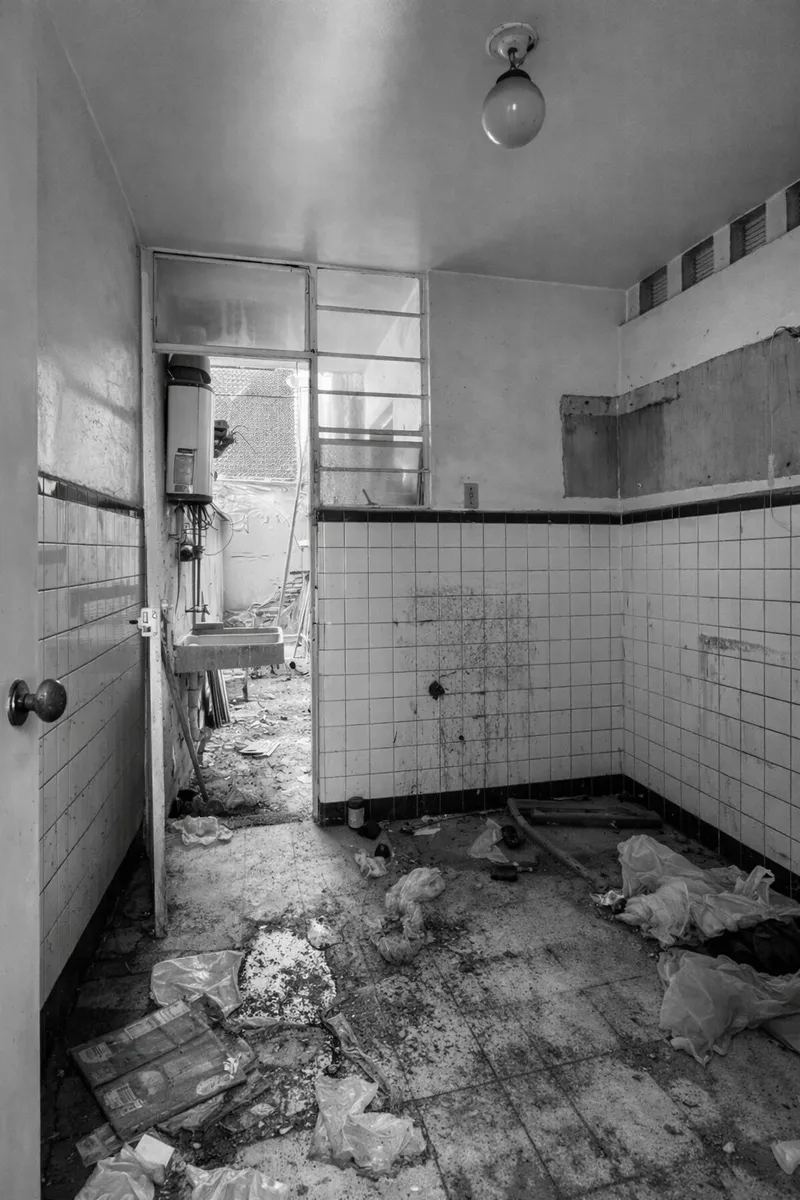
The archival images and pre-renovation photographs tell the story of a building that survived decades of neglect, including the seismic events that have reshaped Mexico City's built fabric. An old newspaper clipping shows the original block with its projecting volumes, already exhibiting the clean horizontal language that Hernández Camarena favored. By the time REIMS 502 arrived, the concrete was weathered, rooms were gutted, and bathrooms had become rubble fields. The building's resilience, its structural integrity despite everything, became the ethical argument for saving rather than demolishing it.
A Facade That Remembers
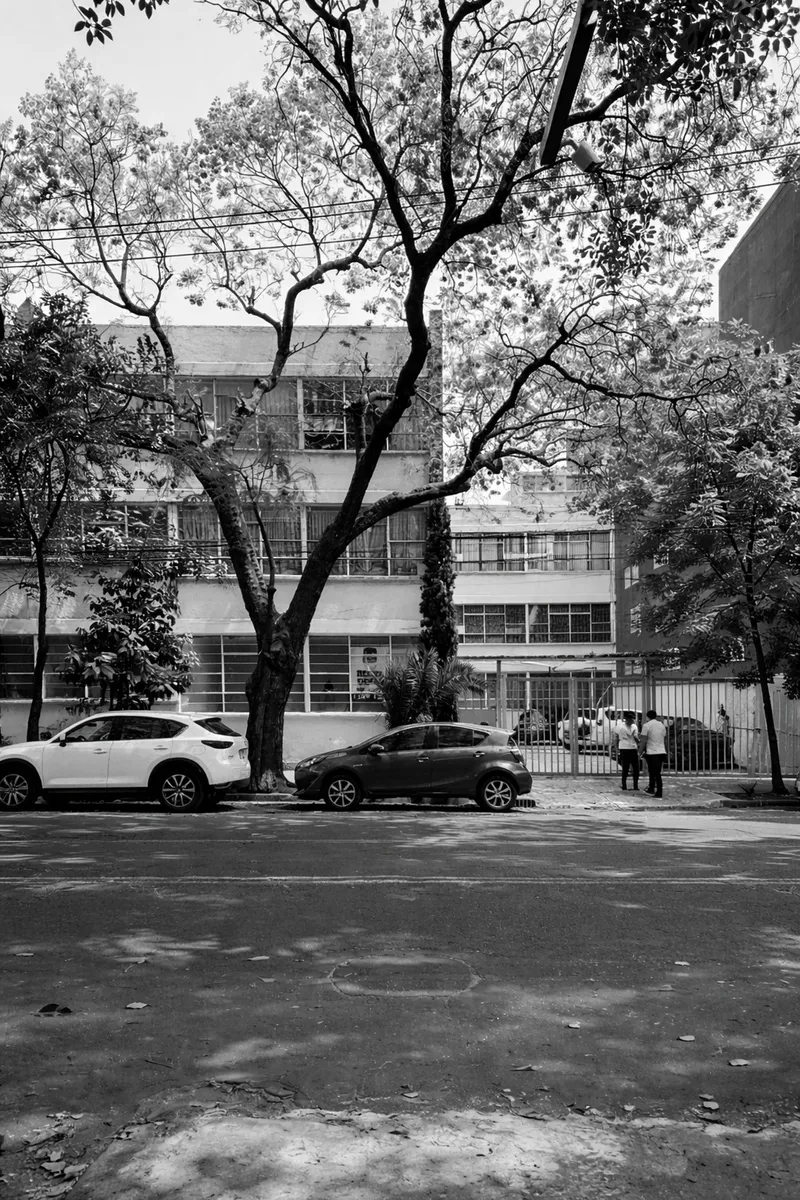
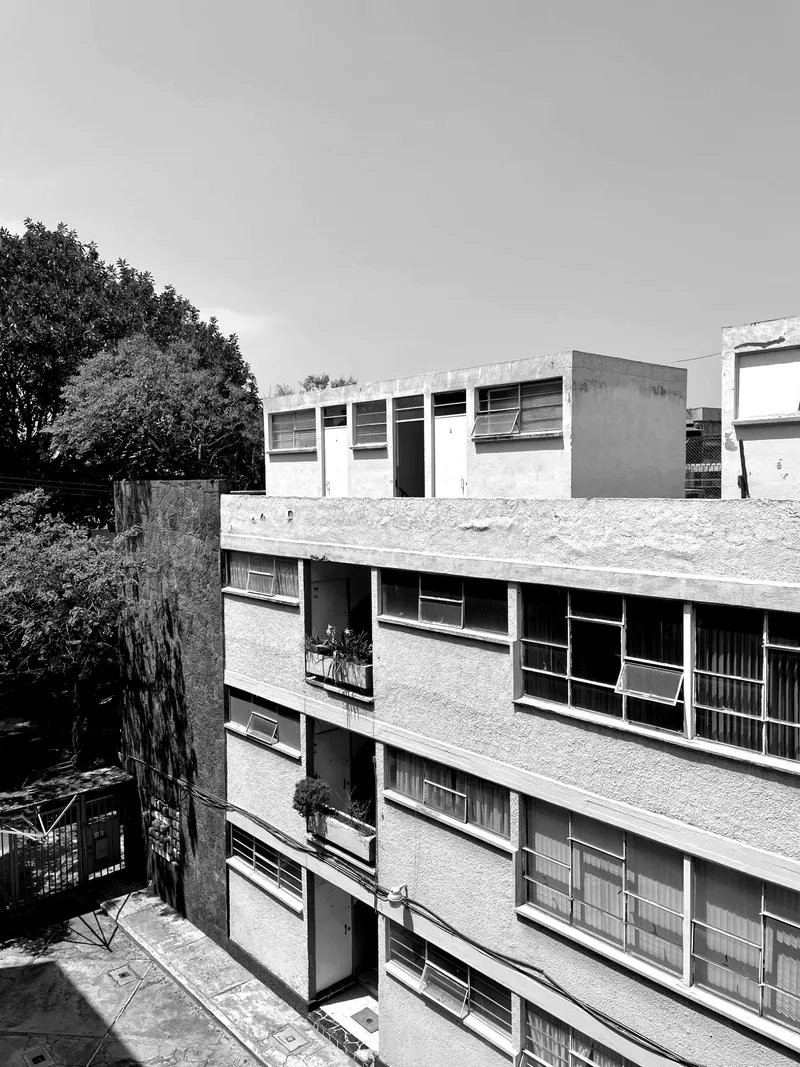
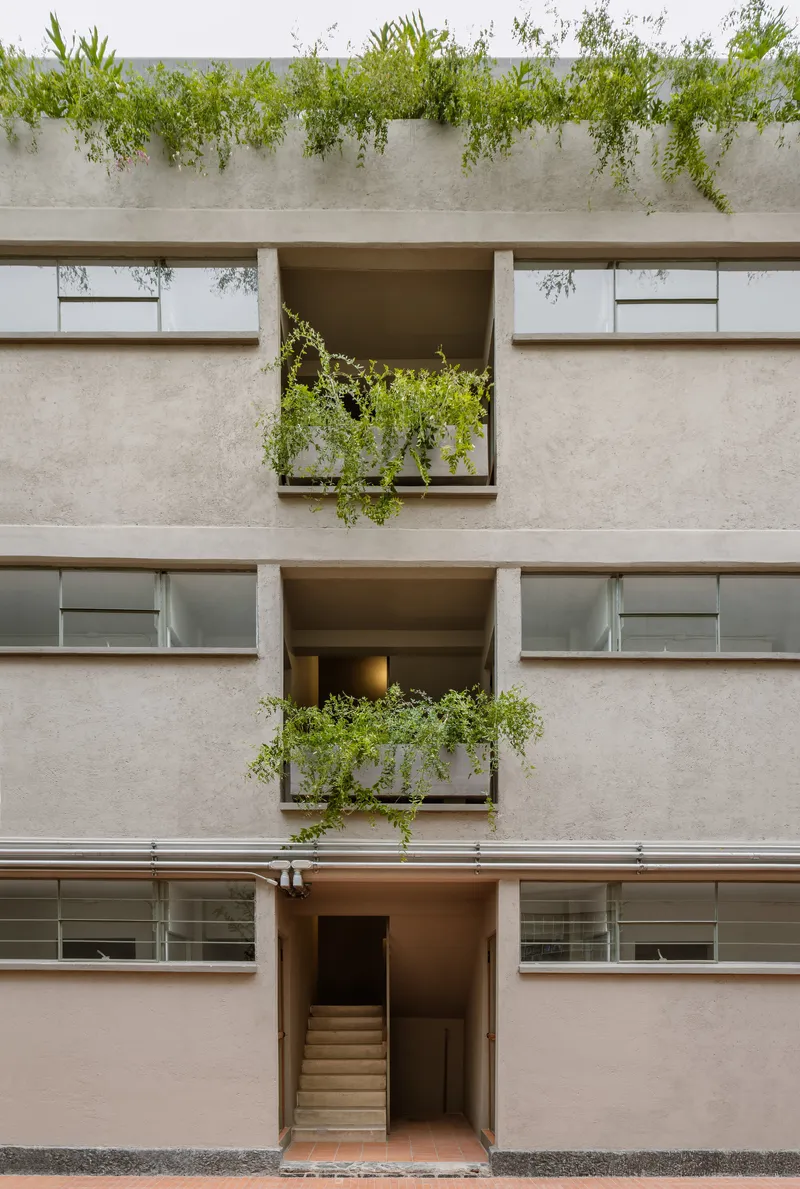
From the street, PETÉN still belongs to its era. The horizontal band windows, the three-story massing beneath mature trees, the symmetrical balconies with planted boxes: all of this reads as mid-century Mexican housing, which is exactly the point. REIMS 502 resisted the temptation to announce the renovation with some conspicuous contemporary gesture. The facade is a preservation act, not a restoration fetish. It is clean, maintained, and legible on its own terms.
The planted terraces cascading from the rooftop add a layer of green that the original likely never had, but they feel earned rather than imposed. They soften the concrete, provide privacy screens, and nod to the broader biophilic current running through contemporary Mexican architecture without feeling like a trend graft.
Courtyards and Circulation
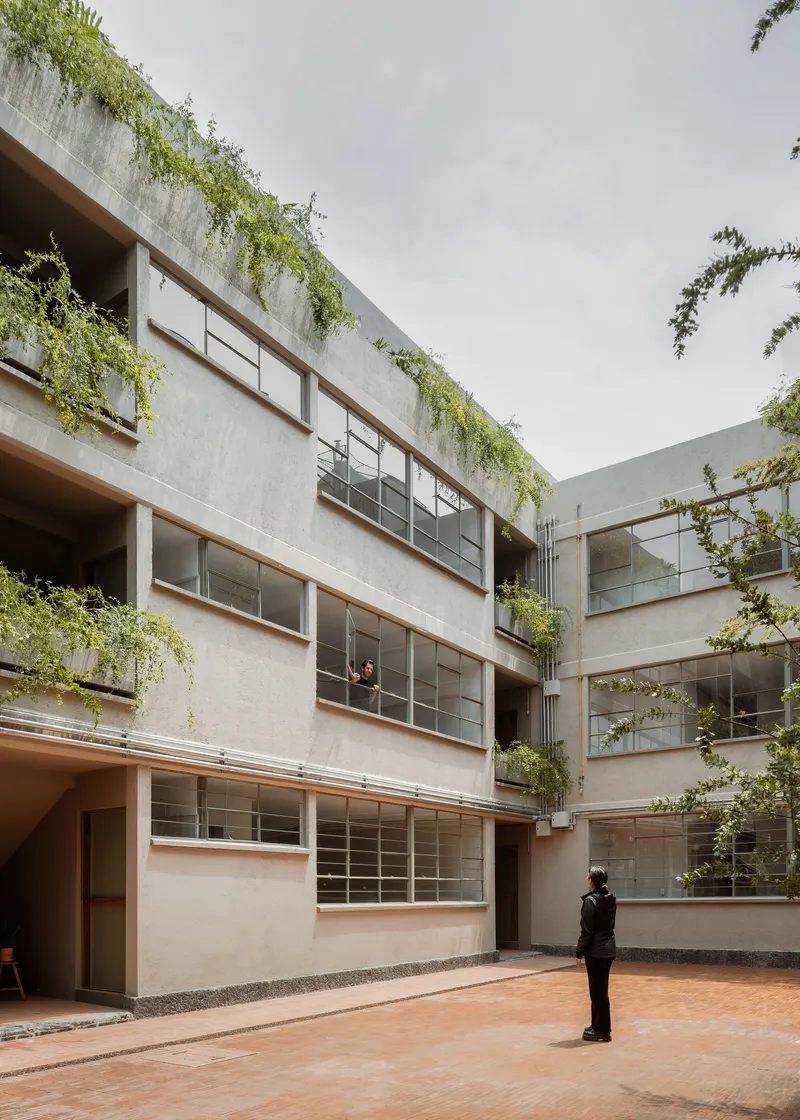
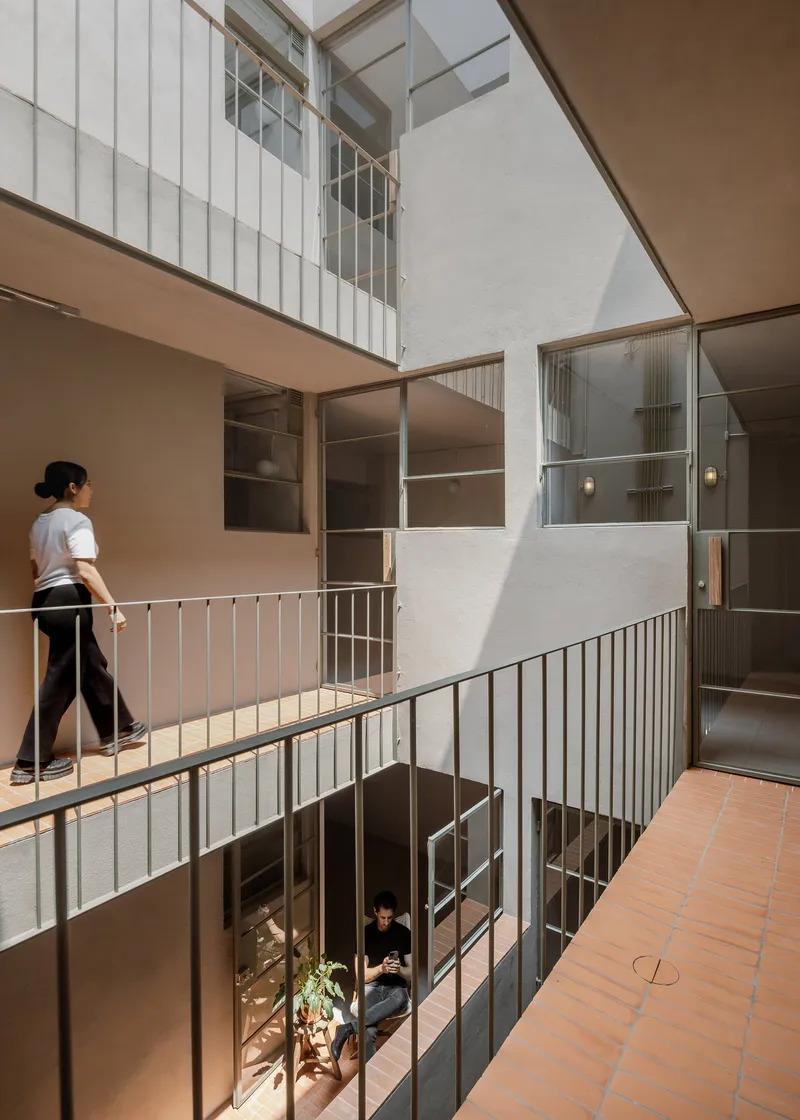
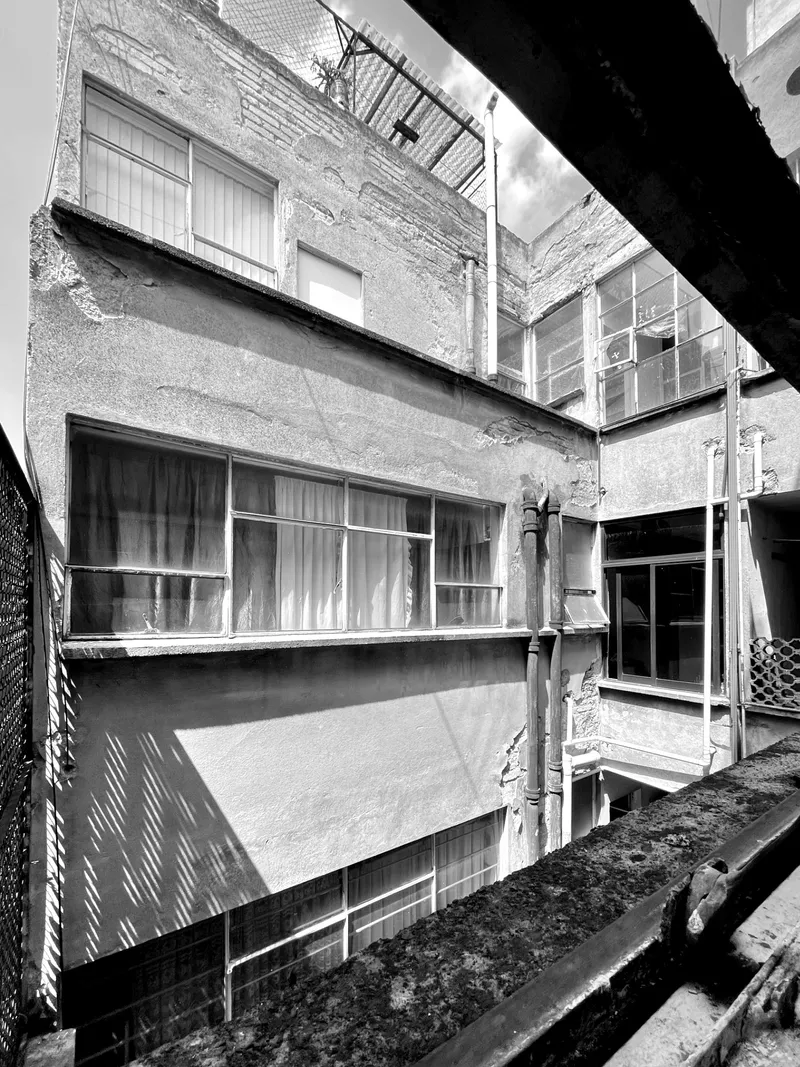
The internal courtyards are where the project breathes. Stacked balconies and ribbon windows face inward, creating a vertical social register where residents encounter each other in passing. The before-and-after contrast here is stark: the same courtyard that once looked abandoned now operates as a communal light well, its railings and walkways populated, its upper levels visible and active. Vegetation tumbles from the roof terraces into these voids, creating a micro-climate that tempers the hard concrete surfaces.
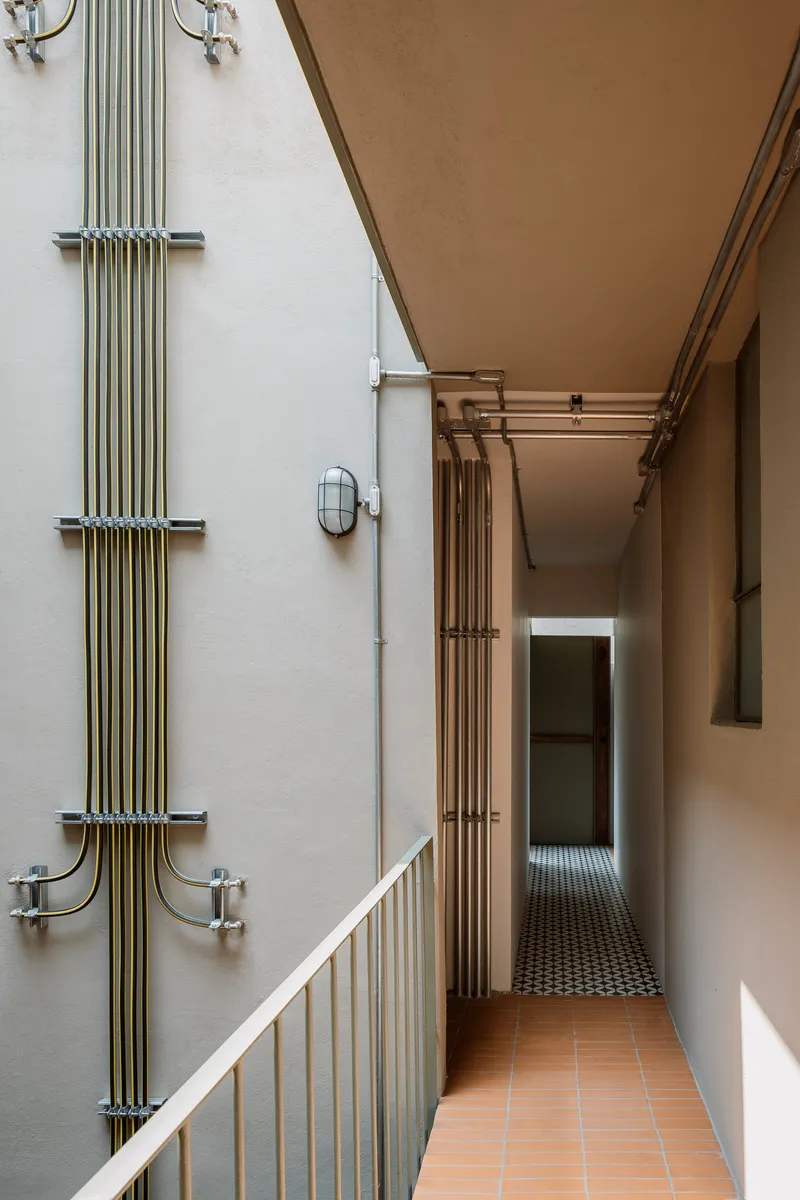
Circulation through the building is handled with a directness that suits its compact program. Metal balusters, timber handrails, and terracotta tile floors mark the shared corridors and staircases. There is no attempt to hide infrastructure. Exposed brass conduit runs along white walls, becoming a decorative element by virtue of its careful alignment rather than its concealment.
Living in a Single Room
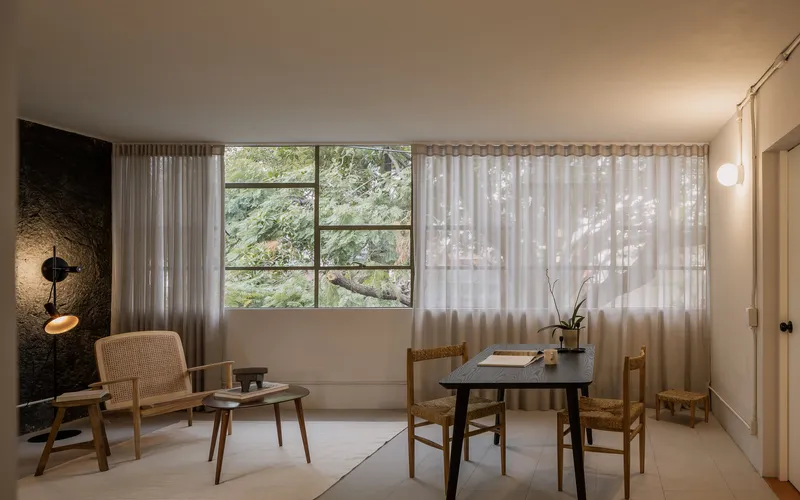
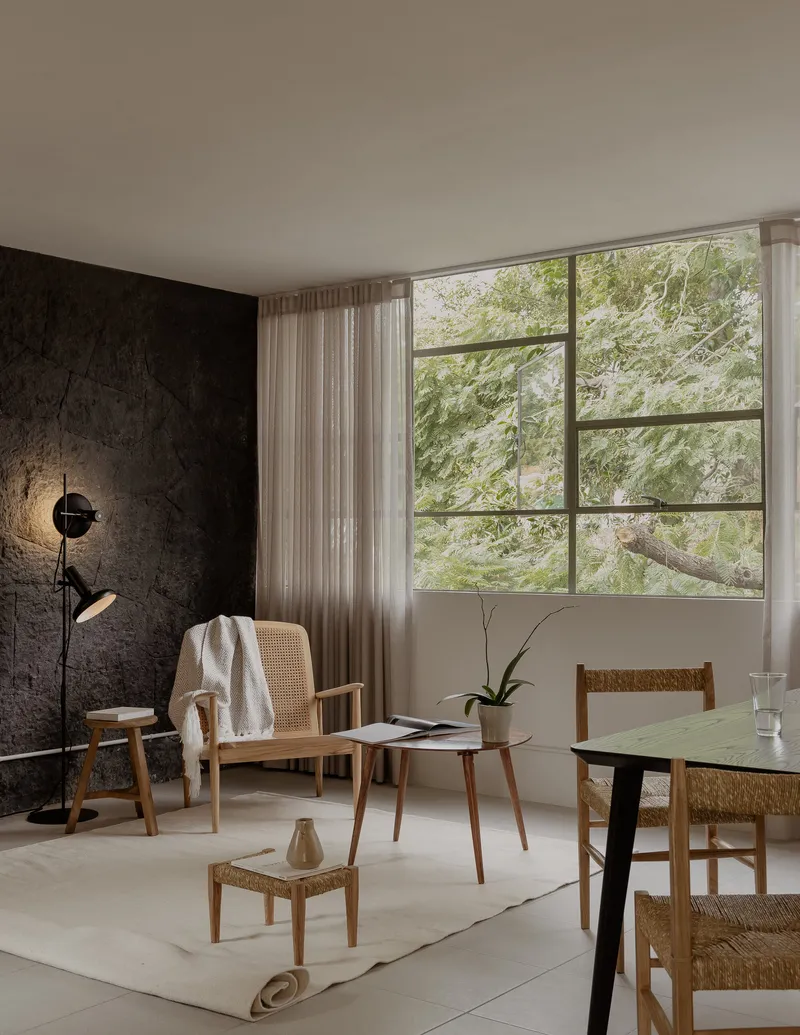
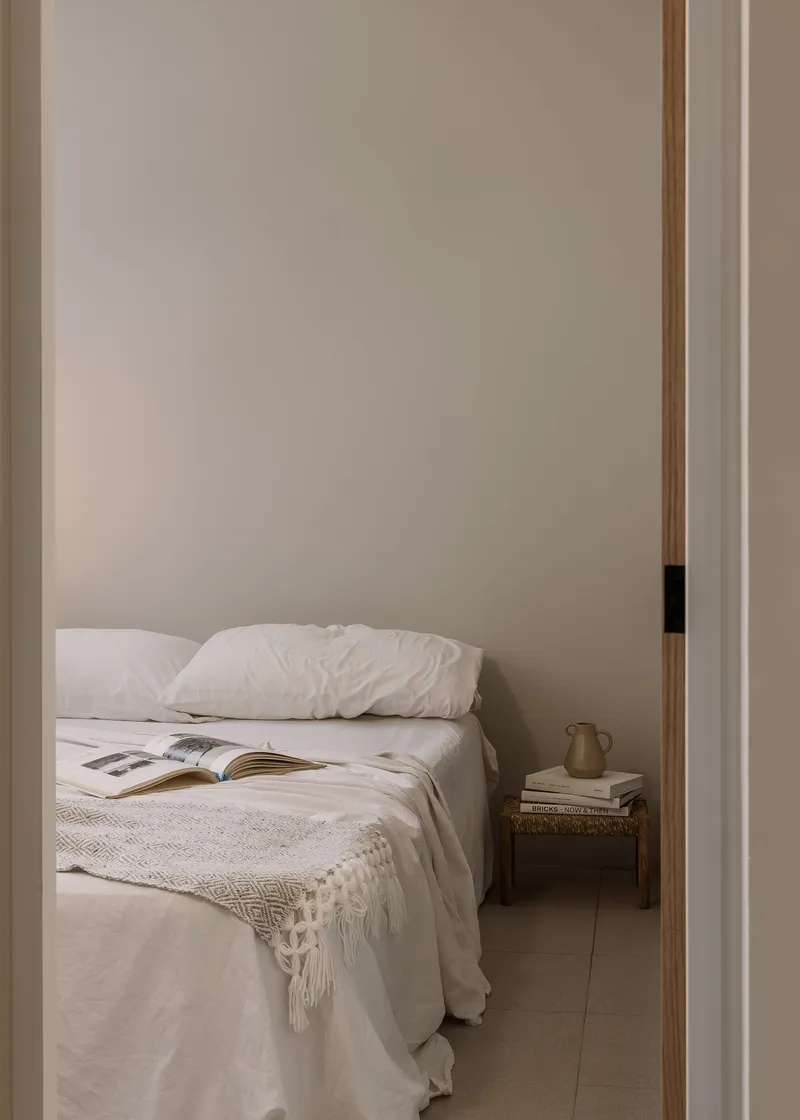
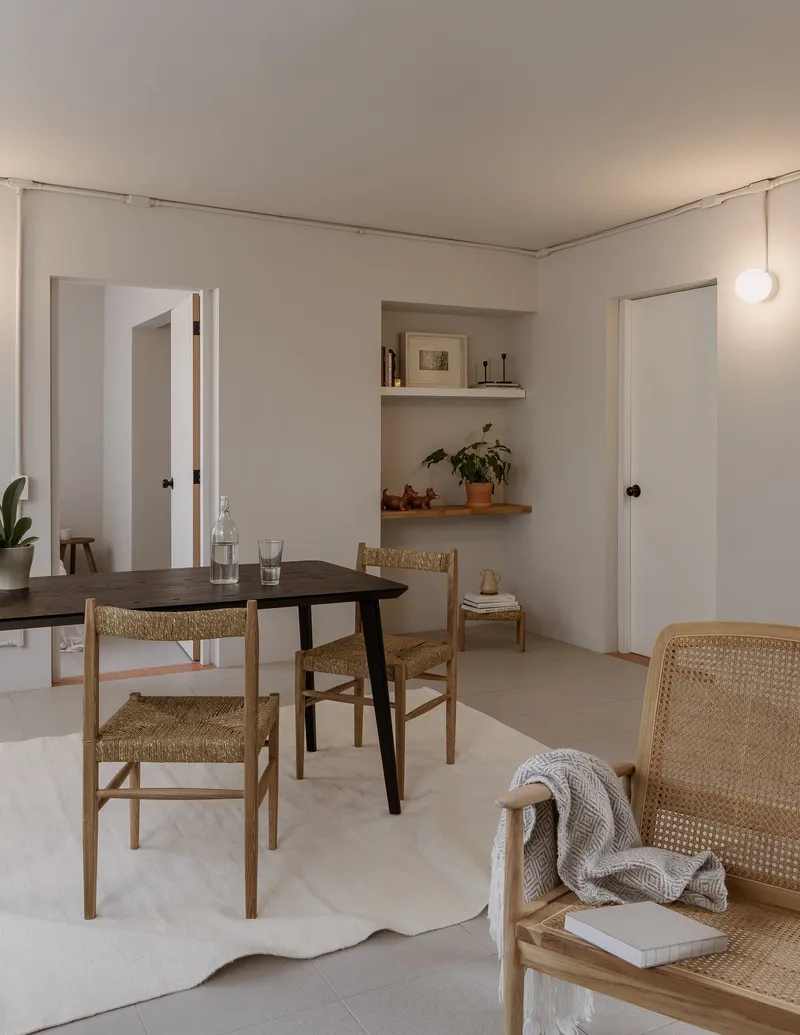
The individual units are small and deliberate. Gridded steel windows frame tree canopies and filter light through sheer curtains. Textured dark feature walls anchor the living spaces, giving each room a sense of enclosure that counteracts the compactness. A bedroom is visible through a doorway, unmade and real, with books stacked on a woven stool serving as a bedside table. These are spaces designed for the way young people in Mexico City actually live: a single room that must function as study, bedroom, and retreat.
The large windows are doing more than aesthetic work. In a building where doubling the unit count could easily have produced a claustrophobic warren, the generous fenestration ensures that every room has a relationship to daylight and to the tree canopy outside. The window frames themselves, their steel grids, become the dominant interior motif, connecting the units visually to the mid-century language of the original building.
Kitchens, Bathrooms, and the Honesty of Infrastructure
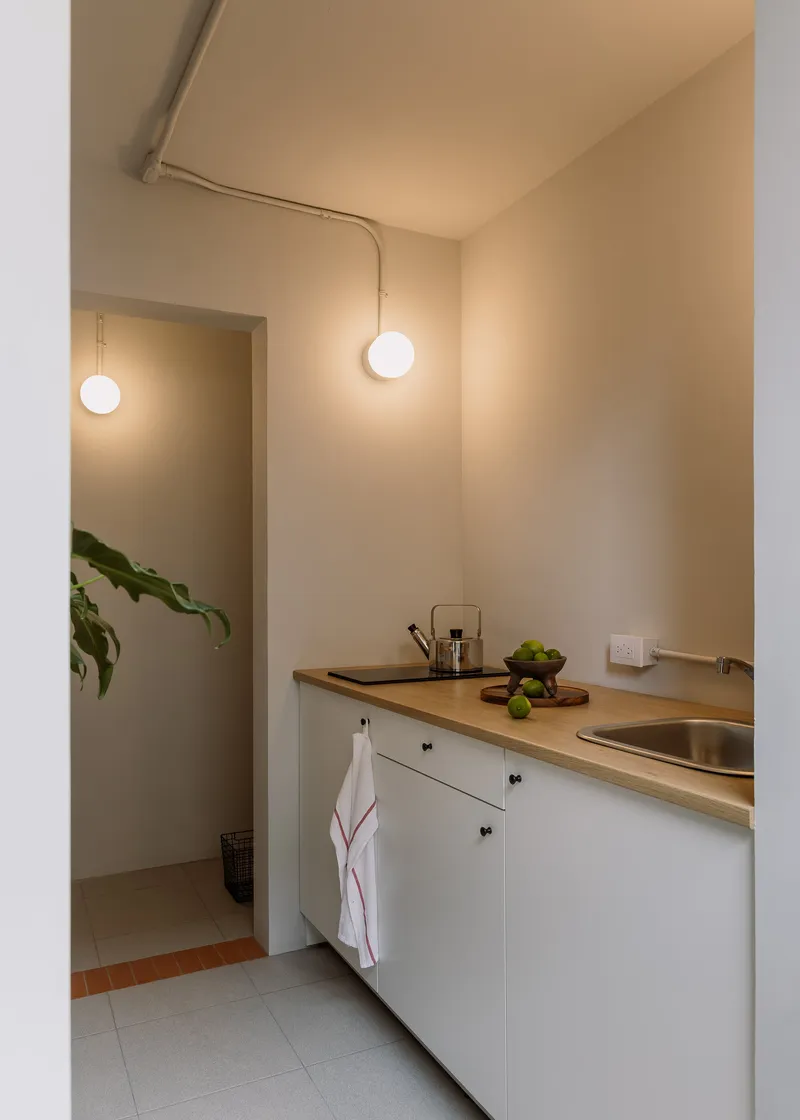
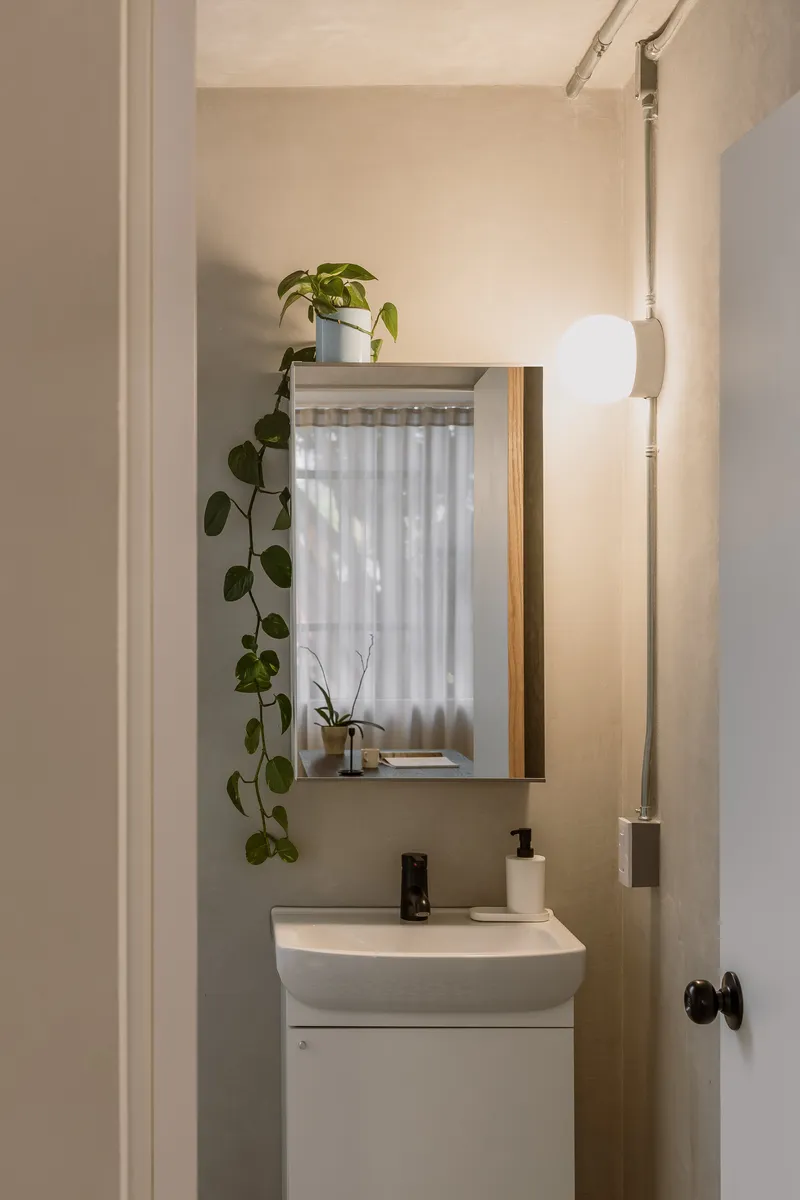
The compact kitchen pairs a timber benchtop with white cabinetry, a globe pendant, and exposed conduit running along the ceiling. It is efficient without being austere. The bathroom follows the same logic: a timber-framed mirror, a trailing pothos plant, and visible electrical runs that treat infrastructure as a fact rather than a problem to be hidden. This approach is cost-conscious and visually coherent. When your budget is tight and your unit count has doubled, concealing every pipe in drywall is a luxury. REIMS 502 chose instead to organize the exposed elements with enough care that they register as intentional.
Thresholds and Terraces
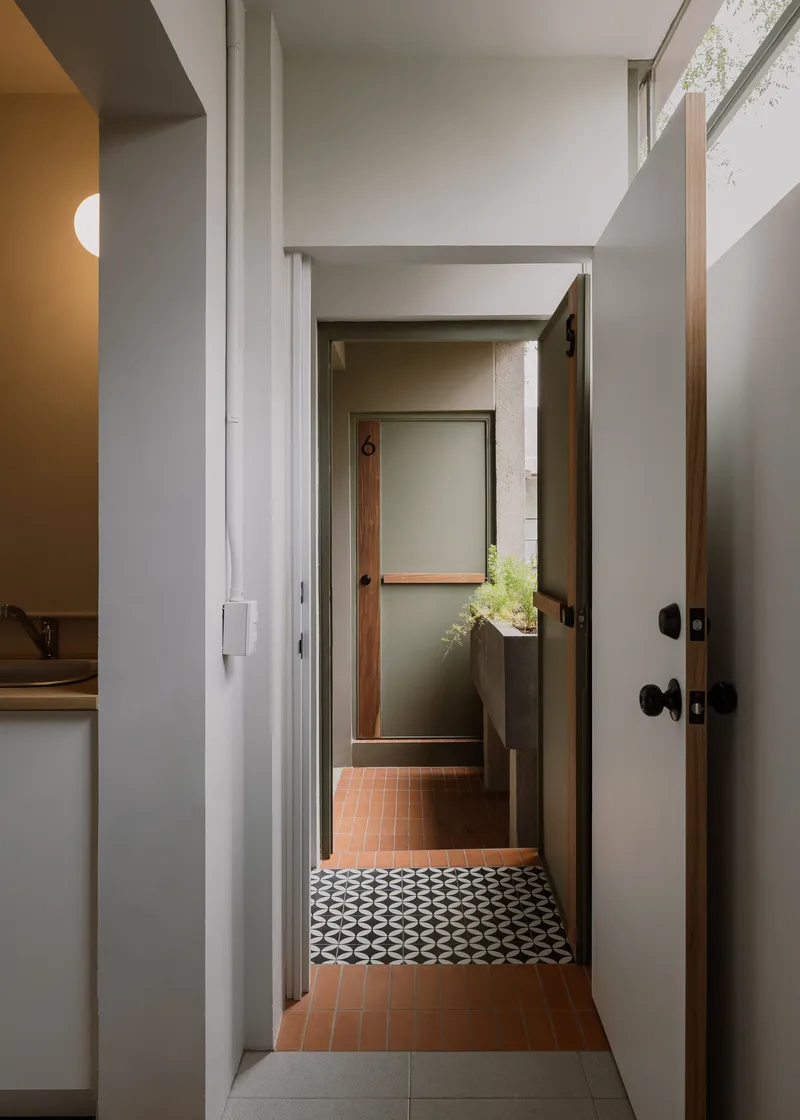
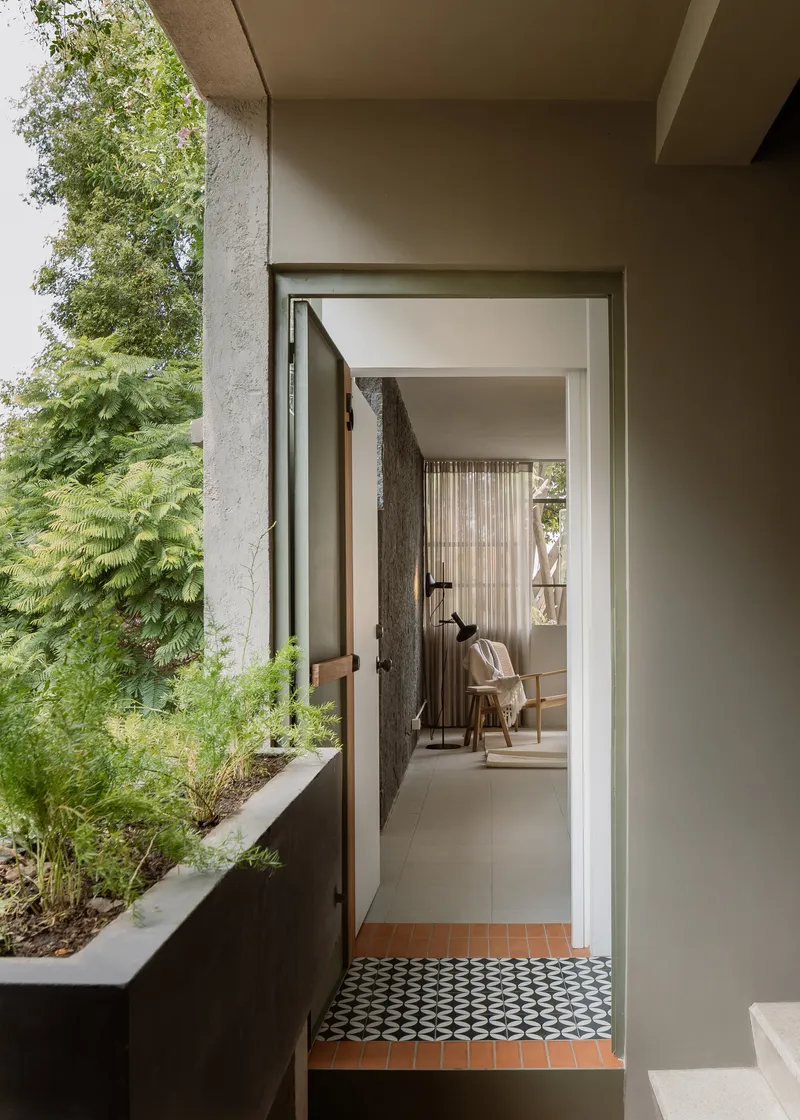
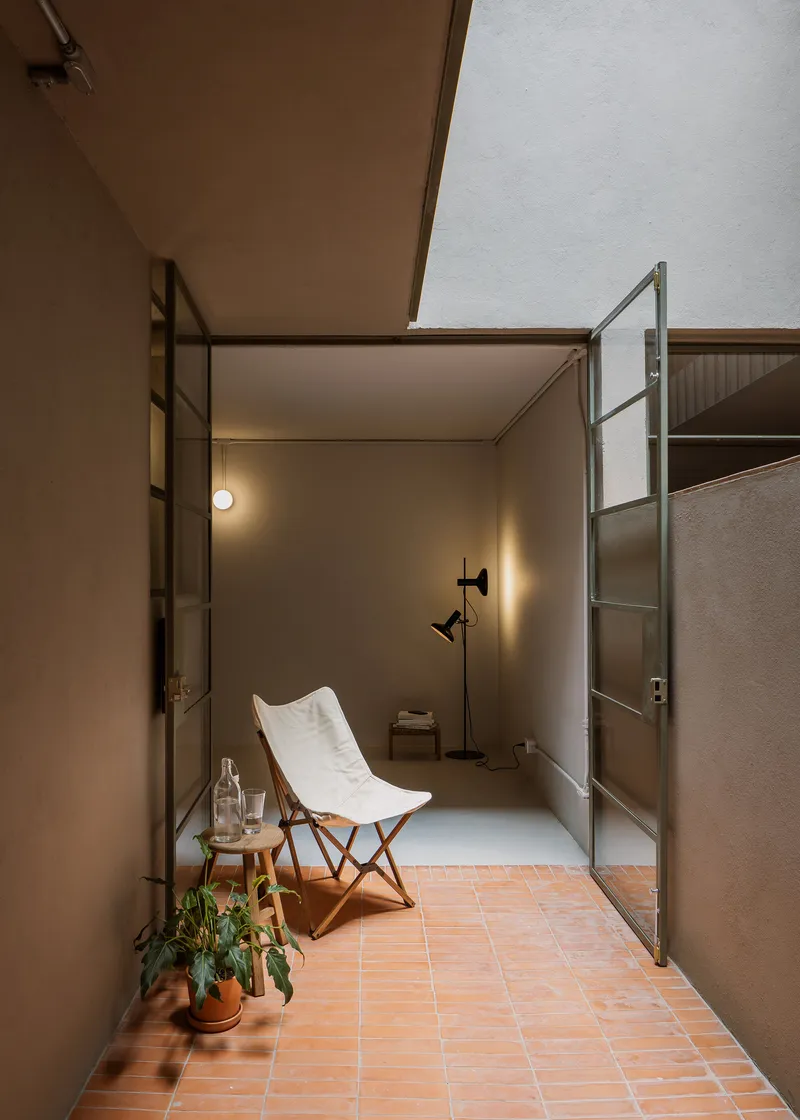
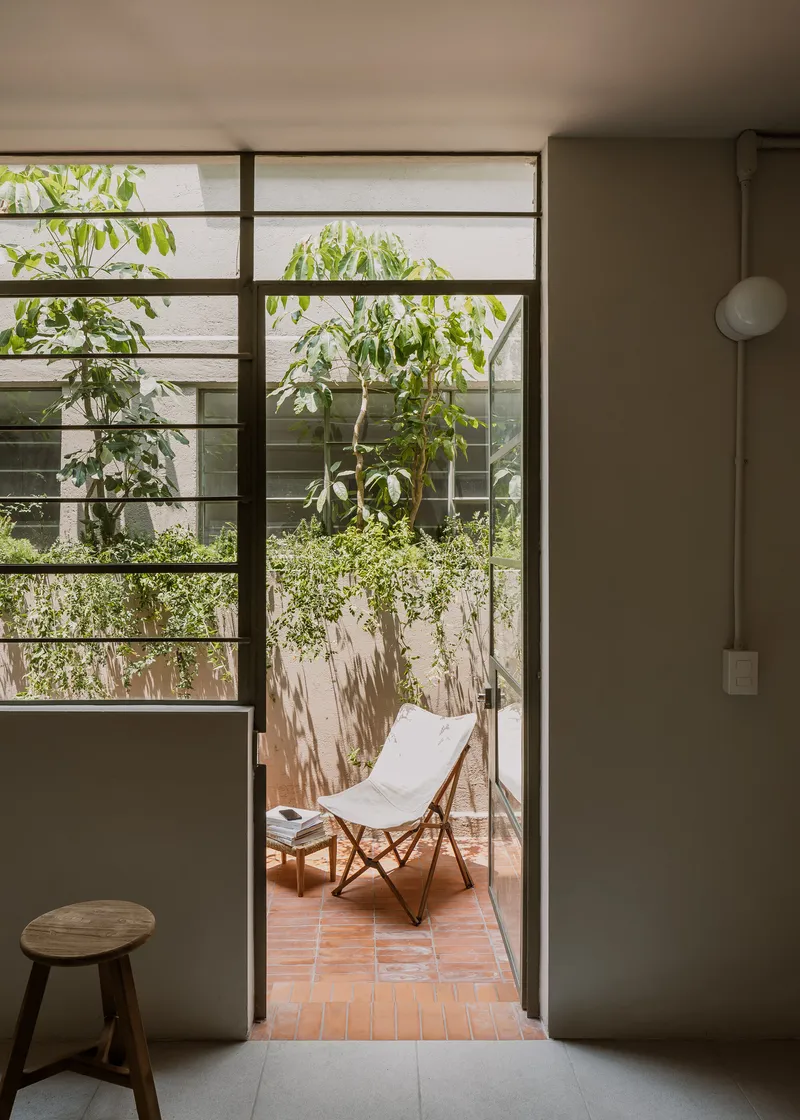
PETÉN handles the transition between inside and outside with particular attention. A hallway view through multiple doorways reveals terracotta tile floors and a geometric patterned threshold, each opening framing the next like a sequence of nested rooms. Fern-planted beds mark the passage from corridor to unit. At dusk, a private terrace with terracotta tiles and a glass door opening onto an interior room offers the kind of quiet outdoor moment that dense housing rarely provides.
These thresholds matter because in a building with 24 single-room units, the gradient from public to private must be carefully managed. The planted beds, the recessed entries, the patterned floor tiles that signal a change of territory: all of these are low-cost, high-impact design moves that give each resident a sense of arriving somewhere specific, even within a relatively tight envelope.
Entry and Street Presence
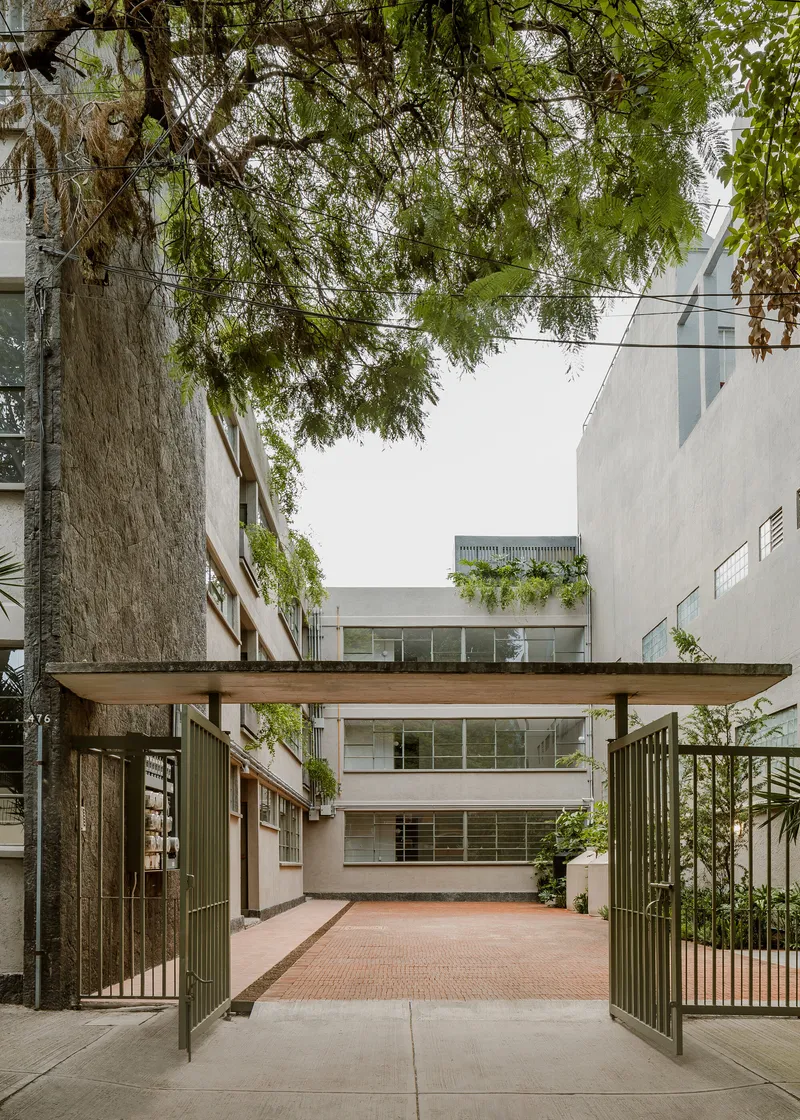
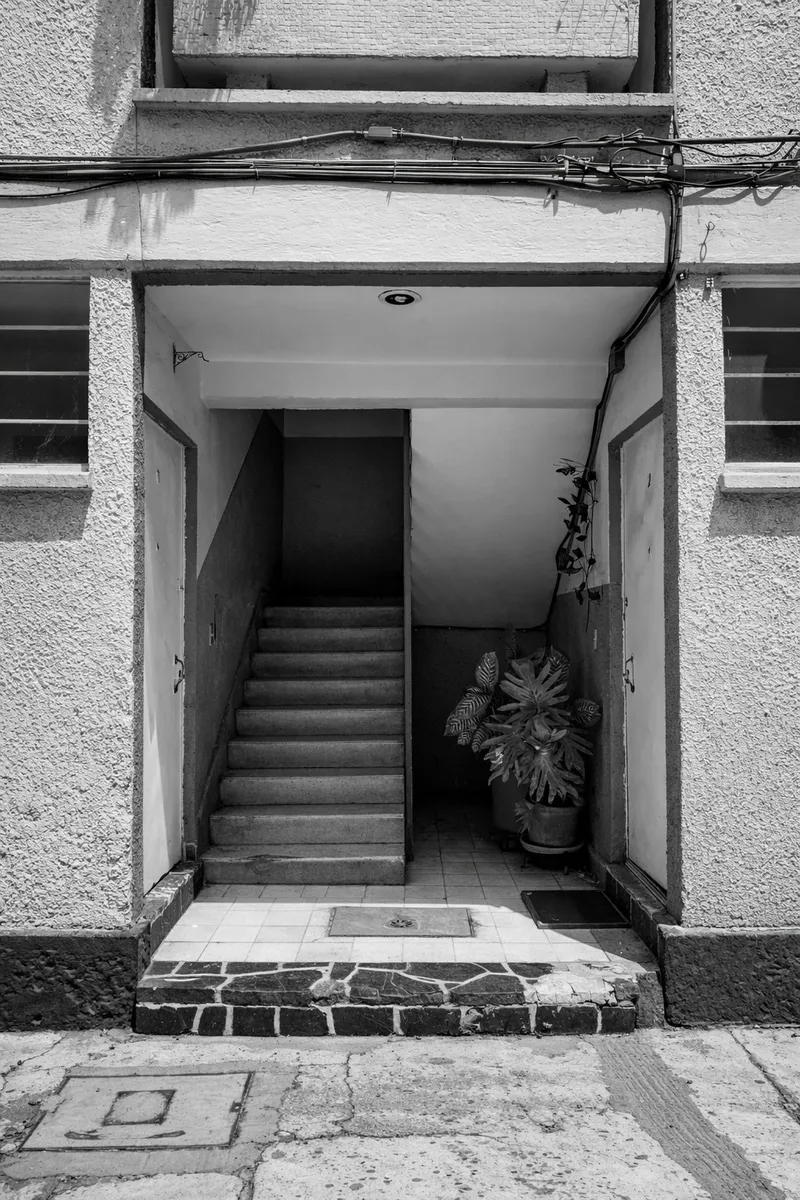
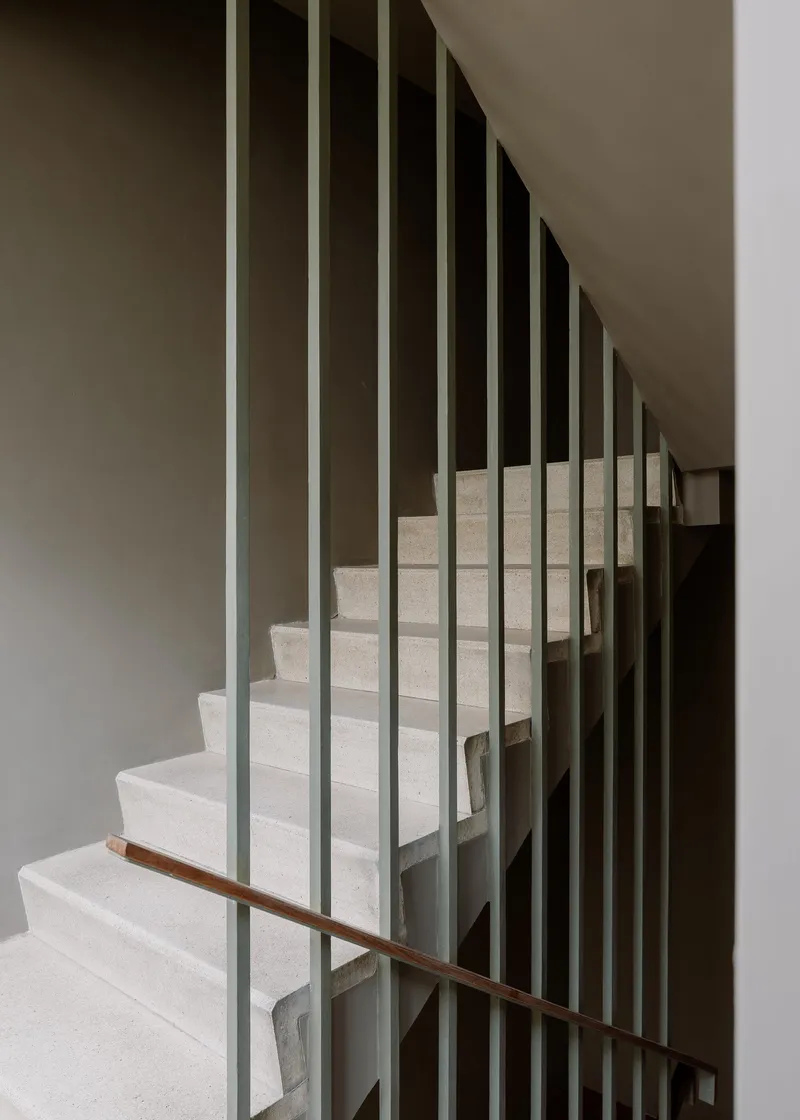
The street entrance, with its green metal gates under a concrete canopy, frames the building's relationship to the neighborhood. It is an invitation, not a barrier. A recessed entry with a stone threshold, concrete stairs, and a single potted plant beside textured stucco establishes the tone: restrained, material-honest, rooted in the existing vocabulary. Inside, the staircase with its vertical metal balusters and timber handrail ascends between white walls with a simplicity that feels appropriate to the building's origins and its renewed purpose.
Plans and Drawings
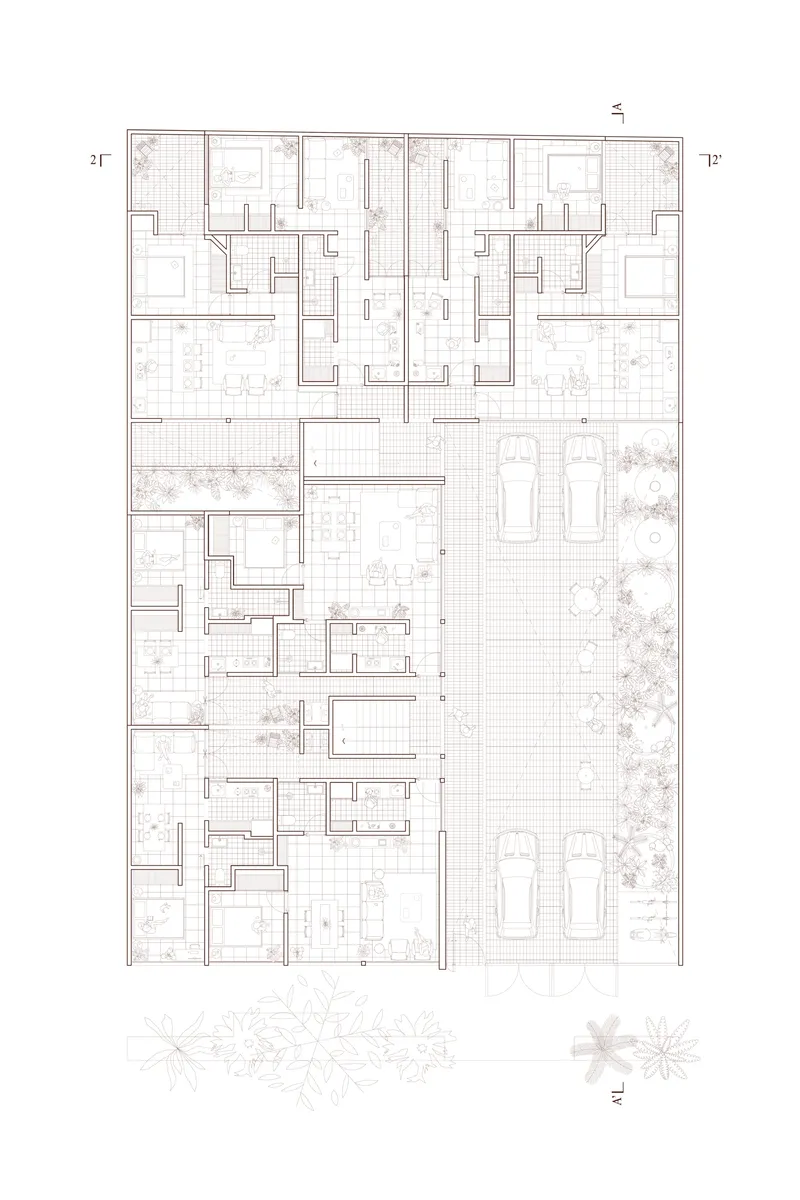
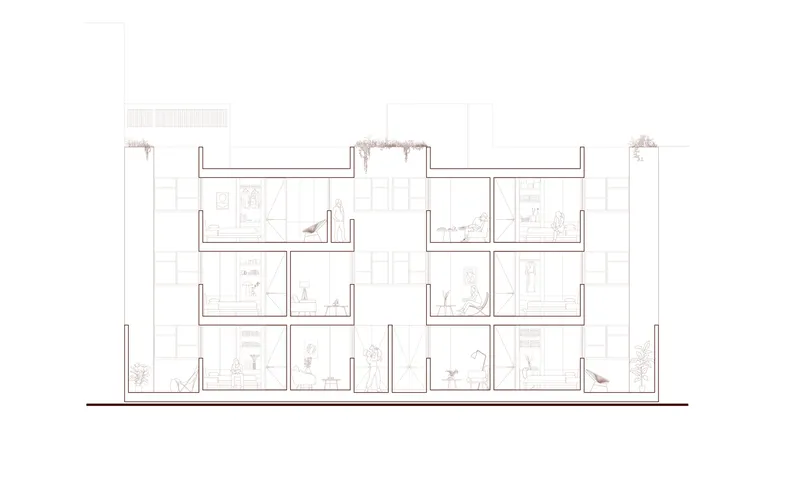
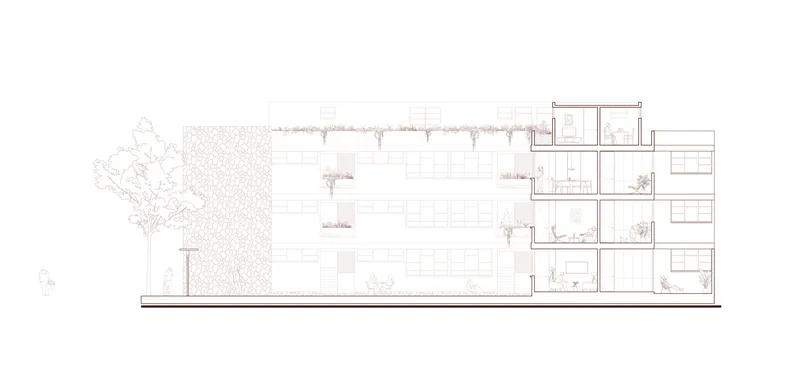
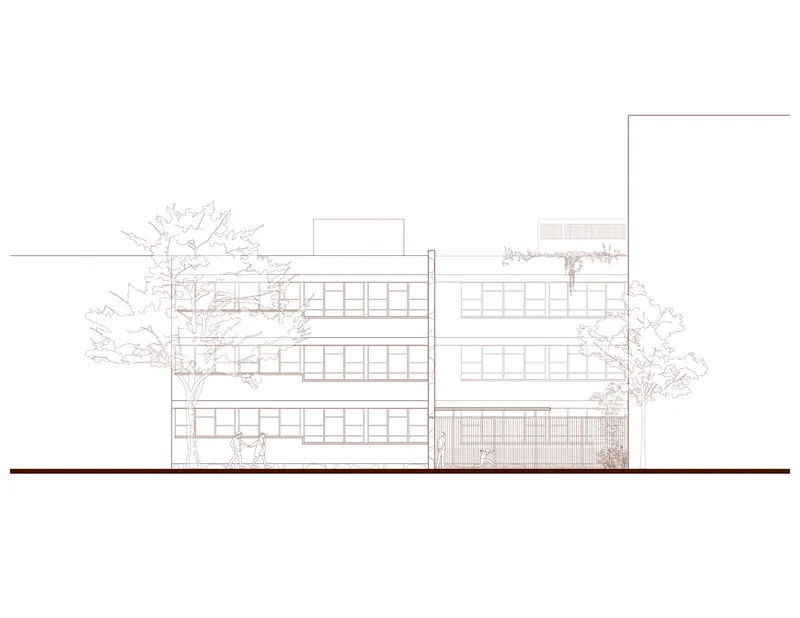
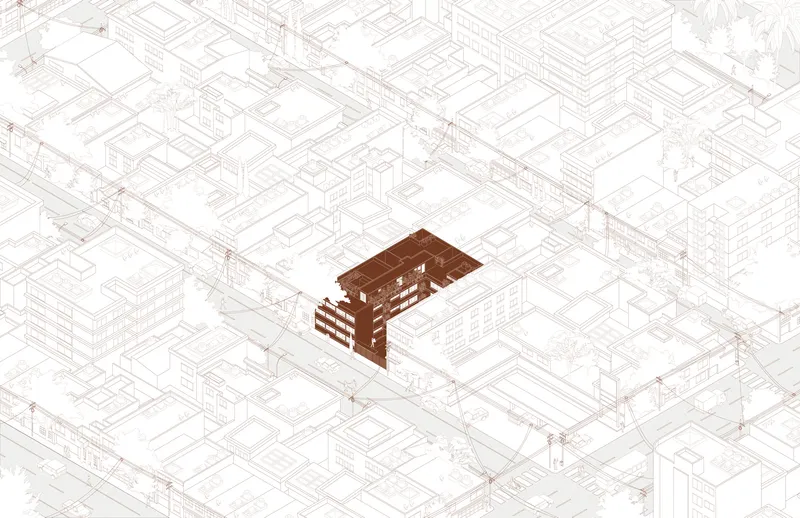
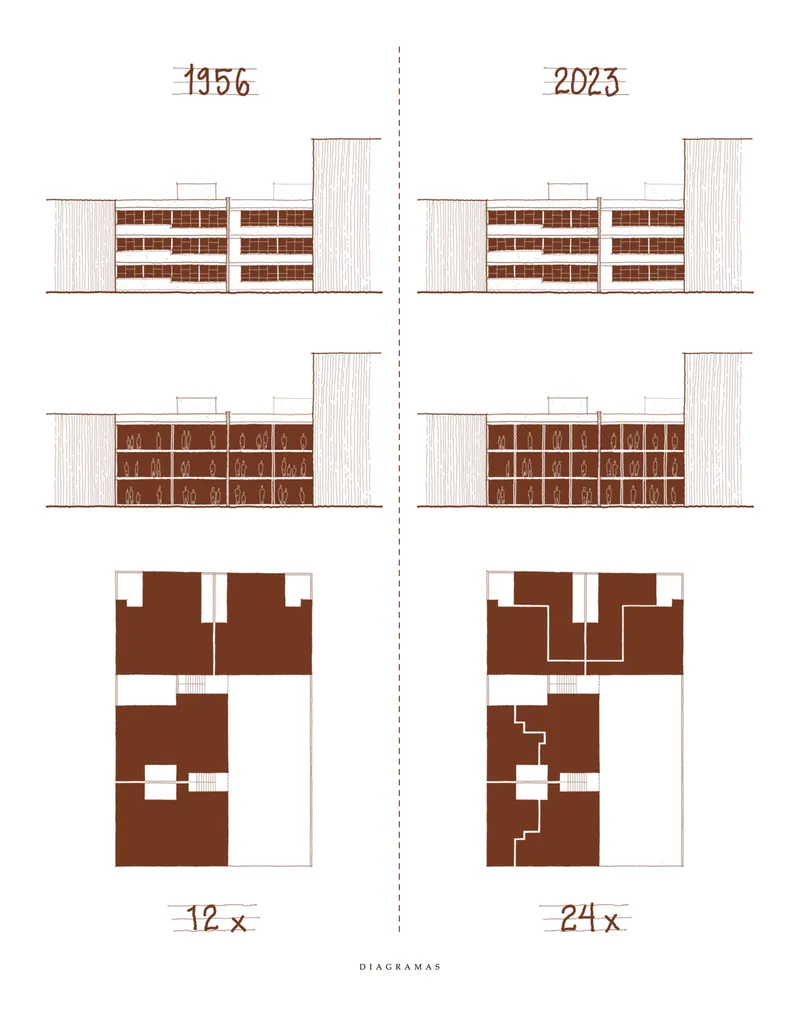
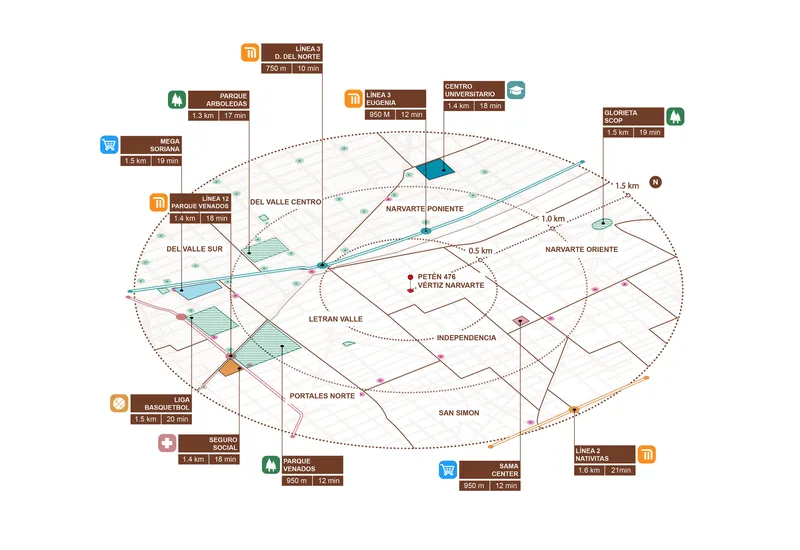
The drawings reveal the spatial logic behind the doubled density. The floor plan shows residential units organized around planted courtyards with clear circulation zones. Sections cut through the building expose the stacked dwelling units, planted roof terraces, and the internal courtyards that bring light deep into the plan. The comparative elevation and plan diagrams are perhaps the most telling: they overlay the original 12-unit configuration against the new 24-unit layout, showing exactly how the transformation was achieved within the same structural footprint.
The axonometric drawing situates the building within its urban block, making visible just how embedded PETÉN is in the existing neighborhood fabric. A site diagram maps radial distances to surrounding facilities and transit connections, reinforcing the project's argument that location, not sprawl, is the answer to housing affordability. The building sits at the center of an established network of infrastructure and services, which is precisely why it deserved saving.
Why This Project Matters
PETÉN is not a glamorous project. It does not have a signature form or a novel structural system or a material innovation that will circulate on social media. What it has is a clear, replicable argument: that mid-century housing stock in Latin American cities can be adapted to serve contemporary needs without erasure, and that doubling density does not have to mean sacrificing dignity. In a market where young people are priced out of central neighborhoods and pushed toward peripheries with poor transit access, the decision to stay put and reinvent an existing building is a political act as much as a design one.
REIMS 502 has treated the original architecture with genuine respect, preserving its facade, its proportions, and its relationship to the street, while fundamentally rethinking the interior to serve a different demographic and a different economy. The exposed conduit, the compact kitchens, the single-room units: these are honest responses to real constraints. If Mexican cities are going to house their next generation without consuming more land, more concrete, and more infrastructure, projects like PETÉN will need to become the norm rather than the exception.
PETÉN, by REIMS 502 (Eduardo Reims), Ciudad de México, Mexico. 1,200 m². Completed 2023. Photography by Ariadna Polo.
About the Studio
Share Your Own Work on uni.xyz
If projects like this are the kind of work you want to make, uni.xyz is a place to publish your own, find collaborators, and enter design competitions.




Popular Articles
Popular articles from the community


Lunar Spiral: Space Architecture Shaped by the Mathematics of the Universe
Lunar Spiral reimagines space architecture through Fibonacci geometry, lunar regolith, levitating habitats, and self-sustaining Moon living.

Riyadh For All: Intergenerational Urban Design for Active Aging in Rabat
Riyadh For All reimagines urban design in Rabat with intergenerational co-living, adaptive courtyards, and Moroccan cultural exchange today.

The Ocean Hive: Sustainable Architecture for a Self-Sufficient Civilization at Sea
The Ocean Hive imagines sustainable architecture at sea, where modular habitats, algae, wave power and ocean waste sustain a growing colony.

Play: Fragments of Their World
Familiar architecture becomes modular playground design, creating safe spaces where displaced children can learn, connect, imagine and play.

Similar Reads
You might also enjoy these articles

Bao Huynh Watercolor Atelier: A Serene Art Retreat in Hội An
Bao Huynh Watercolor Atelier in Hội An blends multifunctional art spaces, sustainable design, local materials, and family-friendly living in a serene environment.

Atelier Macri Concept Store Interior Design by CASE-REAL
Atelier Macri store features a "ko" counter, walnut wood details, cork displays, blending retail, gallery, and seamless customer experiences.

Manuel Vargas Izquierdo Stadium and High-Performance Sports Center: Architectural Excellence in Jalpa de Méndez
The Manuel Vargas Izquierdo Stadium blends sustainable design, inclusive sports facilities, and cultural-inspired architecture, revitalizing Jalpa de Méndez’s public spaces.

KAKR Buluh Awar Hall: Revitalizing Community and Ecology Through Bamboo Architecture
Community built bamboo hall revitalizes Buluh Awar village, empowering youth, restoring ecology, celebrating vernacular craftsmanship through sustainable architecture and culture.
Explore Housing Competitions
Discover active competitions in this discipline


Challenge to design luxury tourism on rails


VR headsets Storefront design competition

Designing a staircase for a client
Comments (0)
Please login or sign up to add comments
No comments yet. Be the first to comment!