
Repos Transit: A Foldable Seat That Turns Commuters Into Architects of Their Own Comfort
A portable, magnetically modular seating unit built on triangular geometry that folds flat to carry and expands to seat entire groups.

What if the most important piece of furniture in a city weighed almost nothing and fit under your arm? Repos Transit proposes exactly that: a foldable, portable seating unit whose triangular geometry provides enough structural strength to bear heavy loads, yet collapses into a compact form a commuter can carry onto a metro. The design distills urban comfort into four verbs: fold, expand, relax, carry. It is a provocation aimed at the static bench, the bolted-down seat, and every fixed piece of public furniture that serves the space rather than the person.
Designed by Vivek Vijayan and Ramkumar, Repos Transit was developed as a modular furniture system targeting transit hubs, public plazas, parks, and bus stops. The project stakes its claim at the intersection of product design and public architecture, arguing that seating in the city should be as mobile as the people who use it. Magnetic joints allow individual units to snap together into larger arrangements, so a single seat carried by one rider can become a communal bench when several users congregate.
Reading the City as a Waiting Room
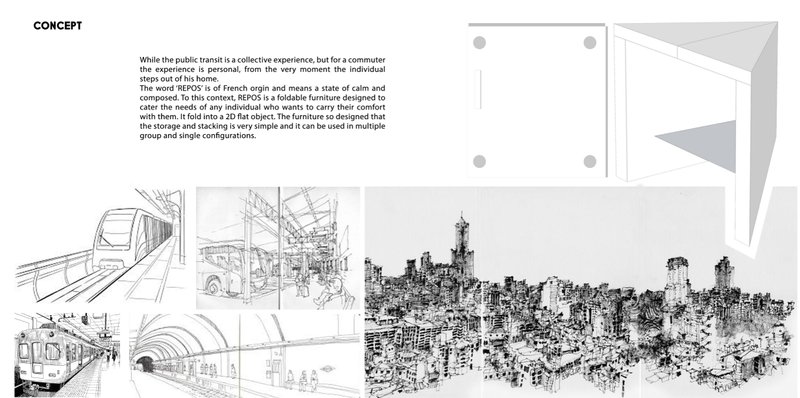
The concept board opens with sketches of transit interiors and a dense cityscape illustration that frames the problem clearly: urban dwellers spend enormous amounts of time in transitional spaces, standing, leaning, shifting weight from foot to foot. Vijayan and Ramkumar treat these interstitial moments not as minor inconveniences but as a genuine gap in how cities serve their inhabitants. The board grounds the project in observational research, cataloguing the postures and spatial conditions of real commuters before proposing any form.
Four Actions, One Folding Sequence
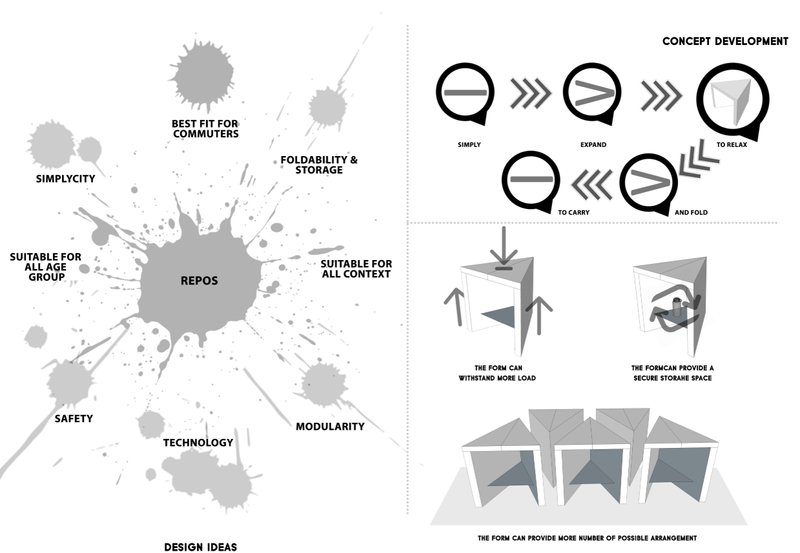
A diagram lays out the design principles and the step-by-step folding sequence that defines the system. The logic is legible at a glance: a flat, packable state transforms through a simple mechanism into a rigid seat. Triangular geometry does the heavy lifting here, literally. Triangles resist deformation under load far better than rectangles, and the designers exploit this to achieve structural durability without adding material weight. The folding sequence also doubles as the user instruction manual; if you can understand the diagram, you can operate the chair.
Modularity enters through magnetic joints positioned at the edges of each unit. When two or more seats are brought together, the magnets lock them into a continuous surface, converting personal furniture into shared infrastructure. Pull them apart, and each person walks away with their own seat. It is a neat social contract embedded in an engineering detail.
Anatomy of the Module: Wood, Fabric, and Integrated Storage
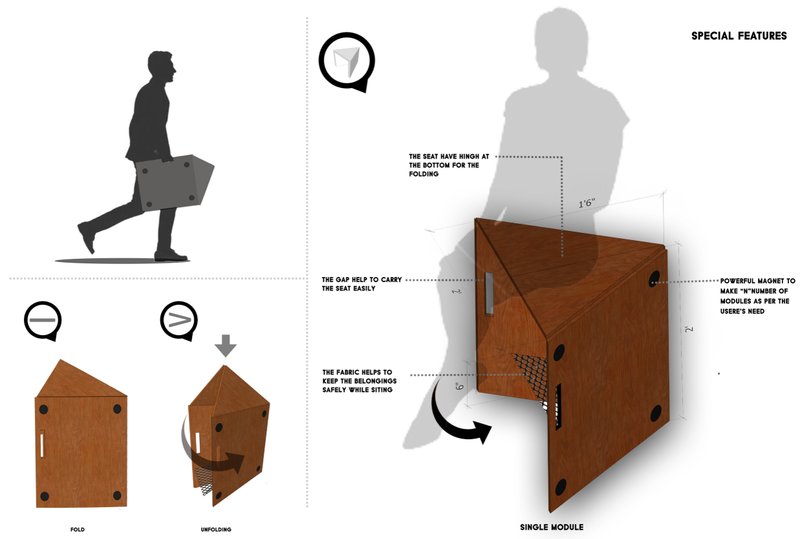
The exploded axonometric drawing reveals the material palette and construction logic. A wooden frame provides the primary structure, chosen for its balance of lightness, strength, and tactile warmth. Fabric panels span between frame members to create the seating surface and, crucially, an integrated storage pocket underneath. That storage detail is a small but telling move: it acknowledges that a commuter sitting down at a bus stop still has a bag, a phone, a bottle of water. Ergonomic thinking here extends beyond seat angle and back support to encompass the full inventory of a person in transit.
Deployed Across the City: Plazas, Parks, and Platforms
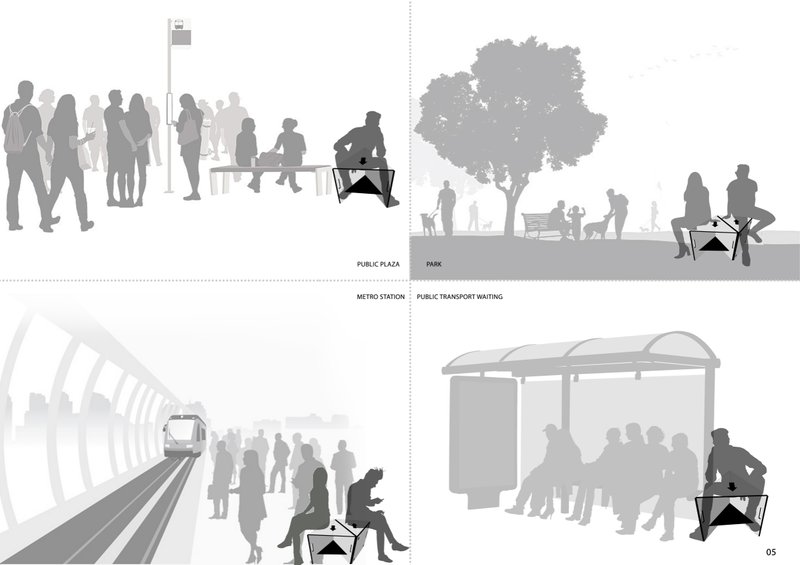
Section drawings place the unfolded unit into three distinct urban scenarios: a public plaza, a park, and a transit station. The drawings make a compelling case for adaptability. In the plaza, multiple units cluster to form communal seating that encourages interaction. In the park, a single unit serves as a lightweight personal bench for recreation. At the transit stop, the seat provides a quick rest spot without requiring permanent installation or maintenance by a municipal authority. Across all three contexts, the same object performs differently because the user, not the city, decides how and where to deploy it.
Why This Project Matters
Repos Transit challenges a deep assumption in public architecture: that furniture must be fixed in place and designed for the median user. By handing ownership of the seat to the individual commuter, Vijayan and Ramkumar shift responsibility from the institution to the person, and in doing so they propose a more democratic model of urban comfort. The magnetic modularity adds another layer, suggesting that individual agency and collective utility are not opposites but can be designed to reinforce each other.
The project's strength lies in its disciplined simplicity. Triangular geometry, a folding mechanism, magnetic connections, integrated storage: each decision solves a specific problem without introducing unnecessary complexity. For a piece of portable furniture to succeed, it must be intuitive enough that a tired commuter will actually use it. Repos Transit passes that test on paper. The next question, and the one worth pursuing, is what happens when hundreds of these units circulate through a city at once.
View the Full Project
About the Designers
Designers: Vivek Vijayan, Ramkumar
Enter a Design Competition on uni.xyz
uni.xyz runs architecture and design competitions year-round that reward proposals with spatial conviction and real site intelligence.
Project credits: FOLD - EXPAND TO RELAX by Vivek Vijayan, Ramkumar.



Popular Articles
Popular articles from the community

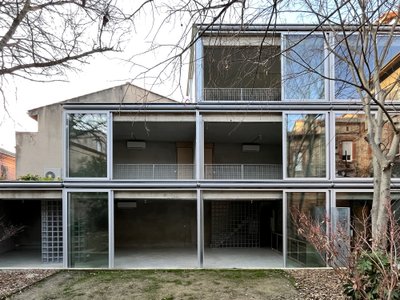
BAST Slots a Four-Story Glass House into a Narrow Gap Between Toulouse Townhouses
In the dense Bonnefoy district, a stepped infill building merges home and office while preserving a majestic hackberry tree.
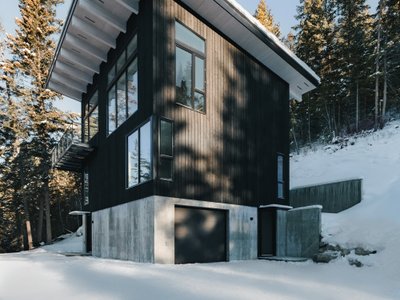
Twobytwo Architecture Studio Towers a Blackened Ski Cabin Above the Trees in Golden, BC
A compact three-storey lookout in the Kootenay mountains trades square footage for 14-foot ceilings and Columbia River Valley views.
Constanti Architects Builds a Fortress of Privacy in Nicosia with House 345
A concrete and timber residence in Cyprus reinterprets the traditional introverted courtyard house for a new urban landscape.
OMCM arquitectos Builds a Summer House in Paraguay from Quarry Waste Blocks and Three Sacred Trees
In the young hillside neighborhood of Altos, a 696-square-meter concrete volume hovers on six pillars around three preserved native Yvyraju trees.


Similar Reads
You might also enjoy these articles

Cyber Oyster: A Visionary Adaptive Reuse Architecture Project Transforming Abandoned Oil Rigs Through Oyster Bionics
An adaptive reuse architecture concept transforming abandoned offshore oil platforms into self-healing marine ecosystems inspired by oyster bionics.

La Macchina Adriatica by Adriana Jul Camargo
An adaptive reuse architecture project transforming abandoned Adriatic oil rigs into a floating museum, research hub, and living sea observatory.
Mechanism of Memories: Adaptive Architecture Reimagines Offshore Structures as Living Cultural Machines
Floating adaptive architecture transforms abandoned offshore structures into cultural spaces that preserve memory, habitation, and human connection.

Wildlife Rehabilitation Architecture in Australia: A Regenerative Sanctuary for Koalas by Philip Skein and Keegan Mayber
A regenerative wildlife sanctuary in Queensland redefines sustainable architecture through habitat restoration, healing, and ecological awareness.


Explore Product Design Competitions
Discover active competitions in this discipline




The Global Benchmark for Architecture Dissertation Awards


Challenge to merge furniture with learning

Design challenge to equip cities with modern furniture

Competition to design a workstation for architects
Comments (0)
Please login or sign up to add comments
No comments yet. Be the first to comment!