

#LET'S MAKE A HABITAT: A Koala Sanctuary That Bridges a Valley Instead of Blocking It
Raised on timber stilts over a Mount Tamborine valley, this rehabilitation sanctuary lets water and wildlife pass beneath a lattice skin built to grow.


Most animal care facilities are built for the animals they admit. #LET'S MAKE A HABITAT is also built for the ones that never need admitting. Its central move is an act of restraint: where a valley carries water and wildlife through the site, the building lifts itself up and bridges over it, leaving that corridor open. The result reads less like a clinic dropped into the bush and more like a piece of forest infrastructure that happens to treat injured koalas.
Designed by Philip Skein and Keegan Maybery, the project was named an Editor's Choice entry in Haven 2020. It sits in Mount Tamborine, Queensland, a landscape marked by bushfires, deforestation and habitat fragmentation. The designers frame human intervention as one of the main causes of wildlife displacement and answer with a bio-centric brief. The building has three jobs: rehabilitate animals, educate visitors and actively repair the ground it stands on. Ecological healing takes priority over visual monumentality.
Pods Lifted Clear of the Forest Floor

The opening view sets out the project's vocabulary: lattice-wrapped timber pods raised on posts above a flowering meadow, with ivy already climbing the lower skin. The elevated timber stilts are the most practical decision in the scheme. They shrink the physical footprint and limit disturbance to the forest floor. They also create shaded ground beneath the structure, where vegetation and wildlife can keep growing instead of being paved over.
The woven timber trellis matters as much as the stilts. The designers describe it as a bio-skin meant to be colonised by plants over time, so the building is planned to become greener and less distinct with age. The ivy in this render is a quiet admission that the architecture is meant to be partly overtaken by its site.
A Walkway Threaded Between Eucalyptus Trunks
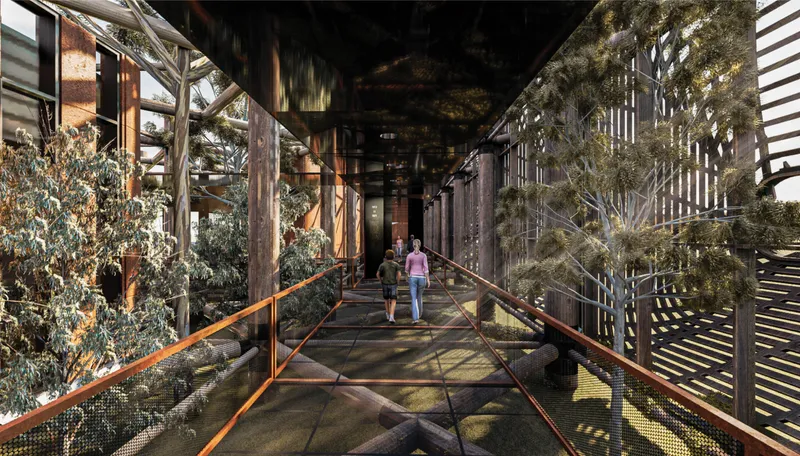
The walkway is where the bridging strategy becomes something a visitor can feel. Rust-coloured steel railings and a mesh deck carry people between eucalyptus trunks and slatted screens at canopy-adjacent height, while the ground below stays free for water movement and animal circulation. The mesh decking reads as a deliberate choice: it keeps the deck visually light and keeps the forest beneath in view, so visitors stay aware that they are passing over a working ecological corridor rather than through a sealed building.
An Amphitheatre That Shares the Ground With Koalas

Education is part of the brief, and this curved timber amphitheatre is its most social expression. A green roof folds it into the terrain, and the render places a koala on the grass beside it, backlit by low sun through the trunks. The image makes the argument plainly. Learning about wildlife happens alongside it, at ground level, under the same eucalyptus cover. The green roof also extends the logic of the bio-skin: built surfaces are treated as places where planting can return.
Crown Shyness as a Site Plan

Seen across dry grass and fallen branches, the pod and walkway show how loosely the scheme is arranged. The designers drew on crown shyness, the canopy phenomenon in which neighbouring trees keep small gaps between their branches. Translated into plan, the buildings stay apart instead of merging into a single mass. The gaps let light shift across the site, break shadows into fragments and allow circulation paths to wander rather than run in straight lines.
This is the strongest conceptual link in the project. The building does not just reference the forest in its materials; it borrows a spatial rule the forest already follows. The layered system, drawn from studies of Queensland's endemic ecosystems, lets the sanctuary sit within the eucalyptus landscape without reading as one imposing object.
A Room of Tree-Trunk Columns
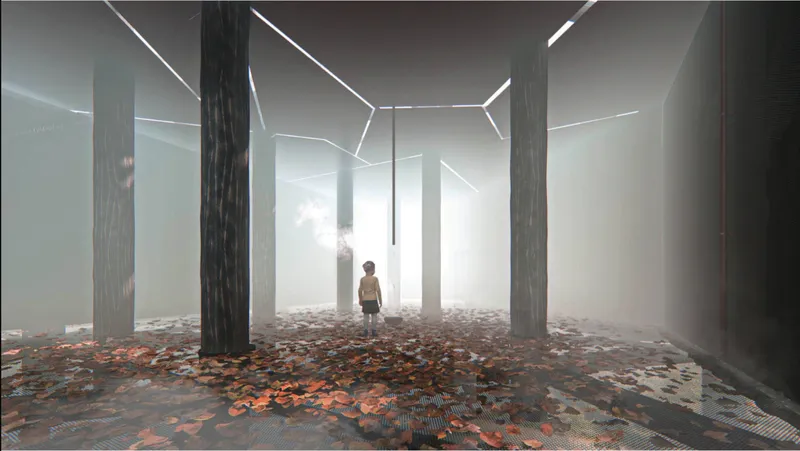
The final image moves indoors and changes register entirely. A child stands among dark tree-trunk columns in a misty room, with red autumn leaves on the floor and strips of light overhead. It is the most atmospheric space in the set, and the most pointed. The columns evoke a forest standing in for, or remembering, the forest outside. It is an interior designed to be felt rather than read, and placing a child at its centre ties it directly to the project's educational ambition: awareness is cultivated by immersion, not by signage.
Why This Project Matters
Rehabilitation centres usually respond after the damage is done. Skein and Maybery's proposal argues that the facility itself can be part of prevention. It keeps a wildlife corridor open, lifts its footprint off the forest floor and grows a living skin. It treats the site as a fractured system to be reconnected, not a plot to be filled, and that shift in brief is more useful than any single formal gesture in the scheme.
The project also shows that ecological intent can drive spatial character rather than limit it. Crown shyness gives the plan its rhythm, the valley gives the building its bridging form, and the bio-skin gives it a future appearance its designers cannot fully control. For a country still counting the losses from bushfire and land clearing, a building that plans to recede into the landscape it helps restore is a persuasive model.
View the Full Project
About the Designers
Designers: Philip Skein, Keegan Maybery
Enter a Design Competition on uni.xyz
uni.xyz runs architecture and design competitions year-round that reward proposals with spatial conviction and real site intelligence.
Project credits: #LET’S MAKE A HABITAT by Philip Skein, Keegan Maybery Haven 2020 (uni.xyz).


Popular Articles
Popular articles from the community


Singing Woman: An Opera House That Performs Before the Curtain Rises
Ovidiu Cristian Pavel's conceptual opera house translates Estonia's choral identity into a sculpted waterfront landmark facing the Baltic Sea.

Temporary Home for Dogs: A Reversed Zoo Rethinks Animal Shelter Architecture
In Bucharest, a sinuous corridor and freed landscape flip the logic of containment, designing a shelter that works to make itself unnecessary.

Cloaked Colonization: A Mobile Underwater Habitat That Moves Like a Fish
Micah Abaya's shortlisted EHC Pacific entry reimagines ocean settlement as a dispersed network of self-sustaining architectural organisms.

The Amber Palace Opera: A Geological Fiction Surfaces on Tallinn's Baltic Waterfront
Pierre Brillard reimagines a Baltic legend as a public landscape, opera house, and waterfront promenade rooted in Tallinn's coastal identity.

Similar Reads
You might also enjoy these articles

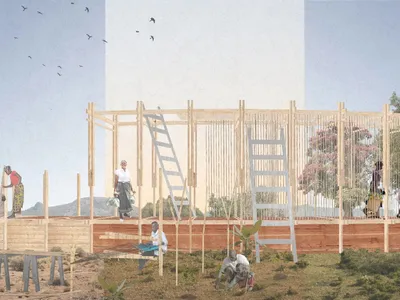
Healing Façade: A Modular Chapel System That Restores Ethiopia's Sacred Forests
Winner of the Eco-Chapel competition, this circular timber façade collects water from air to rebuild soil and reforest degraded Ethiopian landscapes.
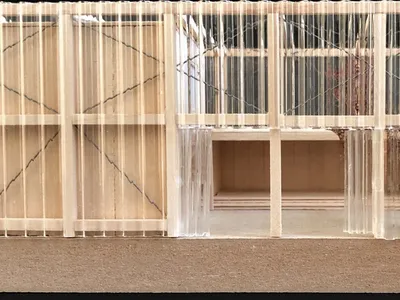
Kaffeebühnen: Where Coffee Shop Architecture Becomes a Civic Stage in Vienna
A linear sequence of timber boxes, transparent shells, and open yards turns the Viennese café tradition into a public performance space.
Eco Chapel: A Modular Forest Pavilion That Grows Like the Landscape It Protects
Hexagonal timber modules weave through existing trees, turning a chapel into a living system for prayer, education, and reforestation.


Urban Forest: A Vertical Ecosystem for 5,000 Workers in Singapore's Changi Business Park
Radially stacked pods and layered green decks turn a 7-acre plot into 47 acres of ecological workspace projected for 2040.

Comments (0)
Please login or sign up to add comments
No comments yet. Be the first to comment!