
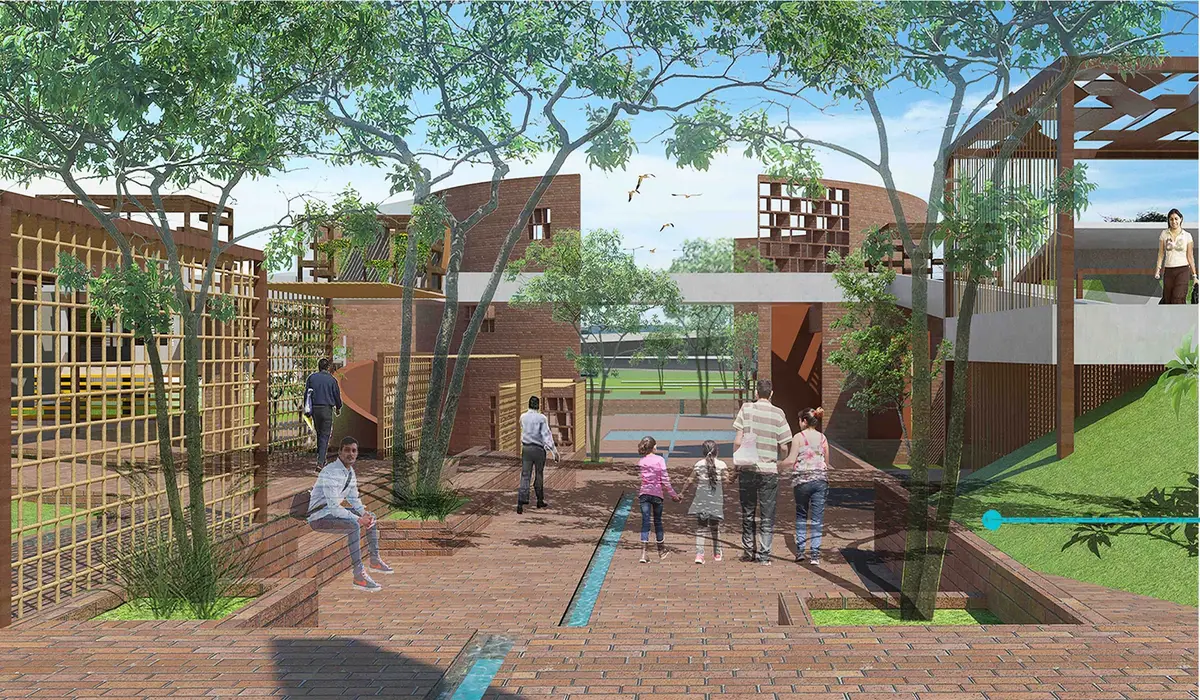
Architecture for the Soul: Sensory Social Infrastructure for a Resilient Mumbai
A civic intervention in Bandra East reconnects people to place through five senses, five elements, and flexible public space.


Resilience in architecture almost always means survival: flood barriers, seismic bracing, redundant systems. Rarely does it mean belonging. In Mumbai, a city where informal networks, layered histories, and relentless monsoons shape daily life, Jahnavi Thakkar argues that resilience must extend beyond physical endurance to cultural and emotional continuity. Her project, "Architecture for the Soul," proposes a network of sensory public spaces in Bandra East that treat social infrastructure as the real backbone of a resilient city.
Published on uni.xyz, the project reframes urban resilience as a human-centered architectural strategy. Rather than accepting the homogenized, efficiency-first responses that have diluted Mumbai's spatial identity since its transformation from Bombay, Thakkar designs for identity, dignity, and sensory richness. The site in Bandra East is reimagined as a civic threshold absorbing children, adults, and senior citizens across the hours of the day, turning leftover urban fragments into meaningful public realms.
Timber Screens and Courtyard Thresholds
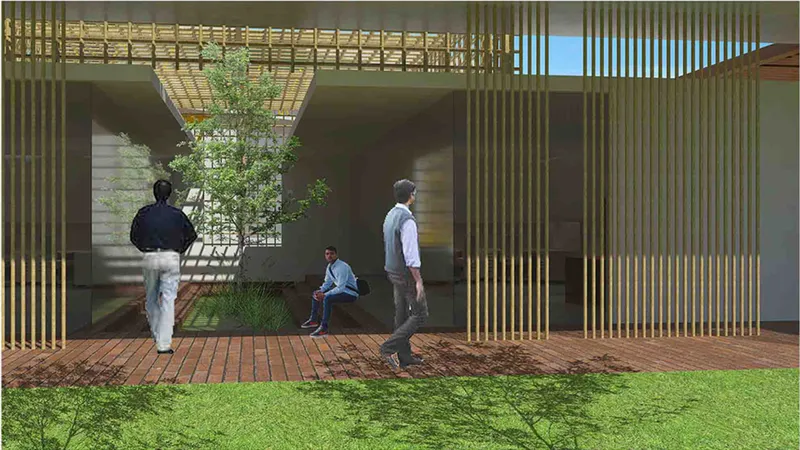
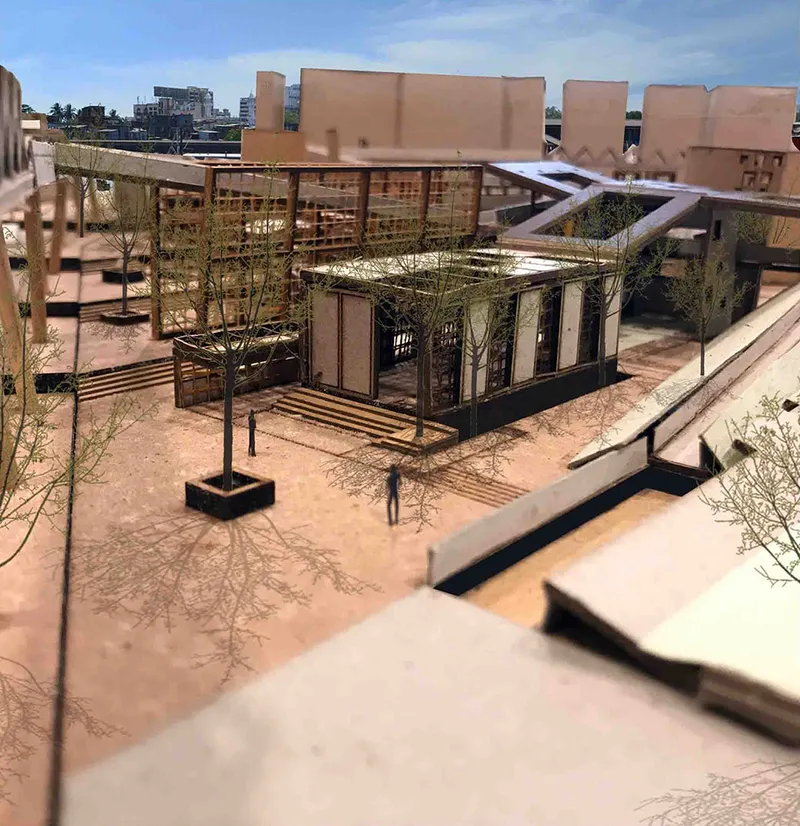
The covered walkway with its vertical timber slats operates as a filter: light, wind, and sound pass through in measured doses, while the courtyard tree at the centre anchors the composition with shade and seasonal change. This is architecture tuned to the senses rather than tuned to spectacle. Visitors move through a sequence that alternates between compression and release, covered corridor and open sky, rough brick and smooth concrete. The physical model confirms these spatial rhythms under midday sun, showing how courtyard buildings with planted trees and timber screens create a dense but breathable fabric.
Thakkar's material palette is deliberate. Layered textures, from brick paving to timber lattice, encourage tactile engagement, one of the five sensory channels she identifies as essential to resilient public space. The screens are not decorative; they modulate Mumbai's intense light and heat, framing views while providing visual comfort. Every surface has a climatic as well as a social purpose.
Water, Moonlight, and the Reflecting Pool

The dusk view of the courtyard model, with its reflecting pool and crescent moon, captures something most resilience frameworks ignore: the quality of time. Water channels along the project's central spine create a continuous auditory experience that masks traffic noise and establishes calm. The pool doubles as a climate device, cooling the microclimate through evaporation, and as a social attractor, giving people a reason to linger after dark. Native vegetation and flowering plants ring the water's edge, layering smell and seasonal awareness onto the spatial experience.
By integrating earth, water, air, light, and vegetation, Thakkar positions her architecture as a living system. The five elements are not metaphorical; they are operative. Water cools. Trees shade. Brick retains warmth in winter and releases it slowly. The architecture adapts to Mumbai's monsoon climate while nurturing the kind of emotional well-being that rigid infrastructure projects consistently fail to deliver.
Brick Pathways and the Invitation to Arrive
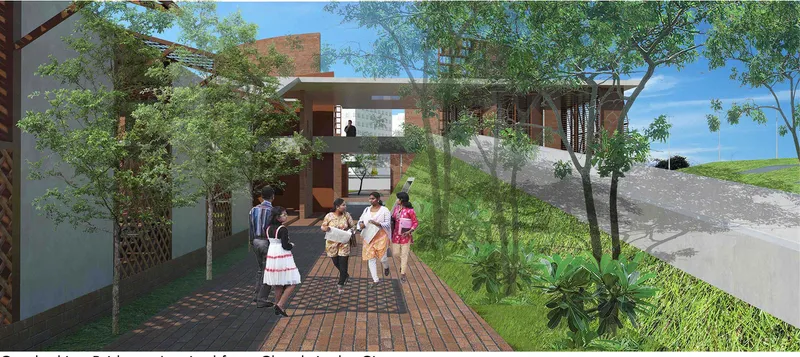
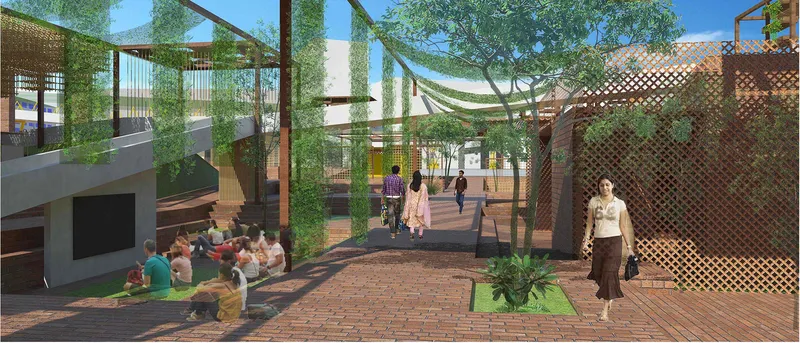
The entry path, lined with brick paving and planted trees, does something deceptively simple: it slows people down. In a city governed by vehicular density and relentless pedestrian flow, the act of approaching a public building on foot, through shade, over textured ground, is itself a form of resistance against the speed of infrastructure-first urbanism. Visitors approaching the complex are drawn in by the rhythm of the tree canopy and the warmth of the brick surface underfoot.
Deeper inside the complex, a courtyard enclosed by diagonal lattice screen walls hosts children seated on grass beside a pathway. The space is deliberately undefined: not a playground, not a classroom, not a garden, but capable of being all three across the course of a day. Thakkar calls these "undefined spaces" that evolve with use, reflecting the informal intelligence of Mumbai's streets and chawls, where architecture has always adapted to people rather than dictating their behaviour. Markets in the morning, learning spaces in the afternoon, cultural venues by evening.
The Pergola as Civic Infrastructure

A covered walkway framed by steel columns and a timber pergola over a brick path crystallizes the project's central argument: that even the simplest structural gesture can become civic infrastructure if it is designed with care for human experience. The pergola filters light into patterns that shift with the sun's angle, creating a corridor that is never the same twice. Visitors move through it not as commuters but as participants in a sensory sequence.
Through careful mapping of vehicular density, pedestrian movement, and existing social nodes in Bandra East, Thakkar identified opportunities where architecture can soften infrastructure and convert residual spaces into public life. The steel and timber structure is modest in scale but precise in intention: it provides shade, defines circulation, and creates a space for informal food-sharing, discussion, and the kind of collective pause that Mumbai's relentless pace rarely permits.
Why This Project Matters
The global discourse on resilient cities overwhelmingly privileges technical performance: drainage capacity, structural redundancy, emergency access. Thakkar's project does not reject these concerns, but it insists they are incomplete. A city that survives a flood but loses its sense of place has not truly been resilient. By grounding her intervention in sensory experience, cultural memory, and programmatic flexibility, she offers a model where resilience and identity reinforce each other rather than compete.
What makes "Architecture for the Soul" compelling is its refusal to treat social infrastructure as secondary. The courtyards, pergolas, water channels, and undefined gathering spaces are not amenities bolted onto a structural system; they are the system. In a city like Mumbai, where public life happens in the gaps between formal planning, this approach feels not just appropriate but essential. It is a reminder that the most durable form of resilience may be the kind that makes people want to stay.
View the Full Project
About the Designers
Designer: Jahnavi Thakkar
Enter a Design Competition on uni.xyz
uni.xyz runs architecture and design competitions year-round that reward proposals with spatial conviction and real site intelligence.
Project credits: Architecture for the Soul ? SOCIAL INFRASTRUCTURE FOR RESILIENT CITIES by Jahnavi Thakkar.


Popular Articles
Popular articles from the community


Cube Design Draws an Ecological Corridor Between Two Shenzhen Hills with the Nankai Building
Beside Shenzhen's container docks, the Nankai Building pairs stacked balconies with a climbing green screen to connect two hillsides across its height.


Opera on the Sea: Driftwood Logic Shapes a Timber Opera House on Estonia's Coast
Trevor Orgill's opera house translates the entangled drift of floating timber into a civic building where wood, water, and music converge.

ETEH Reworks the Shared Spaces of São Domingos School in Brazil Around Timber, Color and Hanging Plants
At São Domingos School in Brazil, 436 m² of hall, refectory and library are recast with timber joinery, a yellow and blue code and trailing greenery.

FCC Arquitectura Expands a Portuguese Granite House with a Board-Marked Concrete Wing
In Portugal, JV House pairs a cleaned-up whitewashed and granite dwelling with a timber-shuttered concrete extension, courtyards and a garden pool.

Similar Reads
You might also enjoy these articles
Yenisei Monitoring Center: A Sun-and-Moon Sphere Anchors a Research Campus on Siberia's Great River
In Krasnoyarsk, shifting square blocks, a glazed central sphere and descending window rhythms turn river science into a public spectacle on the Yenisei.
Andretta Artist's Village: A Node-Based Masterplan That Lets the Hills Write the Plan
A cultural landscape strategy for Palampur's artist colony threads studios, residences and stages along a porous spine shaped by the Dhauladhar terrain.
Street Children Rehabilitation Center: A Brick Campus That Eases Children From Street to Safety
A low-rise courtyard campus where learning streets, uthans and shaded verandahs stage a gradual passage from street into protective, family-scale life.

The NEON Culture: A Field of Pavilions Built for the 24-Hour City
Smaran Alva spreads galleries, stages, clubs and markets across a varied site, treating light, sound and ramped movement as the real building materials.

Explore Mumbai Competitions
Discover active competitions in this discipline

Challenge to reimagine the Iron Throne

Photograph architecture without architects

Illustrate the lost glory of Angkor Wat - Render Challenge

Design challenge to reuse E-waste
Comments (0)
Please login or sign up to add comments
No comments yet. Be the first to comment!