

Reverse Park: A Manhattan Tower That Dismantles Cars Instead of Storing Them
A shortlisted entry for Yo Parking 2019 reimagines the car park as a vertical deconstruction hub feeding a circular urban economy.


What if the best thing a parking garage could do is make cars disappear? Reverse Park takes this provocation literally. Situated in Manhattan, the tower accepts vehicles not for storage but for systematic disassembly, channeling their raw materials back into the city as bike racks, street furniture, public seating, and rain-collecting installations. The building operates as a vertical production hub where every car that enters is broken down into aluminum, steel, glass, and plastic, each material routed to specialized workshop floors for processing and repurposing.
Designed by Joe Maguire and Lorna Lovatt, Reverse Park was shortlisted in the Yo Parking 2019 competition. The project confronts Manhattan's vehicular density head-on, proposing an incentive structure in which residents who relinquish their cars receive lifetime public transport access. It is less a building than a mechanism for behavioral and material transformation: architecture deployed as infrastructure for a circular economy.
A Tower Built from the Cars It Consumes

The axonometric view reveals Reverse Park rising among Manhattan's white context buildings, its facades a patchwork of red, yellow, and patterned panels. These are not decorative choices. As more residents opt into the program and surrender their vehicles, panels fabricated from recycled car parts progressively replace the traditional facade. The building's skin becomes a living record of participation, a mosaic that visually tracks the city's shift away from car dependency.
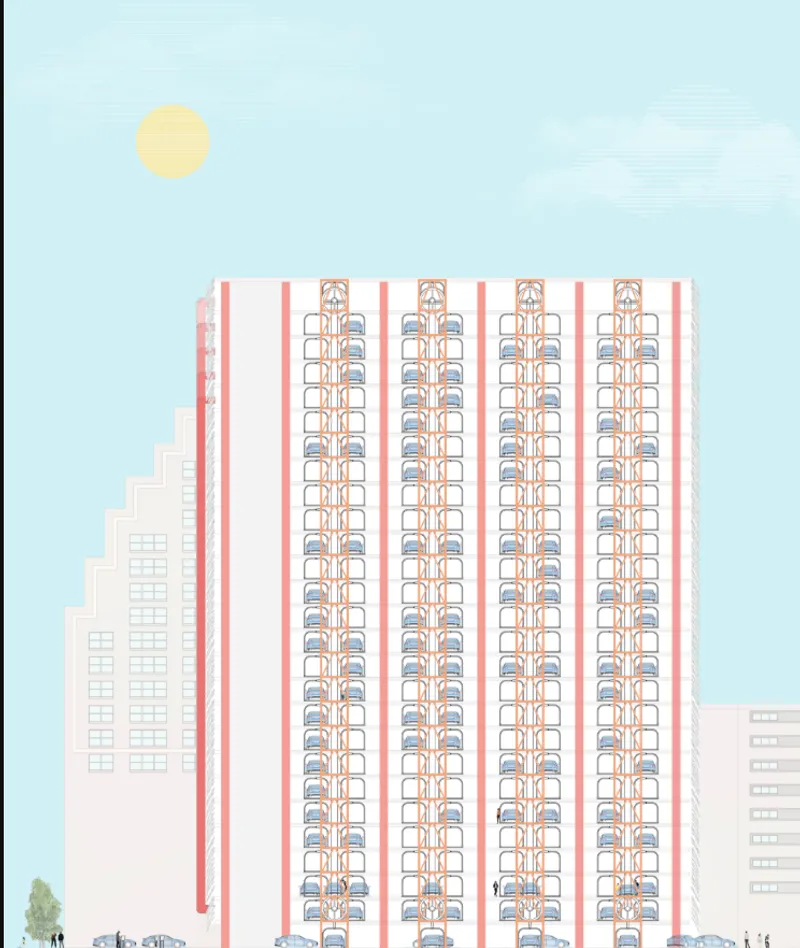
The elevation drawing clarifies the internal logic: four vertical banks of stacked cars, serviced by mechanical track systems and car lifts, feed vehicles into designated drop-off areas. Red structural fins articulate the facade and provide lateral bracing. The tower is organized so that cars enter at grade and ascend through a sequence of workshop floors, each dedicated to stripping specific components. It reads less like a parking structure and more like a vertical factory with a clear material flow from intake to output.
Material Afterlives: From Car Parts to City Furniture
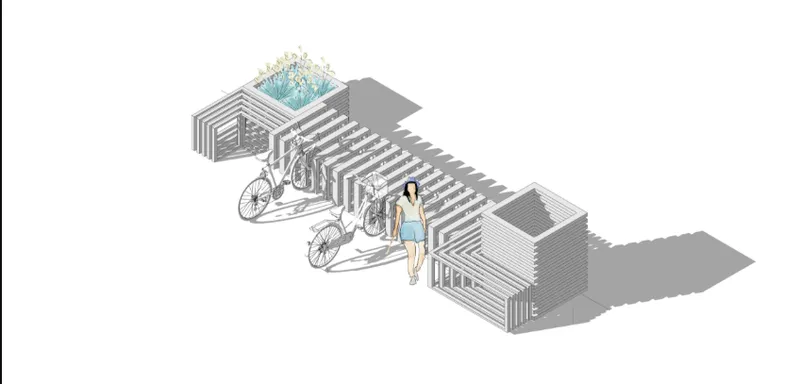

The outputs of deconstruction are where the project's ambition becomes tangible. A detailed isometric drawing shows one product: a bike parking structure with slatted walls assembled from reclaimed materials, complete with a planted roof. The structure accommodates bicycles and pedestrians, directly replacing the infrastructure that cars once demanded with something lighter, greener, and community-scaled.
A companion diagram breaks down the modular street furniture system, showing how recycled steel and plastic are configured into planting beds, seating elements, and hybrid public utility objects. The logic is systematic: specific car components map to specific urban objects. Aluminum wheels become structural frames, plastic interiors become seating surfaces, and the resulting pieces populate the streetscapes freed up by fewer vehicles. The circular loop closes when reclaimed green space and pedestrian zones are furnished entirely by the cars that once congested them.
Inside the Machine: A Driver's Last View

The most compelling image in the set is shot from inside a car looking upward through the tower's interior. Perforated red and yellow facade panels filter daylight across stacked vehicles awaiting their turn for disassembly. The perspective is deliberately cinematic: it places the viewer in the driver's seat at the moment of surrender, looking up into the mechanism that will convert their vehicle into something else entirely. It captures the emotional and spatial threshold between private car ownership and collective urban benefit.
Why This Project Matters
Reverse Park reframes the parking structure, one of the most ubiquitous and least questioned building types, as a site of material and social transformation. The incentive model is sharply conceived: offering lifetime transit access in exchange for a car creates a feedback loop where the building's success accelerates its own evolution. Fewer cars mean more green space, more pedestrian zones, and a facade that literally changes as participation grows.
Maguire and Lovatt push past the familiar territory of adaptive reuse to propose something more radical: not the reuse of a building, but the reuse of the objects a building type was designed to hold. The result is a prototype that challenges architects and planners to see vertical space not as storage but as processing, and to treat the car itself not as a permanent fixture of city life but as a temporary material deposit waiting to be reclaimed.
View the Full Project
About the Designers
Designers: Joe Maguire, Lorna Lovatt
Enter a Design Competition on uni.xyz
uni.xyz runs architecture and design competitions year-round that reward proposals with spatial conviction and real site intelligence.
Project credits: Reverse Park by Joe Maguire, Lorna Lovatt Yo Parking 2019 (uni.xyz).




Popular Articles
Popular articles from the community


Conexión: Biophilic Design Reimagines High-Rise Living in Hong Kong
Conexión reimagines high-rise living in Hong Kong through biophilic design, green facades, shared spaces, daylight, water and nature within.

The Ocean Hive: Sustainable Architecture for a Self-Sufficient Civilization at Sea
The Ocean Hive imagines sustainable architecture at sea, where modular habitats, algae, wave power and ocean waste sustain a growing colony.

Co-life: Sustainable Architecture for Age-Friendly Community Living
Co-life reimagines sustainable architecture for seniors through courtyards, rammed earth, shared gardens, and spaces designed for belonging.

Hill & Cross Opera: Sculptural Opera House Architecture Shaped by Tallinn’s Landscape and Identity
Hill & Cross Opera reimagines opera house architecture in Tallinn through its sculptural hill, civic plaza, glass wave and a luminous cross.


Similar Reads
You might also enjoy these articles

Day and Night Park: A Time-Based Urban Newsstand in Beijing
A temporary urban newsstand in Beijing blending travel, light, and reading through poetic colors, compact form, and community-focused design.

Modernist Patio Renovation in El Masnou, Barcelona by Oliver Segura Arquitectura + Cebrià Arquitectura
Modernist patio renovation blending tradition and innovation with a movable pool, leveled floors, and Catalan materials in El Masnou.

Alto Residencial Coop: Cooperative Housing Development in Santiago de Compostela by Carbajo Barrios Arquitectos
A linear cooperative housing complex blending white volumes and perforated metal façades, enhancing community living, natural light, privacy, and urban integration.
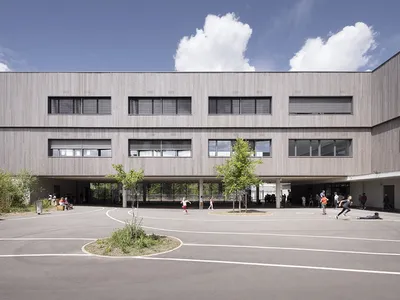
Vil Genis School by BPA ARCHITECTURE – Massy, France
Vil Genis School in Massy, France, features sustainable design, south-facing classrooms, community integration, accessible spaces, and modern educational architecture.


Comments (0)
Please login or sign up to add comments
No comments yet. Be the first to comment!