

REVITALIZING COMMUNITY
Blurring the boundaries between private, semi-private, and public layers to create dynamic, engaging, and inclusive urban experiences

Design Statement - TASK DEFINITION
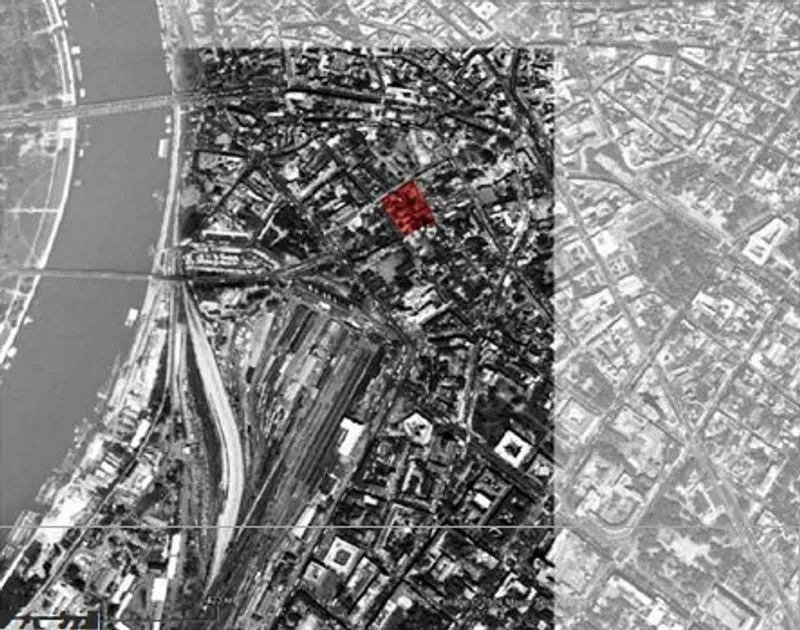
The design task focuses on the block bordered by Gavrila Principa, Kamenicka, Lomin streets, and Luka Celovita Park, near landmarks such as Terazijska Terasa, Zeleni Venac market, the Faculty of Economics, and the Moskva and Bristol hotels.
It explores designing an urban center within the historic city core, balancing cultural heritage preservation with contemporary needs. The work investigates spatial, programmatic, and conceptual potentials, integrating commercial functions with diverse housing types.
Through analysis of density, zoning, traffic, pedestrian flows, and social interactions, the design task adopts a holistic approach to urban planning. The result is a framework that meets modern user needs while enhancing Belgrade’s architectural and urban legacy.
SITE CONTEXT
The plot, previously contextualized within the urban fabric, measures 75 by 105 meters, with a terrain gradient of 15 meters along the east–west axis. Its complex topography is not merely a challenge but a distinctive asset within the broader Savski Venac area. Proximity to the river and its strategic relation to Terazijska Terasa further accentuate the potential for striking river vistas, offering opportunities to integrate seamlessly with the waterfront. The natural features of the site intuitively suggested possible movement paths and opened a broad spectrum of design strategies for terracing and adapting the terrain to future project zones through innovative architectural approaches.
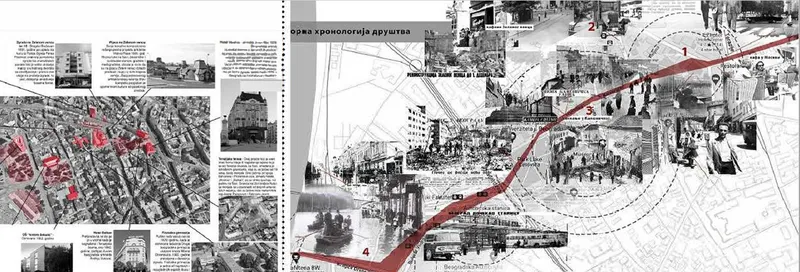
A thorough historical analysis of the urban context deepens the understanding of the site’s significance and informs the design process. The architectural heritage and complexity of this district necessitate solutions that are carefully aligned with the preservation of identity and the authentic spirit of place. The urban context is further animated by the contrast between the historic and contemporary city centers. Old Belgrade and Belgrade Waterfront exemplify divergent trajectories of urban development, historical legacy, and city identity, generating a unique spatial dynamism within a complex urban structure. The plot sits at the epicenter of this dialogue between past and present, offering substantial potential for interventions that act as a bridge between historical and contemporary urban narratives.
Currently, the site is predominantly occupied by low-rise residential buildings in poor condition. The surrounding context comprises residential units with integrated commercial functions, ranging from P+1 to P+6 stories. Key institutions—including a secondary school, university faculty, market, hospitality venues, and a bus station—enhance the site’s functionality and appeal. Connectivity is favorable, with multiple public transport lines traversing the area and close proximity to a tram line. Lomina and Kamenička Streets are classified as tertiary roads, with Kamenička fully pedestrianized, while Gavrila Principa functions as a secondary street. Given the rapid development of Belgrade Waterfront, the traffic infrastructure in this area is expected to gain increasing strategic significance in the near future.
CONCEPT
KEYWORDS: community, communication, connection, interaction
The integration of the site’s physical characteristics with its historical and urban context has not only provided a comprehensive understanding of its potential but also informed the conceptual drivers of the project.
The guiding concept is founded on the synergy between preserving tradition and enhancing awareness of its value, fostering new forms of interaction and spatial relationships. This approach facilitates the renewal of cultural identity, enriching the broader urban context and emphasizing the significance of heritage and contextual identity, offering users not merely a physical experience, but an emotional one that underscores the authentic spirit of place.
Beyond the tangible elements of heritage, context, and spatial relationships, particular attention is given to intangible components deeply rooted in collective memory and spatial experience. Harmonization with pre-existing environmental conditions allows a return to cultural and sociological values—craft, tradition, and community—revitalizing the social fabric.
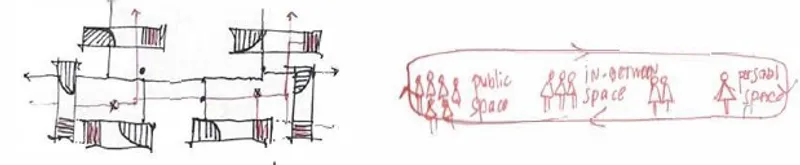
At all levels, the space is designed to integrate rather than isolate, enabling users to engage fully with the community. A central motivation is achieving unity and openness while preserving complete privacy for each dwelling. Inspired by Yamamoto’s idea that the threshold delineates public from private, the project further explores the nature of this connecting zone.
This inquiry led to the organization of the site into three primary zones: public, semi-private, and private. The layering and intertwining of these realms create a unified, dynamic system, where boundaries are not rigid but form a gradient, allowing subtle integration of diverse aspects of community life. By exploring the flexibility and fluidity of these boundaries, the project establishes a spatial framework in which the public and private coexist, merge, and enrich each other.
ANALYSIS FROM THE PERSPECTIVE OF THEMATIC LAYERS
URBANISM
The urban disposition of the plot, developed in response to the brief’s focus on the concept of the “urban side,” offers an engaging solution both in terms of terrain morphology and its relationship with the surrounding context and diverse character of nearby buildings. Conceptually, the project is envisaged as a bridge between two distinct urban fabrics, where form and functional organization serve as instruments of transition between these zones. Within this approach, a comprehensive network of commercial functions integrated with various residential typologies fosters multi-layered interactions across different functional zones.
The urban plan is structured to address the site’s complexity through the delineation of three principal zones: public, semi-private, and private. This tripartite division ensures functional clarity while allowing for the creation of diverse urban ambiances within a unified space. In the upper part of the plot, additional sub-zones within the building contribute to the spatial dynamism through vertical and horizontal segmentation. Given the pronounced 15-meter slope from Gavrila Principa Street to Lomina Street, the ground level is organized as a “double ground plane”, comprising public and semi-public areas. This arrangement enables a continuous transition between functional zones, with the ground floor acting not merely as a passage, but as a generator of activity, interaction, and social cohesion. Within each zone, the space flows into smaller sub-units and cascades, which serve not only to visually mediate height differences but also to create distinct ambient microenvironments with varied functions. These micro-spaces enrich the overall experience, offering opportunities for different activities throughout the day and across seasons.
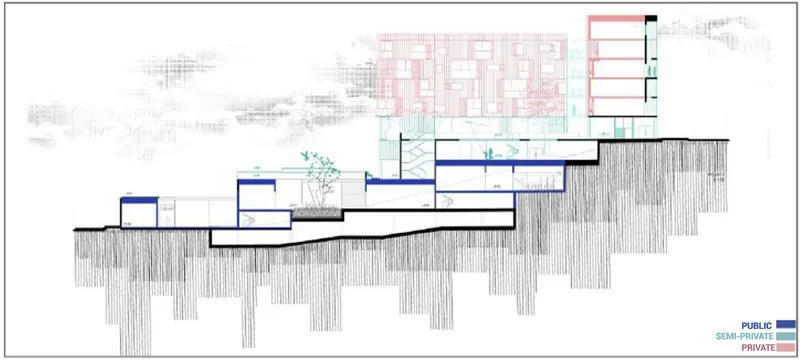
Each of the defined zones has been thoughtfully developed to function autonomously, with a distinct identity and clear functional independence. However, the advantages of their integration within the overall system are immeasurable. This approach ensures that the space is not fragmented, but rather that all components operate as part of a larger urban network. The transitional layer, balancing between open and enclosed, between public and private, represents a key point of social interaction, where users can meet, engage, and exchange ideas.
The elaboration of layers in this project involves a continuous interplay between architectural and urbanistic aspects, where detailed spatial design aligns with the broader urban context. Layers can be observed from an urban planning perspective, with public, semi-private, and private spaces integrated into an urban network, creating a harmonious relationship between space and its surroundings. Architecture then assumes a central role in shaping specific microenvironments and functional elements. Through this synthesis, architecture and urbanism operate in concert, ensuring that each layer contributes to a holistic spatial experience and its interaction with the city.
ARCHITECTURE
1. PUBLIC LAYER
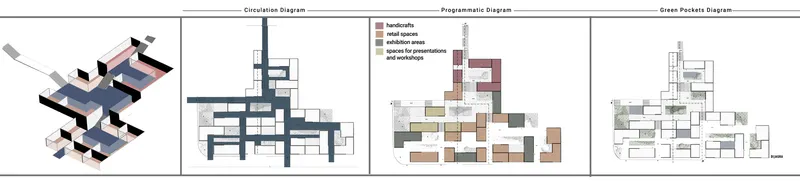
Kamenicka Street, although primarily designed for pedestrian traffic, experiences a significant flow of people who pass through daily, mostly without pausing, focused on fulfilling routine needs. The project aims to leverage this inherent attractiveness, preserving it while enhancing and adapting it. The goal is to transform this habitual route into one that offers experience, fosters interaction, and creates memory.
Initial steps in redefining the space begin with carving public pathways extending from Gavrila Principa Street, cascading upward to the exit at Lomina Street, with an additional secondary access to Kamenicka Street. These paths navigate the terrain through three thematic cascades. The first two cascades (at 0.00 m and 3.00 m elevations) host market stalls and small stands of local artisans, preserving the spirit of tradition. Symbolically embedded into the terrain, partially sunken, these elements create a metaphor of roots, establishing tradition as the foundational layer upon which the broader community is built, highlighting a deep connection with cultural heritage.
Originally, the pathway was intended to pass linearly through the center of the site from east to west. However, to activate a larger portion of the site and encourage greater interaction, the linear route was replaced with a meandering path. This configuration generates numerous “pockets of memory”, designed to intrigue passersby and encourage them to pause, linger, and engage with the space.
2. SEMI-PRIVATE LAYER
The second, perhaps most striking segment of the project opens up a new spatial dimension of living, paving the way for a richer interaction between users and their environment. The semi-private layer, acting as a transitional element between public and private realms, represents a key point of transformation, where the design creates spatial complexity and depth, enabling the discovery of new connections and functions, and fostering unique user experiences.
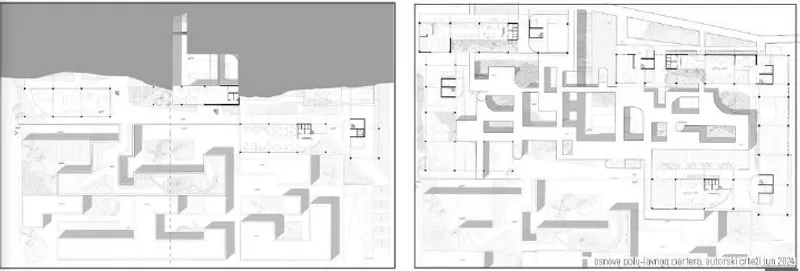
From the elevation of Lomina Street, users access the space exclusively through residential units, as this layer is reserved solely for the residents. Within this zone, interactive platforms are carefully designed to respond to a variety of needs and activities. These platforms allow greenery from the ground-level surroundings to extend through openings in the structure, creating the sensation of moving through tree canopies and forming an additional layer of isolation from the bustling urban fabric.
Users are offered the opportunity to choose and adapt activities across various zones—for relaxation, recreation, or work—modifying them according to their needs by adding or removing options. Whether it is gathering around a guitar, grabbing a quick meal, shopping, exercising, enjoying a morning coffee, sipping a drink at sunset, playing in children’s areas while practicing yoga, or finishing tasks in co-working spaces, users navigate a rich tapestry of experiences, with the chance to color each day differently. The flexibility of the space allows for the creation of interactive capsules that can be closed and isolated, adding an additional layer of privacy and personalization.
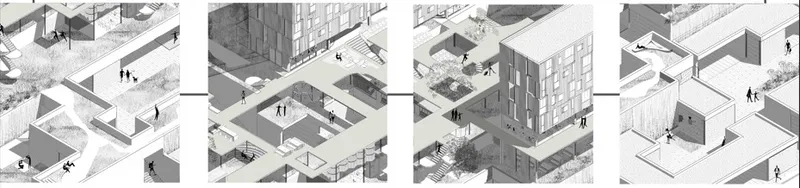
From the platform, users can descend to the open ground level via a core leading to the garage or a spiral steel staircase at multiple points. Reserved exclusively for residents, the ground floor remains largely open and green, with carefully selected trees creating a natural urban oasis. Following the natural slope, the parter is terraced into small gardens with diverse greenery, with paths integrated into the terrain, ensuring all everyday activities are easily accessible.
Similar to the platform above, these terraced areas host essential amenities for residents, providing comfort without compromising the sense of greenery. Ground floors of the blocks parallel to Kamenicka Street remain open, with stairs, seating terraces, and ramps harmoniously integrated to appear as if they have always been part of the terrain. Commercial areas along Lomina and Kamenicka streets, despite differing levels, form a continuous cohesive whole, opening occasionally into adaptable resting areas. From this belt, uninterrupted views to the river enhance the connection with the natural environment and enrich the user’s spatial experience.
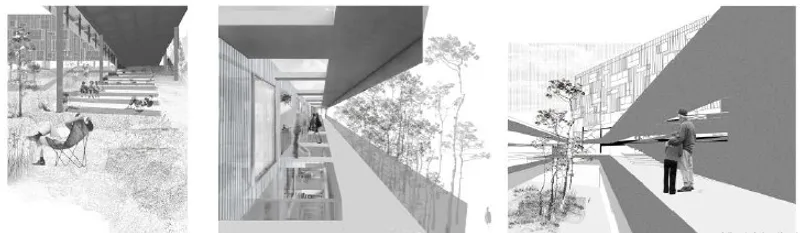
Finally, the residential zone, designed in a gallery typology with galleries-"streets in the air", forms the uppermost level of the semi-private layer. These galleries facilitate encounters and interactions across different floors, creating a gradual gradient from semi-private to private spaces. On each floor, open communal areas at the corners of the units further encourage social interaction and foster a shared sense of belonging within the residential complex. This carefully articulated semi-private layer not only enhances the project’s functionality but also adds a new dimension to residents’ lives, creating a space that is as adaptable as it is inspiring.
3. PRIVATE LAYER
The residential complex occupies the upper part of the site, covering roughly a quarter of its area and divided into six blocks. Two blocks are oriented east-west, while the remaining four are arranged perpendicular in parallel pairs. Heights are carefully adapted to the surrounding buildings, particularly considering Lomina Street, where blocks are set back 7–10 meters, allowing for tall greenery that reduces noise and enhances privacy. Along Kamenicka Street, blocks are placed closer to the regulatory line, with hedges providing additional visual and acoustic screening.
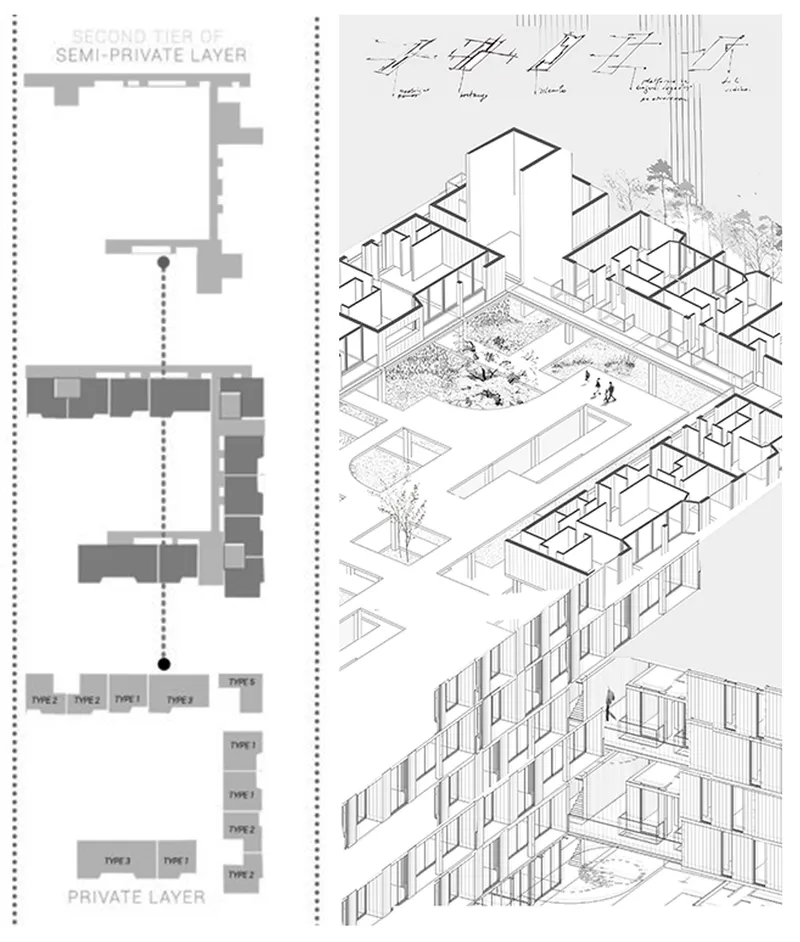
Access to the units is organized via galleries, functioning as elevated streets, enabling continuous movement through the complex. Apartments vary from one- to three-bedroom units and duplexes, ranging from 40 to 125 m², accommodating diverse lifestyles while maintaining functional comfort. Orientation prioritizes daylight and street noise mitigation, with galleries serving as a buffer between public streets and private interiors. Openings in the slab below window lines create distance and privacy, while duplex galleries are staggered every other floor to separate night zones from circulation. Terraces and narrow gardens along facades allow for greenery that visually extends the green flow into the inner courtyard, creating a natural habitat and enhancing the facade’s appeal.
FACADE AND MATERIALITY
The building’s facade embodies a synthesis of architectural and technological principles, highlighting the dynamic interplay between interior and exterior spaces. Designed as an interactive element, it features perforated aluminum panels whose colors harmonize with the concrete structure, subtly transforming light throughout the day. These panels regulate daylight, ventilation, and privacy, allowing residents to choose between privacy and a connection with the city.
The facade’s dynamism is enhanced by an accordion-like overlapping panel system, which can fold compactly when not in use. This enables residents to personalize the facade, reflecting the reciprocal idea that “space shapes the individual” and “the individual shapes the space.”
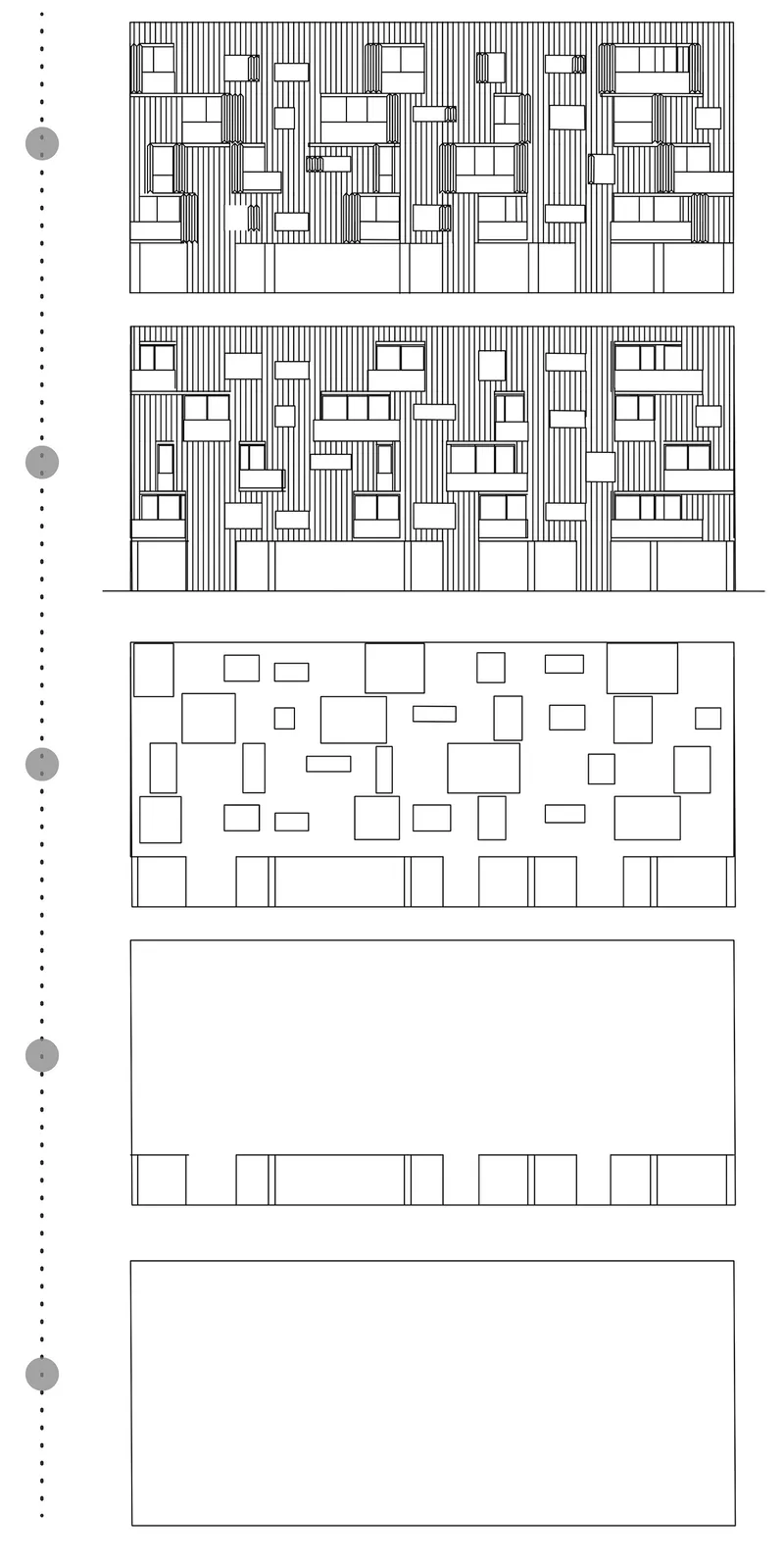
Special attention is given to balconies with folding panels, extending living spaces outward and allowing occupants to adapt the facade for sun protection, ventilation, or framing views. Metal shutters and concrete elements further enhance shading and daylight, providing comfort while optimizing energy performance. Perforations facilitate natural ventilation, improving indoor air quality and reducing mechanical cooling needs.
Together, these strategies create a facade that protects, adapts, and evolves with its residents, transforming the building into a living entity that reflects their lifestyle.

Popular Articles
Popular articles from the community


Architekt Andreas Gruber Scatters 23 Dark Timber Chalets Across a South Tyrolean Forest Edge
In Molini di Tures, Amonti Chalets breaks a resort into a hamlet of gabled timber houses, with parking, storage and services pushed into the slope.

David Macias Steps a Doorless Stone and Plaster House Down a Tropical Colombian Hillside
In the humid hills of Colombia, Threshold House replaces the front door with an open void and terraces its 850 m² down the slope instead of fighting it.

Cube Design Draws an Ecological Corridor Between Two Shenzhen Hills with the Nankai Building
Beside Shenzhen's container docks, the Nankai Building pairs stacked balconies with a climbing green screen to connect two hillsides across its height.

Juan García Correa, John González and Claudia Rueda Sink a Circular Amphitheater into a Manizales Engineering Building
On the La Nubia campus in Manizales, Colombia, the S1 Building folds labs and offices into a hillside of ramped lawns that double as a campus route.

Similar Reads
You might also enjoy these articles

The Rhythm of Seasons
A Farmers' Market Connecting Nature and the City

More Than a Building-Designing a Living System
More Than a Building-Designing a Living System
Base Beyond
DESERT COMPOUND ARID: TOURISM OF ABSENCE AND ABUNDANCE

Explore Civic Architecture Competitions
Discover active competitions in this discipline


Challenge to reimagine the Iron Throne

Photograph architecture without architects

Illustrate the lost glory of Angkor Wat - Render Challenge

Design challenge to reuse E-waste
Comments (0)
Please login or sign up to add comments
No comments yet. Be the first to comment!