

HEx-Stadium: Turning Bleachers into Homes with Honeycombed Urbanism
A shortlisted Staydium 2020 entry transforms a conventional stadium into a mixed-use ring of housing, markets, and urban terraces.


What if the bleachers you sat in last season became someone's living room? HEx-Stadium takes that question seriously, proposing a systematic conversion of stadium infrastructure into a honeycombed ring of housing units, pop-up markets, and communal terraces. The logic is disarmingly straightforward: stadiums are massive, structurally robust, and underused for most of the year. Rather than accepting that waste, the design reconfigures the stadium's tiered geometry into a vertical neighborhood.
HEx-Stadium is a shortlisted entry in the Staydium 2020 competition, designed by Hasan Fawaz, Ali Dhainy, and Michel Farhat. Their proposal challenges the idea that a stadium must remain a single-purpose venue, instead advocating for a phased transformation that introduces residential units, commercial activity, and public green space within the existing structural envelope.
An Oval Ring of Dwellings Around a Central Commons
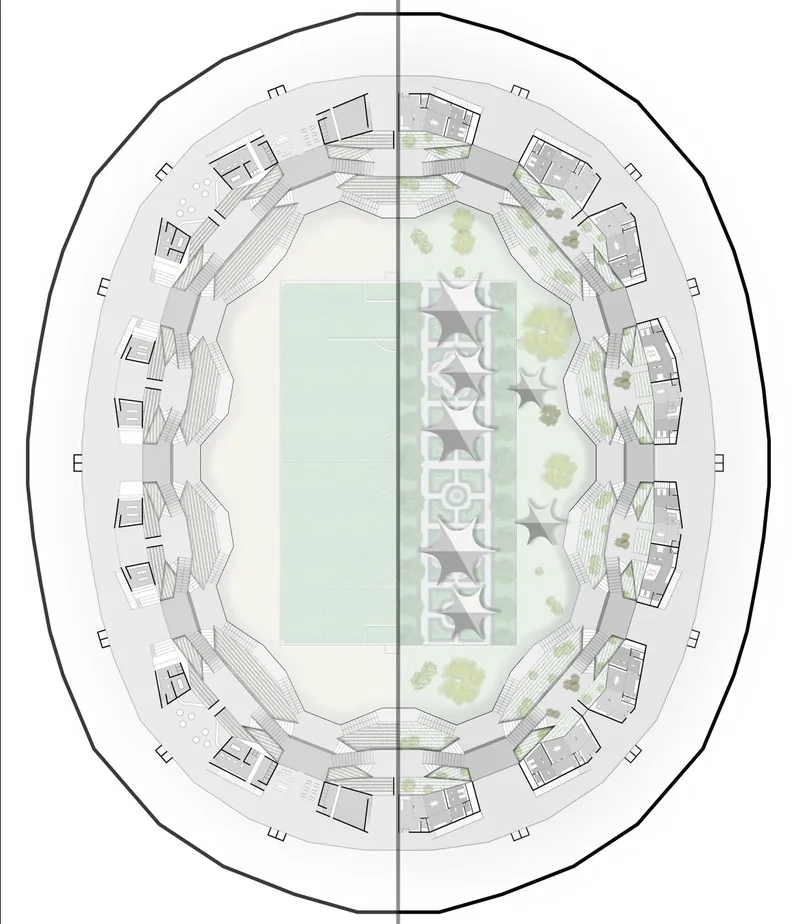
The site plan reveals the project's organizing move clearly: a continuous oval ring of housing units wraps the perimeter, enclosing a central courtyard planted with trees and punctuated by water features. The former pitch becomes shared ground, a commons that gives the residential ring both orientation and purpose. The honeycombed stairway network stitches together semi-public terraces that once served as bleachers, converting stepped seating into a legible system of outdoor balconies and access corridors. Perforations at ground level mark entrances, keeping the ring porous enough for pedestrian flow without sacrificing the enclosure that makes the courtyard feel protected.
Stacking Programs: Housing Over Parking Over Markets
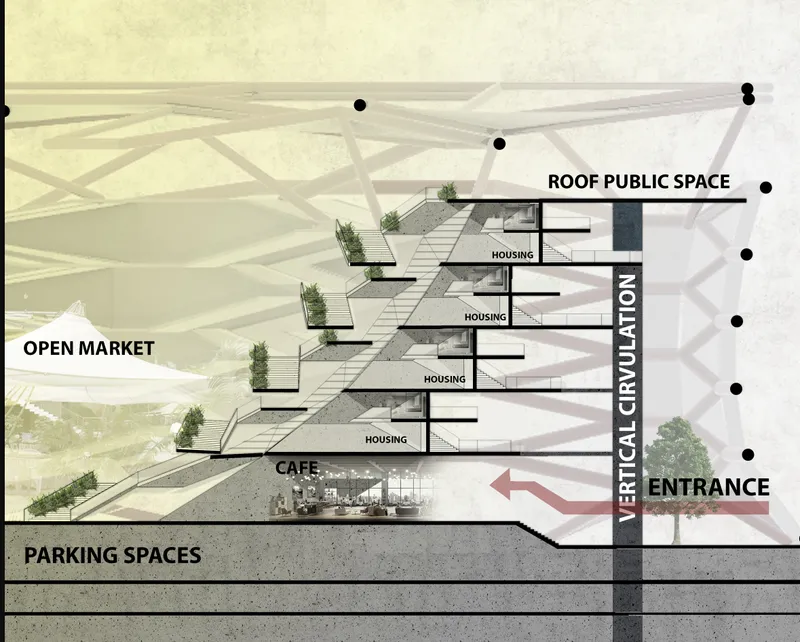
The section drawing is where the proposal's ambition becomes tangible. Stacked housing levels with terraced balconies rise above underground parking and market spaces, creating a layered sandwich of public, semi-public, and private program. Vertical circulation threads through these layers, connecting residents to commercial zones below and communal terraces above without forcing everyone through a single lobby. The phased approach is key: the first phase converts the bleacher zone into semi-residential development, while the second phase activates the football field itself as a pop-up market, injecting economic life into the structure's core.
This sectional strategy is smart because it exploits what stadiums already do well. Their raked geometry naturally produces terraces. Their deep foundations can absorb below-grade parking. The structural capacity designed to hold tens of thousands of spectators can comfortably support residential loads. HEx-Stadium reads these latent capacities and redirects them.
Tensile Roof as Communal Canopy
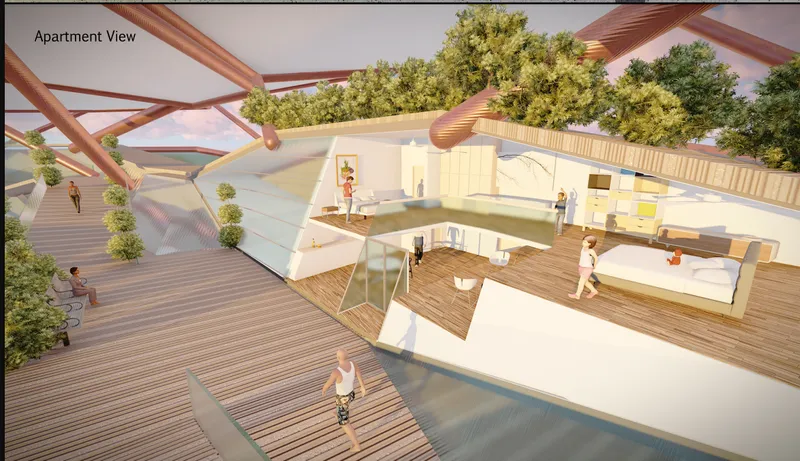
The rooftop terrace rendering shows what the stadium's tensile roof structure becomes after conversion: a generous canopy framing views out to surrounding trees. Timber decking replaces the hard surfaces of concourse levels, and exposed structural trusses remain visible overhead, lending the space an honest, infrastructural character. The roof is not merely decorative; it functions as a shading element for outdoor activity, extending the usability of these upper terraces across seasons. The result feels closer to a well-designed rooftop garden than anything typically associated with a sports venue.
A Faceted Form Holding Its Own at Night
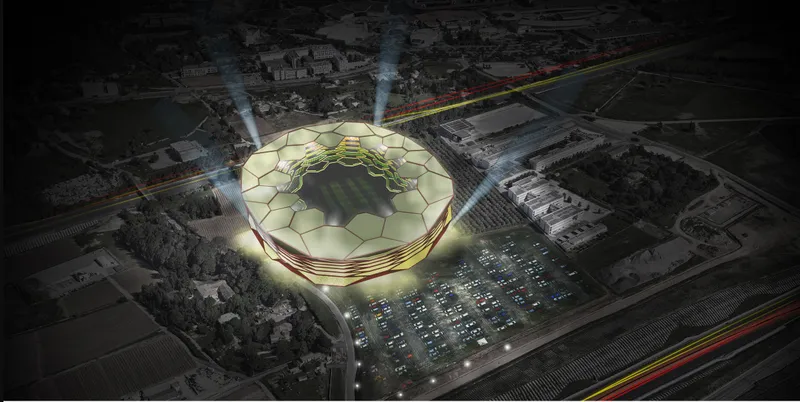
The aerial night rendering confirms that HEx-Stadium retains the civic presence of a stadium even after its conversion. The illuminated circular form, with its faceted facade derived from the honeycombed structural pattern, reads as a landmark within the surrounding landscape of parking lots and roadways. Light leaks through the perforated skin at multiple levels, signaling that the building is inhabited around the clock rather than only on match days. The hexagonal geometry gives the facade a crystalline texture that distinguishes it from the smooth curves of conventional stadium shells.
Why This Project Matters
Stadiums represent some of the most resource-intensive buildings in any city, yet they sit dormant for the vast majority of the year. HEx-Stadium confronts that inefficiency directly by proposing a phased, reversible reprogramming that turns spectator infrastructure into a living neighborhood. The honeycombed stairway network is not just a formal gesture; it is the mechanism that makes the transition from bleacher to balcony spatially coherent, preserving the stepped geometry while reframing it as domestic threshold.
Fawaz, Dhainy, and Farhat demonstrate a clear understanding that adaptive reuse is not about erasing the original building but about reading its latent potential. The stadium's raked section becomes terraced housing. Its pitch becomes a market. Its roof becomes a communal garden. Each move leverages existing structure rather than fighting it, and the result is a proposal that feels both radical in ambition and rational in execution.
View the Full Project
About the Designers
Designers: Hasan Fawaz, Ali Dhainy, Michel Farhat
Enter a Design Competition on uni.xyz
uni.xyz runs architecture and design competitions year-round that reward proposals with spatial conviction and real site intelligence.
Project credits: HEx-Stadium by Hasan Fawaz, Ali Dhainy, Michel Farhat Staydium 2020 (uni.xyz).


Popular Articles
Popular articles from the community


Manzana Morphosis: Stretching Barcelona's Grid into a Living Landscape for 2050
A radical reworking of the Eixample manzana turns density into a tool for generous public space, vertical ecology, and environmental performance.

Opera on the Sea: Driftwood Logic Shapes a Timber Opera House on Estonia's Coast
Trevor Orgill's opera house translates the entangled drift of floating timber into a civic building where wood, water, and music converge.

The Amber Palace Opera: A Geological Fiction Surfaces on Tallinn's Baltic Waterfront
Pierre Brillard reimagines a Baltic legend as a public landscape, opera house, and waterfront promenade rooted in Tallinn's coastal identity.

Cloaked Colonization: A Mobile Underwater Habitat That Moves Like a Fish
Micah Abaya's shortlisted EHC Pacific entry reimagines ocean settlement as a dispersed network of self-sustaining architectural organisms.

Similar Reads
You might also enjoy these articles

Shakur's House: Exposed Brick as an Interior Organiser in a 168 m² Mashhad Residence
Brick moves indoors in this Mashhad residence, where masonry walls, glass partitions and teal planes sequence a compact home without closing it off.

Day and Night Park: A Time-Based Urban Newsstand in Beijing
A temporary urban newsstand in Beijing blending travel, light, and reading through poetic colors, compact form, and community-focused design.

Modernist Patio Renovation in El Masnou, Barcelona by Oliver Segura Arquitectura + Cebrià Arquitectura
Modernist patio renovation blending tradition and innovation with a movable pool, leveled floors, and Catalan materials in El Masnou.

Alto Residencial Coop: Cooperative Housing Development in Santiago de Compostela by Carbajo Barrios Arquitectos
A linear cooperative housing complex blending white volumes and perforated metal façades, enhancing community living, natural light, privacy, and urban integration.

Explore Stadium Competitions
Discover active competitions in this discipline

Challenge to design a barrier free sports center

Challenge to design an outdoor ice-rink and park
Comments (0)
Please login or sign up to add comments
No comments yet. Be the first to comment!