

RigonSimonetti Converts an Abandoned Venetian Villa into a Layered Coworking Campus
Near Vicenza, a long-neglected 18th-century villa and its barchessa become offices that read centuries of change like strata of sediment.


Leaving Vicenza along the Pasubio state road, you arrive at the village of Motta di Costabissara, where the historic Villa Donà sits quietly behind its perimeter walls. For years the complex was severely compromised by abandonment. Now, RigonSimonetti has returned it to active life as a 714 m² office and coworking campus, threading new timber, iron, and glass through an 18th-century stone envelope without pretending the centuries in between never happened.
What makes the project genuinely compelling is its refusal to pick a side in the old preservation-versus-insertion debate. Instead of restoring the villa to a single historical moment or dropping a conspicuously "contemporary" object inside it, RigonSimonetti treats every era of construction, including their own, as another stratum of sediment. The facade still carries marks of both 18th- and 19th-century transformations. Iron beams sit parallel to Tuscan-order stone columns. Concrete is cast in MDF formwork and paired with oiled okoumè wood. Each material registers a different date but speaks the same dialect of craft.
Reading the Facade
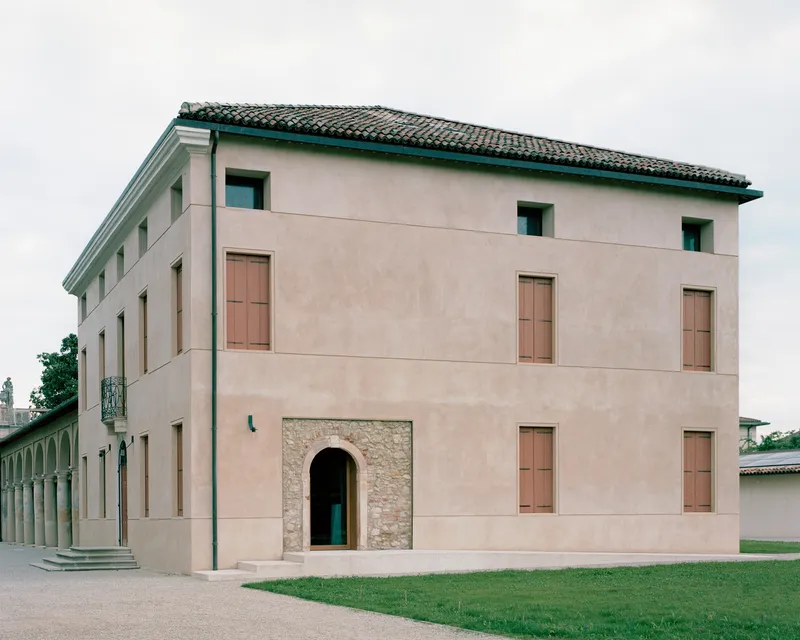
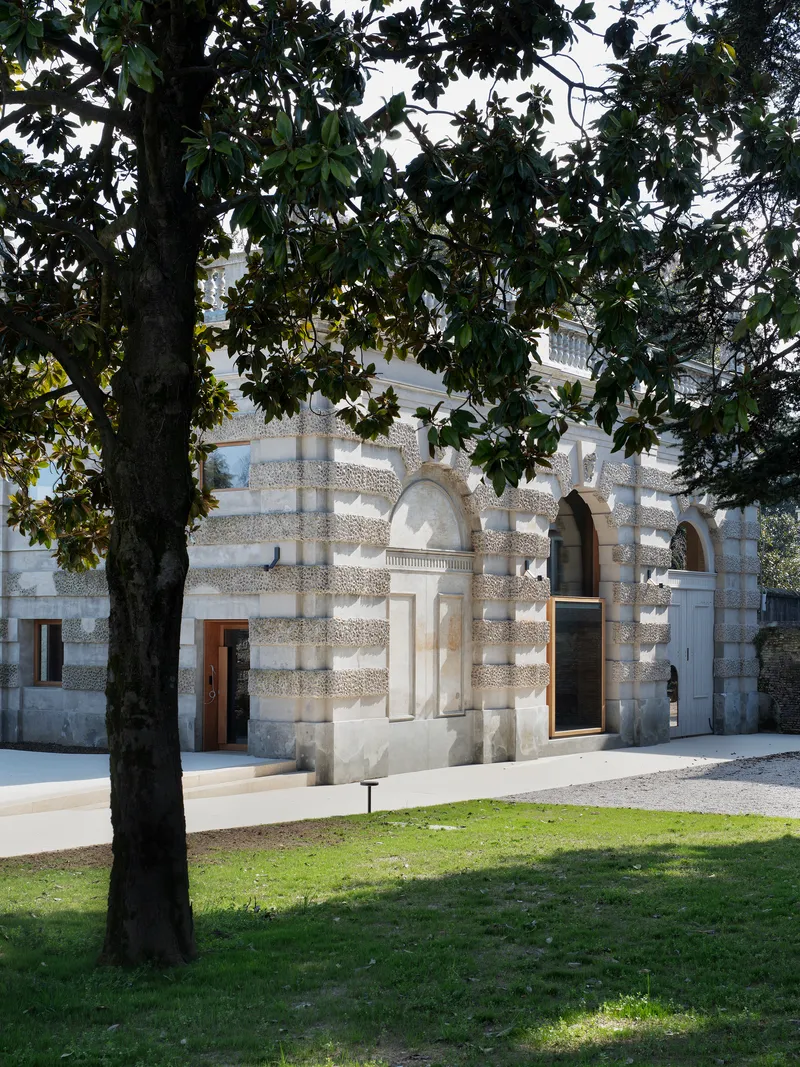
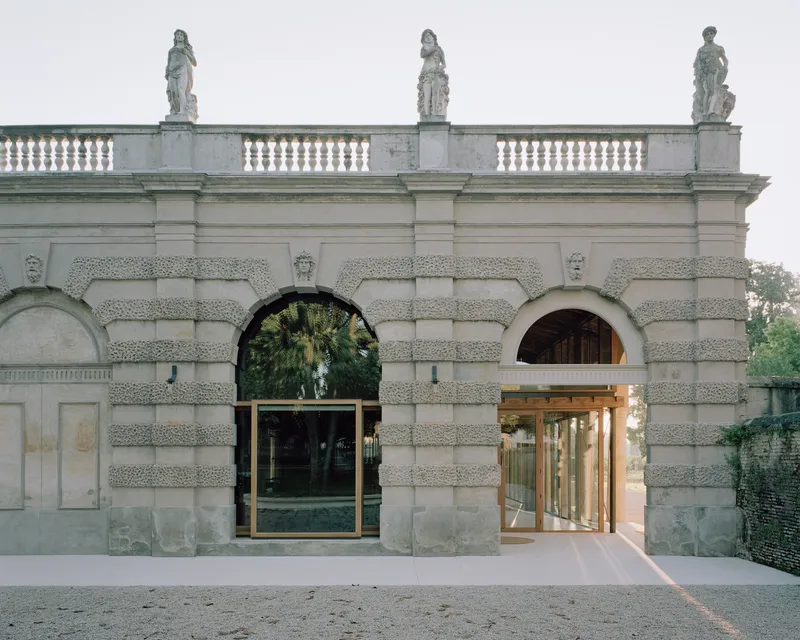
The pink rendered facade of the main villa and its rusticated stone gateway are a record of successive interventions, each campaign leaving its own plaster mix, its own proportioning of arched openings. RigonSimonetti stripped later coats selectively, revealing ancient timber structure embedded in masonry walls and treating it with a lime-based finish rather than concealing it again. New bronze-framed glass doors sit inside the stone arches of the gateway, registering clearly as additions without competing for attention.
The plaster itself is mixed with coarse aggregates and sands colored to match the local Vicenza stone, grounding the new surfaces in a chromatic tradition that predates any single architect's involvement. Narrow 2×2 cm grooves run as a cornice line, wrapping continuously around new Vicenza stone window frames to tie old and new into a shared datum.
The Barchessa as Spine
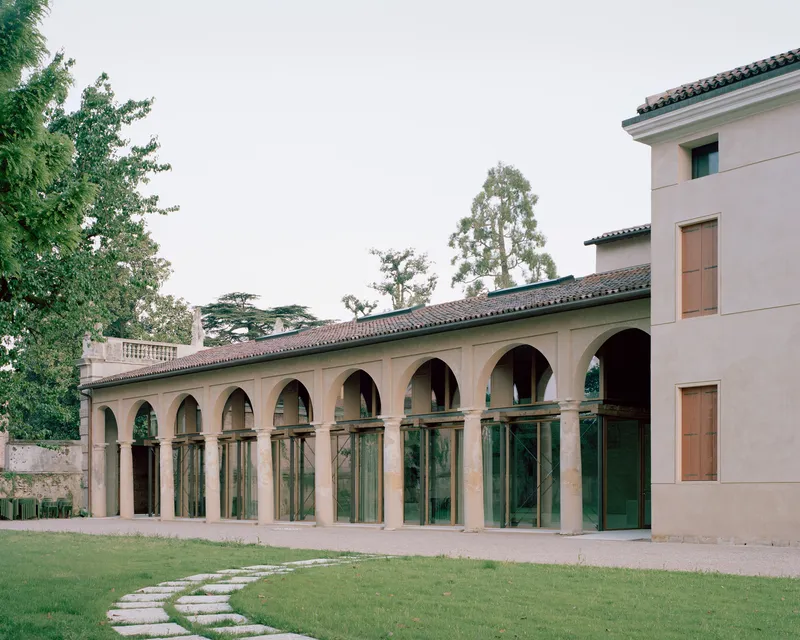
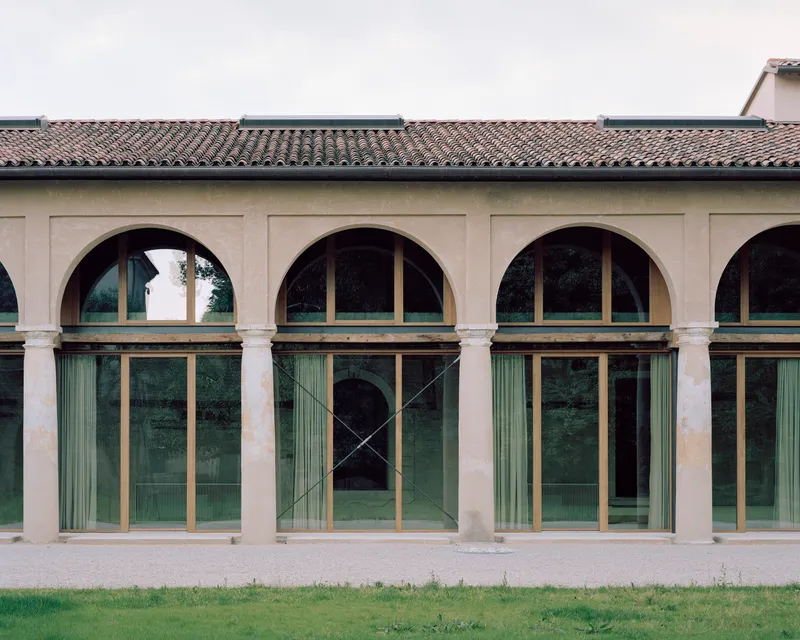
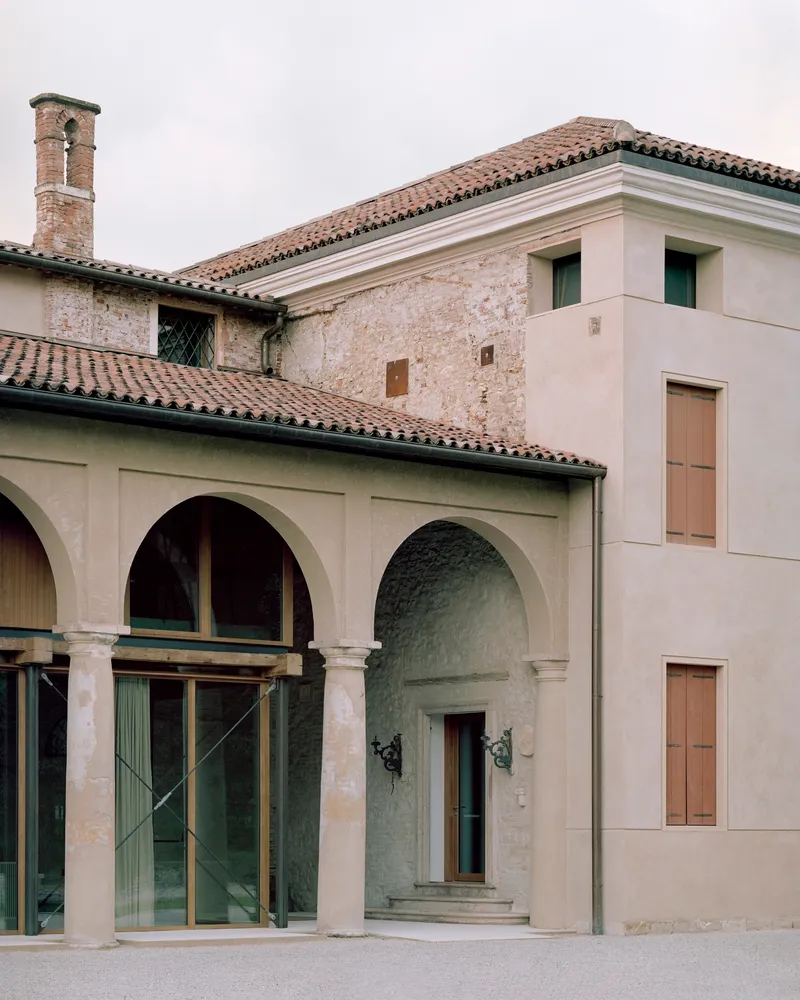
The barchessa, a traditional Venetian villa outbuilding defined by a row of arches, extends roughly 926 m² from the main dwelling and connects it to the road. In its original life it was agricultural infrastructure: storage, shelter, workflow. RigonSimonetti has kept the arcade's rhythm intact, infilling arched openings with glazed bronze-framed doors that let the loggia function as both circulation and threshold. The ground floor loggia is now a multipurpose space for conferences and events, a role that maps neatly onto the barchessa's historical purpose as a communal work shed.
A new annex with a sloped roof sandwiches a garden between itself and the barchessa, creating a courtyard sequence that never existed before but feels earned. The three-part arrangement, main villa, barchessa, and annex, organizes the full 8,840 m² site into front garden, working courtyard, and conserved rear park without hard borders.
Timber, Iron, and the Double-Height Cafe
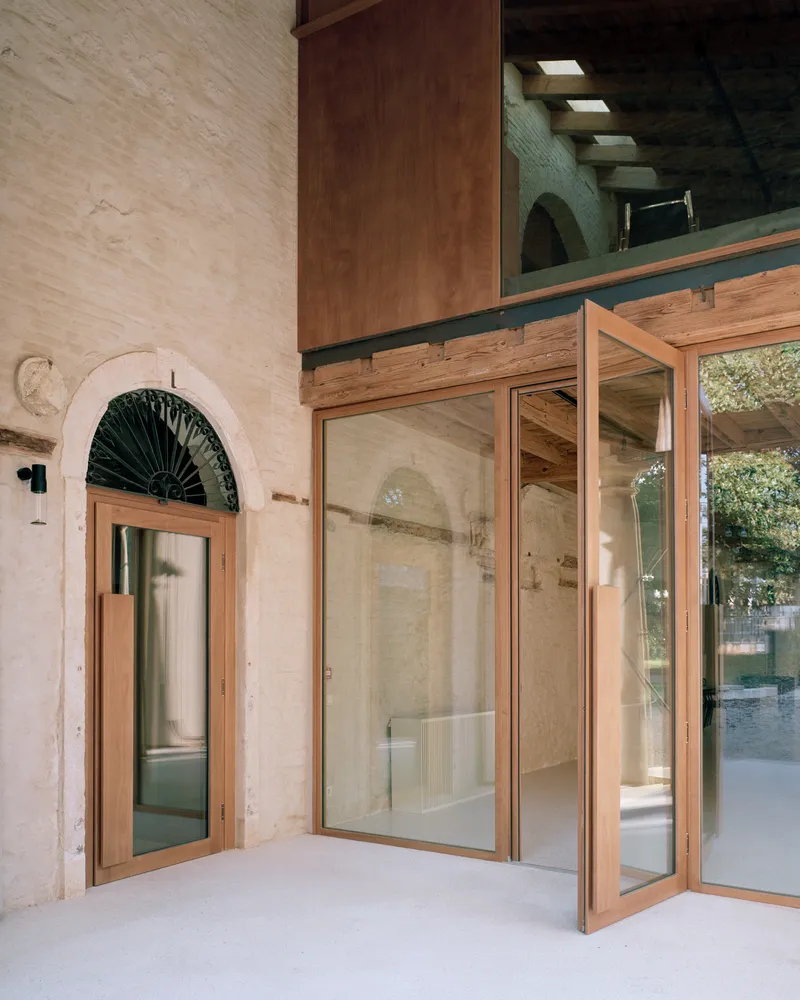
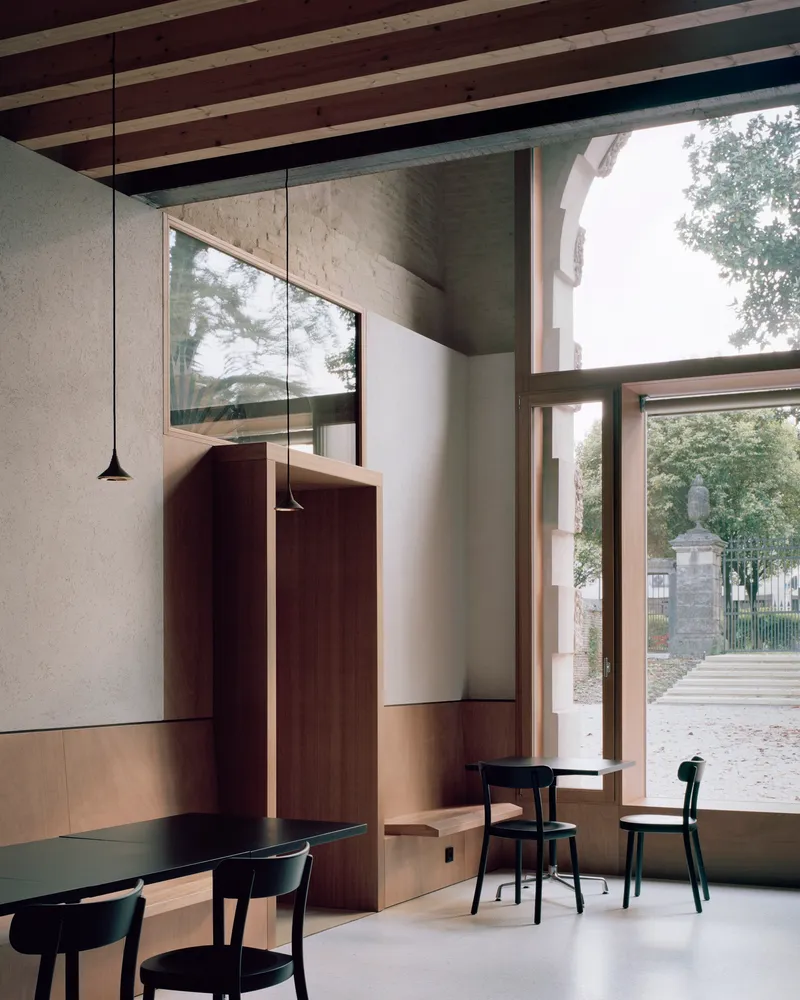
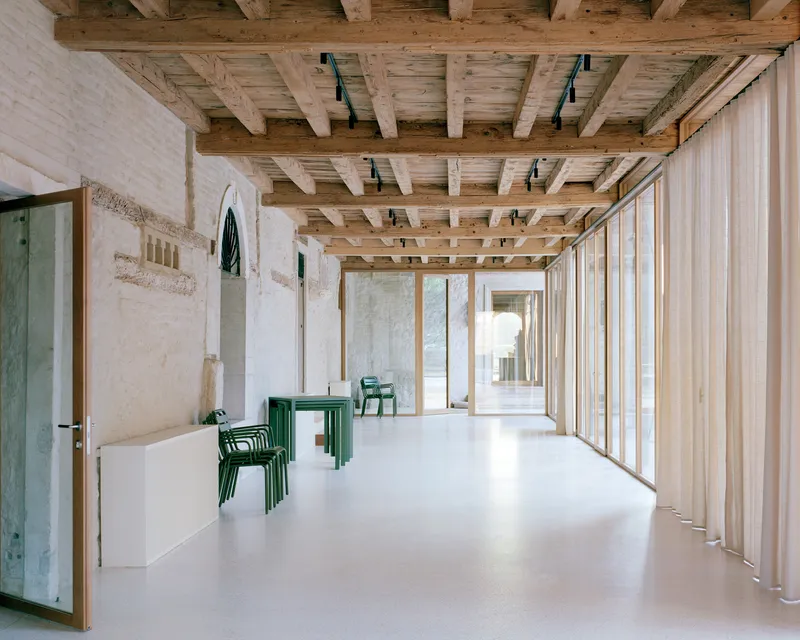
The cafe occupies a double-height space that once housed a hayloft. RigonSimonetti stripped the volume back to its exposed timber rafters and inserted pendant lights at a domestic scale, making a room that feels tall without feeling hollow. Glazed doors along the arcade wall flood the space with filtered courtyard light, and black dining chairs sit casually beneath centuries-old wood, as if the hayloft simply decided to start serving coffee.
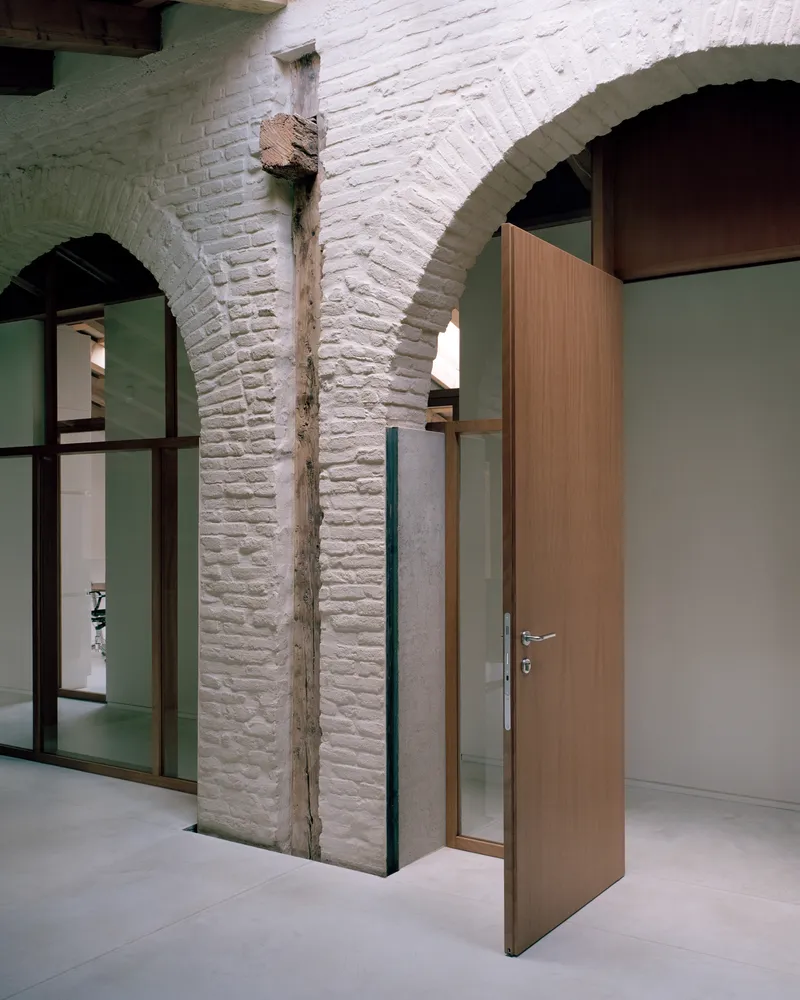
Elsewhere, a timber-framed doorway with a decorative fanlight punches through existing stone wall, and whitewashed brick arches flank timber doors with visible column remnants between openings. These moments are the project's quiet thesis: rather than treating the ancient structure as a precious artifact behind glass, RigonSimonetti makes you walk through it, lean against it, look up at it while you type.
Workspaces Under Exposed Joists
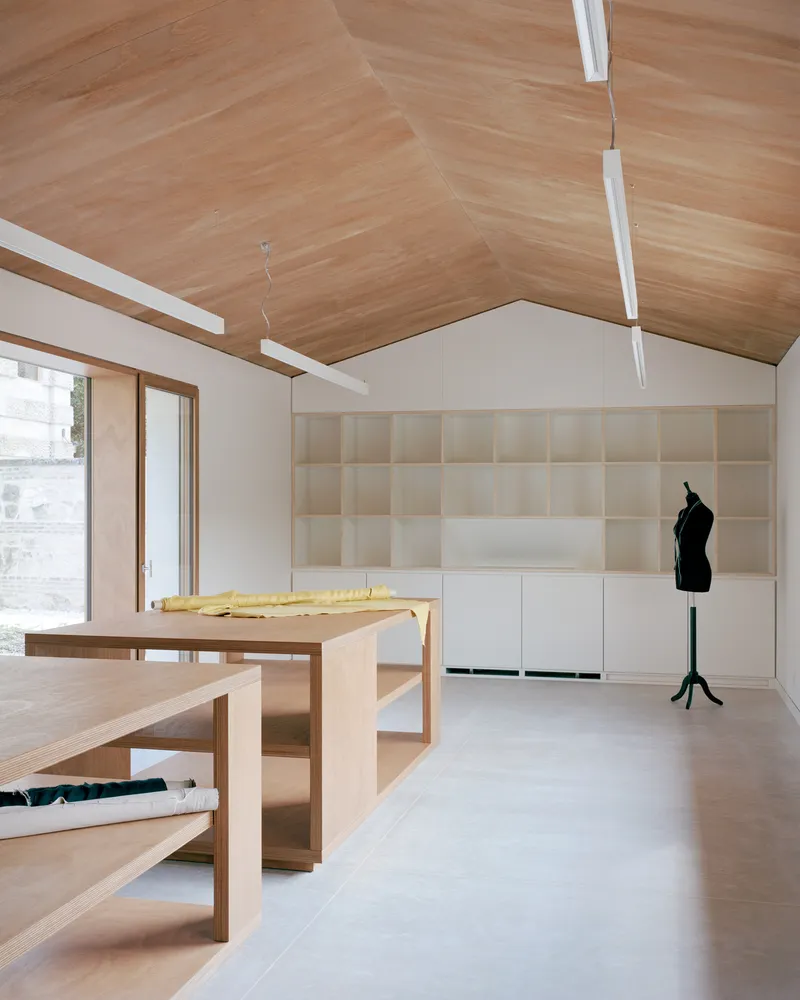
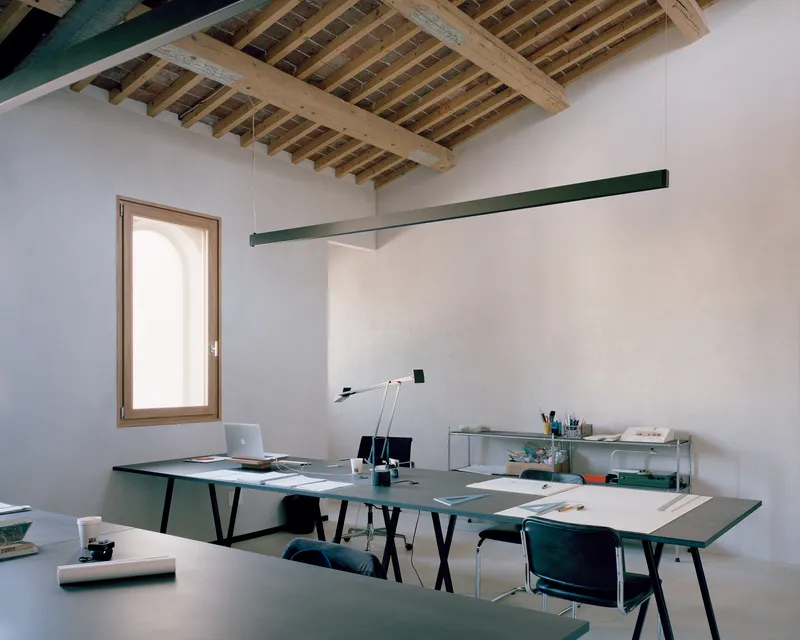
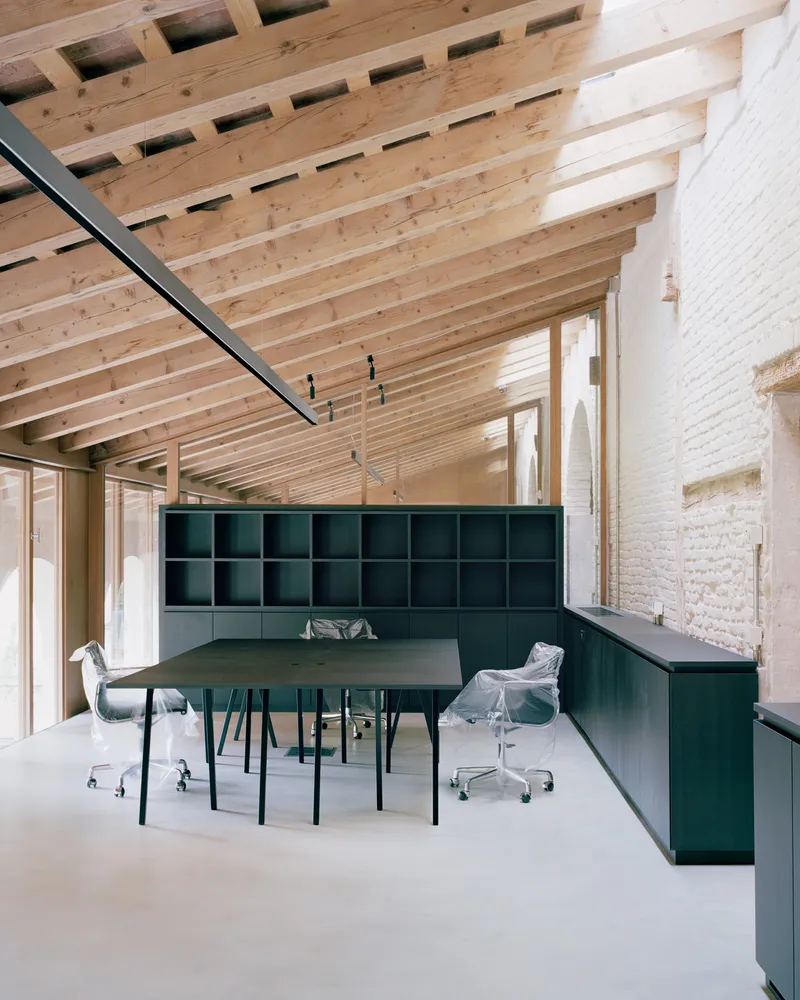
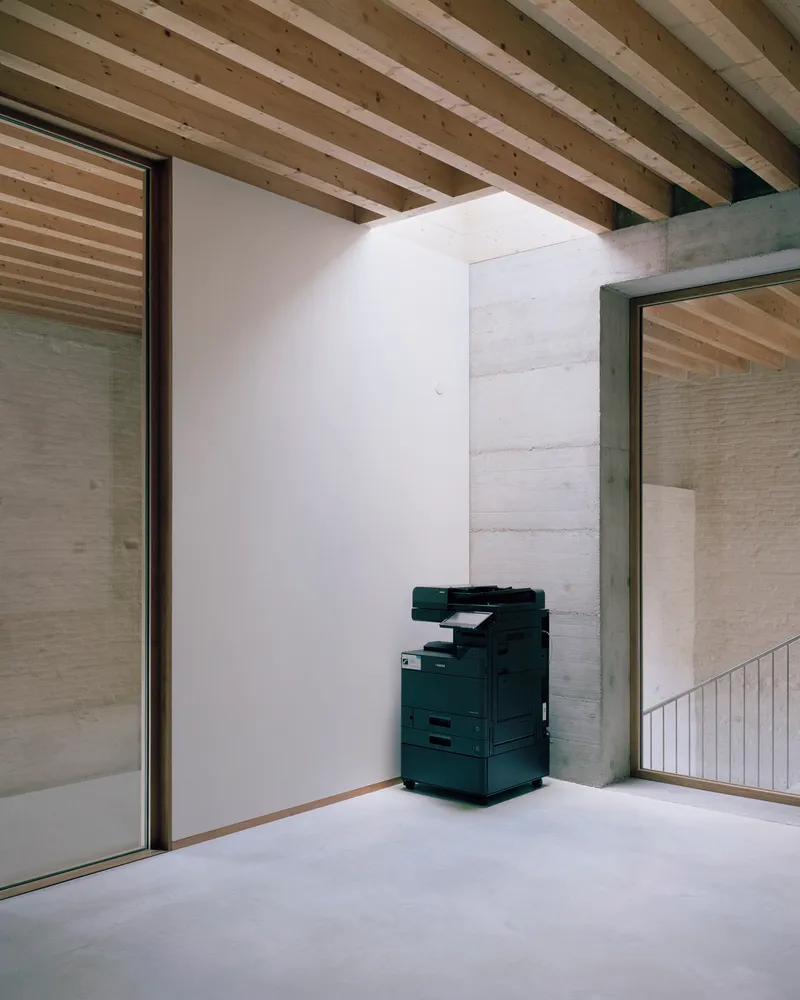
Offices and coworking areas occupy the upper floor, where slender iron beams run parallel to the original stone columns and carry the floor load that the compromised masonry could no longer support alone. The structural doubling is visible but not theatrical: iron sits beside timber, each doing its job. Skylights punch daylight down through the roof assembly, and pitched timber ceilings give each workspace a sectional character that cubicle farms could never replicate.
Green desk surfaces and a cubby wall in the conference room introduce a restrained contemporary palette. The restraint matters. In a building where every surface already has a story to tell, adding loud furniture would just be noise. Polished concrete floors and oiled wood surfaces keep the material count tight, ensuring the new layer reads as deliberate rather than decorative.
Corridors and Material Junctions
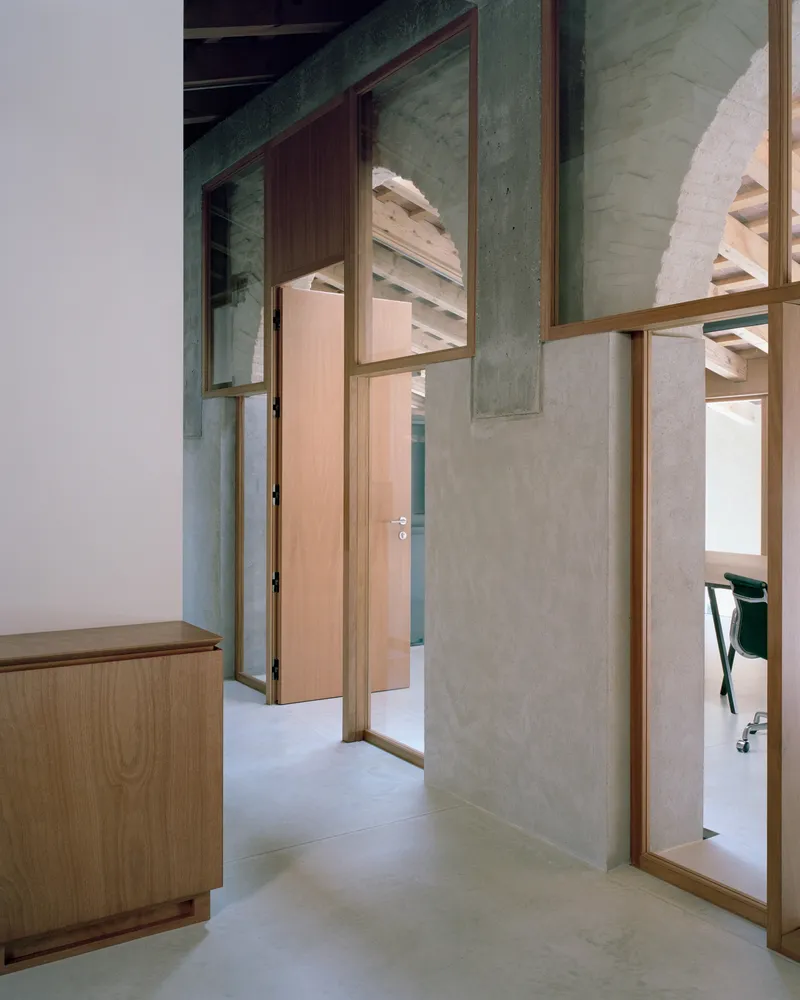
Circulation is where the project's tectonic logic is most legible. A corridor lined with vertical timber cladding runs beneath an exposed beam ceiling, its white resin floor reflecting enough light to make the passage feel generous. Elsewhere, timber-framed glass partitions sit below exposed green steel beams and a painted plaster vault, a junction of at least three construction eras compressed into a single sightline.
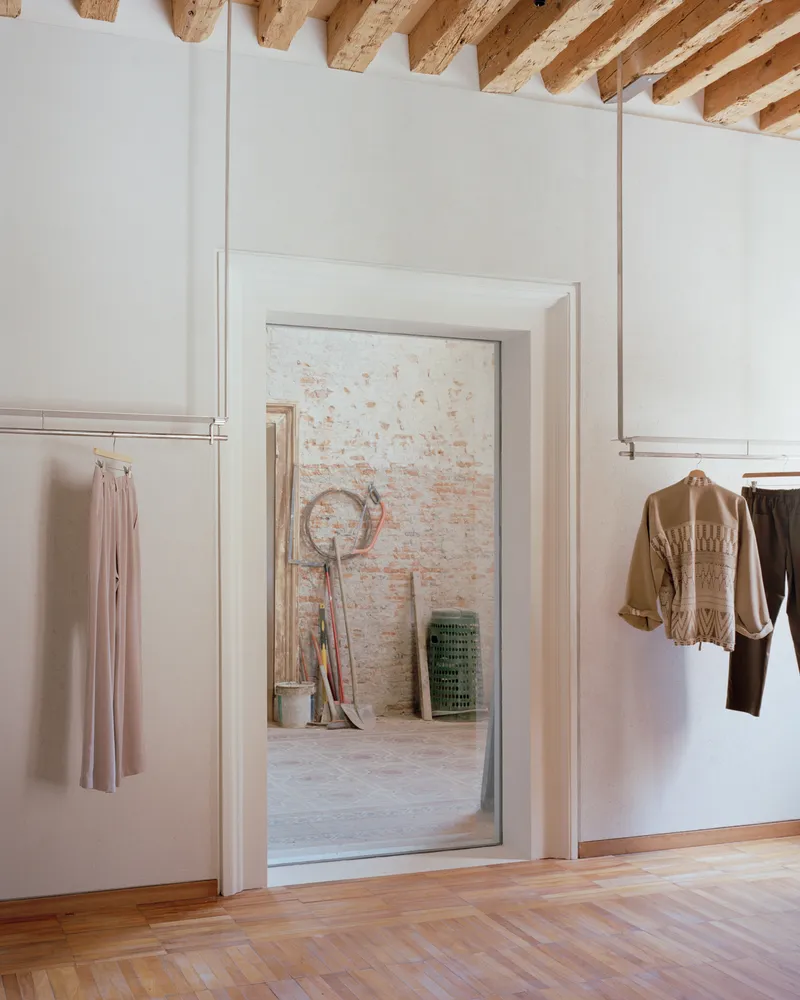
These moments of material collision are never smoothed over. A doorway frames a room with painted white brick walls and herringbone wood flooring, the threshold itself acting as a timeline. The okoumè laminate of the new frames, selected for its workability in both laminated and plywood formats, meets century-old stone with a clean shadow gap rather than a flush joint, keeping the two legible.
Garden, Courtyard, Park
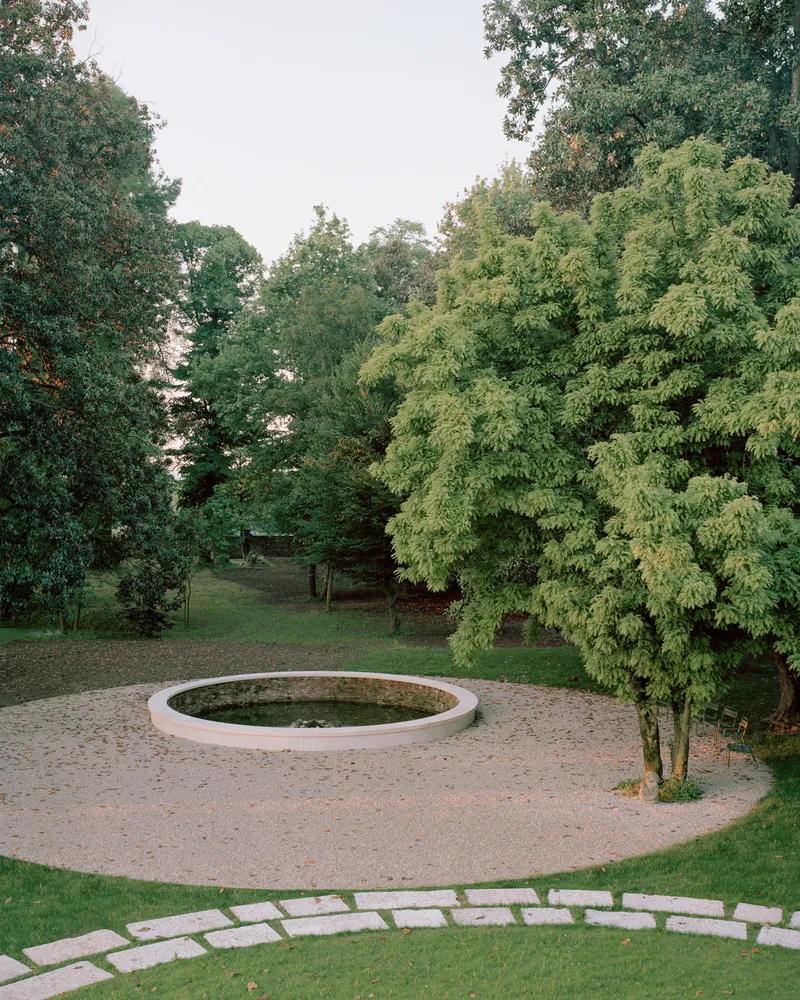
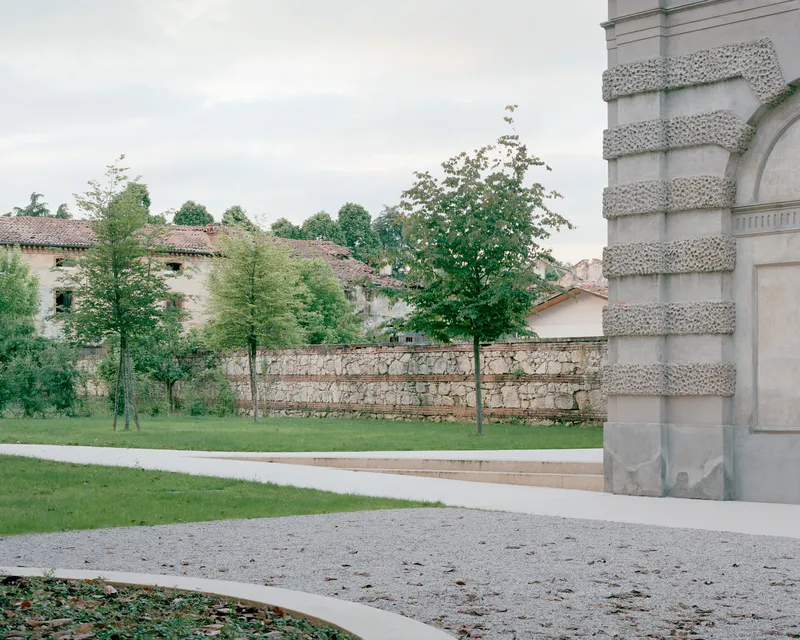
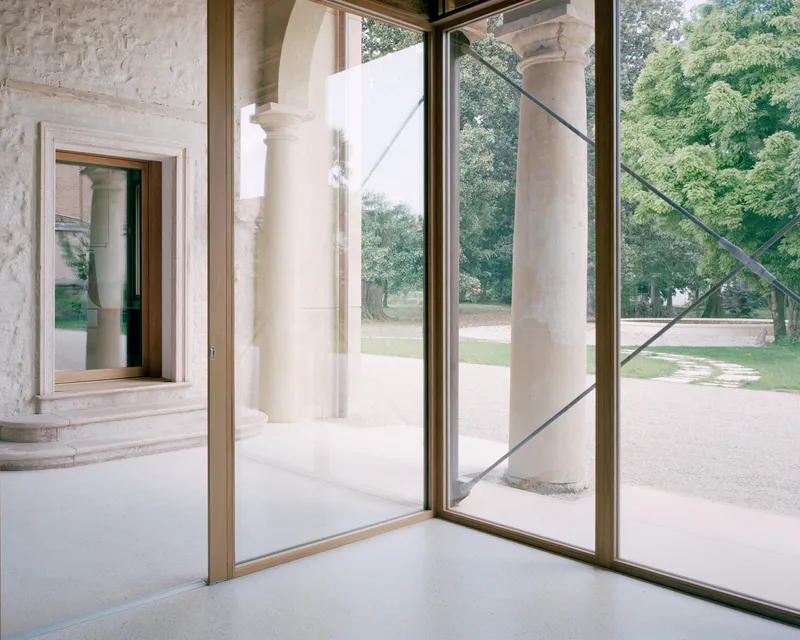
The site strategy is deceptively simple. A front garden accompanies the approach and ties the complex to the village. A rear functional courtyard handles building-related circulation. The existing park is conserved with discrete interventions around water features and rest areas. A circular stone fountain sits in a gravel courtyard surrounded by lawn and deciduous trees, unchanged in spirit if not in maintenance regime.
Looking through the open glass doors of the arcade toward the gravel courtyard and its stone columns, you get the project's clearest spatial proposition: the landscape is not backdrop but connective tissue, binding villa to barchessa to annex in a sequence of outdoor rooms that the building wraps around rather than walls off.
Details at the Seam
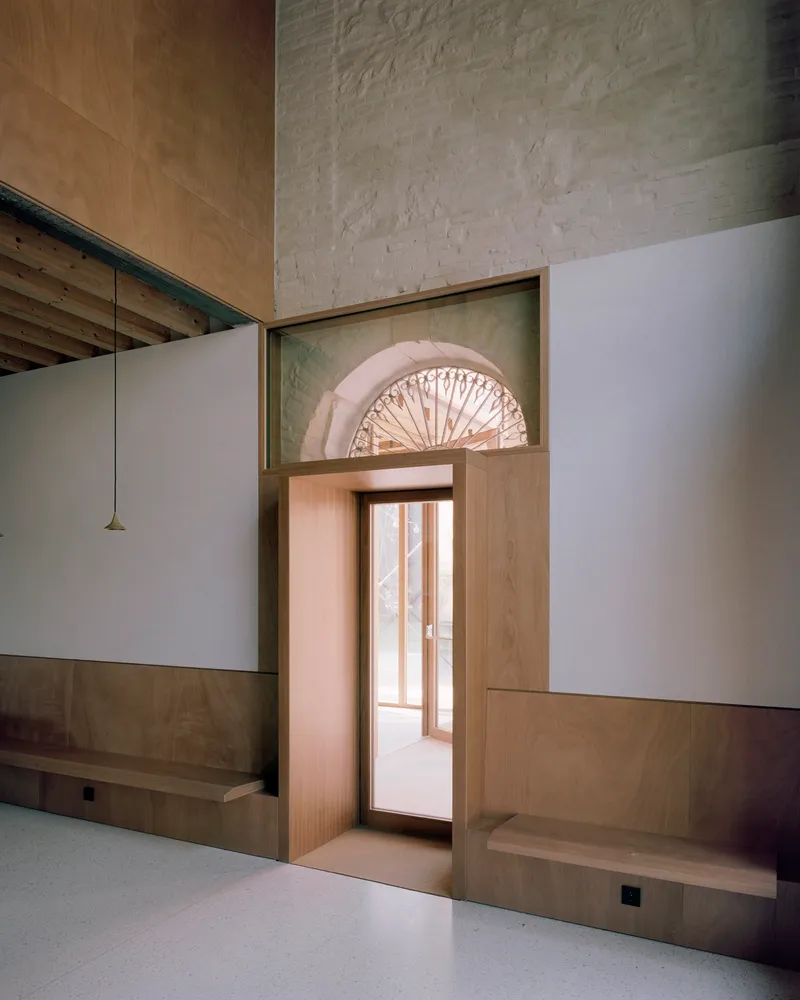
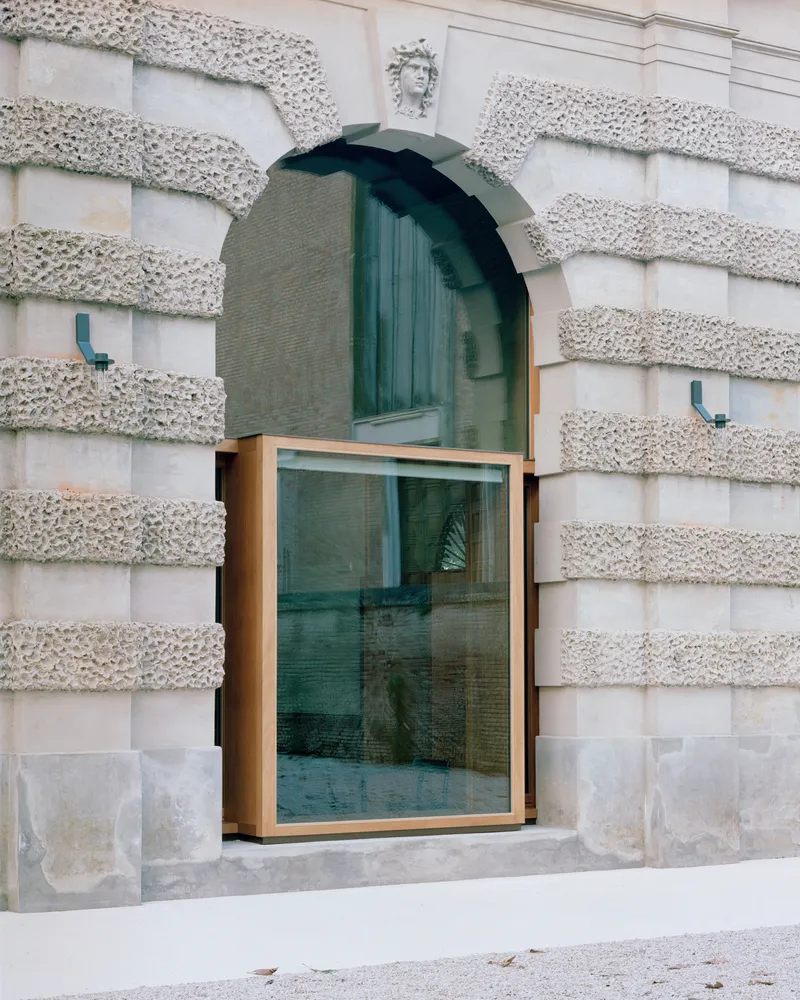
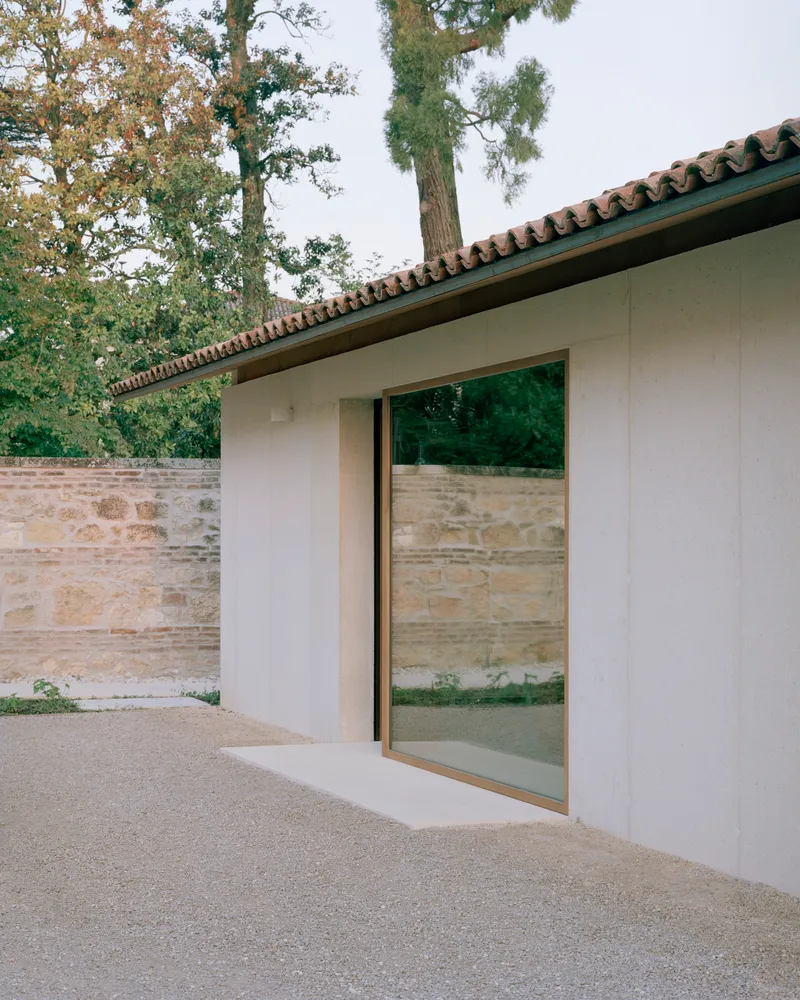
Close up, the project rewards attention. A bronze-framed glass window is set into a rusticated stone facade, the metal meeting the rough-hewn surface with a precision that acknowledges the gap between the two without apologizing for it. A sliding glass door slips into a white rendered wall beneath a clay tile roof, its track barely visible. These are not signature details designed for Instagram close-ups; they are problem-solving details designed for a building that needs to breathe, open, and close across seasons.
The protruding wooden box suspended over the glass opening in the central arch is perhaps the boldest single gesture: a new volume that floats above the arcade's datum line, declaring its independence from the stone below while borrowing its proportional discipline. It resolves a structurally incoherent condition left behind by years of abandonment, turning a liability into a formal proposition.
Context and Village Scale
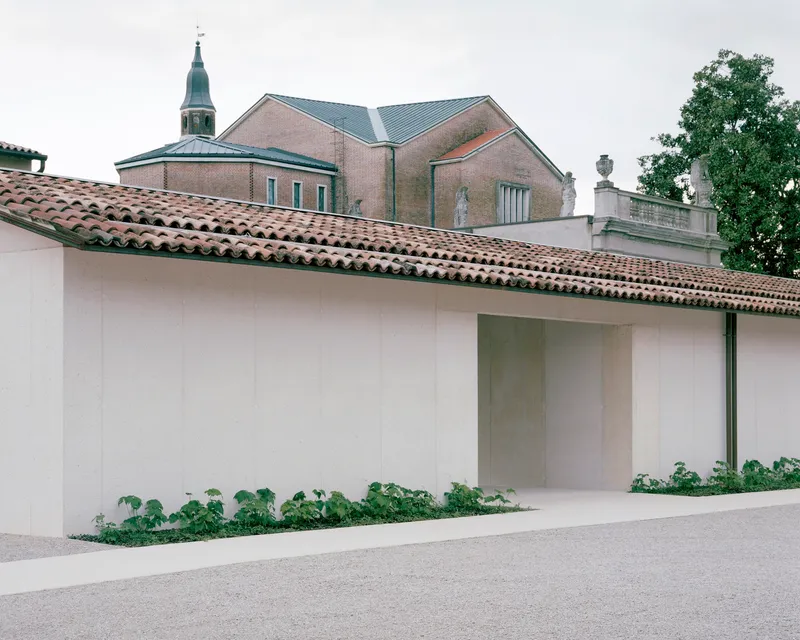
From outside the perimeter wall, you see a white plastered enclosure with a tiled roof and a recessed entry, the church campanile rising beyond. The complex does not announce itself as a coworking campus. It sits within the village fabric at the same scale and with the same material decorum as its neighbors, which is exactly the point. Adaptive reuse only works if the adapted building still belongs to its street.
Plans and Drawings
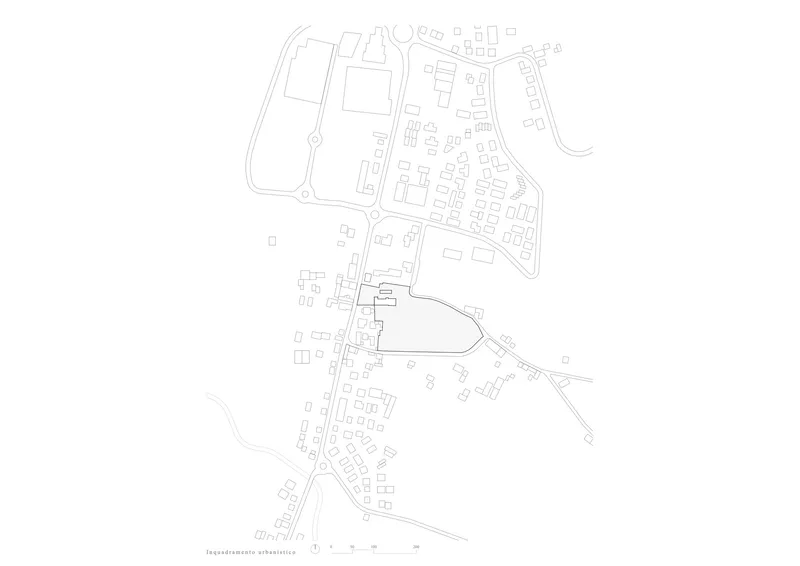
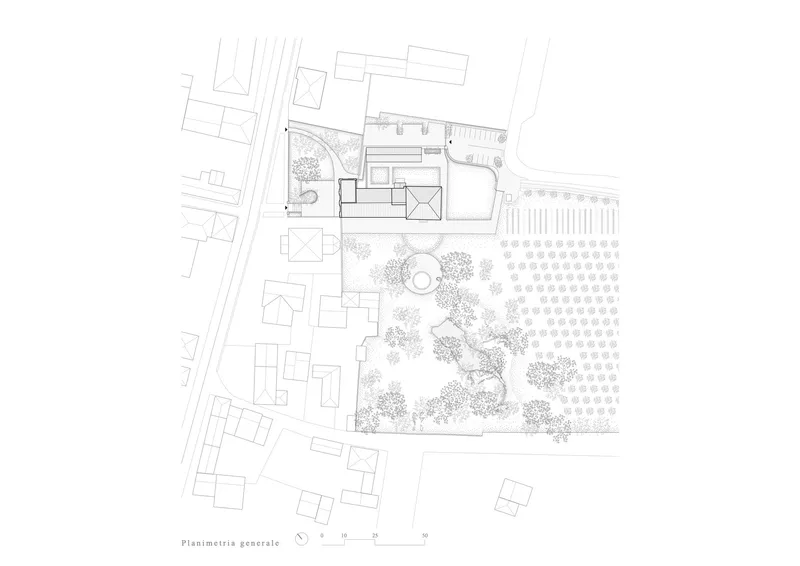
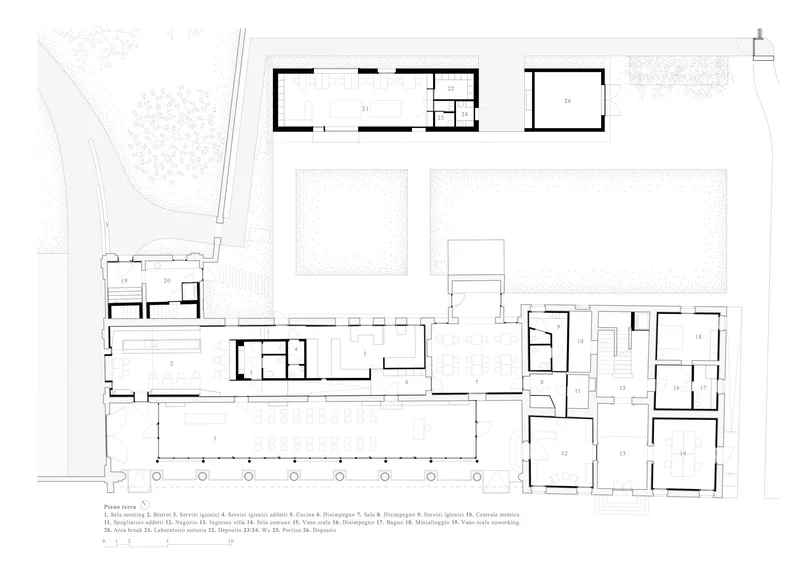
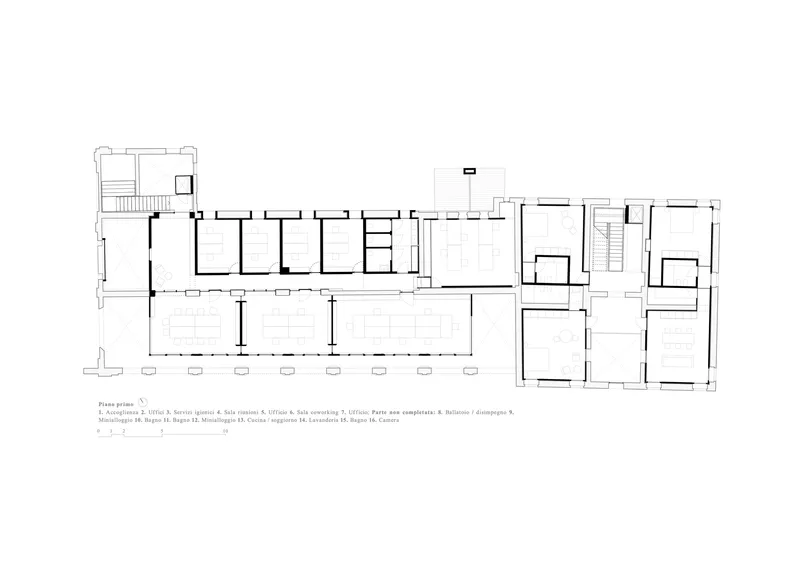
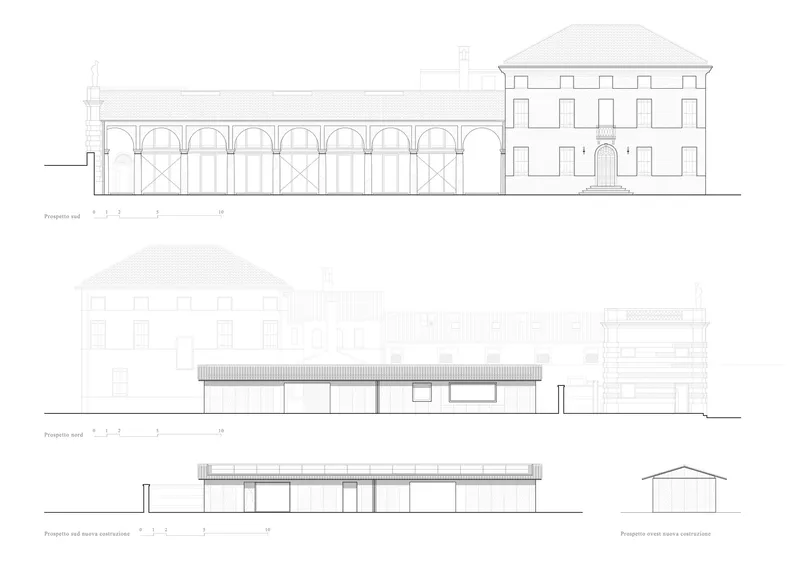
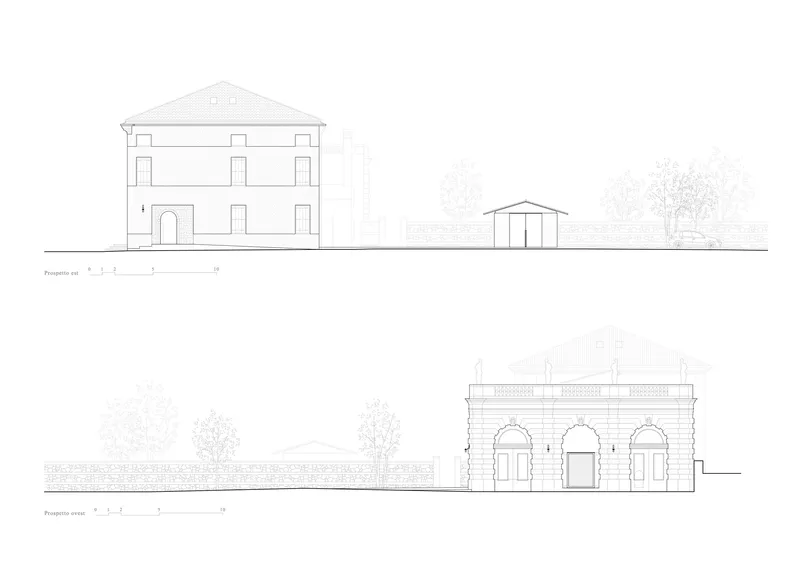
The site plan reveals what the photographs only hint at: the villa complex occupies a generous parcel with a large rear garden, an adjacent orchard, and clear connections to the surrounding village streets. The ground floor plan shows the barchessa's colonnade acting as a covered spine, linking the main villa's more compartmentalized rooms to open courtyards on either side. Upstairs, a long corridor with repeated rooms recalls the serial logic of a traditional piano nobile, now repurposed as individual offices.
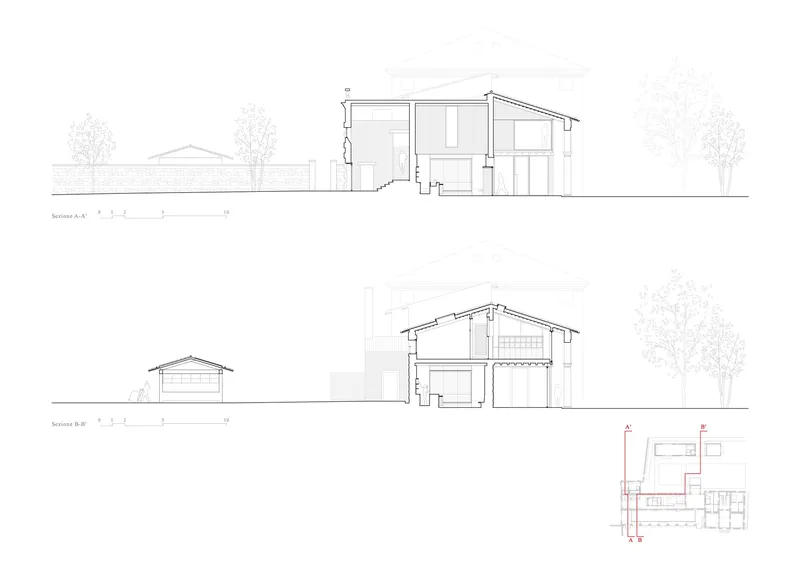
The sections and elevations are where the structural doubling becomes clearest. The sloped roof of the new annex echoes the barchessa's pitch, while the two-story villa's triangular pediment anchors the composition. You can read the iron beams, the timber frame offset from the original masonry, and the skylight openings all in the same drawing: a single section through three centuries of construction logic.
Why This Project Matters
There is no shortage of heritage conversions that succeed on atmosphere alone: exposed brick, pendant lights, a nice espresso machine, and a press release about "honoring the past." Vis-à-Vis Venetian Villa is a rarer thing. It succeeds because its structural interventions, its material choices, and its spatial organization are all doing the same work: making legible the layered history of a building that nearly collapsed under the weight of its own neglect. Iron beams do not hide behind plasterboard. Concrete stairs do not pretend to be stone. The result is a workplace that teaches you how to read a building every time you walk to a meeting.
RigonSimonetti has also, perhaps more importantly, demonstrated that adaptive reuse at a village scale does not require a signature gesture visible from the highway. The villa still looks like a villa. The barchessa still looks like a barchessa. The campanile still rises above the roofline. What has changed is the life inside, and that is exactly the kind of architecture that Veneto's smaller towns need if they are going to keep their historic fabric in use rather than behind a velvet rope.
Vis-à-Vis Venetian Villa by RigonSimonetti. Costabissara, Italy. 714 m². Completed 2025. Photography by Rory Gardiner and Alberto Sinigaglia.
About the Studio
Share Your Own Work on uni.xyz
If projects like this are the kind of work you want to make, uni.xyz is a place to publish your own, find collaborators, and enter design competitions.


Popular Articles
Popular articles from the community

Faces of the Soviet Avant-Garde: Turning Moscow's Street Names into an Open-Air Museum
A network of sculptural installations across a Moscow residential district transforms forgotten architect names into spatial encounters with cultural memor
Tsunami Convergenics: Turning Catastrophic Ocean Forces into Underwater Housing Infrastructure
A speculative underwater settlement off the coast of Onagawa, Japan, treats tsunamis and typhoons as energy sources rather than threats.
Cloaked Colonization: A Mobile Underwater Habitat That Moves Like a Fish
Micah Abaya's shortlisted EHC Pacific entry reimagines ocean settlement as a dispersed network of self-sustaining architectural organisms.

Opera by the Sea Estonia: Three Shells Dissolving Architecture into Tallinn's Coastline
A winning opera house proposal replaces monumental form with interconnected shells that blur the boundary between building, park and Baltic Sea.

Similar Reads
You might also enjoy these articles

Pixel Gardens: One Repeated Module Stacked Into a Terraced Social Housing Tower for Famagusta
Salem Bader's shortlisted housing tower builds a vertical neighbourhood from one repeated module, offsetting units to carve terraces, light and air.

Bao Huynh Watercolor Atelier: A Serene Art Retreat in Hội An
Bao Huynh Watercolor Atelier in Hội An blends multifunctional art spaces, sustainable design, local materials, and family-friendly living in a serene environment.

Atelier Macri Concept Store Interior Design by CASE-REAL
Atelier Macri store features a "ko" counter, walnut wood details, cork displays, blending retail, gallery, and seamless customer experiences.

Manuel Vargas Izquierdo Stadium and High-Performance Sports Center: Architectural Excellence in Jalpa de Méndez
The Manuel Vargas Izquierdo Stadium blends sustainable design, inclusive sports facilities, and cultural-inspired architecture, revitalizing Jalpa de Méndez’s public spaces.

Explore Villa Vernacular Competitions
Discover active competitions in this discipline

Challenge to design mud housing for contemporary communities

Challenge to reimagine the Iron Throne

Photograph architecture without architects

Illustrate the lost glory of Angkor Wat - Render Challenge
Comments (0)
Please login or sign up to add comments
No comments yet. Be the first to comment!