

RISCO Threads 61 Apartments Through a 15th-Century Lisbon Convent Turned Factory
Five heritage buildings along the Tagus become three distinct residential segments organized around landscaped courtyards in eastern Lisbon.


A building that has been a hermitage, a convent, a grain factory, and a ruin does not yield easily to a new program. The Convento do Beato in eastern Lisbon sat in severe decay when RISCO began working on the residential conversion in 2007, a project that would not see completion until 2024. What emerged after nearly two decades of planning and construction is not one building but five, grouped into three segments the architects call Arch, Brick, and View, containing 61 apartments that range from compact 67-square-meter units to 470-square-meter duplexes.
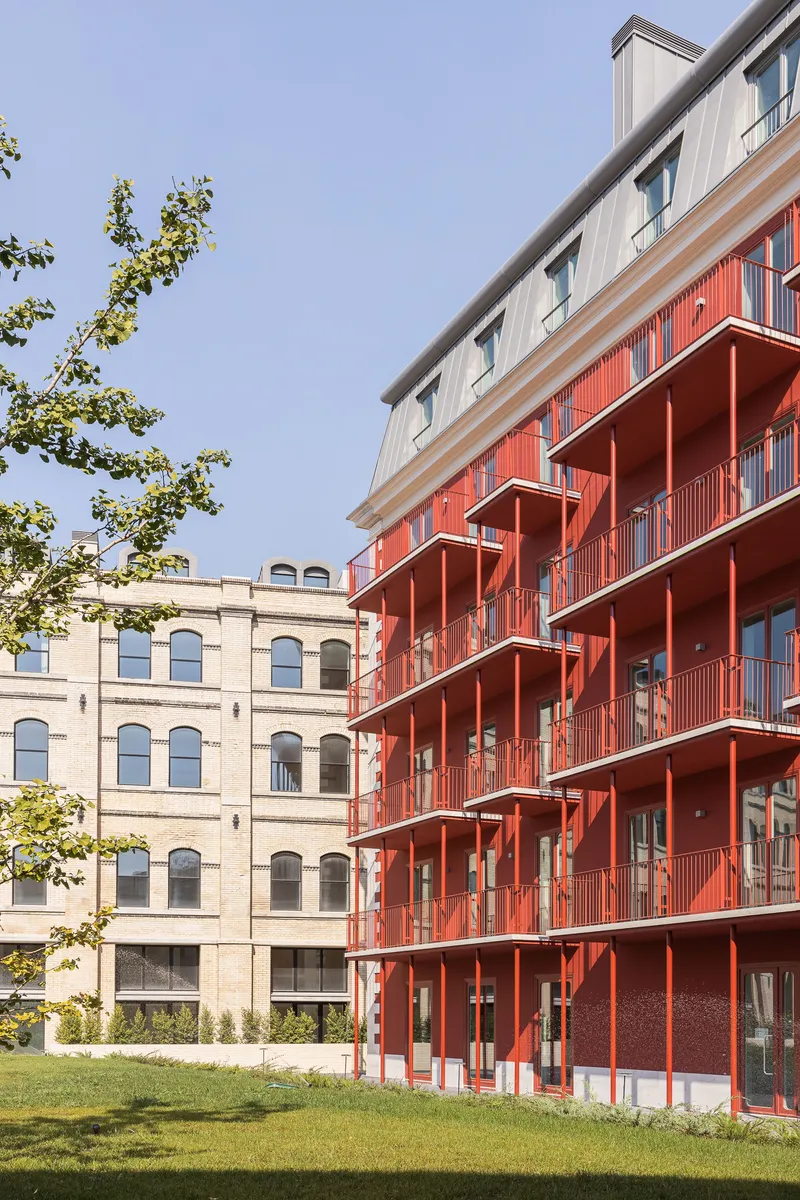
The most interesting move here is the refusal to apply a single conservation strategy. RISCO treats each building as a different problem. In some cases only the facades survive; in others, original cast iron columns and timber beams were retained and celebrated. Technical installations are sometimes hidden, sometimes exposed as compositional elements. New additions speak in a decidedly contemporary language of red corrugated metal and angled balconies, while other interventions replicate historic carpentry and masonry with painstaking accuracy. The result is a residential complex that reads as a stratigraphic record of its own transformation.
Three Segments, Three Characters
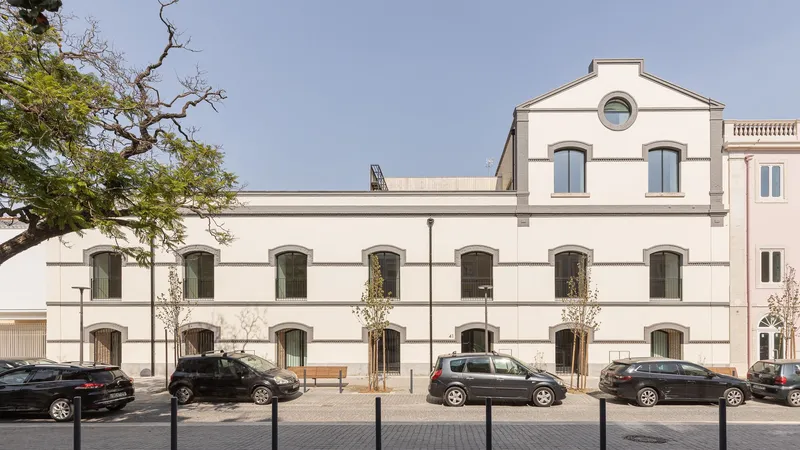

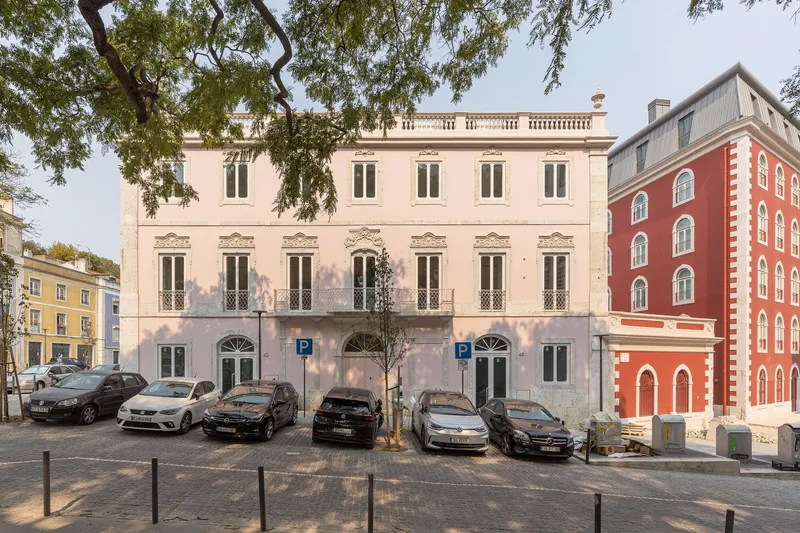
RISCO organizes the five buildings into three segments that draw their identities from the material culture of the existing structures. The Arch segment, encompassing three buildings, takes its name from the ornate stonework and decorative arched openings that define its facades. The white rendered frontage with horizontal banding and arched windows signals a more palatial heritage, while the pink stucco facade with its ground-floor arches belongs to the same family of gesture. The Brick segment, a single building, borrows the language of Lisbon's industrial past: red brick with white quoining and arched windows, topped by a gray metal penthouse that announces its contemporaneity without apology.
The View segment, housed in a former milling building, preserves the cast iron pillars and wooden beams that once supported industrial loads. These three distinct identities prevent the complex from reading as a single monolithic conversion. Instead, residents choose not just a floor plan but a material world.
Old Walls, New Moves
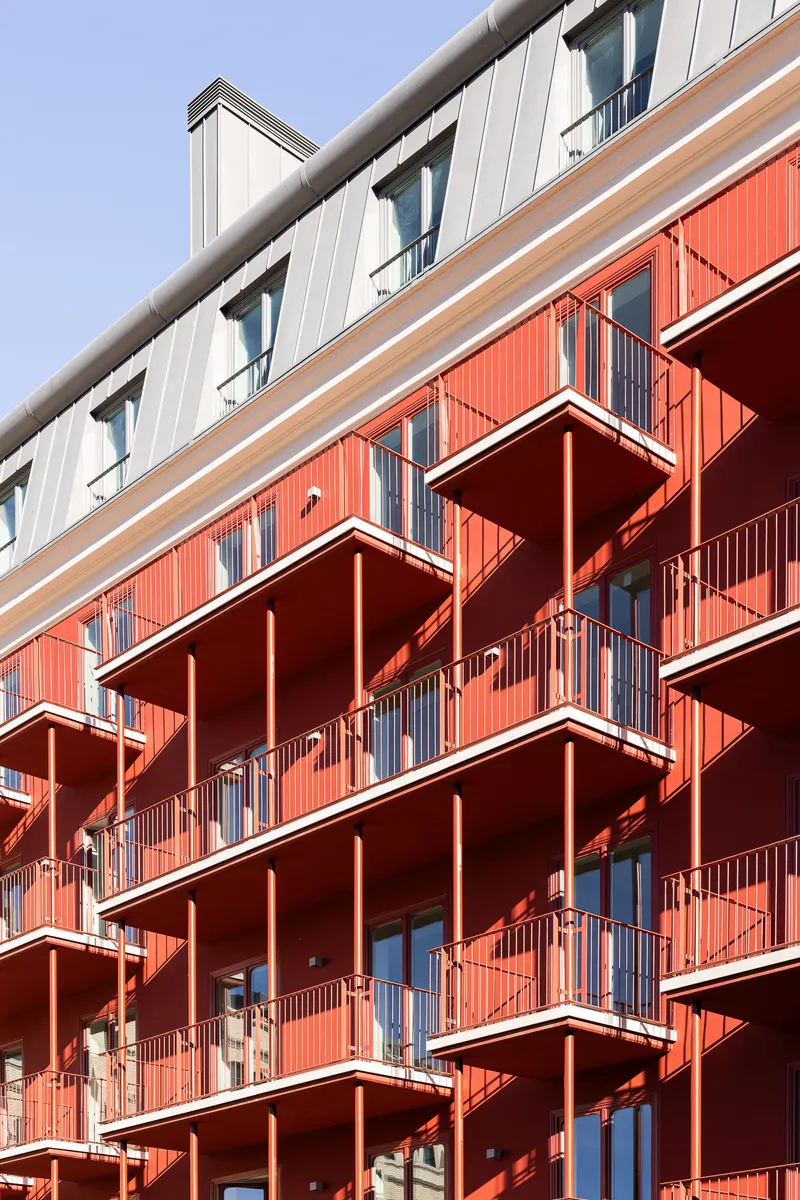


The tension between heritage fabric and contemporary insertion is handled with confidence rather than deference. The red corrugated metal facades and angled balconies protruding from the new block make no attempt to mimic the adjacent arched brick walls. An ornamental red metal elevator enclosure sits boldly against historic brickwork, its material kinship with the new balconies creating a secondary reading that ties old and new without blending them.
A discreet new building was introduced specifically to conceal the access ramp to underground parking, a pragmatic decision that acknowledges the site cannot function as a 21st-century condominium without car infrastructure, yet refuses to let that infrastructure define the experience at ground level. The buff brick landscaped entry wall with young trees suggests that the architects approached the public threshold with as much care as the apartment interiors.
The Courtyards Hold It Together
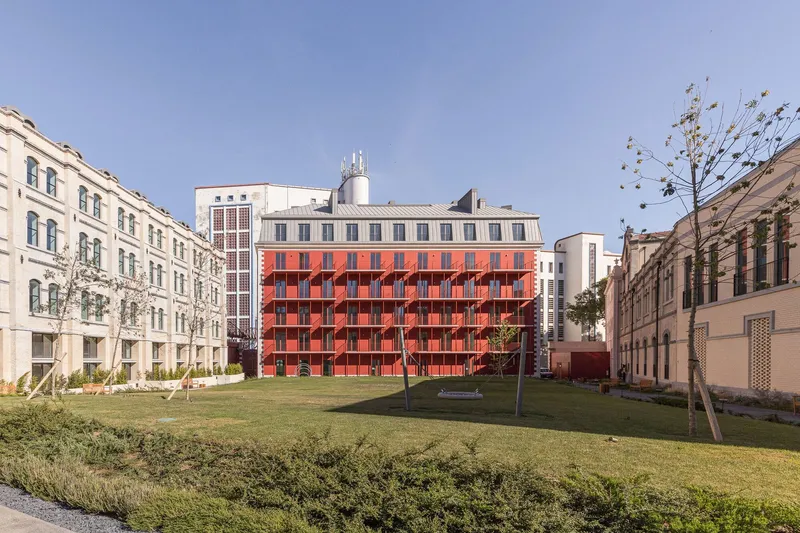
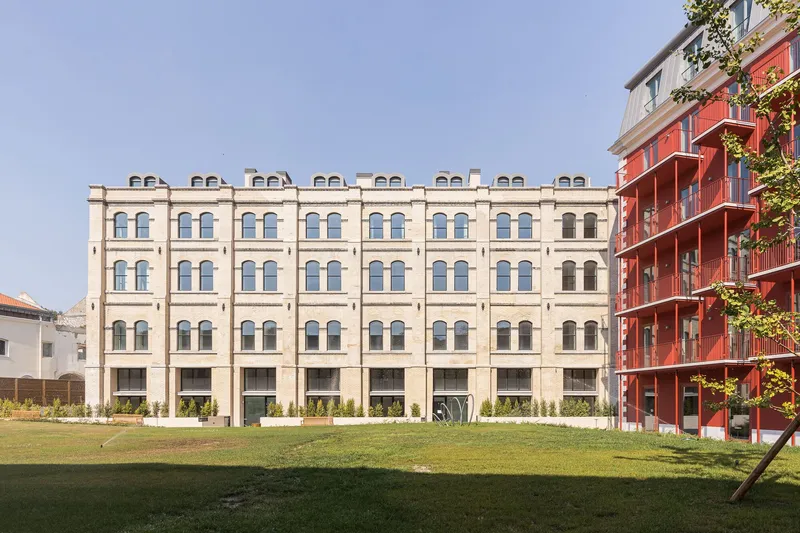

Two landscaped courtyards structure the entire development, and they do real spatial work. The central lawn courtyard, framed on one side by the red corrugated facade and on the other by cream masonry with paired arched windows, establishes a legible domestic commons that avoids the antiseptic quality of many heritage conversions. Planting and paving mediate between the different building characters, creating a collective ground plane where the Arch, Brick, and View segments can coexist without competing.
Ground floors throughout the complex have been adapted for entrances, shared spaces, and uses compatible with residential life, keeping the courtyards active rather than ornamental. The pedestrian pathway between cream brick wall and planted beds establishes a clear hierarchy: this is a place for walking, not driving.
Heritage Structure as Interior Architecture
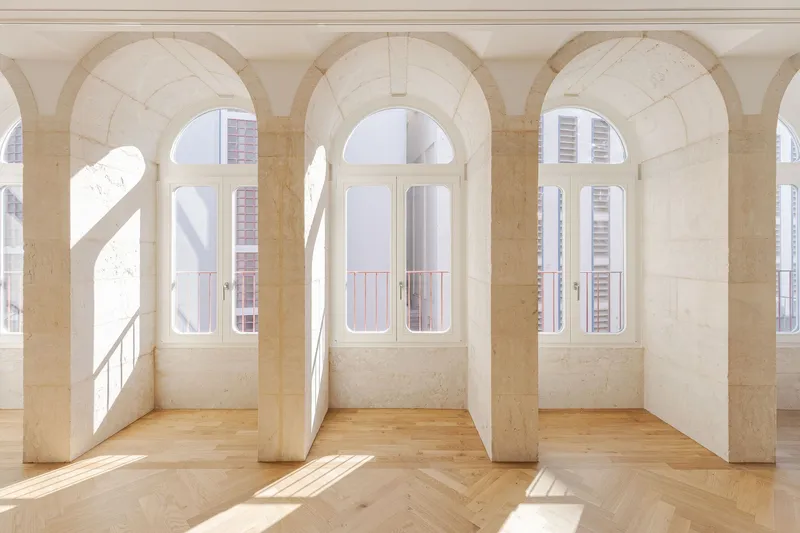


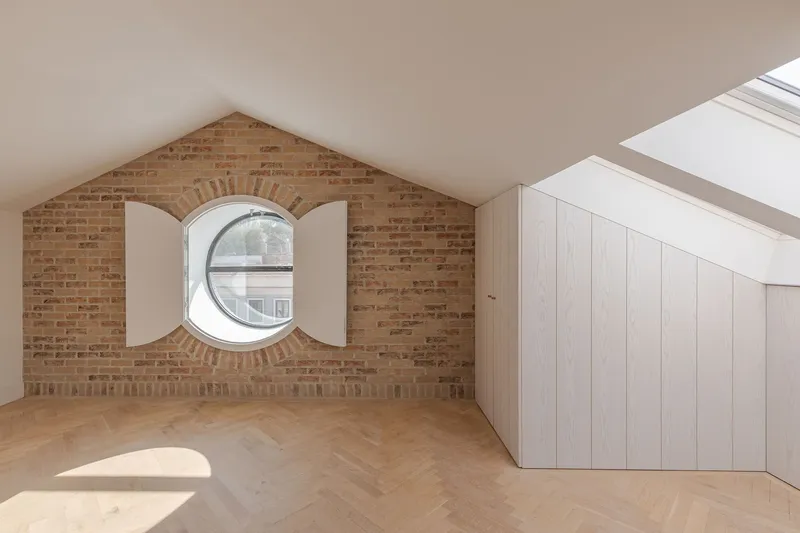
The strongest interiors are those where the architects let the original structure set the terms. Stone arched openings become room dividers. White columns with arched windows lined with stone wainscoting establish a rhythm that no contemporary partition wall could replicate. An exposed brick gable wall with its circular window reads as a found object elevated to the status of interior focal point. These are not compromises forced by conservation regulations; they are genuine spatial discoveries.


The vaulted entry space with its patterned terrazzo floor and arched window shadows communicates the building's monastic past more eloquently than any interpretive plaque could. RISCO's decision to preserve these moments rather than plaster over them gives residents a daily encounter with five centuries of construction history.
Domestic Warmth Across 61 Variations


Herringbone oak flooring appears throughout the apartments, serving as a unifying material across units that otherwise vary dramatically. A slender white column standing in an open living space, sunlight pooling on the floor, could belong to any well-appointed Lisbon apartment, but the decorative ceiling medallion above the kitchenette volume anchors it in a specific history. Six tall windows casting afternoon light across a room remind you that these proportions were drawn for institutional grandeur, not domestic comfort, yet comfort is exactly what they deliver.
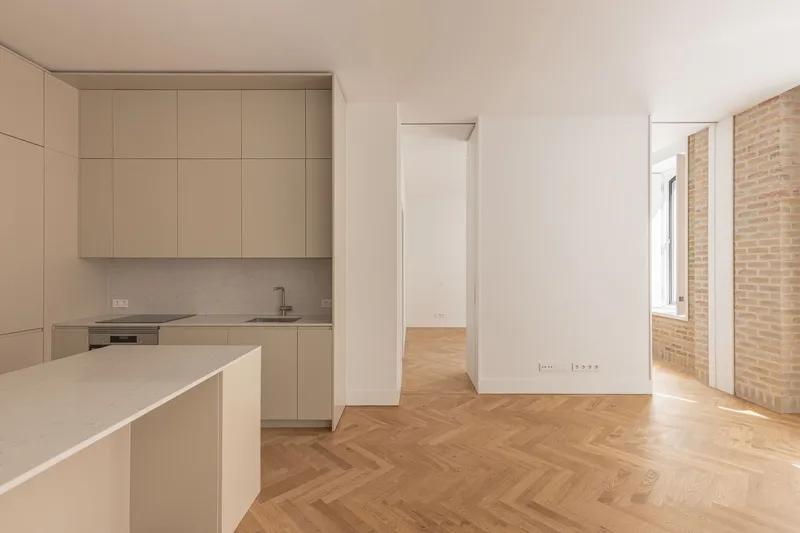


The kitchens reveal the range of the conversion. Pale cabinetry opening to an exposed brick wall sits in one unit; dark blue cabinetry with limestone countertops beneath a vaulted ceiling with a timber door occupies another. The apartments span from 67 to 348 square meters, with four-bedroom duplexes reaching 470 square meters. Balconies range from 3 to 159 square meters. This is not a developer's exercise in maximum repetition; each unit negotiates its own relationship with the existing structure.
The Quiet Spaces

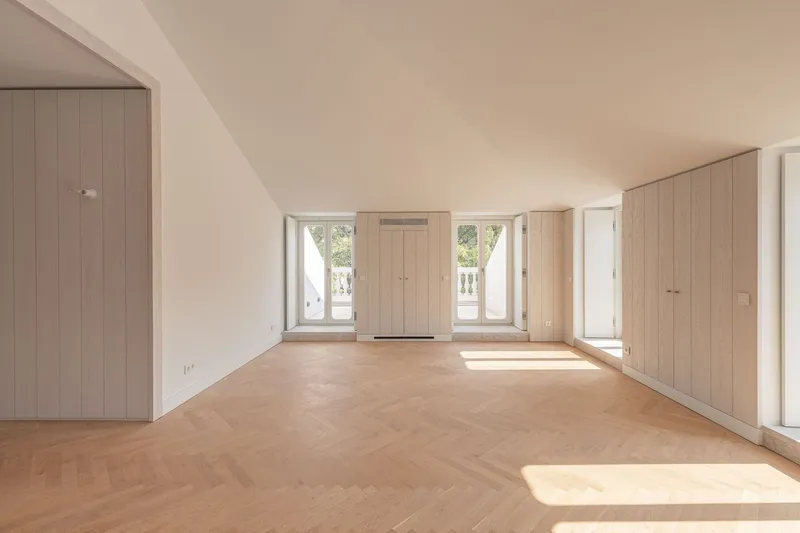

Some of the most considered moments happen in the circulation and secondary spaces. A timber staircase ascending toward a series of skylights transforms what could have been a utilitarian connector into a sequence of light. Rooms under sloped ceilings receive light wood built-in cabinetry that follows the geometry precisely. A hallway lined with timber-veneer panels and a pale oak ceiling connects rooms without interrupting the material flow. These are details that suggest the architects understood the project was not just about preserving facades but about making daily life within heritage walls feel effortless.


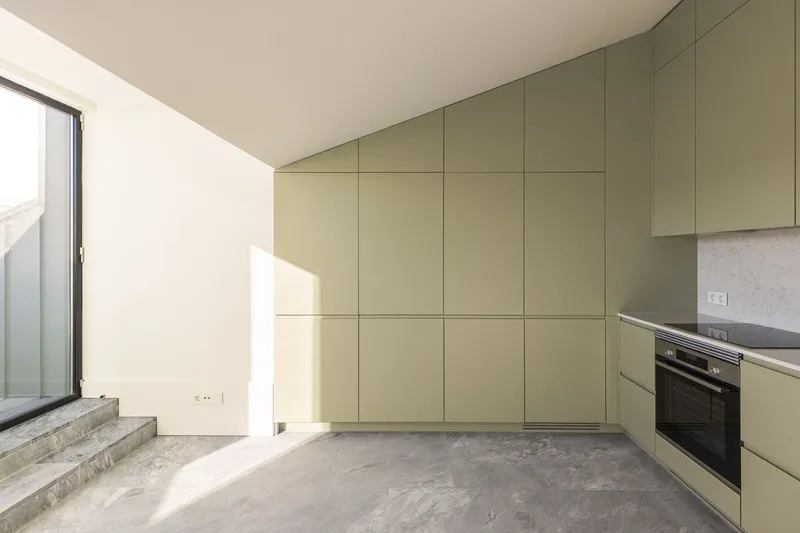
Deep-set windows with splayed reveals, rooms with triple glass doors casting shadow stripes, and rooms with full-height olive-green cabinetry and granite stairs opening to outdoor terraces: the variety is genuine. RISCO accepted that five buildings with different histories would produce different spatial conditions, and designed accordingly rather than imposing uniformity.
Living on the Roof
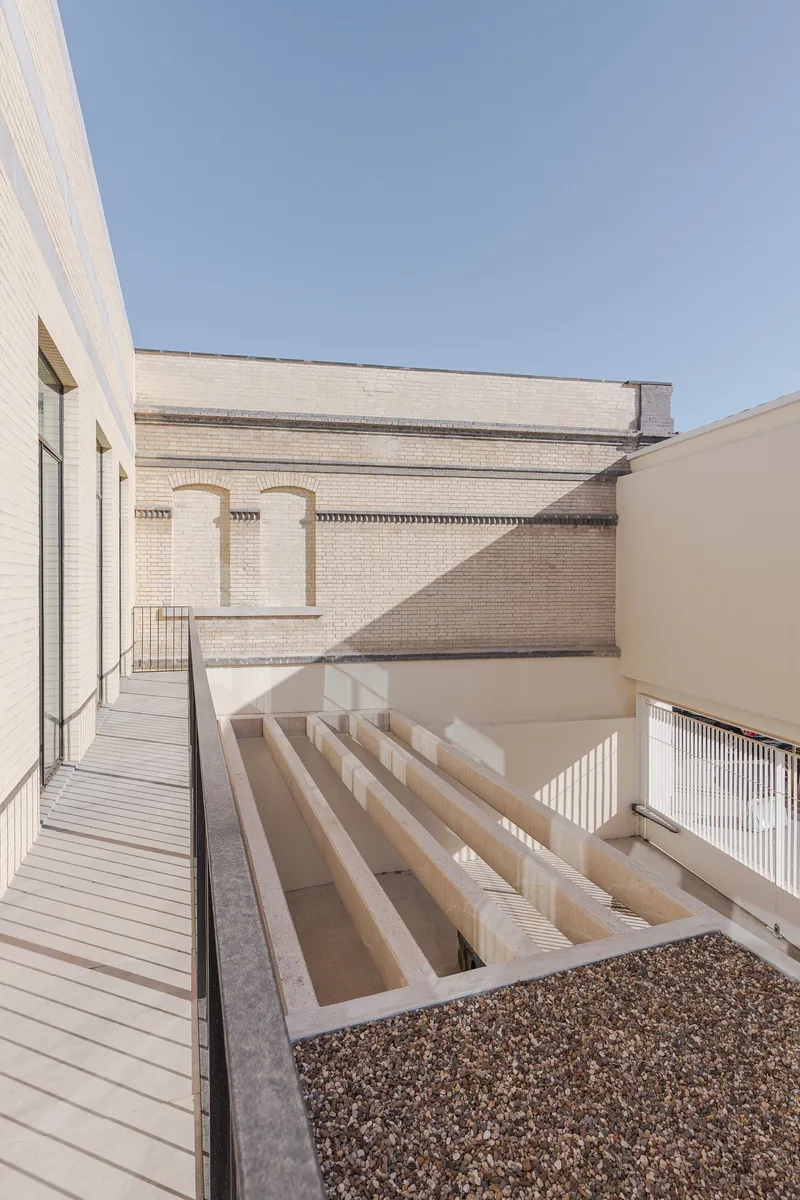

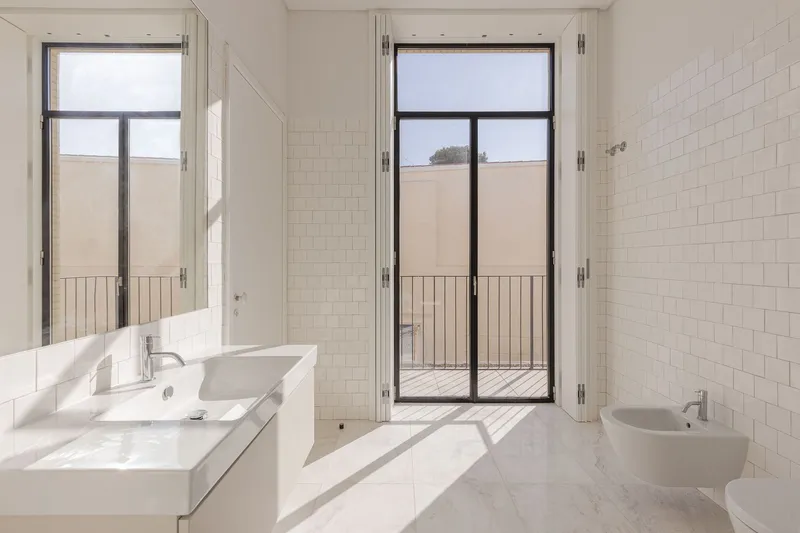
The rooftop terrace with timber decking and a saw-tooth skylight structure offers residents a shared amenity that capitalizes on Lisbon's climate while acknowledging the industrial character of the Brick segment. Below, apartments open onto balconies framed by French doors, and bathrooms with white subway tiles give onto narrow terraces with metal railings. The architects treated outdoor space as a continuum, from the collective courtyards to the private balconies to the communal roof, each scaled to a different kind of encounter.

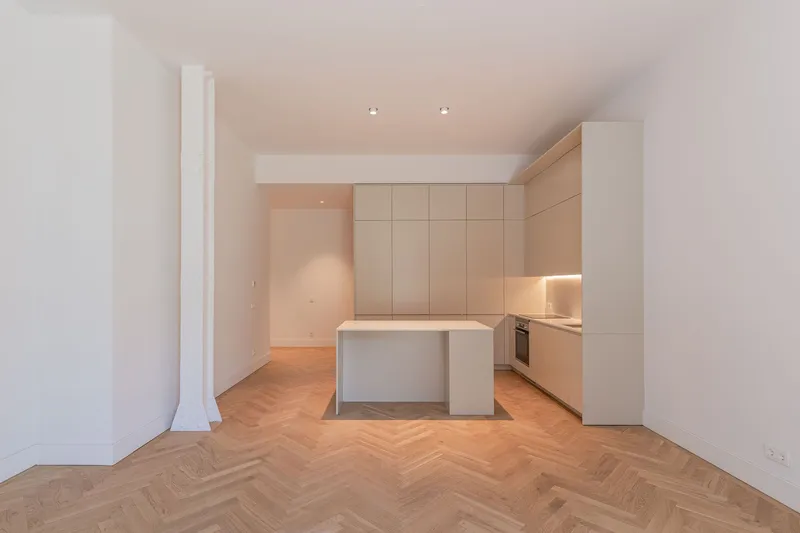
Compact kitchens with islands sit under dropped ceilings, absorbing the structural depth of the floors above. A bathroom with glazed doors opens to a view of the red facade beyond, collapsing the distance between interior and exterior. These small moves add up. They suggest that RISCO never lost sight of the lived experience even while managing the enormous logistical challenge of a multi-building heritage conversion.
Plans and Drawings
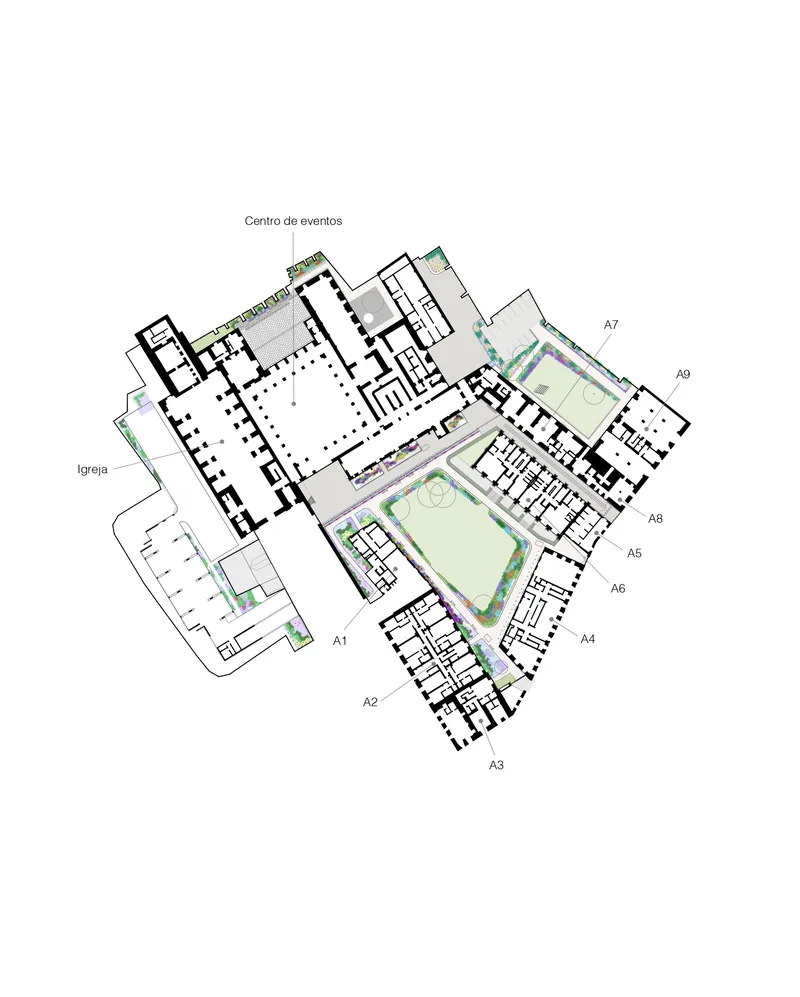
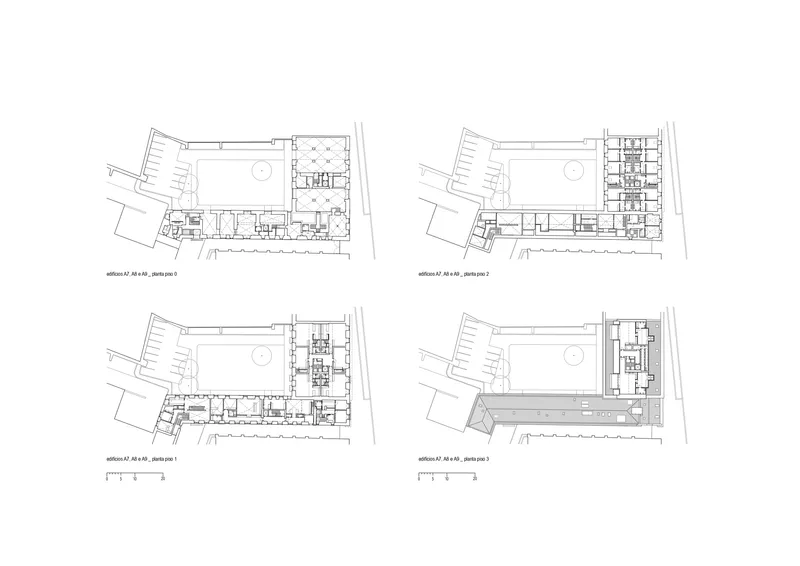

The site plan reveals how the five buildings wrap around the two central courtyards, with the new parking access building tucked discreetly to one side. Floor plans show the variety of unit configurations across levels: ground floors given over to entries and communal uses, upper floors carved into apartments of wildly different sizes. The irregularity of the existing footprints produces plan geometries that no architect would draw from scratch, and that is precisely their value.
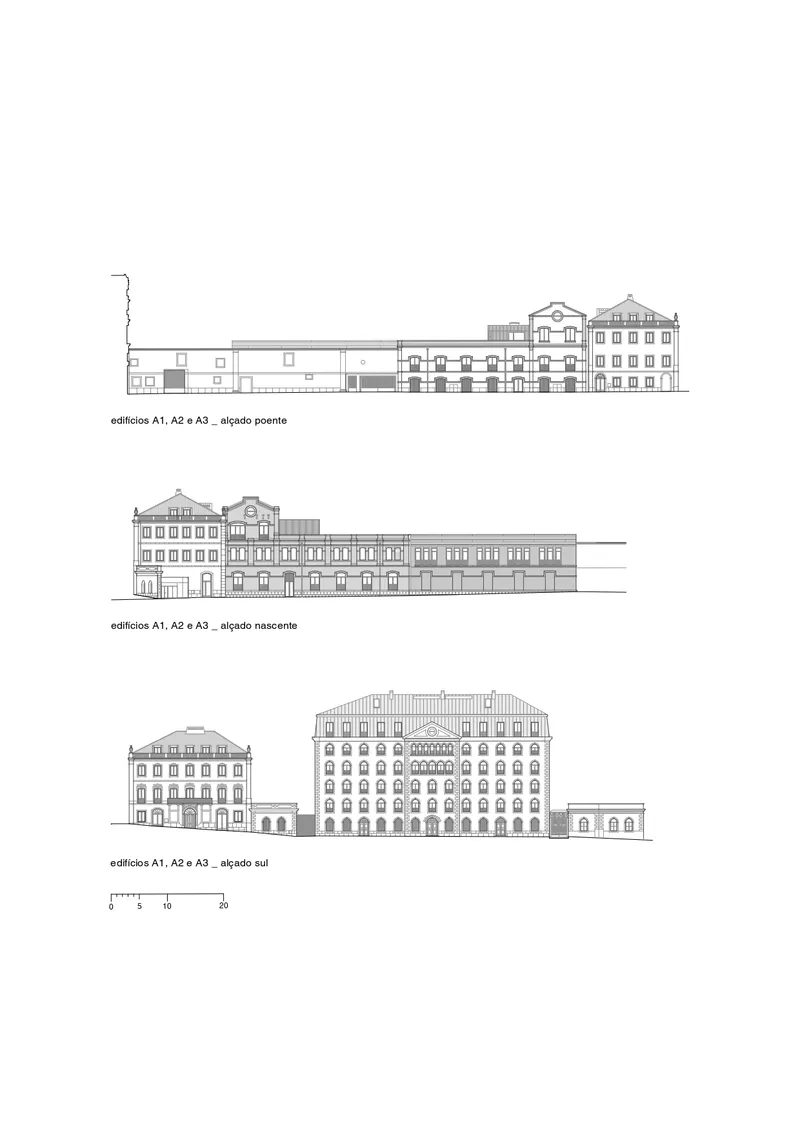

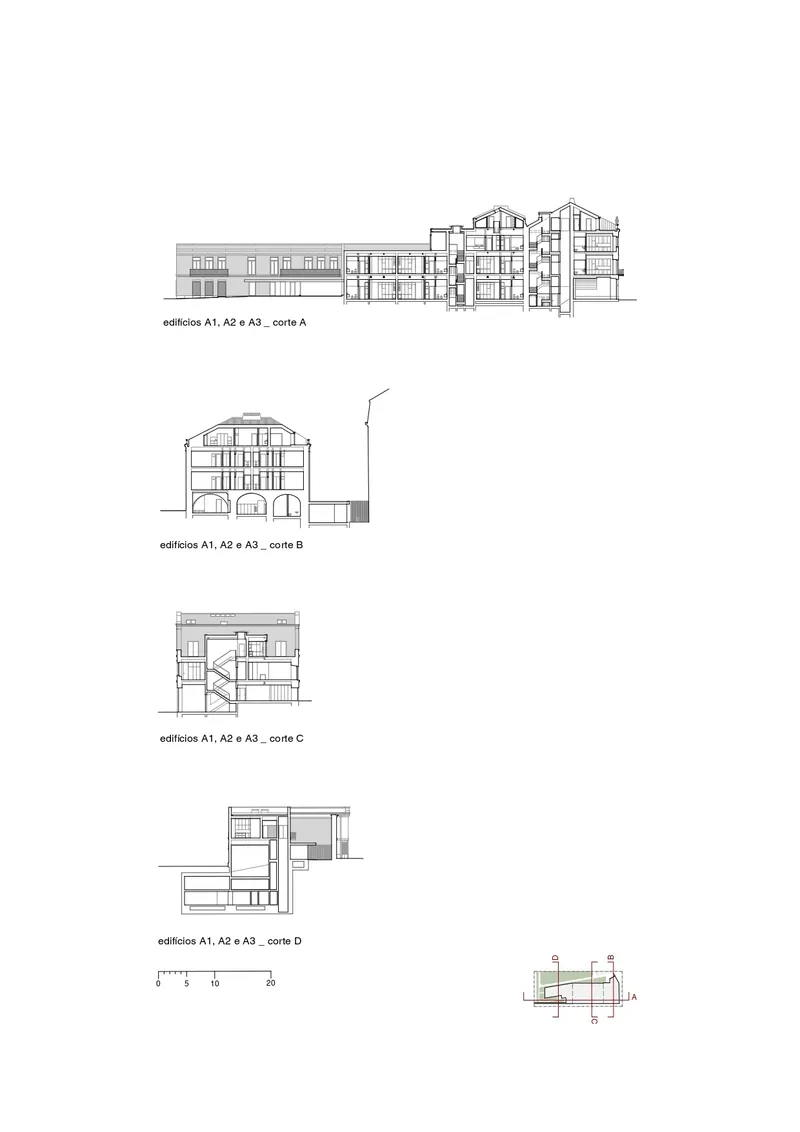
The elevations and sections are the most revealing drawings. They show how the facade compositions vary building by building, with traditional fenestration patterns preserved where they existed and new openings introduced only where structural or programmatic logic demanded them. The sections cut through the interconnected volumes to expose the interior spatial organization: double-height spaces in the former mill, conventional floor-to-floor heights in the palatial residence, and the complex roofline of gabled structures adapted for duplex living.

The gabled roof sections are particularly instructive. They illustrate how RISCO exploited the existing roof geometry to create upper-level apartments with sloped ceilings and built-in storage, turning a conservation constraint into a spatial asset. The drawings make clear that this was never a simple skin-deep renovation; the entire internal logic of five buildings was reimagined.
Why This Project Matters
Heritage conversions to residential use frequently fall into one of two traps: either the old fabric is treated as untouchable scenery behind which generic apartments are inserted, or it is stripped to a shell and rebuilt as a luxury product that retains the address but none of the character. RISCO avoids both by calibrating each intervention to the specific building in front of them. When the internal structure of building A6 was too degraded to save, they replaced it. When the cast iron and wood structure of building A4 could be preserved, they celebrated it. The result is a complex where the conversation between old and new is always specific, never formulaic.
Seventeen years from commission to completion is a long time, and Lisbon changed enormously over that span. The eastern waterfront, once industrial and marginal, is now one of the city's most desirable corridors. The Convento do Beato Residential Complex arrives into that market not as a generic luxury offering but as 61 distinct arguments for living inside history. The three-segment strategy, the courtyard organization, the willingness to let each building speak its own material language: these are decisions that take longer to execute but produce places that resist obsolescence. In a city increasingly defined by rapid turnover and speculative conversion, that patience counts for something.
Convento do Beato Residential Complex by RISCO. Lisbon, Portugal. 18,000 m². Completed 2024. Photography by Carolina Delgado.
About the Studio
Share Your Own Work on uni.xyz
If projects like this are the kind of work you want to make, uni.xyz is a place to publish your own, find collaborators, and enter design competitions.


Popular Articles
Popular articles from the community


Cloaked Colonization: A Mobile Underwater Habitat That Moves Like a Fish
Micah Abaya's shortlisted EHC Pacific entry reimagines ocean settlement as a dispersed network of self-sustaining architectural organisms.
Temporary Home for Dogs: A Reversed Zoo Rethinks Animal Shelter Architecture
In Bucharest, a sinuous corridor and freed landscape flip the logic of containment, designing a shelter that works to make itself unnecessary.

Manzana Morphosis: Stretching Barcelona's Grid into a Living Landscape for 2050
A radical reworking of the Eixample manzana turns density into a tool for generous public space, vertical ecology, and environmental performance.

Tsunami Convergenics: Turning Catastrophic Ocean Forces into Underwater Housing Infrastructure
A speculative underwater settlement off the coast of Onagawa, Japan, treats tsunamis and typhoons as energy sources rather than threats.

Similar Reads
You might also enjoy these articles

Pixel Gardens: One Repeated Module Stacked Into a Terraced Social Housing Tower for Famagusta
Salem Bader's shortlisted housing tower builds a vertical neighbourhood from one repeated module, offsetting units to carve terraces, light and air.

Bao Huynh Watercolor Atelier: A Serene Art Retreat in Hội An
Bao Huynh Watercolor Atelier in Hội An blends multifunctional art spaces, sustainable design, local materials, and family-friendly living in a serene environment.

Atelier Macri Concept Store Interior Design by CASE-REAL
Atelier Macri store features a "ko" counter, walnut wood details, cork displays, blending retail, gallery, and seamless customer experiences.

Manuel Vargas Izquierdo Stadium and High-Performance Sports Center: Architectural Excellence in Jalpa de Méndez
The Manuel Vargas Izquierdo Stadium blends sustainable design, inclusive sports facilities, and cultural-inspired architecture, revitalizing Jalpa de Méndez’s public spaces.


Comments (0)
Please login or sign up to add comments
No comments yet. Be the first to comment!