
Robert Day Sciences Center at Claremont McKenna College by Bjarke Ingels Group (BIG)
Innovative science center by BIG featuring rotating volumes, collaborative atrium, sustainable design, and integrated learning spaces at Claremont McKenna College.


A Dynamic Hub for Integrated Sciences and Interdisciplinary Learning in California
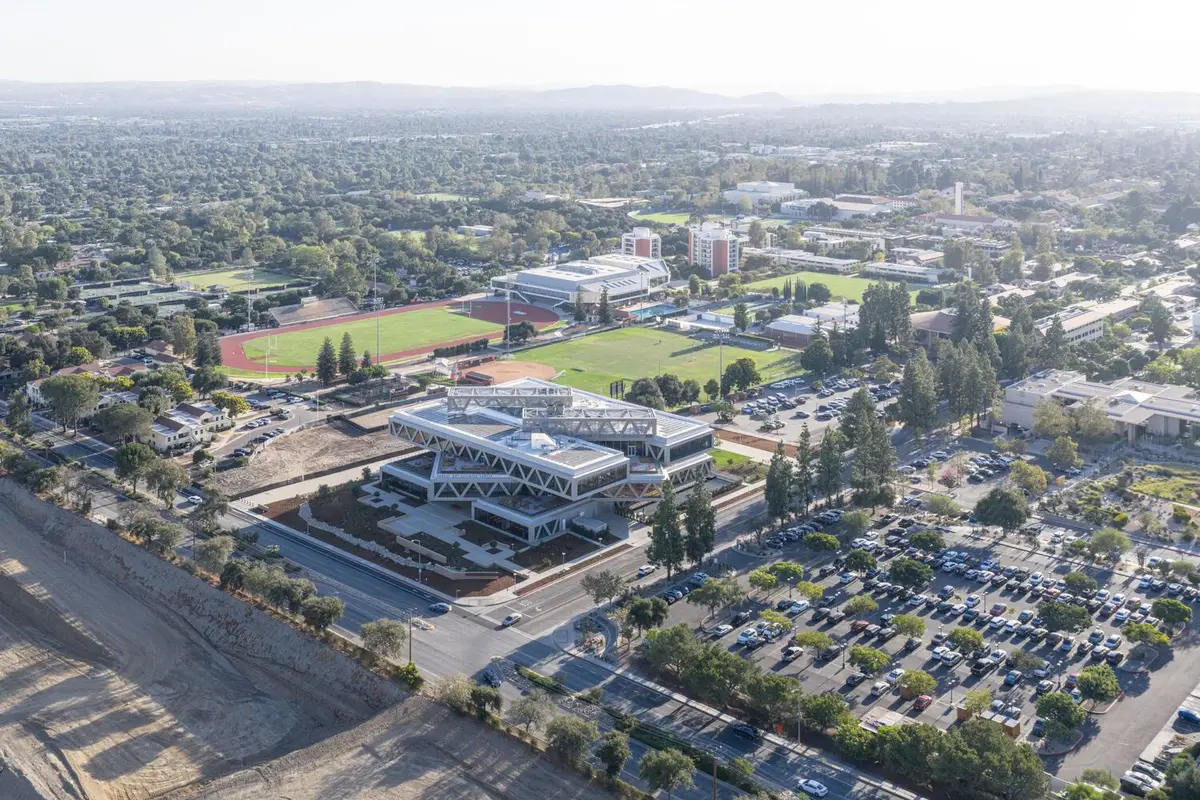
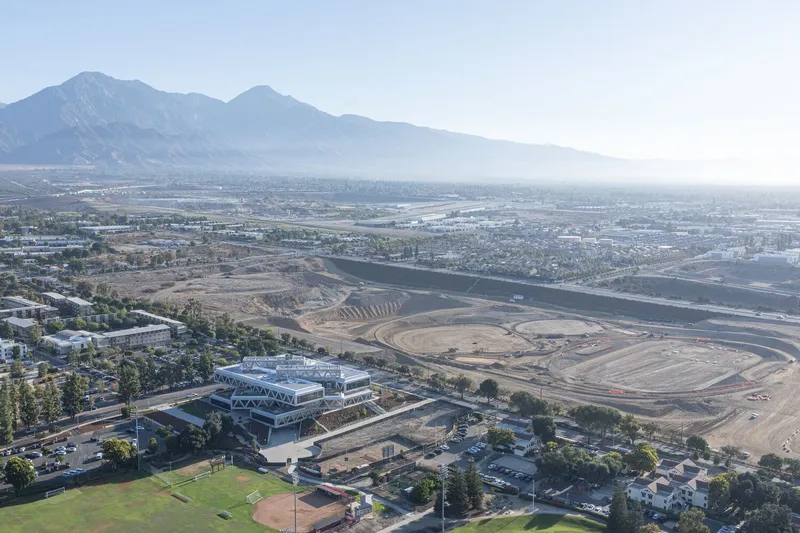
The Robert Day Sciences Center at Claremont McKenna College (CMC), designed by Bjarke Ingels Group (BIG), redefines the architecture of scientific learning through innovation, openness, and multidisciplinarity. Located in Claremont, California, this 135,000-square-foot academic building embodies the future of education—where science, technology, and humanism converge in a transparent and sustainable environment.
Commissioned in 2020, the center serves as a key component of CMC’s Roberts Campus Master Plan, also designed by BIG. As the firm’s first completed project in Los Angeles County, the building stands as a gateway to the college, symbolizing collaboration and intellectual fusion across disciplines.

Architectural Concept: Rotating Volumes and Fluid Connectivity
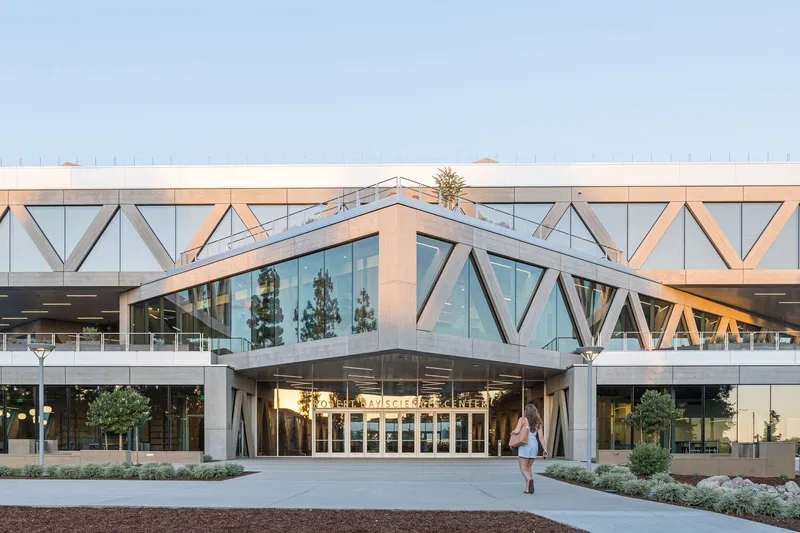
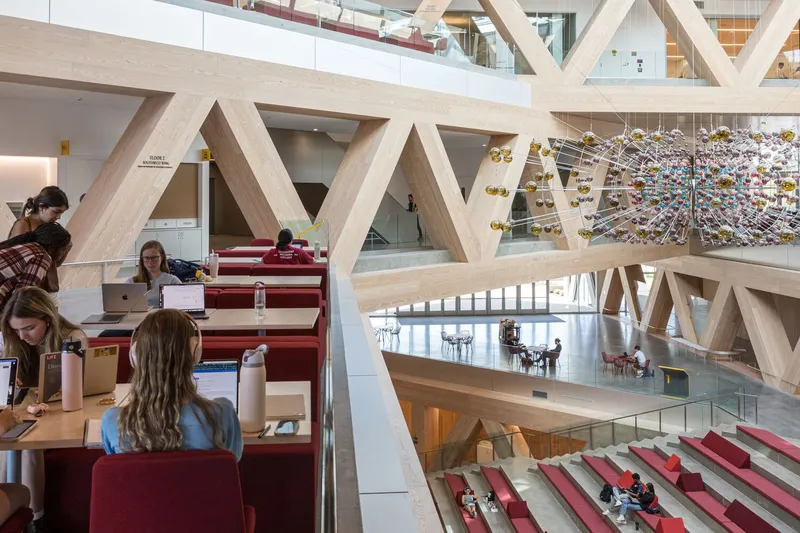
BIG’s design concept revolves around rotated volumes stacked vertically, with each level oriented in a different direction to foster interaction between departments and users. This geometric rotation forms a series of voids and overlaps that generate a full-height, sky-lit atrium at the heart of the building. The atrium becomes a dynamic social core where visual and physical connections encourage the free exchange of ideas.
Bjarke Ingels describes the building as “a crucible of learning,” where students and faculty from computer science, data science, and life sciences coexist in an open, three-dimensional environment. The design blurs traditional academic silos, transforming the learning process into an integrated and collaborative experience.
Material Expression and Structural Innovation
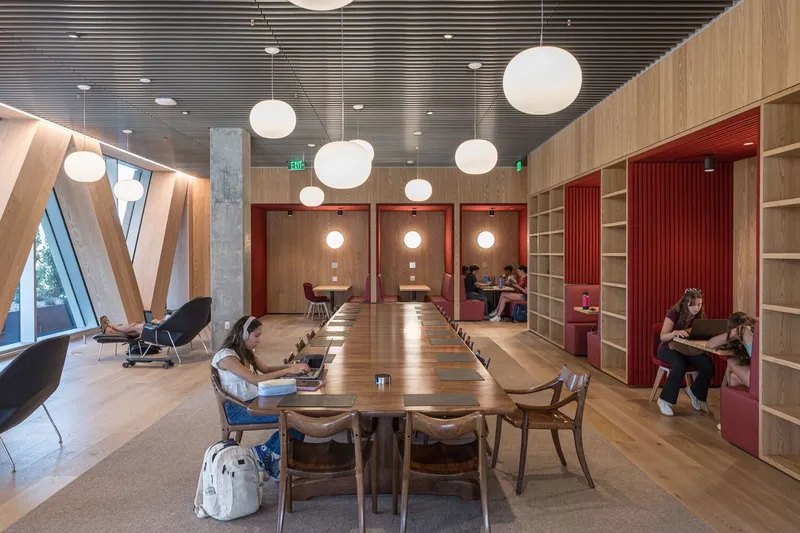
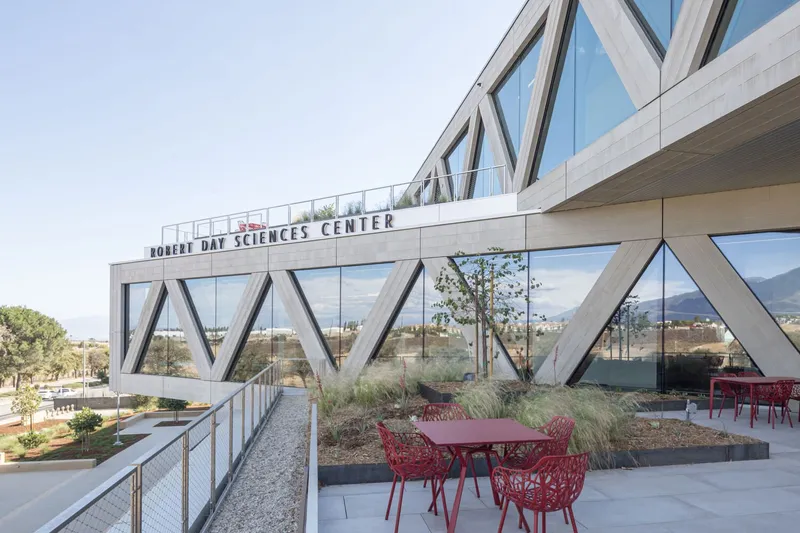
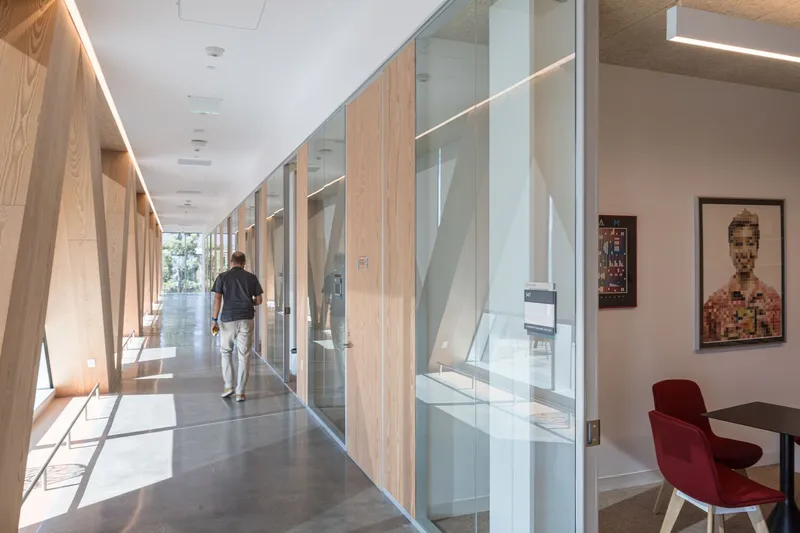
The structure is composed of stacked rectangular volumes supported by triangular steel trusses clad in Douglas fir, creating a rhythmic dialogue between strength and warmth. These trusses extend outward to form a seamless transition between the interior and exterior, while the facade features board-formed glass fiber reinforced concrete (GFRC) panels that evoke the texture of wood but meet the durability demands of a laboratory environment.
Sustainability anchors the design. The building’s 11,000-square-foot solar roof produces approximately 342 megawatt-hours annually, significantly reducing operational energy consumption. Designed to achieve LEED Gold certification, the Robert Day Sciences Center reflects CMC’s commitment to ecological responsibility and academic excellence.
Spatial Experience: A Vertical Campus of Collaboration
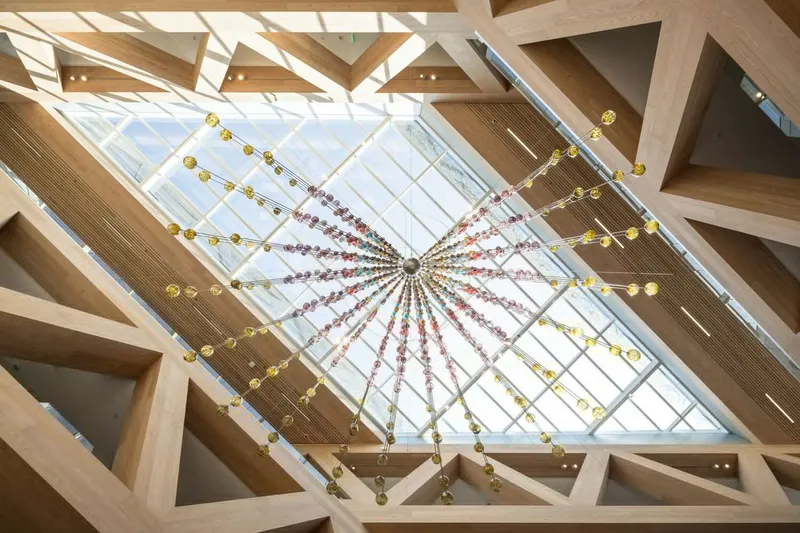
At ground level, a 15-foot cantilevered canopy welcomes visitors into a light-filled atrium buzzing with activity. The central staircase, surrounded by flexible gathering areas and a café, serves as a social and intellectual anchor that connects multiple floors. Above, a suspended art installation—“Magnetic Field” by Damien Ortega—floats dramatically within the atrium, symbolizing the invisible forces that unite disciplines and ideas.
Each floor houses specialized spaces, from wet and dry labs to data science classrooms, maker spaces, and the Quantum Library. The building’s modular layouts and reconfigurable interiors ensure adaptability to evolving academic needs and emerging research methods.
Around the perimeter, eight rooftop terraces offer panoramic views of Mount Baldy, the San Gabriel Mountains, and the campus landscape, serving as outdoor classrooms, study zones, and social gathering spots landscaped with native vegetation.

Integration with Campus and Master Plan Vision
Positioned at the corner of Ninth Street and Claremont Boulevard, the center acts as a gateway between the college and the city, extending CMC’s historic north mall into a network of interconnected public spaces. Its zigzag spatial organization strengthens pedestrian circulation and visually ties the sciences building to future academic and athletic facilities under construction.
According to Leon Rost, Partner at BIG, “Like a well-placed queen on the chessboard, the Robert Day Sciences Building unlocks new moves for the campus.” The design not only enriches the physical master plan but also redefines how learning spaces can promote cross-disciplinary innovation and community engagement.

A Beacon of Science and Sustainability
By day, the Robert Day Sciences Center acts as a lively academic environment filled with movement and collaboration; by night, it glows as a beacon of discovery, illuminating the eastern gateway of the CMC campus against the San Gabriel Mountains.
Through a fusion of architecture, technology, and pedagogy, BIG’s design embodies the evolution of higher education—where architecture becomes a catalyst for creativity, inclusion, and sustainability.
Project Information
Architects: Bjarke Ingels Group (BIG) Location: Claremont, California, USA Client: Claremont McKenna College Project Area: 135,000 ft² Structural Engineer: Saiful Bouquet General Contractor: KPRS Construction Construction Manager: IDS Real Estate Group Photographer: Laurian Ghinitoiu Completion: 2024 Certification Goal: LEED Gold
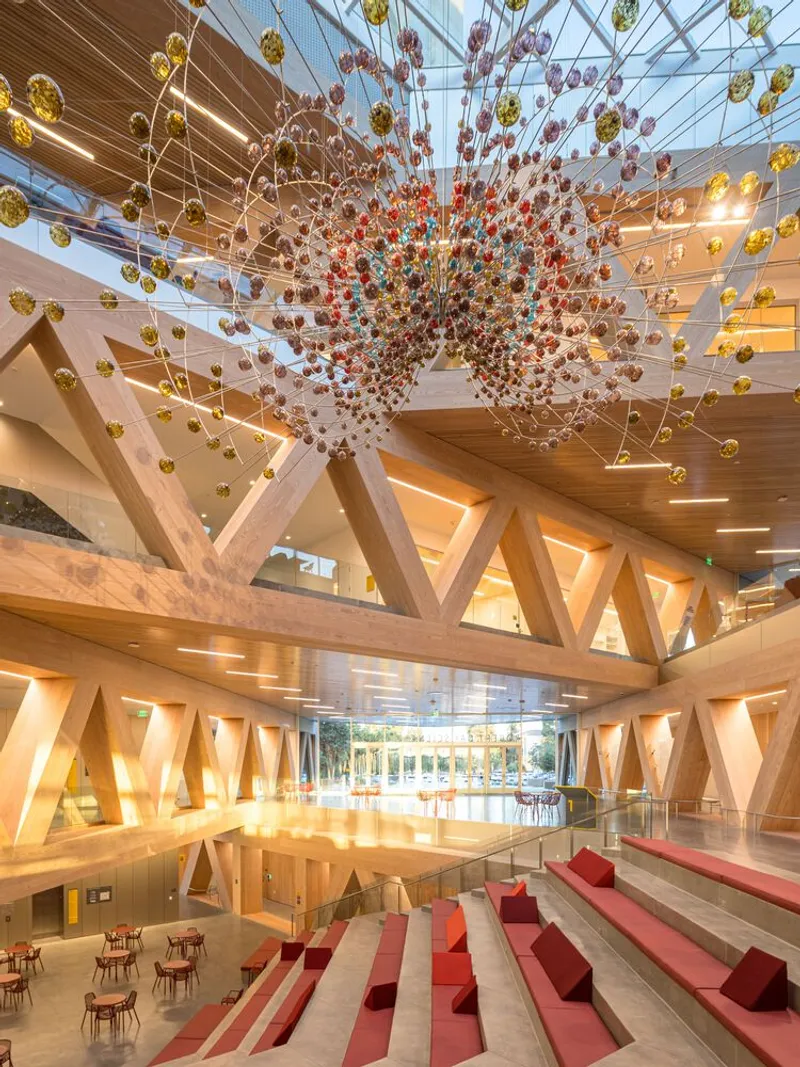

All photographs are works of Laurian Ghinitoiu


Popular Articles
Popular articles from the community

Opera by the Sea Estonia: Three Shells Dissolving Architecture into Tallinn's Coastline
A winning opera house proposal replaces monumental form with interconnected shells that blur the boundary between building, park and Baltic Sea.

Manzana Morphosis: Stretching Barcelona's Grid into a Living Landscape for 2050
A radical reworking of the Eixample manzana turns density into a tool for generous public space, vertical ecology, and environmental performance.

Faces of the Soviet Avant-Garde: Turning Moscow's Street Names into an Open-Air Museum
A network of sculptural installations across a Moscow residential district transforms forgotten architect names into spatial encounters with cultural memor

Extended Shell: Retrofitting Kolkata's Balconies as Living Urban Thresholds
A modular retrofit system recovers the social and environmental intelligence of Kolkata's historic verandas for contemporary Park Street residents.

Similar Reads
You might also enjoy these articles


Hodi-Mandai Geram
Project Function: Preservation and revitalization of the Intangible heritage and socio-spatial identity of the Hodi by Housing, Cultural Memory Center, Sacred Grove, landscape, local tourism economy


Olio Towers: A Mid-Rise for Performers That Fuses Housing, Rehearsal, and Stage
Located blocks from Houston's Theater District, this modular tower stacks living units around a central performance atrium.

Oasis: Modular Green Housing Carved into Dhaka's Urban Fabric
A shortlisted Plugin Housing entry reclaims unauthorized settlements in Dhaka with stepped concrete volumes, green roofs, and ventilation-driven design.

Black Hole: A Floating Megastructure for the Post-Physical Era
Emiliano Mazzarotto envisions a spherical, self-scaling arena where e-sports, digital hotels, and holographic stadiums replace traditional public space.

Explore Academic Building Competitions
Discover active competitions in this discipline

Challenge to design public laboratory

Challenge to reimagine the Iron Throne

Photograph architecture without architects

Illustrate the lost glory of Angkor Wat - Render Challenge
Comments (0)
Please login or sign up to add comments
No comments yet. Be the first to comment!