

Roland Baldi Architects Chars a Timber Forestry Station Black in South Tyrol's Most Wooded Municipality
A CasaClima Gold administration building in Nova Ponente draws on Alpine and Japanese fire-treatment traditions to honor its forested context.


Nova Ponente, or Deutschnofen, is one of the most densely wooded municipalities in South Tyrol. It is fitting, then, that the local forestry office of the Autonomous Province of Bolzano sits inside a building made almost entirely of wood, clad in wood, and blackened by fire in tribute to wood's oldest preservation technique. Designed by Roland Baldi Architects, the 435 square meter Forestry Station is a compact, two-storey gabled volume that reads simultaneously as a deeply local building and something more elemental: a piece of the forest itself, carbonized and set upright in the center of town.
What makes this project genuinely interesting is the directness of its central idea. A forestry office should be built of wood. That premise, taken literally and pushed hard, produces an architecture that communicates its purpose without signage or symbolism. The charred facade connects to both the Japanese yakisugi tradition and an older, lesser-known Alpine practice of fire-treating wooden poles at the point where they enter the ground for moisture and rot protection. Roland Baldi does not pick one cultural lineage over the other. He acknowledges both, and lets the material speak.
A Blackened Shell in a Village of White Plaster


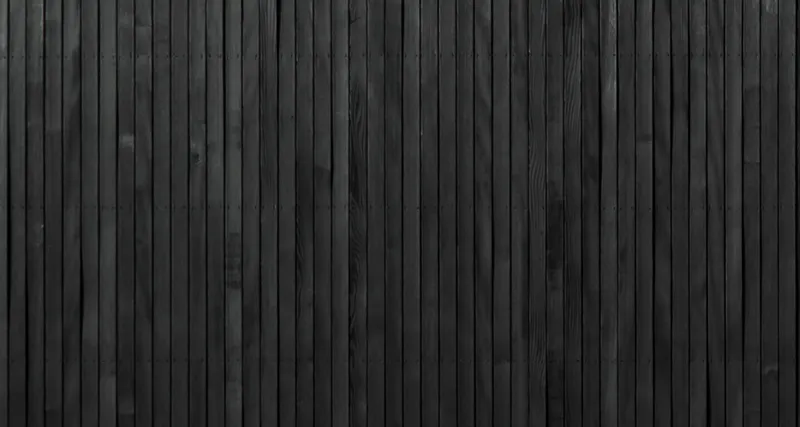
Set beside traditional South Tyrolean houses with their light stucco walls and timber balconies, the Forestry Station's blackened exterior creates an immediate visual rupture. The vertical charred timber cladding, with its fine parallel grooves, absorbs light rather than reflecting it. The building appears to have emerged from a controlled burn, which in a sense it has. The charring is not decorative; it is a surface treatment that improves durability and weather resistance, the same logic that Alpine farmers applied for centuries when fire-treating fence posts.
The massing is deliberately simple. A pitched roof and rectangular footprint echo the residential typology of the valley, but the form has been stripped to its essentials. The upper volume cantilevers slightly over the ground floor, supported by recessed columns that create a shadowed base. This move gives the building a sense of hovering weight, as though the charred shell has been lifted off the earth it references.
The Gable as Lantern
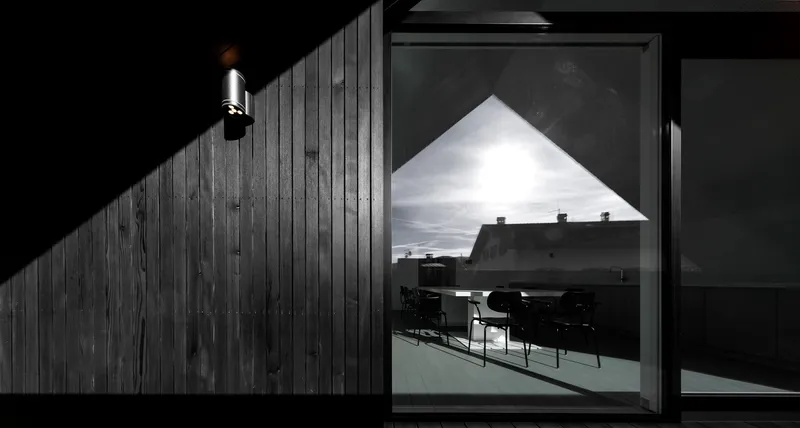

At dusk, the building inverts. During the day it is a dark, monolithic presence. At night, the triangular gable window and the ribbon glazing at its base glow from within, transforming the station into a lantern against the mountain backdrop. The triangular window at the gable end is a simple geometric gesture, but it works hard: it identifies the building's public face, frames the interior meeting room, and lets mountain views penetrate deep into the upper floor.
The decision to place glazing at the gable rather than punching conventional openings into the long facades keeps the charred timber surfaces intact and uninterrupted. The building's opacity is part of its argument. You see the wood first, the program second.
An Attic Meeting Room That Doubles as Crisis Headquarters


Under the pitched roof, a generous meeting room occupies the full gable profile. Perforated acoustic ceiling panels curve gently above the space, managing sound without flattening the volume. A large gable window frames the mountain view and pulls natural light across the length of the room. A kitchenette sits at one end, making the space self-sufficient for extended sessions.
The room has a second, more urgent purpose. Pull-out beds allow it to be converted into an operations center during forest fire emergencies or other crises. For a forestry office in one of the most densely forested regions of the Alps, this dual-use logic is not a gimmick but a necessity. The architecture accommodates it quietly: the room's proportions and services are designed to work equally well for a planning meeting or an overnight emergency response.
Ground Floor: Public Service and Administration
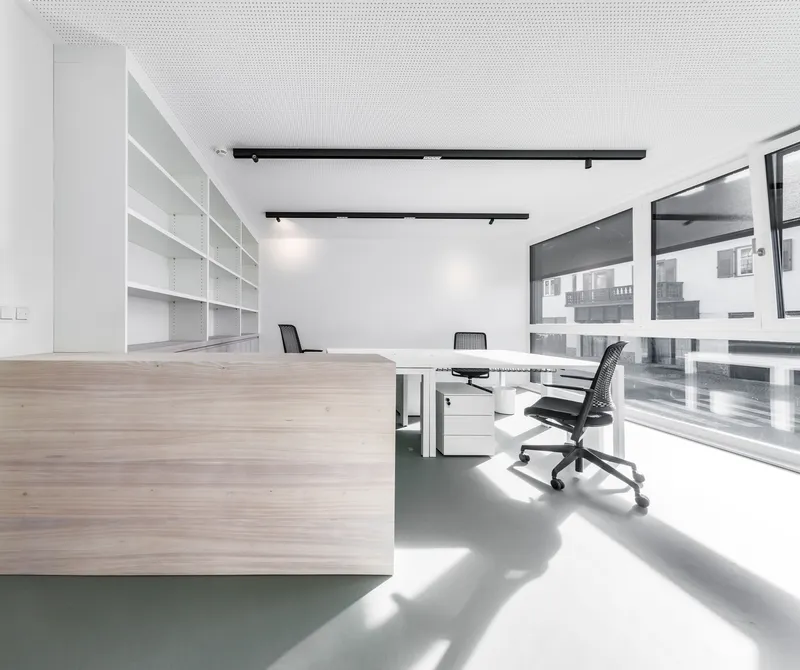

The ground floor houses the entrance, a public reception area, administrative offices, an archive, and an accessible toilet. The interior palette shifts dramatically from the exterior: light timber finishes, white shelving, grey resin floors, and exposed timber roof planks overhead create a calm, functional workspace. Black track lighting and simple office furniture reinforce the sense that this is a working building, not a showpiece.
The reception desk, finished in pale timber, sits beneath the same perforated acoustic ceiling system used upstairs. The consistency of these interior finishes across both floors unifies the building from the inside even as the exterior reads as a single dark shell. The offices are compact and efficient, with individual workstations tucked into narrow bays that make disciplined use of the building's modest footprint.
Energy Independence on a CasaClima Gold Standard
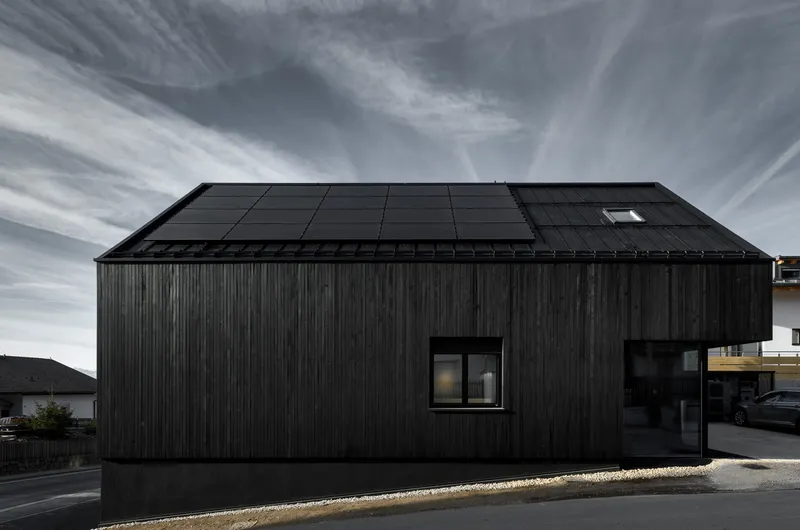
A photovoltaic array covers the south-facing pitch of the roof, generating electricity to power the building's heat pumps. The system achieves CasaClima Gold certification, which in the South Tyrolean context is not a marketing badge but a rigorous performance standard that governs energy efficiency, durability, and consumption. The cross-laminated timber (X-lam) structural system, used for both walls and floors, contributes to the building's thermal performance while keeping the construction fast and largely dry.
There is an integrity to a forestry station that generates its own energy from the same roof that protects its timber structure. The building does not lecture about sustainability. It simply operates within a closed loop: wood structure, wood cladding, solar energy, heat pumps. The technology is standard. The coherence is not.
Plans and Drawings
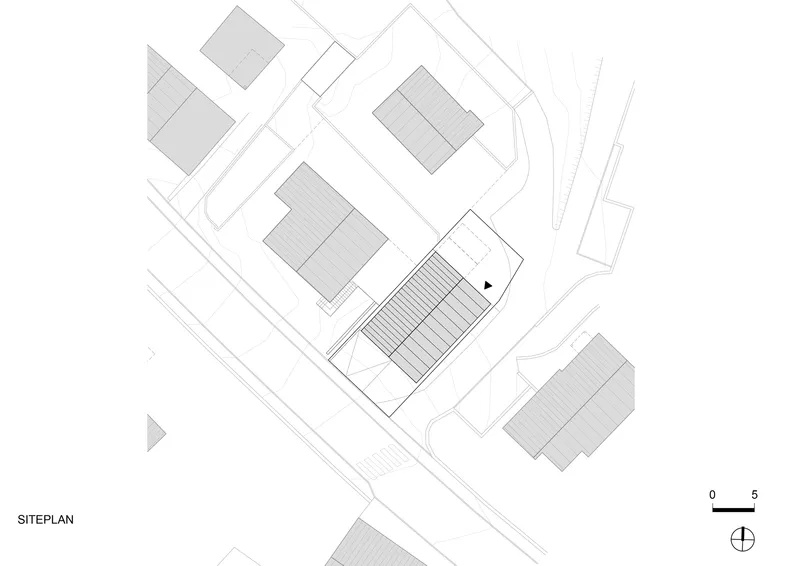


The site plan reveals the building's angled orientation relative to the street, allowing it to address the village center while maintaining setbacks on all sides. The basement accommodates a small garage with two parking spaces and service rooms. At the ground floor, offices cluster around a central staircase that provides vertical circulation to the meeting room above. The first floor plan shows the meeting room opening onto a terrace, an outdoor extension that increases the building's usable space in good weather without adding to its compact footprint.
Why This Project Matters
Public architecture too often defaults to neutral materials and generic forms, as though civic buildings must avoid specificity in order to serve everyone equally. The Forestry Station takes the opposite position. Its material, its surface treatment, and its program are bound together so tightly that the building could not exist anywhere else or serve any other purpose without losing its meaning. That is a high standard for a 435 square meter administrative building, and Roland Baldi meets it.
The charring technique, drawn from two distinct traditions separated by thousands of kilometers, demonstrates that vernacular knowledge is not a closed system. It can be borrowed, combined, and applied with contemporary precision. The Forestry Station does not romanticize the past or fetishize the handmade. It uses industrial cross-laminated timber, photovoltaics, and heat pumps alongside an ancient fire treatment. The result is a building that feels inevitable in its context, which is the hardest thing for architecture to achieve.
Forestry Station, designed by Roland Baldi Architects. Nova Ponente, Italy. 435 m². Completed 2026. Photography by Oskar Da Riz.
About the Studio
Share Your Own Work on uni.xyz
If projects like this are the kind of work you want to make, uni.xyz is a place to publish your own, find collaborators, and enter design competitions.


Popular Articles
Popular articles from the community


Cloaked Colonization: A Mobile Underwater Habitat That Moves Like a Fish
Micah Abaya's shortlisted EHC Pacific entry reimagines ocean settlement as a dispersed network of self-sustaining architectural organisms.

Singing Woman: An Opera House That Performs Before the Curtain Rises
Ovidiu Cristian Pavel's conceptual opera house translates Estonia's choral identity into a sculpted waterfront landmark facing the Baltic Sea.

Faces of the Soviet Avant-Garde: Turning Moscow's Street Names into an Open-Air Museum
A network of sculptural installations across a Moscow residential district transforms forgotten architect names into spatial encounters with cultural memor

Tsunami Convergenics: Turning Catastrophic Ocean Forces into Underwater Housing Infrastructure
A speculative underwater settlement off the coast of Onagawa, Japan, treats tsunamis and typhoons as energy sources rather than threats.

Similar Reads
You might also enjoy these articles

Pixel Gardens: One Repeated Module Stacked Into a Terraced Social Housing Tower for Famagusta
Salem Bader's shortlisted housing tower builds a vertical neighbourhood from one repeated module, offsetting units to carve terraces, light and air.

Bao Huynh Watercolor Atelier: A Serene Art Retreat in Hội An
Bao Huynh Watercolor Atelier in Hội An blends multifunctional art spaces, sustainable design, local materials, and family-friendly living in a serene environment.

Atelier Macri Concept Store Interior Design by CASE-REAL
Atelier Macri store features a "ko" counter, walnut wood details, cork displays, blending retail, gallery, and seamless customer experiences.

Manuel Vargas Izquierdo Stadium and High-Performance Sports Center: Architectural Excellence in Jalpa de Méndez
The Manuel Vargas Izquierdo Stadium blends sustainable design, inclusive sports facilities, and cultural-inspired architecture, revitalizing Jalpa de Méndez’s public spaces.

Explore Power Station Competitions
Discover active competitions in this discipline

Challenge to design mud housing for contemporary communities

Challenge to reimagine the Iron Throne

Photograph architecture without architects

Illustrate the lost glory of Angkor Wat - Render Challenge
Comments (0)
Please login or sign up to add comments
No comments yet. Be the first to comment!