
Role of Architecture in space habitats
“We are all astronauts on a little spaceship called Earth” Buckminster Fuller
Outer space isn’t just a physically demanding environment, but a mentally and emotionally challenging one as well. Crew members are forced to live in a confined space, away from their families for long periods of time, and perform difficult tasks with their work constantly examined by experts on earth. The human body is not made to survive in space, and neither is the mind.
This essay will focus on the challenges and successes associated with creating a safe, functional, and productive environment for the human being living in space for an extended length of time. Specifically, the study will be focusing on the issues surrounding habitation in space including:
1) Human factors; isolation, daily rhythm, privacy (image 2)
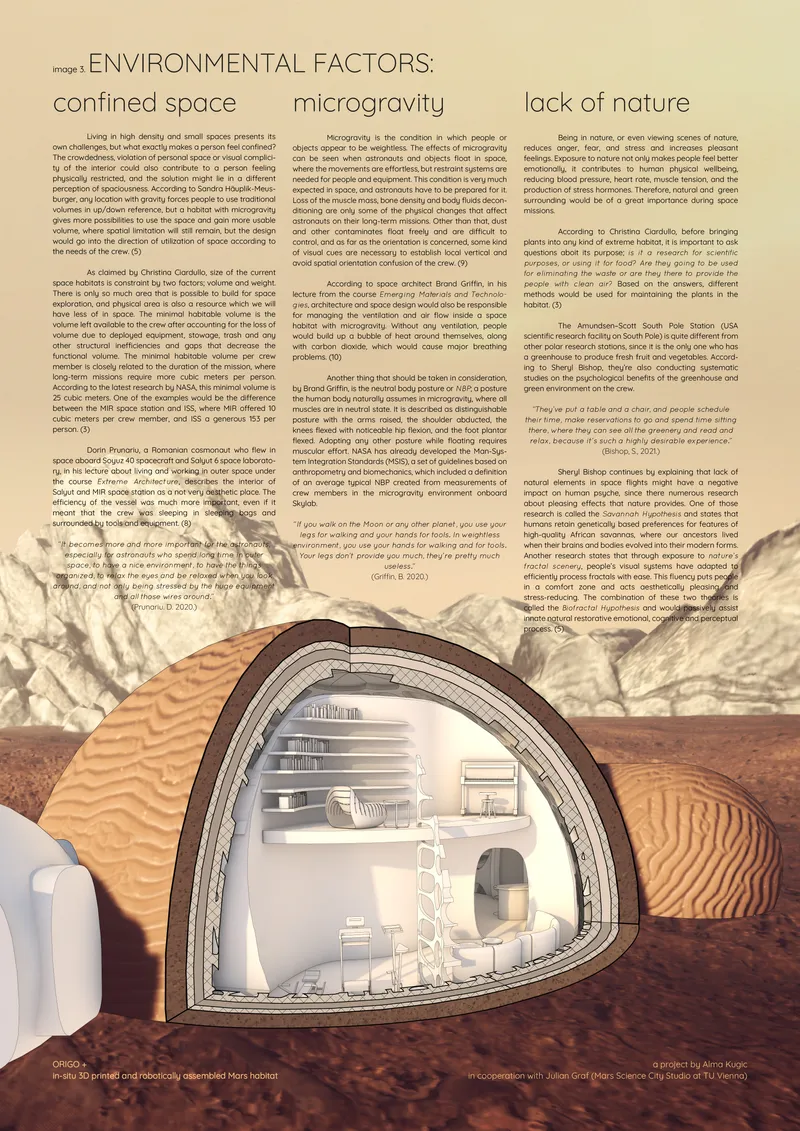
2) Environmental factors; confined space, microgravity, lack of nature (image 3)
All these issues are going to be elaborated and described with information collected and by different lecturers from the Emerging Fields in Architecture module on Technical University in Vienna, held by Professor Sandra Häuplik-Meusburger on WS 2020. Many quotes from different lecturers have been used to describe certain topics deeper, but also to bring the reader closer to the facts and feelings attached to them. The lessons learned will be used to make recommendations for future long term space exploration.
Main questions that are going to be asked and elaborated throughout this research are: What makes a group of people perform well and be healthy in a habitat that was situated in extreme environments? And what do we have to do to make a habitat where people could thrive?
Space Architecture is the theory and practice of designing and building inhabited environments in outer space and it includes architectural design of living and working environments in space related facilities, habitats, and vehicles. The impact of architecture on human psychology has led to architects giving a lot of importance to the needs and desires of the occupants of the spaces that they are asked to design. An architect can control human behaviour with his design by understanding the way that a building’s design can influence a person’s behaviour, thus, modifying the individual’s mood and perception, whether the environment is natural or man-made. Understanding the way in which environment effect people could enable the design and construction of work, recreation and living space that has the ability to influence people’s behaviour. (1)
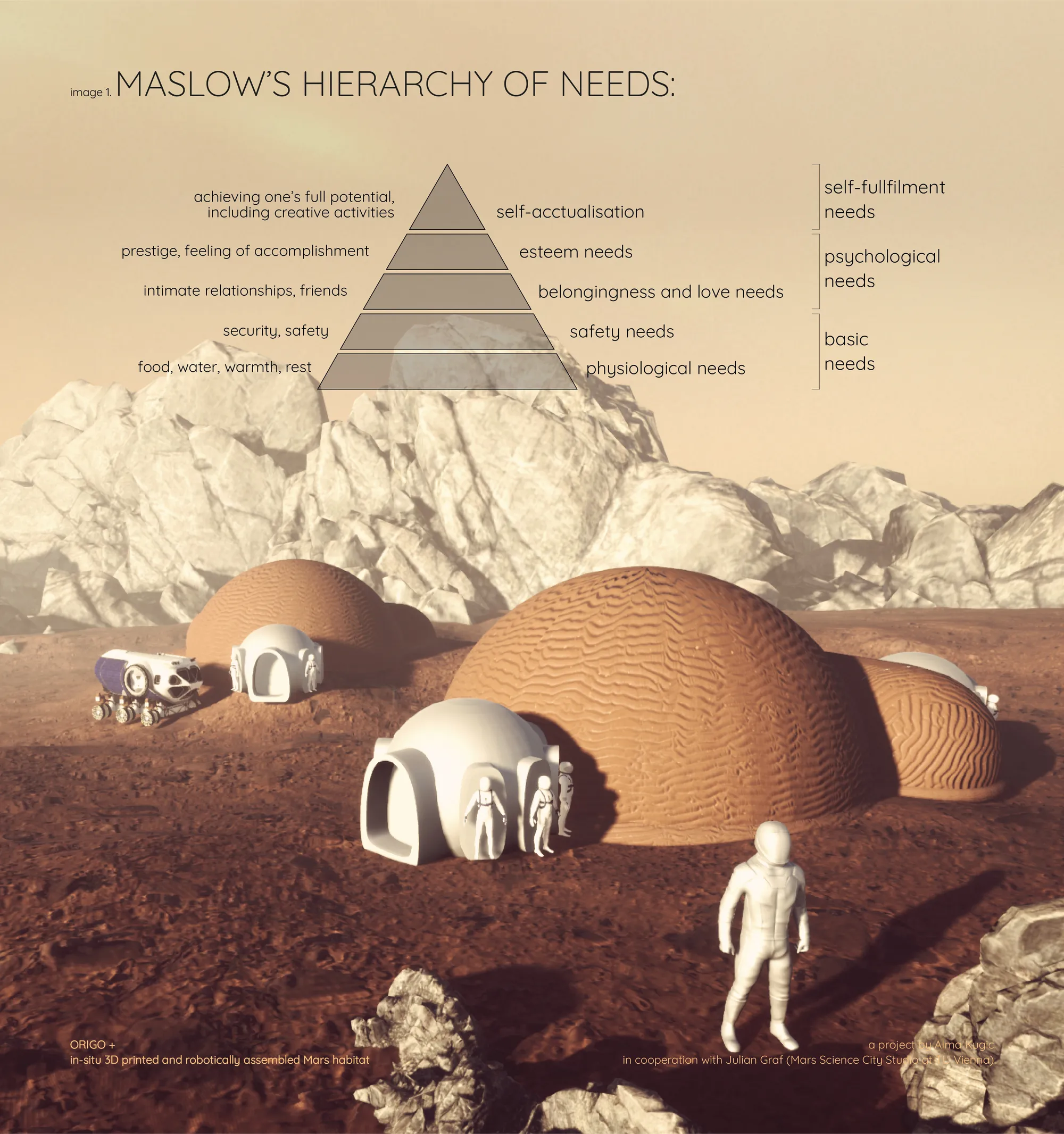
The environment of a deep-space mission represents a physiological and psychological contradiction to the terrestrial environment in which humans evolved. Optimal performance and welfare of crew members will depend on successful adaptation to the challenges of the extreme environment, which in turn depends on the satisfaction of fundamental human needs. These fundamental human needs – drawn from Maslow's hierarchy of needs (image 1) – gives us the hierarchy to follow: first survival, food and beverage, then sleep, and only then protection, social activities and work. The satisfaction of each need over the course of a protracted space mission will require the crew to overcome novel psychobiological obstacles for which they must be prepared. (2)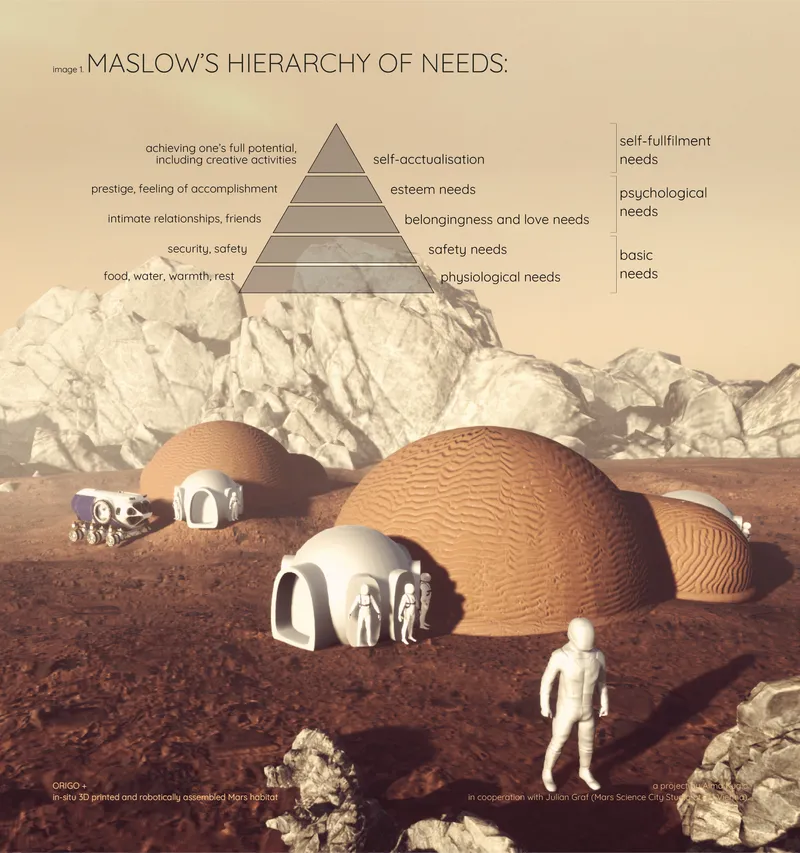 As per Christina Ciardullo, a senior architect (NY) and a PhD student at the Center for Ecosystems in Architecture, space architecture brings us face-to-face with a question; to what extent are we able to integrate with environment? Or to what extent do we have to create an artificial one? In lecture under the course name Emerging Materials and Technologies, Christina Ciardullo talks about space architecture strategies and designing for extreme environments, where design for space is actually an extension for design at any location. Architecture anywhere is always a protection against outer elements and conditions. (3)
“Why space architecture? Why now? Heavy with the weight of the global problems and there’s so much to be done here on Earth. Problems with overpopulation, resources, climate change - why do we look to space? But, I would argue for some of the reasons why architecture should be looking up! Because it so clearly helps us to put ourselves in the right frame of mind, as we look around.” (Ciardullo, C. 2020.)
A manned space mission could be perfectly prepared in terms of sciences and technologies, but without a good habitat, a place where the needs of the crew are respected, this isolation and confinement can turn into a nightmare. There is the limitation of engineering: it is more than important to take care about architecture when human lives are part of the experiment. Habitability in extreme environment plays a big role.
The term Habitability describes the suitability of a habitat for its inhabitants. Over the last 40 years NASA has made great strides in creating habitable environments that support long-term space exploration. Most recently, the Skylab, Mir, and International Space Station exploration endeavours have provided NASA with a wealth of lessons learned to be carried forth to the new national vision for space exploration. (4)
On a lecture from Extreme Architecture course, the authors of the book Space Habitats and Habitability - Designing for Isolated and Confined Environments on Earth and in Space (Springer, 2021) have presented and discussed the topics from the book and issues around space habitability. Sheryl Bishop, a social psychologist and internationally recognized behavioural researcher in space psychology, as one of the authors, has described the views from psychology; who are the best people for a space? Sandra Häuplik-Meusburger, an architect and researcher specializing in compact habitability design solutions for extreme environments, describes the views from architecture; what is the best space for a place?
“The reason this book came to be was because it became clear that the solution to the home in space can’t be just from engineering perspective and has to have psychological perspective added.” (Bishop, S., 2021.)
Sheryl Bishop continues by explaining that engineers were very resistant to having that conversation, especially early on, and architects were just beginning to appreciate the fact that building a habitat for structural purposes only, and excluding the holistic benefit of the crew, seemed like a bad solution. According to Sandra Häuplik-Meusburger, there is not only one solution, or one list that combines all the human necessities - the list can only be used as guideline. (5)
“Before we can design the proper habitat, we need to understand the human-space relationship. We have to understand what makes the changes, what can happen and what are the possibilities.” (Häuplik-Meusburger, S., 2021.)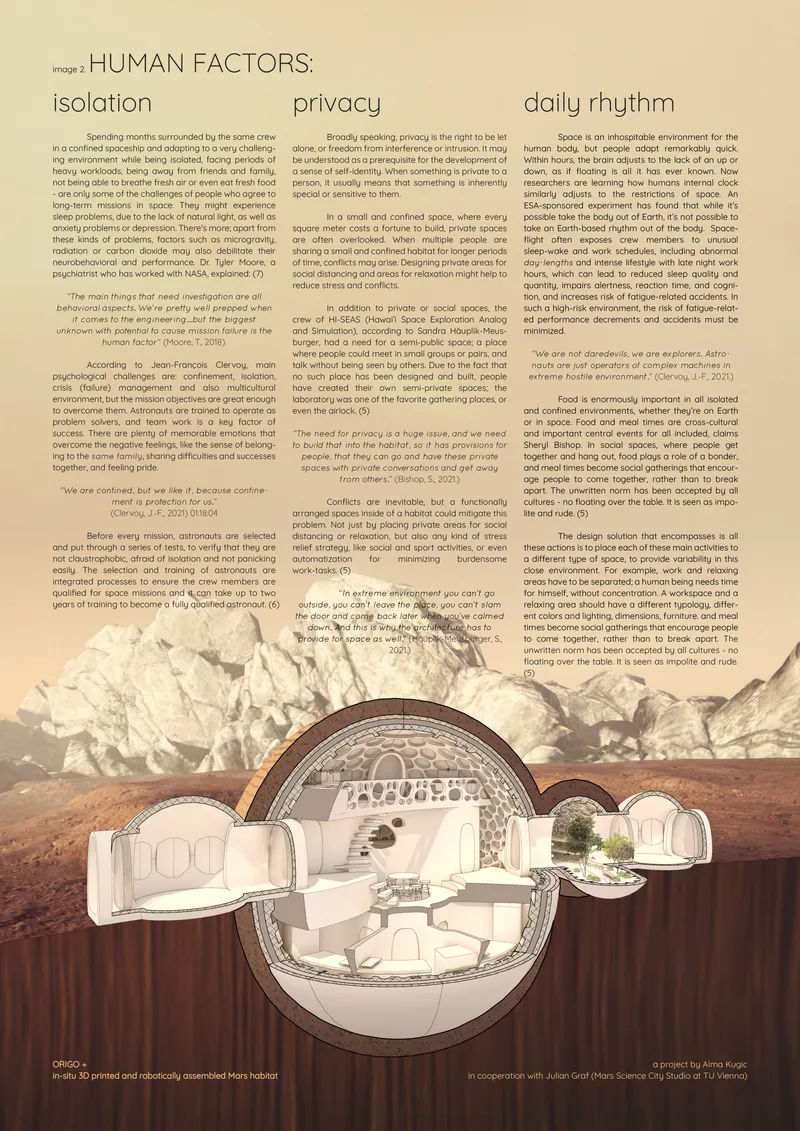 Jean-François Clervoy is a French engineer, CNES (National Centre for Space Studies) and ESA (European Space Agency) astronaut and a veteran of three NASA Space Shuttle missions. In his lecture about living and working in space, under the course Extreme Architecture, Jean-François Clervoy described the difference between short-term and long-term human spaceflight. (6)
“All my missions were on board a space shuttle, and space shuttle missions are always short and very intense. You don’t have free time. But, when you fly six months, the weekends are more or less free and you can have activities like playing music, reading, writing, painting, drawing, taking artistic photographs...” (Clervoy, J.-F., 2021)
In the words of Sheryl Bishop, short-term missions are expeditionary missions, where there is a task, accompanied by an intense work schedule and often compared to a camping lifestyle, where minimum comfort is acceptable. Therefore, adapting to a certain environment is not an issue. But, long-term space missions, where people would be residing (habitating) in hostile environment over extended period of time, are completely different. (5)
“Long-term missions are characterized by lots and lots of monotony and boredom and repetition. And if you’re a person that needs to be active and being challenged, you’re going to be miserable.” (Bishop, S., 2021)
Both kinds of missions are very significant to space exploration and demand many months of training in simulated surroundings. Both missions are different in training, in scientific approach and in the outcome. In order to calculate the difficulty of the mission, there are three important parameters for confinement: number of people, duration of the mission and volume of the habitat. As the number of people increase, and the number of days spent in the outer space, so should the volume of the habitat.
 Thanks to modern technology, the boundaries of progress are constantly expanding, and new wonders can be made every day. As we stand poised on the verge of a new era of spaceflight, we must rethink every element, including the human dimension. The psychological effects have gained in attention recently, and in uncovering those challenges that individuals and teams can face, research options that integrate psychosocial aspects with behavioural, performance, technical and environmental issues are very much needed. Modern technology can provide for security of the crew, but does it create a sense of safety? It can provide for comfort, but does it create consolation?
Along with another emerging discipline, space architecture, psychological challenges of the astronauts on long-term missions could be minimized. Being a science, architecture covers the functional needs, providing people with living space and environment that is practical and comfortable. Being an art, it provides people with an outlet for creative expression and allows the society to view, create and shape their environment and living space differently, in a unique way. The balanced integration of artistic sensibility and scientific methodology as it applies to designing buildings and their environments is essential to creating great solutions. According to Jean-François Clervoy, designing any kind of extreme habitat requires an individual approach, and not a mere replication of the habitats across Europe. He encourages designing habitats that use the characteristics of an extreme environment as an asset, and not as a constraint. (6)
“This is what you should do in your field - think outside the box! Seek new materials, new methods, new way of assembling modules, new systems...” (Clervoy, J.-F., 2021)
References:
(1) SPACEARCHITECT.ORG - BY SPACE ARCHITECTURE TECHNICAL COMMITTEE AIAA
http://spacearchitect.org/ (04.02.2021.)
(2) Wikipedia - Maslow's hierarchy of needs
https://en.wikipedia.org/wiki/Maslow%27s_hierarchy_of_needs (04.02.2021.)
(3) Ciardullo, C. (02.12.2020.) - Emerging Fields is Architecture, Emerging Materials and Technologies
https://www.youtube.com/watch?v=HHpyYLvD_YA&t=233s
(4) Sage journals - Habitability in Space
https://journals.sagepub.com/ (10.02.2021.)
(5) Häuplik-Meusburger, S. and Bishop, S. (12.01.2021.) - Emerging Fields is Architecture, Extreme Architecture
https://www.youtube.com/watch?v=Tz3bYT7G4RE&t=4482s
(6) Clervoy, J.-F. (12.01.2021.) - Emerging Fields is Architecture, Extreme Architecture
https://www.youtube.com/watch?v=gvwI8Cosmio&t=2s
(7) Turner, D. D. - Headspace: How Space Travel Affects Astronaut Mental Health
https://cmsw.mit.edu/angles/2019/headspace-how-space-travel-affects-astronaut-mental-health/ (04.02.2021.)
(8) Prunariu, D. (01.12.2020.) - Emerging Fields is Architecture, Extreme Architecture
https://www.youtube.com/watch?v=ByNoChP1SBM&t=4161s
(11) May, S. - What Is Microgravity?
https://www.nasa.gov/audience/forstudents/5-8/features/nasa-knows/what-ismicrogravity-58.html (11.02.2021.)
(12) Griffin, B. (24.11.2020.) - Emerging Fields is Architecture, Emerging Materials and Technologies
https://www.youtube.com/watch?v=iqzG8QziAKI



Popular Articles
Popular articles from the community


The Ocean Hive: Sustainable Architecture for a Self-Sufficient Civilization at Sea
The Ocean Hive imagines sustainable architecture at sea, where modular habitats, algae, wave power and ocean waste sustain a growing colony.

Lunar Spiral: Space Architecture Shaped by the Mathematics of the Universe
Lunar Spiral reimagines space architecture through Fibonacci geometry, lunar regolith, levitating habitats, and self-sustaining Moon living.

The Musturak Paradise: Senior Living Architecture for a Connected Future in Temara, Morocco
The Musturak Paradise reimagines senior living architecture in Temara via private homes, social spaces, culture, community, and shared care.

Co-Life: Senior Housing Design That Reconnects Older Adults With the City
Co-Life reimagines senior housing design through healing gardens, shared streets, workshops, and a sustainable community across generations.


Similar Reads
You might also enjoy these articles

Day and Night Park: A Time-Based Urban Newsstand in Beijing
A temporary urban newsstand in Beijing blending travel, light, and reading through poetic colors, compact form, and community-focused design.

Modernist Patio Renovation in El Masnou, Barcelona by Oliver Segura Arquitectura + Cebrià Arquitectura
Modernist patio renovation blending tradition and innovation with a movable pool, leveled floors, and Catalan materials in El Masnou.

Alto Residencial Coop: Cooperative Housing Development in Santiago de Compostela by Carbajo Barrios Arquitectos
A linear cooperative housing complex blending white volumes and perforated metal façades, enhancing community living, natural light, privacy, and urban integration.

Vil Genis School by BPA ARCHITECTURE – Massy, France
Vil Genis School in Massy, France, features sustainable design, south-facing classrooms, community integration, accessible spaces, and modern educational architecture.


Comments (0)
Please login or sign up to add comments
No comments yet. Be the first to comment!