

Sakura House: A Multi-Generational Home Woven Around Cherry Blossoms in Kobe
Four floors of interlocking family life, dappled light, and integrated cherry blossom planting reshape dense urban housing in Japan.


Stack a grandmother's meditation garden beneath a children's playroom, thread cherry blossom trees through four storeys, and wrap the whole thing in aluminum mesh that filters Kobe's afternoon light into soft, shifting patterns. Sakura House treats multigenerational living not as a constraint to manage but as a spatial opportunity to celebrate, assigning each floor a distinct rhythm of public and private life while binding them together with greenery, shared sightlines, and a continuous flow of daylight.
The project is the work of designers Ruocheng Ma, 何 浩田, Bo Bo, and Ma Sha. Set within one of Kobe's compact residential neighbourhoods, the house accommodates six family members across three generations: grandmother, parents, and three children. Its programme reads like a vertical neighbourhood in miniature, from ground-level planting areas and a meditation zone up through a glass-corridor dining terrace, flexible study and play spaces, and a rooftop yoga retreat.
A Vertical Family, Floor by Floor

The opening presentation board lays out the logic plainly: site plan, street elevation, and annotated floor plans show how the house slots into Kobe's tight urban grain. The first floor is given over to accessibility and calm, with a communication and meditation area that opens directly onto cherry blossom planting beds. The second floor introduces a glass corridor and terrace dining space oriented toward blossoming canopies, turning an ordinary meal into a seasonal event. Above that, the third floor provides study and play zones for the children, with flexible layouts that can evolve as they grow. The fourth floor caps the sequence with yoga and relaxation spaces for the parents, lifted above the streetscape and surrounded by rooftop greenery.
What makes this layering more than a simple stacking of programmes is the relationship between floors. Occupant diagrams on the board clarify who inhabits each level and why, revealing a careful calibration of proximity and distance. The grandmother has ground-floor autonomy; the children have room to be noisy above the social floor rather than directly overhead; the parents' retreat sits at the top, where city noise fades and sky replaces street.
Dappled Light Through Perforated Screens

Interior renderings of public and personal spaces show how the design team handles the perennial challenge of dense urban housing: getting light deep inside without sacrificing privacy. Perforated metal mesh facades allow sunlight to enter as a constellation of moving spots, animating walls and floors throughout the day. Frosted glass corridors maintain brightness in transitional zones without creating the glare or exposure that full glazing would produce on a narrow street. Patios and skylights are punched into the plan where the section steps back, pulling natural light down to lower levels.
The renderings also underscore the duality between communal warmth and individual retreat. Shared spaces like the terrace dining room are open and luminous, framed by cherry blossom branches. Personal rooms, by contrast, are smaller and more enclosed, tailored to specific hobbies and psychological needs. The mesh screen becomes the mediator: visible from both inside and out, it signals openness to the city while preserving the intimacy each family member requires.
A Section That Reads Like a Day in the Life

The sectional perspective is the drawing that holds the project together conceptually. Figures populate every level, engaged in daily activities: stretching, cooking, reading, playing. Trees grow through floor plates and alongside stairs, reinforcing the idea that greenery is not applied decoration but structural to the experience of the house. Stepped-back platforms create depth and openness in what could easily read as a narrow tower, and the section reveals how each setback doubles as an outdoor terrace or planting zone, giving even interior rooms access to sky and vegetation.
By showing the house in use rather than empty, the designers make a persuasive argument for their spatial strategy. The vertical separation of generations is legible at a glance, yet the connecting staircase and shared visual axis keep the family within arm's reach. It is compact urbanism that still breathes.
Concrete, Mesh, and Modular Economy
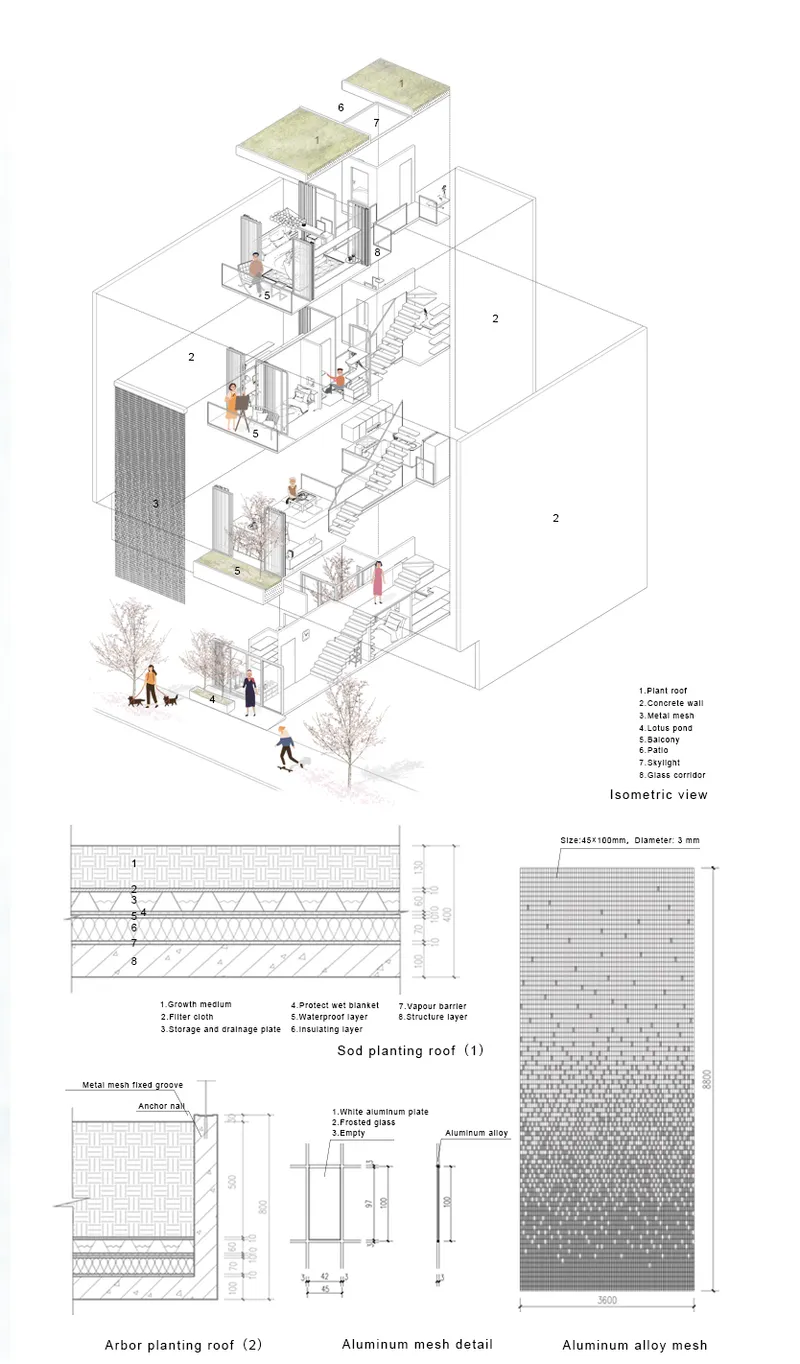
An isometric drawing and accompanying construction details break down the material and structural logic. The primary structure is concrete, chosen for cost-effectiveness and straightforward construction in a dense lot. Simple, modular forms keep the build affordable while leaving room for the architectural gestures that give the house its character: rooftop gardens, cantilevered terraces, and the aluminum mesh facade system that wraps selected elevations. The isometric makes clear how the mesh panels are layered over the concrete frame, creating an inhabitable depth between interior and city.
The rooftop gardens are detailed as layered assemblies of waterproofing, substrate, and planting, integrated with the structural slab rather than simply placed on top. This integration signals an understanding that greenery in dense urban housing cannot be an afterthought; it must be designed into the bones of the building from the start. The result is a structure that looks modest from the street but delivers a remarkably rich sequence of spaces within.
Why This Project Matters
Multigenerational housing is one of the oldest building types on earth, yet contemporary architecture rarely addresses it with the specificity Sakura House brings. Rather than offering generic open plans and calling it flexibility, the design team assigns each generation a clear spatial identity, then knits those identities together with light, greenery, and a deliberate vertical sequence. The cherry blossom, a cultural symbol so ubiquitous it risks becoming mere motif, is here given a genuine architectural role: structuring views, tempering climate, and extending the domestic landscape into Kobe's streetscape.
Ruocheng Ma, 何 浩田, Bo Bo, and Ma Sha demonstrate that affordability and spatial richness are not opposites. Concrete frames, modular systems, and standard construction techniques become the scaffolding for an inventive domestic world. In a housing landscape increasingly defined by generic developer apartments, Sakura House argues that the compact family home can still be the most fertile territory for architectural experimentation.
View the Full Project
About the Designers
Designers: Ruocheng Ma, 何 浩田, Bo Bo, Ma Sha
Enter a Design Competition on uni.xyz
uni.xyz runs architecture and design competitions year-round that reward proposals with spatial conviction and real site intelligence.
Project credits: Sakura House by Ruocheng Ma, 何 浩田, Bo Bo, Ma Sha.


Popular Articles
Popular articles from the community


U.GA Architects Wraps an Oval Rooftop Pool in Curved Board-Formed Concrete on Busan's Jeollidan-gil
In Busan's Jeonpo-dong, a 454 m² mixed-use block stacks a neighborhood facility, guest rooms and an oval rooftop pool inside spiraling concrete walls.

Juan García Correa, John González and Claudia Rueda Sink a Circular Amphitheater into a Manizales Engineering Building
On the La Nubia campus in Manizales, Colombia, the S1 Building folds labs and offices into a hillside of ramped lawns that double as a campus route.

Architekt Andreas Gruber Scatters 23 Dark Timber Chalets Across a South Tyrolean Forest Edge
In Molini di Tures, Amonti Chalets breaks a resort into a hamlet of gabled timber houses, with parking, storage and services pushed into the slope.

Cube Design Draws an Ecological Corridor Between Two Shenzhen Hills with the Nankai Building
Beside Shenzhen's container docks, the Nankai Building pairs stacked balconies with a climbing green screen to connect two hillsides across its height.

Similar Reads
You might also enjoy these articles

Gil Mello Arquitetura Tilts a Single Roof Toward the Waterfalls on a Plateau Above Aiuruoca, Brazil
In Aiuruoca, Minas Gerais, a 200 m² house of local labor and reclaimed poles pairs a low valley veranda with a tall mountain one.
U.GA Architects Wraps an Oval Rooftop Pool in Curved Board-Formed Concrete on Busan's Jeollidan-gil
In Busan's Jeonpo-dong, a 454 m² mixed-use block stacks a neighborhood facility, guest rooms and an oval rooftop pool inside spiraling concrete walls.

Felipe Hess Arquitetos Turns a Blind Stone Wall to the Street and Opens a Brazilian House onto a Courtyard and Canal
A canal-front house in Brazil hides behind painted stone and planting, then opens to an olive-tree courtyard, a reed-ceilinged porch and a curving pool.

David Macias Steps a Doorless Stone and Plaster House Down a Tropical Colombian Hillside
In the humid hills of Colombia, Threshold House replaces the front door with an open void and terraces its 850 m² down the slope instead of fighting it.

Comments (0)
Please login or sign up to add comments
No comments yet. Be the first to comment!