

Salinetorium: An Adriatic Oil Rig Rebuilt in Salt That Is Designed to Dissolve Back Into the Sea
An Editor's Choice Proximity Island entry turns a retired offshore rig into a salt factory, museum and retreat whose additions slowly erode into habitat.


Most architecture fights the sea. Salinetorium lets the sea win, and plans for it. The proposal takes an abandoned offshore oil rig, harvests salt from the water around it, and builds walls, terraces, pools and public platforms out of that salt. Over time, those additions dissolve back into the water, leaving the steel skeleton to become an artificial marine habitat. It treats erosion as part of the building's lifecycle rather than a failure to engineer against, and that inversion is what makes the project worth a close look.
Designed by Zhenxiong Yang, Alan Fan and Chia-Chia Liu, Salinetorium was selected as an Editor's Choice entry in Proximity Island 2019. The site is the Adriatic Sea, where obsolete platforms sit as leftovers of fossil fuel extraction. Instead of demolishing them, the team proposes a hybrid offshore community built around a desalination plant, a salt factory, the Museum of Water and Salt, recreational salt pools and residential retreats, all phased in over roughly a decade.
A Rig That Grows in Phases, From Factory to Villas
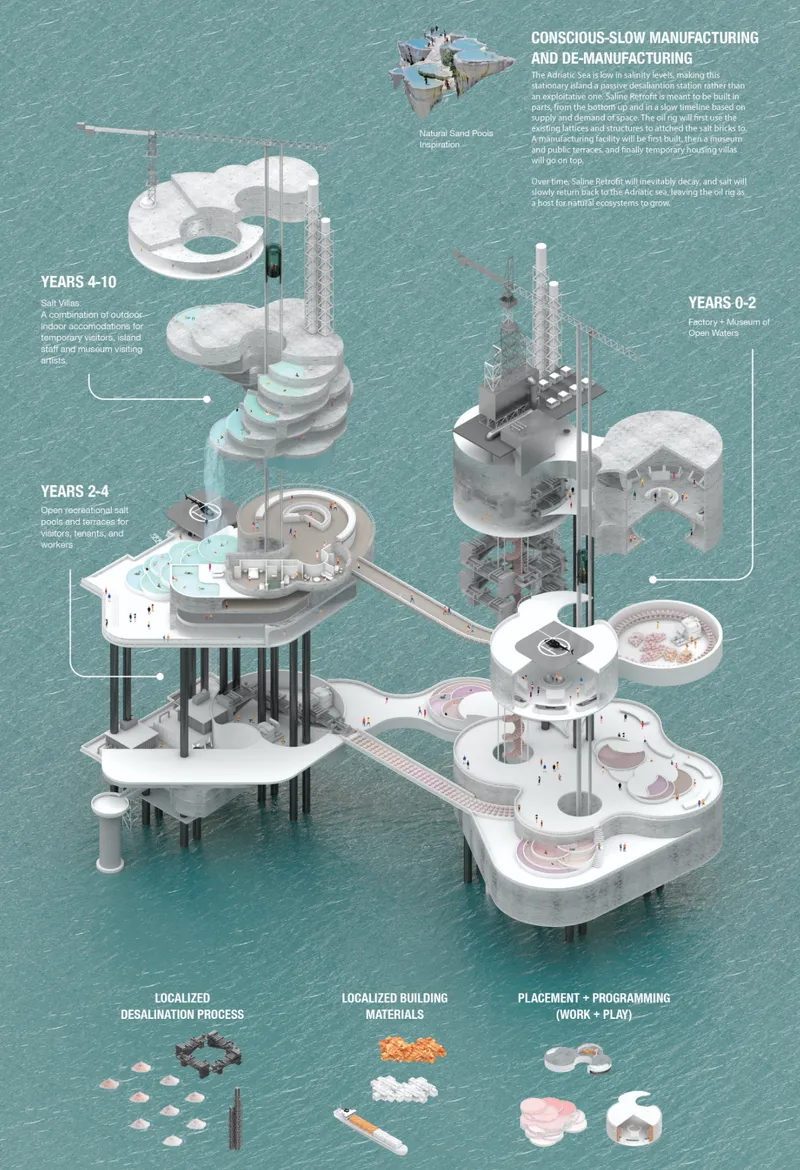
The axonometric is the project's clearest argument. Stacked platforms on stilts are drawn as a timeline: in years 0 to 2 the desalination factory and museum come first, establishing both the material supply and the public reason to visit. In years 2 to 4, salt pools, terraces, observation platforms and communal outdoor spaces spread across the rig, opening it to visitors, workers, researchers and residents. Villas arrive later in the ten-year sequence.
The ordering is sensible. Production precedes occupation, so every new layer is built from material the rig has already made. This is a closed loop in a literal sense: the desalination byproduct becomes the construction system, which removes the need to ship in conventional building components to a remote marine site.
Living Behind Walls Made From the Water Outside
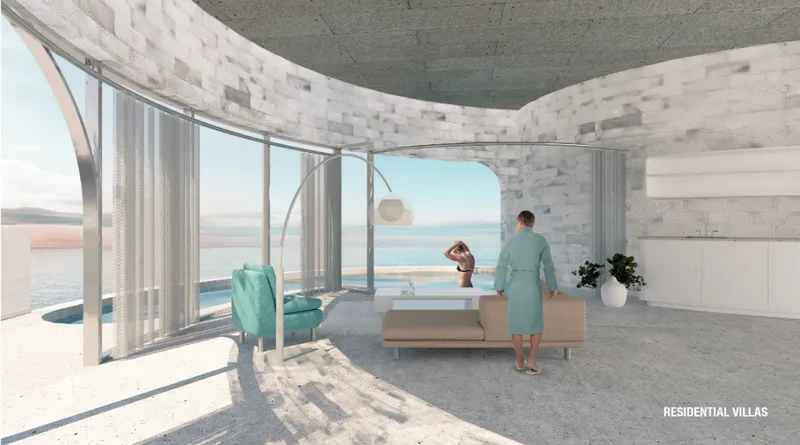
The villa interior brings the material strategy down to domestic scale. Curved salt brick walls wrap the living room, while a full glass wall opens onto the sea at dusk. The image makes an uncomfortable idea feel calm: the enclosure is made of the same substance as the view, and it is temporary by design. Residents are not owners of a permanent object so much as occupants of one stage in the rig's slow return to the ocean.
Keeping the Industrial Skeleton Visible
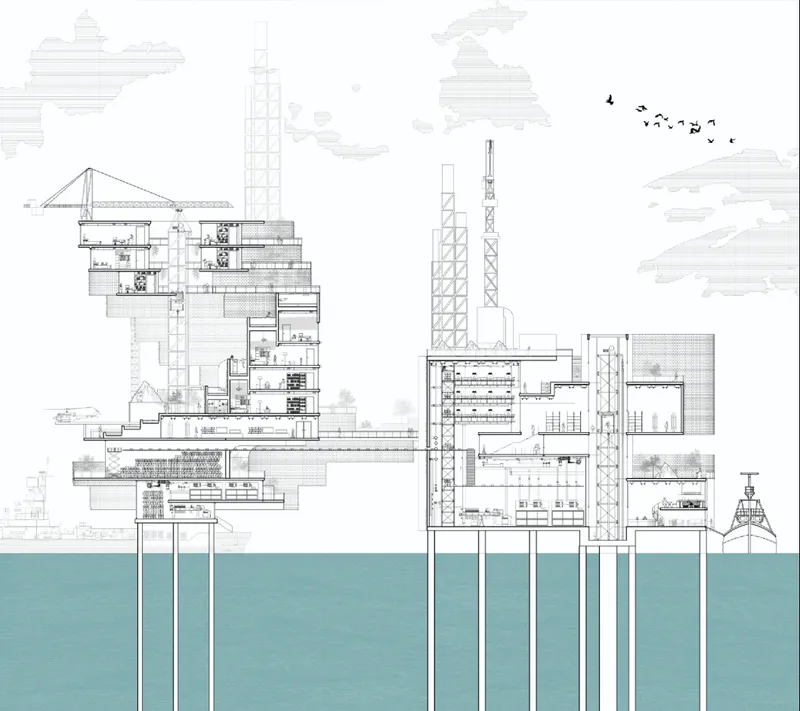
The section refuses to disguise the rig's origins. Two platforms stand on piles, with cranes, lattice towers and a ship docked alongside, and the new stepped floors are inserted among this equipment rather than replacing it. That restraint matters. The steel structure is the long-term asset in this proposal, the part that remains once the salt is gone, so keeping it legible tells visitors exactly what will be left to host marine life.
A Museum Lit Through Salt, Linked by a Bridge Over Open Water
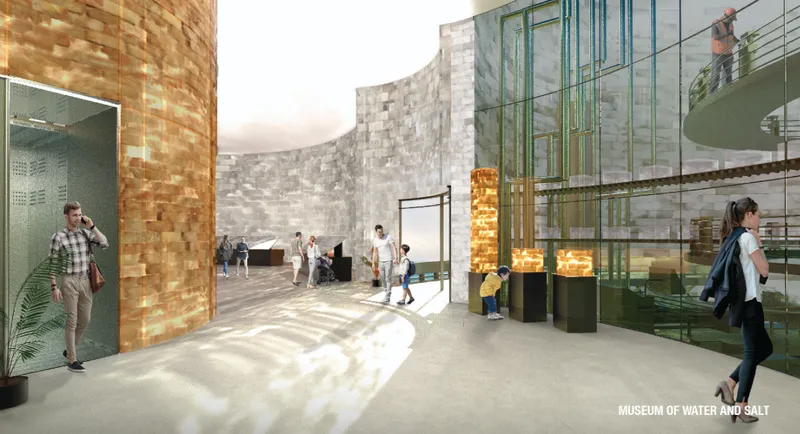
The Museum of Water and Salt is the public core, an educational platform on marine ecosystems, renewable resources, desalination and industry's impact on the ocean. In the lobby rendering, amber salt block walls glow with transmitted light and backlit plinths display exhibits as visitors cross a sunlit floor. The designers describe soft curved geometries, filtered daylight, panoramic views and textures drawn from crystallised salt; here the wall itself is the first exhibit, demonstrating the material before any panel explains it.
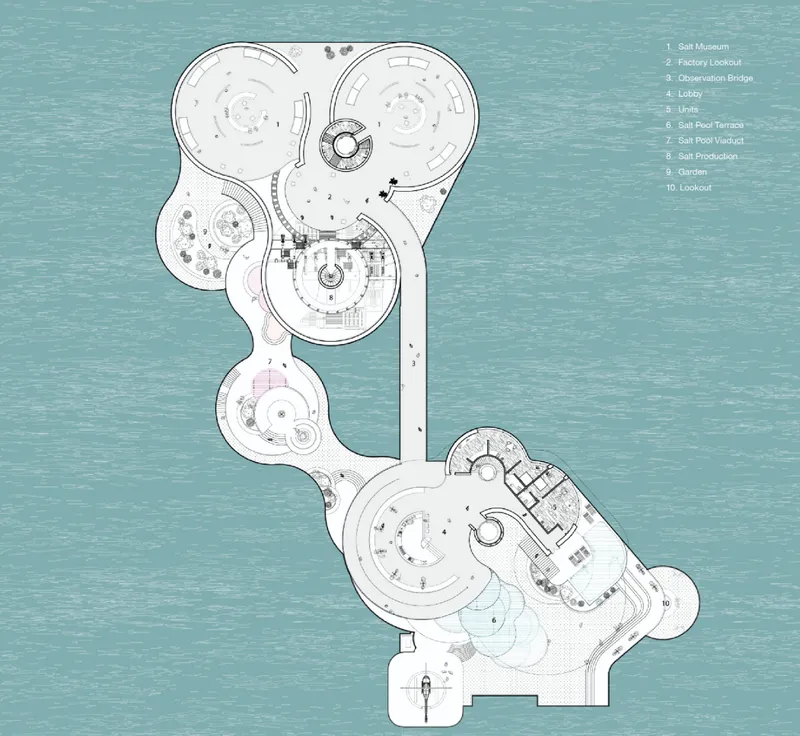
The plan shows how the programme is distributed: lobed circular platforms, numbered for the salt museum, pools and a lookout, are joined by a long observation bridge stretched across the water. The bridge turns circulation into an event, forcing visitors to move between programmes over open sea. It is a simple move that keeps the ocean in view at every transition, which suits a project whose subject is the ocean.
Why This Project Matters
Adaptive reuse usually aims to extend a structure's life indefinitely. Salinetorium proposes something more honest about offshore infrastructure: give the rig one more useful chapter as a factory, museum and retreat, then let its human layer wash away so the frame can serve the sea. Sustainability here is measured by how gracefully the building yields to environmental change, not by how long it resists it.
The proposal leaves open questions about dissolution rates and maintenance, but the core idea is coherent and clearly drawn. By making the material source, the programme and the decay process part of one cycle, Yang, Fan and Liu offer a useful model for how the Adriatic's dormant platforms, and others like them, might move from extraction to restoration.
View the Full Project
About the Designers
Designers: Zhenxiong Yang, Alan Fan, Chia-Chia Liu
Enter a Design Competition on uni.xyz
uni.xyz runs architecture and design competitions year-round that reward proposals with spatial conviction and real site intelligence.
Project credits: Salinetorium by Zhenxiong Yang, Alan Fan, Chia-Chia Liu Proximity Island 2019 (uni.xyz).


Popular Articles
Popular articles from the community

Opera by the Sea Estonia: Three Shells Dissolving Architecture into Tallinn's Coastline
A winning opera house proposal replaces monumental form with interconnected shells that blur the boundary between building, park and Baltic Sea.

Tsunami Convergenics: Turning Catastrophic Ocean Forces into Underwater Housing Infrastructure
A speculative underwater settlement off the coast of Onagawa, Japan, treats tsunamis and typhoons as energy sources rather than threats.
Manzana Morphosis: Stretching Barcelona's Grid into a Living Landscape for 2050
A radical reworking of the Eixample manzana turns density into a tool for generous public space, vertical ecology, and environmental performance.

The Amber Palace Opera: A Geological Fiction Surfaces on Tallinn's Baltic Waterfront
Pierre Brillard reimagines a Baltic legend as a public landscape, opera house, and waterfront promenade rooted in Tallinn's coastal identity.

Similar Reads
You might also enjoy these articles

Healing Façade: A Modular Chapel System That Restores Ethiopia's Sacred Forests
Winner of the Eco-Chapel competition, this circular timber façade collects water from air to rebuild soil and reforest degraded Ethiopian landscapes.
Kaffeebühnen: Where Coffee Shop Architecture Becomes a Civic Stage in Vienna
A linear sequence of timber boxes, transparent shells, and open yards turns the Viennese café tradition into a public performance space.
Eco Chapel: A Modular Forest Pavilion That Grows Like the Landscape It Protects
Hexagonal timber modules weave through existing trees, turning a chapel into a living system for prayer, education, and reforestation.


Urban Forest: A Vertical Ecosystem for 5,000 Workers in Singapore's Changi Business Park
Radially stacked pods and layered green decks turn a 7-acre plot into 47 acres of ecological workspace projected for 2040.

Comments (0)
Please login or sign up to add comments
No comments yet. Be the first to comment!