

Sanjay Puri Architects Wraps a Nagpur Office Tower in Undulating Terracotta Ribs
On a compact urban plot in central India, the Stella Office Building uses sculptural brise-soleil fins to filter heat and light.


Nagpur sits near the geographic center of India and endures some of its harshest summers. Designing a 5,574 square meter office building on a plot barely larger than a tennis court demands discipline, but Sanjay Puri Architects has turned that constraint into a vertical proposition where the facade does almost all the heavy lifting. The Stella Office Building, completed in 2026, is wrapped in a continuous skin of vertical terracotta fins that bulge, recede, and curve around its corners, forming a deep environmental filter between the workplace and a dense urban neighborhood.
What makes this project worth studying is not the use of terracotta itself, which has become a favored material for sustainable cladding worldwide, but how the geometry of the fins varies across the elevation to create differentiated light conditions inside. The staggered recessed balconies punched into the screen add depth, shadow, and the opportunity for planting at every level, turning a straightforward commercial tower into something that reads more like a living organism than a glass box. On a tight site in a second-tier Indian city, that level of ambition is rare.
The Facade as Environmental Machine
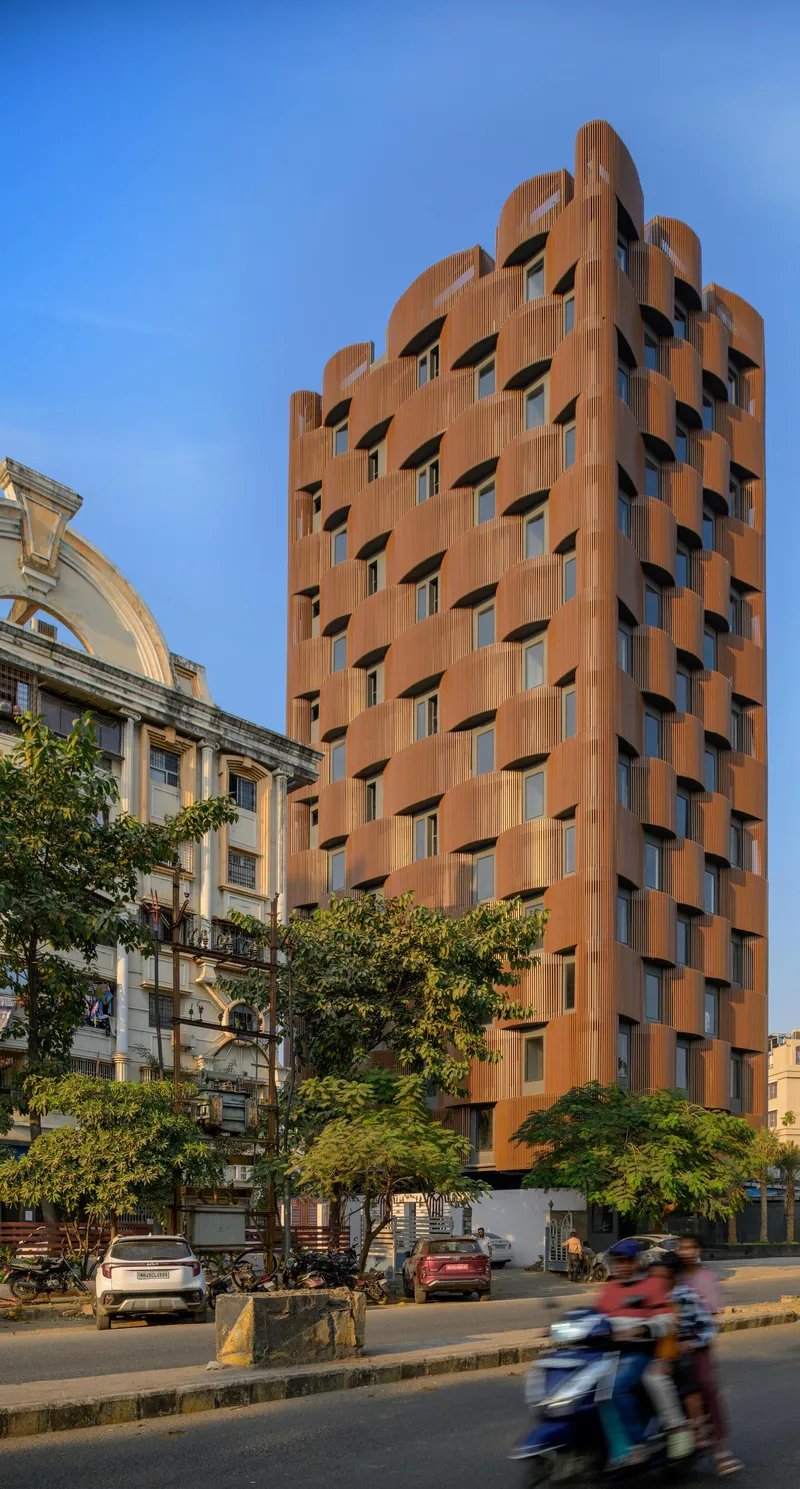
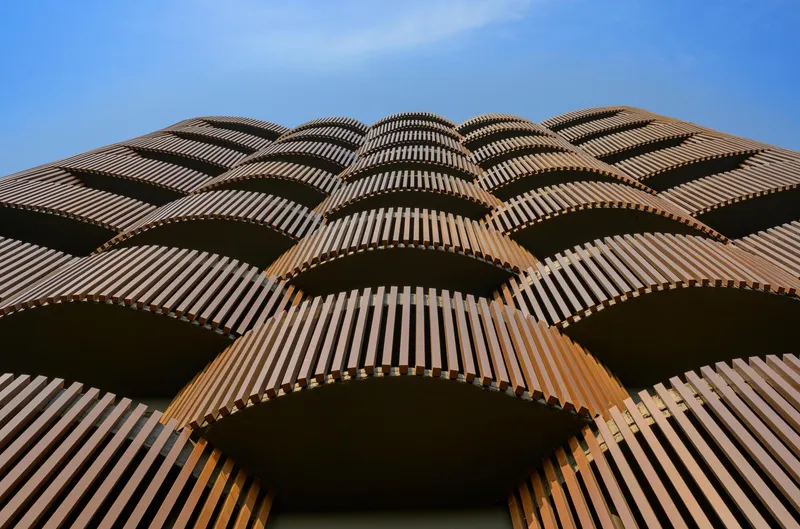
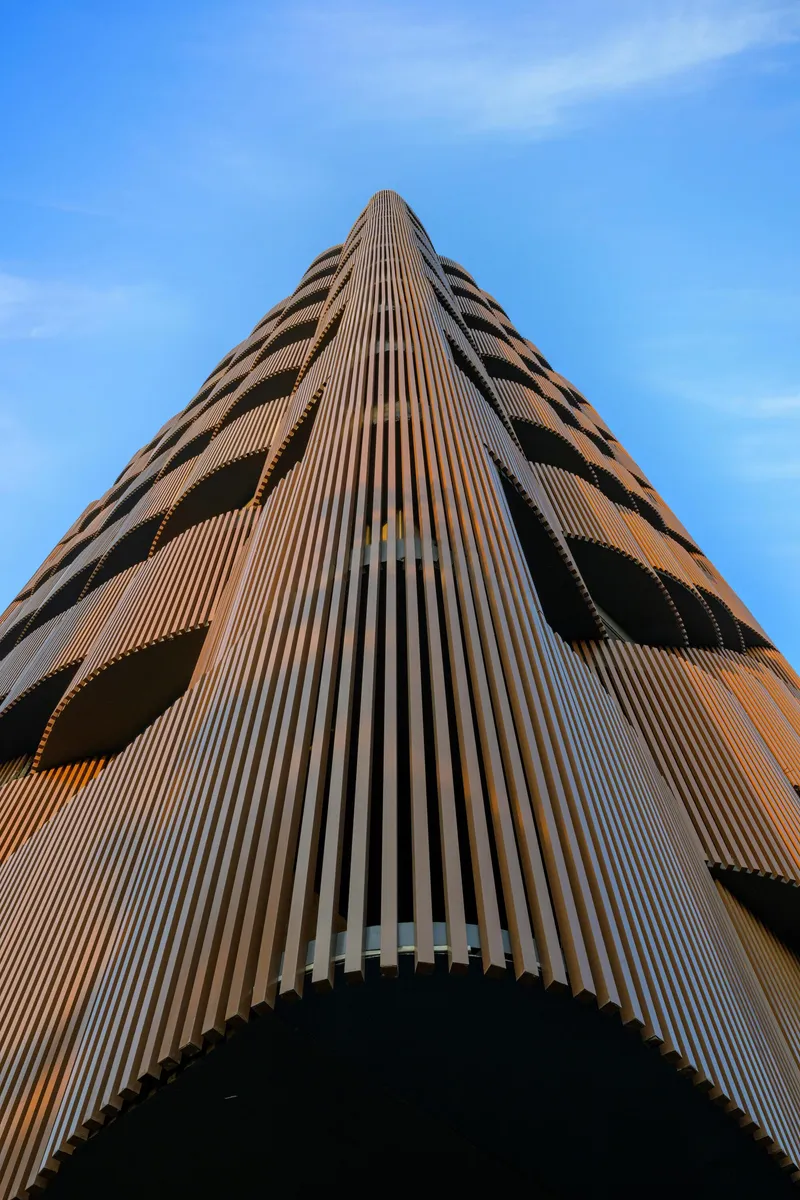
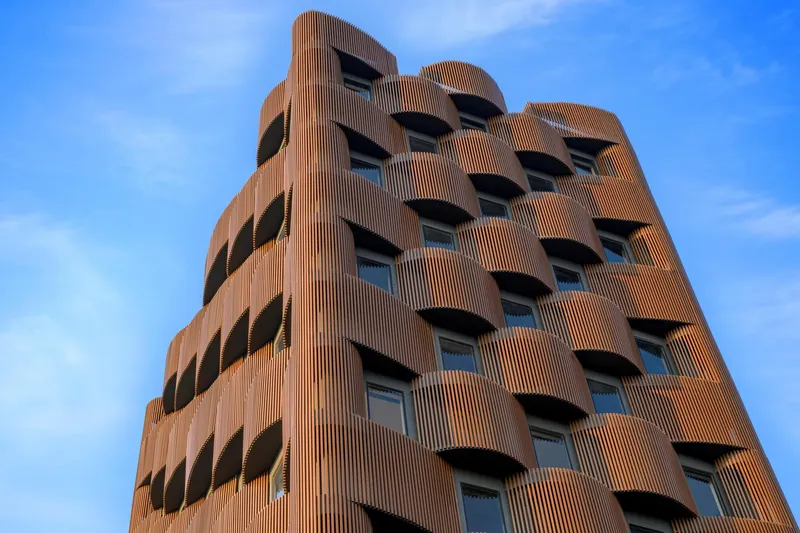
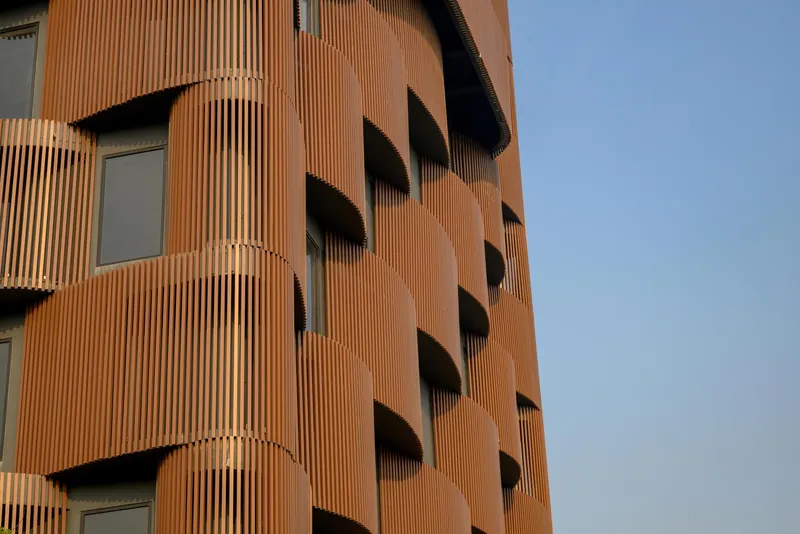
The dominant move here is the brise-soleil: vertical terracotta ribs that run the full height of the building, spaced closely enough to block direct solar gain but wide enough to permit airflow and outward views. Seen from the street, the fins produce a rhythmic moiré effect that shifts as you walk past. The ribs are not uniform. They follow a parametric logic, clustering tighter where solar exposure is most intense and opening where views are desirable.
At the corners, the geometry becomes genuinely sculptural. The fins wrap in smooth curves, eliminating hard edges and giving the tower a softer, almost organic profile against the sky. The repeating arched patterns visible from below suggest a craft tradition, a nod perhaps to the jali screens of Mughal architecture, reinterpreted at the scale of a contemporary commercial building.
Terracotta Up Close
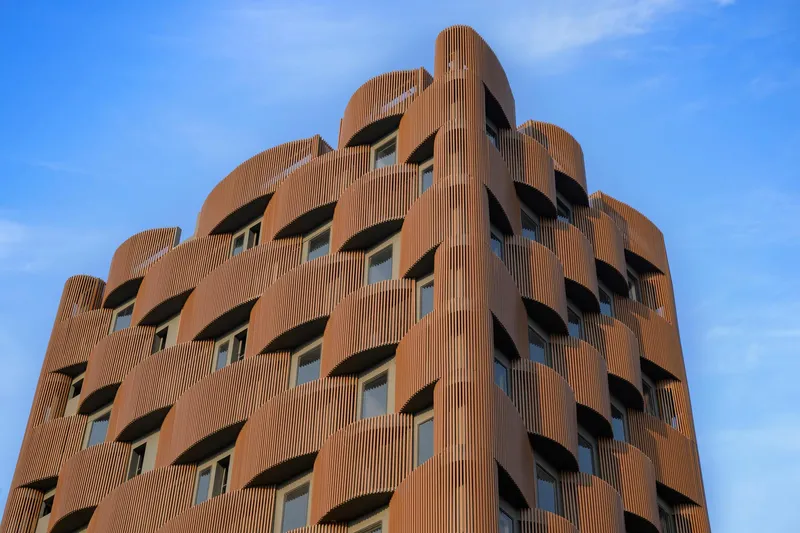
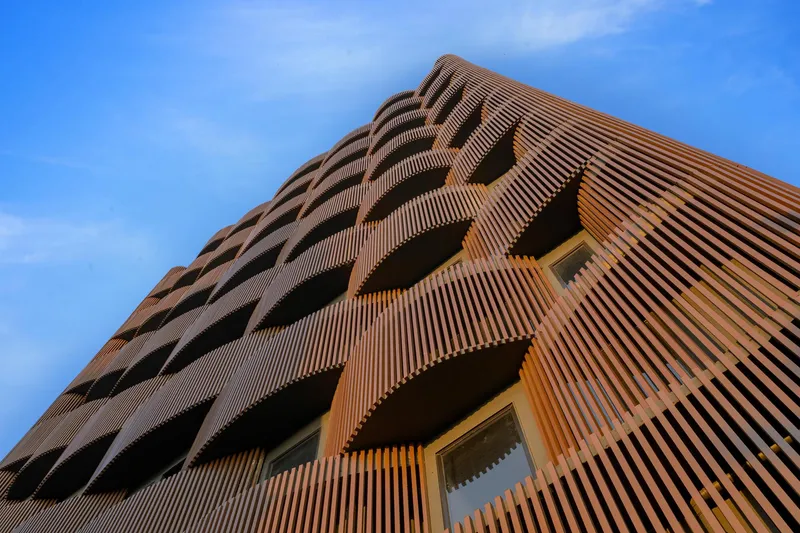
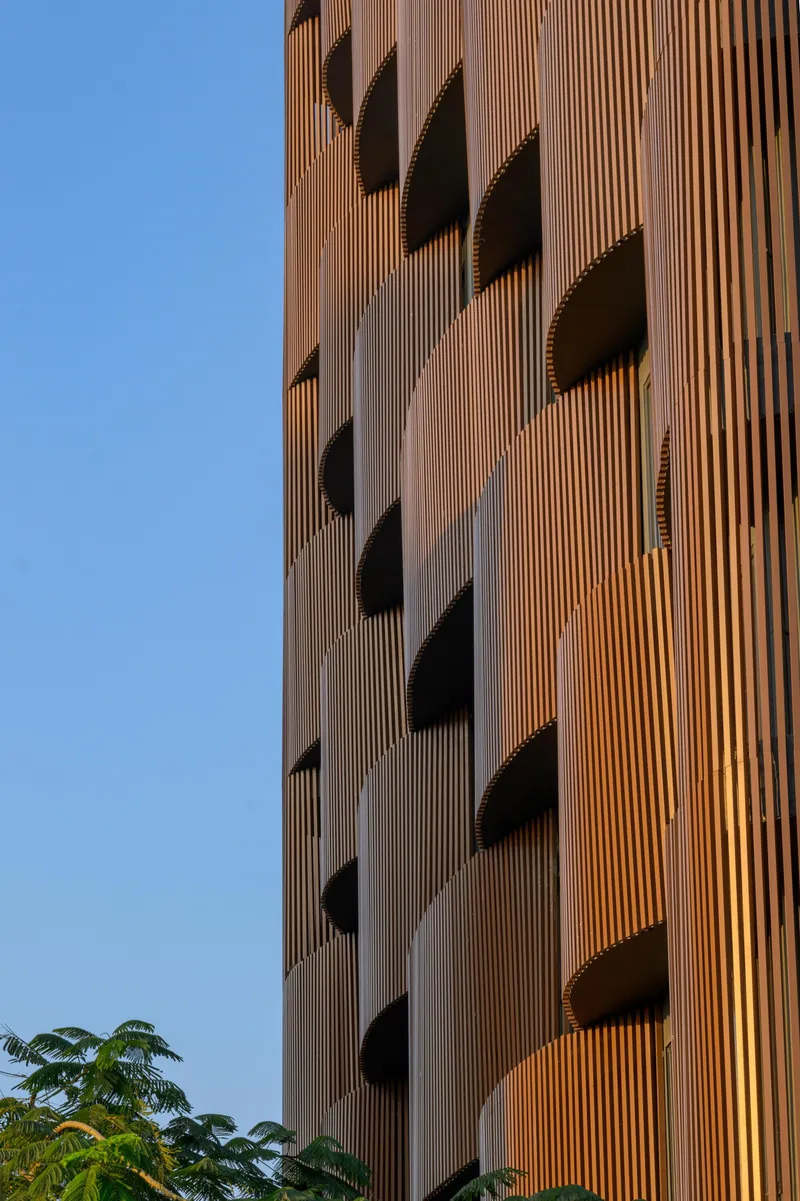
In detail, the cladding system reveals its intelligence. Each terracotta fin is a substantial element, not a thin appliqué. The warm ochre tone ages well in Nagpur's climate, gaining character rather than deteriorating. At dusk, the fins catch sidelight and throw long shadows across the balcony recesses, creating a layered depth that flat curtain walls can never achieve.
The balconies themselves are carved into the fin matrix at irregular intervals, their edges wrapped in the same ribbed language so they feel integrated rather than punched out. Planting spills from some of these recesses, softening the terracotta with green. It is a simple gesture, but it transforms the perception of the tower from pure office infrastructure to something with a vegetal, inhabited quality.
The Tower in Its Context
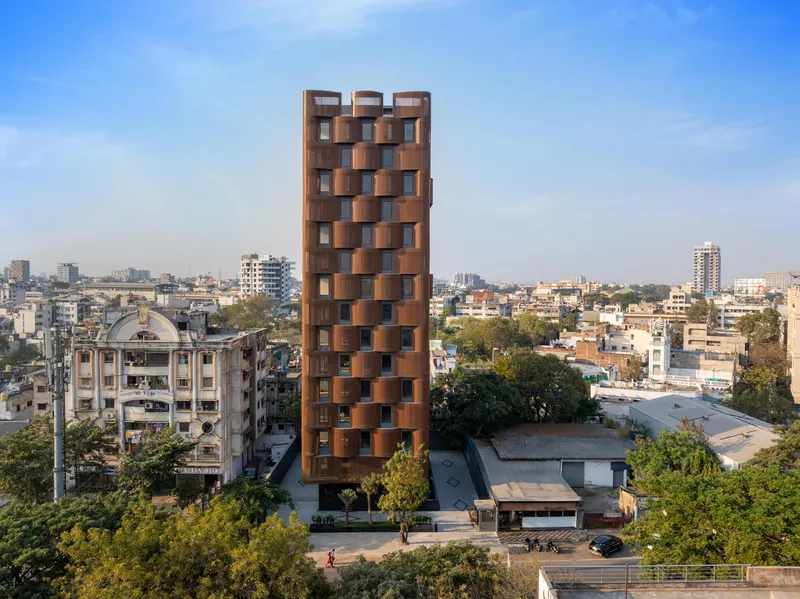
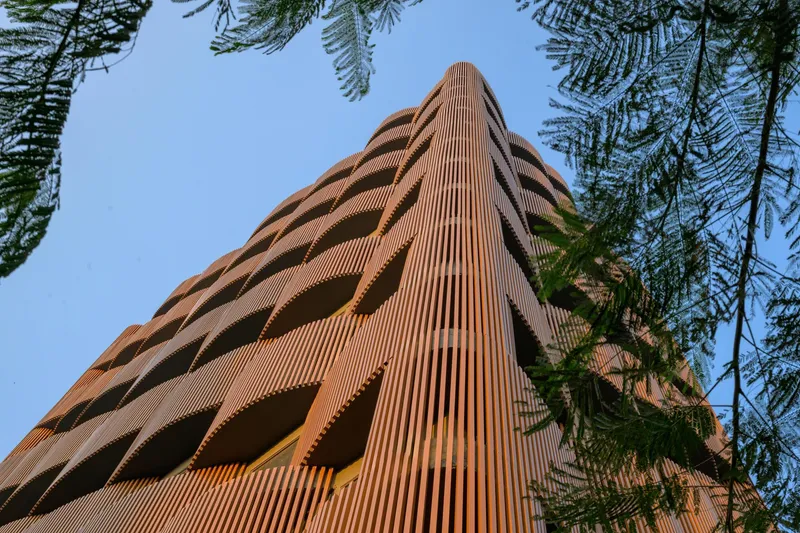
From the air, Stella reads as a tightly packed column rising above a canopy of mature trees and low-rise neighbors. Its footprint is modest, which is precisely the point: by going vertical and wrapping the entire envelope in a performative screen, the architects avoid consuming scarce ground-level land for sprawling floor plates. The aerial view also reveals how much of the site has been left to landscape rather than paving, a decision that helps mitigate the urban heat island effect.
At street level, the building's relationship with the road is mediated by trees, not by gates or blank walls. Motorcyclists and pedestrians move past a tower that engages the public realm rather than retreating from it. The terracotta color palette is sympathetic to the earth tones of Nagpur's older built fabric, grounding a modern structure in local material culture.
Staggered Balconies and Vertical Rhythm
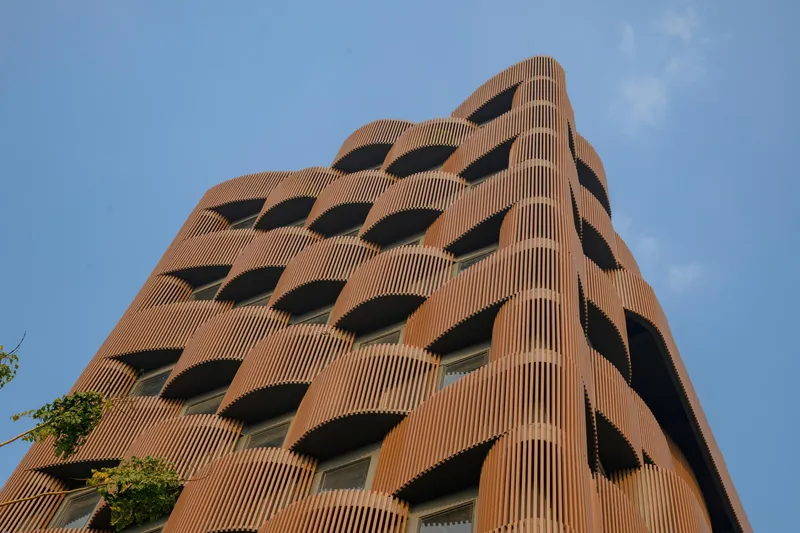
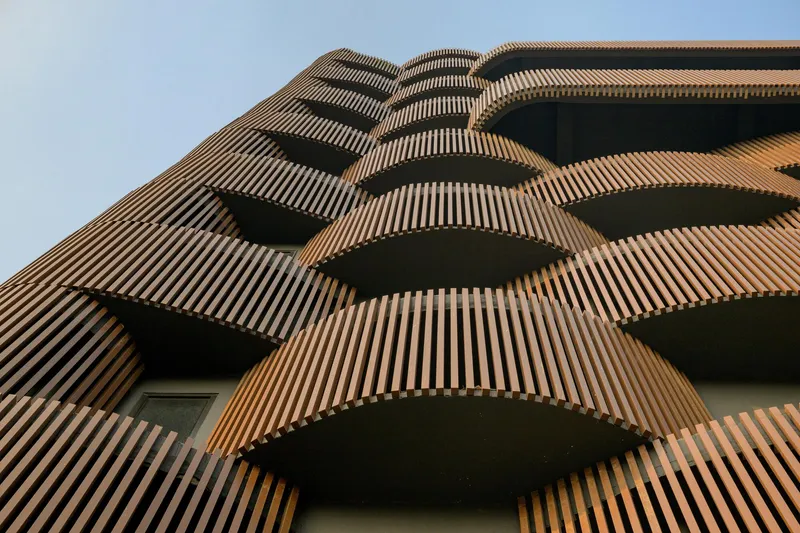
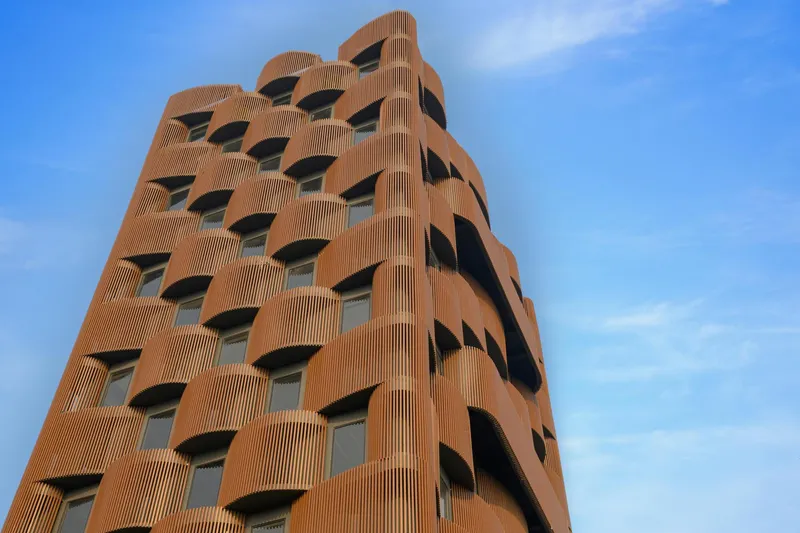
The recessed balconies are staggered in a way that prevents the facade from reading as a monotonous grid. Each void is placed at a slightly different position relative to its neighbors, so the elevation acquires a syncopated rhythm. The resulting pattern is orderly enough to feel intentional but irregular enough to hold your attention. It is a deliberate rejection of the speculative office tower's default: identical floor plates expressed as identical bands on the exterior.
Looking upward from the base, the stagger becomes even more pronounced. The balconies step in and out, creating a cascade of terraces that draw the eye vertically. Planting on these terraces introduces further variation across seasons, promising a building that will never look exactly the same twice.
Inside the Screen
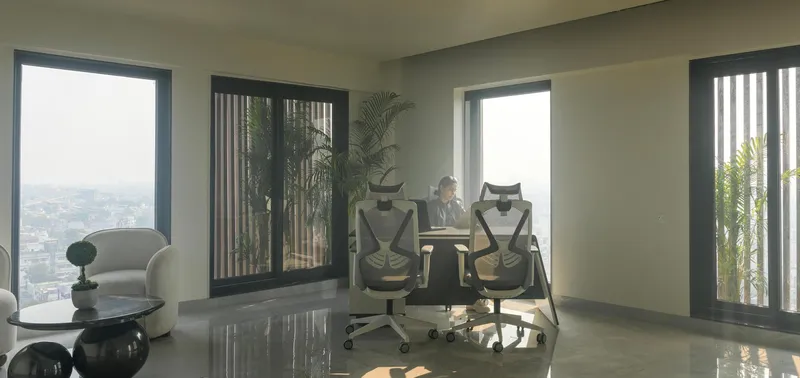
From the interior, the terracotta fins frame the city in narrow slices, filtering glare while maintaining a clear connection to the outside. Glass doors open onto the screened balconies, offering occupants a threshold space that is neither fully inside nor fully outside. In a climate where air conditioning dominates, these semi-outdoor zones are a meaningful amenity: they allow workers to step into fresh air without stepping into direct sun.
The interior finish is restrained, with light surfaces and minimal partitions, letting the facade screen do the visual work. The play of light and shadow cast by the fins across floor and ceiling creates a constantly shifting pattern through the day, animating an otherwise straightforward office layout.
Plans and Drawings
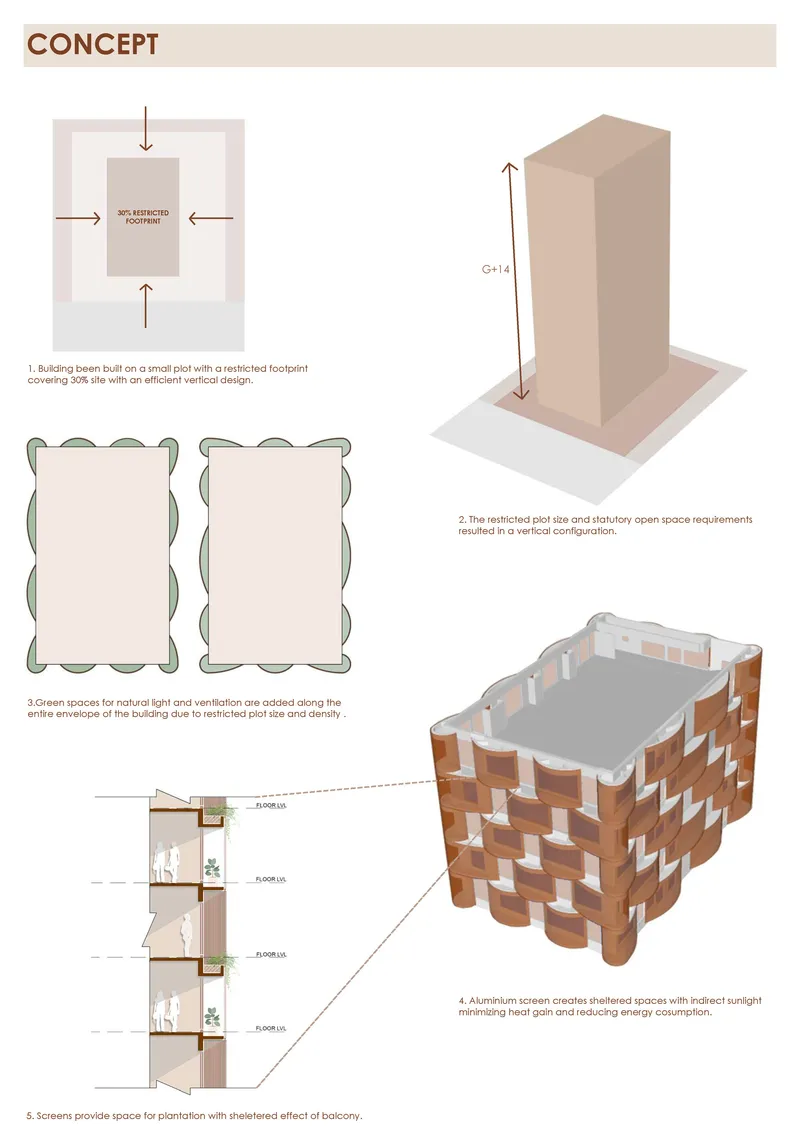
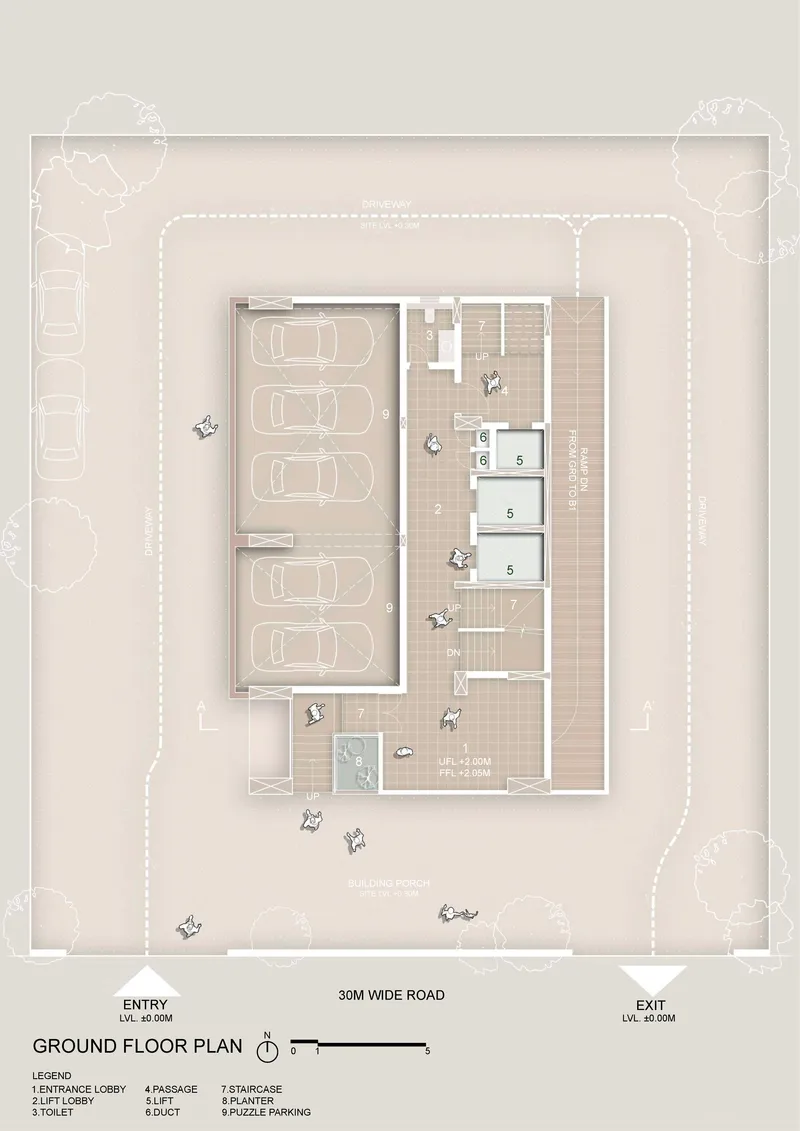
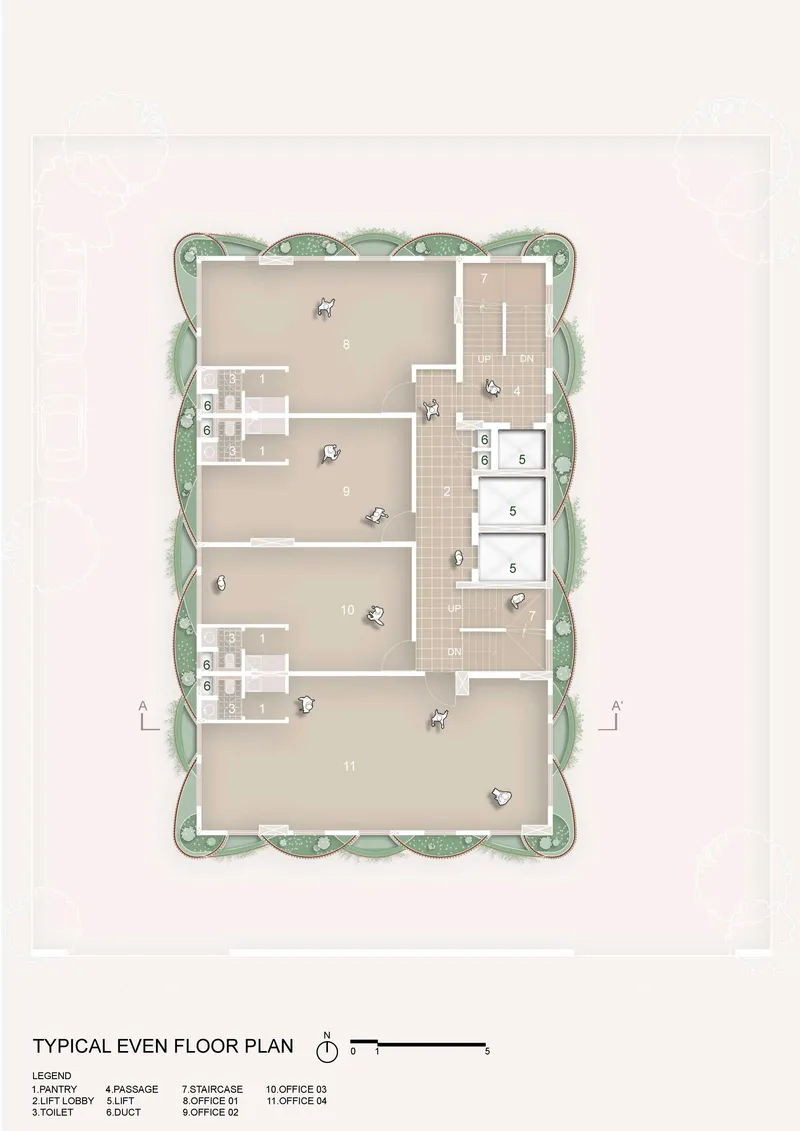
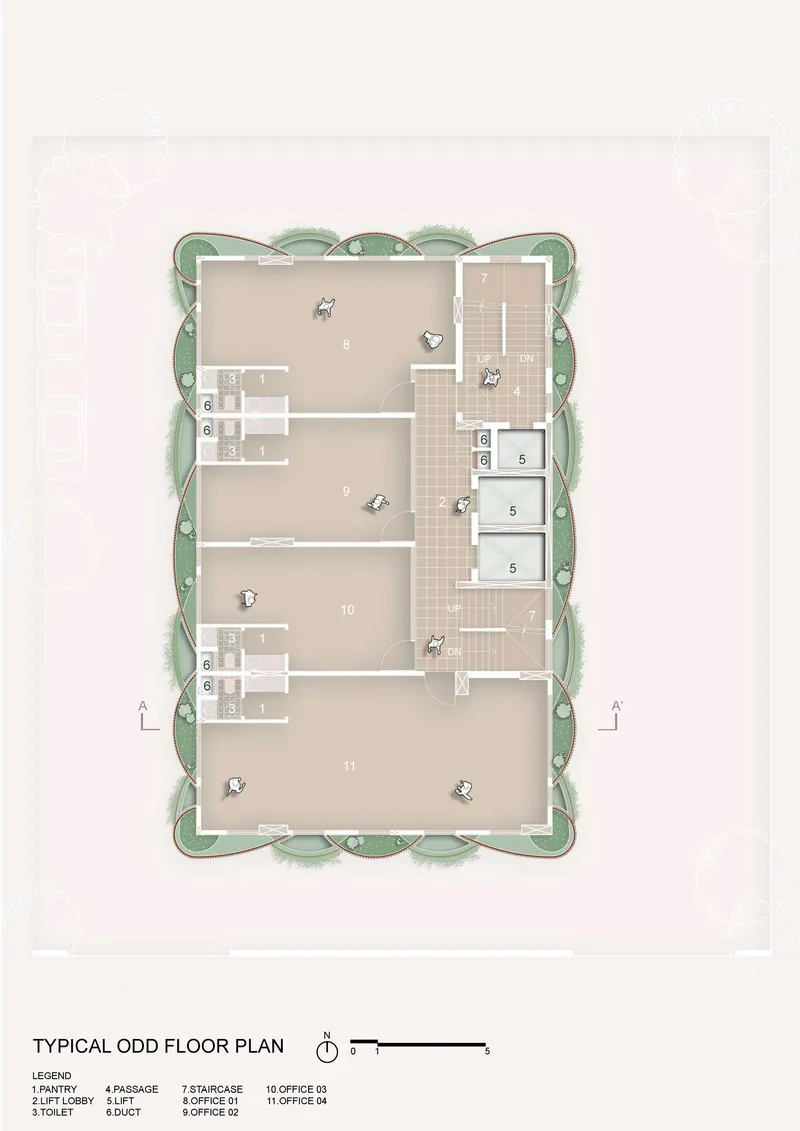
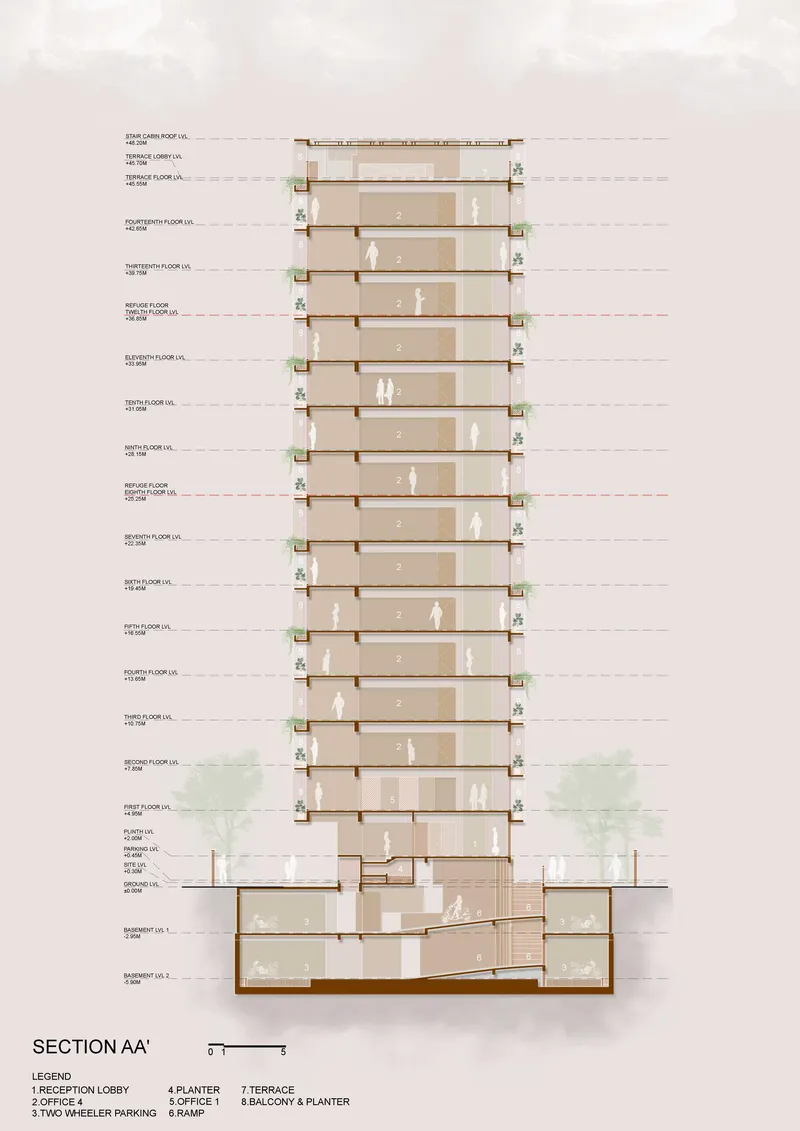
The concept diagram lays out the facade strategy clearly: a rectangular floor plate is wrapped in a continuous screen whose depth varies by orientation, and the balconies are distributed to maximize cross-ventilation and solar shading. The ground floor plan reveals that parking is handled efficiently at grade, freeing upper levels entirely for workspace. Typical plans show planted balconies wrapping the perimeter, confirming that the green terraces are not ornamental afterthoughts but are integrated into every floor.
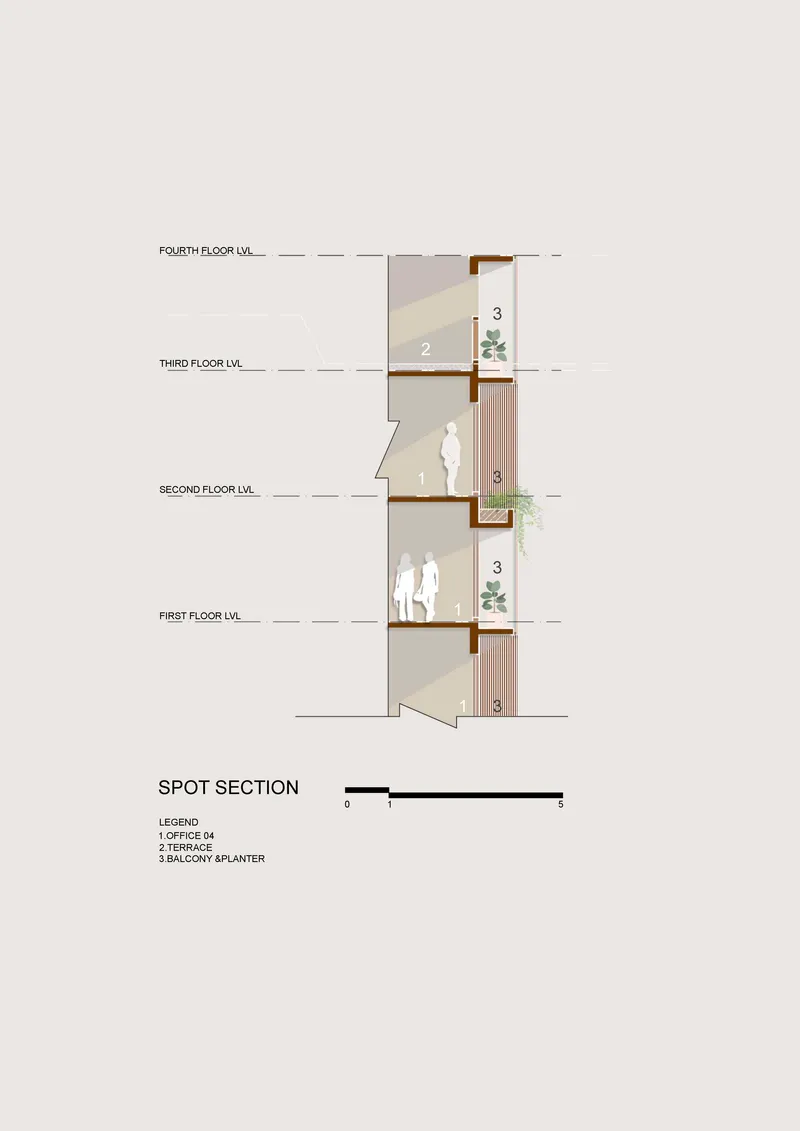
The section drawings are the most revealing. Stacked floor plates are interspersed with double-height volumes, breaking up the monotony of identical office levels and allowing light to penetrate deeper into the plan. Terrace planters appear at every level in section, reinforcing the idea that the building breathes through its skin. The spot section showing four staggered levels with planted terraces confirms that the vertical choreography visible from outside is a genuine spatial strategy, not merely a cosmetic exercise.
Why This Project Matters
Indian cities are building enormous volumes of commercial space, and most of it defaults to glass curtain walls that demand relentless mechanical cooling. Stella is a counterargument. By investing design intelligence in a terracotta screen, Sanjay Puri Architects reduces cooling loads, improves occupant comfort, and gives a mid-sized city a landmark that does not rely on glass or steel spectacle. The material is local, the logic is climatic, and the result is a building that looks better the closer you get to it.
Beyond performance, the project demonstrates that compact commercial towers do not have to be dull. The staggered balconies, the parametric fin geometry, and the integration of planting at every level add up to an architecture that is genuinely responsive to its environment. In a country where the office building is too often treated as a mere container for square meters, Stella insists that the envelope is the design, and that terracotta, one of humanity's oldest building materials, is still capable of surprise.
Stella Office Building by Sanjay Puri Architects. Nagpur, India. 5,574 m². Completed 2026. Photography by Vinay Panjwani.
About the Studio
Share Your Own Work on uni.xyz
If projects like this are the kind of work you want to make, uni.xyz is a place to publish your own, find collaborators, and enter design competitions.


Popular Articles
Popular articles from the community


Singing Woman: Contemporary Architecture Inspired by Estonia’s Voice and the Sea
Singing Woman turns Estonia’s song culture into flowing opera house architecture, blending public life, landscape, sea, and national memory.

Extended Shell: Retrofitting Kolkata's Balconies as Living Urban Thresholds
A modular retrofit system recovers the social and environmental intelligence of Kolkata's historic verandas for contemporary Park Street residents.

Tsunami Convergenics: Turning Catastrophic Ocean Forces into Underwater Housing Infrastructure
A speculative underwater settlement off the coast of Onagawa, Japan, treats tsunamis and typhoons as energy sources rather than threats.

Faces of the Soviet Avant-Garde: Turning Moscow's Street Names into an Open-Air Museum
A network of sculptural installations across a Moscow residential district transforms forgotten architect names into spatial encounters with cultural memor

Similar Reads
You might also enjoy these articles

Bao Huynh Watercolor Atelier: A Serene Art Retreat in Hội An
Bao Huynh Watercolor Atelier in Hội An blends multifunctional art spaces, sustainable design, local materials, and family-friendly living in a serene environment.

Atelier Macri Concept Store Interior Design by CASE-REAL
Atelier Macri store features a "ko" counter, walnut wood details, cork displays, blending retail, gallery, and seamless customer experiences.

Manuel Vargas Izquierdo Stadium and High-Performance Sports Center: Architectural Excellence in Jalpa de Méndez
The Manuel Vargas Izquierdo Stadium blends sustainable design, inclusive sports facilities, and cultural-inspired architecture, revitalizing Jalpa de Méndez’s public spaces.

KAKR Buluh Awar Hall: Revitalizing Community and Ecology Through Bamboo Architecture
Community built bamboo hall revitalizes Buluh Awar village, empowering youth, restoring ecology, celebrating vernacular craftsmanship through sustainable architecture and culture.


Comments (0)
Please login or sign up to add comments
No comments yet. Be the first to comment!