

Sarv Office Building by Tamouz Architecture: A Layered Façade Redefining Light, Privacy, and Urban Interaction
A layered façade filters light, enhances privacy, and transforms this Tehran office into a dynamic, ventilated workspace despite tight urban constraints.


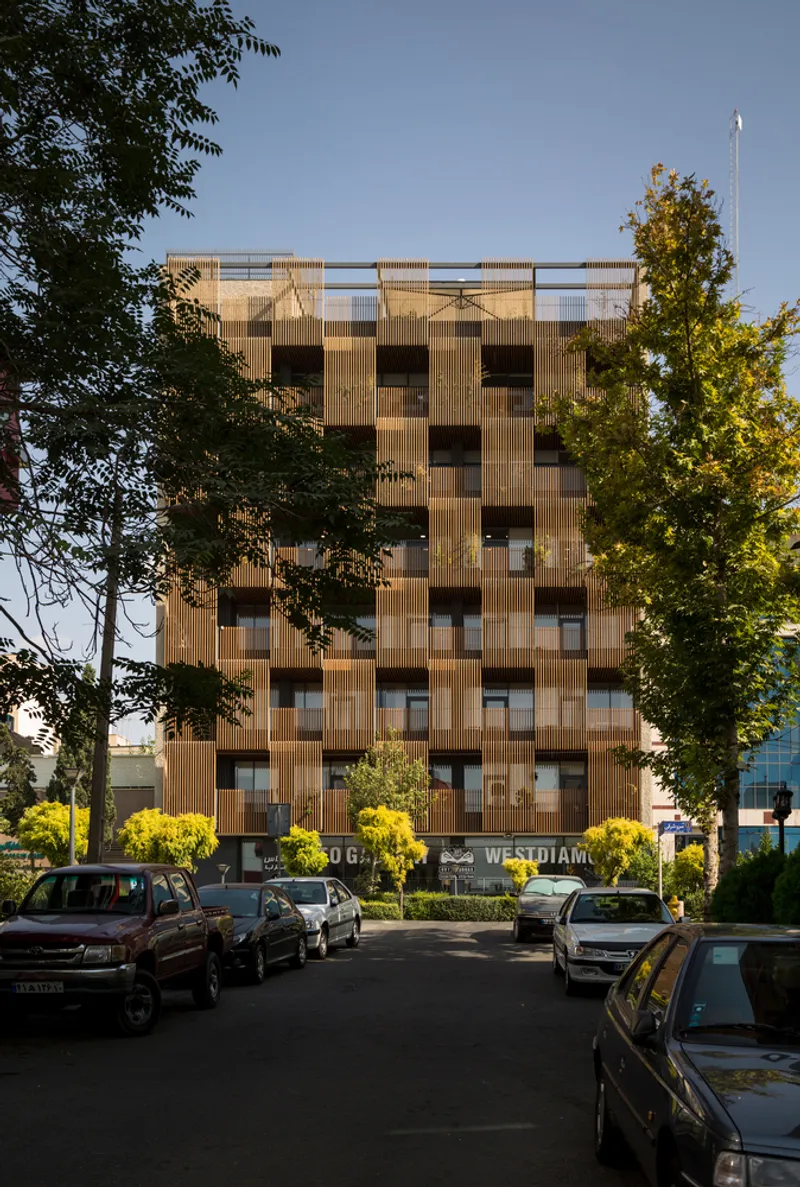
The Sarv Office Building in Tehran, designed by Tamouz Architecture & Construction Group, presents a compelling architectural exploration of dualities—light and shade, openness and enclosure, visibility and privacy. Completed in 2018 and spanning 4,420 m², the project transforms a partially built structure with severe site constraints into a dynamic urban presence through a meticulously layered façade strategy.

Site Constraints and Conceptual Framework
When the design team was first briefed in June 2017, the building was already under partial construction, tightly occupying 100% of the plot area. With only the southern façade available for natural light and airflow, the architects faced a demanding challenge: how to create a functional, comfortable office environment when all environmental performance hinged on a single side.
Inspired by ideas of Disorder/Order, Unseen/Seen, and Closed/Open, the architects developed a conceptual framework that embraced contradiction. Their goal was to turn a rigid, closed shell into a façade that behaves as a living threshold—not simply a protective surface, but a spatial filter mediating between the indoors and the city.
Transforming the Façade into a Spatial Interface
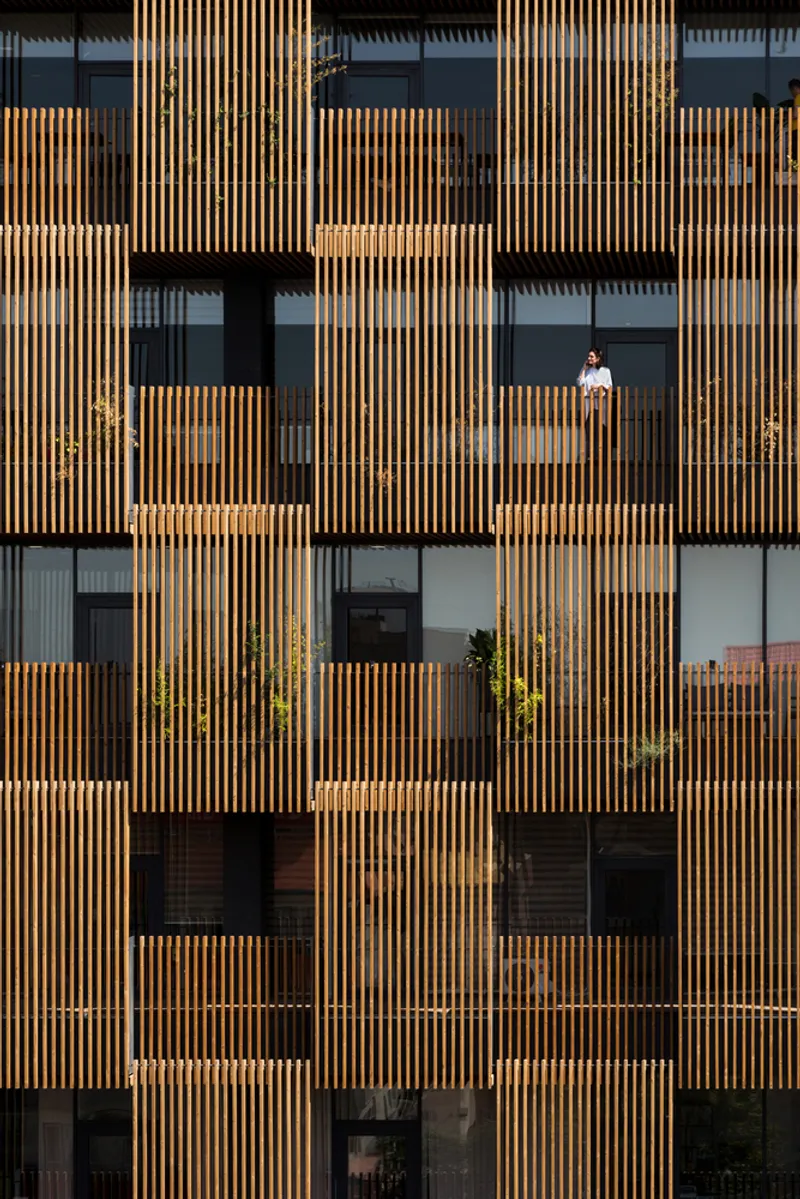
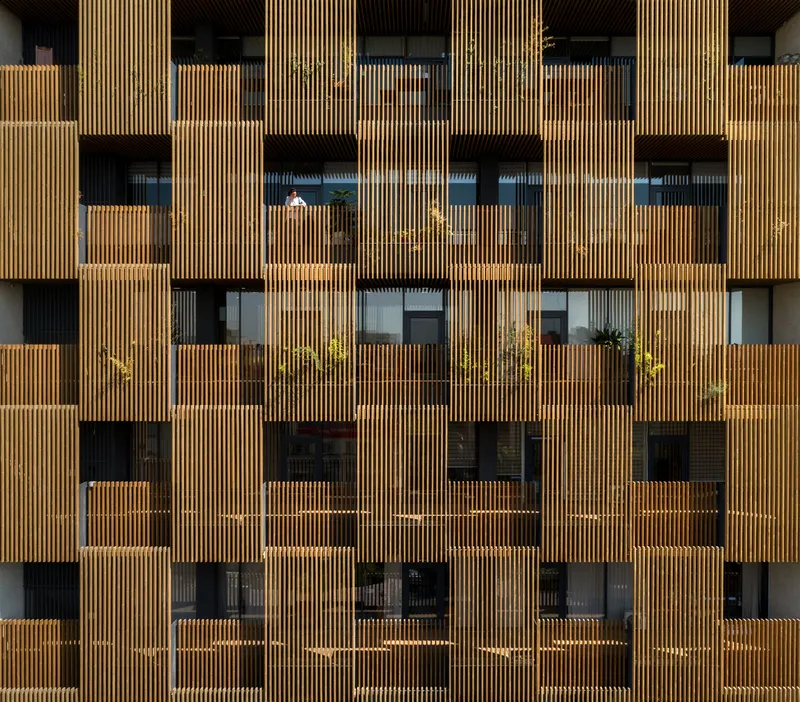
The building’s original flat façade offered no potential for depth or environmental modulation. The architects reimagined this surface as a two-layer system, creating a mediating zone that is at once open, filtered, and protective.
1. Inner Transparent Layer
The first layer is composed of generous, clear windows that maximize daylight penetration. This layer establishes a strong visual connection from inside to outside, drawing sunlight deep into office spaces and enhancing clarity, openness, and orientation.
2. Outer Semi-Transparent Layer
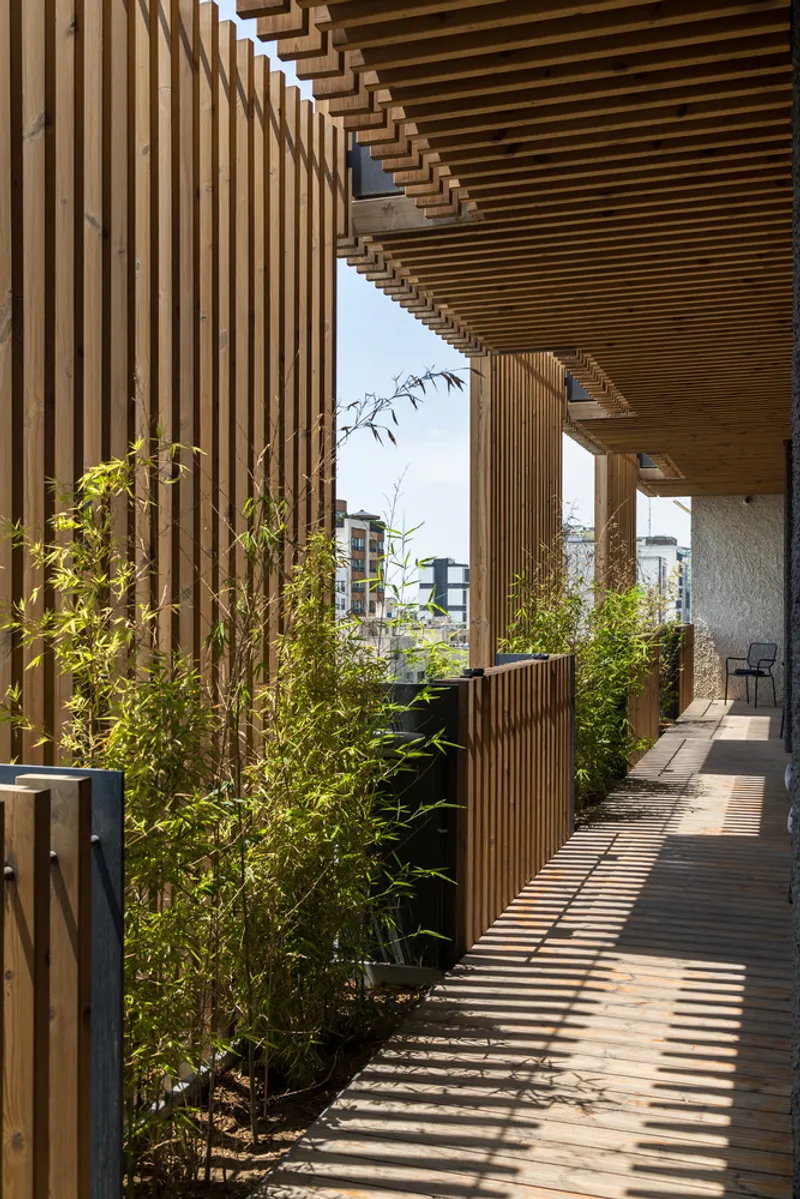
The second layer, positioned outward toward the street, features:
- Wooden railings
- Steel planters
- A permeable vertical screen
This semi-transparent skin performs several critical functions:
- Filters harsh southern sunlight
- Introduces controlled natural ventilation
- Protects interiors from direct views
- Creates a buffer that enhances privacy without severing the building’s relationship with its surroundings
The space created between these layers becomes an active intermediate zone—a shaded, ventilated, atmospheric threshold that blurs the line between façade and functional space.
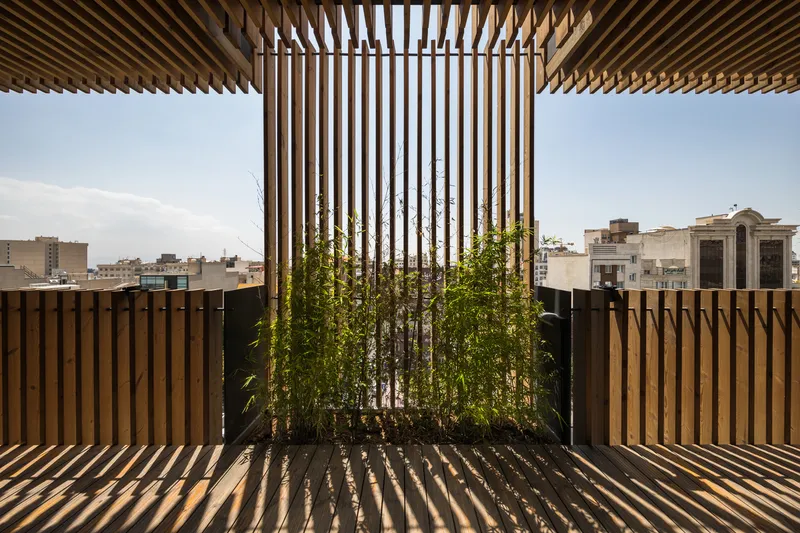
The Façade as an Urban Mediator
The dual façade system also enhances the building’s urban presence. Its depth and complexity animate the southern elevation with shifting shadows, greenery, and textured materiality. The building appears both solid and porous, closed yet open—reflecting the conceptual oppositions at the heart of the design.
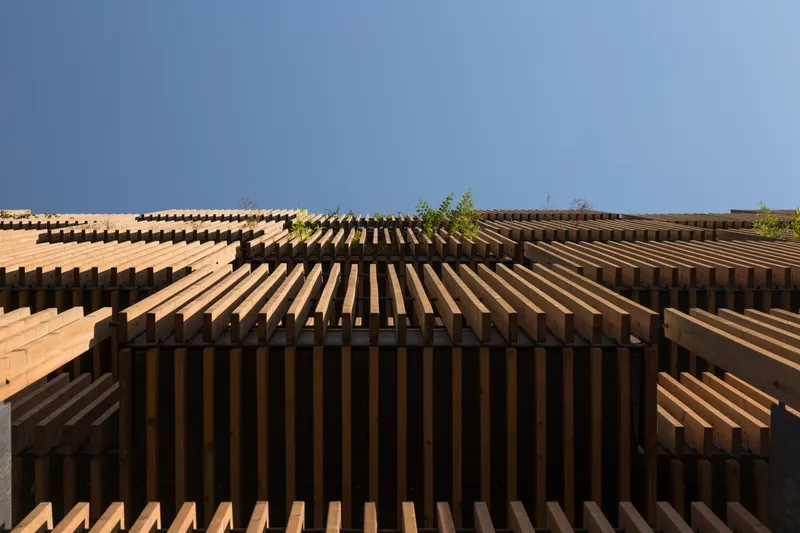
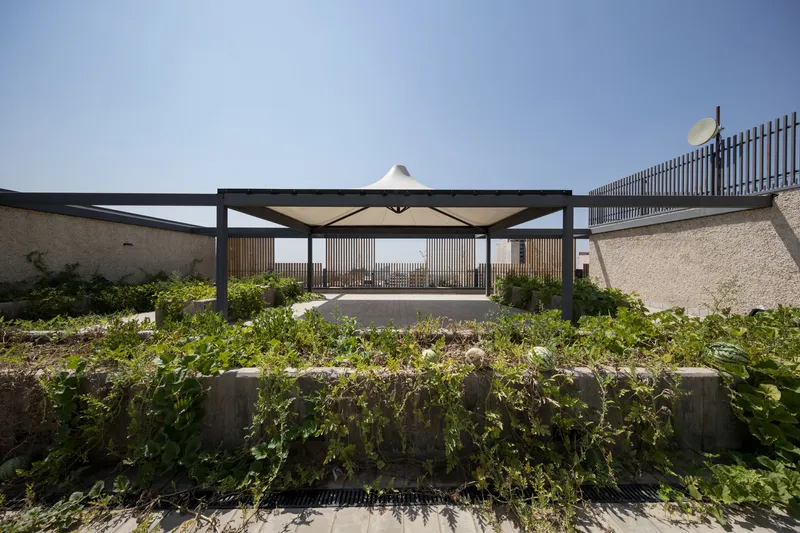
Rooftop Continuity and Layered Transparency
The same architectural language extends to the rooftop, where transparency, semi-opacity, and environmental filtering define the spatial experience. The rooftop becomes an elevated interface with the city, offering views, fresh air, and light while preserving the users’ comfort and privacy. This creates a holistic architectural identity that flows seamlessly from façade to sky.
Interior Organization and Spatial Strategy
Inside, the design continues the theme of layering and controlled openness. Service cores, communal areas, and mechanical infrastructure are arranged with clarity and precision, ensuring uninterrupted visual flow and functional efficiency. The interior planning mirrors the façade’s logic—resolving contrasts by integrating them into a unified architectural system.
The Sarv Office Building is a masterful response to extreme site limitations, transforming a constrained shell into a refined and responsive architectural composition. Through its layered façade, the project achieves a delicate balance between light and shadow, openness and privacy, and urban exposure and interior comfort. Tamouz Architecture succeeds in crafting a building that not only adapts to its context but elevates the very idea of façade design in dense urban environments.
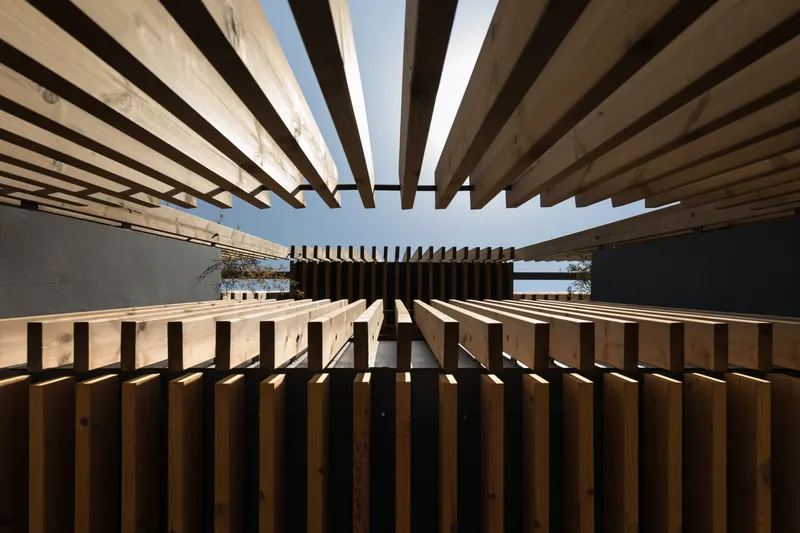
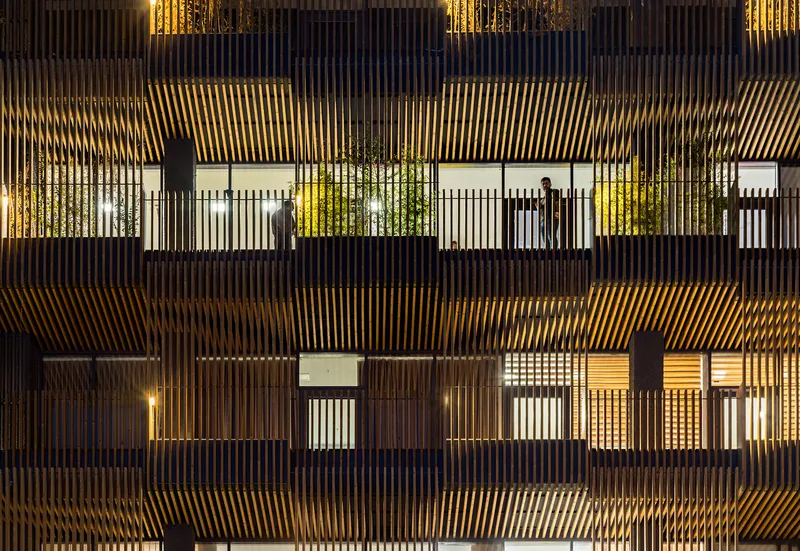
All photographs are works of Mohammad Hassan Ettefagh


Popular Articles
Popular articles from the community


The Amber Palace Opera: A Geological Fiction Surfaces on Tallinn's Baltic Waterfront
Pierre Brillard reimagines a Baltic legend as a public landscape, opera house, and waterfront promenade rooted in Tallinn's coastal identity.

Opera on the Sea: Driftwood Logic Shapes a Timber Opera House on Estonia's Coast
Trevor Orgill's opera house translates the entangled drift of floating timber into a civic building where wood, water, and music converge.
Faces of the Soviet Avant-Garde: Turning Moscow's Street Names into an Open-Air Museum
A network of sculptural installations across a Moscow residential district transforms forgotten architect names into spatial encounters with cultural memor

Manzana Morphosis: Stretching Barcelona's Grid into a Living Landscape for 2050
A radical reworking of the Eixample manzana turns density into a tool for generous public space, vertical ecology, and environmental performance.

Similar Reads
You might also enjoy these articles


Hodi-Mandai Geram
Project Function: Preservation and revitalization of the Intangible heritage and socio-spatial identity of the Hodi by Housing, Cultural Memory Center, Sacred Grove, landscape, local tourism economy


Olio Towers: A Mid-Rise for Performers That Fuses Housing, Rehearsal, and Stage
Located blocks from Houston's Theater District, this modular tower stacks living units around a central performance atrium.

Oasis: Modular Green Housing Carved into Dhaka's Urban Fabric
A shortlisted Plugin Housing entry reclaims unauthorized settlements in Dhaka with stepped concrete volumes, green roofs, and ventilation-driven design.

Black Hole: A Floating Megastructure for the Post-Physical Era
Emiliano Mazzarotto envisions a spherical, self-scaling arena where e-sports, digital hotels, and holographic stadiums replace traditional public space.
Explore Office Building Competitions
Discover active competitions in this discipline

Challenge to reimagine the Iron Throne

Photograph architecture without architects

Illustrate the lost glory of Angkor Wat - Render Challenge

Design challenge to reuse E-waste
Comments (0)
Please login or sign up to add comments
No comments yet. Be the first to comment!