
SBSA Dismantles and Rebuilds an Alpine Barn into a Mountain Holiday Home in the Dolomites
A century-old tabià in Santo Stefano di Cadore gets taken apart, cleaned, and reassembled as a larch-clad retreat with valley views.


The tabià is a building type so embedded in the culture of the Veneto Alps that its silhouette reads as landscape. Stables below, hay storage above, a gabled roof pitched against snowfall: the formula has survived for centuries because it works. When SBSA ⎮ Sandri Barbara Smaniotto Andrea Architetti Associati took on this early 20th-century example in Santo Stefano di Cadore, the question was not whether to preserve the type but how to make it inhabitable without turning it into a museum piece.
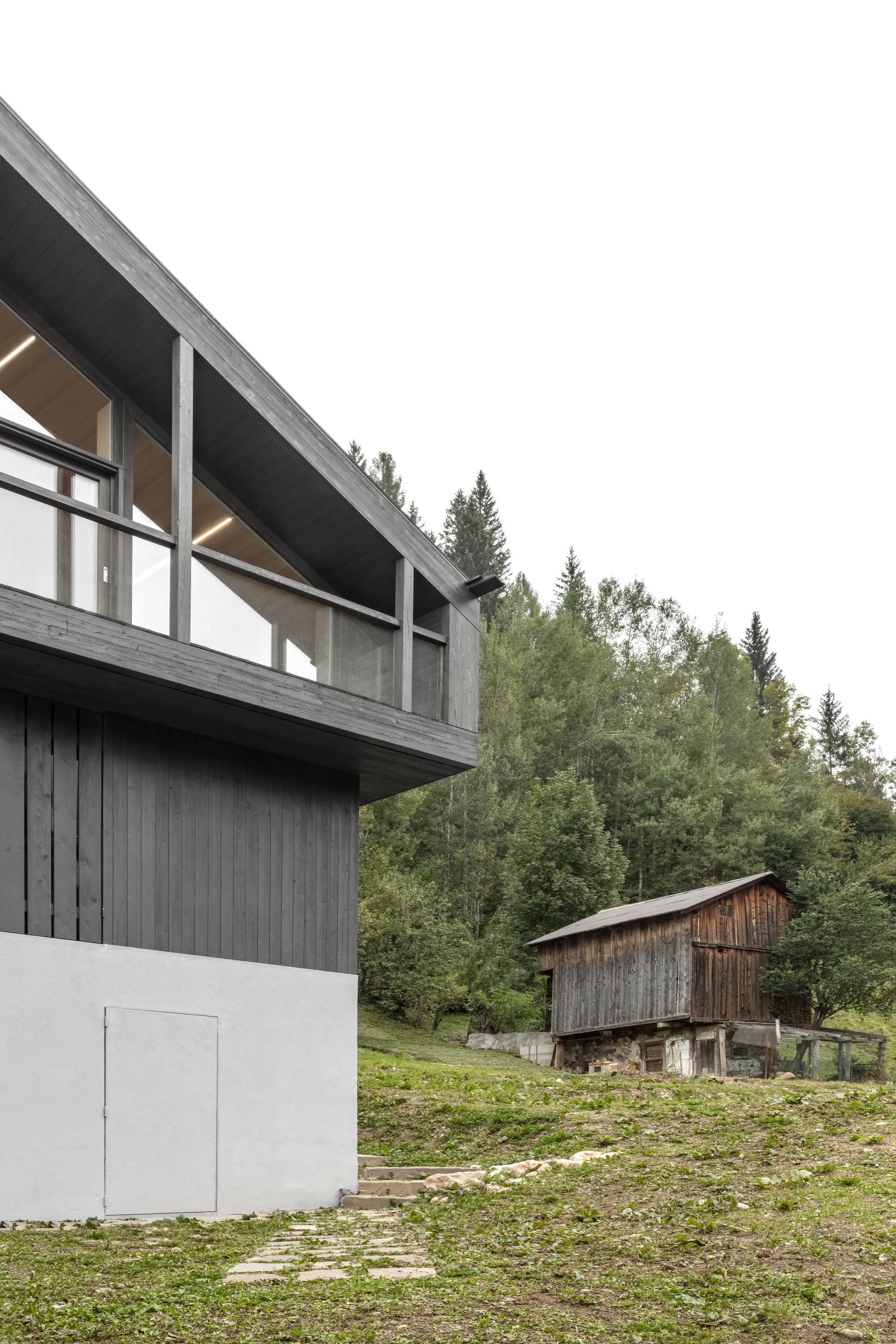
Their answer was radical in method and restrained in appearance. The building was completely dismantled, its wooden beams and pillars catalogued, cleaned, and then reassembled alongside recycled old materials where originals had deteriorated. The original "a telaio" frame structure was preserved, but the interior was reorganized to flip the traditional hierarchy: bedrooms sit on the lower floors while a single open living space occupies the attic, where floor-to-ceiling glazing now frames the Dolomite peaks to the south and dense forest to the north. The result is 170 square meters of holiday home that reads, from the outside, as a dark timber volume barely distinguishable from its neighbors. Get closer, and the precision of the larch cladding, the recessed balconies, and the careful glazing reveals a building thinking hard about its own traditions.
Sitting on a Slope
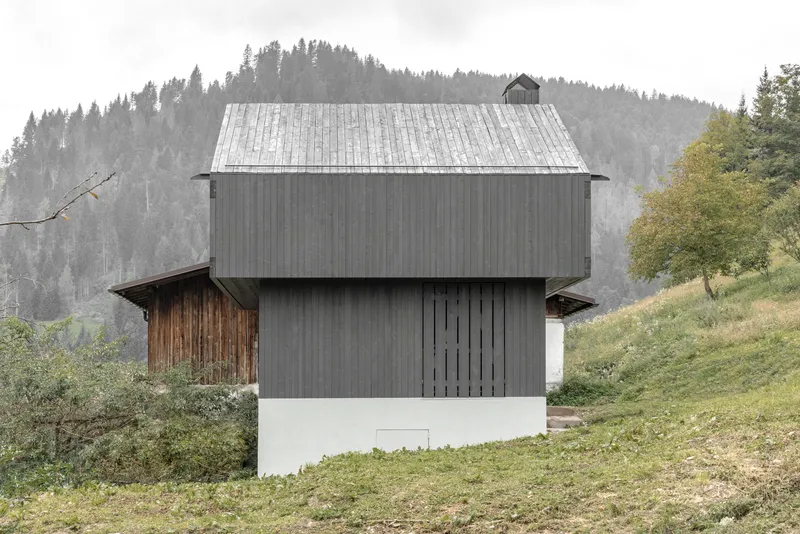


The building occupies a sloping plot set back from the road in a second lane of structures, a position that shields it from the village's main circulation while granting open views across meadow and valley. The partially buried basement exploits the natural grade: its hybrid stone and concrete structure anchors the house into the hillside, while the upper timber volumes appear to hover above the grass. An eastward expansion added volume without disrupting the proportional logic of the original footprint.
Seen through morning mist, with forested ridgelines rising behind, the house registers as one more dark gabled form in a loose constellation of barns and dwellings. That camouflage is deliberate. The architects adopted the typical distribution scheme of local mountain buildings, keeping the massing tight and the roofline low enough to sit comfortably among neighbors.
Dark Timber and Stone: A Facade of Layers
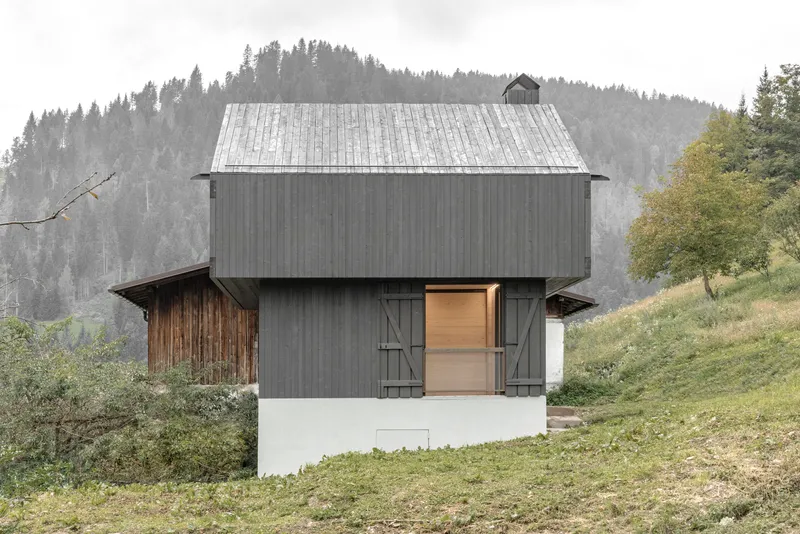


The exterior resolves into distinct material bands that correspond to the building's structural logic. At the base, recycled porphyry sliced stone and white stucco mark the concrete and masonry zone of the basement. Above, solid larch cladding runs vertically in tight planks, darkened and uniform, wrapping the timber-framed upper stories. The roof, completely rebuilt, exposes only joists, wooden planks, and a metal covering, keeping the external aspect faithful to the vernacular without mimicking it.
Folding shutters made of spaced planks line the south facades. When closed, they filter light into the rooms behind; when open, they fold flat against the cladding and nearly vanish. The shutter system transforms the facade from sealed volume to perforated screen depending on the season and time of day, a functional detail that also gives the elevation a shifting graphic quality.
The Cantilevered Crown


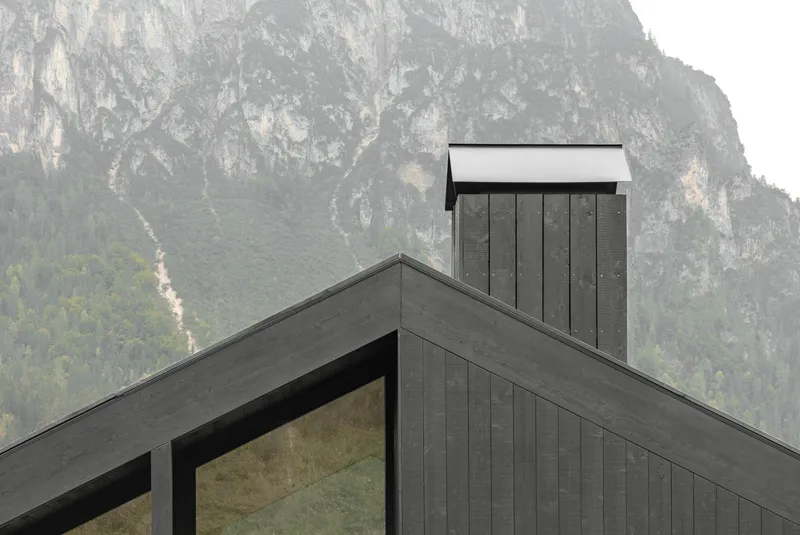
The attic level is the architectural event. It projects outward on all four sides as a cantilever, a move that distinguishes the new intervention from the original footprint below while referencing the overhanging hay lofts of traditional tabià construction. On the valley-facing gable, a triangular glazing panel fills the peak, and below it, diagonal barn doors hint at the building's agricultural past. The chimney, clad in the same dark larch as the walls, rises as a vertical exclamation mark against the rocky mountain face beyond.
From the meadow below, this upper volume reads as a lantern. The full-height windows on the south side let the interior glow at dusk, and during the day they frame a panoramic sweep of alpine peaks. It is a simple inversion: what was once the darkest, most utilitarian part of the barn is now the most transparent and social.
Living at the Top
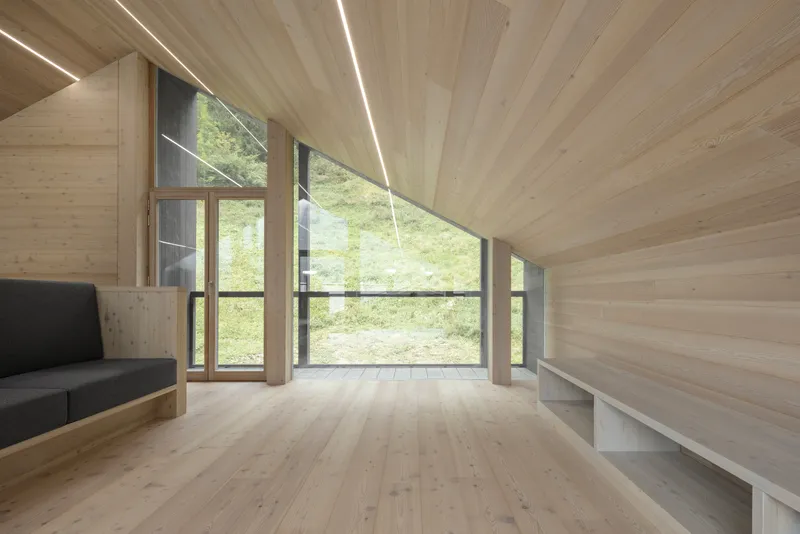


Placing the kitchen and living room in the attic is the project's strongest spatial decision. The pitched ceiling, lined in pale larch, amplifies the sense of volume while linear lighting traces the ridge beam. Floor-to-ceiling glazing wraps the south wall, and the room opens to the valley as a single generous space without partitions. Built-in benches along the timber walls under the gabled windows create intimate reading nooks that contract the space just enough to make the panoramic views feel earned rather than given.
One window looks past the village rooftops and a church tower toward distant alpine peaks. The view is layered: foreground terrace, middle-ground settlement, background geology. It is a reminder that the house sits within a community, not apart from it.
The Central Staircase as Spine

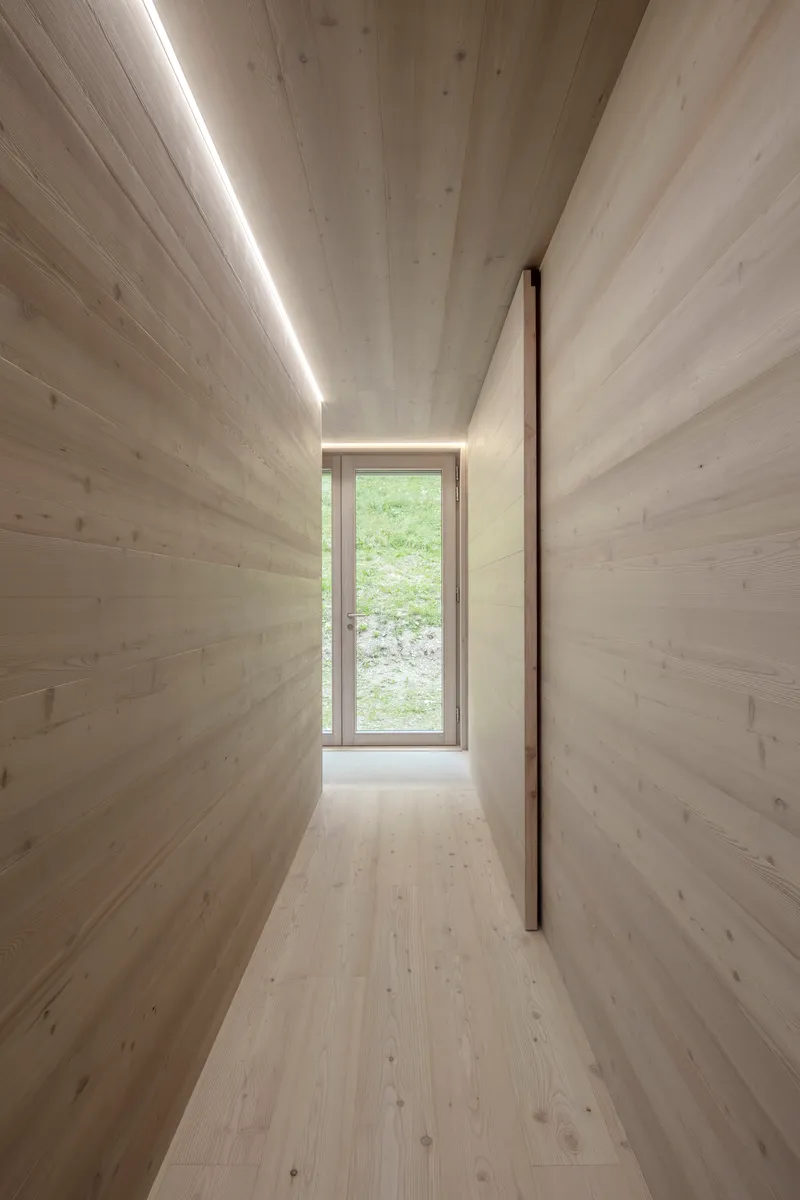
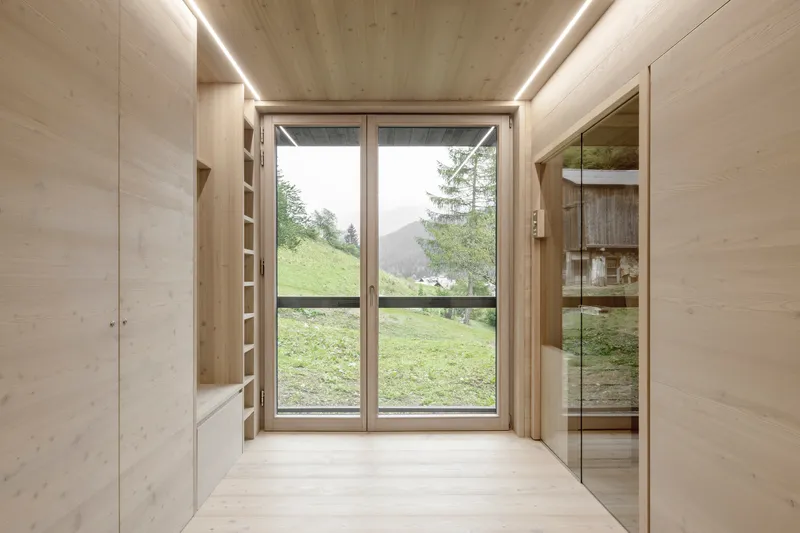
Each storey is organized as a single large room, and the staircase occupying the central portion of the plan stitches the three levels together. Ascending from the lower bedrooms toward the living space, the stair is wrapped in horizontal larch planks and capped by a pentagonal skylight that pulls daylight down through the core. It functions less as a corridor and more as a light well, drawing you upward.
Technical rooms and secondary circulation are pushed to the north, against the blind walls, so that the south-facing rooms remain uninterrupted. The entrance hall on the intermediate level opens through a glazed door directly onto the green meadow and distant mountains, collapsing the threshold between inside and out.
Interior Material Consistency


Inside, larch dominates every surface: walls, ceilings, stair treads, cabinetry. The material palette is deliberately narrow, letting the grain and color of the wood carry the visual weight. Dolomite stone slabs appear on select interior floors and thresholds, grounding the timber volumes with something heavier and cooler. In the bathroom, a white vessel sink and chrome fixtures provide the only chromatic interruption, sharp and minimal against the warm timber backdrop.
The restraint pays off. Without competing materials or finishes, attention falls on proportions, on the quality of light through slatted shutters, on the texture of cleaned and reused beams showing their age beside newer planks. It is an interior that rewards slow looking.
Plans and Drawings
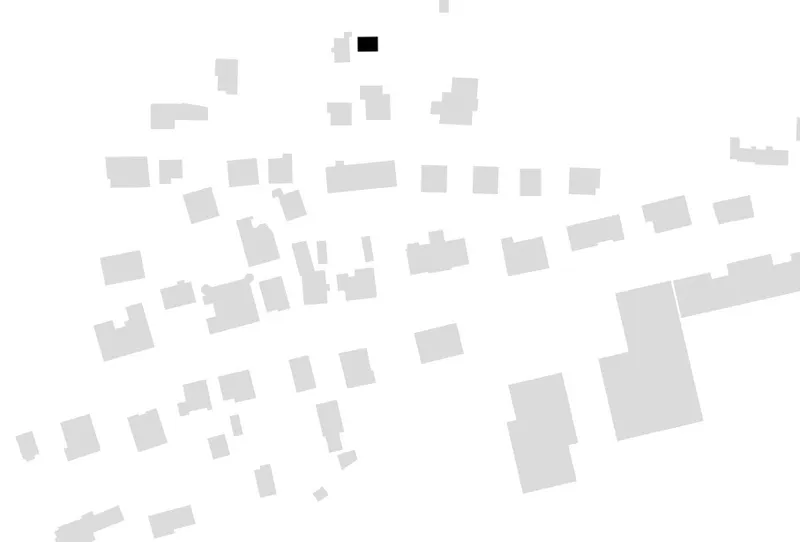
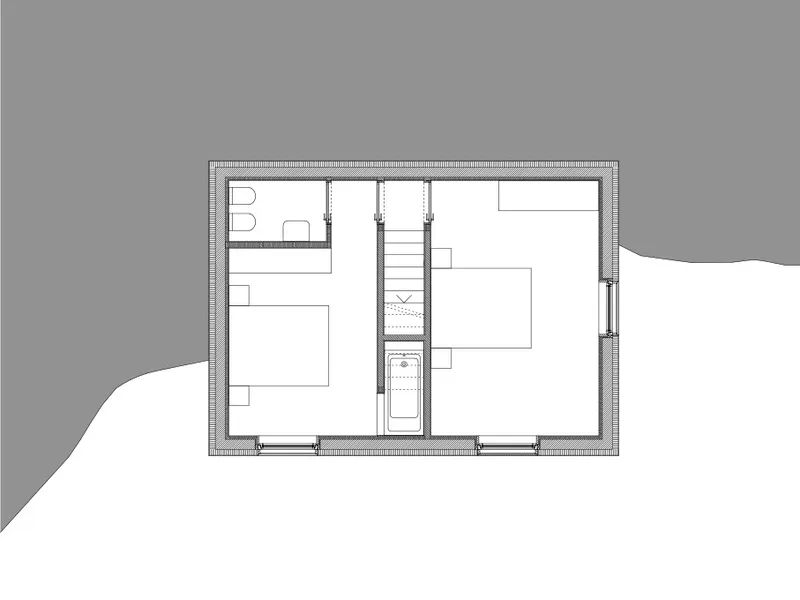


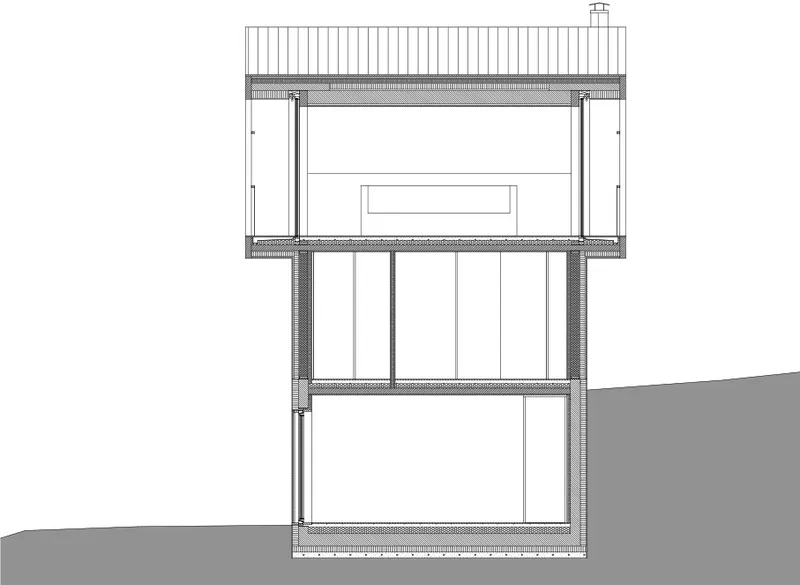


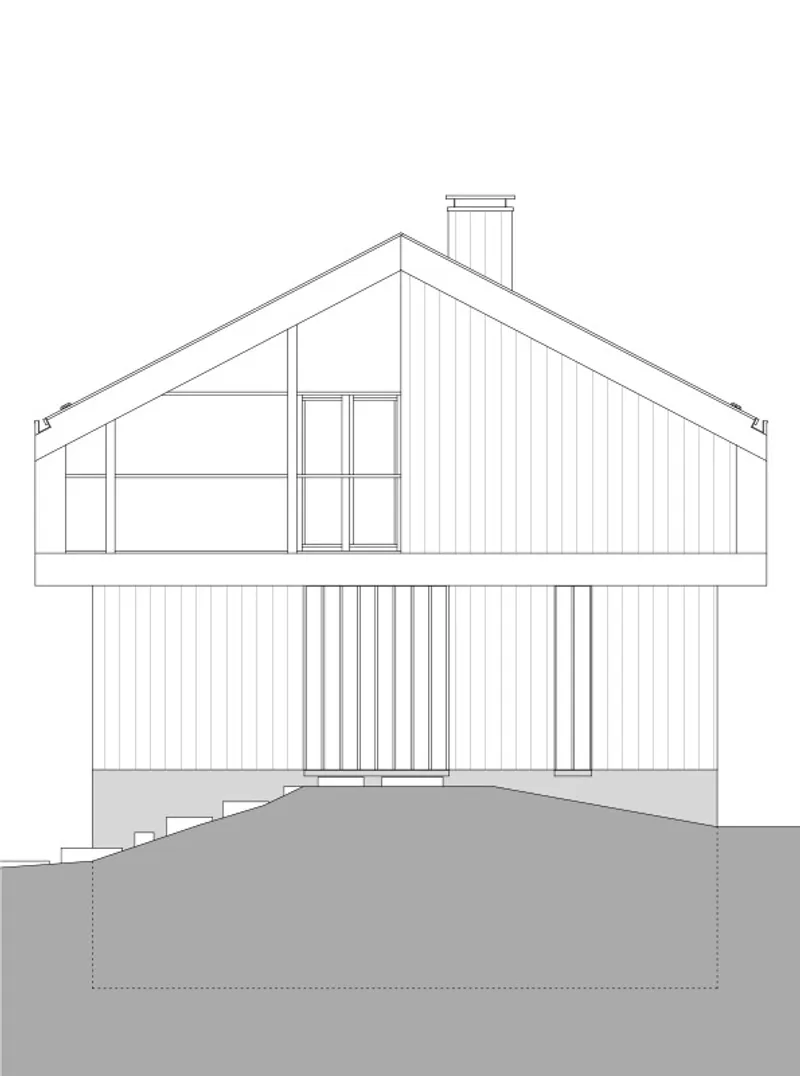

The site plan reveals how the tabià sits among a scattered pattern of gabled footprints along the slope, an arrangement that is informal but rhythmic. The three floor plans confirm the one-room-per-level logic: bedrooms and a circular tub below, more bedrooms and a corner balcony on the upper floor, and the open kitchen-living volume at the top. The sections are the most revealing drawings. They show the three stacked levels, the central staircase as continuous vertical spine, the cutaway terrain pressing against the basement, and the slatted roof deck overhead. The relationship between solid base and projecting timber crown is legible at a glance.
Why This Project Matters
Alpine renovation work often falls into one of two traps: faithful restoration that produces a building nobody wants to live in, or aggressive modernization that erases everything worth preserving. The Tabià S. Stefano House sidesteps both by treating the original structure as a kit of parts. Dismantling and reassembling the frame let the architects evaluate every beam, replace only what was necessary with recycled old materials, and introduce a new spatial hierarchy without abandoning the structural type that gave the building its character. The method is labor-intensive and slow, taking four years from 2018 to 2022, but the result carries an authenticity that cosmetic renovation cannot achieve.
The project also makes a quiet argument about where life should happen in a mountain house. By placing the communal room at the summit of the building, under a vaulted larch ceiling with panoramic glazing, Andrea Smaniotto and Barbara Sandri turn the attic into the social heart of the home. You climb toward light, toward views, toward each other. It is a reordering that respects the barn's vertical logic while giving it entirely new meaning. For anyone working on rural building stock in the Alps or elsewhere, this is a reference worth studying closely.
Tabià S. Stefano House by SBSA ⎮ Sandri Barbara Smaniotto Andrea Architetti Associati (lead architects Andrea Smaniotto and Barbara Sandri). Located in Santo Stefano di Cadore, Italy. 170 m². Completed 2022. Photography by Gustav Willeit.
About the Studio
Share Your Own Work on uni.xyz
If projects like this are the kind of work you want to make, uni.xyz is a place to publish your own, find collaborators, and enter design competitions.


Popular Articles
Popular articles from the community


The Earth Pod: 3D Printed Homes for Resilient Refugee Communities
The Earth Pod reimagines refugee housing through 3D printed homes made from clay, combining resilience, self-sufficiency, and rapid shelter.

Co-Life: Senior Housing Design That Reconnects Older Adults With the City
Co-Life reimagines senior housing design through healing gardens, shared streets, workshops, and a sustainable community across generations.

The Musturak Paradise: Senior Living Architecture for a Connected Future in Temara, Morocco
The Musturak Paradise reimagines senior living architecture in Temara via private homes, social spaces, culture, community, and shared care.

Hill & Cross Opera: Sculptural Opera House Architecture Shaped by Tallinn’s Landscape and Identity
Hill & Cross Opera reimagines opera house architecture in Tallinn through its sculptural hill, civic plaza, glass wave and a luminous cross.


Similar Reads
You might also enjoy these articles

Bao Huynh Watercolor Atelier: A Serene Art Retreat in Hội An
Bao Huynh Watercolor Atelier in Hội An blends multifunctional art spaces, sustainable design, local materials, and family-friendly living in a serene environment.

Atelier Macri Concept Store Interior Design by CASE-REAL
Atelier Macri store features a "ko" counter, walnut wood details, cork displays, blending retail, gallery, and seamless customer experiences.

Manuel Vargas Izquierdo Stadium and High-Performance Sports Center: Architectural Excellence in Jalpa de Méndez
The Manuel Vargas Izquierdo Stadium blends sustainable design, inclusive sports facilities, and cultural-inspired architecture, revitalizing Jalpa de Méndez’s public spaces.

KAKR Buluh Awar Hall: Revitalizing Community and Ecology Through Bamboo Architecture
Community built bamboo hall revitalizes Buluh Awar village, empowering youth, restoring ecology, celebrating vernacular craftsmanship through sustainable architecture and culture.



Comments (0)
Please login or sign up to add comments
No comments yet. Be the first to comment!