
Sepide Elmi Converts an Iranian Factory into an Open-Air Gallery Without Walls
A disused industrial compound near Kermanshah becomes a cultural space where courtyards replace corridors and brick piers frame the sky.


Forty kilometers outside Kermanshah, the old Biston factory has spent years serving the workers who live on site for entire weeks at a stretch. Sepide Elmi saw the compound not as a ruin to be replaced but as an armature to be reactivated. The result is the Wall-Less Gallery, a 280 square meter cultural space inserted into the existing brick shell. Its name is literal: rather than enclosing art behind continuous walls, the design dissolves boundaries between inside and outside, letting courtyards, pivot doors, and deep window reveals do the work that plasterboard usually handles.
What makes the project worth studying is the discipline of its insertions. Every new element, whether a black steel box window, a pyramidal timber roof, or a concrete plinth, is legible against the yellow brick fabric it inhabits. The gallery doesn't compete with the factory; it occupies the gaps the factory left open. That restraint turns a modest renovation budget into something architecturally precise, proving once again that the most compelling adaptive reuse projects are the ones that know when to stop.
Factory Fabric as Found Material
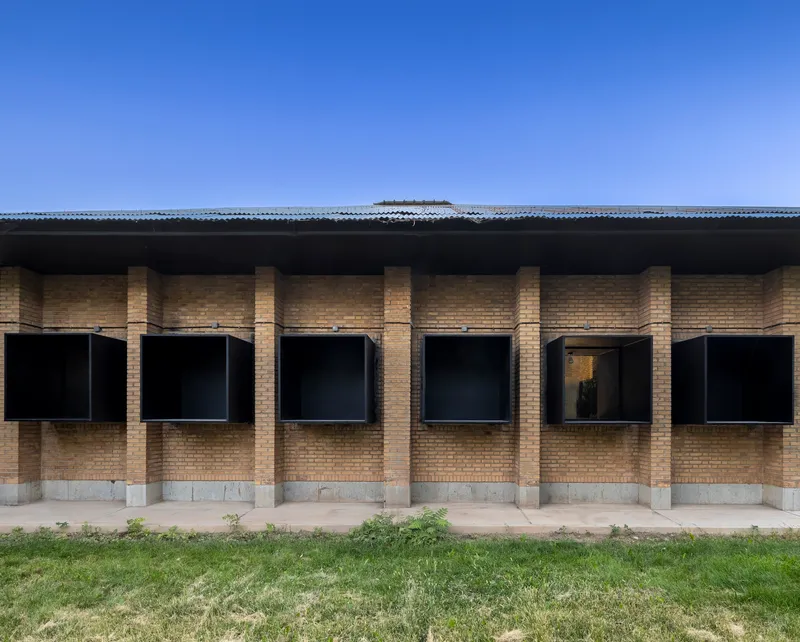
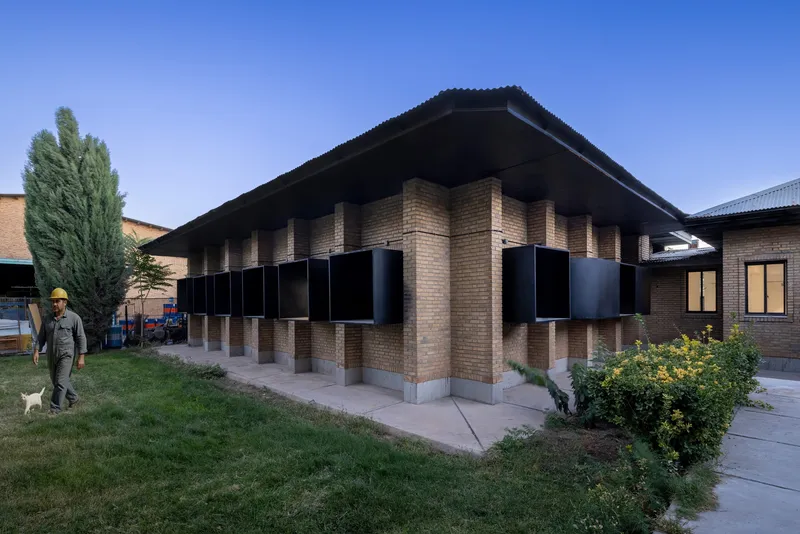
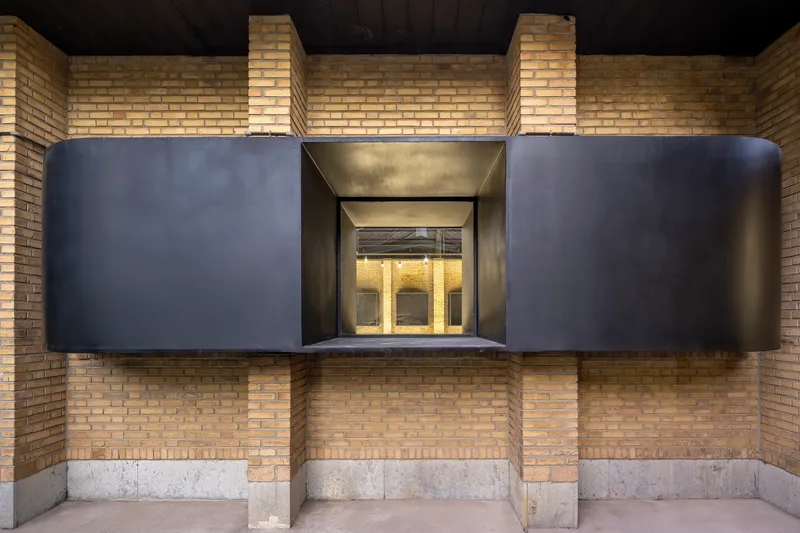
The existing yellow brick walls are thick, regular, and generous enough to support both structural loads and visual identity. Elmi keeps them largely intact, cleaning them up and letting the warm masonry set the tone for the entire complex. New black metal window boxes project outward from the brick piers like parasitic volumes, their dark steel creating hard contrasts that clarify what is original and what is new.
At dusk, this contrast sharpens into something almost graphic. The corrugated metal roof edge, the concrete base, and the projecting bay windows register as a set of surgical incisions in a body that was never meant to be pretty. The factory aesthetic is respected, not sentimentalized.
Black Steel Insertions and Threshold Framing

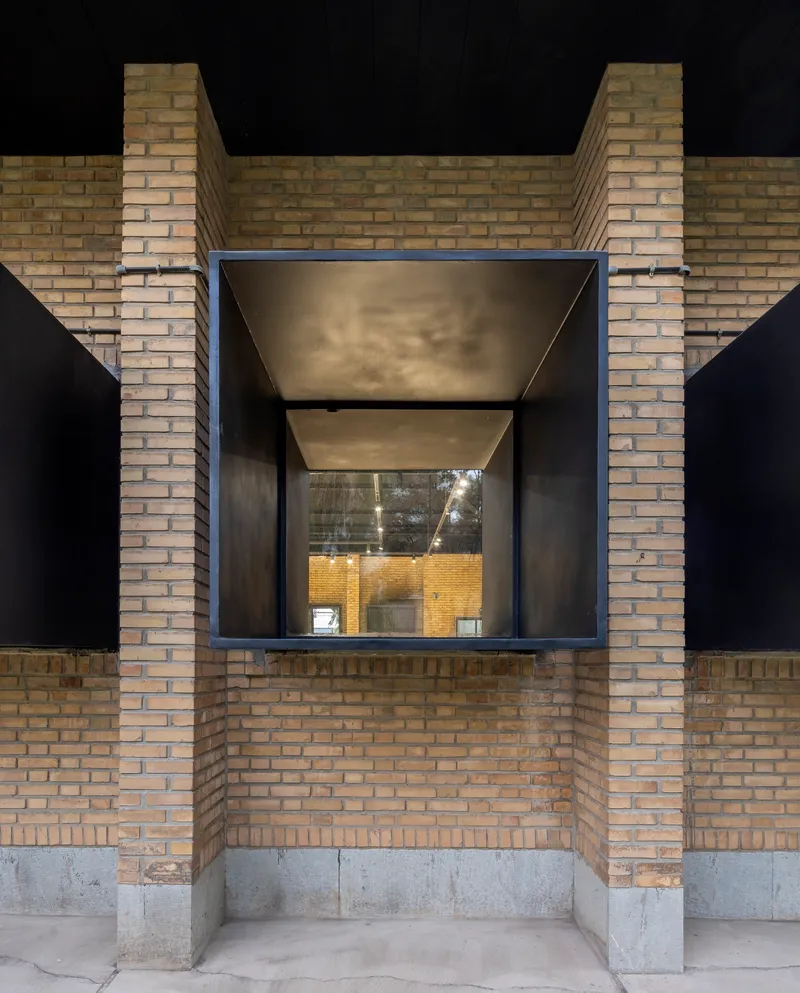
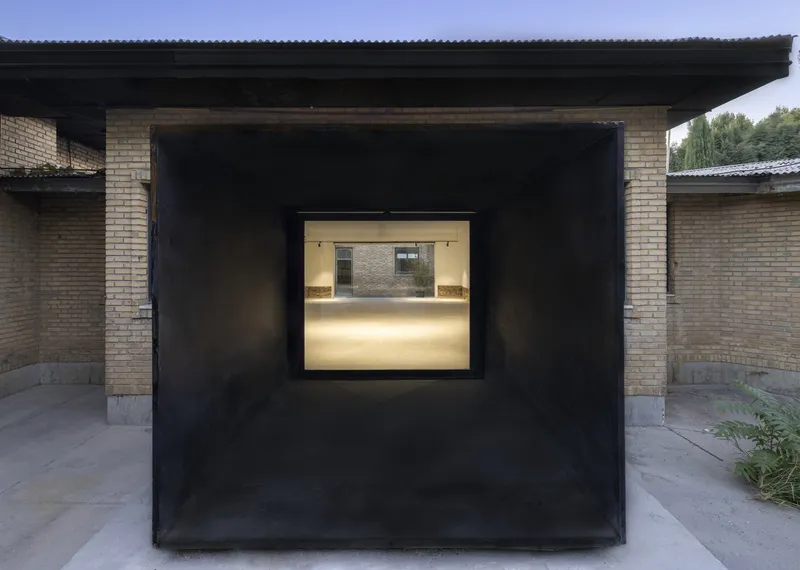
The most striking formal move is the black steel cube volume that sits between existing brick walls on a raised concrete plinth. At twilight it reads as a dark lantern, its interior glow leaking through precisely cut openings. The material palette is kept intentionally tight: steel, concrete, brick, timber. Nothing competes.
Passages framed in black steel create sequential views from one courtyard to the next, collapsing depth into flat compositions that reward slow movement through the site. These thresholds do the spatial work that walls would normally perform, guiding visitors without ever blocking their sightlines. It is threshold architecture in the truest sense: every transition is an event.
The Pyramidal Timber Roof
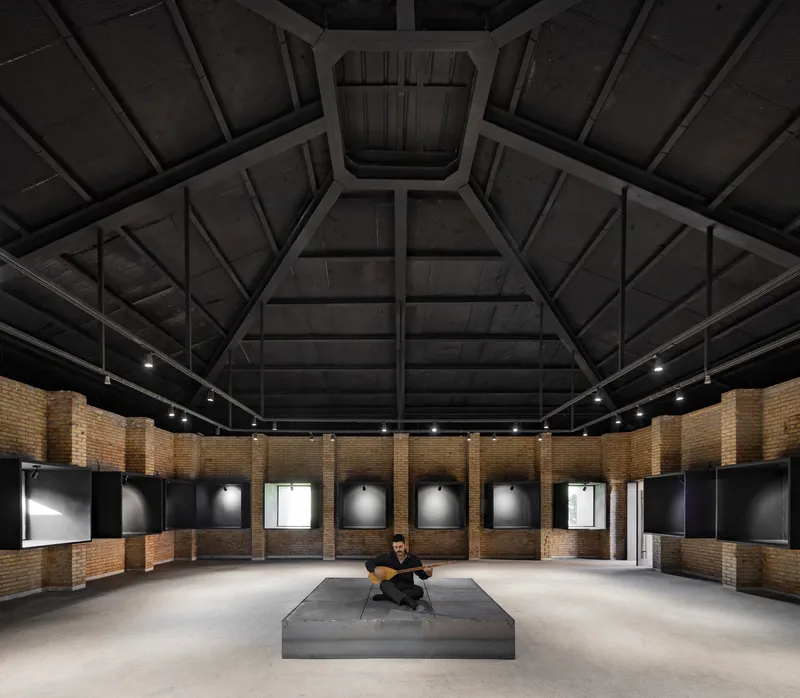
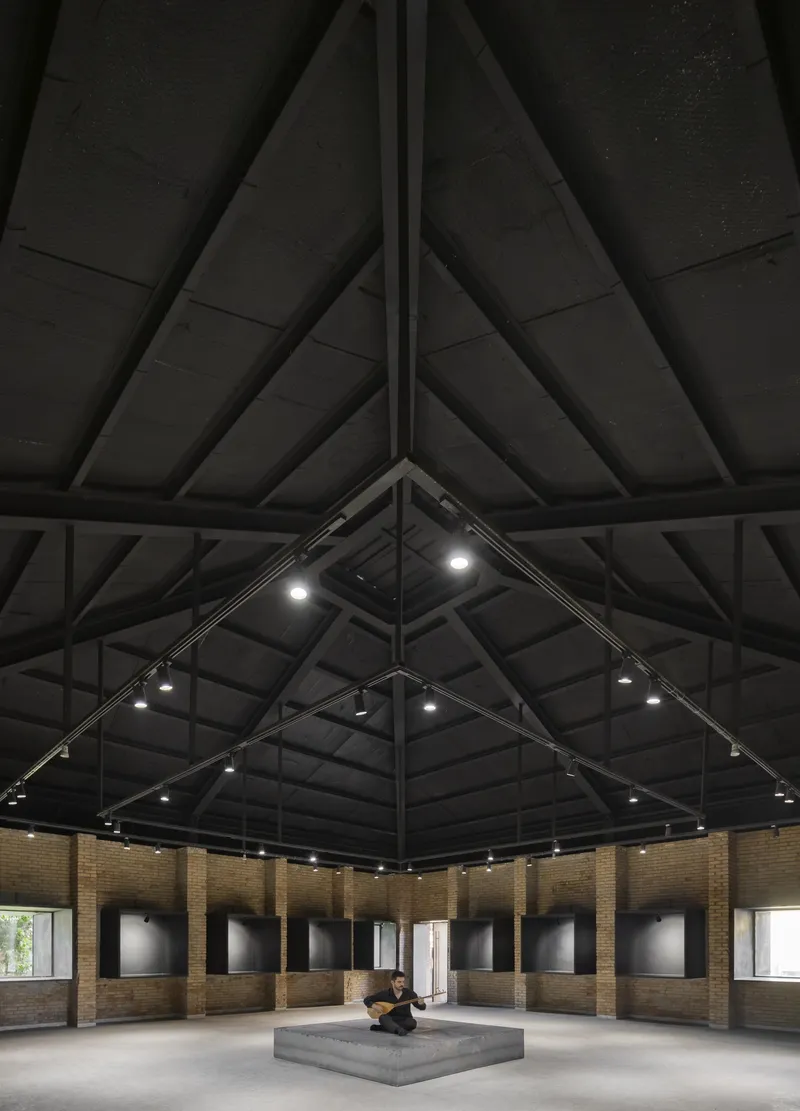
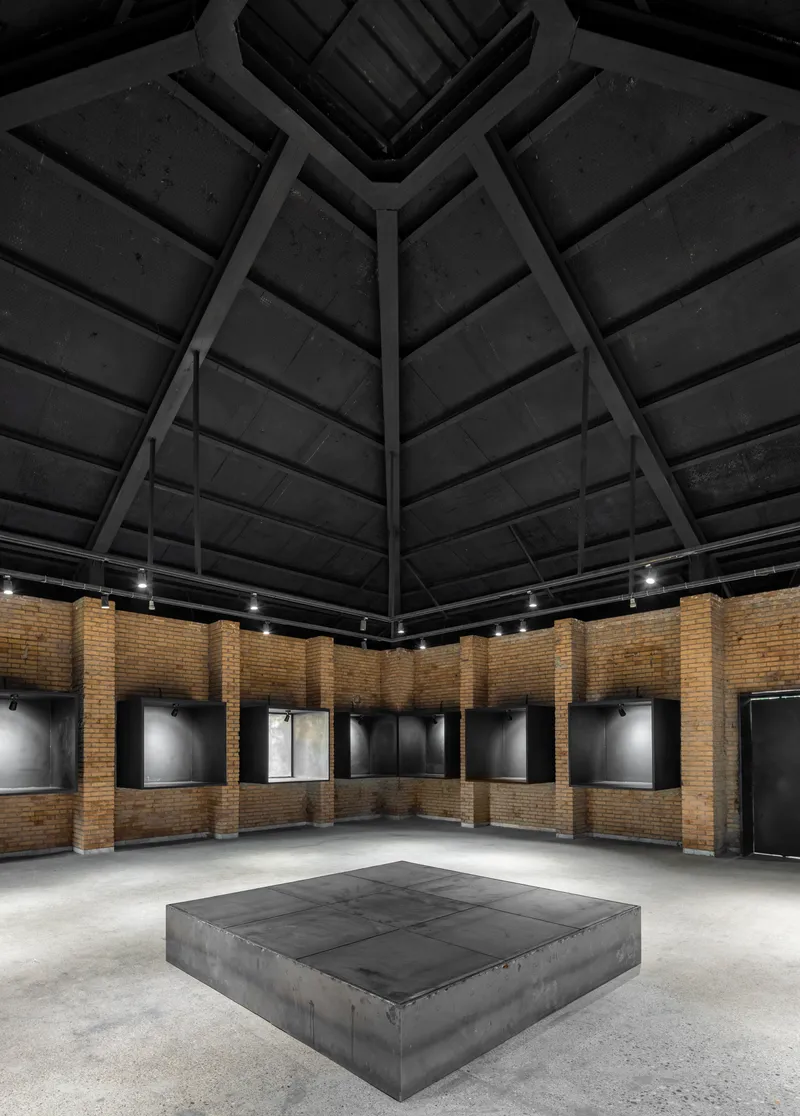
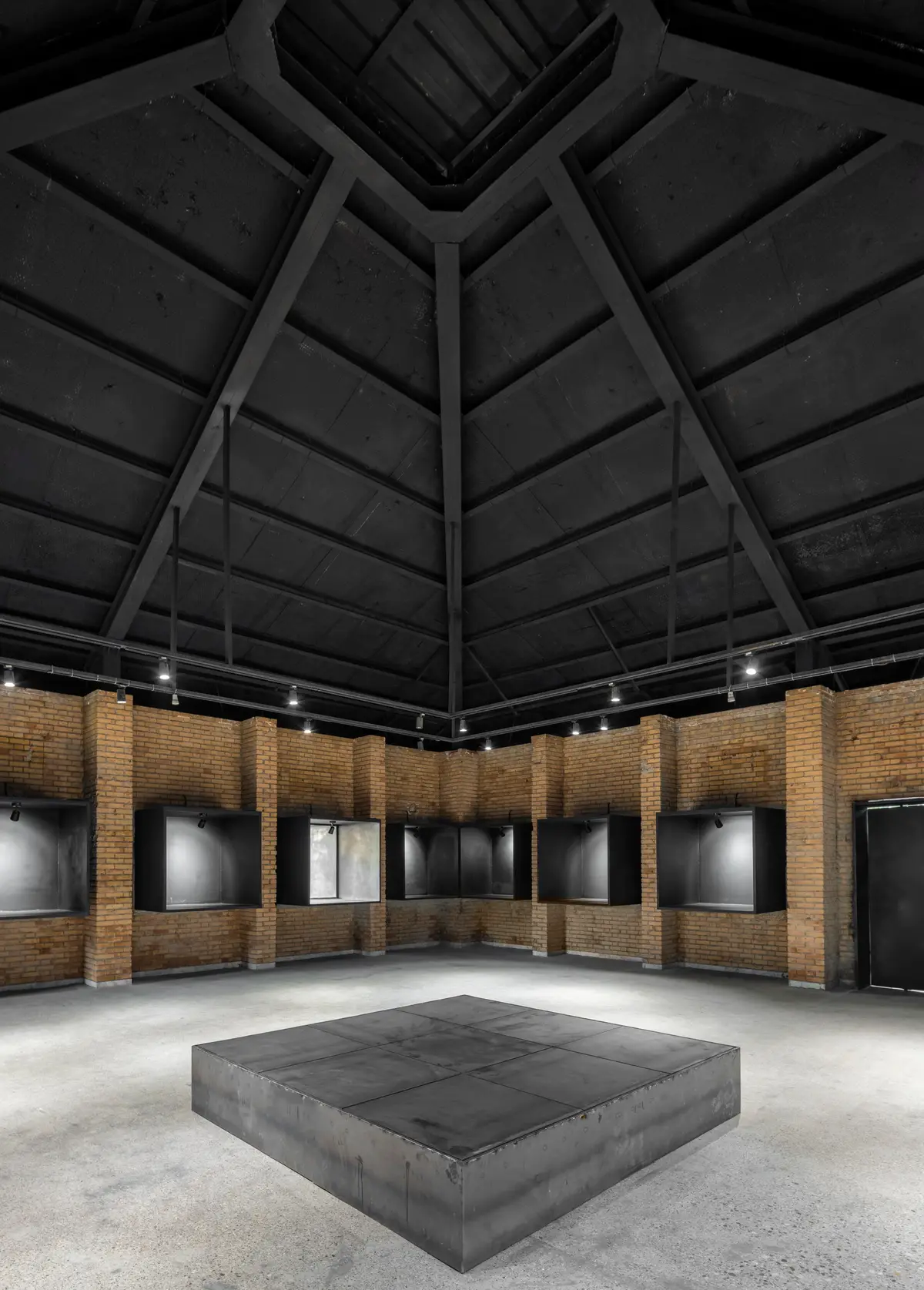
The gallery's primary interior volume is crowned by a pyramidal timber structure whose beams radiate from a central skylight. This is the spatial centerpiece: the roof draws your eye upward and floods the brick perimeter walls with diffused daylight that changes by the hour. Track lighting supplements the natural wash for evening exhibitions, but during the day the skylight alone does most of the heavy lifting.
Structurally, the roof sits on a colonnade of brick piers, keeping the perimeter walls free from load-bearing duty and allowing large openings to punch through to the courtyard. It is a simple move with disproportionate spatial payoff, turning what could have been a flat-roofed shed into something genuinely uplifting.
Gallery as Courtyard, Courtyard as Gallery
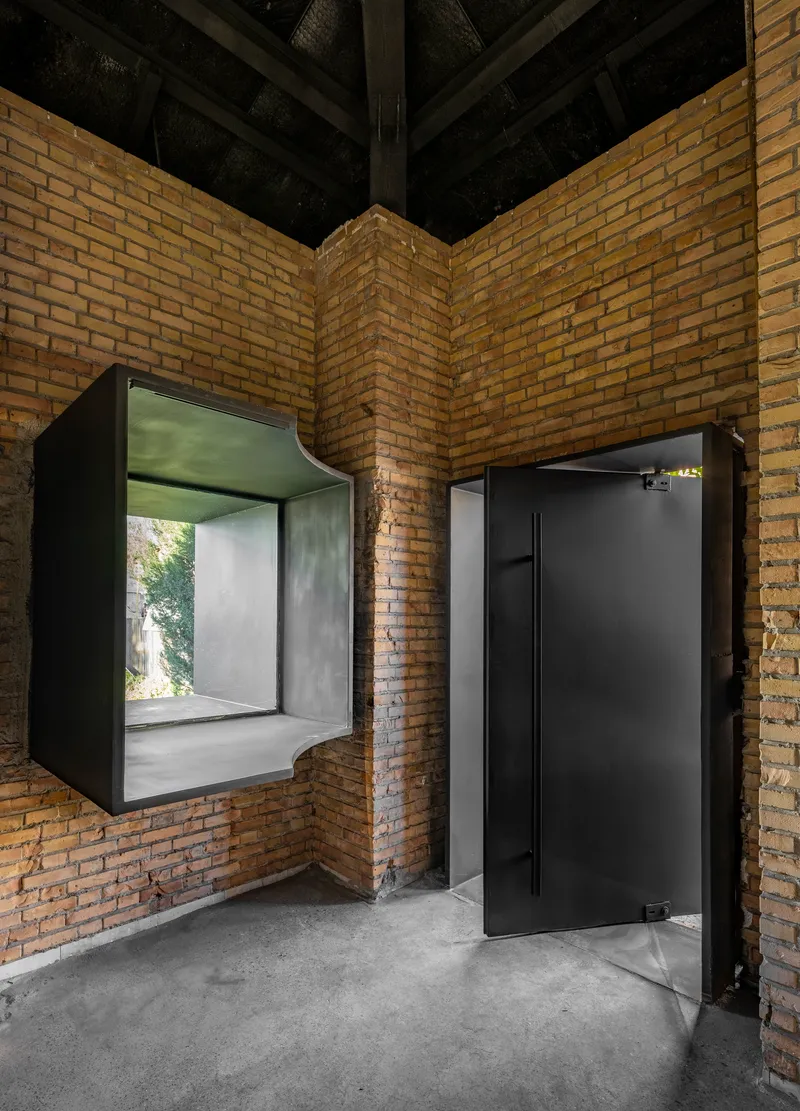
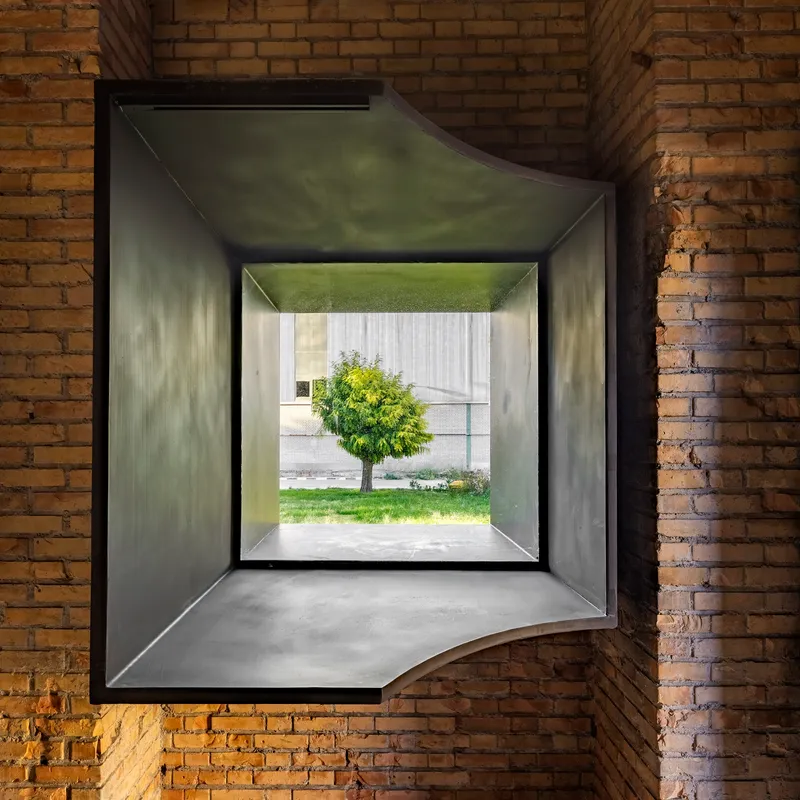

The "wall-less" concept is most convincing in the moments where interior and exterior become interchangeable. A deep window opening frames a single courtyard tree like a piece in a vitrine. A corner courtyard with its black timber ceiling feels as composed as any interior room. A large opening from the gallery space looks out onto a brick courtyard where a potted plant sits as casually as any sculpture on a plinth.
These dissolving boundaries are not just atmospheric. They suggest a model for exhibition-making in which the landscape participates. For workers who spend their entire week at the factory, the courtyard is already domestic territory. Turning it into gallery space collapses the distance between daily life and cultural experience.
Interior Sequence and Display Strategy


Inside, framed artworks line the yellow brick walls beneath the timber trusses, the warm masonry functioning as a textured backdrop that gives paintings more visual depth than a white cube ever could. A central concrete platform serves as both seating and orientation device, anchoring visitors beneath the peak of the pyramidal ceiling.
White-walled rooms also appear, offering quieter zones for work that needs neutrality. Pivot doors in black metal frames swing open to connect these rooms to the brick volumes, letting curators modulate the spatial sequence from intimate to expansive. It is a flexible system built from fixed elements, which is far harder to achieve than it looks.
Detail and Materiality
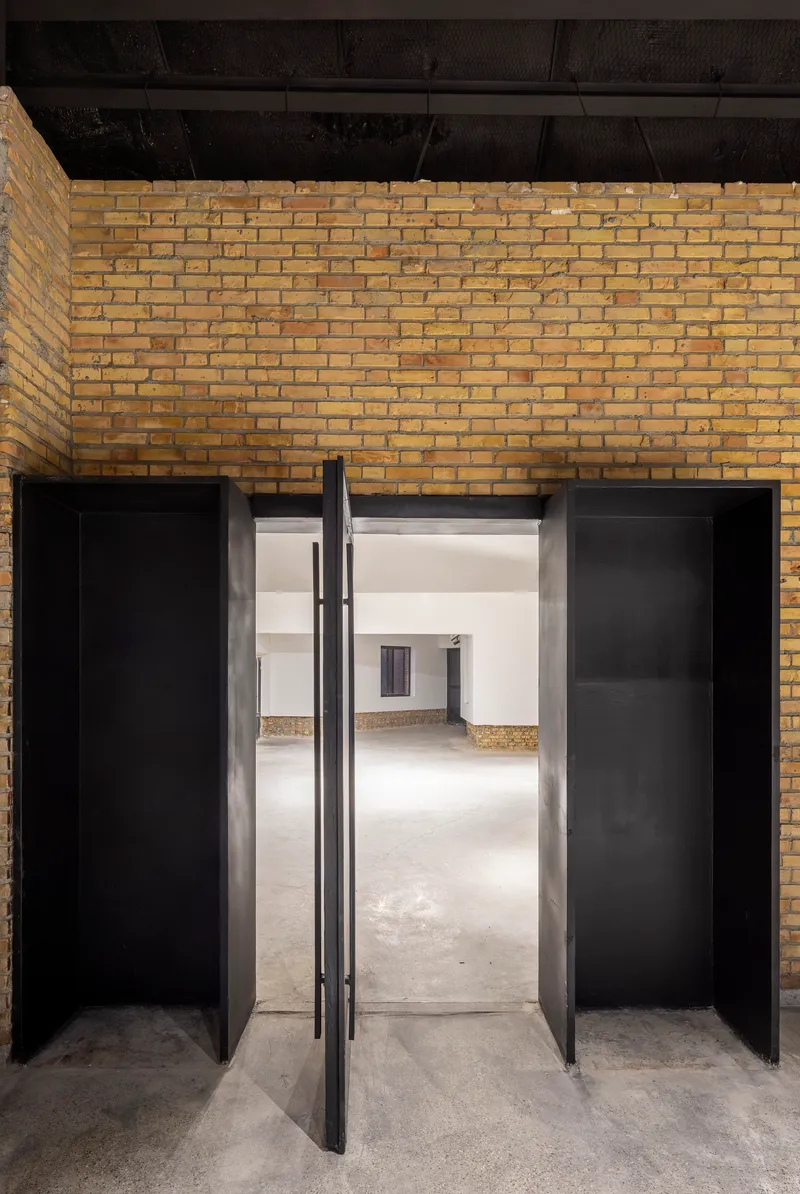
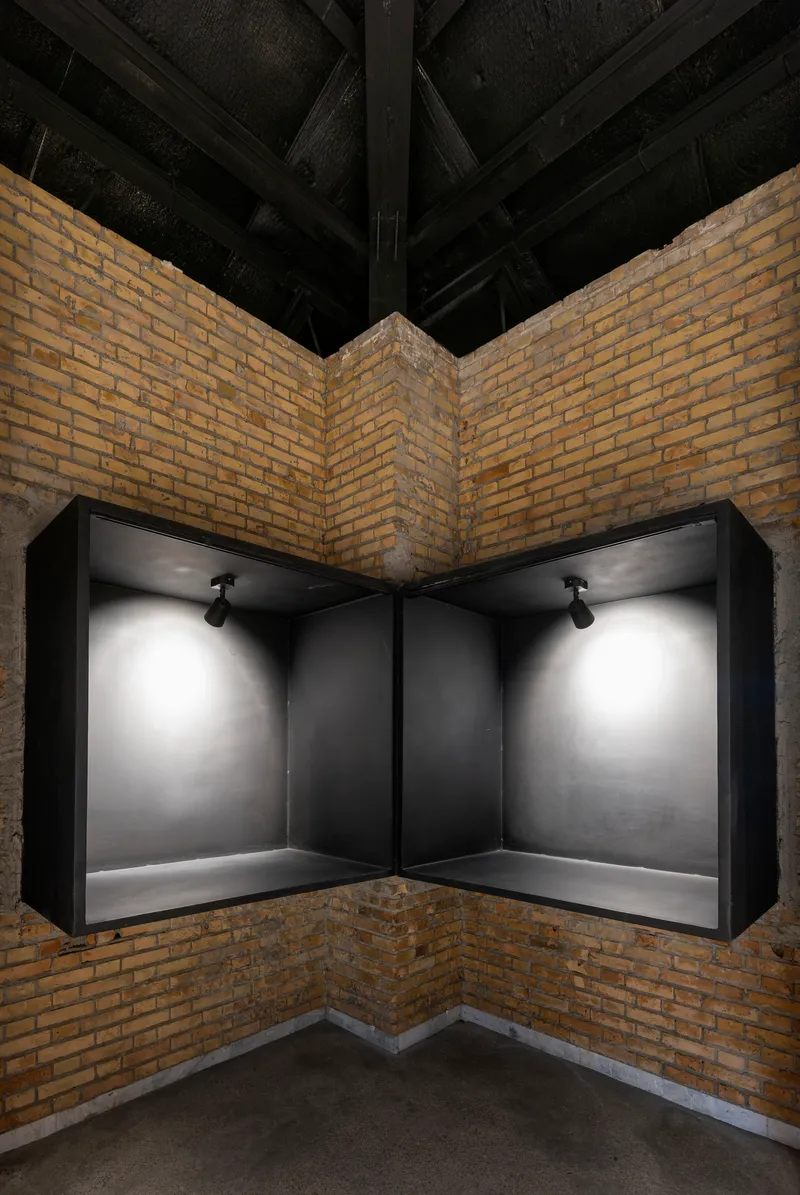
Corner display niches with black metal frames and spotlights are set directly into the brick walls, treating the masonry as a cabinet rather than a surface. These moments of fine-grained detailing reward close inspection and signal a level of craft that lifts the project above a typical industrial conversion. The pivot doors, similarly, are not afterthoughts but calibrated objects whose proportions respond to the brick module around them.
Plans and Drawings
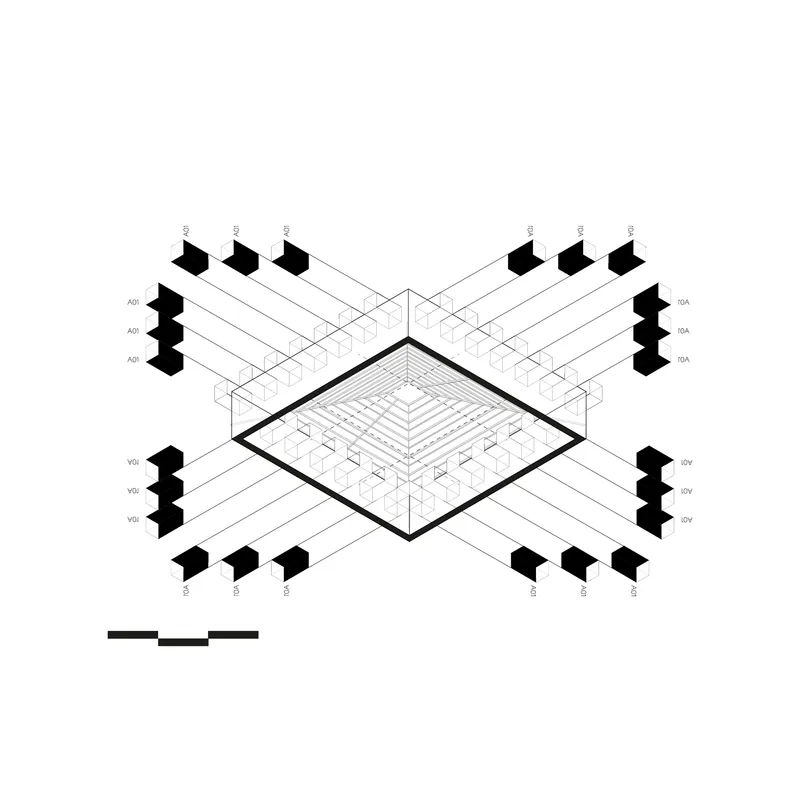
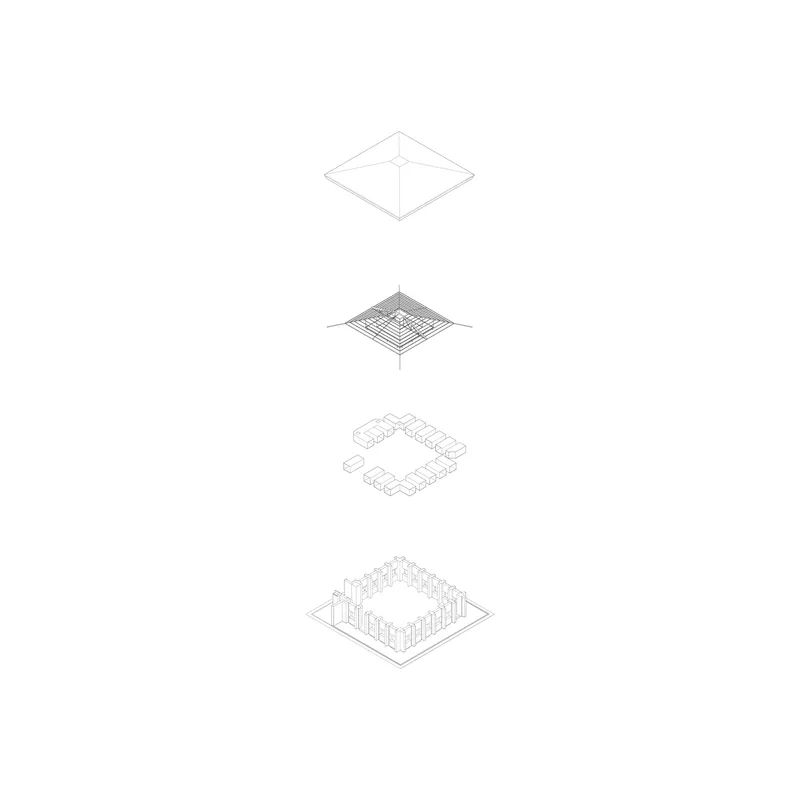

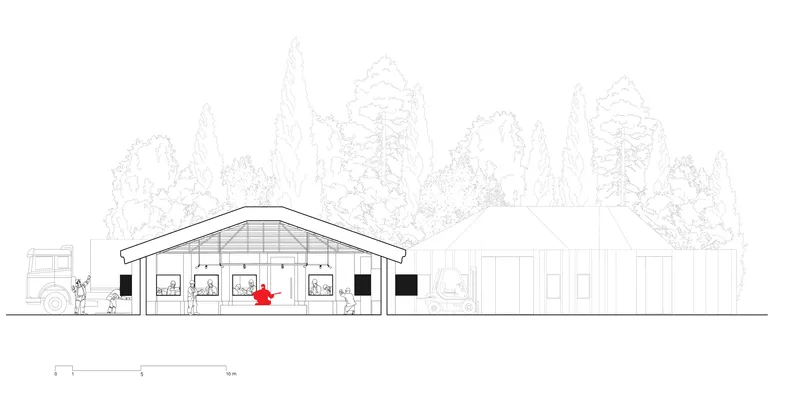
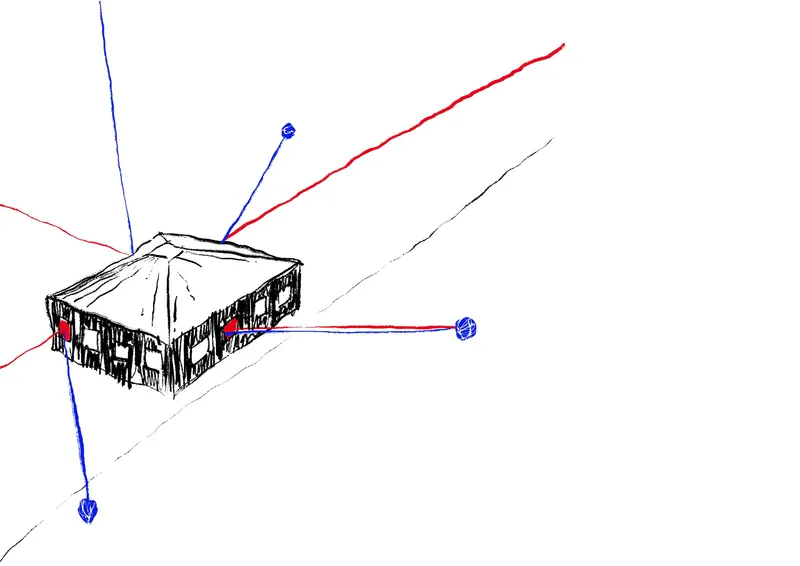



The axonometric drawings reveal the organizational logic most clearly: a central courtyard acts as the gravitational center from which programmatic volumes radiate outward. Circulation paths are not corridors but open-air routes through and around these volumes. The assembly sequence of the pyramidal roof, shown in an exploded axonometric, demonstrates how the timber structure lifts away from the colonnade below, achieving the spatial separation that makes the interior feel generous.
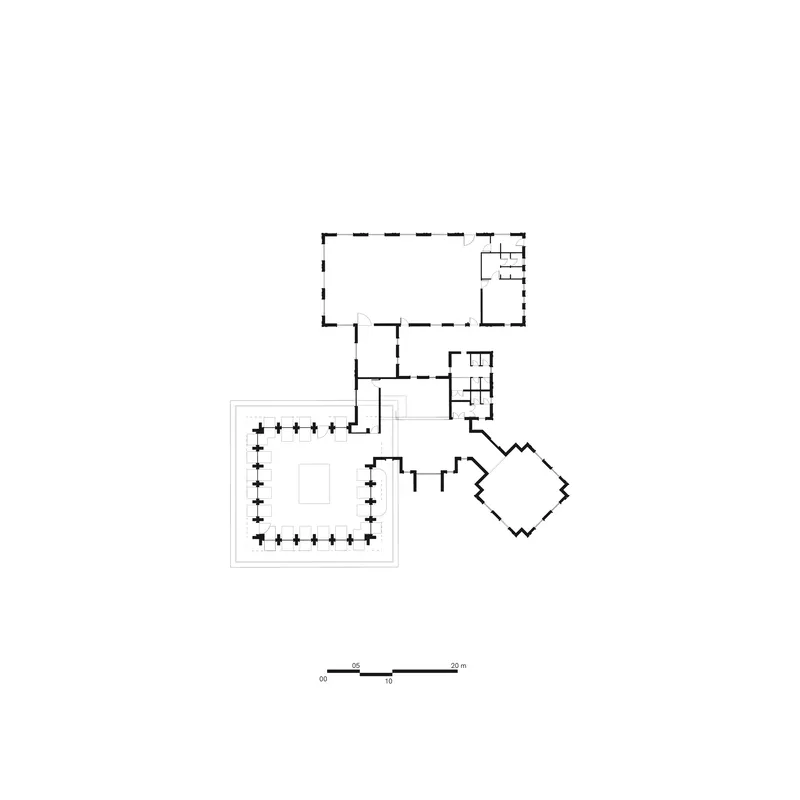
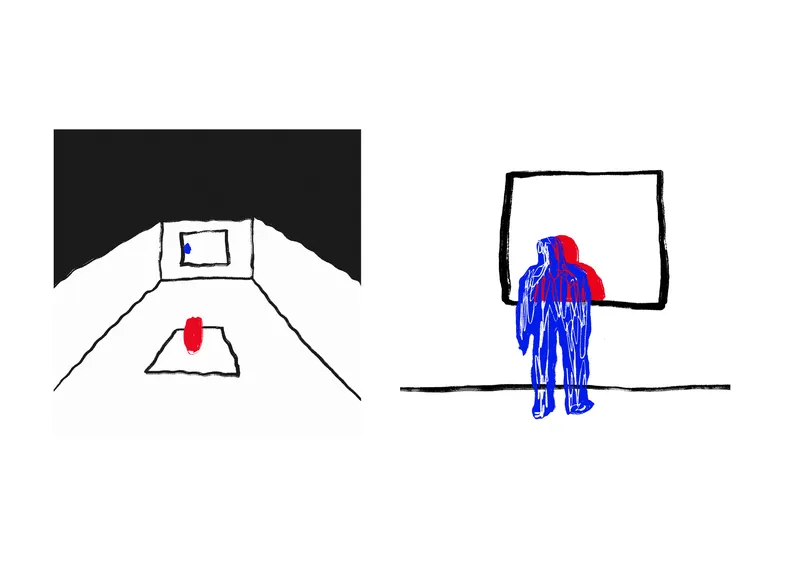
The floor plan confirms that the angular wing and rectilinear volumes are organized around the courtyard colonnade, while the elevation drawing of the gabled warehouse structures with clerestory windows locates the gallery within the broader factory campus. Sketch studies and physical models in red acrylic show the early design thinking: programmatic blocks suspended within a grid, courtyard voids carved out of solid volume. The top-down model view is particularly instructive, revealing how the square courtyard orchestrates everything around it.
Why This Project Matters
The Wall-Less Gallery demonstrates that cultural infrastructure does not require a metropolitan context or a heroic budget. By working with an existing industrial compound and a clear material strategy, Sepide Elmi delivers a space that is architecturally rigorous and socially generous. For a workforce that rarely leaves the factory site during the week, the gallery transforms routine surroundings into a place of encounter and reflection.
More broadly, the project offers a model for how adaptive reuse can operate in peripheral contexts where resources are limited but spatial intelligence is not. The decision to dissolve walls rather than build new ones is both a practical economy and a conceptual statement. When the boundary between art space and daily life is this porous, culture stops being an event you attend and becomes something you simply walk through on your way to lunch.
Wall-Less Gallery by Sepide Elmi. Kermanshah, Iran. 280 m². Completed 2024. Photography by Parham Taghioff.
About the Studio
Share Your Own Work on uni.xyz
If projects like this are the kind of work you want to make, uni.xyz is a place to publish your own, find collaborators, and enter design competitions.


Popular Articles
Popular articles from the community


Cube Design Draws an Ecological Corridor Between Two Shenzhen Hills with the Nankai Building
Beside Shenzhen's container docks, the Nankai Building pairs stacked balconies with a climbing green screen to connect two hillsides across its height.

Juan García Correa, John González and Claudia Rueda Sink a Circular Amphitheater into a Manizales Engineering Building
On the La Nubia campus in Manizales, Colombia, the S1 Building folds labs and offices into a hillside of ramped lawns that double as a campus route.

LT2A and OPEN Architectes Thread a Brick and Glass High School Through a Wooded Belgian Campus
In Braine-l'Alleud, a 3,000 m² wing for Collège Cardinal Mercier pairs pale brick with a glazed colonnade, deferring to a small chapel and a dense wood.

David Macias Steps a Doorless Stone and Plaster House Down a Tropical Colombian Hillside
In the humid hills of Colombia, Threshold House replaces the front door with an open void and terraces its 850 m² down the slope instead of fighting it.

Similar Reads
You might also enjoy these articles


LAVA Architecten Gives Vocational Education a Sawtooth-Roofed Face on a Mechelen School Campus
In Mechelen, Belgium, a 2,053 m² STEM school on a 6×6 m grid turns workshops and classrooms into rooms that can be rearranged as teaching changes.

KEMA Studio Turns a Derelict Marvila Attic into a 60 m² Lighthouse Apartment Above Lisbon
In Lisbon's Marvila district, a rebuilt roof, four skylights and two plywood volumes turn an unlivable attic into a bright home facing the Tagus.

Pixel Gardens: One Repeated Module Stacked Into a Terraced Social Housing Tower for Famagusta
Salem Bader's shortlisted housing tower builds a vertical neighbourhood from one repeated module, offsetting units to carve terraces, light and air.

Bao Huynh Watercolor Atelier: A Serene Art Retreat in Hội An
Bao Huynh Watercolor Atelier in Hội An blends multifunctional art spaces, sustainable design, local materials, and family-friendly living in a serene environment.


Comments (0)
Please login or sign up to add comments
No comments yet. Be the first to comment!