
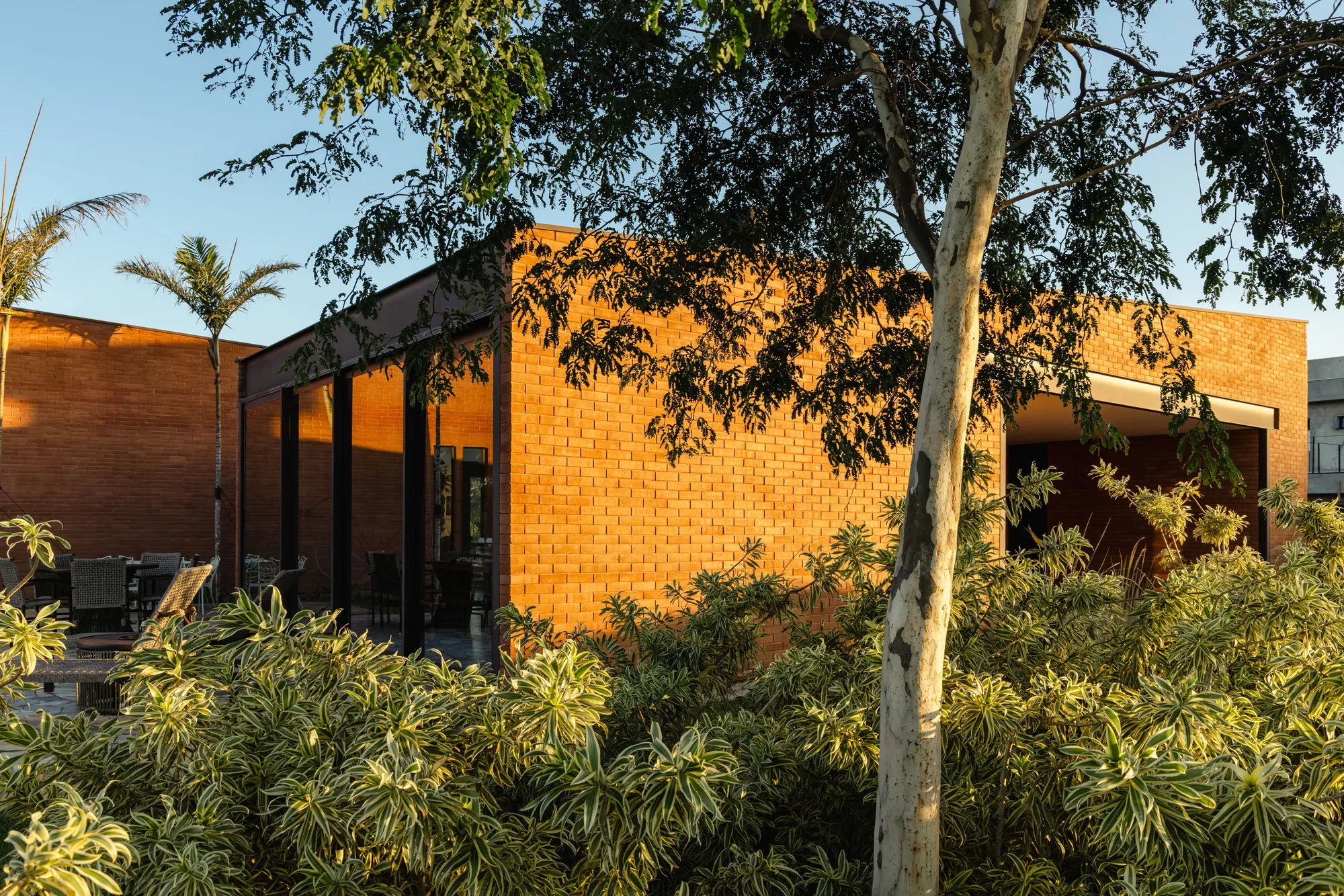
Sergio Sampaio and Tectônica Set Two Brick Volumes on a Raised Plateau in Rural São Paulo
Casa Dahora splits a 450-square-meter country house into parallel blocks linked by a canopy above the landscape of Itu, Brazil.


Country houses in Brazil tend to fall into two camps: the open tropical pavilion that dissolves into its garden, or the fortified retreat that turns its back on everything. Casa Dahora, designed by Sergio Sampaio Archi and Tectônica in Itu, roughly 100 kilometers northwest of São Paulo, refuses both clichés. Instead, it proposes a pair of red brick blocks set on a natural plateau above the street, connected by a covered walkway and organized around a courtyard that mediates between enclosure and openness. The result is a 450-square-meter residence that reads as solid and grounded from the road, yet unfolds into generous, light-filled living spaces once you step inside its perimeter.
What makes the project worth studying is the discipline of its material palette and the precision of its siting. The elevated plateau is not merely a topographic given; it becomes an architectural strategy, lifting the house above the suburban surroundings and establishing a horizon of its own. The two volumes, arranged in a loose L-shape, frame views and create zones of shade, breeze, and privacy without relying on heavy landscaping or mechanical barriers. Lead architect Sergio Sampaio, working with project coordinator Renata Hirayama and team member Piero Artuzo, treats the brick not as nostalgic decoration but as a structural and atmospheric system that defines the entire character of the building.
Brick as Argument
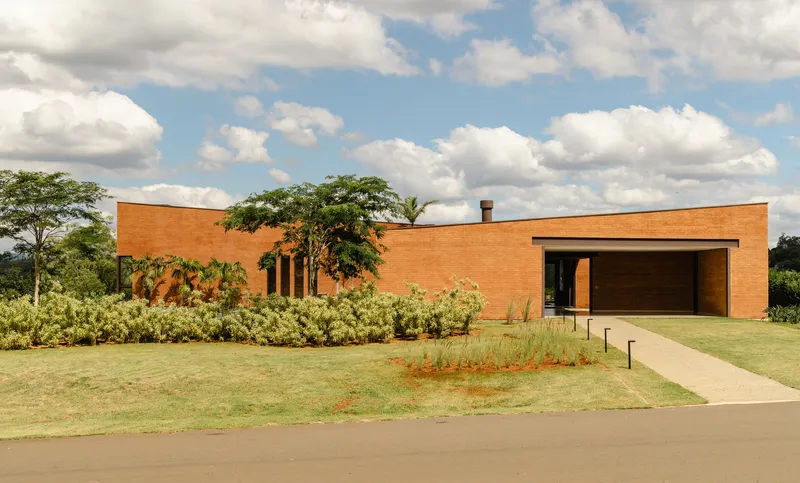
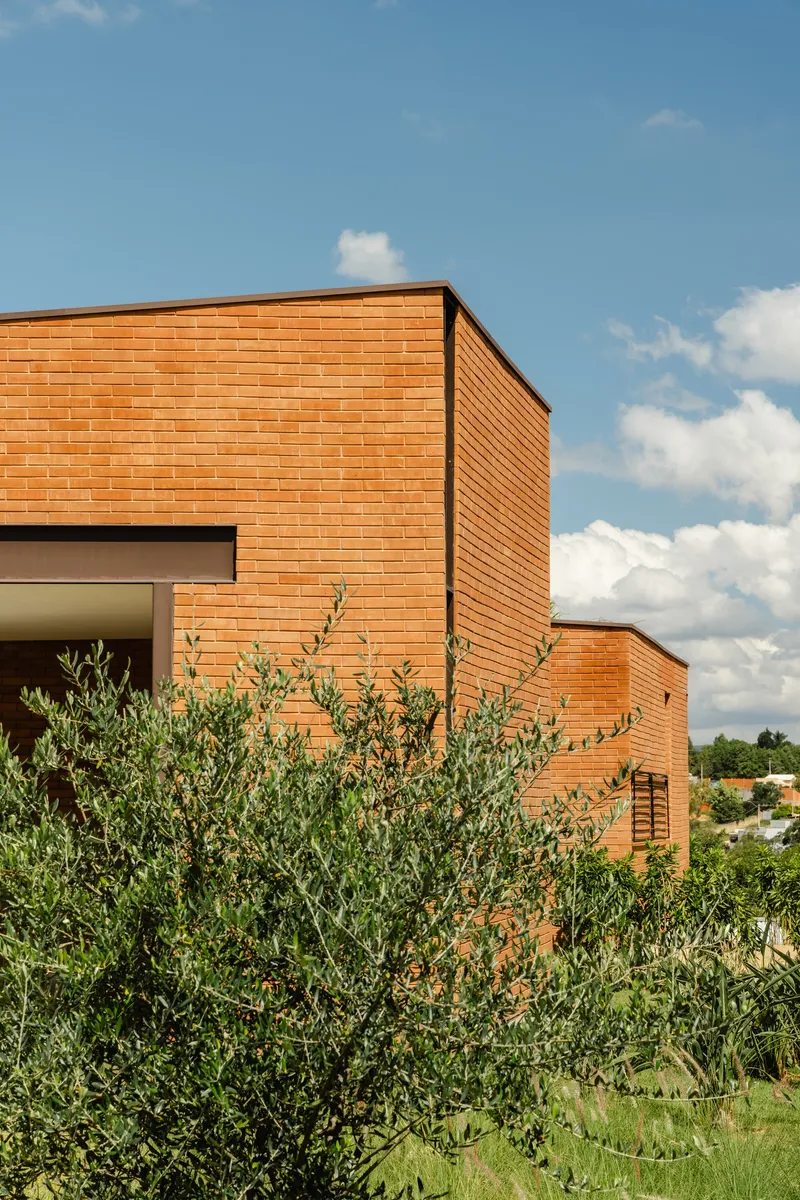
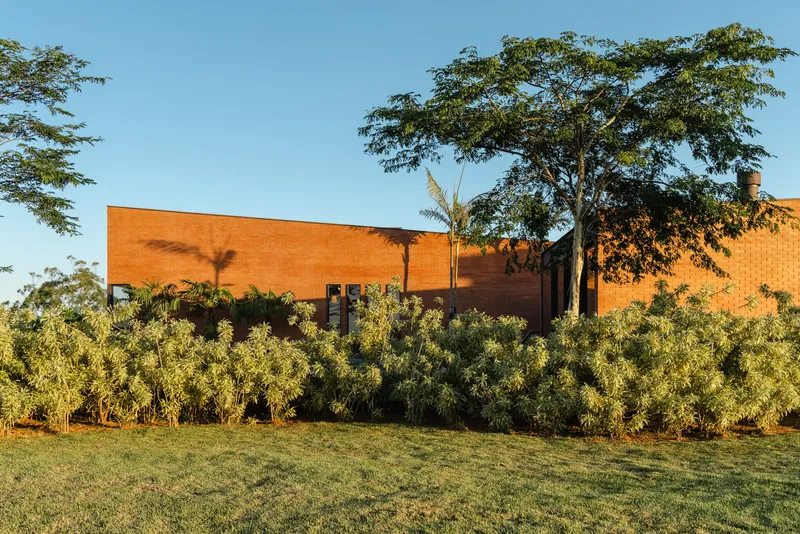
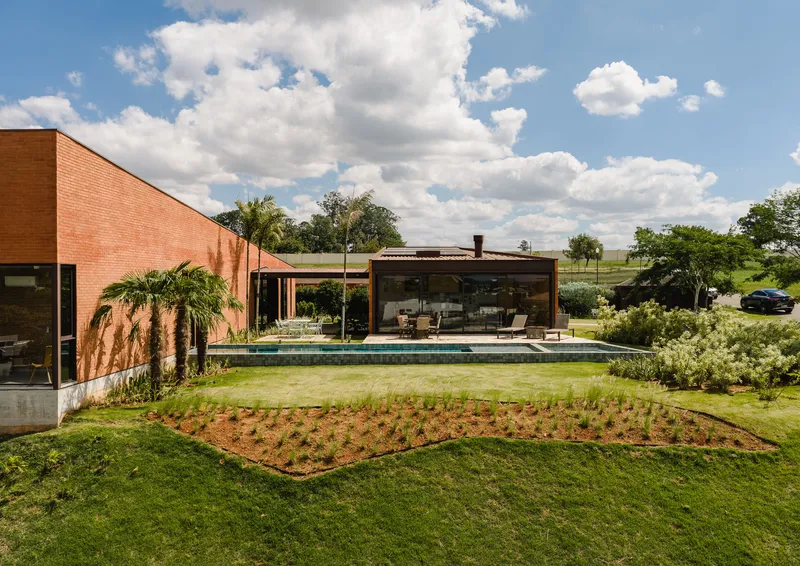
The orange-red brick is the single loudest statement in Casa Dahora, and it is everywhere: walls, parapets, courtyard enclosures. From the street, the facade presents itself as a stacked, almost monolithic mass punctuated by narrow vertical window slits and a recessed timber garage door. The corner window at the upper volume is one of the few concessions to lightness, suggesting a bedroom or study behind it. Elsewhere, the brick surface remains unbroken and warm, absorbing the long afternoon sun of interior São Paulo state.
What separates this from generic brickwork is the consistency with which the material is deployed. There is no plaster reveal, no contrasting render panel. The brick courses wrap corners and step up to meet corrugated metal roofing without apology. Against the dense green shrubs and mature trees that crowd the lower slope, the masonry glows with a saturated intensity that only improves as light conditions change through the day.
The Plateau and the Street
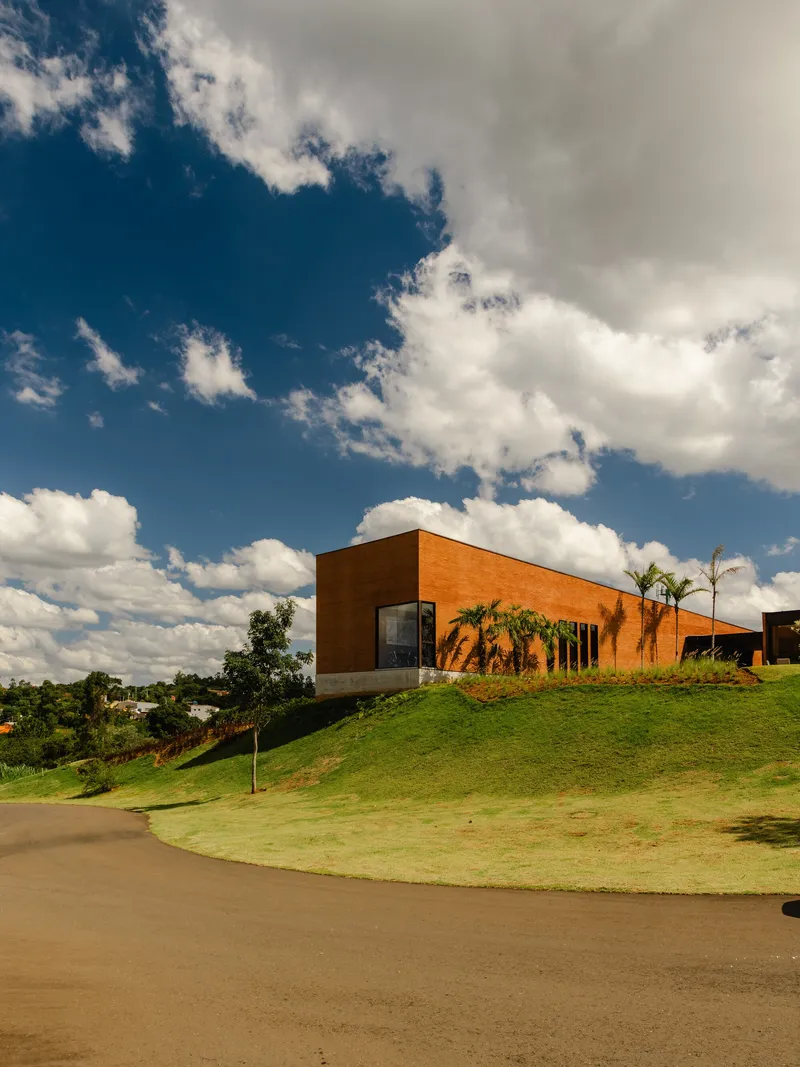
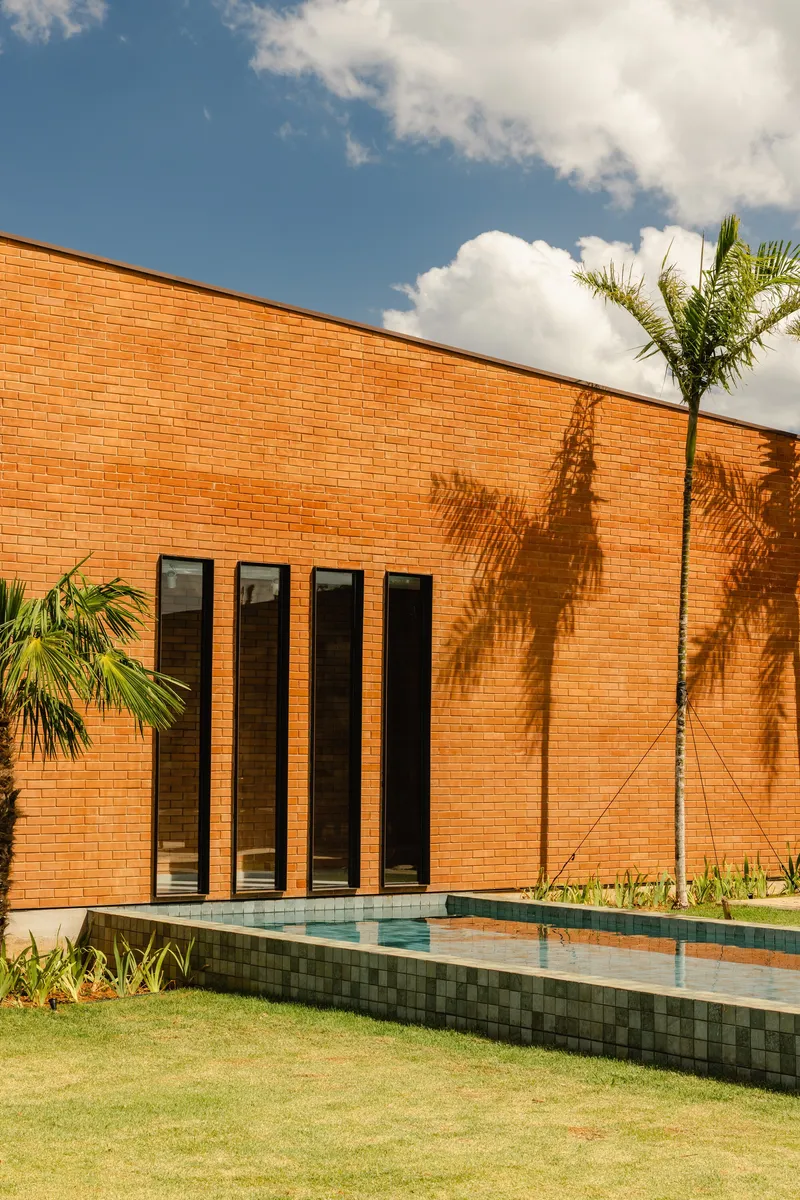
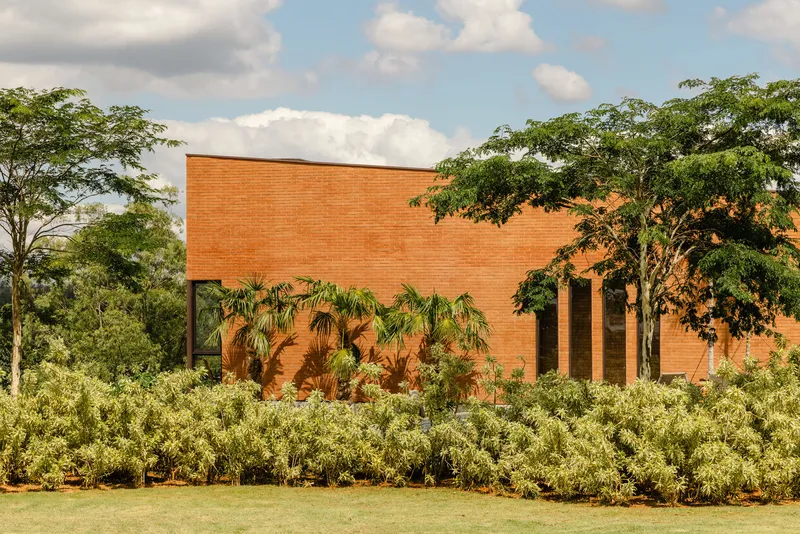
The natural grade change between street and building level is the project's hidden engine. Rather than excavate or terrace the site into submission, the architects let the lawn slope upward so that the brick volumes appear to sit on a green pedestal. From below, the house looms with a certain severity; the vertical windows and uninterrupted brick planes recall warehouse typologies or rural industrial buildings. From the garden level itself, though, the house relaxes. Flowering shrubs, palms, and the turquoise flash of the pool soften the geometry considerably.
This dual reading, monumental from the approach and domestic from within, is not accidental. The raised plateau provides both privacy and prospect: residents look out over the surrounding neighborhood and open fields without being observed. It is a simple topographic move that saves the architects from needing tall fences or opaque screens.
Two Blocks, One Canopy
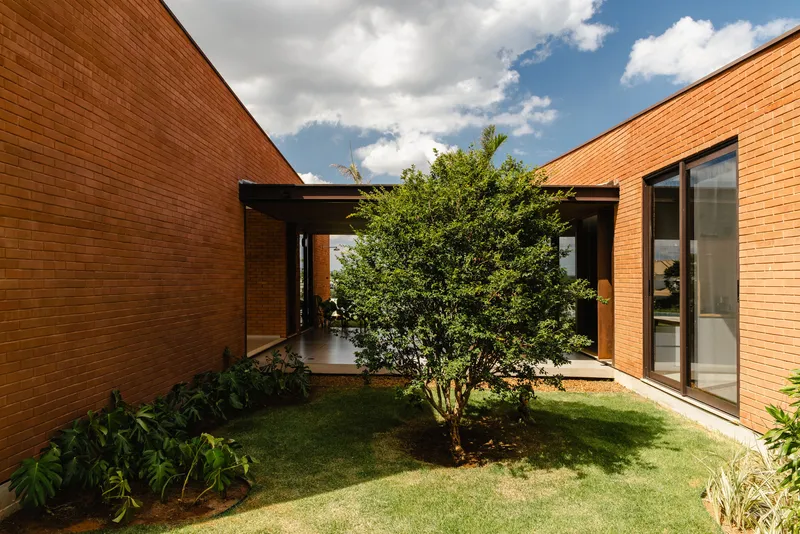
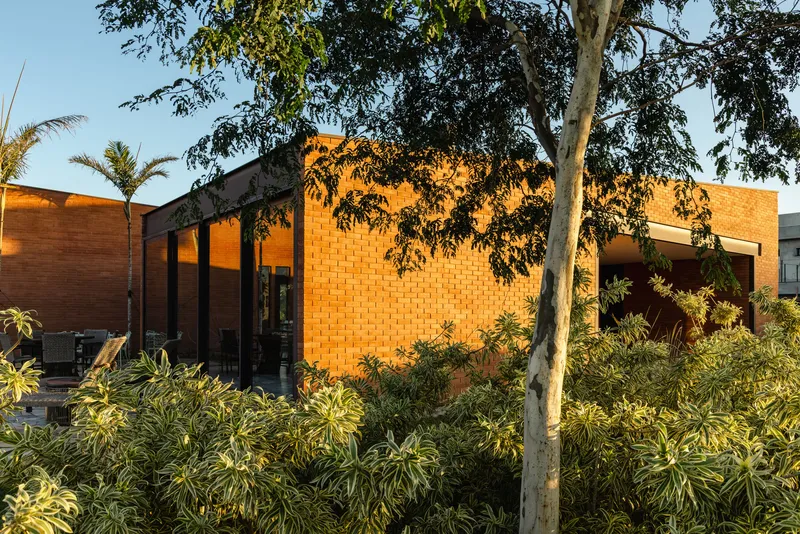
The organizational logic is direct: two parallel volumes, one likely housing the social and service areas, the other containing bedrooms and private spaces. Between them, a covered walkway creates a shaded threshold that doubles as a circulation spine. A courtyard with a single planted tree occupies the gap between the blocks, providing cross-ventilation and a pocket of calm that anchors the interior spatial sequence.
At golden hour, the glazed colonnade along one wing catches low light and projects warm reflections across the courtyard floor. The covered walkway, with its simple post-and-beam structure, avoids competing with the heavy masonry walls; it reads as a thin, almost temporary connection between two permanent objects. This contrast between the mass of brick and the transparency of the link is the most effective spatial move in the entire composition.
The Pool as Organizing Element
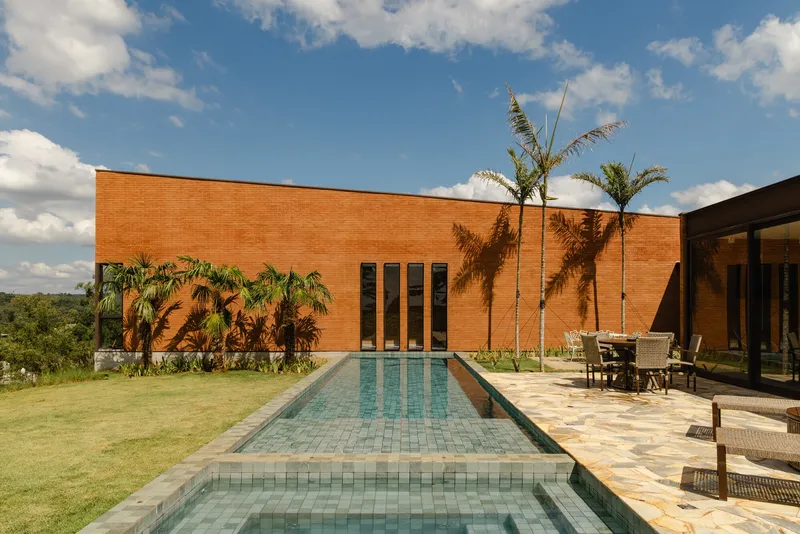
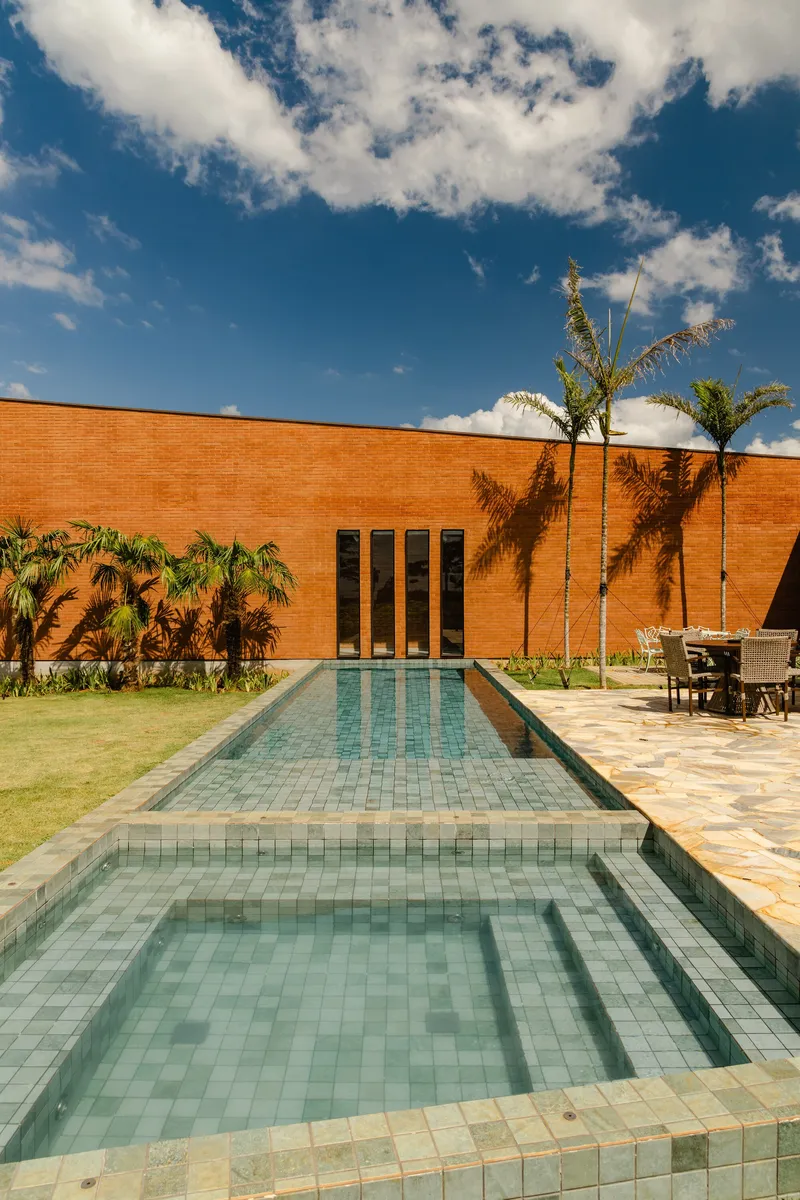
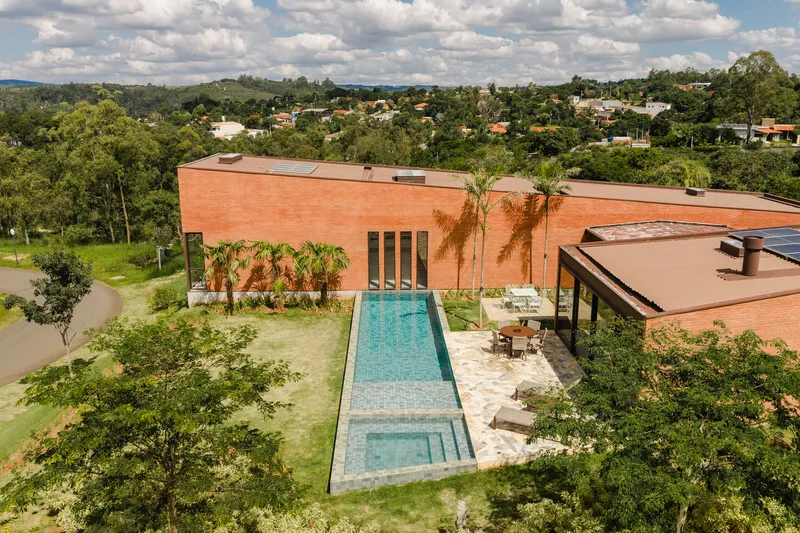
The lap pool is not an afterthought tucked into a leftover corner. It runs parallel to one of the brick wings and effectively bisects the outdoor terrace, creating a clear division between the garden side and the courtyard side. Turquoise tile lines the pool, and a raised spa element sits at one end, flanked by young palm trees that will eventually provide shade. The stone terrace surrounding the pool is generous enough for furniture and circulation without feeling like a hotel deck.
From the aerial views, the pool's role becomes even clearer: it acts as a reflective strip that links the two perpendicular wings, drawing the eye along the length of the site and reinforcing the linearity of the plan. Against the suburban neighborhood backdrop visible in the distance, the pool terrace and its palm trees establish a distinct micro-landscape that belongs entirely to the house.
Roofscape and Energy
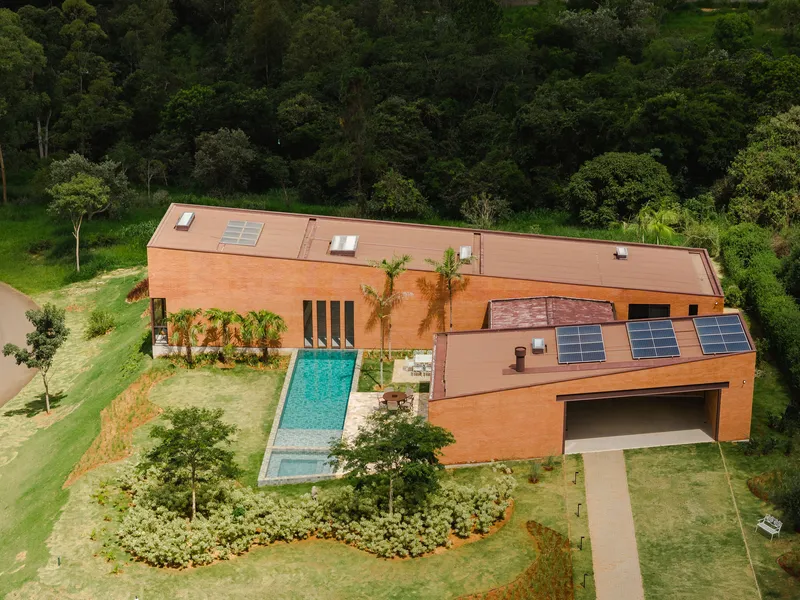
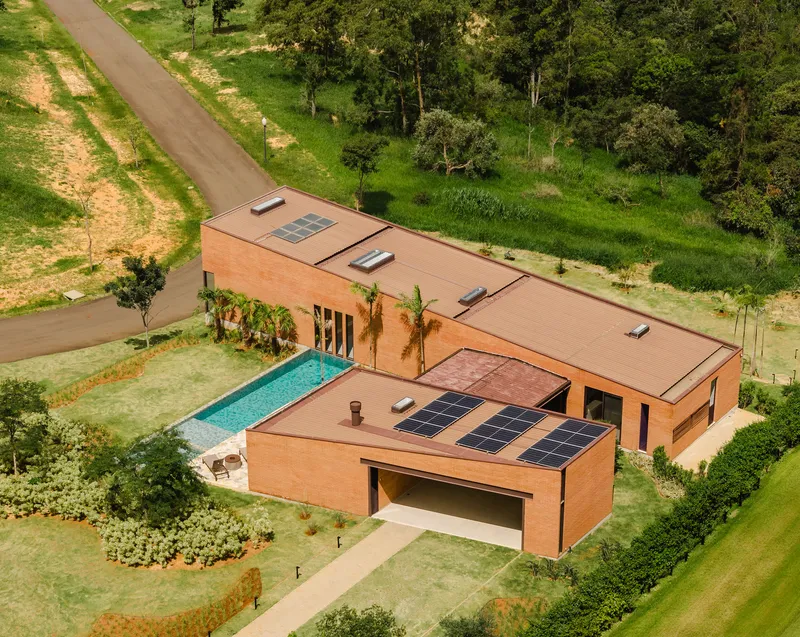
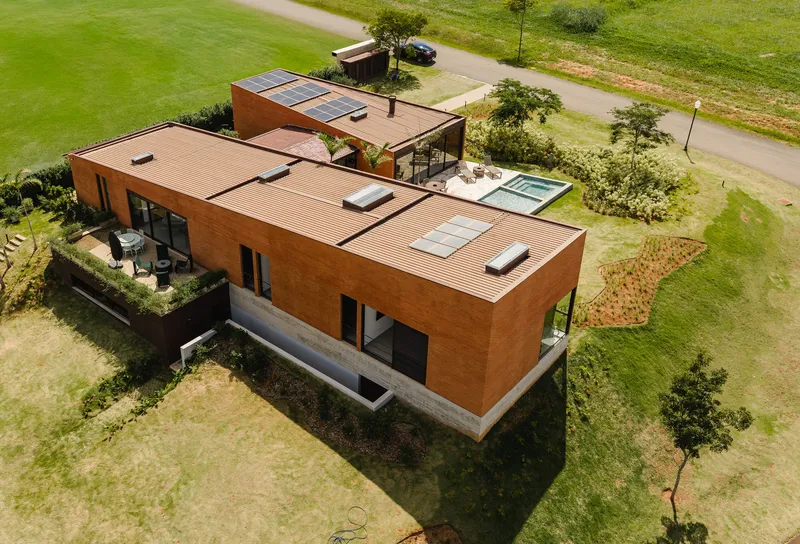
The corrugated metal roofs, visible primarily from drone perspectives, are fitted with photovoltaic arrays that cover a significant portion of the available surface. Skylights punctuate the metal sheets at regular intervals, delivering zenithal light into interior spaces that would otherwise depend entirely on the vertical window slits for illumination. The barrel-vaulted profile of at least one roof section adds a subtle curve to an otherwise rectilinear composition, breaking the horizontal monotony when seen from above.
The solar installation is pragmatic rather than performative. Panels face the optimal orientation for the Southern Hemisphere latitude, and the corrugated metal provides a straightforward substrate for mounting. For a weekend house in a region with abundant sunshine, the decision to integrate renewable energy at this scale is both sensible and increasingly expected. What matters here is that the panels do not compromise the architectural composition; from ground level, they are invisible behind the brick parapets.
Interior Light and Texture
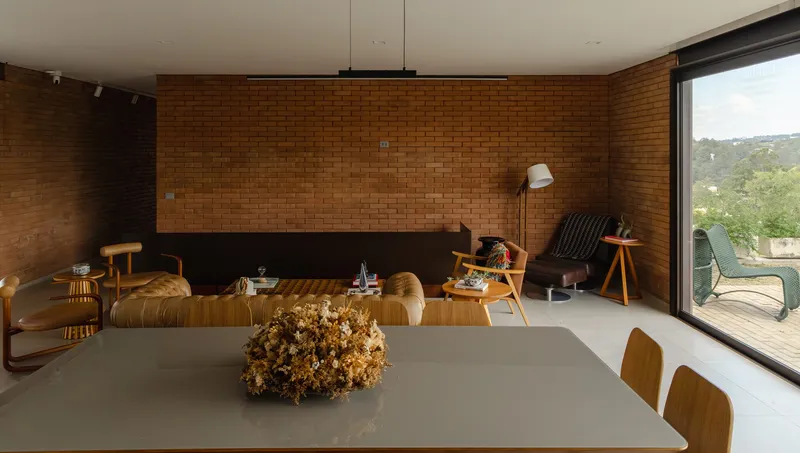
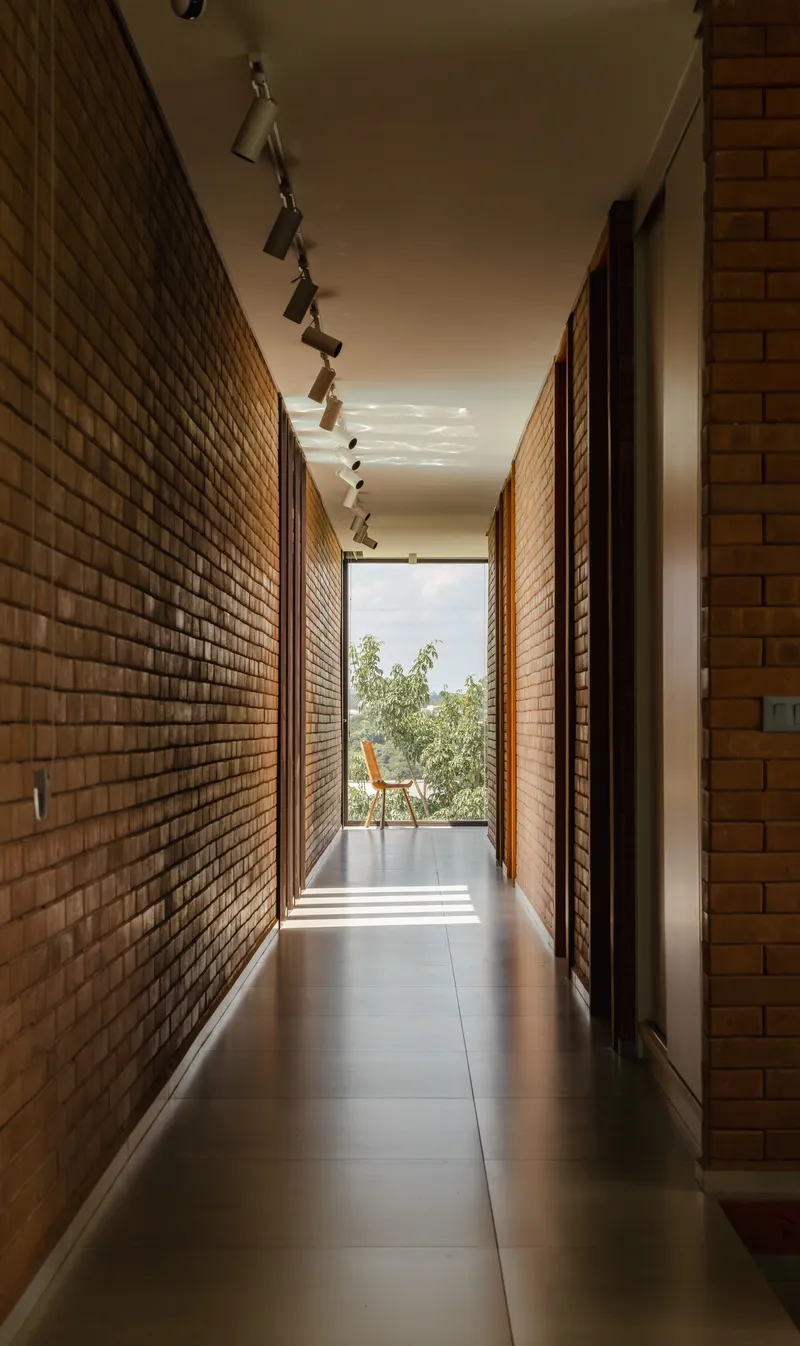
Inside, the brick walls continue their exterior logic, remaining exposed and carrying the warmth of the facade into the living spaces. A recessed fireplace carved into one brick wall becomes the focal point of the main living room, flanked by sliding glass doors that open fully onto the terrace. The material continuity between inside and outside is total: there is no moment where the house pretends to be something other than a brick building.
A corridor running along the garden edge uses louvered timber screens to filter daylight into horizontal bands, creating a rhythm of light and shadow across the brick surface. Track lighting supplements natural illumination at night. The effect is measured and restrained, avoiding the theatrical contrasts that many contemporary houses chase. Instead, the interiors feel steady, warm, and anchored by the material weight of the walls themselves.
Plans and Drawings
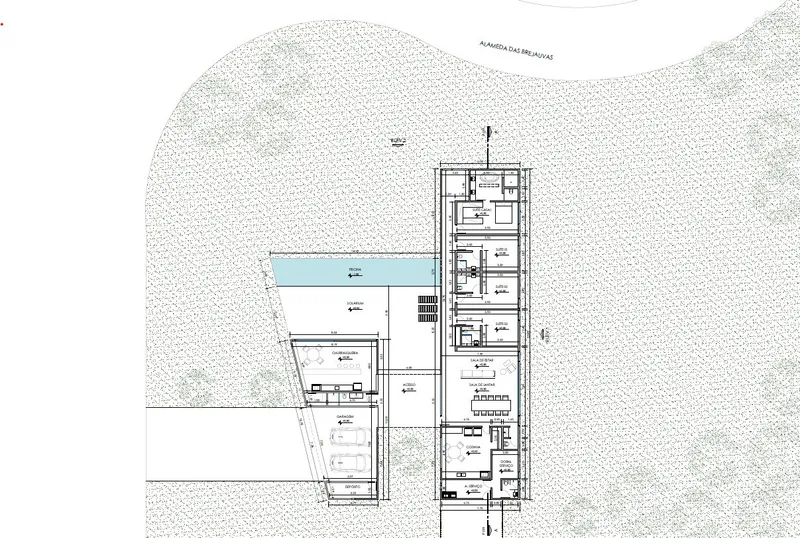
The site plan confirms the L-shaped arrangement of the two volumes, with the pool stretched along the outer edge and stippled landscape surrounding the footprint. The perpendicular relationship between the wings creates a sheltered courtyard on one side and an open garden on the other, a classic bioclimatic strategy for controlling wind and sun exposure in the subtropical interior of São Paulo state.
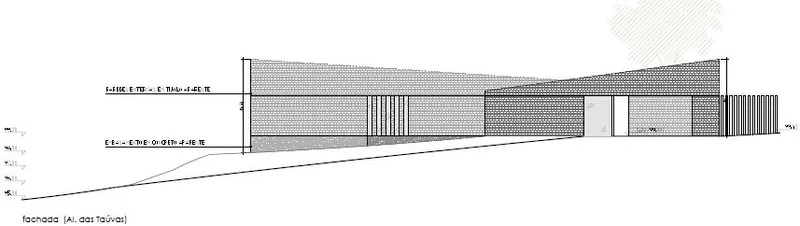
The elevation drawing reveals the long, low profile of the primary brick wing as it tracks the sloping grade. Vertical window bays are spaced with regularity, reinforcing the industrial cadence of the facade. The roof pitches are barely perceptible, confirming that the horizontal emphasis of the design is intentional and absolute. Compared to the more expressive sections typical of Brazilian modernist houses, these drawings communicate restraint.
Why This Project Matters
Casa Dahora is significant not because it reinvents the country house but because it builds one with uncommon conviction. The commitment to a single material system, brick walls from grade to parapet, eliminates the visual noise that plagues so many weekend residences. Every decision, from the raised plateau siting to the corrugated roof with its solar panels and skylights, serves the same argument: a house can be both heavy and open, both rural and precise, without contradiction.
Sergio Sampaio and Tectônica demonstrate that in a landscape increasingly populated by glass-and-steel pavilions, there is still substantial ground to cover with loadbearing masonry and simple plan geometries. The project's real lesson is about confidence. When the material choice is right and the siting is smart, you do not need formal gymnastics to make architecture that holds your attention.
Casa Dahora, designed by Sergio Sampaio Archi and Tectônica. Lead architect: Sergio Sampaio. Itu, Brazil. 450 m². Completed 2025. Photography by Manuel Sá.
About the Studio
Sergio Sampaio Archi
Share Your Own Work on uni.xyz
If projects like this are the kind of work you want to make, uni.xyz is a place to publish your own, find collaborators, and enter design competitions.



Popular Articles
Popular articles from the community


Riyadh For All: Intergenerational Urban Design for Active Aging in Rabat
Riyadh For All reimagines urban design in Rabat with intergenerational co-living, adaptive courtyards, and Moroccan cultural exchange today.

Co-life: Sustainable Architecture for Age-Friendly Community Living
Co-life reimagines sustainable architecture for seniors through courtyards, rammed earth, shared gardens, and spaces designed for belonging.

The Musturak Paradise: Senior Living Architecture for a Connected Future in Temara, Morocco
The Musturak Paradise reimagines senior living architecture in Temara via private homes, social spaces, culture, community, and shared care.

The Earth Pod: 3D Printed Homes for Resilient Refugee Communities
The Earth Pod reimagines refugee housing through 3D printed homes made from clay, combining resilience, self-sufficiency, and rapid shelter.

Similar Reads
You might also enjoy these articles

Bao Huynh Watercolor Atelier: A Serene Art Retreat in Hội An
Bao Huynh Watercolor Atelier in Hội An blends multifunctional art spaces, sustainable design, local materials, and family-friendly living in a serene environment.

Atelier Macri Concept Store Interior Design by CASE-REAL
Atelier Macri store features a "ko" counter, walnut wood details, cork displays, blending retail, gallery, and seamless customer experiences.

Manuel Vargas Izquierdo Stadium and High-Performance Sports Center: Architectural Excellence in Jalpa de Méndez
The Manuel Vargas Izquierdo Stadium blends sustainable design, inclusive sports facilities, and cultural-inspired architecture, revitalizing Jalpa de Méndez’s public spaces.

KAKR Buluh Awar Hall: Revitalizing Community and Ecology Through Bamboo Architecture
Community built bamboo hall revitalizes Buluh Awar village, empowering youth, restoring ecology, celebrating vernacular craftsmanship through sustainable architecture and culture.

Explore Architecture Competitions
Discover active competitions in this discipline



Challenge to reimagine the Iron Throne


Photograph architecture without architects


Illustrate the lost glory of Angkor Wat - Render Challenge


Design challenge to reuse E-waste
Comments (0)
Please login or sign up to add comments
No comments yet. Be the first to comment!