
Sherpa Designs a Fifth-Floor Hospital Lounge in Daejeon That Treats Space as Therapy
An 83-square-meter lounge inside Rich Oriental Hospital gives patients a private retreat above the Daejeon skyline.


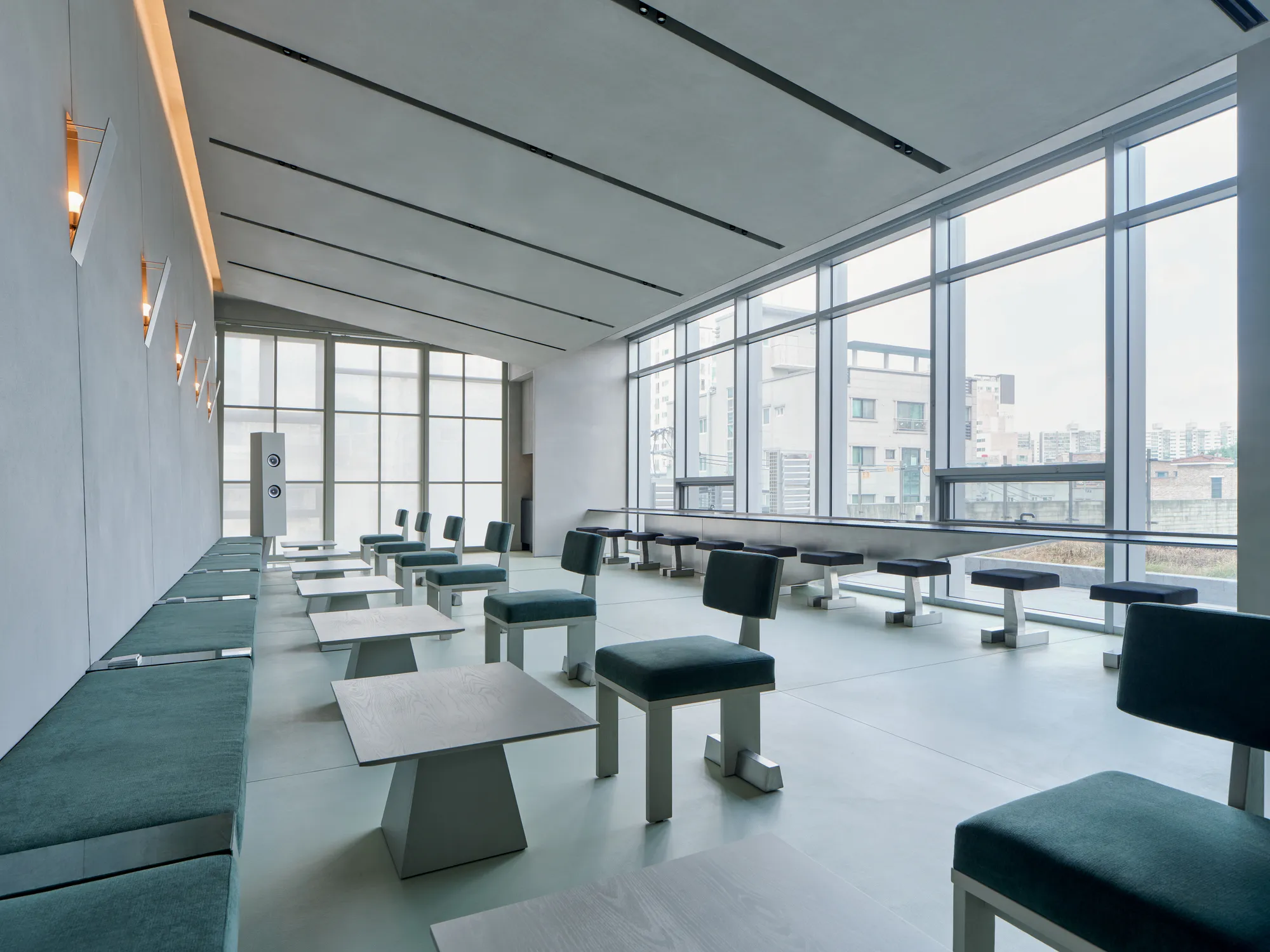
Hospital design rarely concerns itself with the emotional life of the patient. Corridors are optimized for gurney widths, rooms for equipment access, and waiting areas for throughput. The lounge at Rich Oriental Hospital in Daejeon, designed by Sherpa and led by architects Shin Yeon Ho and Mo Byeong Guk, takes a different position. Sitting on the fifth floor of the hospital at 595 Gyeryong-ro in Seo-gu, the 83-square-meter interior carves out a space that belongs to the patient, not the institution.
The core problem is straightforward: patients in shared hospital rooms have almost no autonomy over their environment. They cannot control light, noise, or social exposure. Sherpa's response is a lounge that provides what the ward cannot: visual openness, material calm, and the sensation of being somewhere other than a medical facility. The design leans on a restrained palette of grey paneling, teal upholstery, and floor-to-ceiling glazing to create a room that reads more like a members' club than a hospital common area.
A Teal Line Against Grey


The material strategy is deliberately narrow. Grey wall panels run floor to ceiling, providing a neutral, almost monastic backdrop. Against this, teal upholstered benches form a continuous horizontal band that anchors the room. The color pairing is specific enough to feel intentional without tipping into forced cheerfulness, which is a common failure in healthcare interiors that try too hard to be "warm." Here the warmth is structural, embedded in the proportions and the quality of surfaces rather than painted on.
Suspended pendant lights drop at regular intervals above the bench seating, creating a rhythm that organizes the long wall into individual zones without physical dividers. Each pendant marks a seat, giving patients a sense of personal territory within a shared room. It is a small gesture, but in a context where personal space is scarce, it matters.
Communal Seating Without the Communal Feel
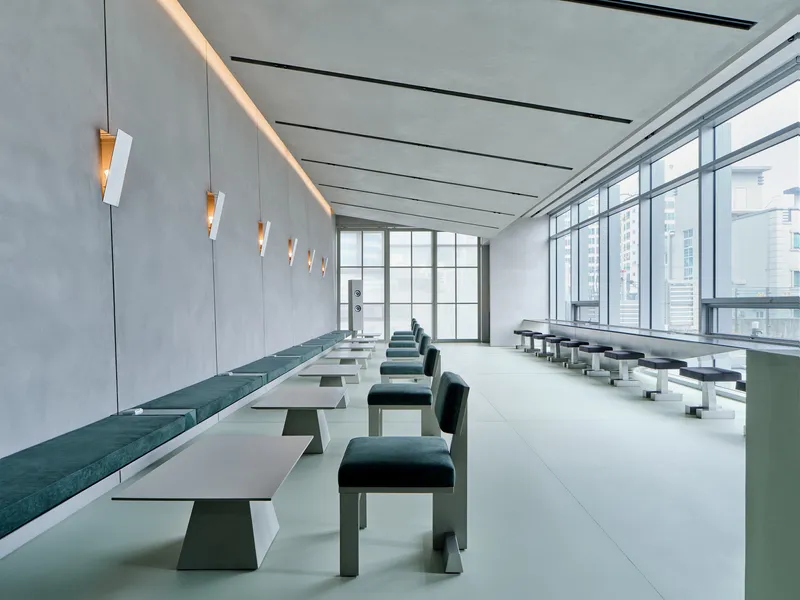
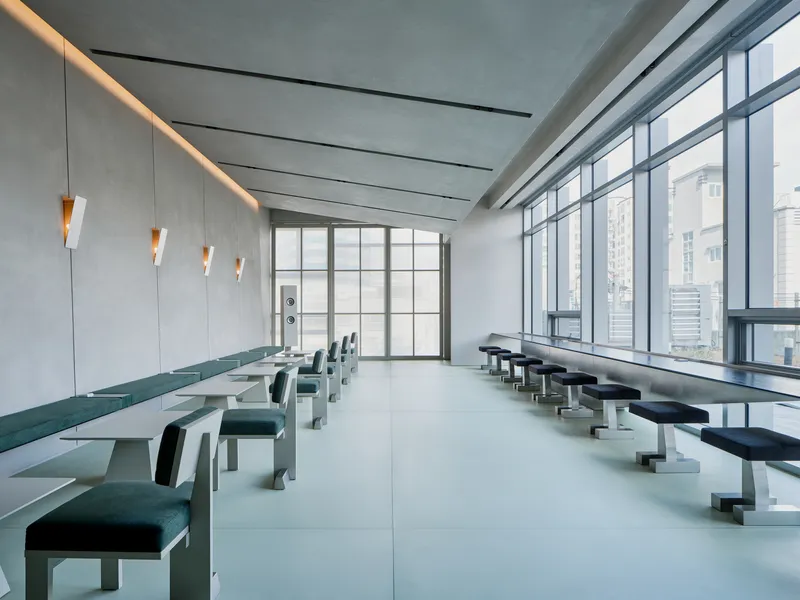
The central zone of the lounge arranges white tables with paired seating along the glazed walls. A coved ceiling with recessed linear lighting runs the length of the room, washing the space in even, diffuse light that avoids the harsh downlighting typical of institutional interiors. The tables are spaced generously enough that two patients can sit within visual range of each other without feeling surveilled.
Sherpa clearly understands that "communal" does not have to mean "social." The layout allows for solitary use of every seat. You can sit at a table and face the window, read, or simply watch the clouds move over Daejeon's residential towers. Nobody is forced into eye contact. For patients whose daily life is dictated by rounds, meals, and shared bathrooms, this level of spatial autonomy is not a luxury; it is a basic need that most hospitals ignore.
The Window Wall as Horizon
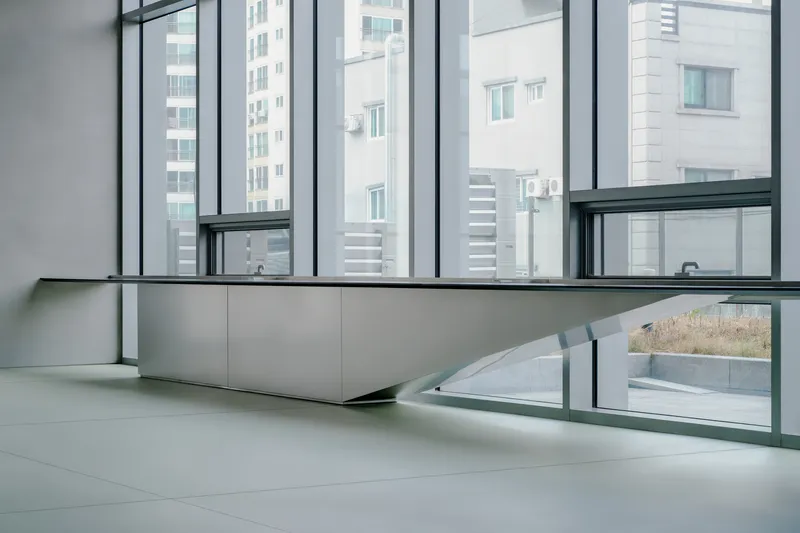

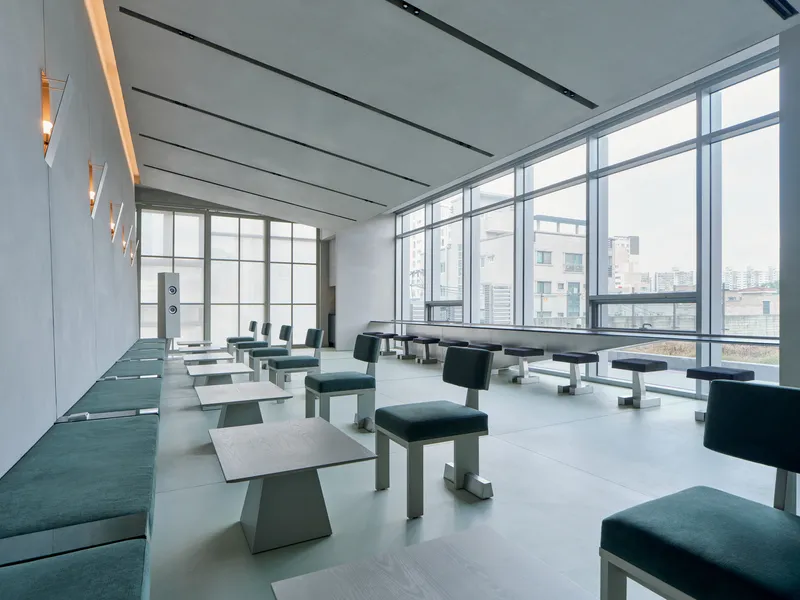
The strongest move in the project is the floor-to-ceiling glazing along the exterior wall. At five stories up, the lounge looks out across a cluster of residential towers under the wide Daejeon sky. The view is not spectacular in a scenic sense; it is ordinary urbanism, apartment blocks and overcast light. But that ordinariness is the point. It reconnects patients with the life happening outside the hospital. It reminds them that the city is still there, still going.
A continuous low bench runs beneath the glass, inviting patients to sit close to the edge and look down or out. Dark upholstered stools line up facing the windows in another zone, creating what amounts to a viewing bar without the bar. The effect is contemplative without being solemn. On an overcast day, the even light fills the room without glare, and the towers outside become a kind of muted backdrop, a reminder of scale and distance that a hospital room simply cannot provide.
A Service Counter That Knows Its Place

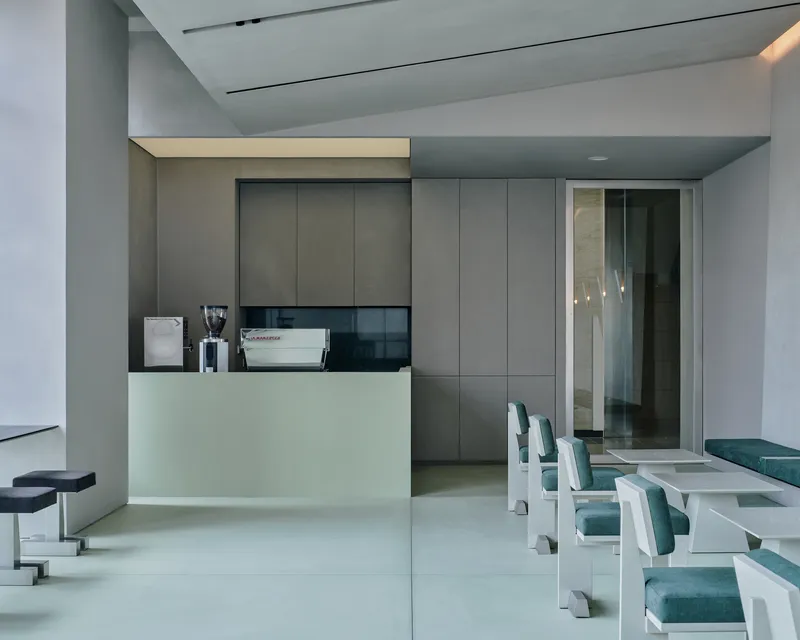
Tucked into a corner, the service counter is a compact piece of joinery that doubles as a reception point and a beverage station, complete with an integrated espresso machine visible through a frameless glass partition. The counter itself is backlit with a frosted panel, casting a soft glow that separates it visually from the darker grey cabinetry behind. It reads as a hospitality element, not a nurses' station.
The distinction matters. When a hospital lounge includes a coffee counter that looks like it belongs in a specialty cafe, it signals to patients that this room operates on different rules. The clinical hierarchy relaxes here. You are not a patient at this counter; you are a person getting a coffee. Sherpa's decision to finish this area with the same material rigor as the rest of the lounge, rather than treating it as a utilitarian add-on, shows a consistency of intent that holds the project together.
Plans and Drawings
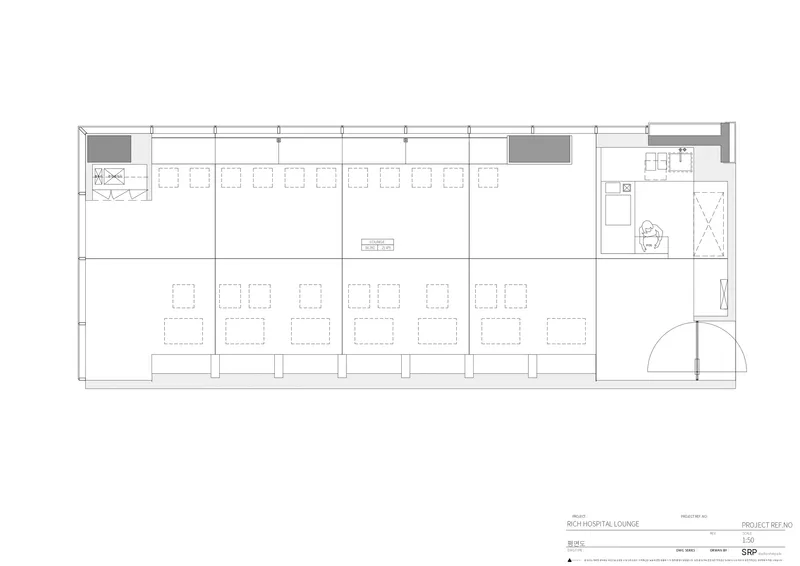
The floor plan reveals the simplicity of the organization. Seating rows line one long wall, the service counter occupies a corner, and the glazed facade runs the full opposite side. There is no labyrinthine complexity, no wasted circulation. The plan is essentially a single room with a clear front and back, which is exactly what an 83-square-meter lounge on a hospital floor should be. Complexity would have been the wrong instinct here; clarity serves the user who is tired, possibly in pain, and looking for a place that does not require wayfinding.
Why This Project Matters
Healthcare architecture has spent decades optimizing for clinical outcomes, infection control, and operational efficiency. Those are real concerns, and they should be addressed. But the patient experience of space, the question of what it feels like to spend days or weeks inside an institution, remains underserved. Sherpa's Reach Hospital Lounge does not reinvent the hospital. It intervenes at a precise scale, 83 square meters on the fifth floor, and demonstrates that even a small room can provide genuine spatial relief when it is designed with the patient's emotional state in mind.
The project also makes an implicit argument about cost. A teal bench, some pendant lights, grey panels, and a glass wall are not extravagant materials. The quality here comes from proportion, restraint, and a clear understanding of who will use the room and why. If more hospitals in South Korea and elsewhere treated patient lounges with this level of care, the cumulative effect on recovery, morale, and trust would be significant. Sherpa has built a small proof of concept for a much larger idea.
Reach Hospital Lounge, designed by Sherpa (lead architects Shin Yeon Ho and Mo Byeong Guk, design team member Park Young Min). Located at Rich Oriental Hospital, 595 Gyeryong-ro, Seo-gu, Daejeon, South Korea. 83 m². Completed 2025.
About the Studio
Share Your Own Work on uni.xyz
If projects like this are the kind of work you want to make, uni.xyz is a place to publish your own, find collaborators, and enter design competitions.




Popular Articles
Popular articles from the community


Riyadh For All: Intergenerational Urban Design for Active Aging in Rabat
Riyadh For All reimagines urban design in Rabat with intergenerational co-living, adaptive courtyards, and Moroccan cultural exchange today.

Play: Fragments of Their World
Familiar architecture becomes modular playground design, creating safe spaces where displaced children can learn, connect, imagine and play.

Conexión: Biophilic Design Reimagines High-Rise Living in Hong Kong
Conexión reimagines high-rise living in Hong Kong through biophilic design, green facades, shared spaces, daylight, water and nature within.

Lunar Spiral: Space Architecture Shaped by the Mathematics of the Universe
Lunar Spiral reimagines space architecture through Fibonacci geometry, lunar regolith, levitating habitats, and self-sustaining Moon living.


Similar Reads
You might also enjoy these articles

Bao Huynh Watercolor Atelier: A Serene Art Retreat in Hội An
Bao Huynh Watercolor Atelier in Hội An blends multifunctional art spaces, sustainable design, local materials, and family-friendly living in a serene environment.

Atelier Macri Concept Store Interior Design by CASE-REAL
Atelier Macri store features a "ko" counter, walnut wood details, cork displays, blending retail, gallery, and seamless customer experiences.

Manuel Vargas Izquierdo Stadium and High-Performance Sports Center: Architectural Excellence in Jalpa de Méndez
The Manuel Vargas Izquierdo Stadium blends sustainable design, inclusive sports facilities, and cultural-inspired architecture, revitalizing Jalpa de Méndez’s public spaces.

KAKR Buluh Awar Hall: Revitalizing Community and Ecology Through Bamboo Architecture
Community built bamboo hall revitalizes Buluh Awar village, empowering youth, restoring ecology, celebrating vernacular craftsmanship through sustainable architecture and culture.

Explore Lounge Chair Competitions
Discover active competitions in this discipline



Challenge to design locus for the upliftment of human rights


Design challenge to reuse E-waste
Comments (0)
Please login or sign up to add comments
No comments yet. Be the first to comment!