

Shy House: Architecture That Mirrors the Psychology of Healing
A therapy center in curved concrete moves from enclosed refuge to open community, tracing the emotional arc of recovery itself.


What does it look like when a building is designed to feel shy? Shy House answers that question with a curving concrete volume that turns its back to the street, shields its occupants from scrutiny, and only gradually reveals openness to those who move through it. The architecture literalizes a psychological journey: from enclosed, secure retreat to communal, light-filled engagement. It is a therapy center that treats the act of entering a building as the first therapeutic gesture.
Designed by Елена Ушакова, Shy House was shortlisted in the Live Laugh Love 2020 competition, which asked participants to explore architecture's capacity to support mental health and emotional well-being. Ushakova's response rejects the institutional look typical of clinical facilities and instead proposes a form rooted in empathy: unassuming, grounded, and deliberately modest in its material palette. The result reads less like a healthcare building and more like a landscape folded into habitable shelter.
A Facade That Refuses to Perform
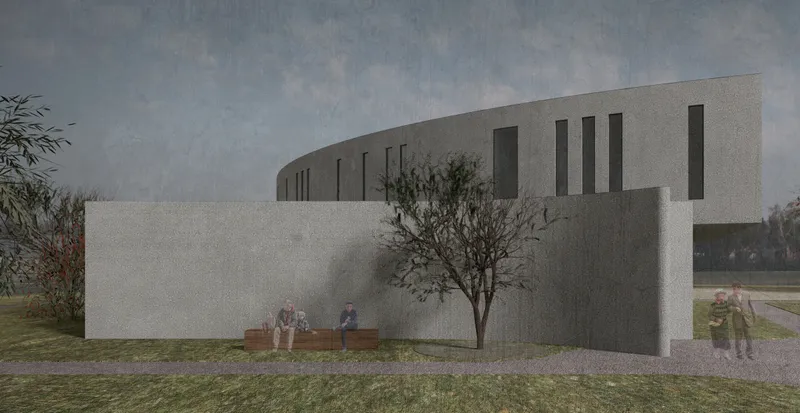
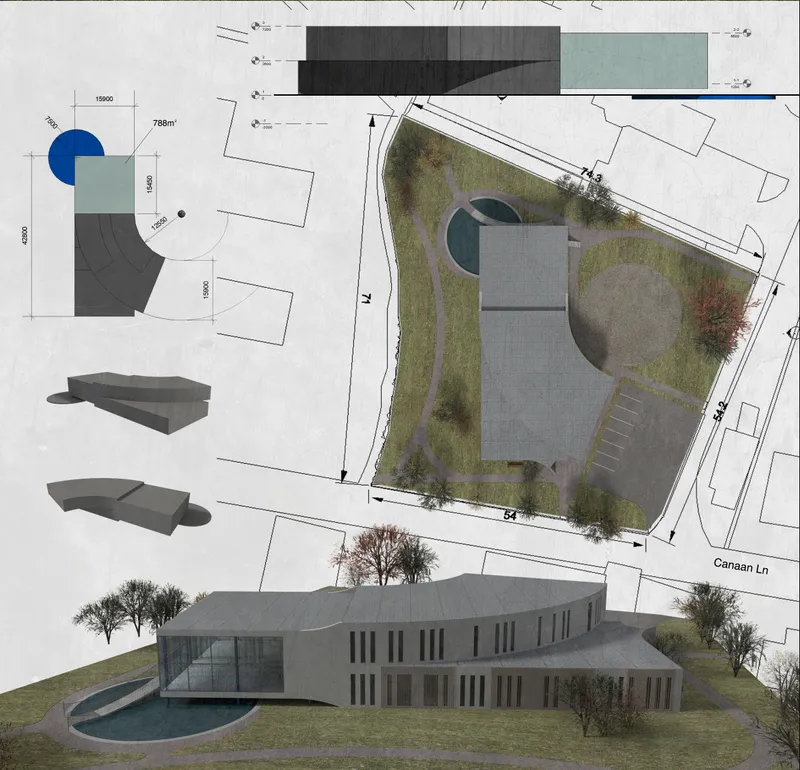
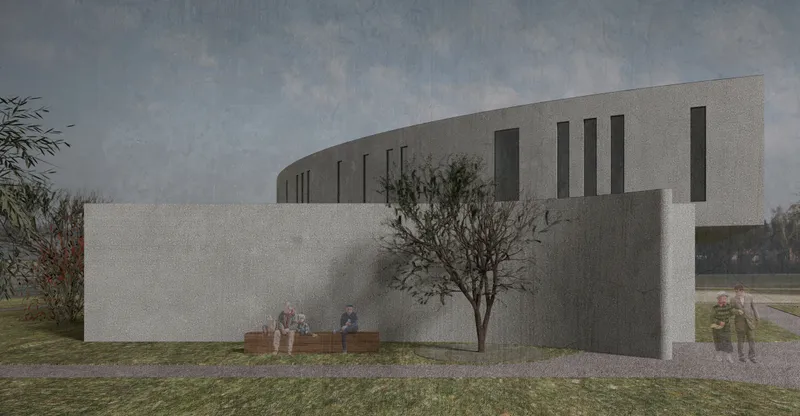
The rendered street view reveals a building that almost withdraws from observation. The curved concrete facade presents a series of narrow vertical window slits rather than expansive glazing, controlling exactly how much of the interior is visible and how much external stimulus reaches occupants inside. Figures sit quietly beneath a tree in front of the wall, and the scene feels deliberate: the building lets people exist alongside it without demanding interaction. Neutral, stone-like tones and textured surfaces avoid stimulation. There is nothing loud here.
The site plan makes the spatial strategy legible from above. The building's curved footprint wraps around a circular water feature and landscaped courtyard, creating a protected interior world. Elevated slightly above the ground and partially extending over water, the center uses the landscape not as decoration but as a therapeutic instrument. A bridge connecting therapy rooms to the open area functions as both circulation and metaphor: the crossing from inner turmoil toward external connection.
Program Organized as a Gradient of Exposure
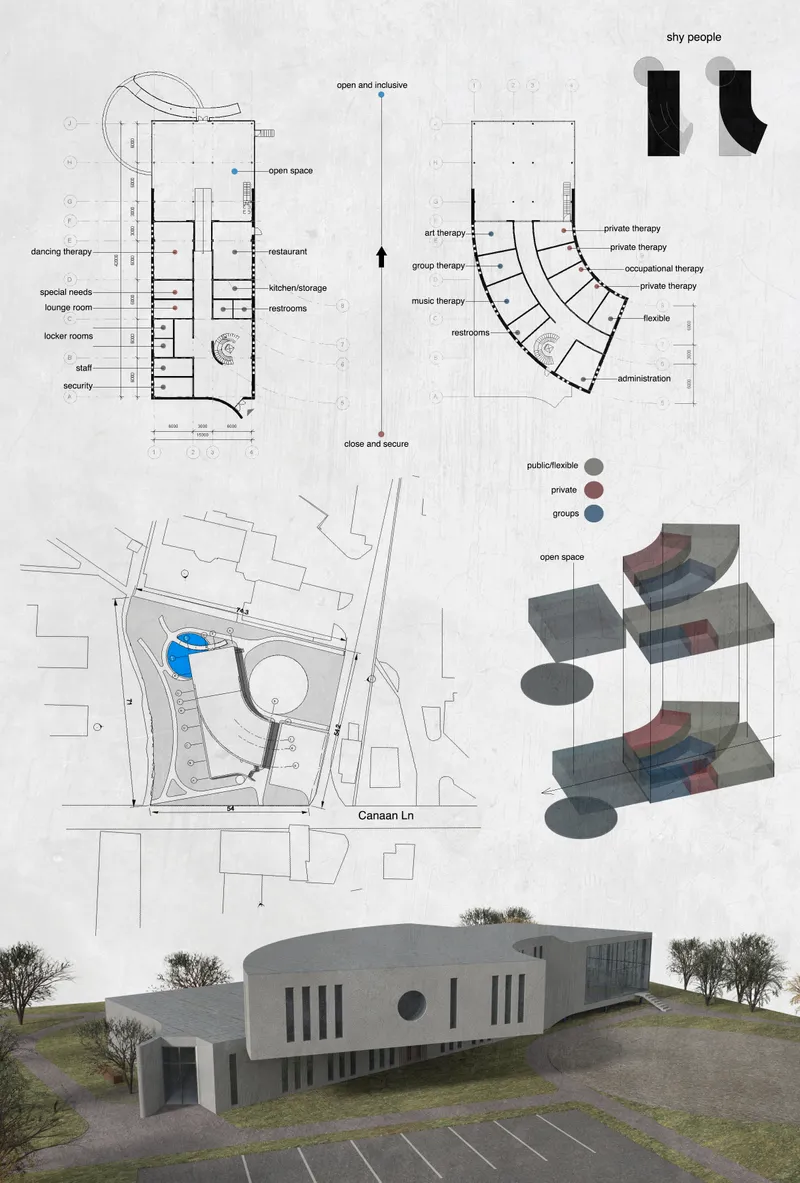
The floor plans and axonometric diagram reveal how Ushakova distributes the program along the building's curve. Private therapy rooms occupy the most enclosed sections, tucked deep within the form's protective bend. Group therapy spaces, music and art session rooms, and masterclass areas occupy intermediate zones. The most open and communal programs, including a restaurant, lounge areas, a small library, concert and lecture spaces, and a playground, sit where the building opens outward toward daylight and landscape. The architecture does not merely contain these functions; it sequences them as a spatial narrative of increasing social exposure.
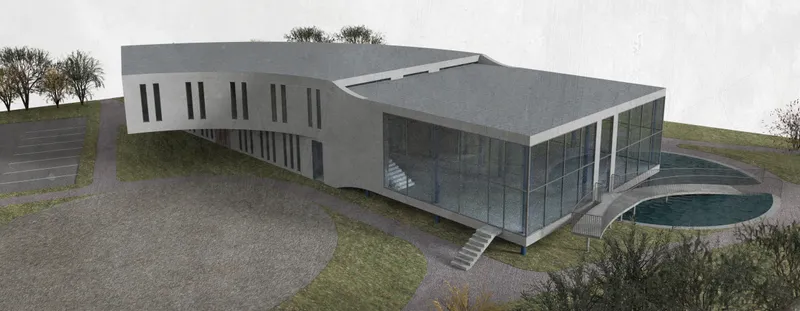
The aerial view of the glazed entrance pavilion shows where the protective wall relents. A transparent volume marks the threshold, offering arriving visitors a moment of visual connection to the interior before they commit to entering. The vertical slit windows continue along the curved wing behind, maintaining the rhythm of controlled transparency. Under overcast light, the concrete reads as soft and muted rather than brutalist, reinforcing the intended atmosphere of calm.
Concrete Walls That Feel Like Shelter, Not Confinement
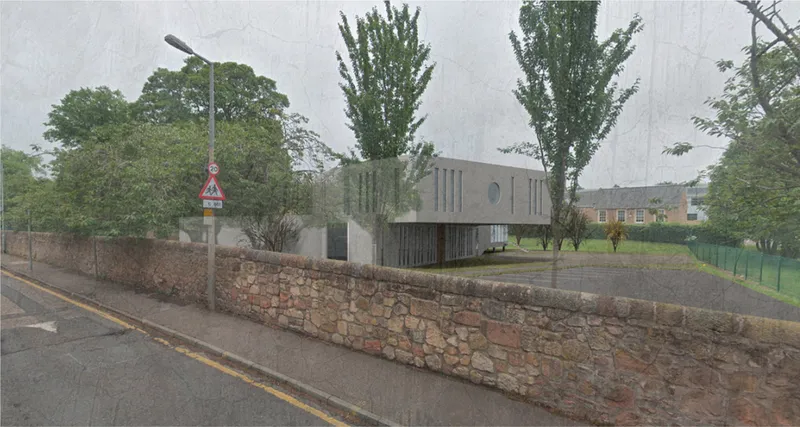
Seen from the street in rain, the facade sits behind a stone retaining wall and mature trees. The layering is important: before you reach the building itself, you pass through landscape elements that buffer the transition from public to private. The vertical window openings punctuate the wall at a rhythm that prevents monotony without introducing visual noise. There is a discipline here. Every opening is sized to admit light and air, not to frame a view for passersby. The building serves its occupants first.
The corner view reinforces this reading. Textured concrete wraps around the building's curve, and figures gathered beneath a bare tree occupy the foreground with an ease that suggests the architecture has successfully dissolved the stigma often associated with mental health facilities. The form bends around the needs of its users, Ushakova writes, like a protective embrace. Critically, the embrace never becomes a cage. Glass is used selectively to foster transparency while maintaining privacy, ensuring occupants feel safe without feeling confined.
Landscape as Therapeutic Infrastructure
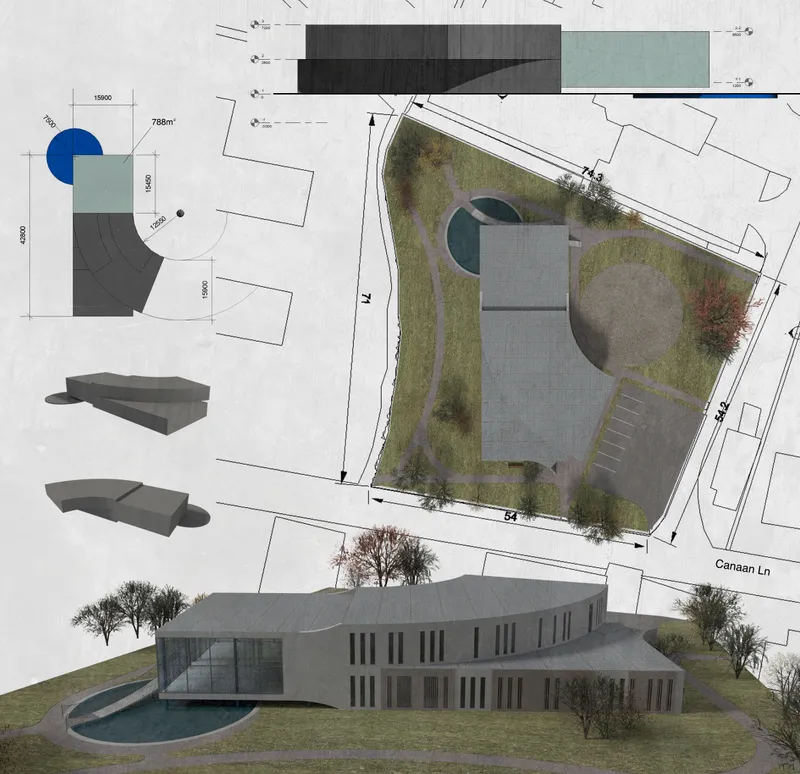
The final rendered site plan and axonometric view reveal the full extent of the landscape strategy. A pool sits within the building's curved embrace, surrounded by a courtyard and open lawns framed by winter trees. The outdoor spaces are not leftover land between built volumes; they are programmed environments designed to encourage interaction without pressure. Open lawns and playgrounds welcome both patients and the broader community, blurring the boundary between clinical facility and public amenity. The winter trees in the rendering are a quiet but effective choice: they suggest the building is meant to comfort in every season, not only when the weather cooperates.
Why This Project Matters
Shy House succeeds because it takes a psychological condition and translates it into spatial logic without resorting to sentimentality. The curved plan, the gradient from enclosure to openness, the selective transparency, the elevated relationship to water: each decision addresses a specific emotional need. Anxiety about being watched is met with narrow window slits. Fear of institutional environments is countered by domestic scale and natural materials. The reluctance to engage socially is respected by placing communal programs at the end of a spatial sequence, not at the entrance.
Architecture for mental health too often defaults to clinical efficiency or superficial wellness aesthetics. Ushakova proposes something more demanding and more honest: a building whose form is shaped by the inner experience of its users. Shy House does not insist that healing happens on a schedule. It offers a path and trusts people to walk it at their own pace. That patience, built into concrete and glass and landscape, is what makes the project genuinely therapeutic rather than merely therapeutic-looking.
View the Full Project
About the Designers
Designer: Елена Ушакова
Enter a Design Competition on uni.xyz
uni.xyz runs architecture and design competitions year-round that reward proposals with spatial conviction and real site intelligence.
Project credits: Shy House by Елена Ушакова Live Laugh Love 2020 (uni.xyz).


Popular Articles
Popular articles from the community


Architekt Andreas Gruber Scatters 23 Dark Timber Chalets Across a South Tyrolean Forest Edge
In Molini di Tures, Amonti Chalets breaks a resort into a hamlet of gabled timber houses, with parking, storage and services pushed into the slope.

David Macias Steps a Doorless Stone and Plaster House Down a Tropical Colombian Hillside
In the humid hills of Colombia, Threshold House replaces the front door with an open void and terraces its 850 m² down the slope instead of fighting it.

longwave studio Reorganizes a 112 m² Tainan Apartment Around the Daily Routines of a Family and Two Cats
In Tainan, Taiwan, birch plywood, rust-red furniture and a freestanding plaster wall link arrival, storage, work and family life in one apartment.

David Ortega Stacks a Two-Story Mexico City Penthouse Around a Steel Stair and a Pergola-Shaded Roof Terrace
In Colonia Roma, a 300 m² penthouse uses oak joinery, a planted steel stair and a slatted roof pergola to make a new-build apartment feel like a house.

Similar Reads
You might also enjoy these articles


Vereda Arquitetos Renovates a 40-Square-Meter Apartment Inside Niemeyer's Copan Building
A compact unit in São Paulo's most iconic residential tower gets a material overhaul that pairs exposed concrete with bold blue Formica.

Shakur's House: Exposed Brick as an Interior Organiser in a 168 m² Mashhad Residence
Brick moves indoors in this Mashhad residence, where masonry walls, glass partitions and teal planes sequence a compact home without closing it off.

Day and Night Park: A Time-Based Urban Newsstand in Beijing
A temporary urban newsstand in Beijing blending travel, light, and reading through poetic colors, compact form, and community-focused design.

Modernist Patio Renovation in El Masnou, Barcelona by Oliver Segura Arquitectura + Cebrià Arquitectura
Modernist patio renovation blending tradition and innovation with a movable pool, leveled floors, and Catalan materials in El Masnou.

Explore Architecture Competitions
Discover active competitions in this discipline

Challenge to reimagine the Iron Throne

Photograph architecture without architects

Illustrate the lost glory of Angkor Wat - Render Challenge

Design challenge to reuse E-waste
Comments (0)
Please login or sign up to add comments
No comments yet. Be the first to comment!