

siarchitecture Nestles a 720 m² Resort into Jingdezhen's Tea Fields and Mining Landscape
A hillside hotel in China's porcelain capital layers terrazzo, stone, and timber to root itself in agricultural terrain.


Jingdezhen is synonymous with porcelain, a city whose identity has been shaped by millennia of extracting, refining, and firing local earth. That relationship between ground and craft is precisely what siarchitecture taps into with Mine Resort · Hill, a 720 m² hotel completed in 2025 on the outskirts of the city. Positioned among tea plantations and rolling farmland, the building doesn't borrow the usual hospitality playbook of disappearing into the landscape. It stands up, three storeys tall, white terrazzo walls catching the light, and announces itself as a constructed thing among cultivated things.
What makes the project worth paying attention to is how it negotiates between roughness and precision. The facades shift between smooth white terrazzo, rough-cut stone, and timber-framed recesses. These are not decorative choices layered onto a neutral box; they correspond to different structural and spatial conditions within the building. Led by LI Fengbo, siarchitecture appears to have treated each elevation as a separate argument about how a wall meets the sky, the ground, or a guest's line of sight toward the mountains. That layered logic, combined with a modest footprint and a solar canopy overhead, makes this small hotel feel more considered than many projects several times its size.
A Compound in the Fields


Seen from above, the resort reads as a tight cluster of volumes dropped into a patchwork of agricultural plots, tree rows, and a nearby water body. The aerial view reveals how the building's footprint has been carefully calibrated: compact enough to avoid consuming farmland, yet tall enough to grant upper-floor rooms panoramic views across the tea fields to distant ridgelines. The photovoltaic canopy that crowns the structure is the first thing visible from a distance, tilting the roofline into an angular silhouette that distinguishes the building from the surrounding low-slung vernacular.
The site strategy is one of adjacency rather than immersion. The building doesn't pretend to be a hill or mimic agricultural terracing. Instead, it sits firmly beside the fields, allowing the boundary between constructed volume and cultivated ground to remain legible. That honesty is refreshing in a Chinese rural hospitality market saturated with resorts that fetishize camouflage.
Facade as Material Argument
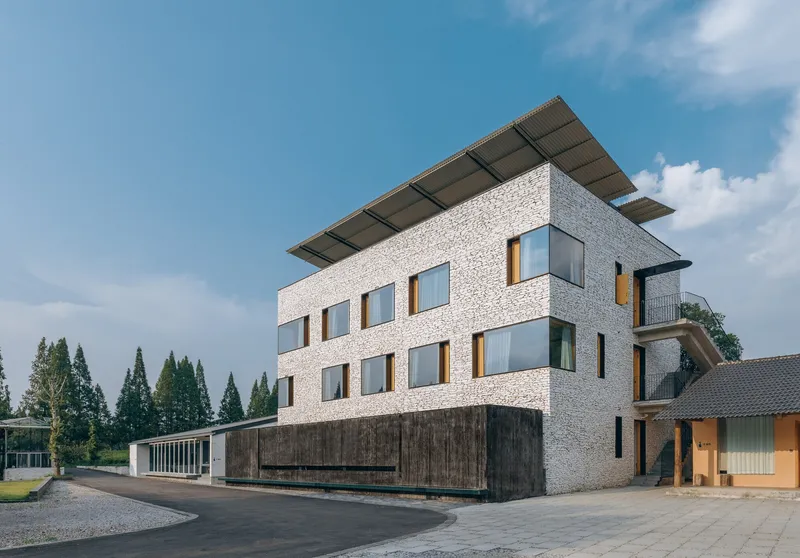


The elevations tell at least three material stories. The primary volumes are clad in white terrazzo, smooth and almost chalky, which gives the building a brightness that reads well against both overcast skies and the deep green of tea bushes. Where the building meets the ground, rough-textured stone takes over, forming a base that feels geological, as though the lower portion were carved from the same earth that Jingdezhen has been mining for centuries. Timber-framed openings punctuate both materials, their warm tone mediating between the cool white above and the grey stone below.
Corner window details reveal the care siarchitecture has taken at transitions. Glass is set flush into the stone cladding, catching sky reflections that momentarily dissolve the wall's solidity. An exterior stair on the stone-clad volume leads up to a timber-framed balcony, creating a vertical promenade that exposes guests to each material layer in sequence. The solar panel canopy overhead tilts at a pragmatic angle, but its steel frame also gives the roofline a deliberate incompleteness, as if the building is still reaching upward.
Stacked Thresholds


The most photogenic move is the series of stacked balconies that project from the white terrazzo facade. Each recess is lined in timber, creating deep shadow boxes that break the wall's planarity and give every room a semi-outdoor threshold. In afternoon sunlight these recesses glow warm against the cool white surface, turning the elevation into a rhythm of solids and voids that shifts with the time of day.
From the rear, the building is quieter. White terrazzo walls with timber-framed windows face a green field, and without the projecting balconies the volume reads as a simple, almost austere block. That restraint on the back elevation suggests siarchitecture reserved its expressive gestures for the sides and front where guests and the public interact with the building, treating the field-facing facade as a private, contemplative surface.
Rooms Framed Toward the Horizon
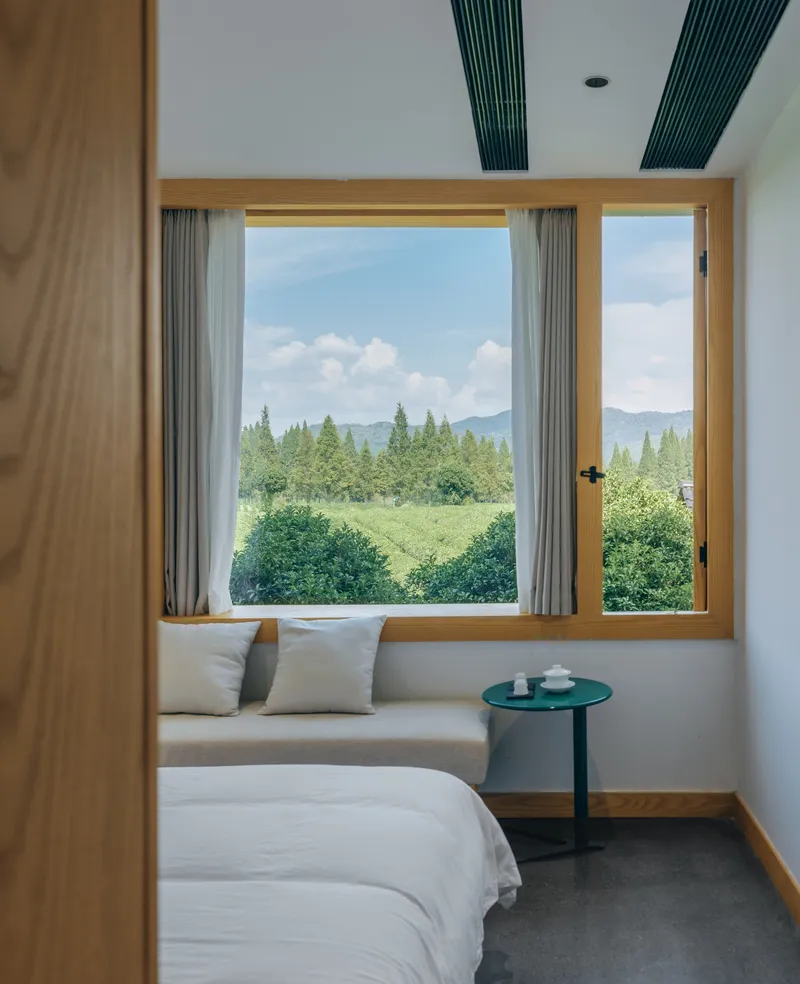


Inside the guest rooms, timber dominates. Window seats are framed in light wood, deep enough to sit in, and oriented to push your gaze past the building's own geometric volumes toward the tea plantation and the mountain horizon beyond. The window proportions are generous but not floor-to-ceiling; they frame a landscape painting rather than a panorama, which gives the rooms a sense of enclosure that full glazing would have destroyed.
One room offers a view not outward but across, looking at the adjacent white geometric volume of the building itself. It's a smart compositional decision: not every room needs a mountain view if the architecture can be its own subject. Elsewhere, a ground-level interior space uses herringbone flooring, corrugated metal ceilings, and glazed tile walls flanking a central doorway. The material palette here is denser, almost industrial, nodding to Jingdezhen's kiln heritage without lapsing into nostalgia.
The Rooftop as Destination

The rooftop terrace is capped by a steel-framed canopy supporting photovoltaic panels, turning a functional energy system into the building's crowning spatial gesture. A glass brick wall filters light onto the terrace while a white parapet defines the edge, framing views toward the mountains. The effect is of a belvedere, an observation platform that rewards the vertical journey through the building.
From ground level in the tea fields, that canopy is the building's most distinctive feature, tilting against the sky like a visor. It gives the otherwise rectilinear volumes a directional quality, pointing toward the sun's arc and, by extension, toward the energy logic that justifies its presence.
Plans and Drawings
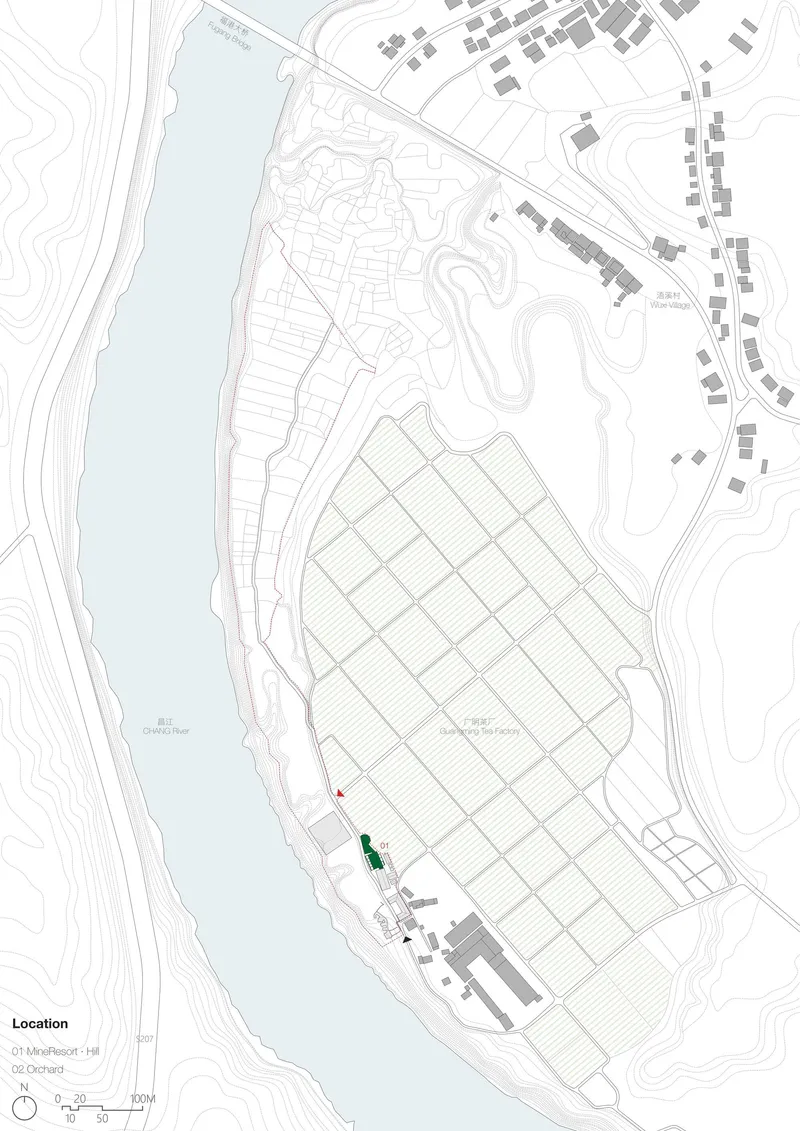


The site and master plans confirm the compound strategy: the building sits within a scattered constellation of structures amid planted landscape and agricultural fields, with a water body nearby anchoring the broader resort composition. The floor plans reveal a dual-wing organization: one curved, one rectangular, each containing repeated room units. The repetition is practical for a hotel, but the curved wing introduces variety in corridor experience and facade orientation that a single bar would have lacked.
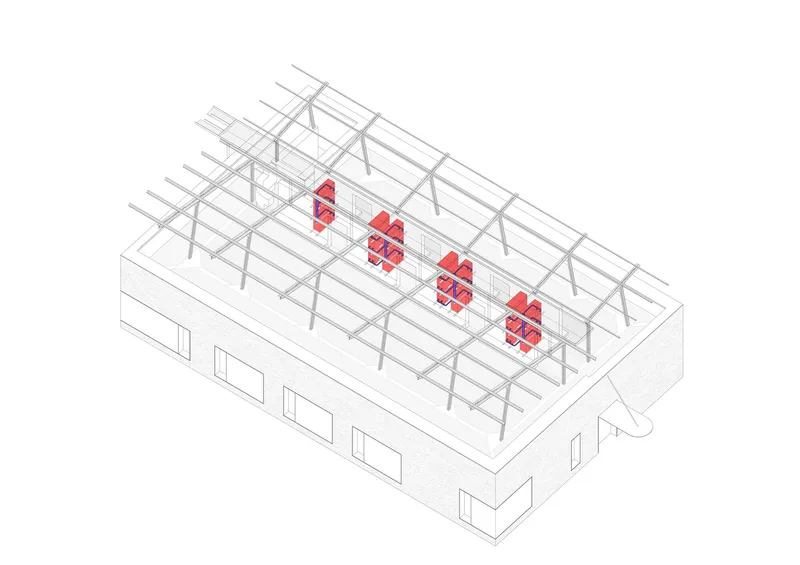
Sections and facade drawings show how the three-storey volume is articulated with timber-clad vertical elements and a sloped roof structure supporting the solar canopy. The wall section is revealing: insulation layers, brick cladding, and timber panel assemblies are drawn in detail, showing a thermally considered envelope rather than a thin decorative skin. The axonometric structural drawings expose a regular grid of green steel columns and beams, with red-highlighted mechanical units arranged in a row along one axis. It's a straightforward structural system, which is precisely what frees the facades to do their more expressive work.
Why This Project Matters
Rural hospitality architecture in China has, over the past decade, produced extraordinary variety, from rammed-earth retreats to cantilevered glass pavilions. Mine Resort · Hill sits in neither camp. siarchitecture has produced a building that is neither camouflaged nor spectacular. It is specific: specific to Jingdezhen's material culture of earth and fire, specific to the rolling topography it occupies, and specific in the way each facade addresses a different condition. That specificity, more than any single formal gesture, is what gives the project its coherence.
At 720 m² the building is modest, but modesty here is a design position, not a constraint. The solar canopy, the detailed wall assembly, the careful orientation of window seats toward landscape or architecture: these are decisions that reflect a studio thinking about how a small hotel can be a serious piece of work. In a market that rewards Instagram-ready scenography, siarchitecture has bet on material logic and tectonic clarity. It's a bet worth watching.
Mine Resort · Hill by siarchitecture, Jingdezhen, China. 720 m², completed 2025. Photography by Yumeng Zhu, Zhechen Yu, and siarchitecture.
About the Studio
Share Your Own Work on uni.xyz
If projects like this are the kind of work you want to make, uni.xyz is a place to publish your own, find collaborators, and enter design competitions.


Popular Articles
Popular articles from the community


LT2A and OPEN Architectes Thread a Brick and Glass High School Through a Wooded Belgian Campus
In Braine-l'Alleud, a 3,000 m² wing for Collège Cardinal Mercier pairs pale brick with a glazed colonnade, deferring to a small chapel and a dense wood.

Jaramillo Van Sluys Arquitectura and Urbanismo Turn a Demolished Registry Lot in Quito into an Orchard Plaza
In Quito's Centro Histórico, a 2,800 m² plaza exposes the San Agustín convent wall and redraws its lost Augustinian orchard in volcanic stone.

Cube Design Draws an Ecological Corridor Between Two Shenzhen Hills with the Nankai Building
Beside Shenzhen's container docks, the Nankai Building pairs stacked balconies with a climbing green screen to connect two hillsides across its height.

GROUP A Strips a 1969 Rotterdam Harbor Headquarters to Its Frame and Wraps It in Timber Louvers
In Rotterdam's M4H harbor district, Ferro Offices reuses a 1969 frame, adds one timber storey and reaches BREEAM-NL Outstanding.

Similar Reads
You might also enjoy these articles


LAVA Architecten Gives Vocational Education a Sawtooth-Roofed Face on a Mechelen School Campus
In Mechelen, Belgium, a 2,053 m² STEM school on a 6×6 m grid turns workshops and classrooms into rooms that can be rearranged as teaching changes.

KEMA Studio Turns a Derelict Marvila Attic into a 60 m² Lighthouse Apartment Above Lisbon
In Lisbon's Marvila district, a rebuilt roof, four skylights and two plywood volumes turn an unlivable attic into a bright home facing the Tagus.

Pixel Gardens: One Repeated Module Stacked Into a Terraced Social Housing Tower for Famagusta
Salem Bader's shortlisted housing tower builds a vertical neighbourhood from one repeated module, offsetting units to carve terraces, light and air.

Bao Huynh Watercolor Atelier: A Serene Art Retreat in Hội An
Bao Huynh Watercolor Atelier in Hội An blends multifunctional art spaces, sustainable design, local materials, and family-friendly living in a serene environment.
Comments (0)
Please login or sign up to add comments
No comments yet. Be the first to comment!