
SIDES CORE Tilts Mirrors on Two Axes to Rethink Privacy Inside an Osaka Hair Salon
On the fourth floor of a Nishi-ku corner building, Siten Salon turns skewed reflections into a quiet statement about perspective.


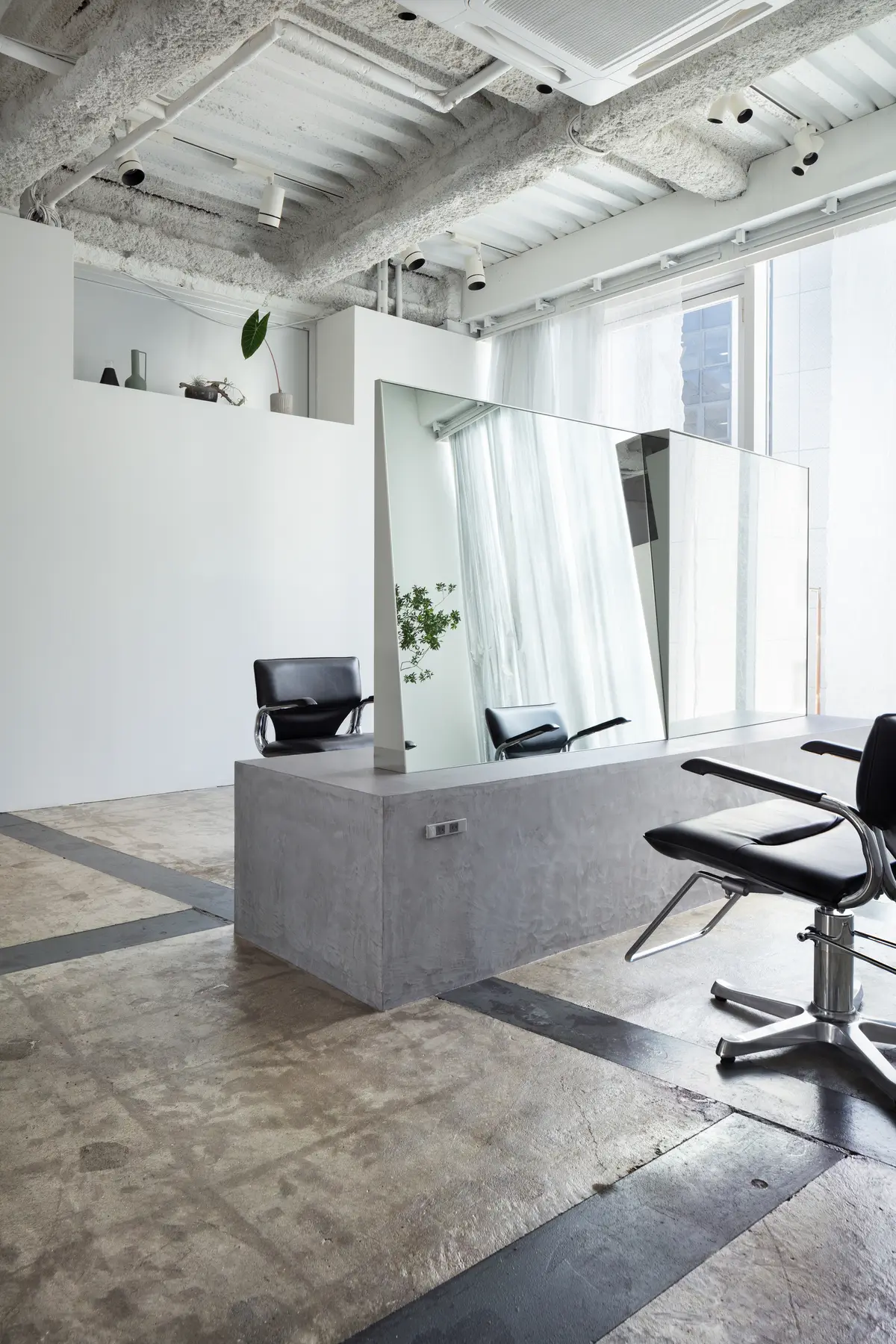
Most hair salons treat mirrors as furniture: flat panels bolted to a wall, facing the client, end of story. SIDES CORE, the Osaka practice led by Sohei Arao, treats them as architecture. At Siten Salon, a 72 square meter renovation on the fourth floor of a corner building in the Edobori district, four styling stations each carry a mirror tilted on two independent axes. The contradictory angles mean no two clients share a line of sight, a spatial trick that delivers genuine privacy without solid partitions. It is a small move with an outsized effect: what could have been a cramped loft feels open, luminous, and oddly intimate all at once.
The concept resonates with the salon's own branding. Siten's logo, designed by Sumiko Arao, symbolizes perspective, field of view, and viewpoint, ideas the interior literalizes in glass, concrete, and silver-foiled curtain fabric. From the avenue intersection below, the end face of the tilted mirror set is visible through the full-height glazing, turning the fourth floor into a legible sign for the business. The project is simultaneously a hair salon and an eye salon, and that duality of seeing and being seen runs through every detail.
Skewed Reflections as Spatial Dividers
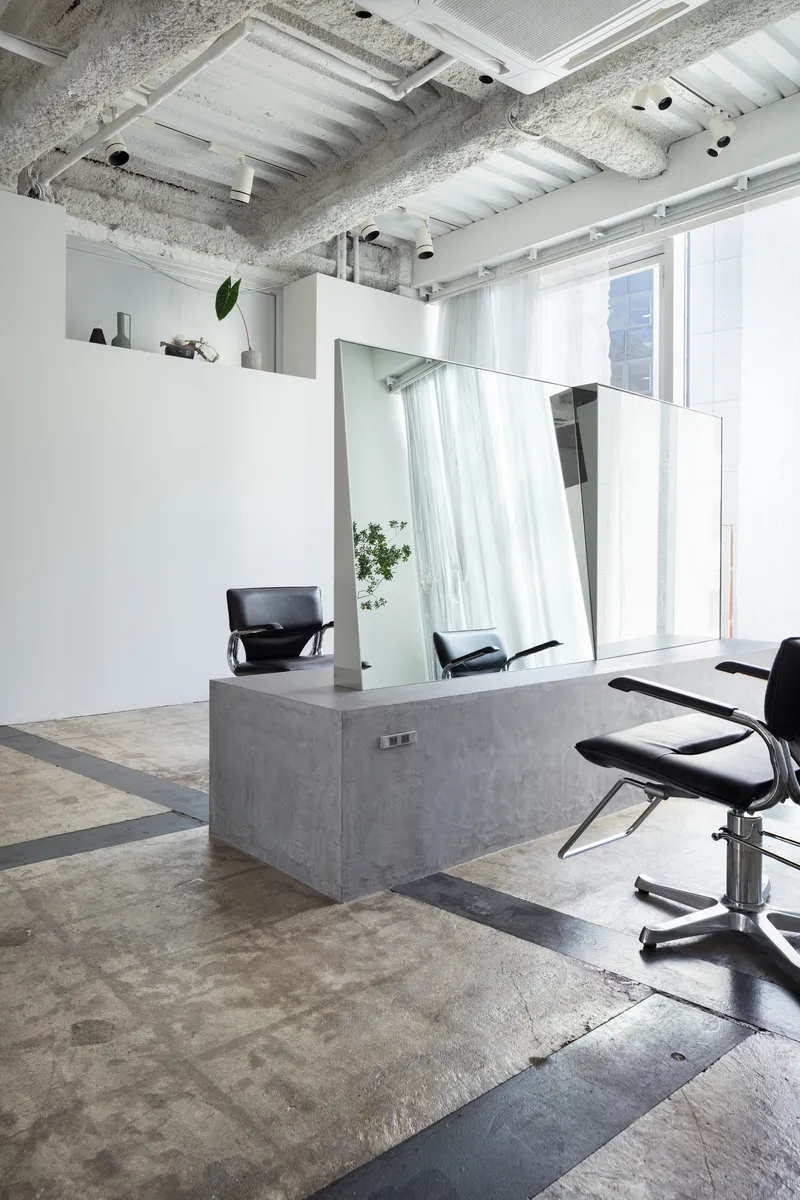


The defining gesture is the mirror assembly itself. Each of the four cutting stations receives a mirror angled on two axes, tilted both laterally and vertically so that the reflected image diverges sharply from the neighboring station. The result is that adjacent clients cannot accidentally lock eyes, even though the workspace is essentially a single open room. Privacy emerges from geometry rather than enclosure.
Seen up close, the mirrors read almost as sculptural objects. Their beveled edges and skewed profiles break the usual flatness of salon furniture, creating angular facets that catch and redirect daylight in unexpected ways. The effect is subtle but constant: every slight head movement reshuffles the reflections, reinforcing the project's core idea that a change of perspective can change the experience entirely.
Concrete Platforms and Layered Ground


The floor is far from flat. SIDES CORE carves the salon into a series of concrete platforms at slightly different heights, creating thresholds between program zones without doors or corridors. A timber step detail mediates between the raised seating area and the main floor, giving the space a topographic quality that feels deliberate rather than accidental. Embedded power outlets in the concrete counters keep cables invisible, preserving the clean geometry.
Exposed ceiling beams and mechanical systems overhead are left raw, reinforcing the material honesty of polished concrete below. The contrast between the rough upper register and the precise, smooth surfaces at hand height is an effective way to make 72 square meters feel taller and more generous than they are.
Curved Walls and the Hidden Eye Salon


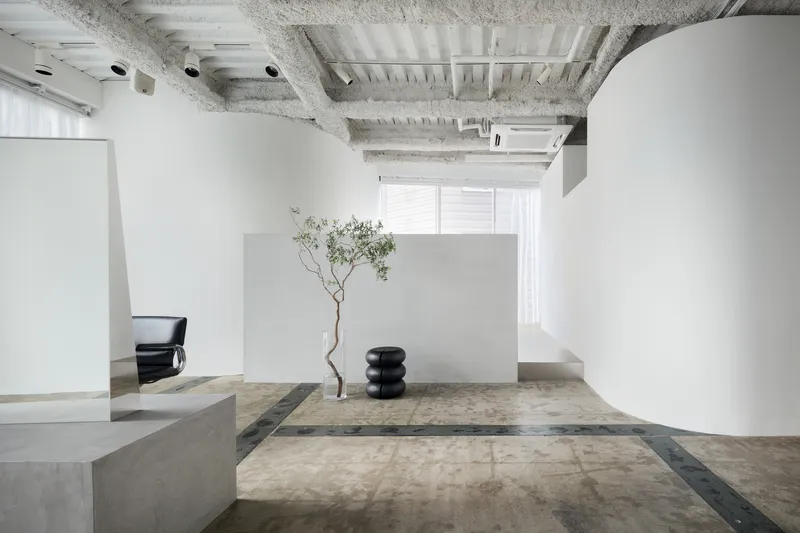
Siten is not just a hair salon. Behind a narrow slit in the curved interior wall, a personal eyecare room is tucked away. The curve itself is not arbitrary: new partitions adopt the same radius as the existing building frame, which was already composed of curved wall surfaces. By echoing the shell's geometry, the added partitions blend into the envelope and read as continuous surfaces rather than inserted boxes.
The curved volume becomes the project's organizing spine. It separates public from private, directs circulation from entry to cutting floor, and catches natural light that enters through the full-height window wall. Slender potted trees and plants placed alongside the partitions soften the otherwise rigorous palette of concrete, metal, and glass.
Light, Curtain, and Silver Foil
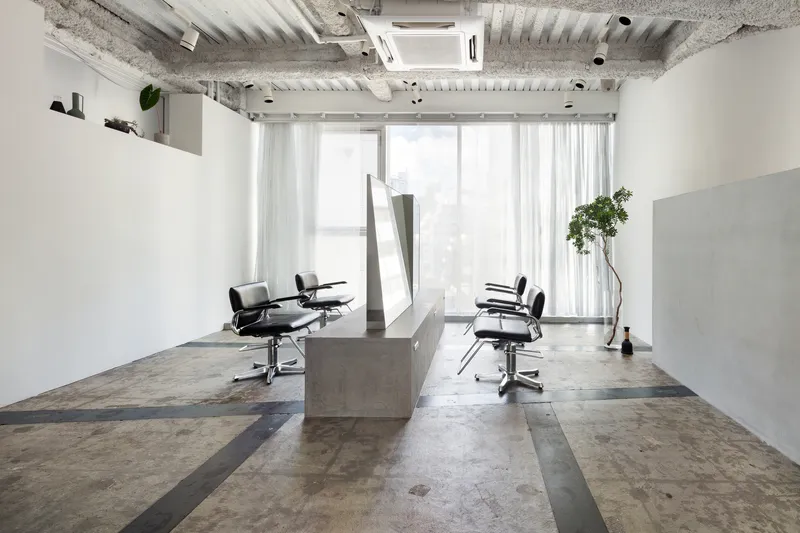
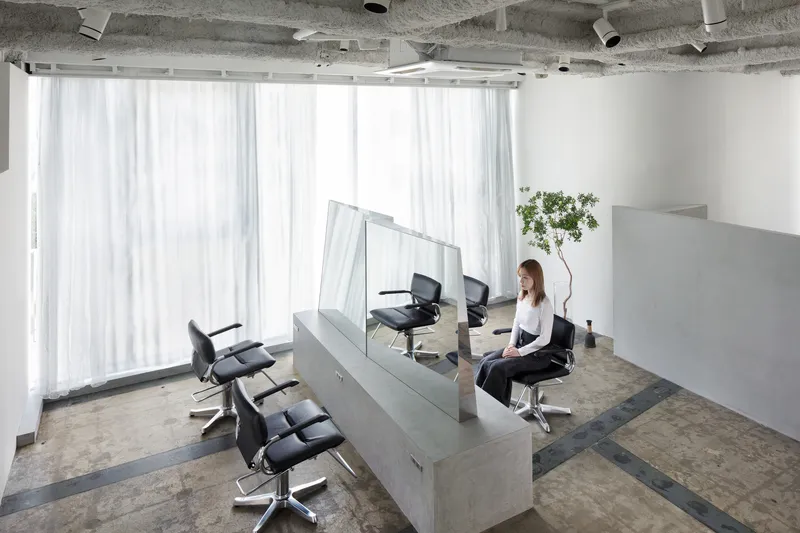
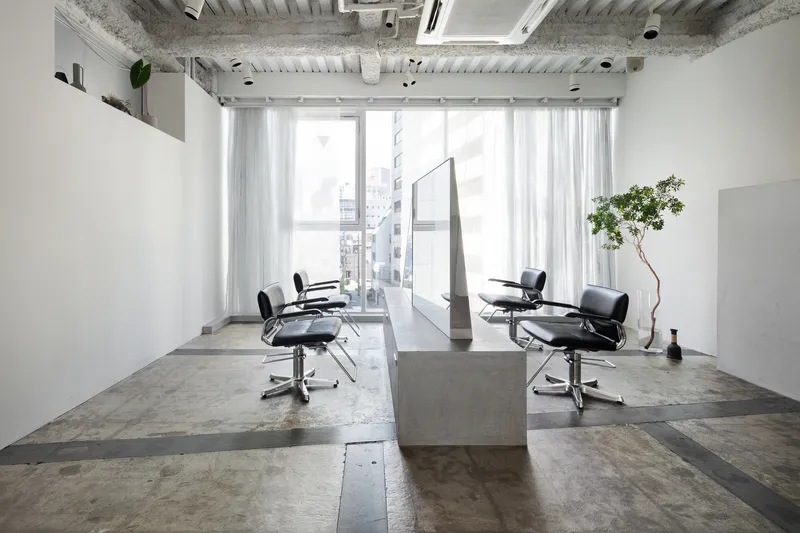
Floor-to-ceiling windows dominate the facade, flooding the interior with diffuse daylight. Sheer curtains manage glare and provide a soft backdrop for the styling stations, but they do more than filter light. The fabric is treated with thin vapor-deposited silver foil, giving the drapes a faint metallic shimmer that ties them visually to the mirror assemblies. When the light is right, the boundary between curtain and reflection dissolves.
Lighting design, credited to Daiko Electric Co., Ltd. and Yoriaki Kokubu, supplements the natural light with restrained artificial sources. The strategy lets the curtains remain the dominant luminous surface during the day while ensuring even illumination for precision work at each station.
Facade as Urban Signal
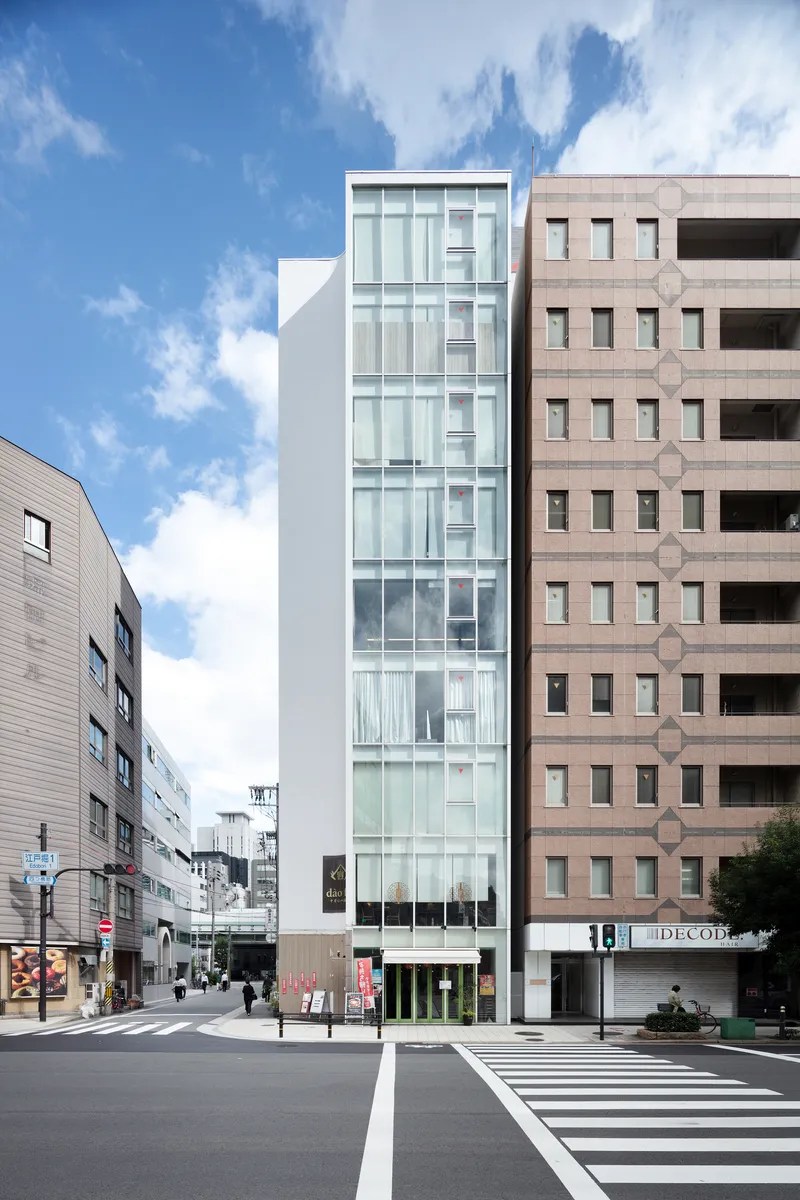


Occupying a slim slot between neighboring buildings on an avenue intersection, the salon's glazed facade is narrow but tall. From street level four stories below, the end face of the tilted mirror set is visible through the glass, projecting a sharp, angular form outward. It functions as signage without being signage: the architecture itself advertises the salon's presence and its conceptual preoccupation with vision and angle.
The red lettering on the glass is minimal. SIDES CORE trusts the mirror geometry to do the heavy lifting in terms of identity, a bet that pays off because the angled facets catch afternoon sun and read as a distinct object even at a distance.
Washing and Service Zones

The shampoo stations sit beneath exposed concrete ceiling beams, their curved basins forming a softer counterpoint to the angular mirror assemblies at the cutting floor. White curtains separate this zone from the main space when needed, maintaining the project's preference for soft boundaries over hard walls. The reception desk, also cast in concrete, doubles as a gathering point and operational hub, with two stylists often visible in motion behind it.
Plans and Drawings

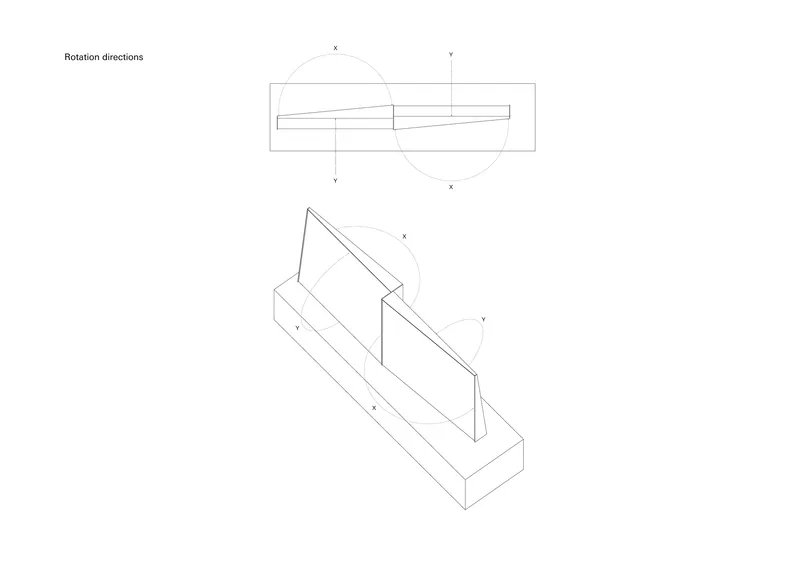
The floor plan reveals how economically the 72 square meters are divided: cutting area, shampoo stations, and the curved entrance wall trace a clear circulation loop. The axonometric drawing is the real revelation, illustrating the two rotation axes that govern each mirror panel. Seeing the angles diagrammed in plan and perspective makes explicit what the photographs only hint at: these are not casually placed mirrors but precisely calibrated instruments of spatial privacy.
Why This Project Matters
Siten Salon is a reminder that interior architecture does not need scale to be inventive. Within a footprint barely larger than a studio apartment, SIDES CORE constructs a full argument about vision, privacy, and identity, then communicates it legibly to the street below. The tilted mirror is a genuinely clever device: it solves a real program problem (adjacent clients staring at each other) while doubling as brand symbol and urban marker. That kind of multi-tasking is rare.
It also models a healthy relationship between graphic and spatial design. The Arao partnership, Sohei on space and Sumiko on identity, produces a project where logo and architecture are not merely aligned but structurally the same idea. For a discipline that often bolts branding on as an afterthought, Siten shows what happens when both are conceived together from the start.
Siten Salon, designed by SIDES CORE (spatial design: Sohei Arao; logo and graphic design: Sumiko Arao), Edobori, Nishi-ku, Osaka, Japan. 72 m², completed 2022. Construction by VENCER inc. Lighting design by Daiko Electric Co., Ltd. and Yoriaki Kokubu. Photography by Takumi Ota.
About the Studio
Share Your Own Work on uni.xyz
If projects like this are the kind of work you want to make, uni.xyz is a place to publish your own, find collaborators, and enter design competitions.


Popular Articles
Popular articles from the community


U.GA Architects Wraps an Oval Rooftop Pool in Curved Board-Formed Concrete on Busan's Jeollidan-gil
In Busan's Jeonpo-dong, a 454 m² mixed-use block stacks a neighborhood facility, guest rooms and an oval rooftop pool inside spiraling concrete walls.

David Ortega Stacks a Two-Story Mexico City Penthouse Around a Steel Stair and a Pergola-Shaded Roof Terrace
In Colonia Roma, a 300 m² penthouse uses oak joinery, a planted steel stair and a slatted roof pergola to make a new-build apartment feel like a house.

longwave studio Reorganizes a 112 m² Tainan Apartment Around the Daily Routines of a Family and Two Cats
In Tainan, Taiwan, birch plywood, rust-red furniture and a freestanding plaster wall link arrival, storage, work and family life in one apartment.

LT2A and OPEN Architectes Thread a Brick and Glass High School Through a Wooded Belgian Campus
In Braine-l'Alleud, a 3,000 m² wing for Collège Cardinal Mercier pairs pale brick with a glazed colonnade, deferring to a small chapel and a dense wood.

Similar Reads
You might also enjoy these articles


LAVA Architecten Gives Vocational Education a Sawtooth-Roofed Face on a Mechelen School Campus
In Mechelen, Belgium, a 2,053 m² STEM school on a 6×6 m grid turns workshops and classrooms into rooms that can be rearranged as teaching changes.

KEMA Studio Turns a Derelict Marvila Attic into a 60 m² Lighthouse Apartment Above Lisbon
In Lisbon's Marvila district, a rebuilt roof, four skylights and two plywood volumes turn an unlivable attic into a bright home facing the Tagus.

Pixel Gardens: One Repeated Module Stacked Into a Terraced Social Housing Tower for Famagusta
Salem Bader's shortlisted housing tower builds a vertical neighbourhood from one repeated module, offsetting units to carve terraces, light and air.

Bao Huynh Watercolor Atelier: A Serene Art Retreat in Hội An
Bao Huynh Watercolor Atelier in Hội An blends multifunctional art spaces, sustainable design, local materials, and family-friendly living in a serene environment.

Explore Site Section Competitions
Discover active competitions in this discipline

Challenge to reimagine the Iron Throne

Photograph architecture without architects

Illustrate the lost glory of Angkor Wat - Render Challenge

Design challenge to reuse E-waste
Comments (0)
Please login or sign up to add comments
No comments yet. Be the first to comment!