
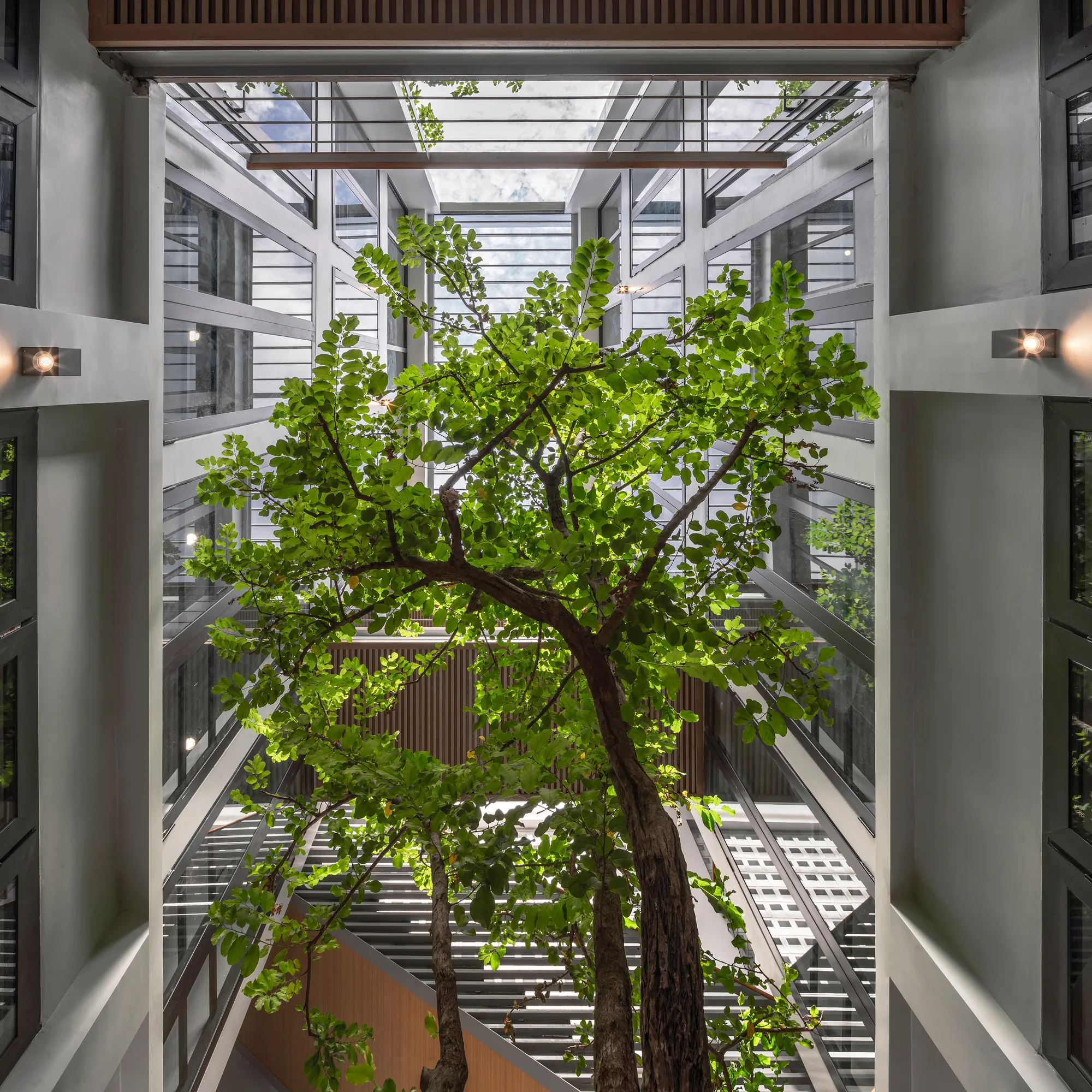
Silp Architects Carve Courtyards Through a Colonial Bangkok House to Build a Hybrid Home Office
On Sukhumvit 62, a narrow two-story colonial house becomes an 880 m² live-work compound organized around a tree-filled atrium.


The typical Bangkok home renovation story involves demolition, a blank slate, and a glass box. The Est62 project by Silp Architects follows a different logic. Working with an old colonial-style two-story house on Sukhumvit 62, a quiet residential pocket near the BTS Skytrain and the expressway, the firm kept the reinforced concrete bones and reorganized the long, narrow plan around a series of internal courtyards. The result is an 880 m² hybrid that handles both domestic and professional life without either program dominating the other.
What makes Est62 worth studying is not the conversion itself but the environmental strategy embedded in its circulation. A central atrium, open enough for a mature tree to rise through multiple levels, acts as both the thermal engine and the organizational spine of the building. Light, air, and movement all pass through this void. Every workspace and living quarter addresses it, which means the building breathes from the inside out rather than relying solely on its perimeter walls for ventilation and daylight.
A Street Facade That Deflects and Invites


The street elevation reads as a single cantilevered volume clad in vertical precast concrete fins, resting above a recessed ground floor that glows at twilight. It is a deliberate act of privacy for a building that must double as an office: the facade signals professionalism without advertising the domestic life behind it. Up close, the precast panels reveal a diamond-shaped textured pattern with metal inserts, a detail that catches raking light and gives the surface a shifting depth throughout the day.
The concrete fin system also serves a practical role, functioning as a brise-soleil that filters Bangkok's aggressive western sun before it reaches the interior glazing. Folded metal ventilation openings punched into the fins allow cross-ventilation at the facade plane itself, a detail that reduces the building's reliance on mechanical cooling along its most exposed face.
The Central Atrium as Organizing Principle


Look up from the ground floor and you see a tree trunk rising through horizontal louvered bridges, skylights washing the shaft with diffused light, and perforated block walls filtering views between the two wings of the building. The atrium is not decorative. It is the single move that makes the long, narrow plan livable. By cutting the building open at its center, the architects gave every room a short path to daylight and air, something the original colonial layout almost certainly did not offer.
The timber bridges that span the courtyard at upper levels connect studio spaces on one side to living quarters on the other. This separation is legible in section and in plan: you cross the garden to switch modes. The gravel bed at the base of the tree keeps things minimal, reflecting light upward and requiring no irrigation system, a low-maintenance gesture appropriate for a workspace that cannot tolerate constant garden upkeep.
Threshold and Entry


At dusk the entrance sequence reveals itself most clearly. Linear LEDs set beneath the entry treads turn the steps into a light gradient, drawing visitors from the sidewalk through a vertical brise-soleil screen framed by mature trees. The timber-clad door sits at the end of this compressed passage, deliberately modest in scale relative to the building's total volume. During daylight hours, the white textured facade absorbs into the streetscape of low-rise residential buildings around it, an intentional act of neighborliness in a district where three-story volumes are still the norm.
Circulation as Architecture


The staircases in Est62 are not tucked into service cores. They are the most architecturally resolved elements in the building. A terrazzo stair with horizontal metal railings and timber handrails ascends toward a slatted timber ceiling. Nearby, a steel staircase with timber handrail overlooks the planted courtyard below. Looking up through a stairwell clad in perforated metal mesh, you see the folded, zigzag underside of the flights above, a detail that turns structure into ornament without adding a single non-functional element.
These moments of vertical connection reinforce the atrium strategy. Climbing through the building, you are never sealed off from the garden or the sky. The perforated materials, metal mesh, louvered steel, punched block, create a layered transparency that lets you orient yourself at every landing.
Filtered Light and Perforated Screens

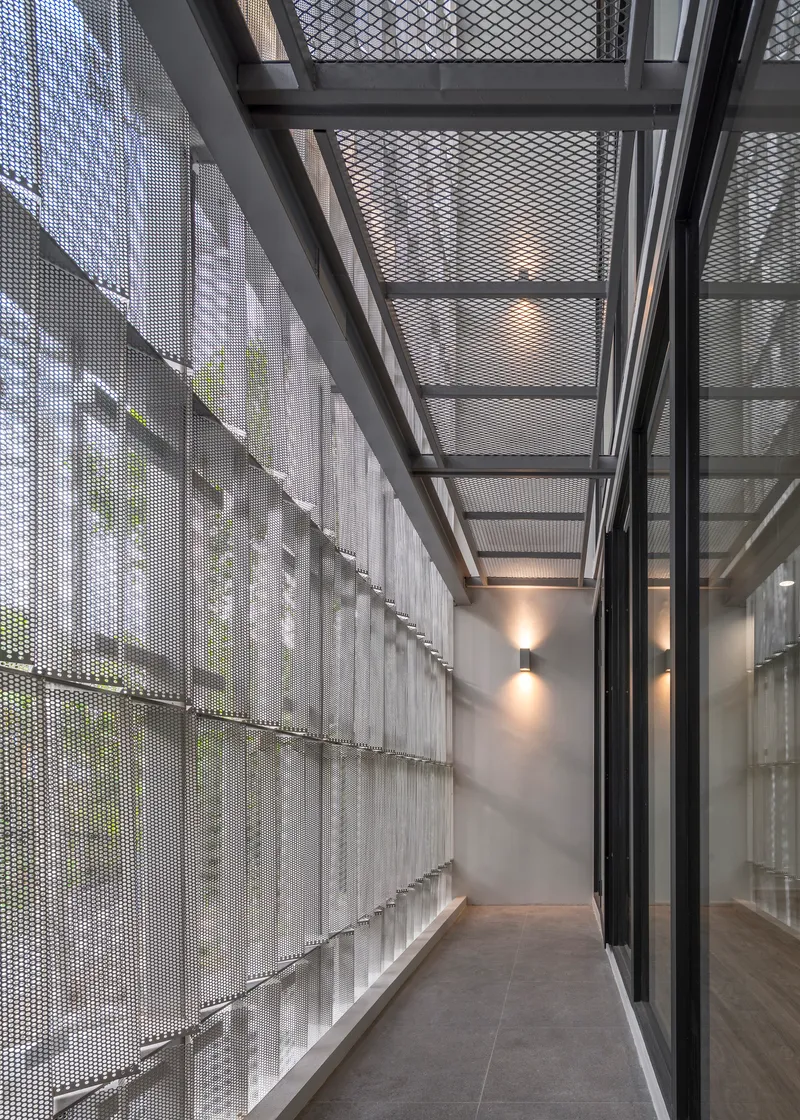

A recurring material language runs through Est62: perforated metal screens, exposed steel beams, and white concrete block walls with geometric openings. These elements appear in corridors, walkways, and stair enclosures, always positioned between the occupant and direct sunlight. The effect is dappled, almost textile in quality, casting shifting patterns across floors and walls as the sun moves. In a climate where glare and heat are constant adversaries, these screens do the work of curtains and blinds without any of the visual clutter.
The upper-level walkway is especially effective. A timber bridge links two wings beneath skylights, with perforated block walls on either side. The space feels like an exterior loggia but is fully sheltered, a productive ambiguity that gives the building's circulation a sense of openness rarely found in home-office hybrids.
Living Spaces That Open Outward
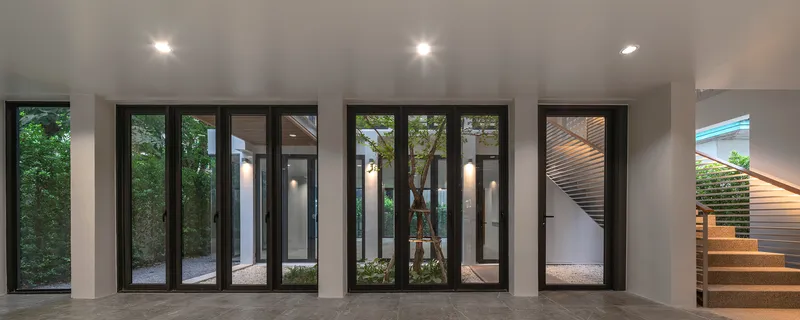


The domestic rooms at Est62 are characterized by their relationship to planted courtyards rather than by their interior finishes. Black-framed glass doors fold open to reveal multiple garden pockets, each with its own mature tree. Timber flooring and perforated screen walls create warm, low-contrast interiors that frame the green views without competing with them. At dusk, the glass walls dissolve the boundary between inside and out, and the courtyards become illuminated rooms in their own right.


Functional details reinforce the hybrid program. A kitchen pass-through with timber cabinetry and glass block windows serves both the domestic side and the studio. Floor-to-ceiling glazed doors open to balconies and terraces where informal meetings can spill outdoors. Even the stairwell landing, facing a gridded window wall with diagonal muntins, treats a utilitarian space as an opportunity for framed daylight and visual interest.
Plans and Drawings
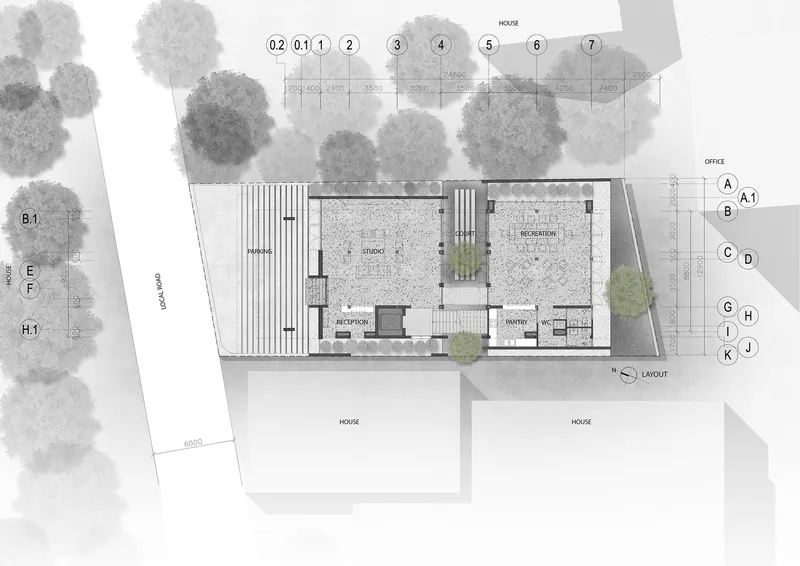
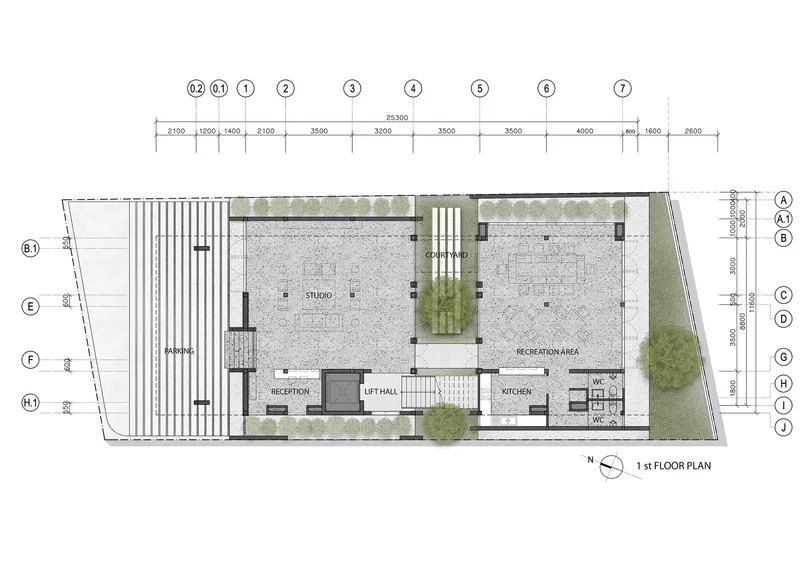
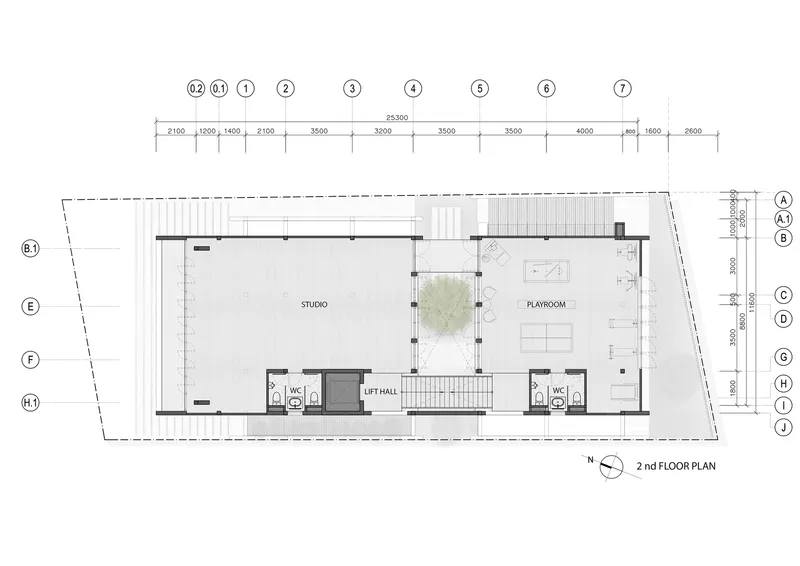


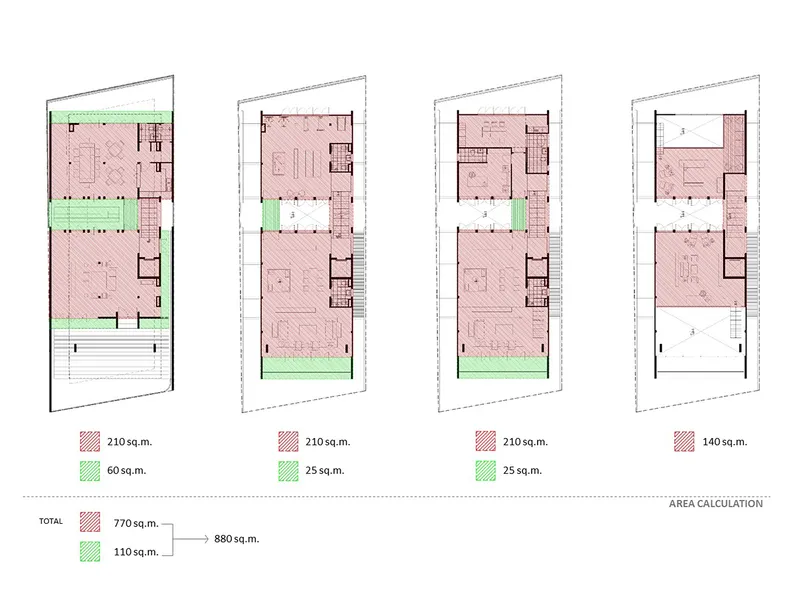

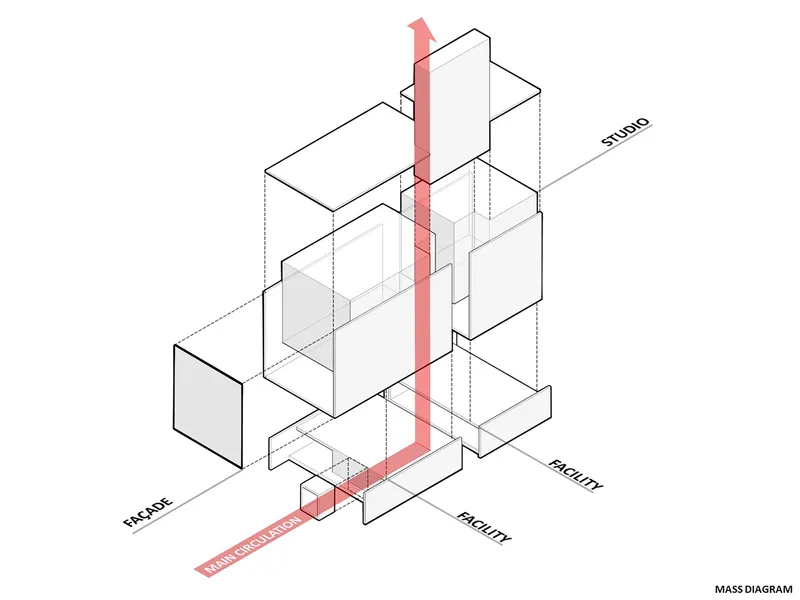


The floor plans confirm what the photographs suggest: the central courtyard is the generative void from which everything else is organized. Studio and recreation areas occupy opposite sides of the ground floor, separated by a lift hall and the garden. Upper levels mirror this logic, with bedrooms and living spaces flanking the courtyard and connected by bridges. The longitudinal section reveals the diagonal staircase threading through the atrium alongside the planted tree, and the axonometric diagram highlights the vertical circulation core in red, making its role as the building's structural and spatial backbone unmistakable.
The technical detail sections are worth pausing on. A zigzag drainage layer at the roof assembly, along with careful column connections, shows a building designed for Bangkok's monsoon rains and high water tables. The area calculation diagram, color-coded in pink and green, lays out how 880 m² are distributed across four stacked levels and a mezzanine, revealing a tight but efficient allocation that avoids wasted corridor space by routing all movement through the atrium.
Why This Project Matters
Est62 arrives at a moment when the home office has become an architectural cliché. Most conversions simply annex a spare bedroom or bolt a glass volume onto an existing house. Silp Architects took a harder path: they restructured the entire building around the idea that living and working occupy different psychological zones that need physical separation and a shared commons. The courtyard is that commons. It makes the building legible, breathable, and, critically, adaptable. If the program shifts in ten years, the spatial DNA holds.
The project also demonstrates that renovation in Southeast Asia's rapidly densifying suburbs does not have to mean erasure. The colonial bones of the original house are still present in the reinforced concrete frame, but they have been reinterpreted through a contemporary material palette of perforated metal, terrazzo, and timber. The quiet street facade respects the low-rise neighborhood while the interior, cracked open to the sky, offers a quality of space that most new-build offices on this scale never achieve. It is a persuasive argument for working with what already exists.
Est62 Home Office Renovation by Silp Architects, led by Sasicholwaree Sawatdisawanee. Khet Phra Khanong, Bangkok, Thailand. 880 m². Completed 2020. Photography by Jirayu Rattanawong.
About the Studio
Share Your Own Work on uni.xyz
If projects like this are the kind of work you want to make, uni.xyz is a place to publish your own, find collaborators, and enter design competitions.




Popular Articles
Popular articles from the community


EW PARK: Sustainable Architecture Reimagines the Future of Urban Parking
EW PARK reimagines city parking as a modular wooden tower combining automation, solar energy, electric mobility, and adaptable urban design.

The Musturak Paradise: Senior Living Architecture for a Connected Future in Temara, Morocco
The Musturak Paradise reimagines senior living architecture in Temara via private homes, social spaces, culture, community, and shared care.

Co-Life: Senior Housing Design That Reconnects Older Adults With the City
Co-Life reimagines senior housing design through healing gardens, shared streets, workshops, and a sustainable community across generations.

Riyadh For All: Intergenerational Urban Design for Active Aging in Rabat
Riyadh For All reimagines urban design in Rabat with intergenerational co-living, adaptive courtyards, and Moroccan cultural exchange today.


Similar Reads
You might also enjoy these articles

Bao Huynh Watercolor Atelier: A Serene Art Retreat in Hội An
Bao Huynh Watercolor Atelier in Hội An blends multifunctional art spaces, sustainable design, local materials, and family-friendly living in a serene environment.

Atelier Macri Concept Store Interior Design by CASE-REAL
Atelier Macri store features a "ko" counter, walnut wood details, cork displays, blending retail, gallery, and seamless customer experiences.

Manuel Vargas Izquierdo Stadium and High-Performance Sports Center: Architectural Excellence in Jalpa de Méndez
The Manuel Vargas Izquierdo Stadium blends sustainable design, inclusive sports facilities, and cultural-inspired architecture, revitalizing Jalpa de Méndez’s public spaces.

KAKR Buluh Awar Hall: Revitalizing Community and Ecology Through Bamboo Architecture
Community built bamboo hall revitalizes Buluh Awar village, empowering youth, restoring ecology, celebrating vernacular craftsmanship through sustainable architecture and culture.

Explore Office Building Competitions
Discover active competitions in this discipline


Challenge to design luxury tourism on rails


VR headsets Storefront design competition

Designing a staircase for a client
Comments (0)
Please login or sign up to add comments
No comments yet. Be the first to comment!