
Siqueira and Azul Arquitetura Fuse Two Disconnected Blocks into an Art Studio in Rio's Botanical Garden
A 450-square-meter atelier in Jardim Botânico stitches together an artist's archive, studio, and courtyard with iron mesh and glass block.


An artist needs more than a room. They need a circuit: a place to work, a place to store, a place to think, and thresholds between all three. At Atelier Horto, Siqueira and Azul Arquitetura, led by Lia and Felipe Siqueira, inherited two separated blocks on a narrow site in Rio de Janeiro's Jardim Botânico neighborhood and turned them into exactly that kind of circuit. The result is a 450-square-meter compound completed in 2014 that joins an art production studio, an archive and library, social spaces, and a landscaped courtyard into one continuous flow.
What makes the project worth studying isn't the program itself but the connective tissue. Rather than demolishing the existing structures and starting over, the architects created a new structural axis between the two blocks, generating an indoor courtyard that acts as both a spatial hinge and a climate device. Large-scale square iron mesh panels, operable as pivoting screens, regulate light and air through the deep plan. The whole thing reads as a tightly edited negotiation between openness and enclosure, where every threshold is a decision about how much of Rio's subtropical climate to let in.
Street Face and Entry Sequence

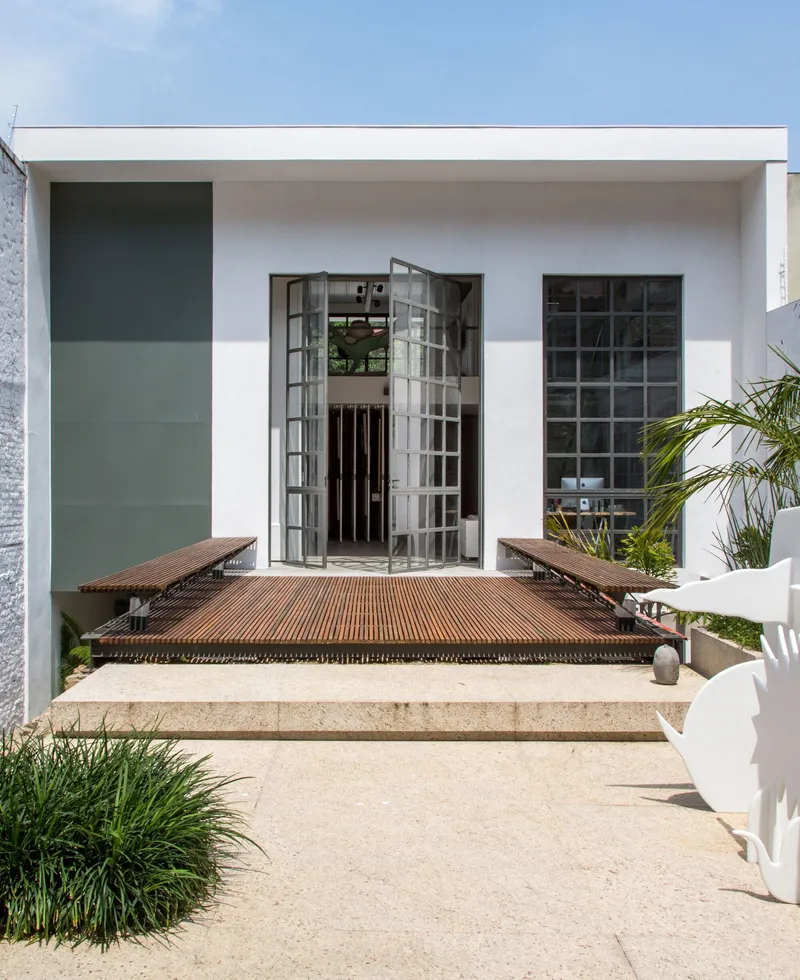
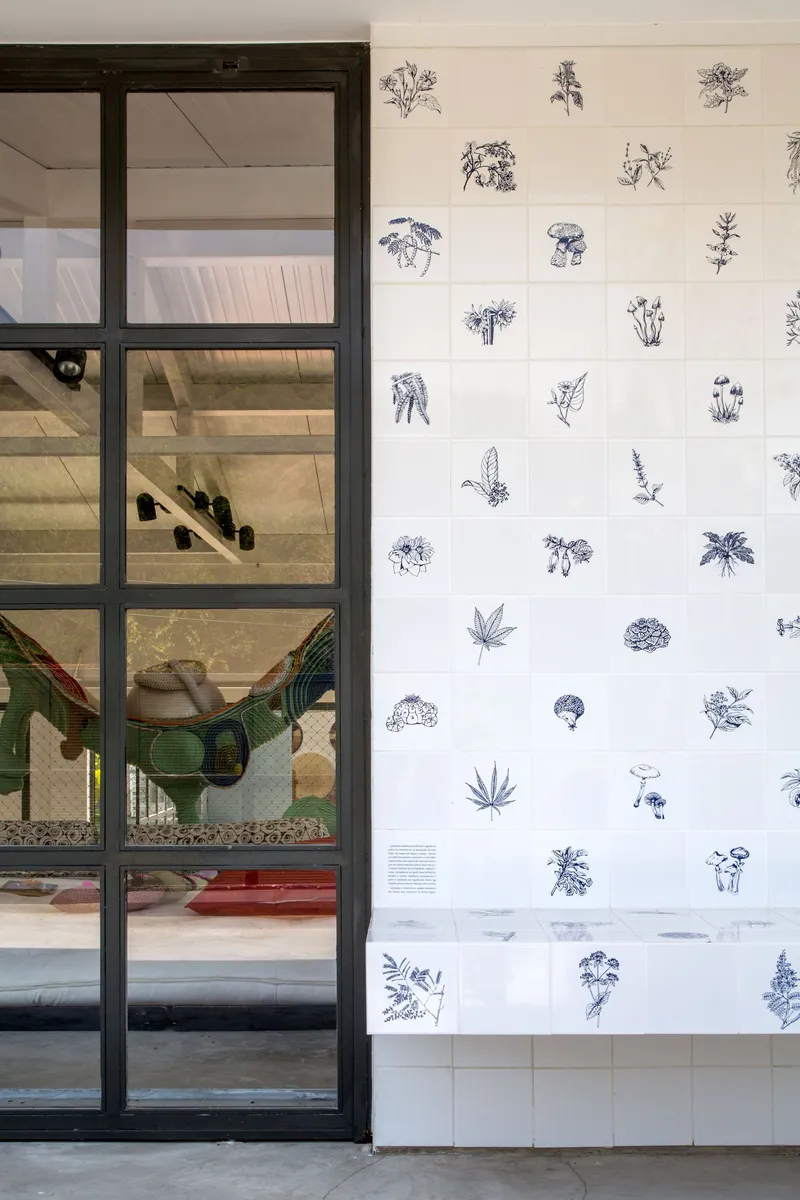
The street facade is deliberately reticent. A translucent glass block wall rises above a dark, recessed entrance, filtering daylight into the interior while revealing almost nothing of the life behind it. A patterned tile courtyard at ground level establishes the first material vocabulary: handmade, textured surfaces meeting industrial steel. This compression at the entrance makes the release into the courtyard beyond feel earned rather than given.
A timber deck bridge extends from the glass block openings under a deep cantilevered roof overhang, creating a covered outdoor passage that negotiates between the two blocks. Through the steel-framed glass doors, botanical illustrations scattered on the interior wall signal the building's purpose before you fully enter it. The entry sequence is choreographed, moving from the sealed street face through filtered light, across the deck, and into the working heart of the compound.
The Courtyard as Climate Engine
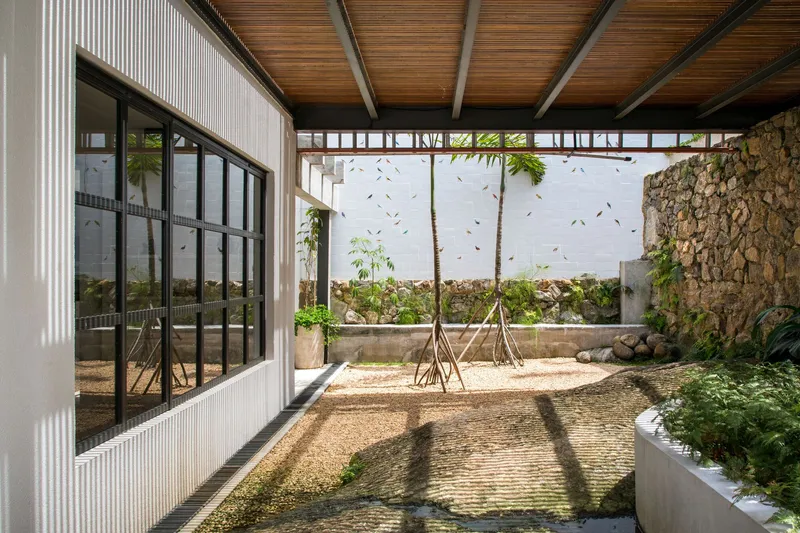
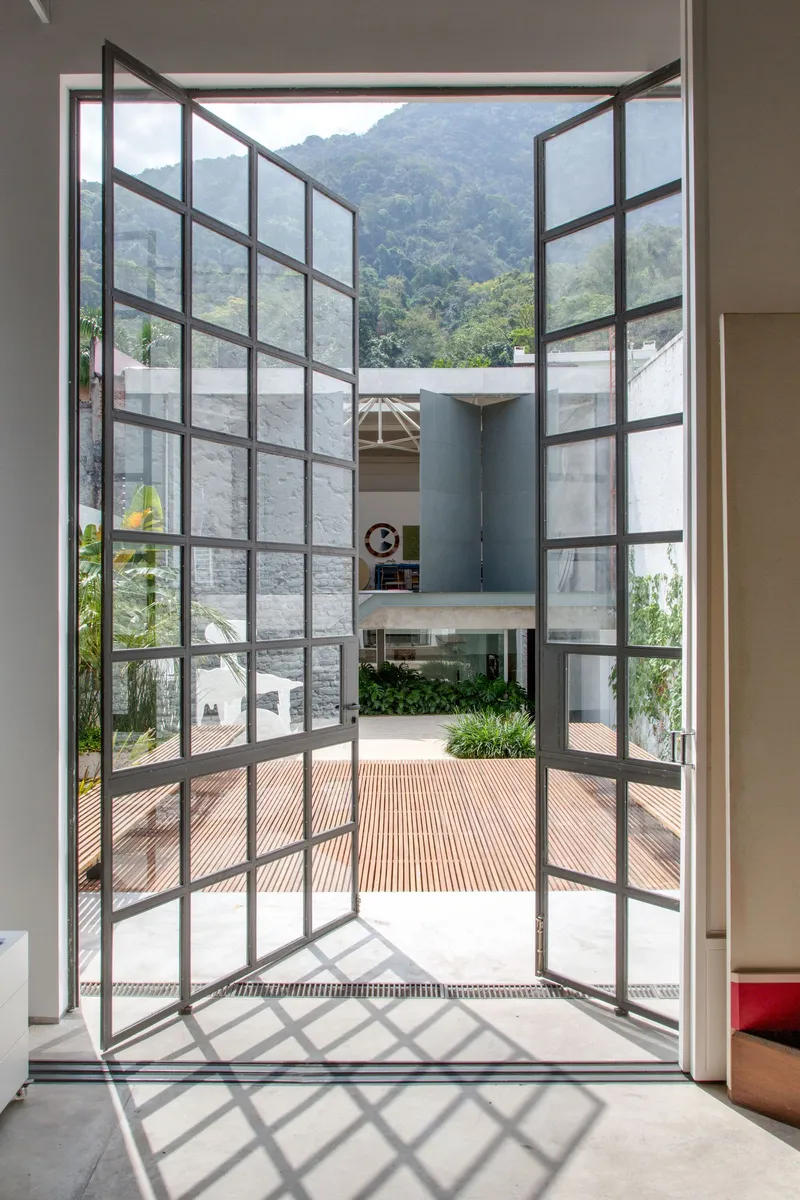
The central courtyard, floored in gravel with young trees and bounded by a rough stone wall, is the project's single most important move. It does three things simultaneously: it pulls natural light into the center of a deep, narrow plan; it enables cross ventilation through the building's length; and it gives the occupant a constant visual anchor. The timber ceiling overhead casts long afternoon shadows across the ground, turning the courtyard into a sundial that marks the working day.
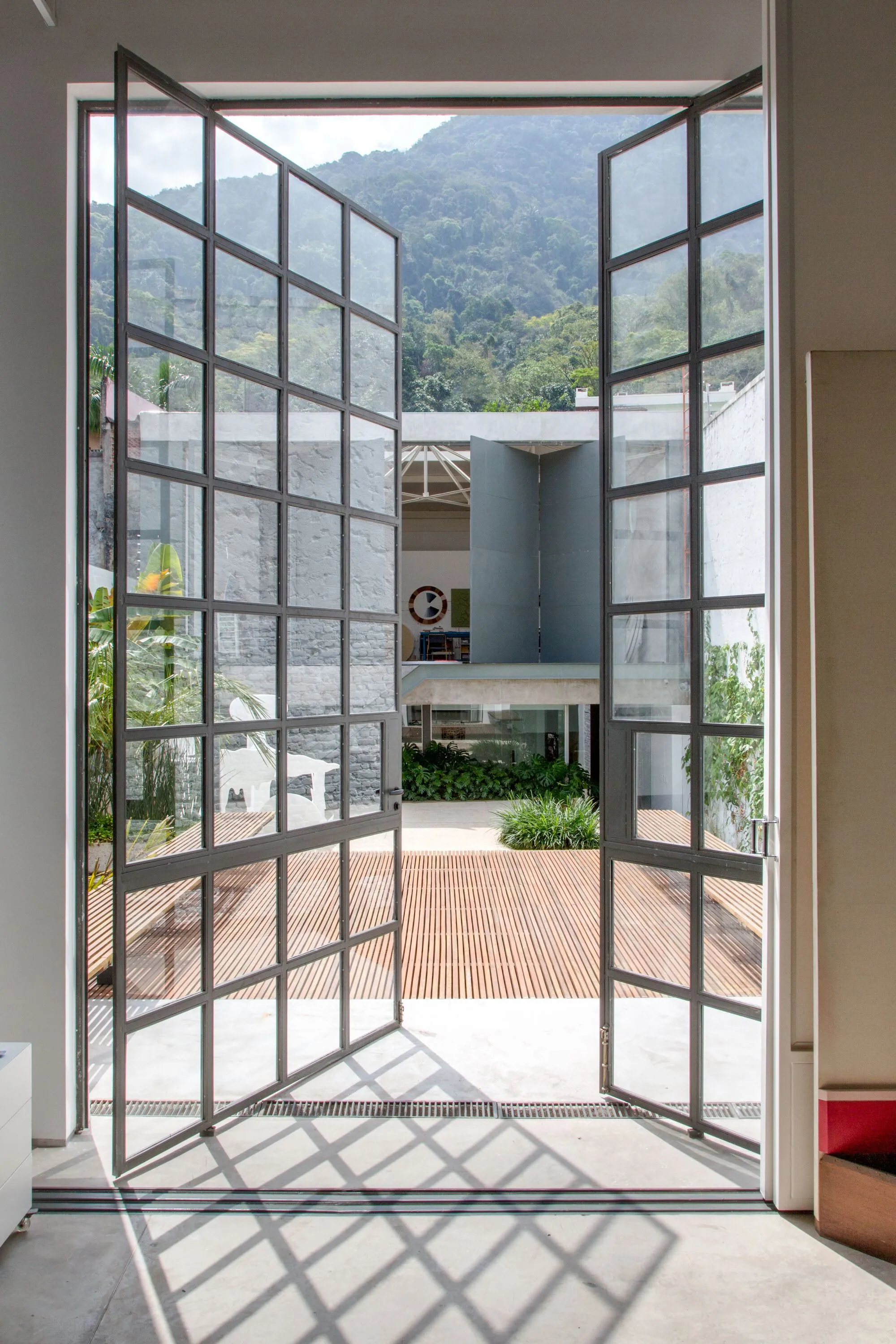
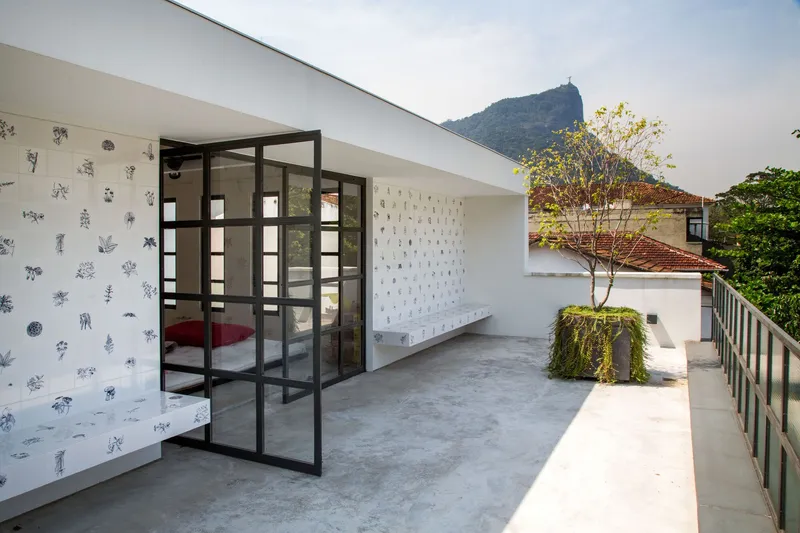
When the steel-framed glass doors are swung fully open, the courtyard effectively dissolves the boundary between inside and outside. Mountains are visible beyond the roofline, a reminder that this tight urban site sits within one of Rio's most botanically rich districts. The architects understood that for a space devoted to art-making, the quality of ambient light and air matters as much as any wall surface.
Iron Mesh and the Vertical Section
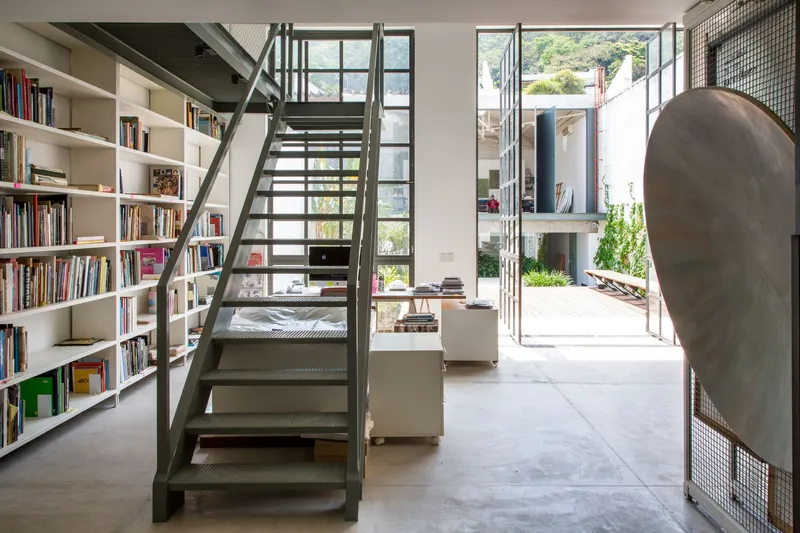
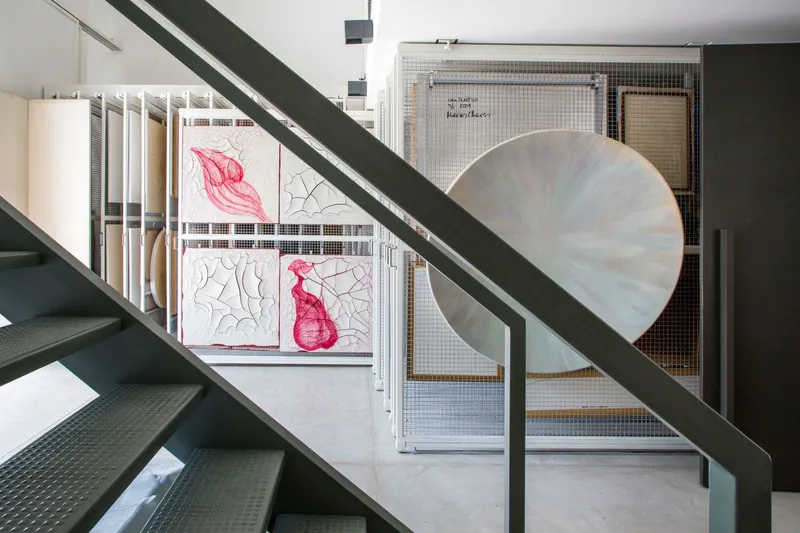
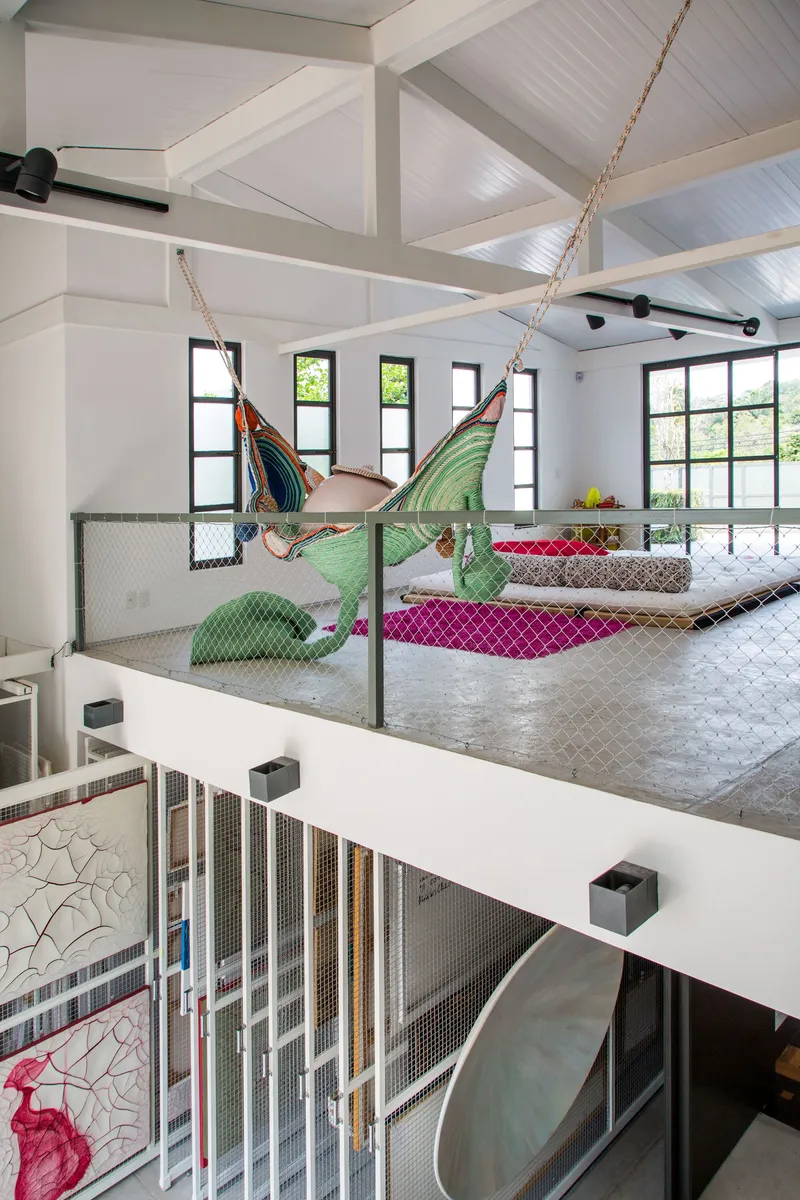
The large-scale square iron mesh is the material that gives the project its identity. Used for balustrades, screens, and spatial dividers, it allows visual continuity across levels while maintaining a sense of separation. At the steel staircase, perforated treads rise beside a floor-to-ceiling bookshelf in a double-height volume, and the mesh wraps the upper balcony to create a porous edge. A pink fabric artwork hung on a distant balcony is visible through several layers of screen, demonstrating how the mesh calibrates views rather than blocking them.
The verticality of the design is deliberate. Double-height spaces ensure natural light reaches deep into the plan, while the mesh screens modulate that light without eliminating it. On the upper level, exposed timber ceiling beams span overhead as a wire mesh balustrade defines the edge of a lounge area. A suspended hammock occupies the void, turning the section into a place you can actually inhabit rather than merely pass through. The stacking of archive, studio, and leisure across levels keeps each function distinct while the open section holds them in dialogue.
Living and Working at Ground Level
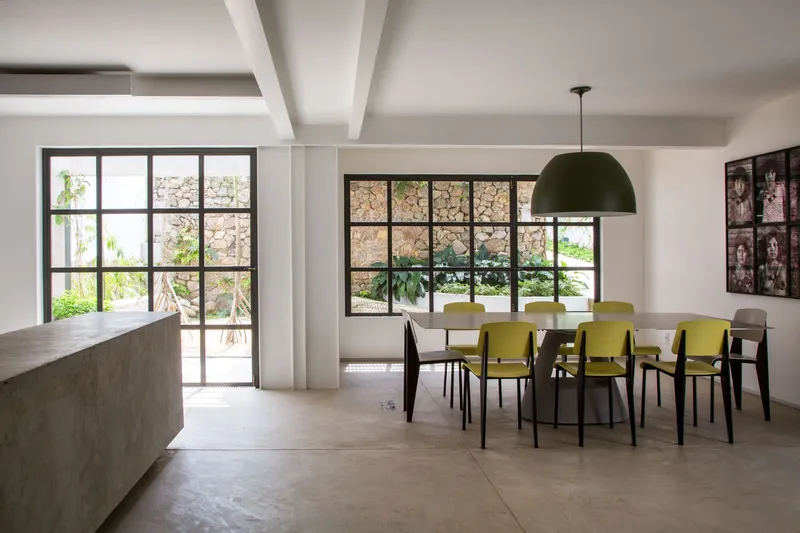

The ground level alternates between domestic and productive zones with a fluidity that refuses to separate life from practice. A concrete kitchen island doubles as a dining surface, flanked by steel-framed windows that look out onto a stone wall garden. The material palette here is raw but precise: poured concrete, steel frames, rough stone. Nothing is decorated; everything is finished.
A study corner with a desk and lounge chair sits beside tall steel-framed windows overlooking dense foliage, creating the kind of focused, naturally lit workspace that an artist's research and filing demands. At the far end of the compound, a concrete terrace with black steel-framed glass doors opens to a bedroom with a distant mountain peak centered in the frame. The archive and library have been combined into a dedicated study area, ensuring that the intellectual work of cataloging and researching is given as much spatial dignity as the physical act of making.
Plans and Drawings
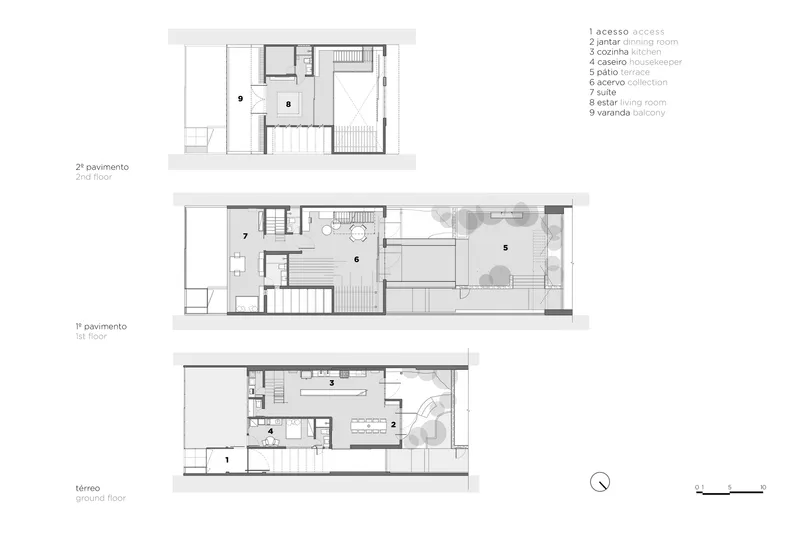
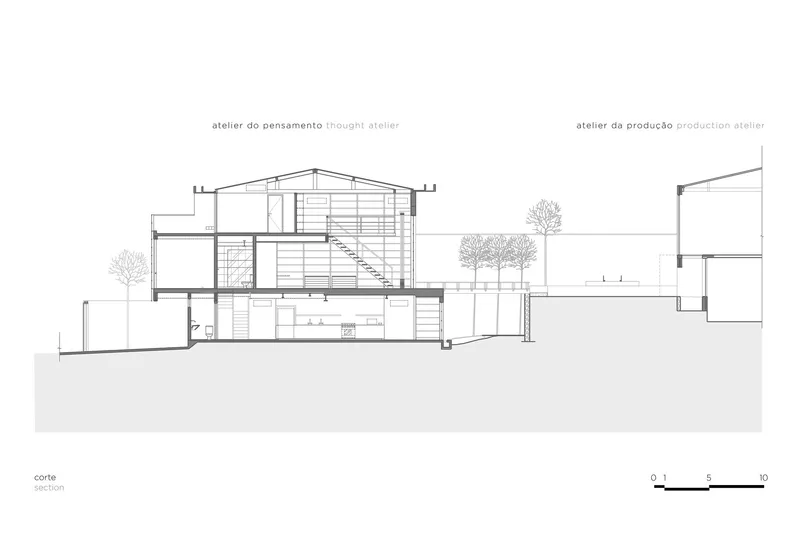
The floor plans reveal the narrow, linear logic of the site. Three levels are organized around a central staircase, with each floor distributing functions along the site's length. The section drawing is even more telling: it shows the two volumes clearly, one with a gabled roof and one with a flat roof, separated by the courtyard with its young trees. The height difference between the blocks creates the double-height spaces that the architects exploit for light and ventilation. What reads as a single compound from the inside is, in section, still legibly two distinct structures held together by the courtyard and the connecting axis.
Why This Project Matters
Atelier Horto is a small project with a clear lesson: when you inherit an awkward existing condition, the answer is rarely demolition and rarely preservation. It is usually surgery. Siqueira and Azul Arquitetura did not erase the two-block configuration of the original site; they threaded a new spine through it and used that spine, the courtyard and its flanking screens, to organize light, air, and movement. The iron mesh is not a decorative gesture. It is the mechanism that makes the open section work, regulating privacy and visual depth without sealing off any part of the plan.
For anyone designing a live-work space in a tropical urban context, the project offers a useful model. The climate strategy is entirely passive: cross ventilation, operable panels, vertical light wells, and a courtyard that acts as a thermal buffer. No elaborate mechanical systems, just disciplined section design and well-chosen materials. The fact that the building houses an art practice, with all its requirements for controlled light and flexible space, only raises the stakes. Atelier Horto meets them without overbuilding.
Atelier Horto by Siqueira and Azul Arquitetura (Lia Siqueira, Felipe Siqueira). Jardim Botânico, Brazil. 450 m². Completed 2014. Photography by André Nazareth.
About the Studio
Share Your Own Work on uni.xyz
If projects like this are the kind of work you want to make, uni.xyz is a place to publish your own, find collaborators, and enter design competitions.



Popular Articles
Popular articles from the community


Conexión: Biophilic Design Reimagines High-Rise Living in Hong Kong
Conexión reimagines high-rise living in Hong Kong through biophilic design, green facades, shared spaces, daylight, water and nature within.

The Ocean Hive: Sustainable Architecture for a Self-Sufficient Civilization at Sea
The Ocean Hive imagines sustainable architecture at sea, where modular habitats, algae, wave power and ocean waste sustain a growing colony.

Co-Life: Senior Housing Design That Reconnects Older Adults With the City
Co-Life reimagines senior housing design through healing gardens, shared streets, workshops, and a sustainable community across generations.

Riyadh For All: Intergenerational Urban Design for Active Aging in Rabat
Riyadh For All reimagines urban design in Rabat with intergenerational co-living, adaptive courtyards, and Moroccan cultural exchange today.

Similar Reads
You might also enjoy these articles

Bao Huynh Watercolor Atelier: A Serene Art Retreat in Hội An
Bao Huynh Watercolor Atelier in Hội An blends multifunctional art spaces, sustainable design, local materials, and family-friendly living in a serene environment.

Atelier Macri Concept Store Interior Design by CASE-REAL
Atelier Macri store features a "ko" counter, walnut wood details, cork displays, blending retail, gallery, and seamless customer experiences.

Manuel Vargas Izquierdo Stadium and High-Performance Sports Center: Architectural Excellence in Jalpa de Méndez
The Manuel Vargas Izquierdo Stadium blends sustainable design, inclusive sports facilities, and cultural-inspired architecture, revitalizing Jalpa de Méndez’s public spaces.

KAKR Buluh Awar Hall: Revitalizing Community and Ecology Through Bamboo Architecture
Community built bamboo hall revitalizes Buluh Awar village, empowering youth, restoring ecology, celebrating vernacular craftsmanship through sustainable architecture and culture.


Explore Atelier Competitions
Discover active competitions in this discipline



Challenge to reimagine the Iron Throne


Photograph architecture without architects


Illustrate the lost glory of Angkor Wat - Render Challenge


Design challenge to reuse E-waste
Comments (0)
Please login or sign up to add comments
No comments yet. Be the first to comment!