

CHAP Wraps WAF's Speakers Lounge in Undulating Green Walls
A 120-square-metre pavilion at the World Architecture Festival in Lisbon turns a convention hall into a playful, curvaceous retreat.


When Sir Peter Cook designs a temporary pavilion, you expect it to vibrate with the restless optimism that has defined his career since the Archigram days. The Speakers and Judges Lounge at the 2022 World Architecture Festival in Lisbon delivers exactly that: a 120-square-metre intervention inside the cavernous Feira Internacional de Lisboa that refuses to behave like an expo booth. Instead, Cook Haffner Architecture Platform (CHAP) produced a continuous landscape of bright green curved walls, punched through with peepholes and slot openings, that simultaneously encloses, displays, and performs.
What makes this project worth studying is not its size or its budget but its attitude toward enclosure in an open-plan hall. The pavilion needed to seat forty or more people at tables, host private conversations for festival judges, and project the identity of WAF itself. CHAP's answer was to reject the conventional booth grid entirely and instead deploy a sandwich-constructed wall system whose curves create pockets of intimacy without ever fully sealing the lounge off from the surrounding event. The result is less a room and more a topography, a terrain of glossy green ridges that you navigate by instinct rather than signage.
Green Ridgelines Under an Industrial Sky


Viewed from a distance, the pavilion reads as a single organism dropped into the exhibition hall. Its undulating walls rise just high enough to define territory while staying well below the exposed industrial ceiling, which becomes a neutral datum against which every curve registers sharply. The bright green finish, consistent across every surface, makes the intervention unmistakable even in a hall crowded with competing installations. It is a deliberate act of chromatic aggression: the pavilion does not blend in, and it does not try to.
The continuous, flowing profile avoids any straight edge. From the long views you can trace how the wall system bends and doubles back on itself, forming bays and coves without ever breaking into discrete panels. A reception desk emerges from the same material language, its counter surfacing as if the wall simply decided to become furniture for a stretch before resuming its vertical duties.
Apertures as Architecture
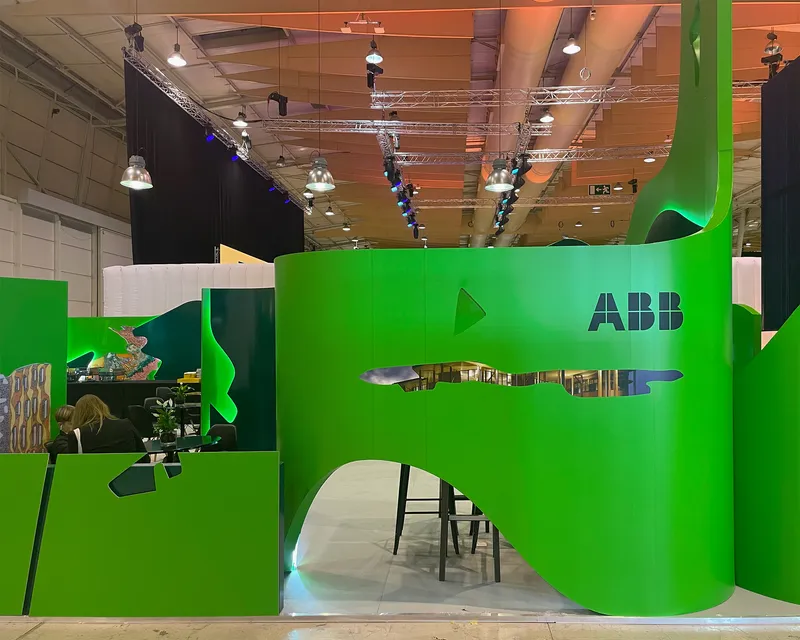

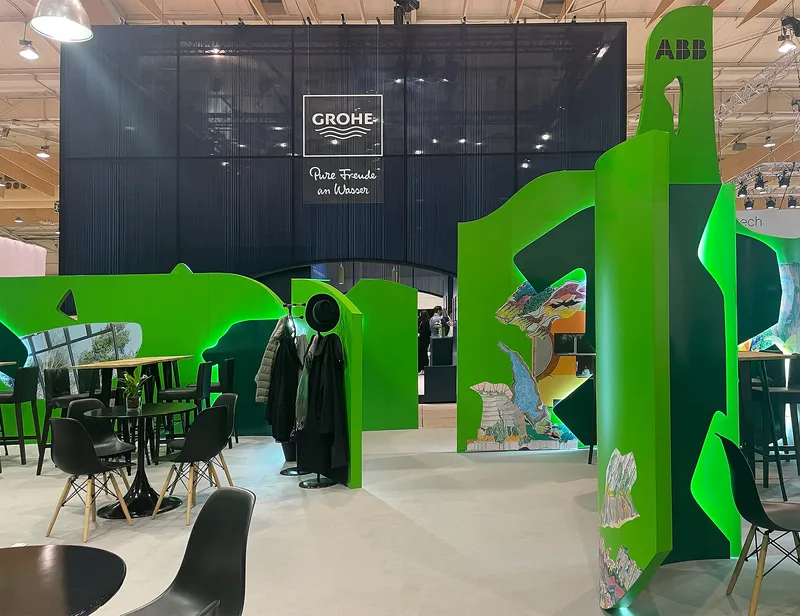
The cutouts in the green walls are where the design moves from sculptural gesture to genuine spatial intelligence. Horizontal slot openings frame fragments of the lounge interior, turning a glimpse of someone seated at a table into a cinematic vignette. Larger rectangular openings function as windows between zones, offering visual connections that encourage movement without collapsing the sense of separation. These apertures are not decorative; they calibrate exactly how much of the interior is revealed to passersby, managing privacy and curiosity simultaneously.
The embedded display panels visible through some of these openings add another layer. Architectural collages and graphic panels sit flush within the wall thickness, transforming structural partitions into gallery surfaces. You discover content as you move along the curves, not because a label directs you but because the slot in front of you happens to frame it.
The Lounge Interior

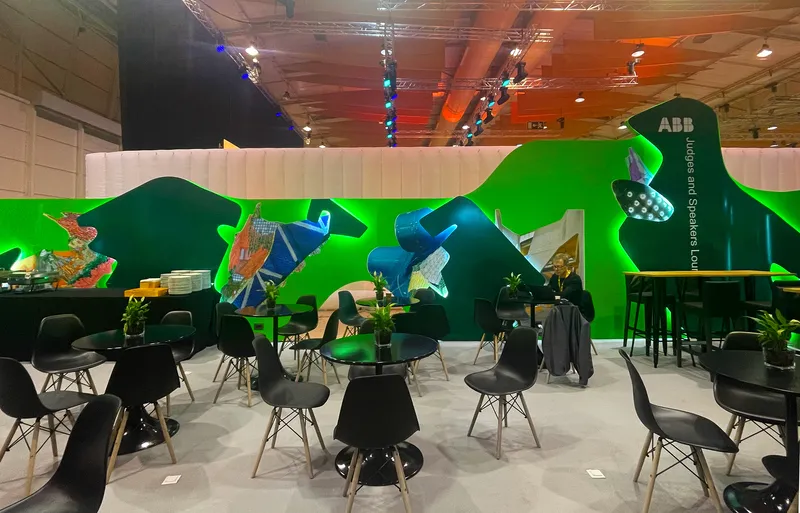
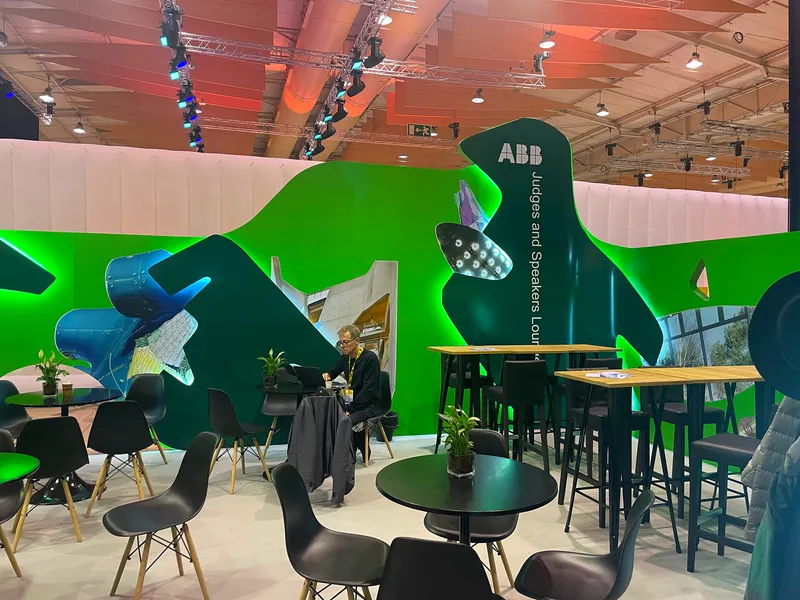
Inside the enclosure, the atmosphere shifts. The green walls wrap around clusters of round tables and black chairs, creating alcoves that feel surprisingly domestic given the industrial context. Photographic murals mounted on the partitions supply visual density, while the curvature of the walls softens acoustic reflections, generating a quieter zone in an otherwise noisy hall. It is a convincing demonstration that you do not need a sealed ceiling to achieve a sense of refuge.
The furniture itself is deliberately plain: standard black event chairs, simple round tables. CHAP let the architecture do all the spatial work and refused to compete with the walls through bespoke seating. That restraint pays off. The contrast between generic furnishing and flamboyant enclosure makes the walls feel even more alive.
Sandwich Construction and Quick Assembly
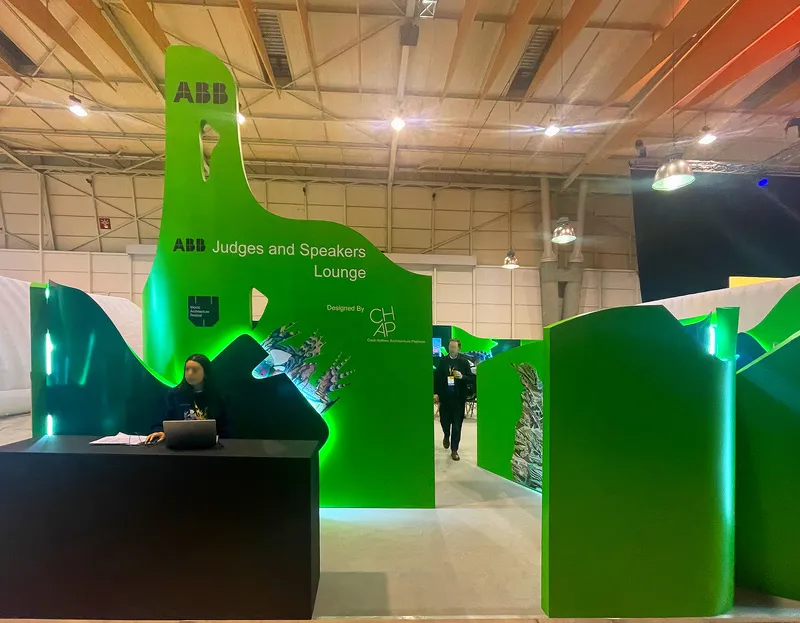
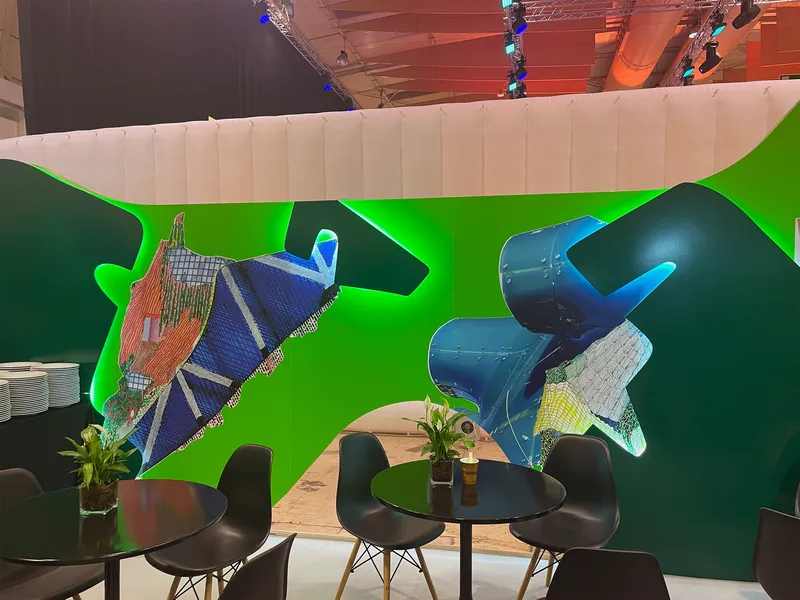
A pavilion that exists for barely a week must justify its material footprint through the intensity of the experience it delivers. CHAP used a sandwich construction system for the curved corners, a technique that yields stiff, lightweight panels capable of holding complex profiles without heavy framing. The glossy surface finish suggests a laminated or coated composite, rigid enough to stand free yet light enough for rapid assembly and disassembly. For a team working under Sir Peter Cook's direction, including Cong Ding, Pablo Wheldon, Ronghua Lei, and Jenna de Leon, speed of erection was not a compromise; it was a design parameter.
The wall system's modularity is most visible where display panels are integrated. These inserts sit within prepared openings, implying a kit-of-parts logic beneath the organic appearance. What looks free-form is, in fact, carefully coordinated: every curve has a radius that the sandwich panels can achieve, and every aperture aligns with an interior function.
Plans and Drawings
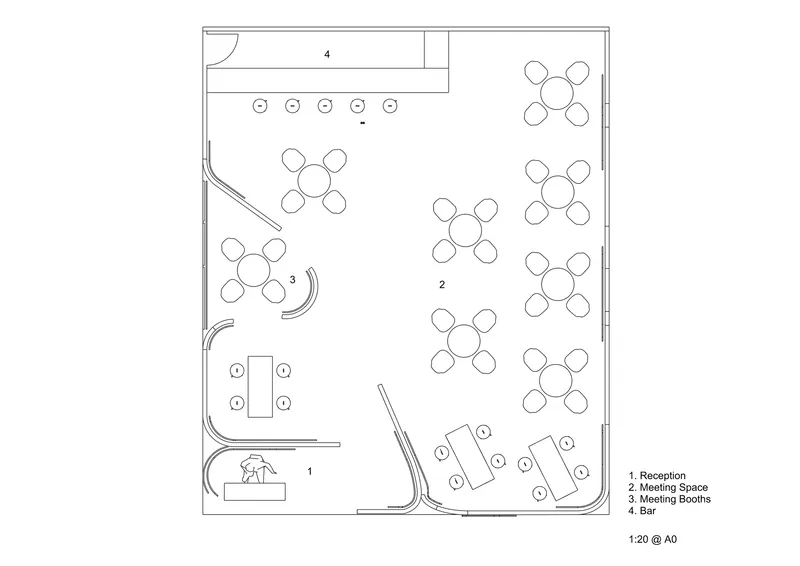

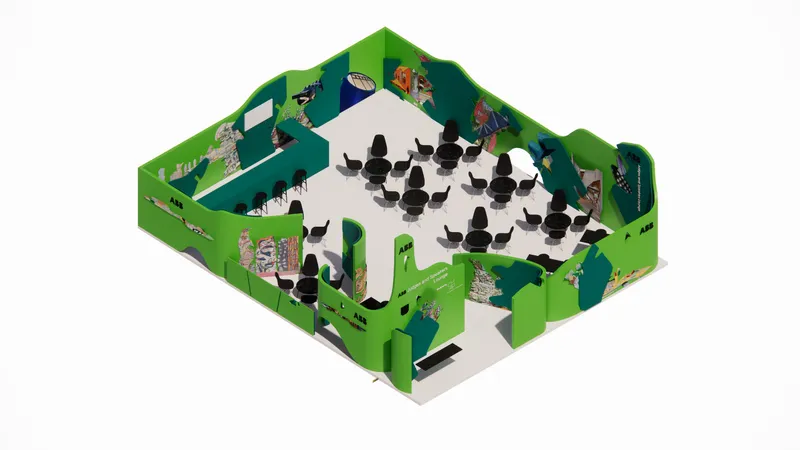

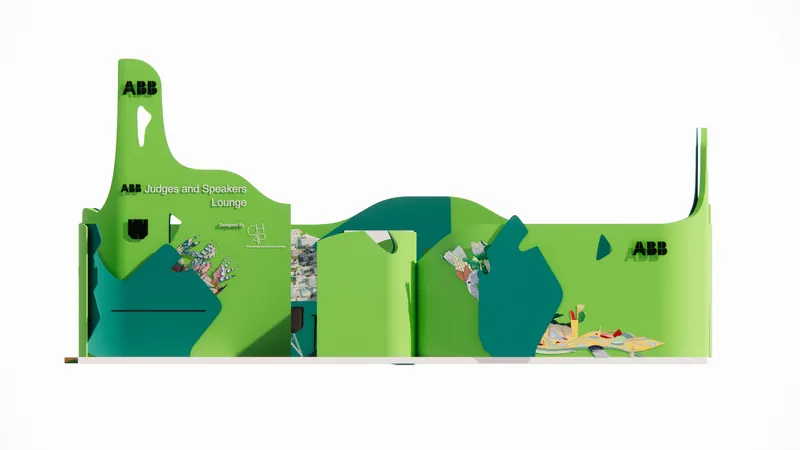
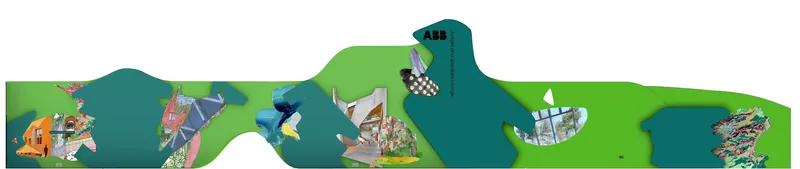

The floor plan reveals a layout that is far more organized than the sinuous walls suggest. A reception desk anchors one end, meeting tables occupy the core, and a bar area sits at the opposite edge. The axonometric views expose how the partition walls weave between these programmatic zones, creating circulation paths that loop rather than dead-end. Sections confirm that the walls maintain a consistent height, with variations in curvature doing all the work of spatial differentiation.
The elevation drawing is particularly revealing: a wavelike profile with teal accent bands and integrated graphic panels plotted along its length. It reads like a musical score, each rise and dip corresponding to a change in program on the other side of the wall. The drawings collectively show that CHAP treated this tiny pavilion with the analytical rigor of a much larger building, an approach that explains why the finished result feels so spatially rich despite its modest footprint.
Why This Project Matters
Temporary pavilions at architecture festivals often fall into two traps: they either try to be serious tectonic statements that overreach their brief, or they settle for branded wallpaper stretched over a generic booth frame. The Speakers and Judges Lounge avoids both. It is exuberant without being frivolous, rigorously planned without feeling stiff. In 120 square metres, CHAP demonstrates that enclosure is not binary. You can create privacy, display, circulation, and spectacle with a single continuous wall system, provided you are willing to let that wall misbehave.
For a first major post-pandemic architecture gathering, the pavilion also carried symbolic weight. It declared that physical space still matters, that the qualities of curvature and glimpse and threshold cannot be replicated on a screen. Coming from Sir Peter Cook, a figure whose visionary drawings have often been accused of existing only on paper, the lounge is a quiet rebuttal: here is the drawing, built, inhabited, and unmistakably green.
Speakers and Judges Lounge by Cook Haffner Architecture Platform (CHAP), led by Sir Peter Cook. Lisbon, Portugal. 120 m². Completed 2022. Photography by Cong Ding and Fiona Castiñeira.
About the Studio
Share Your Own Work on uni.xyz
If projects like this are the kind of work you want to make, uni.xyz is a place to publish your own, find collaborators, and enter design competitions.


Popular Articles
Popular articles from the community

Temporary Home for Dogs: A Reversed Zoo Rethinks Animal Shelter Architecture
In Bucharest, a sinuous corridor and freed landscape flip the logic of containment, designing a shelter that works to make itself unnecessary.

Manzana Morphosis: Stretching Barcelona's Grid into a Living Landscape for 2050
A radical reworking of the Eixample manzana turns density into a tool for generous public space, vertical ecology, and environmental performance.

Cloaked Colonization: A Mobile Underwater Habitat That Moves Like a Fish
Micah Abaya's shortlisted EHC Pacific entry reimagines ocean settlement as a dispersed network of self-sustaining architectural organisms.

Tsunami Convergenics: Turning Catastrophic Ocean Forces into Underwater Housing Infrastructure
A speculative underwater settlement off the coast of Onagawa, Japan, treats tsunamis and typhoons as energy sources rather than threats.

Similar Reads
You might also enjoy these articles

Pixel Gardens: One Repeated Module Stacked Into a Terraced Social Housing Tower for Famagusta
Salem Bader's shortlisted housing tower builds a vertical neighbourhood from one repeated module, offsetting units to carve terraces, light and air.

Bao Huynh Watercolor Atelier: A Serene Art Retreat in Hội An
Bao Huynh Watercolor Atelier in Hội An blends multifunctional art spaces, sustainable design, local materials, and family-friendly living in a serene environment.

Atelier Macri Concept Store Interior Design by CASE-REAL
Atelier Macri store features a "ko" counter, walnut wood details, cork displays, blending retail, gallery, and seamless customer experiences.

Manuel Vargas Izquierdo Stadium and High-Performance Sports Center: Architectural Excellence in Jalpa de Méndez
The Manuel Vargas Izquierdo Stadium blends sustainable design, inclusive sports facilities, and cultural-inspired architecture, revitalizing Jalpa de Méndez’s public spaces.

Explore Lounge Chair Competitions
Discover active competitions in this discipline

Challenge to reimagine the Iron Throne

Photograph architecture without architects

Illustrate the lost glory of Angkor Wat - Render Challenge

Bring back Drive In's
Comments (0)
Please login or sign up to add comments
No comments yet. Be the first to comment!