
SMxL Architects Carve a Concrete Panorama House into a Korean Hillside
In Yangsan, South Korea, a 114-square-meter residence uses raw concrete and strategic leveling to unlock reservoir and mountain views.


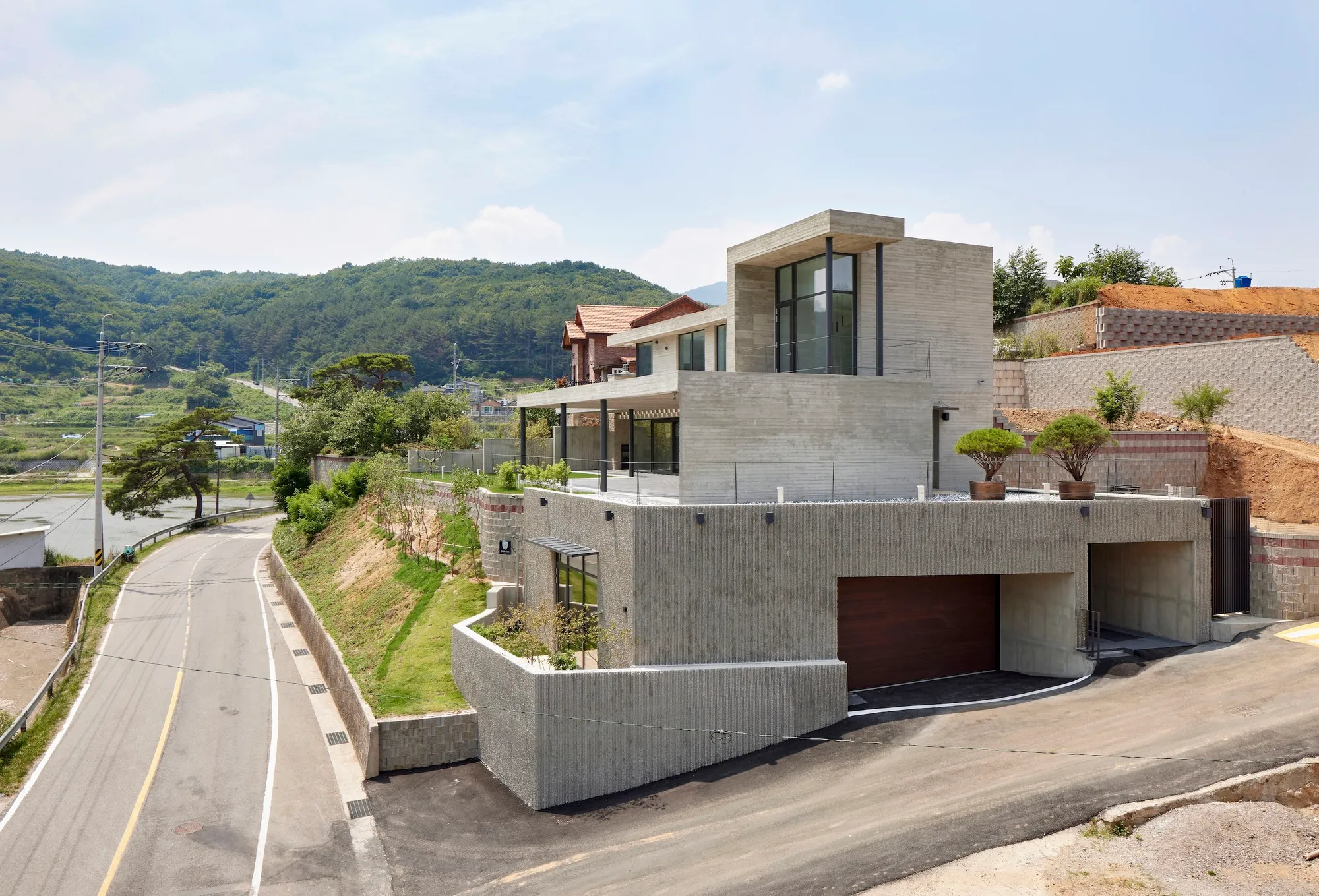
There is a particular stubbornness to this house. The site in Yangsan, South Korea, was originally covered with dense woods and concealed a four-meter elevation dip that made it look, from the road at least, entirely unremarkable. SMxL Architects cleared the land, leveled it with reinforced soil blocks, and then poured a building that, in every sense, insists on its own terms. What you get is a 114-square-meter residence that reads as a series of terraced concrete volumes stepping into the slope, each tier calibrated to pull in panoramic views of Dangchon reservoir and the surrounding mountains that are completely invisible from street level.
The real story here is not just the view grab, though that is well executed. It is the way the house uses a single material, concrete, in enough textural variations to avoid monotony while staying committed to a hard, mineral vocabulary. Board-formed surfaces, manually chipped surfaces, smooth interior walls: the palette is narrow but deep. Combined with louvers stretching up to 7.5 meters long that manage solar gain across the south-facing facade, the house becomes a precise instrument for living on a difficult site rather than simply sitting on top of one.
Terracing Into the Terrain
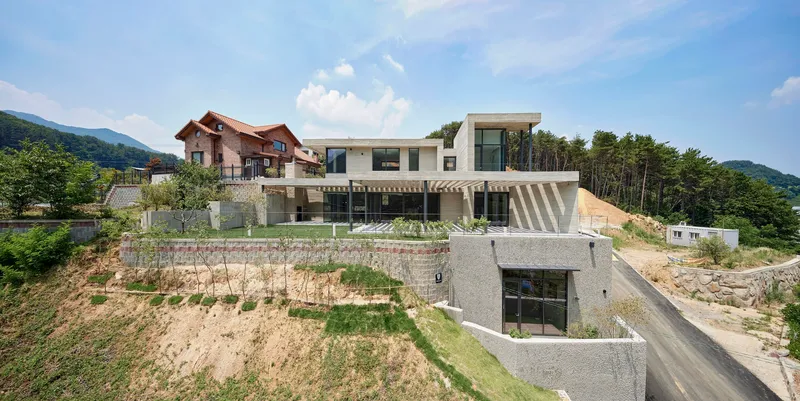
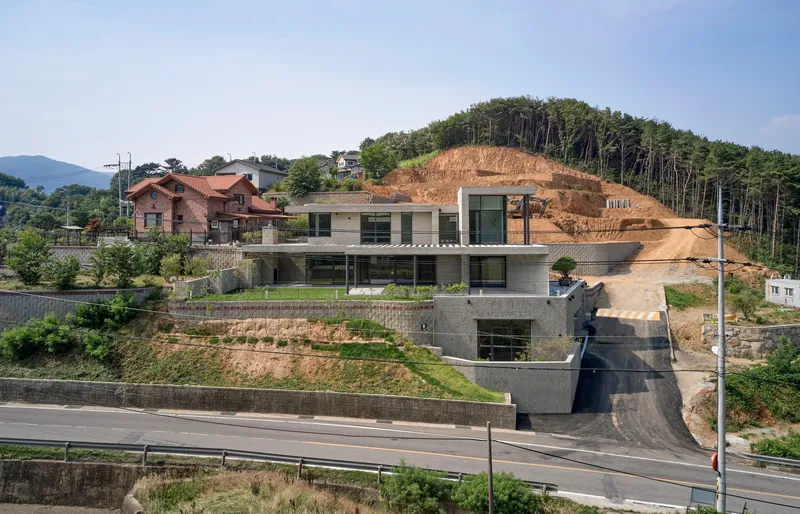
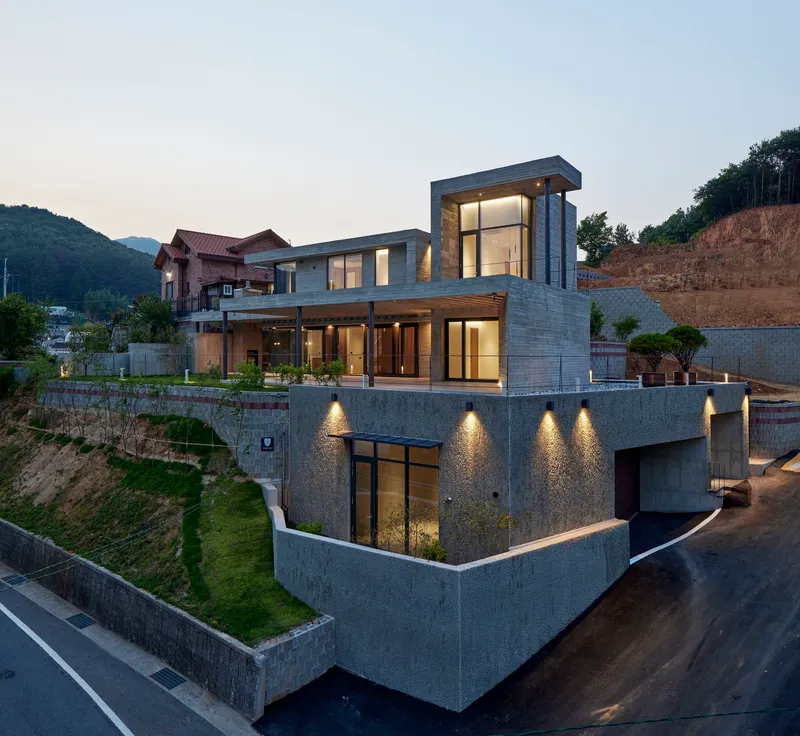
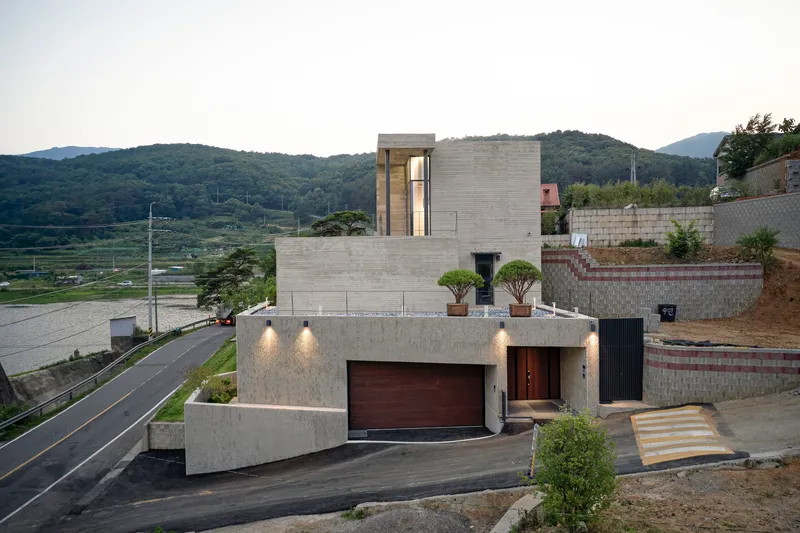
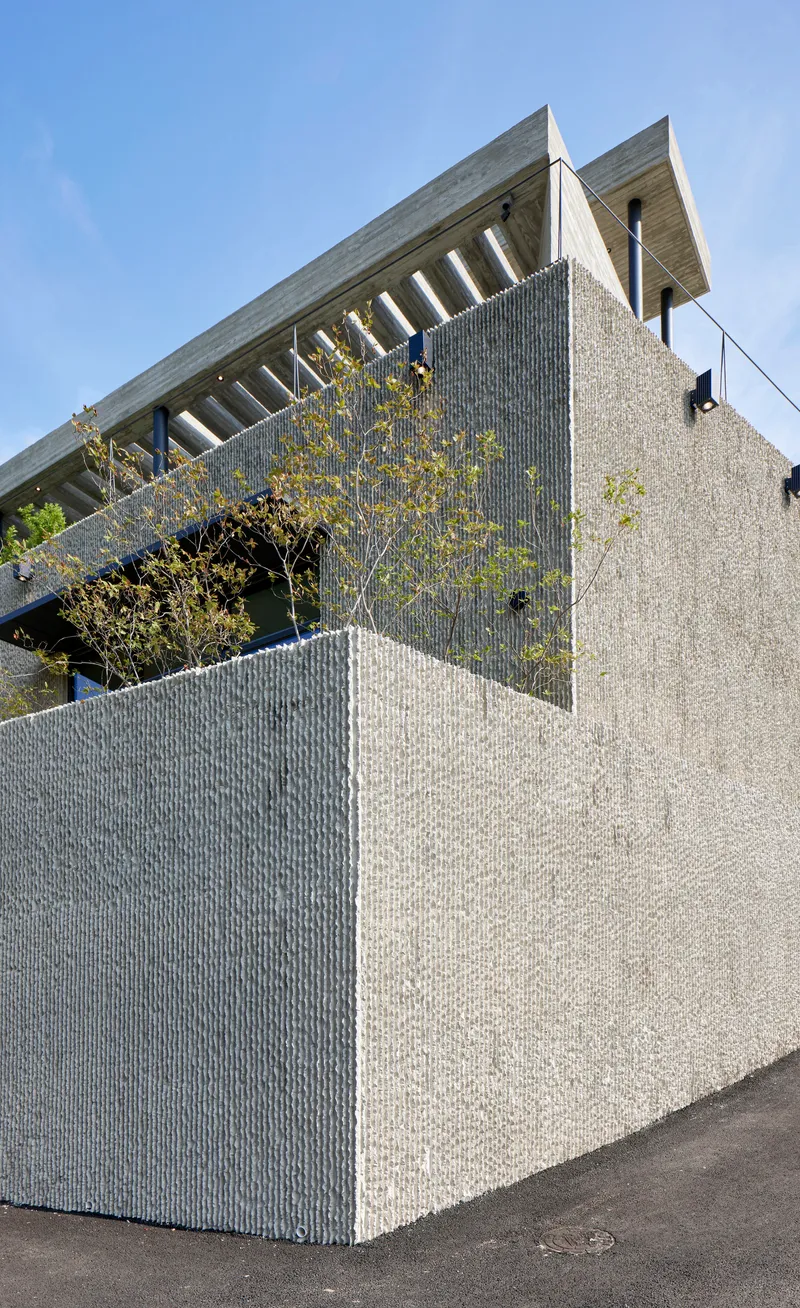
From the highway below, the house registers as three stacked volumes carved out of the hillside, their forms stepping in section to follow the slope. The ground floor acts as a stereobate, a massive plinth that supports the entire structure and absorbs the site's grade change. Underground parking sits at the base beside the main gate and driveway, tucking the car entirely out of sight. This decision is critical: it means the visible faces of the house are free to deal with light and views instead of garage doors.
At dusk, the glazed openings glow against the concrete mass, revealing just how much of the interior opens toward the reservoir and the forested ridgelines beyond. The building's silhouette, broad and horizontal, reads almost geological against the mountain backdrop.
A Facade Made of Textures
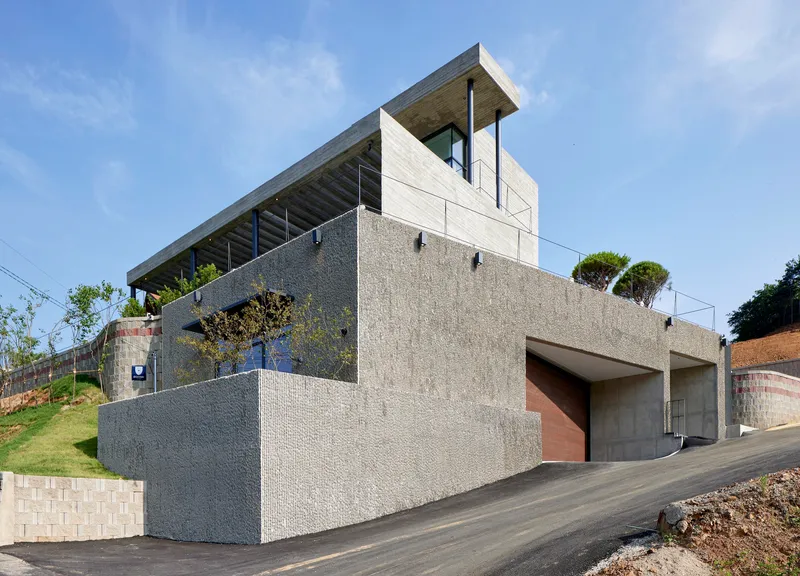
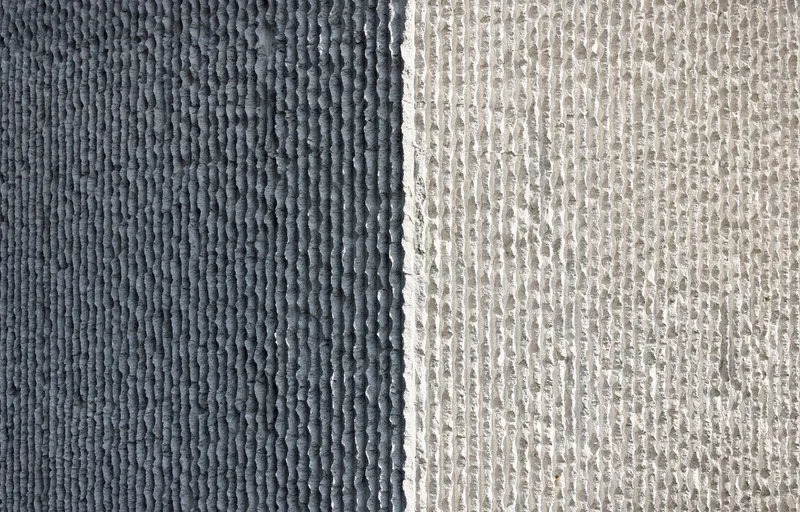
SMxL Architects avoid the trap of using exposed concrete as a default finish by treating each surface as a distinct material expression. The first and second floor exteriors use board-formed concrete, the timber grain legible in raking light. The ground floor exterior is a different animal entirely: cast against EPS molds with 35-millimeter-deep, 20-millimeter-wide ribs, then manually chipped to produce a rough, almost geological surface. Set side by side, the dark grey and light grey panels create a tonal rhythm that keeps the monolithic walls from flattening out.
The sandwich insulation method embedded within the concrete walls means these are not just aesthetic surfaces. Thermal performance is built into the section, allowing the raw concrete to remain exposed on both interior and exterior without compromising comfort. It is an honest approach: the wall you see is the wall that works.
Living with the View
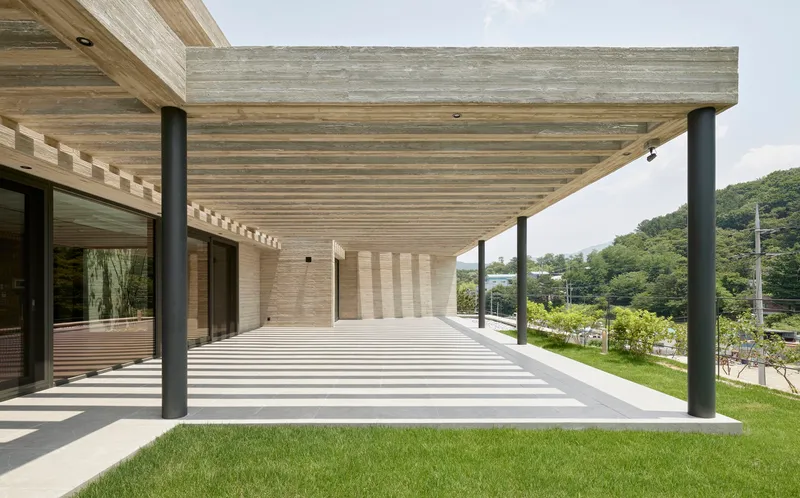
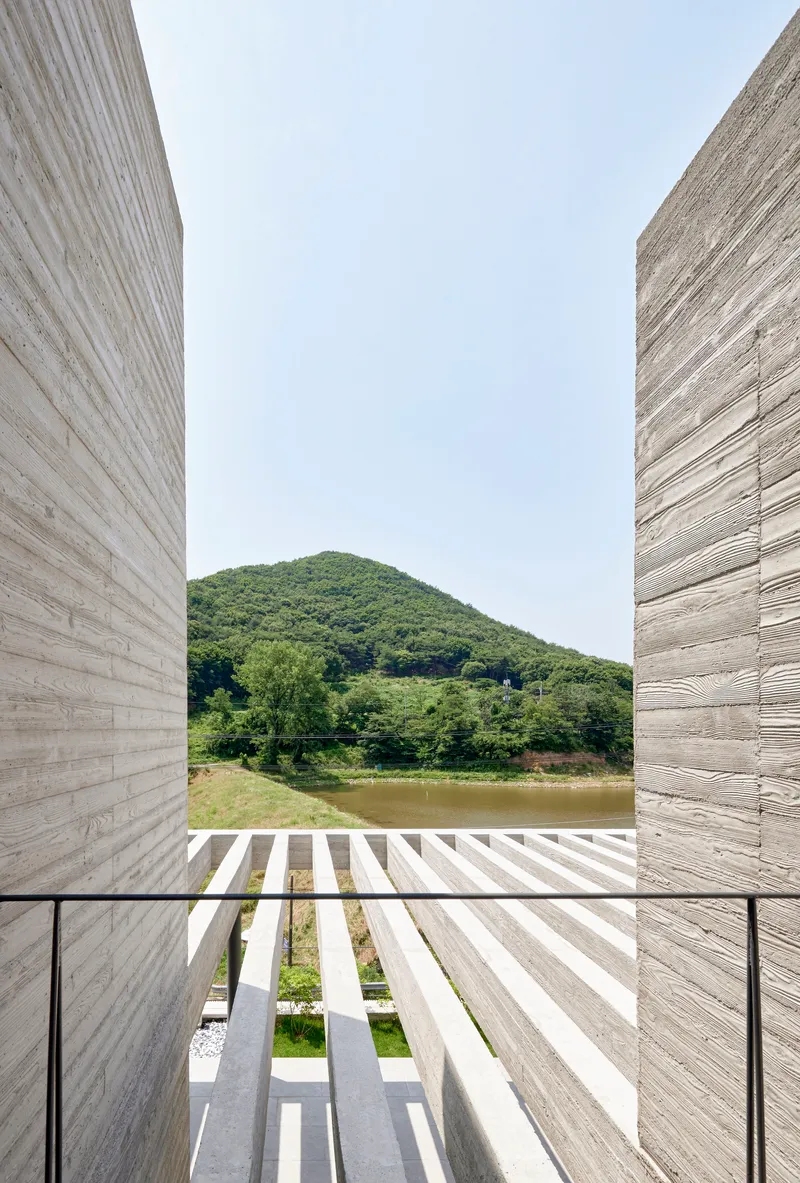
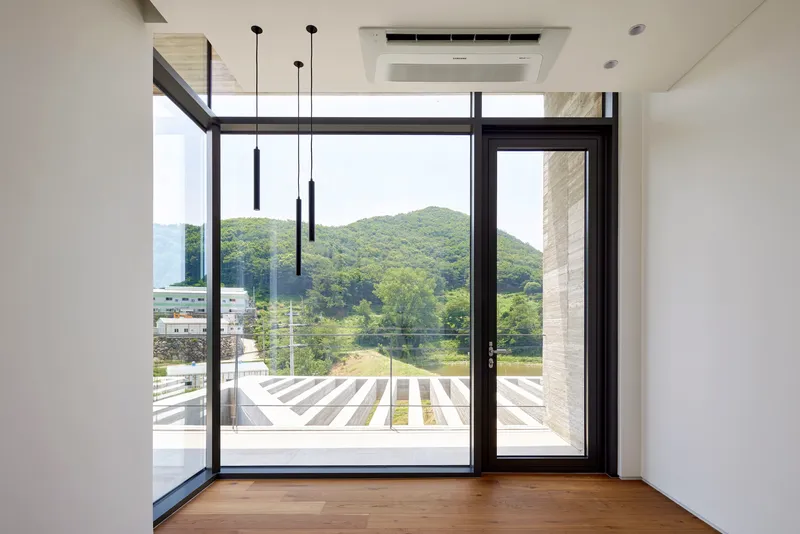
The first floor organizes the public program, bedroom, living room, and kitchen, along the south-facing edge where panoramic windows open to the reservoir. A covered terrace with a timber slat ceiling supported by slender black steel columns mediates between the interior and a flat front garden kept deliberately free of trees to preserve the sight line. Large concrete louvers, some as long as 7.5 meters, project from the facade to control the amount of sunlight hitting the terrace and the rooms behind it. The shadows they cast shift through the day, modulating the interior atmosphere without mechanical intervention.
Through the slatted deck, you can see a pond, green hills, and sky. The effect is cinematic, but it is also strategic: by framing views tightly through deep concrete apertures, the architects ensure that the panorama never becomes wallpaper. You notice it every time.
Courtyards as Interior Landscapes
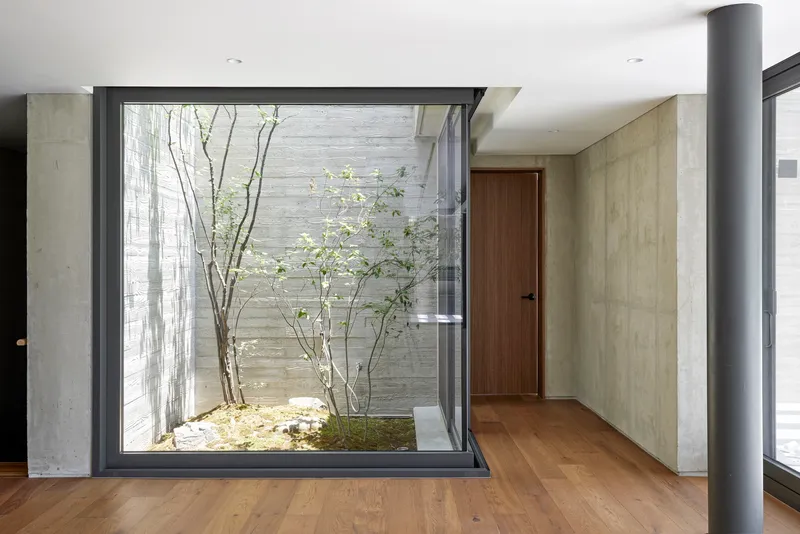
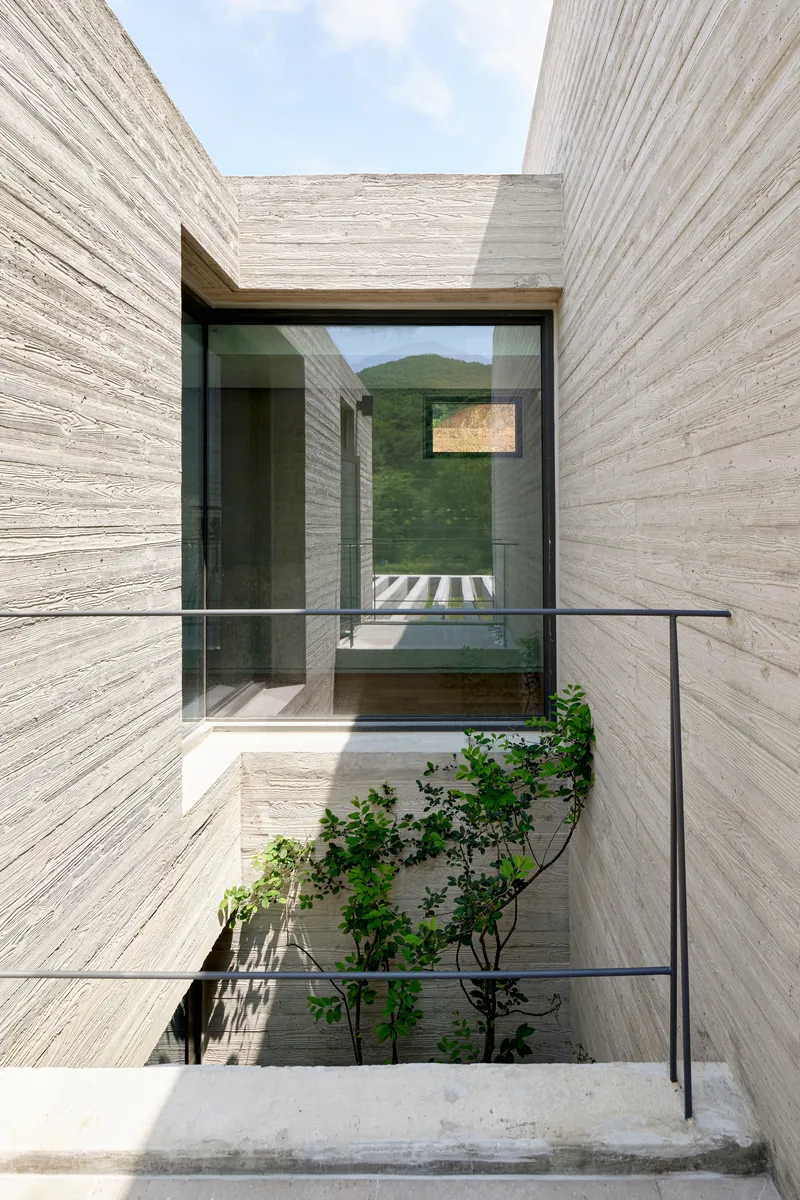
Between the living room and the main bedroom, a glass-paned courtyard introduces daylight and greenery into the center of the plan. Birch trees grow inside board-formed concrete walls, their pale bark playing off the grey surfaces. This is not a decorative gesture; the courtyard provides cross-ventilation, visual relief between the social and private zones, and a micro-landscape that changes with the seasons.
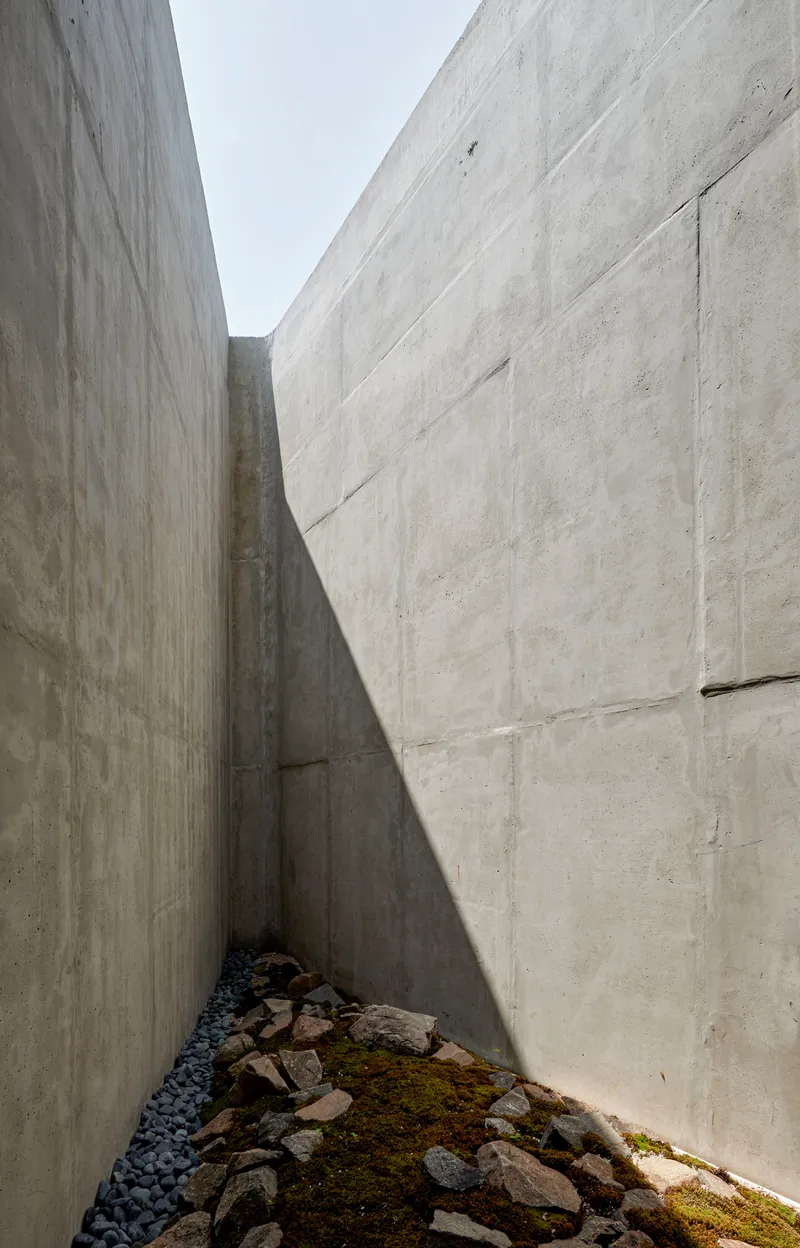
A smaller triangular courtyard sits outside the main bedroom's shower, filled with rocks and moss. It turns a utilitarian space into something contemplative. The narrow gap between concrete walls becomes a controlled fragment of the forested site, brought inside without domesticating it.
Wet Rooms Carved from Stone
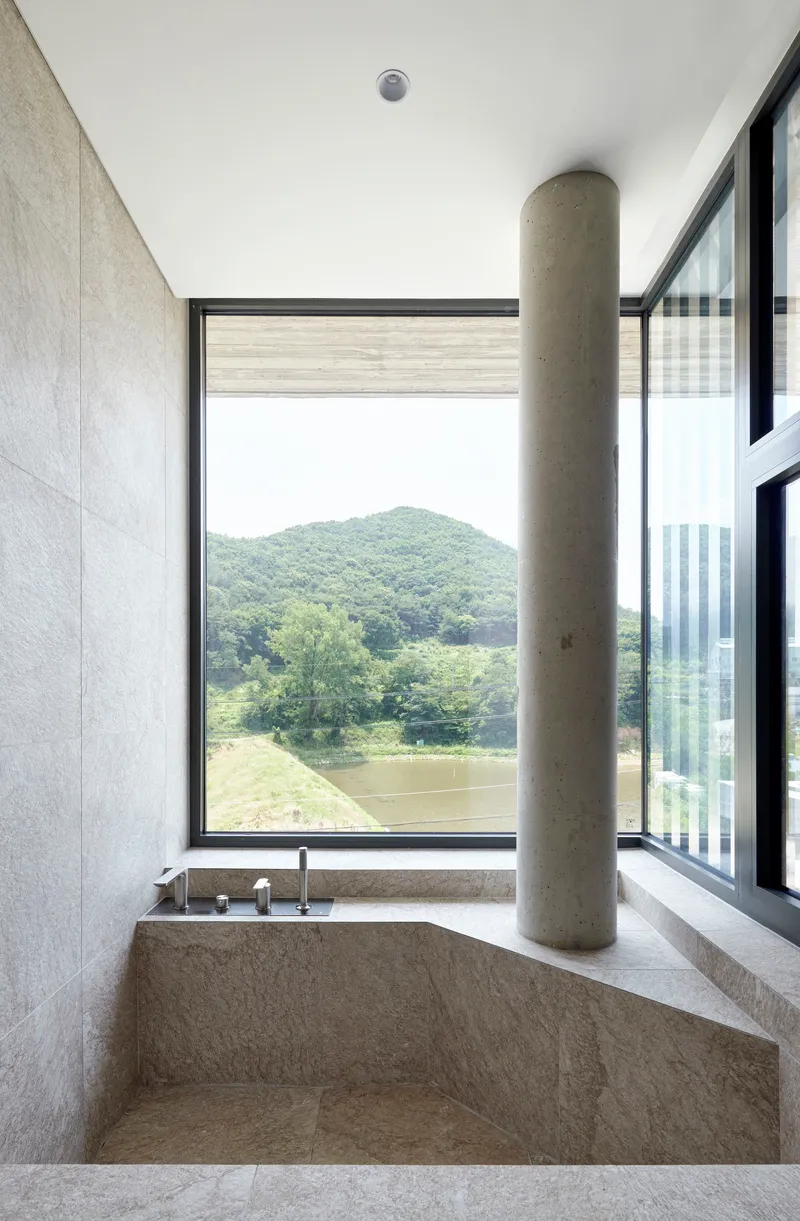
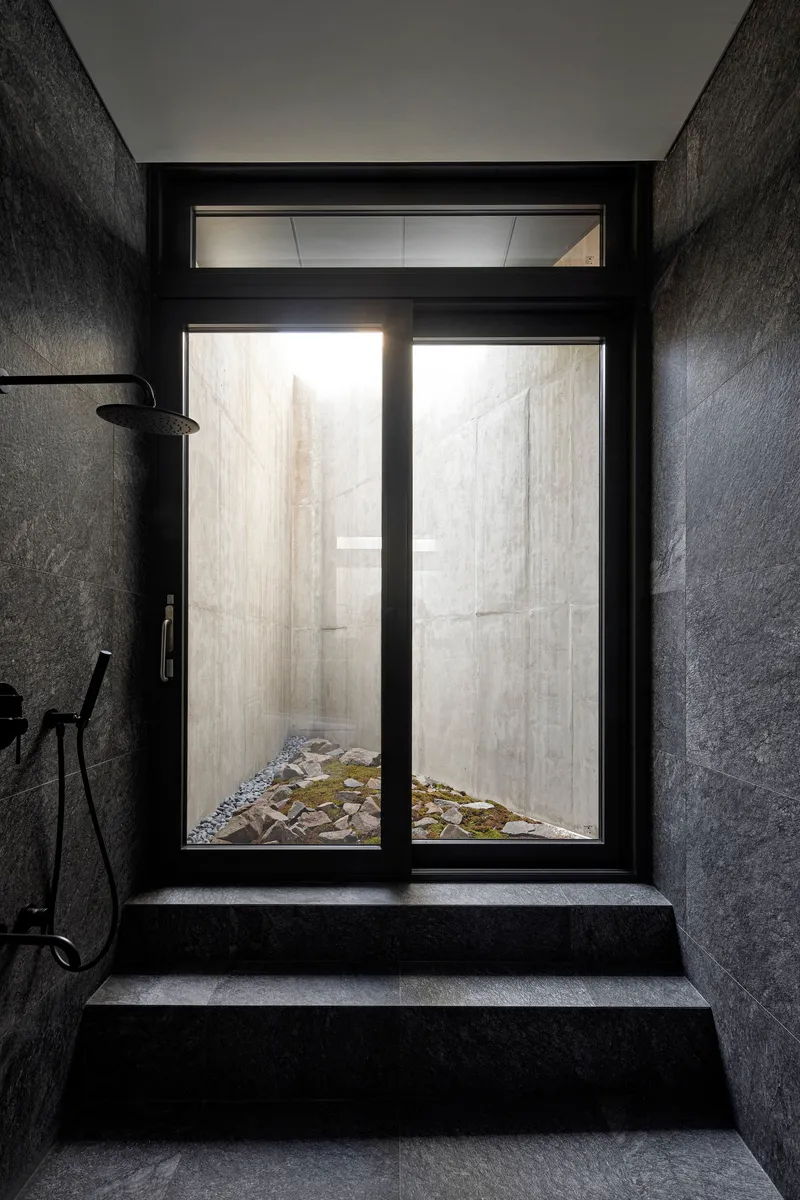
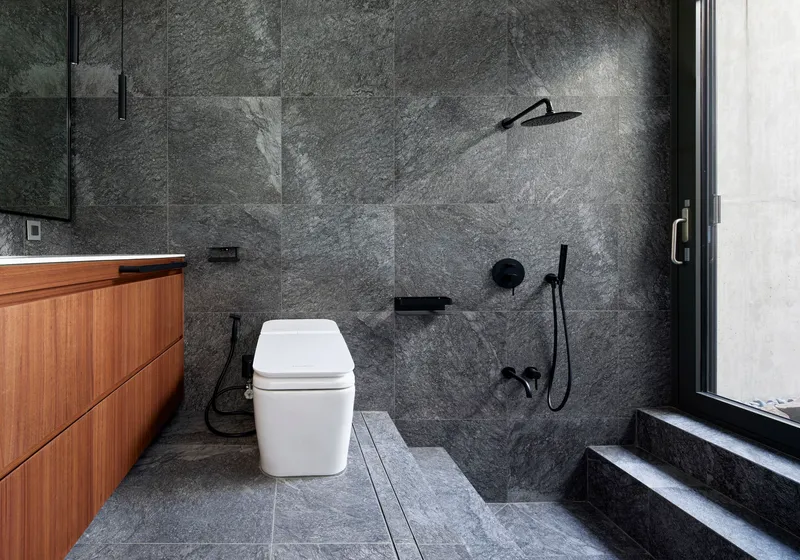
The bathrooms are among the most considered spaces in the house. A stone bathtub sits beside a cylindrical concrete column and a corner window that frames a single tree against a distant mountain. The charcoal stone tile, dark shower fixtures, and timber vanity create a palette that feels both heavy and warm. One shower room opens directly through a glazed door onto the planted courtyard with its rocks and moss, collapsing the boundary between bathing and landscape.
These rooms prove a point about material consistency. When every surface in the house belongs to the same family, concrete, stone, timber, the wet rooms do not feel like a departure. They feel like a refinement.
Domestic Details and Kitchen Craft
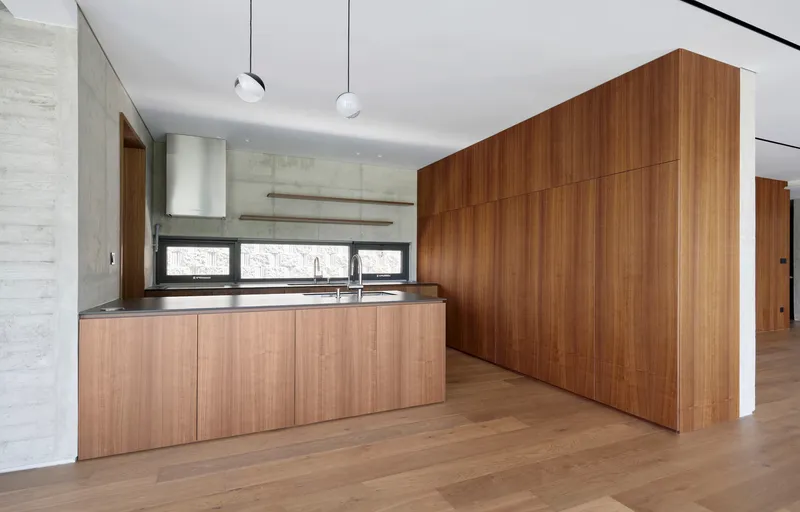
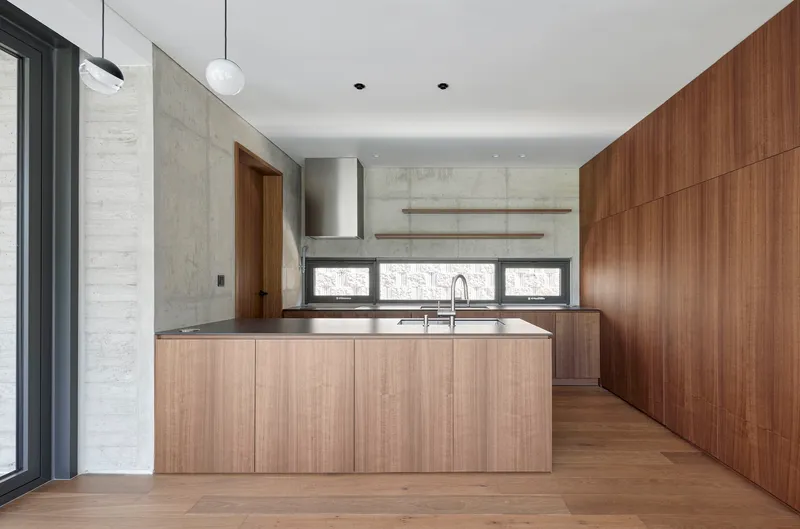
The kitchen holds its own against the concrete. A wood veneer island and wall cabinetry sit comfortably beside board-formed walls, with globe pendant lights providing warm contrast to the grey surfaces. A horizontal window band beneath the concrete backsplash pulls in a strip of landscape, keeping the cook connected to the site. The stainless steel range hood and timber detailing by Haemil Kitchen Furniture are precise without being precious.
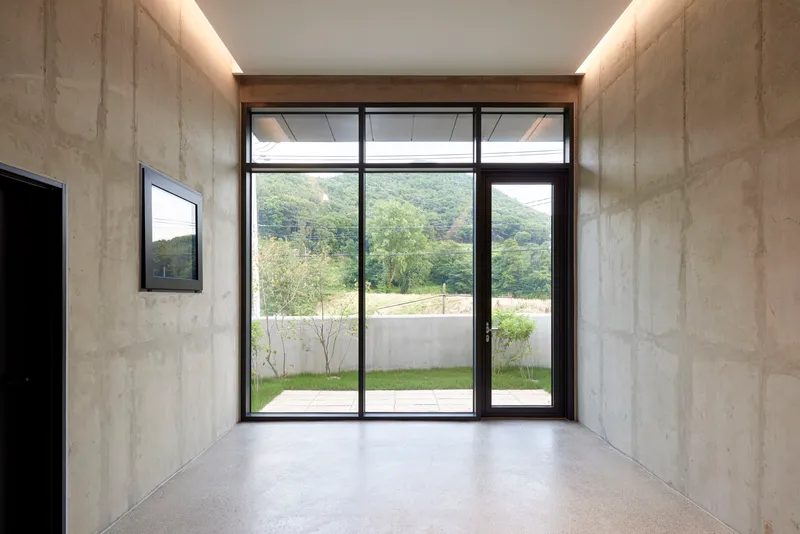
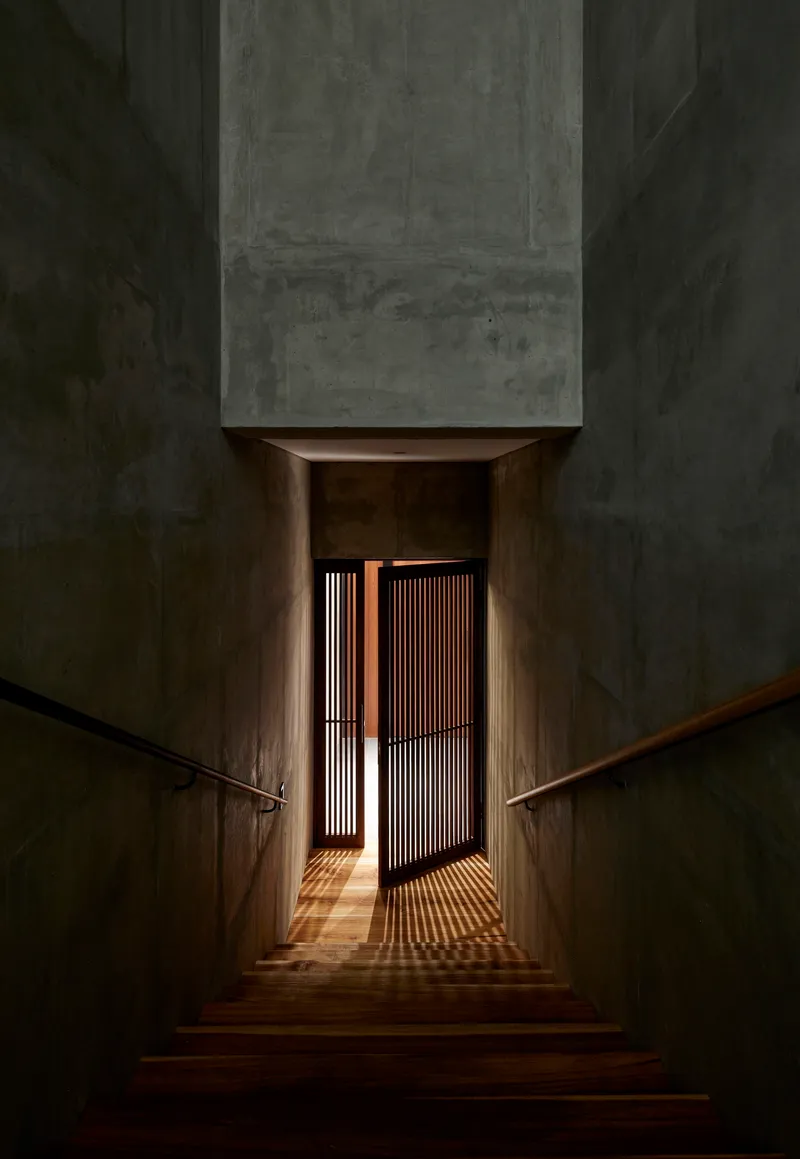
At the entry, a vestibule framed in board-formed concrete and terminated by a full-height glazed door establishes the sequence: you move from the chipped exterior texture through the grain-imprinted walls and into a view of the hillside beyond. The transition is compressed but legible, a threshold that earns the panorama waiting at the other end.
Rooftop and Vertical Circulation
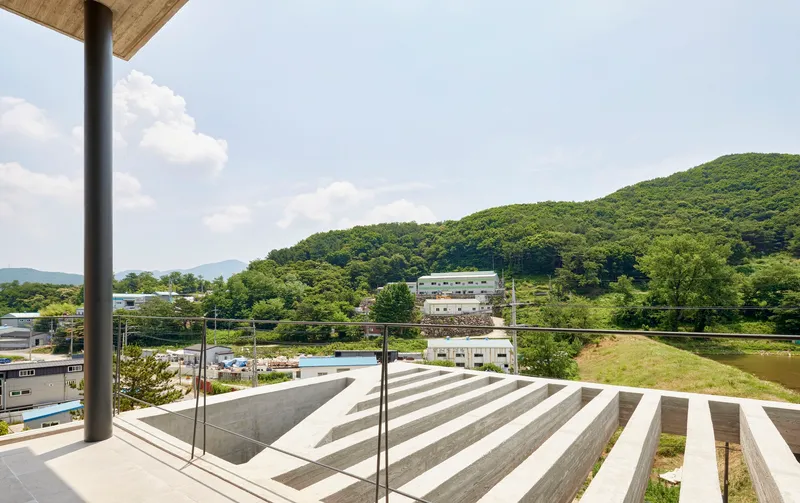
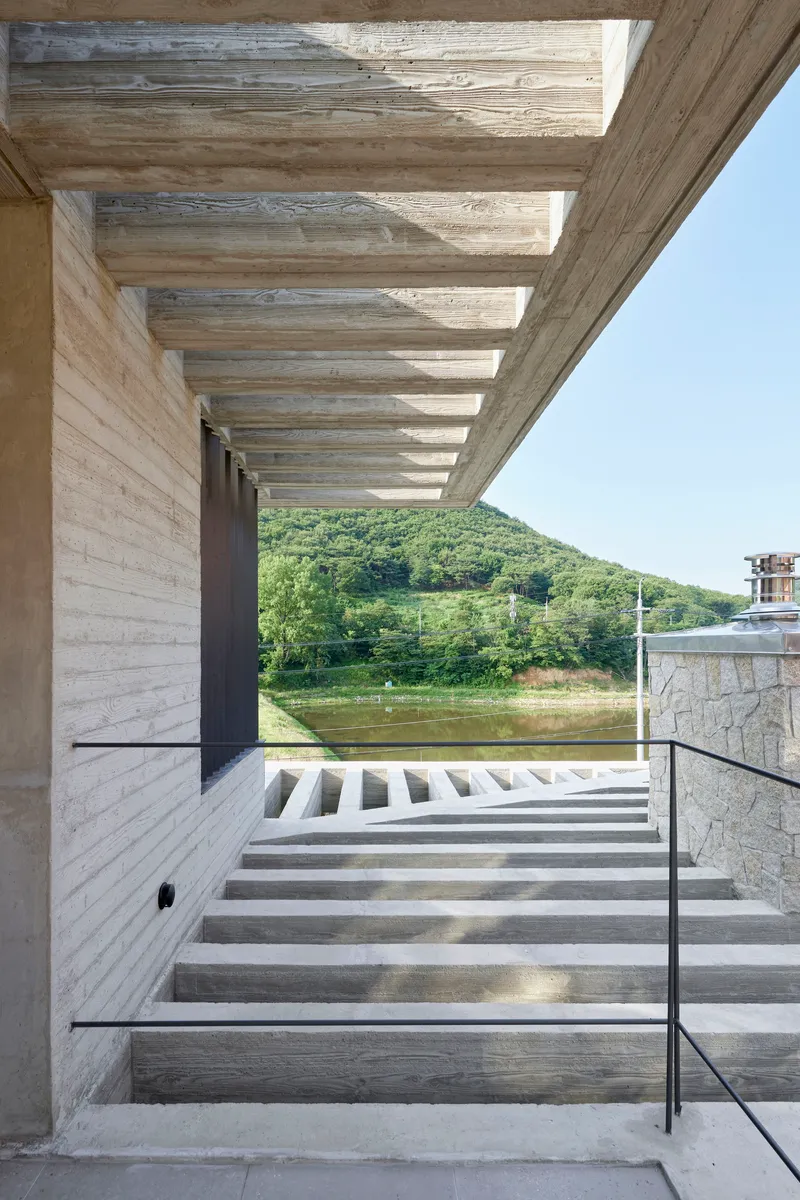
The rooftop terrace, enclosed by a glass balustrade, overlooks striped concrete seating steps that cascade toward the hillside. It is a simple move that extends the usable outdoor area vertically, compensating for the compact footprint. An exterior concrete staircase descends toward the river, connecting the upper levels to the landscape in a direct, almost processional way.
Interior stairs are handled with equal care. A descent toward a timber slat door, backlit at dusk, turns vertical circulation into one of the house's quieter moments. Light filters through the slats, marking time and weather.
Plans and Drawings
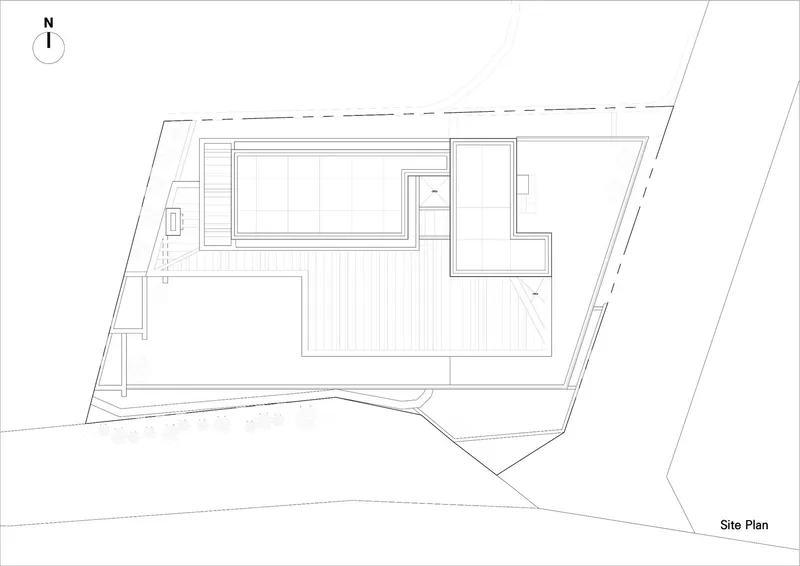
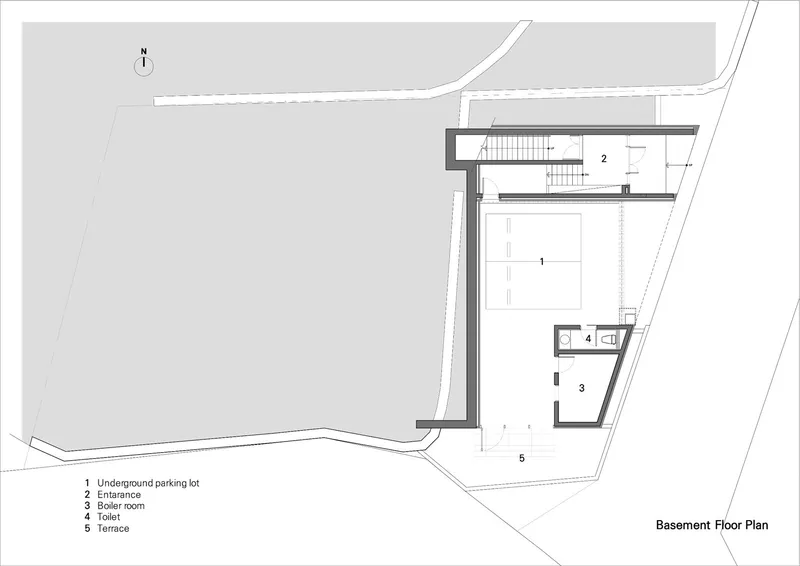
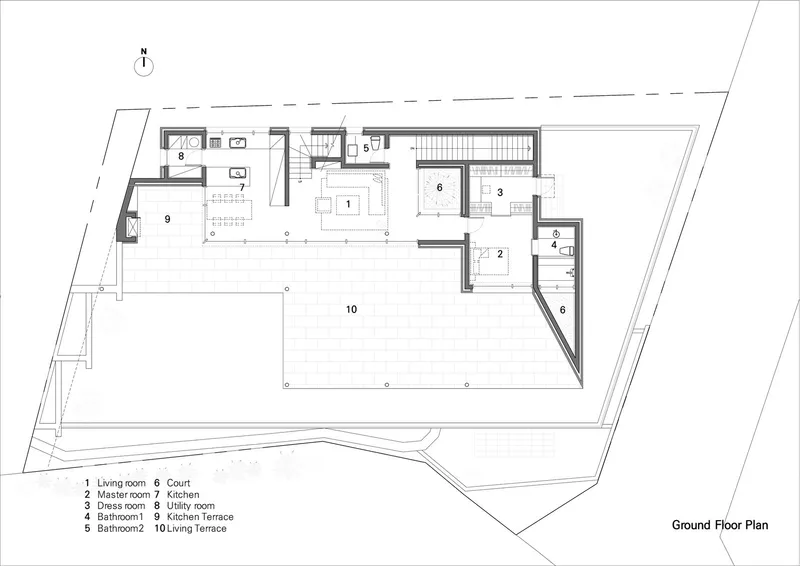
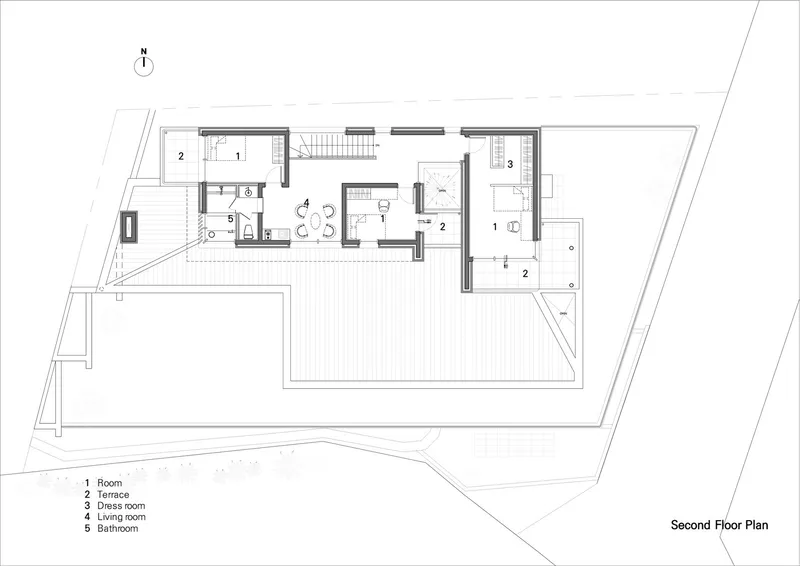
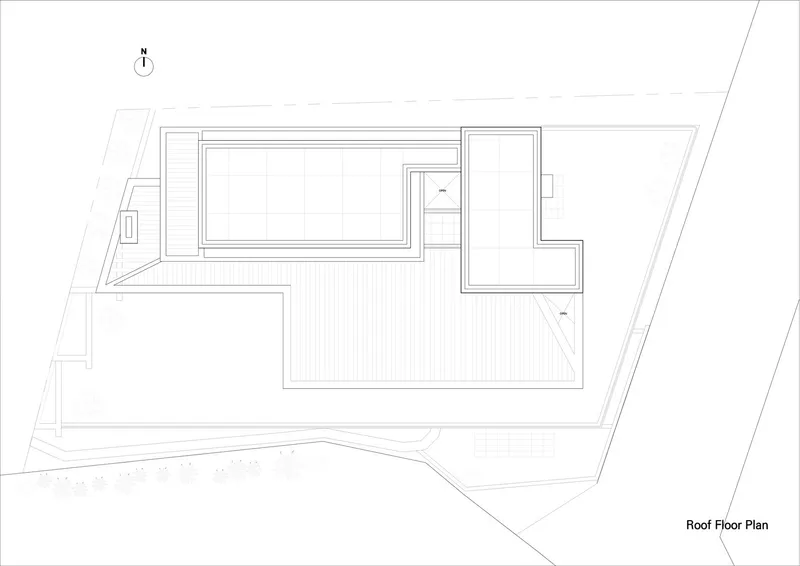
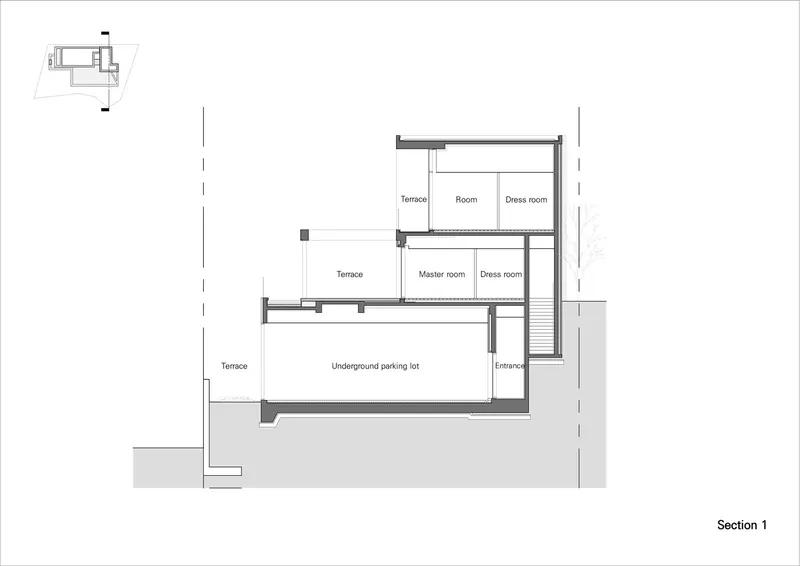
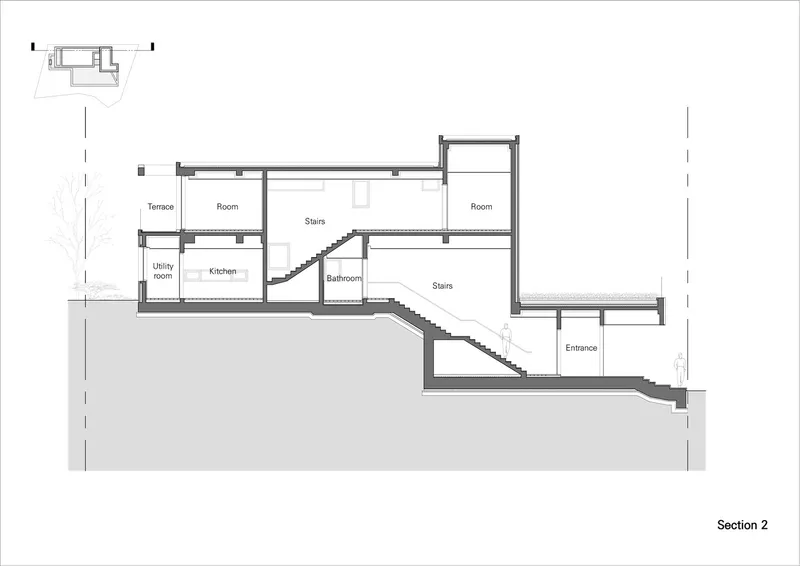
The site plan reveals the building's relationship to a trapezoidal lot, with the pool and deck oriented to maximize southern exposure. In section, the split-level organization becomes clear: cascading stairs connect underground parking to living spaces to bedrooms to the rooftop pool deck, each level shifted to follow the terrain's natural drop. The basement plan shows how efficiently the parking and service rooms are tucked into the earth, freeing the floors above for light and view. The second floor clusters three bedrooms around a central circulation core with access to roof terraces on both sides.
Why This Project Matters
The Yangsan Panorama House is a reminder that view-oriented houses do not need to be glass boxes. SMxL Architects use concrete's mass and opacity as framing devices, controlling exactly what you see and when you see it. The louvers, the courtyard apertures, the precisely placed window bands: every opening is earned through the discipline of the surrounding wall. The result is a house where the landscape feels more vivid because it is not everywhere at once.
At 114 square meters, the house is not large. But its sectional complexity, terracing down into the slope across four levels including underground parking, gives it a spatial generosity that the floor area alone would not suggest. The textural range of the concrete, from board-formed to chipped to smooth, proves that working within a tight material palette does not mean working without variety. This is a house that takes a forgettable roadside plot and, through sheer architectural conviction, turns it into a place worth staying.
Yangsan Panorama House by SMxL Architects. Yangsan, South Korea. 114 m². Completed 2022. Structural engineering by Archfeel Structural Engineering. Construction by Tae Young Engineering & Construction. Photography by Hanbit Kim.
About the Studio
Share Your Own Work on uni.xyz
If projects like this are the kind of work you want to make, uni.xyz is a place to publish your own, find collaborators, and enter design competitions.



Popular Articles
Popular articles from the community


Lunar Spiral: Space Architecture Shaped by the Mathematics of the Universe
Lunar Spiral reimagines space architecture through Fibonacci geometry, lunar regolith, levitating habitats, and self-sustaining Moon living.

The Musturak Paradise: Senior Living Architecture for a Connected Future in Temara, Morocco
The Musturak Paradise reimagines senior living architecture in Temara via private homes, social spaces, culture, community, and shared care.

Co-life: Sustainable Architecture for Age-Friendly Community Living
Co-life reimagines sustainable architecture for seniors through courtyards, rammed earth, shared gardens, and spaces designed for belonging.

Conexión: Biophilic Design Reimagines High-Rise Living in Hong Kong
Conexión reimagines high-rise living in Hong Kong through biophilic design, green facades, shared spaces, daylight, water and nature within.


Similar Reads
You might also enjoy these articles

Bao Huynh Watercolor Atelier: A Serene Art Retreat in Hội An
Bao Huynh Watercolor Atelier in Hội An blends multifunctional art spaces, sustainable design, local materials, and family-friendly living in a serene environment.

Atelier Macri Concept Store Interior Design by CASE-REAL
Atelier Macri store features a "ko" counter, walnut wood details, cork displays, blending retail, gallery, and seamless customer experiences.

Manuel Vargas Izquierdo Stadium and High-Performance Sports Center: Architectural Excellence in Jalpa de Méndez
The Manuel Vargas Izquierdo Stadium blends sustainable design, inclusive sports facilities, and cultural-inspired architecture, revitalizing Jalpa de Méndez’s public spaces.

KAKR Buluh Awar Hall: Revitalizing Community and Ecology Through Bamboo Architecture
Community built bamboo hall revitalizes Buluh Awar village, empowering youth, restoring ecology, celebrating vernacular craftsmanship through sustainable architecture and culture.



Comments (0)
Please login or sign up to add comments
No comments yet. Be the first to comment!