
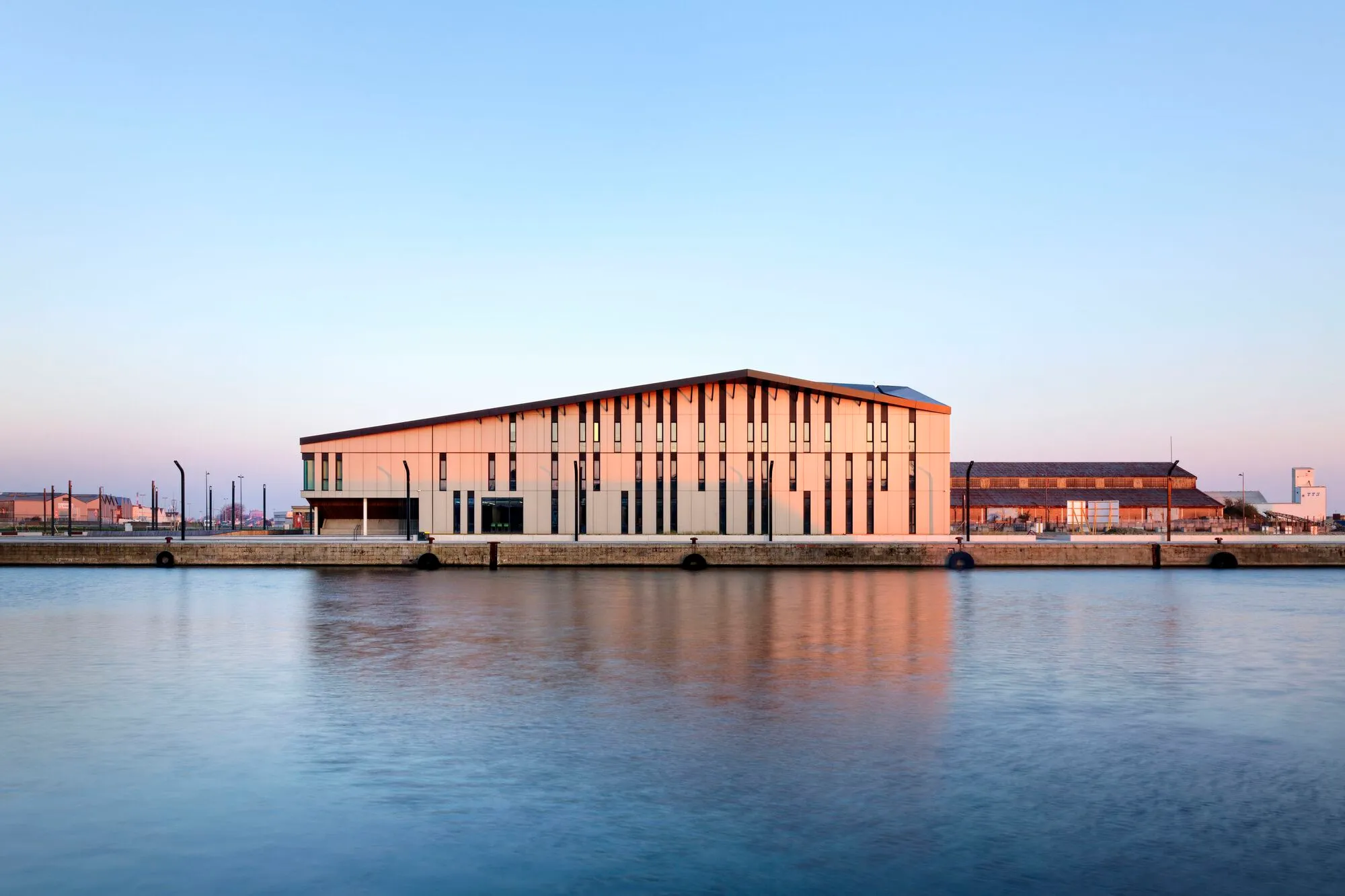
Snøhetta and Santer Vanhoof Plant an Energy-Positive Timber Landmark on Dunkirk's Industrial Waterfront
Ecosystème D turns a former port site in northern France into a bioclimatic hub for energy transition, producing more power than it consumes.


Dunkirk's port is not the kind of place that invites delicacy. Prevailing winds off the North Sea sweep through industrial sheds, and decades of heavy infrastructure have left atmospheric pollution embedded in the site's identity. So when Snøhetta and Santer Vanhoof were tasked with designing a building on Mole 2, at the interface between port and city, the brief was not simply to build well but to prove that low-impact architecture can thrive in hostile terrain. Ecosystème D, completed in October 2024, is the result: a 4,400-square-metre timber-framed complex that generates more energy than it consumes and funnels the surplus into the surrounding port development.
What makes the project genuinely interesting is the refusal to treat energy performance and civic ambition as separate problems. The building's angular, multi-pitched roof is not a formal flourish; it is 1,200 square metres of photovoltaic surface shaped by wind analysis. The central planted courtyard is not decorative landscape; it is the engine of natural ventilation and daylighting for a program that includes a prototyping technology hall, training center, incubator, showroom, and flexible workspaces. Every formal move here traces back to a climatic or programmatic decision, and the architecture is more convincing for it.
Dockside Presence
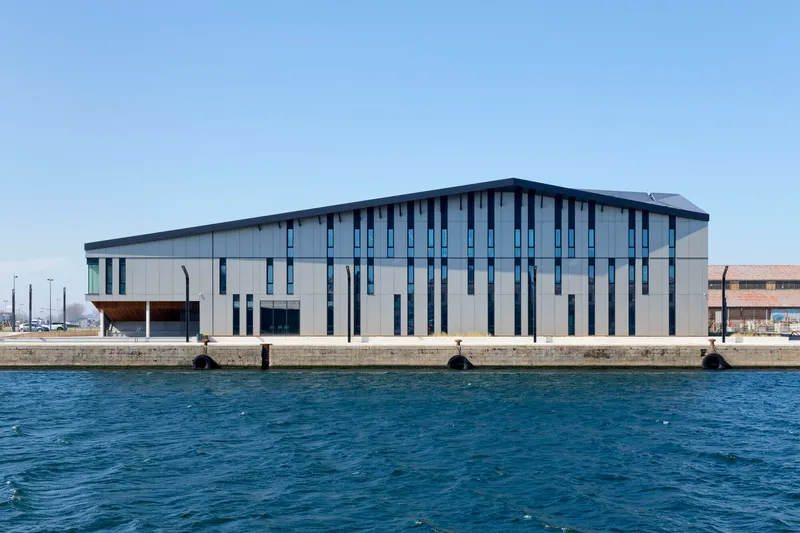
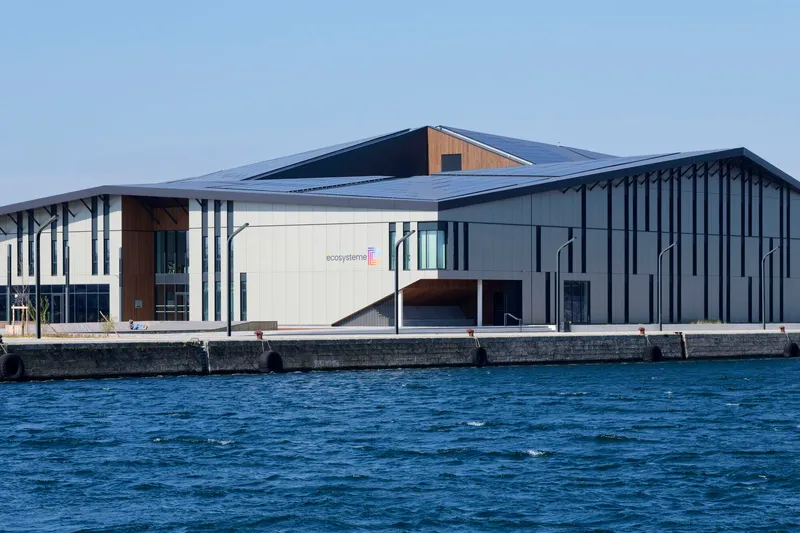
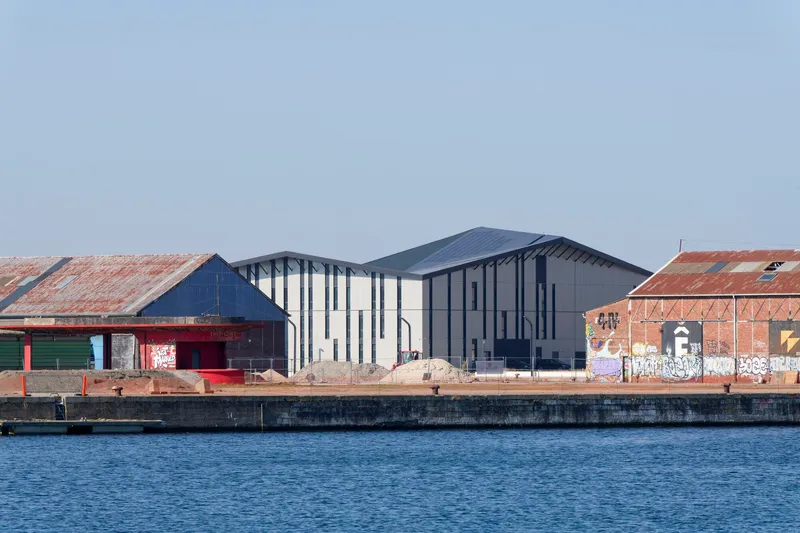
From across the harbor, the building reads as a cluster of pitched-roof volumes rather than a single monolithic block. The metal-clad facades are interrupted by vertical window slots that lend rhythm without fuss. This is a deliberate strategy: by breaking the mass into several gable profiles, the architects echo the scale and grain of the weathered brick warehouses that line the quay alongside it. The result is a building that feels earned by its context rather than imposed upon it.
The beige and zinc tones of the cladding shift perception depending on weather and light. Under the grey skies typical of northern France, the surfaces recede into the industrial palette; at dusk, the vertical timber fins catch warm light and the building separates itself from its neighbors. It is a calibrated act of camouflage and distinction.
The Roof as Power Plant
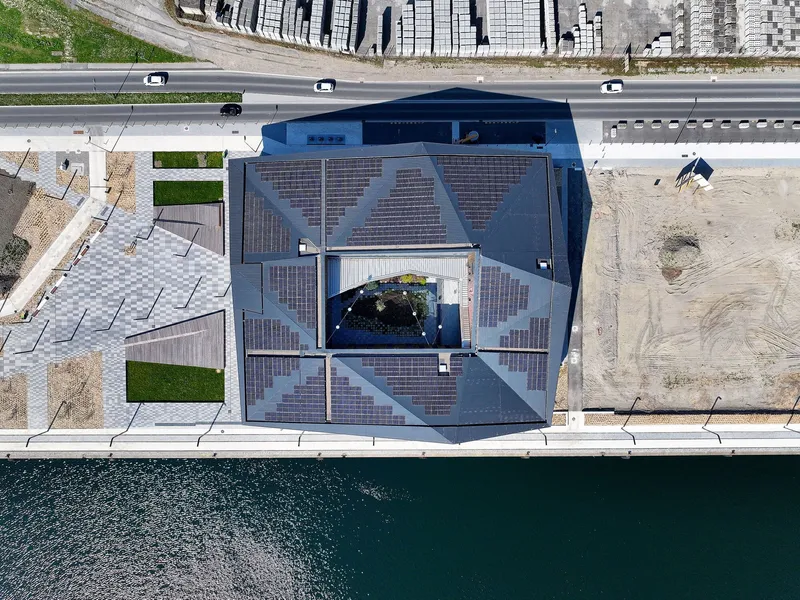
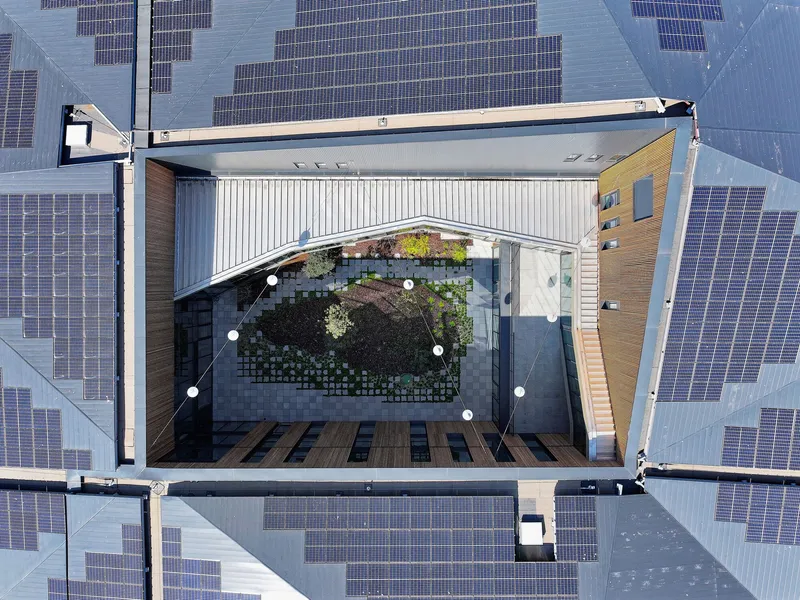
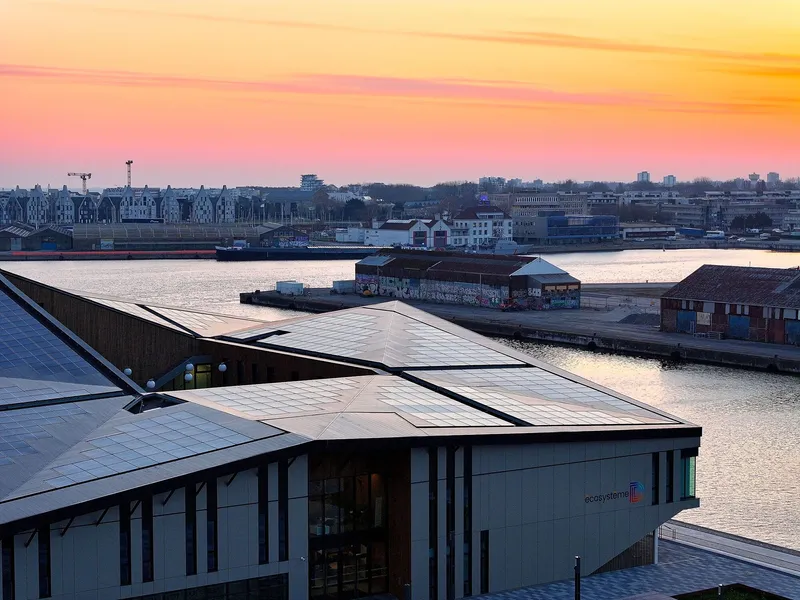
Seen from above, the building's defining feature becomes obvious: nearly the entire roof surface is given over to photovoltaic panels arranged across angular planes that rise and fall between nine and eighteen metres. The morphology is not arbitrary. It was derived from an analysis of the site's industrial and climatic context, with slopes oriented to maximize solar gain while deflecting the prevailing winds that batter this stretch of coast.
The energy-positive claim is the headline, but the engineering detail is what makes it credible. A high-performance envelope with triple-glazed windows and enhanced insulation works alongside the PV array to minimize demand before maximizing generation. The surplus electricity is distributed to the surrounding Neptune development zone, a strategy launched in the 1990s to reconnect Dunkirk's industrial wastelands with the city center. Ecosystème D is not just a net-positive building; it is a net-positive neighbor.
Courtyard as Climate Device
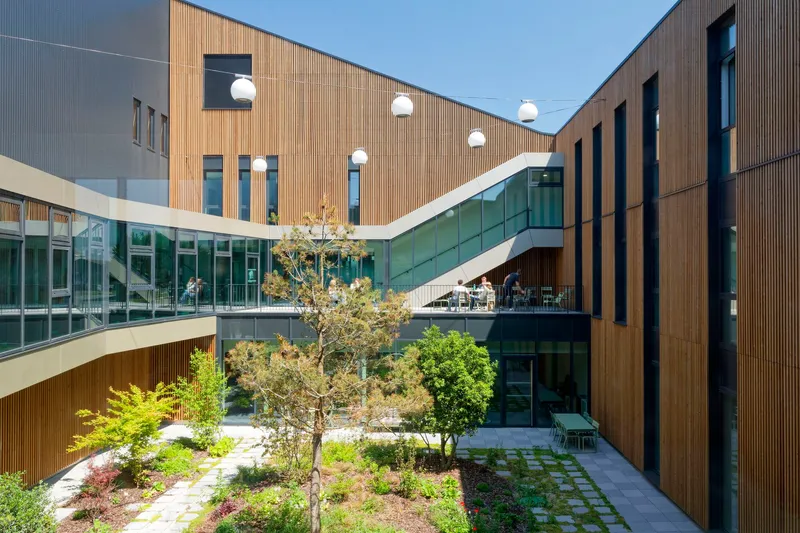
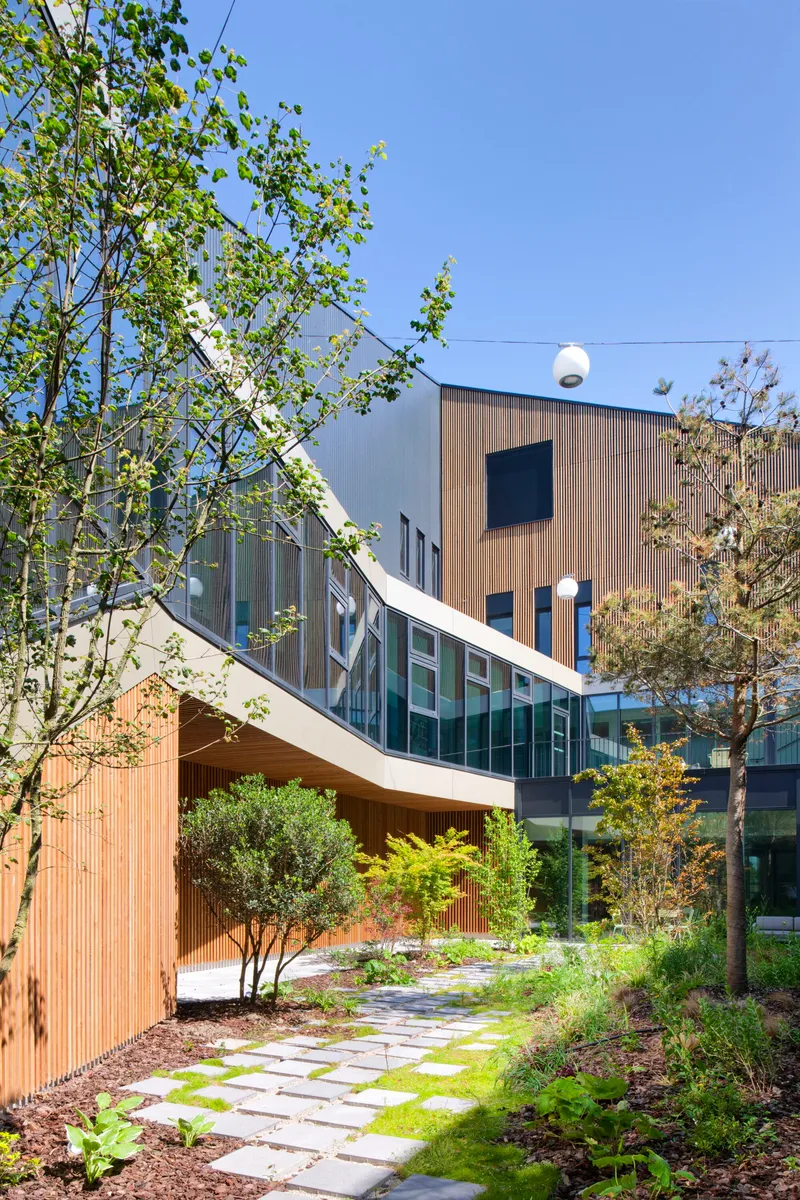
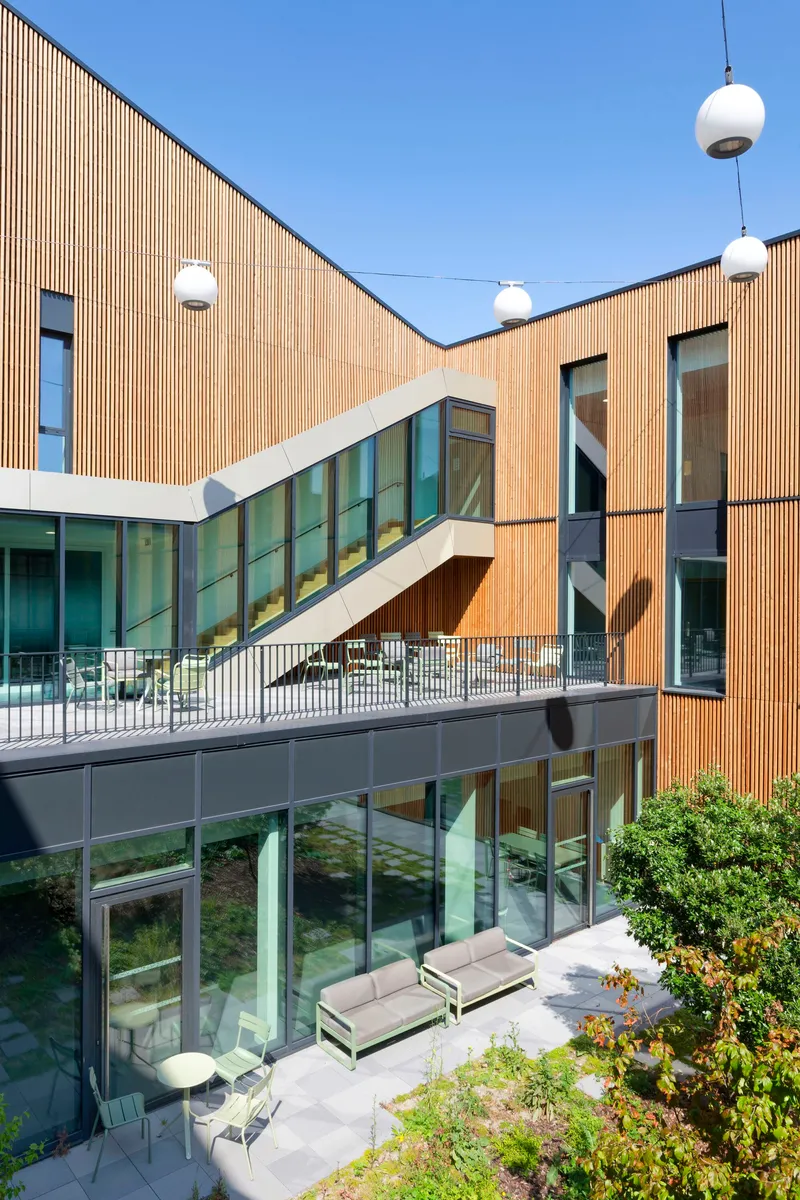
The central planted courtyard is the organizational heart of the project. Planted beds, birch trees, and paved paths occupy the void, while timber-clad walls and a glazed upper walkway frame views inward from every level. The courtyard draws light deep into the floor plates and creates a stack-ventilation chimney that moves air through the building without mechanical assistance during mild months.
It also functions as a social condenser. The wide staircase that winds between levels wraps around this open-air room, and the glazed diagonal stair volume with its suspended globe lights turns vertical circulation into a visible, shared event. You see people moving, and they see you. In a building dedicated to incubation and collaboration, that visibility is not incidental; it is the program made spatial.
Timber Interior and the Central Stair
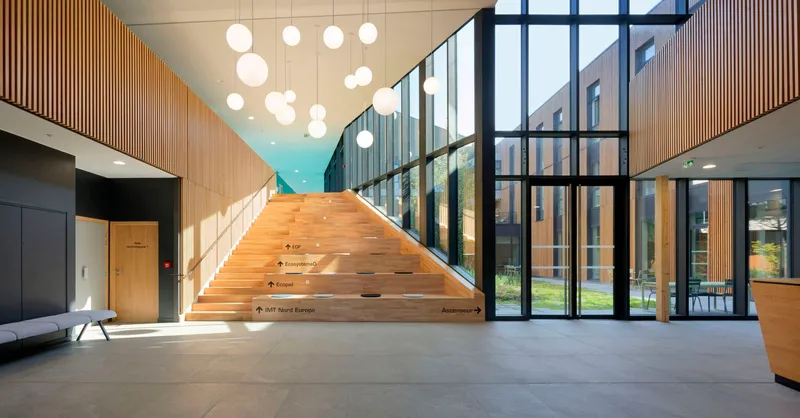
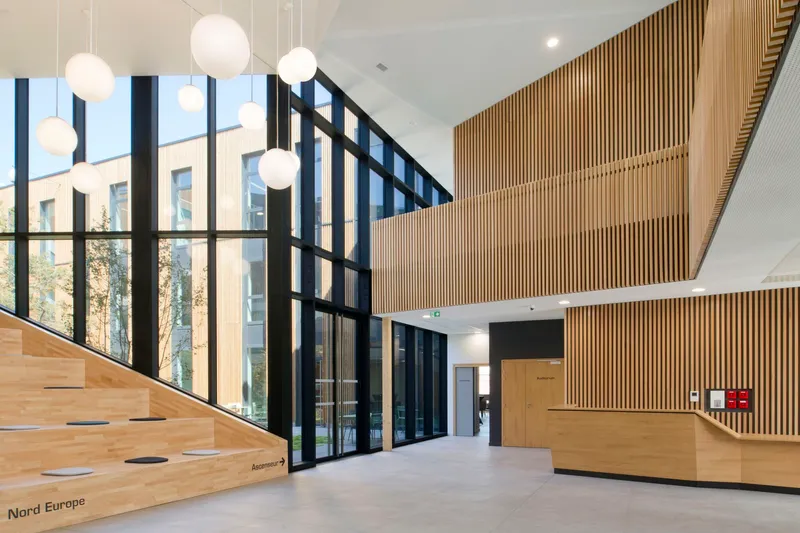
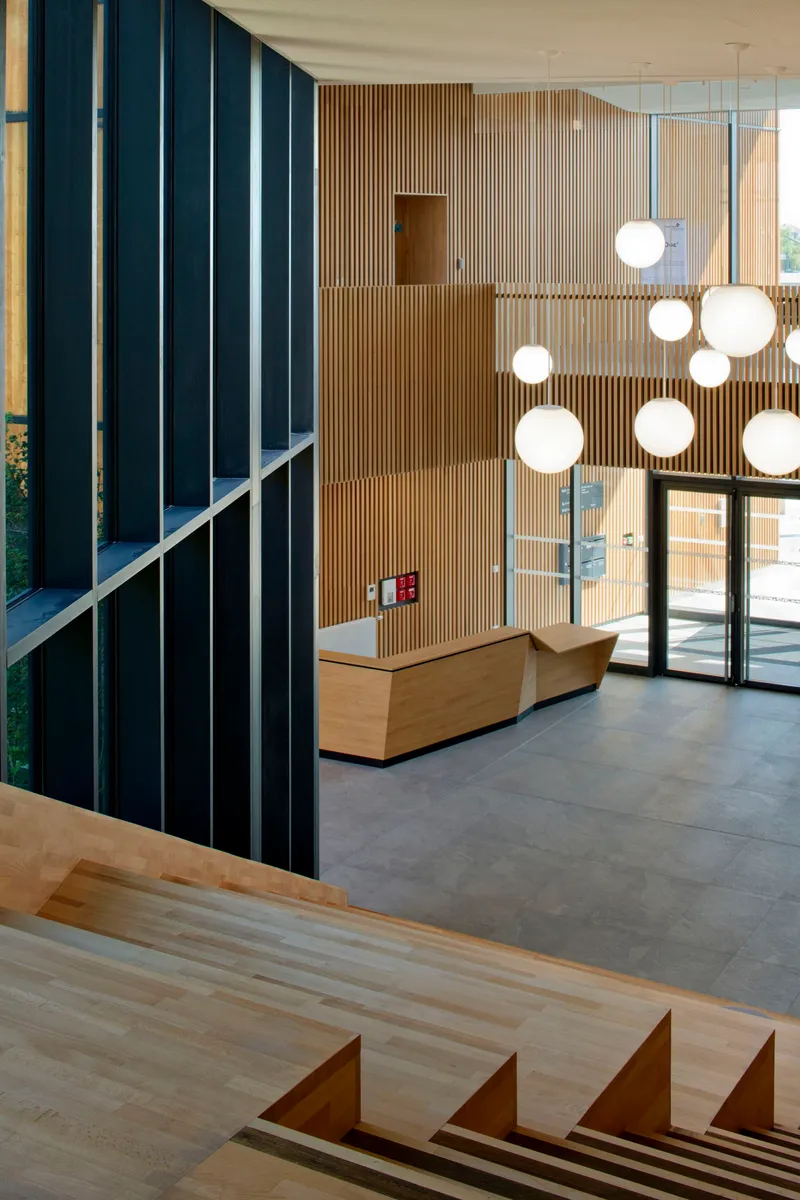
Step inside and the material palette tightens to timber: slatted walls, wide stair treads, tiered seating, and the warm tones of a solid wood structure that accounts for more than 36 kilograms of bio-sourced material per square metre. The entrance lobby sets the tone with floor-to-ceiling glazing on one side and a generous timber staircase on the other, framed by clusters of sphere pendant lights that act as soft wayfinding markers.
The stepped seating area below the pendants doubles as an informal auditorium, a meeting spot, and an observation platform overlooking the courtyard. It is the kind of multifunctional gesture that makes a training center feel less institutional and more like a place people actually want to occupy between sessions. The architects sourced materials primarily from local suppliers, reinforcing the project's commitment to reducing embodied carbon through proximity rather than exoticism.
Detail and Materiality
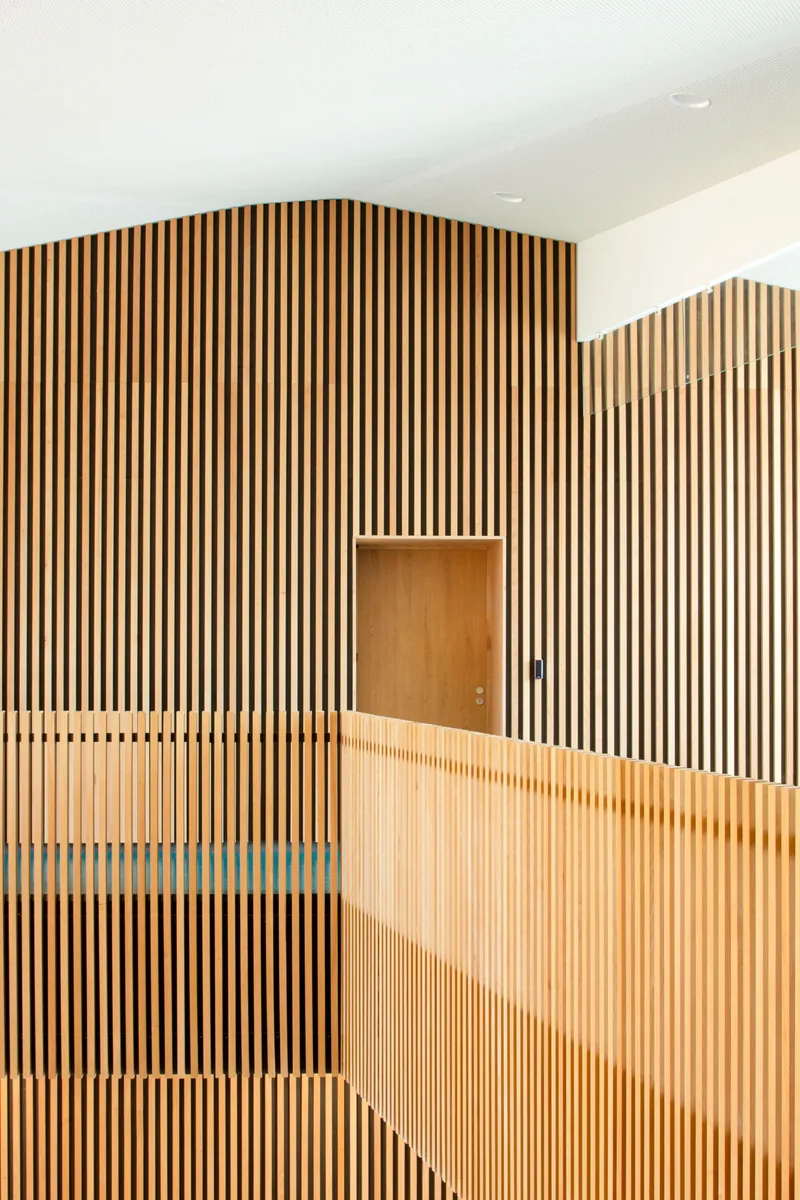
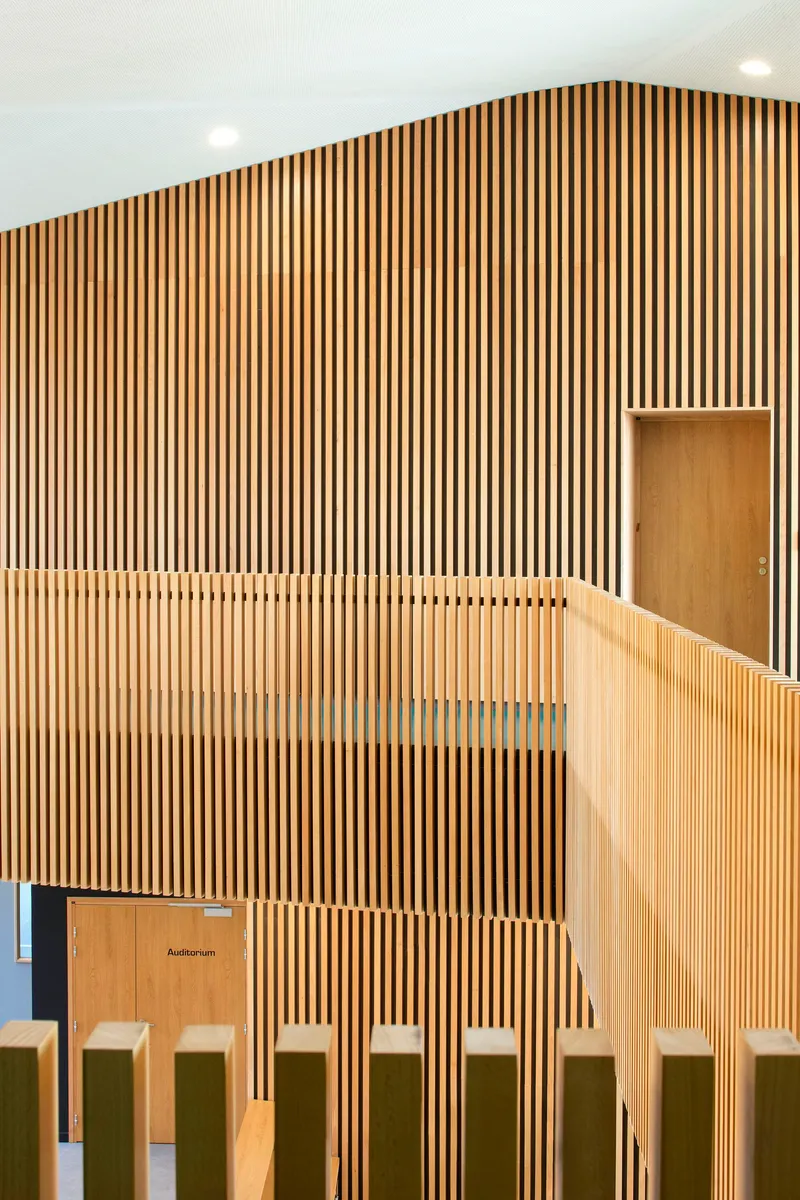
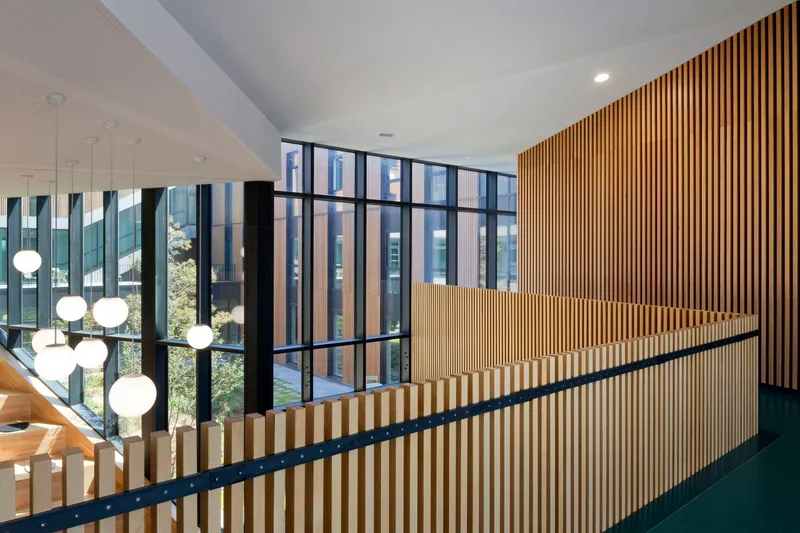
Close up, the vertical timber slats reveal a carefully considered layering: recessed door openings sit flush with glazed balustrades, and black steel handrails provide crisp contrast against the pale wood. The joinery is engineered to minimize heat loss at connection points, a detail that rarely gets celebrated but makes the difference between a building that performs on paper and one that performs in reality.
The upper-level landings overlook the courtyard through generous openings, maintaining the interior-to-exterior visual connection at every turn. The repetition of the slat motif across walls, ceilings, and balustrade infills gives the building a cohesive identity without becoming monotonous. It reads as one material language spoken at different volumes.
Threshold and Public Ground
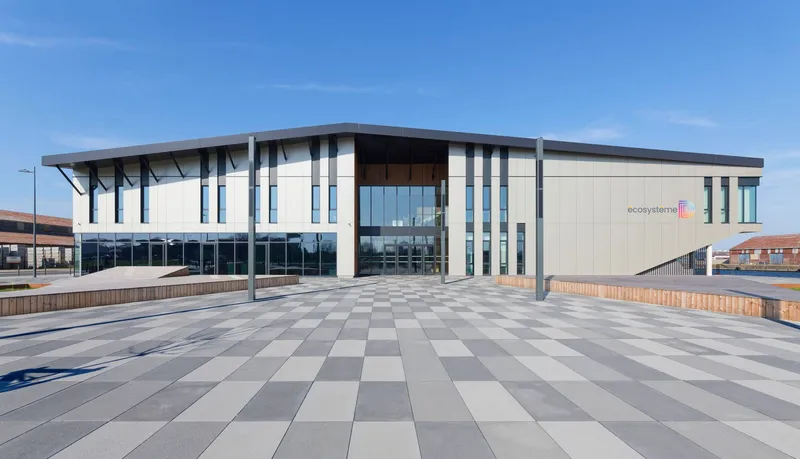
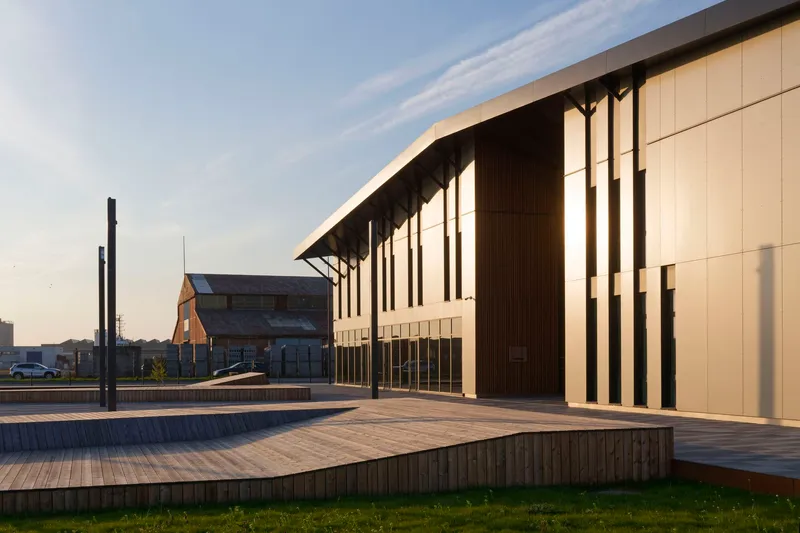
The main entrance plaza, designed with landscape architect RVB Paysage, uses a chequered paving pattern and a cantilevered canopy to create a generous threshold between street and building. The forecourt incorporates street furniture, connected platforms, and educational installations about renewable energies, turning the approach sequence into a public amenity rather than a buffer zone.
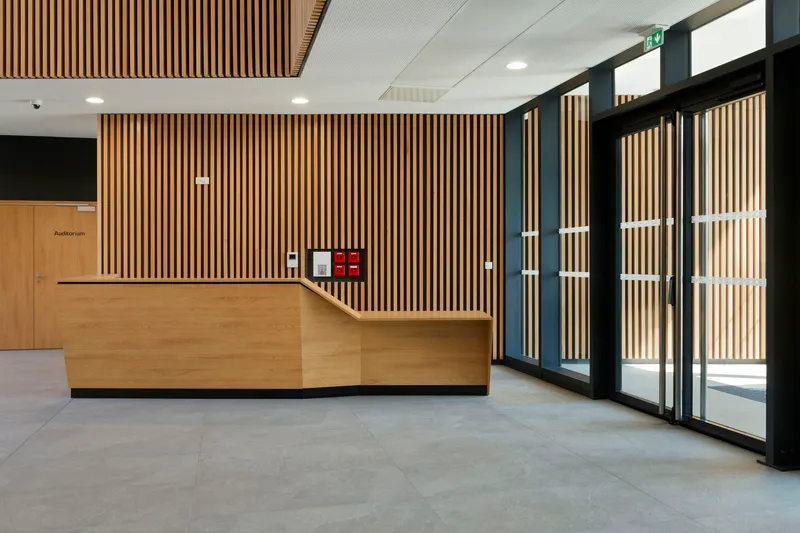
At golden hour, the timber-decked plaza and deep overhang catch light in a way that softens the building's industrial bearing. The reception desk inside, with its vertical slat wall and black-framed glazed doors, completes the transition from public to semi-public with a minimum of fuss. There is no grand atrium here, just a carefully tuned series of spatial compressions and releases.
Waterfront at Twilight
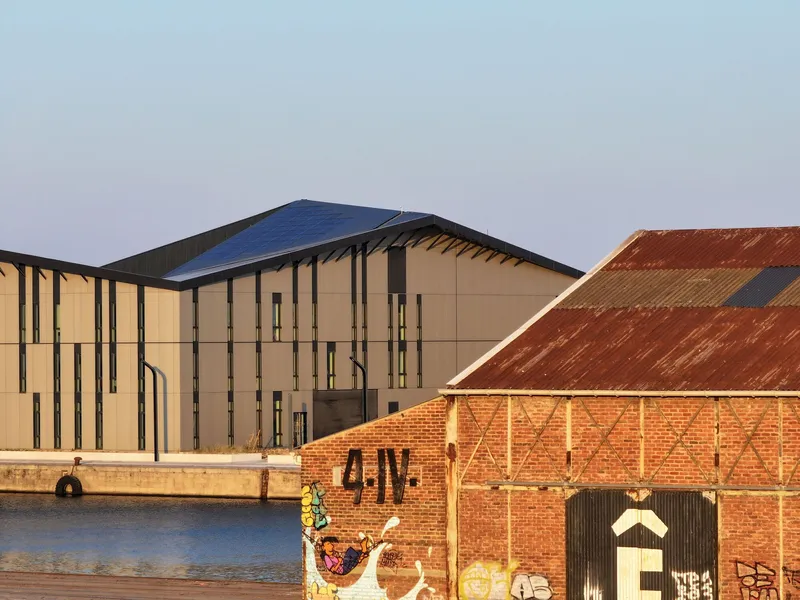
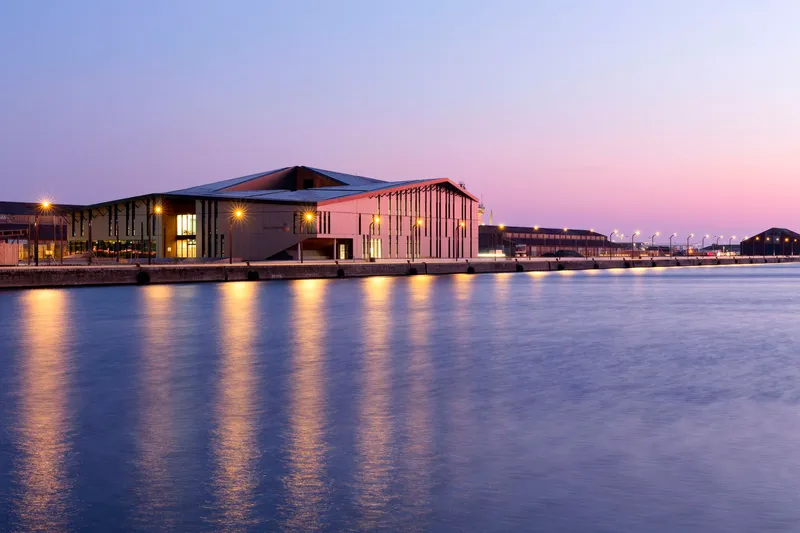
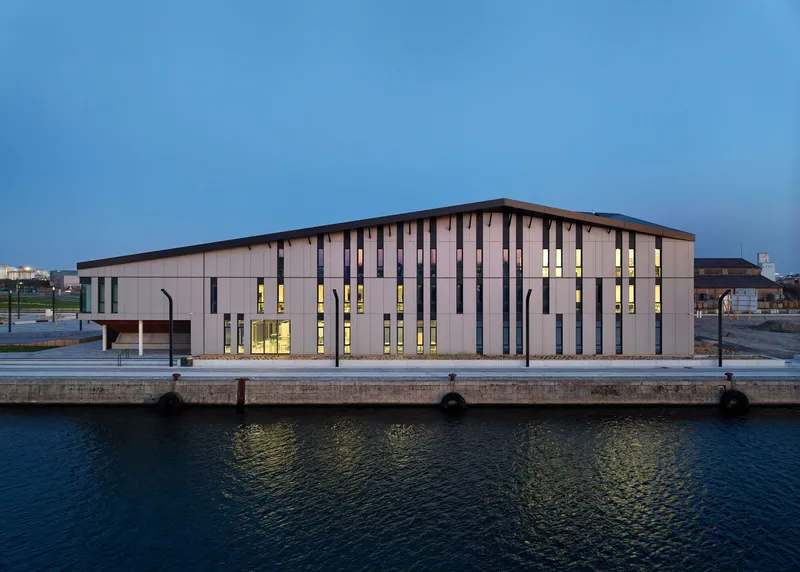
The building's relationship to water becomes most legible at dusk. The long waterfront elevation, illuminated from within, reveals the rhythm of vertical window openings between timber cladding panels. Reflected in the still harbor, the facade doubles itself and gains a presence that the daytime views only hint at. The architects positioned the building at the interface between port and urban fabric precisely to create these visual connections with neighboring iconic structures.

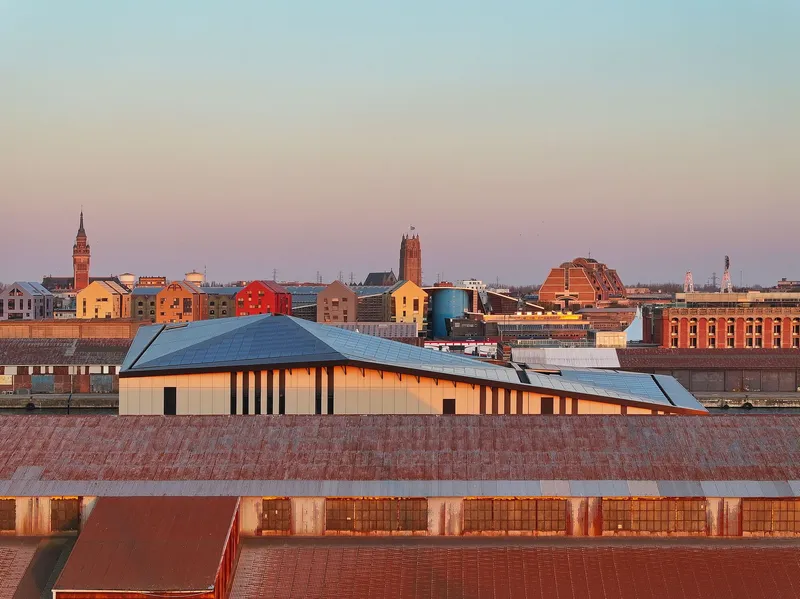
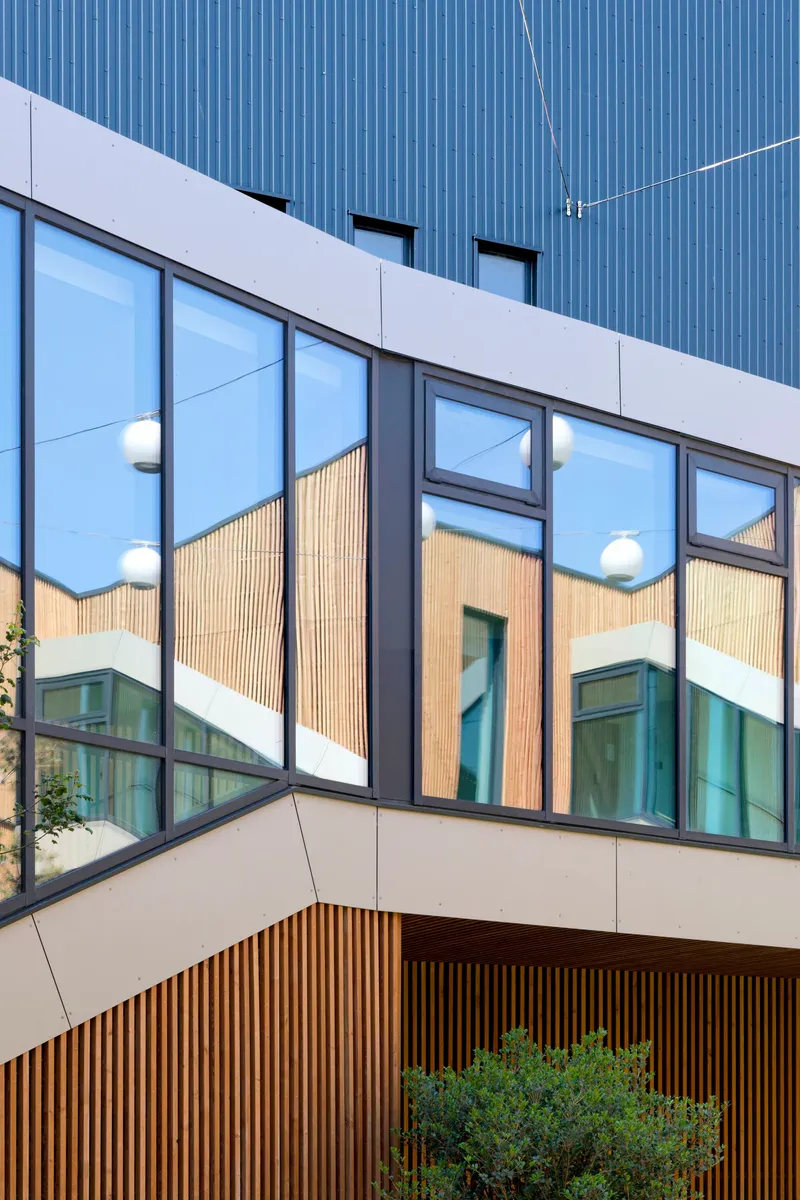
From the rooftops, the zinc roof form rises between graffitied industrial sheds like a geological outcrop. The reflective glass curtainwall at the corner captures the surrounding context in its surface, folding the old port back into the new building's skin. It is a smart, economical way to acknowledge history without resorting to pastiche.
Aerial Context

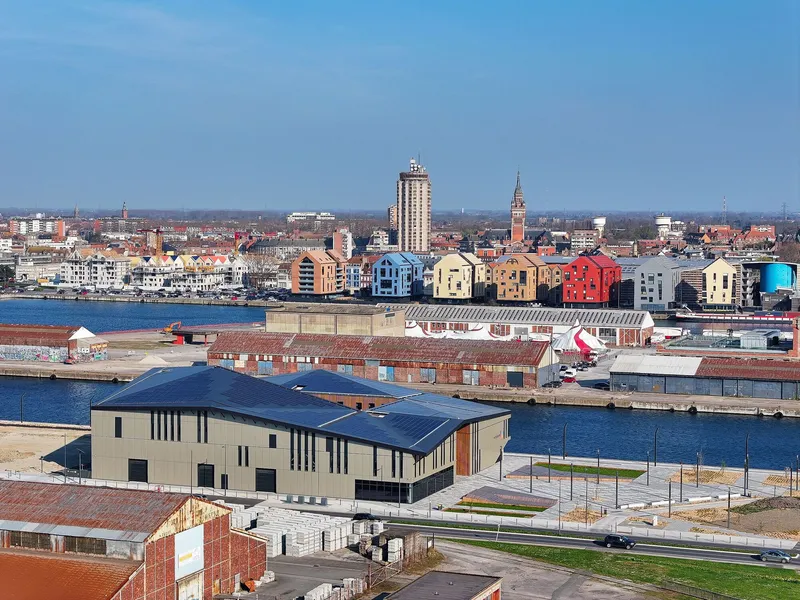
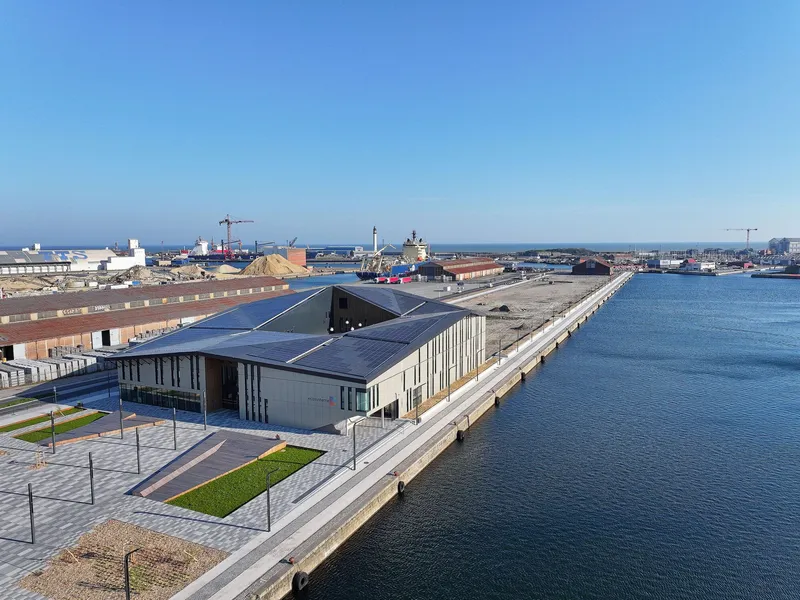
From altitude, the project's dual allegiance becomes clear. On one side, the waterfront quay and harbor; on the other, the roadway and traffic of the city. The building mediates between these two conditions with its low-slung profile and faceted roof, never competing with the scale of the port infrastructure but asserting itself as something unmistakably purposeful. Sitting five metres above sea level on the former Mole 2, it occupies ground that was, until recently, an industrial afterthought.
Why This Project Matters
Energy-positive buildings are no longer theoretical propositions, but they remain rare enough that each new one carries disproportionate weight as proof of concept. Ecosystème D matters because it refuses to let performance metrics excuse architectural ambivalence. The building is rigorous in its climate strategy, achieving level 3 of France's bio-sourced building label, while simultaneously creating a legible, welcoming civic landmark on a site that had none. That combination, technical credibility paired with spatial generosity, is what separates demonstration projects from real architecture.
Snøhetta and Santer Vanhoof have also made a shrewd argument about scale and context. By fragmenting the volume into pitched-roof clusters, grounding the material palette in timber and local sourcing, and designing the morphology around wind and sun rather than image, they produced a building that looks inevitable on its site. In a port city defined by pragmatism and hard weather, that is perhaps the highest compliment available.
Ecosystème D, designed by Snøhetta and Santer Vanhoof, Dunkerque, France. 4,400 m², completed 2024. Photography by Nicolas Fussler.
About the Studio
Share Your Own Work on uni.xyz
If projects like this are the kind of work you want to make, uni.xyz is a place to publish your own, find collaborators, and enter design competitions.



Popular Articles
Popular articles from the community


The Musturak Paradise: Senior Living Architecture for a Connected Future in Temara, Morocco
The Musturak Paradise reimagines senior living architecture in Temara via private homes, social spaces, culture, community, and shared care.

Hill & Cross Opera: Sculptural Opera House Architecture Shaped by Tallinn’s Landscape and Identity
Hill & Cross Opera reimagines opera house architecture in Tallinn through its sculptural hill, civic plaza, glass wave and a luminous cross.

Lunar Spiral: Space Architecture Shaped by the Mathematics of the Universe
Lunar Spiral reimagines space architecture through Fibonacci geometry, lunar regolith, levitating habitats, and self-sustaining Moon living.

The Earth Pod: 3D Printed Homes for Resilient Refugee Communities
The Earth Pod reimagines refugee housing through 3D printed homes made from clay, combining resilience, self-sufficiency, and rapid shelter.


Similar Reads
You might also enjoy these articles

Bao Huynh Watercolor Atelier: A Serene Art Retreat in Hội An
Bao Huynh Watercolor Atelier in Hội An blends multifunctional art spaces, sustainable design, local materials, and family-friendly living in a serene environment.

Atelier Macri Concept Store Interior Design by CASE-REAL
Atelier Macri store features a "ko" counter, walnut wood details, cork displays, blending retail, gallery, and seamless customer experiences.

Manuel Vargas Izquierdo Stadium and High-Performance Sports Center: Architectural Excellence in Jalpa de Méndez
The Manuel Vargas Izquierdo Stadium blends sustainable design, inclusive sports facilities, and cultural-inspired architecture, revitalizing Jalpa de Méndez’s public spaces.

KAKR Buluh Awar Hall: Revitalizing Community and Ecology Through Bamboo Architecture
Community built bamboo hall revitalizes Buluh Awar village, empowering youth, restoring ecology, celebrating vernacular craftsmanship through sustainable architecture and culture.

Comments (0)
Please login or sign up to add comments
No comments yet. Be the first to comment!