

Space of Experience: A Shortlisted School Where Corridors, Atriums and Rooftops Do the Teaching
Junghyeon Choo carves voids into a school's mass so circulation, atriums and rooftop gardens become shared rooms for learning by encounter.


Ask a graduate what they remember from school, and few will name a lesson plan. They remember a staircase where friendships formed, a courtyard where arguments got settled, a rooftop where they first looked at the city differently. Space of Experience starts from that memory. It treats everything outside the classroom as the real curriculum and then designs the school to make those encounters unavoidable.
The proposal by Junghyeon Choo was shortlisted in School Of Thought 2020, a competition that asked participants to rethink the architecture of learning. Choo's answer questions what students actually learn inside a school building. The scheme keeps classrooms and curriculum, but it argues that communication, observation and exploration happen mostly in the spaces between them. Open circulation, interconnected community spaces, rooftop gardens, transparent interiors and flexible learning zones carry that argument into built form.
A Campus Read as a Social Ecosystem From Above
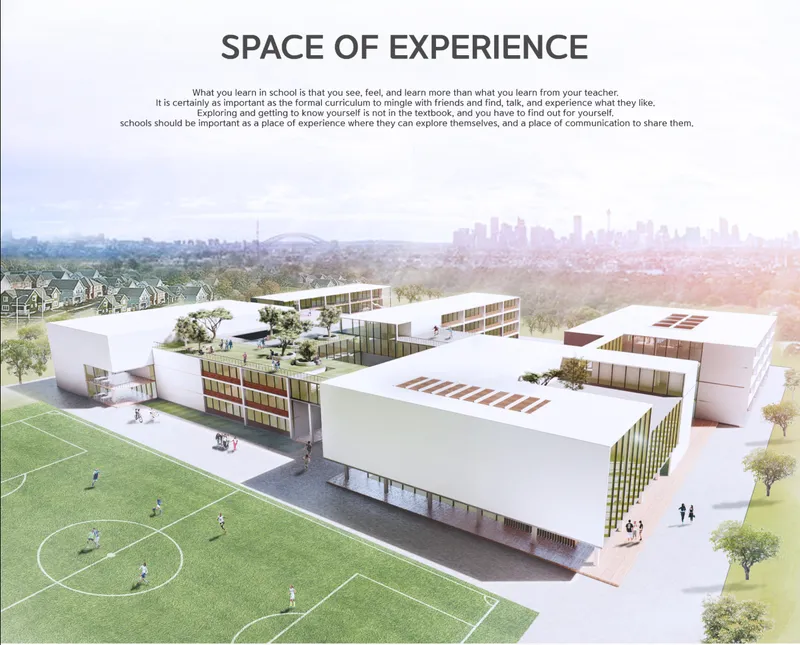
The aerial view sets the terms. White school blocks gather around a planted rooftop terrace, a soccer pitch sits alongside, and a hazy city skyline closes the horizon. The school appears as a cluster of volumes arranged around shared ground, not as a single sealed box. The roof is landscaped and occupied, and that one move changes the reading of the building: surfaces that schools usually leave inert are claimed as places to gather.
This is the scheme's central position. Choo writes that corridors are not merely transitional, atriums are not simply voids, and rooftops are not inactive surfaces. Where conventional school planning separates classrooms, circulation and social zones into efficient compartments, this campus is organised around communal experience. Its strength depends on whether every in-between space earns that claim, and the aerial suggests the designer took the commitment seriously.
Timber Atriums Where Circulation Becomes Programme
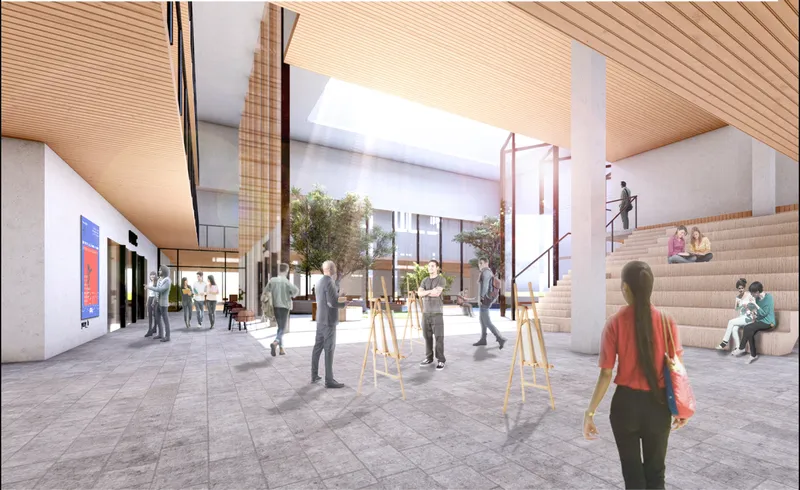
The interiors show the idea working at human scale. In the main atrium, timber slat ceilings filter soft skylight onto a tiered wooden seating stair, with easels set out and students crossing the space. The stair does three jobs at once: it moves people, it seats an audience, and it holds an informal studio. Here movement itself becomes part of the learning experience, which is the claim the project makes most directly.
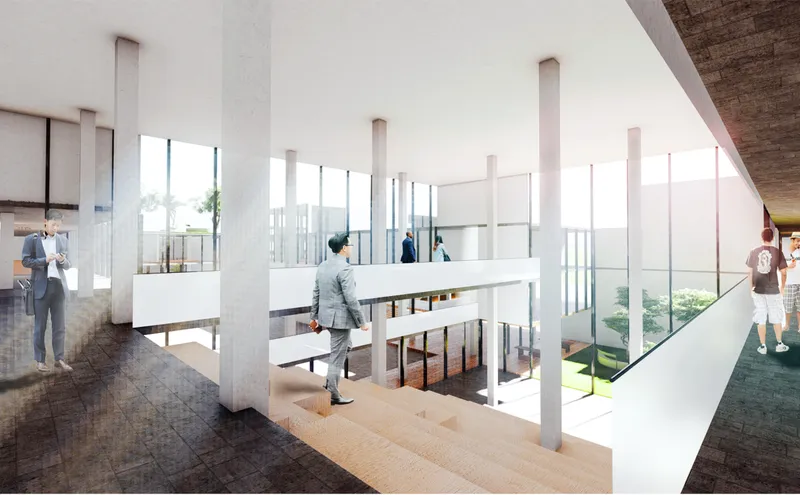
The second view, looking down a wide timber stair beside slender white columns, extends that logic. Glazing opens onto a planted courtyard, and people on the walkways above stay in view. This is where the proposal's emphasis on transparency pays off. A student on the stair can see a friend on the bridge and a class in the courtyard, and that visual continuity is how a building quietly encourages encounter. The warm timber against the restrained white structure keeps the spaces calm enough to linger in.
A Ground Floor That Dissolves Into the Garden
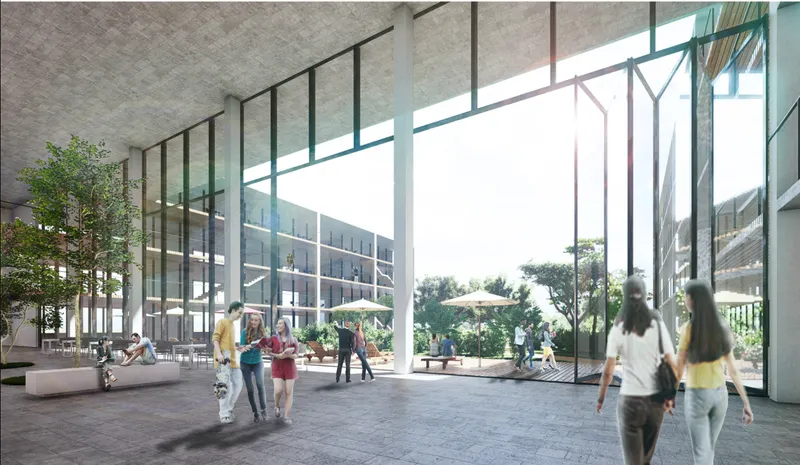
At ground level, a covered concourse opens through full-height glazing onto a garden scattered with umbrellas, and students walk through in daylight. The threshold between inside and outside almost disappears. Libraries, gyms, discussion spaces and gathering zones in this scheme are meant to be equal participants in education, and this concourse is the connective tissue that lets students drift between them during the day without a sense of leaving one regime for another.
The design value lies in how undramatic this space is. It is not a showpiece atrium but a generous, sheltered route, the kind of space where unplanned conversations happen. By placing communal programme where students will naturally cross paths, the proposal makes social engagement a by-product of ordinary movement rather than a scheduled activity.
Massing by Subtraction: Six Steps Toward Openness
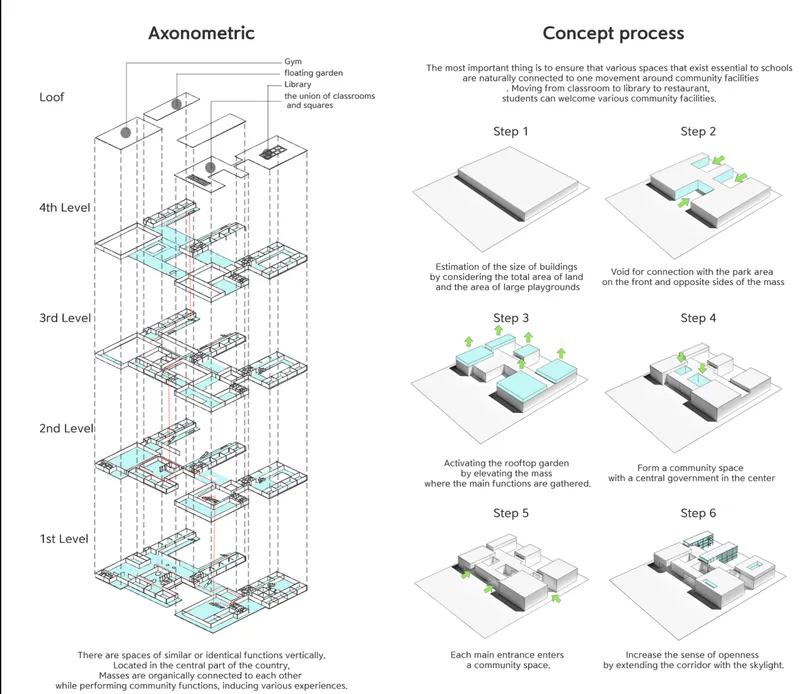
The exploded axonometric pulls apart four stacked floor levels beside a six-step massing diagram that traces how the school volumes take shape. Choo's process works through subtraction and opening rather than enclosure. Voids cut into the building mass establish sightlines and connections with the surrounding public spaces, and the volumes turn deliberately toward community-oriented zones.
This drawing is the key to the whole project. Each atrium, courtyard and terrace seen in the renderings comes from a decision to remove mass, not add it. The stacked plans show how the shared spaces thread vertically through the section, so the communal system reads as one continuous structure rather than a set of isolated amenities attached to a classroom block.
Why This Project Matters
School design often lags behind teaching practice. Pedagogy has moved toward participation, discussion and collaborative work, while many buildings still separate learning into boxes connected by corridors built for throughput. Space of Experience closes that gap with a clear spatial argument: if learning happens through interaction, the architecture has to produce interaction, and it does so most reliably through circulation, voids and shared ground.
What makes the entry persuasive is its consistency. The subtractive massing, the transparent interiors, the timber seating stairs and the occupied rooftop all follow the same premise, so the scheme reads as one idea carried through rather than a collection of attractive moments. For a shortlisted student proposal, it offers a useful reminder that the most formative rooms in a school may be the ones that were never labelled on the plan.
View the Full Project
About the Designers
Designer: Junghyeon Choo
Enter a Design Competition on uni.xyz
uni.xyz runs architecture and design competitions year-round that reward proposals with spatial conviction and real site intelligence.
Project credits: Space of Experience by Junghyeon Choo School Of Thought 2020 (uni.xyz).


Popular Articles
Popular articles from the community


ETEH Reworks the Shared Spaces of São Domingos School in Brazil Around Timber, Color and Hanging Plants
At São Domingos School in Brazil, 436 m² of hall, refectory and library are recast with timber joinery, a yellow and blue code and trailing greenery.

David Ortega Stacks a Two-Story Mexico City Penthouse Around a Steel Stair and a Pergola-Shaded Roof Terrace
In Colonia Roma, a 300 m² penthouse uses oak joinery, a planted steel stair and a slatted roof pergola to make a new-build apartment feel like a house.

FCC Arquitectura Expands a Portuguese Granite House with a Board-Marked Concrete Wing
In Portugal, JV House pairs a cleaned-up whitewashed and granite dwelling with a timber-shuttered concrete extension, courtyards and a garden pool.


The Amber Palace Opera: A Geological Fiction Surfaces on Tallinn's Baltic Waterfront
Pierre Brillard reimagines a Baltic legend as a public landscape, opera house, and waterfront promenade rooted in Tallinn's coastal identity.

Similar Reads
You might also enjoy these articles
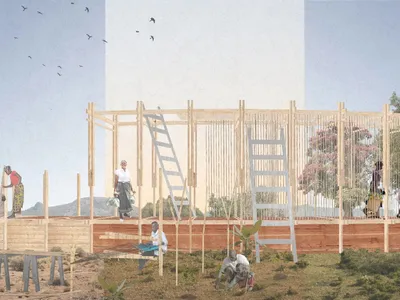
Healing Façade: A Modular Chapel System That Restores Ethiopia's Sacred Forests
Winner of the Eco-Chapel competition, this circular timber façade collects water from air to rebuild soil and reforest degraded Ethiopian landscapes.
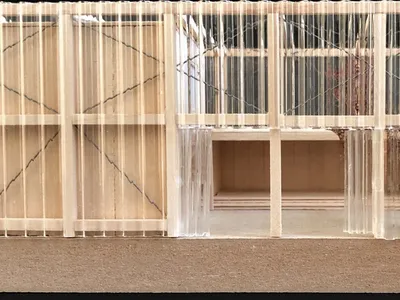
Kaffeebühnen: Where Coffee Shop Architecture Becomes a Civic Stage in Vienna
A linear sequence of timber boxes, transparent shells, and open yards turns the Viennese café tradition into a public performance space.
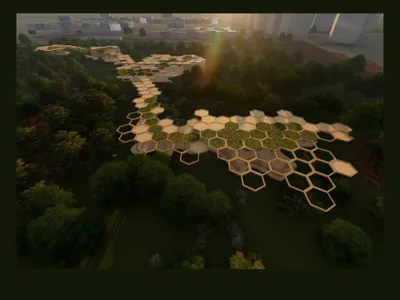
Eco Chapel: A Modular Forest Pavilion That Grows Like the Landscape It Protects
Hexagonal timber modules weave through existing trees, turning a chapel into a living system for prayer, education, and reforestation.


Urban Forest: A Vertical Ecosystem for 5,000 Workers in Singapore's Changi Business Park
Radially stacked pods and layered green decks turn a 7-acre plot into 47 acres of ecological workspace projected for 2040.

Explore Architecture Competitions
Discover active competitions in this discipline

Challenge to reimagine the Iron Throne

Photograph architecture without architects

Illustrate the lost glory of Angkor Wat - Render Challenge

Design challenge to reuse E-waste
Comments (0)
Please login or sign up to add comments
No comments yet. Be the first to comment!