
STAPATI Builds a Rammed Earth Farmhouse in Tamil Nadu That Opens Like a Matchbox
Set among Bagalur's agricultural fields, The Matchbox House pairs scalloped concrete canopies with rammed earth to frame a life lived between indoors and o


Farmland in Tamil Nadu has a particular horizontal gravity. The sky is enormous, the tree groves punctuate the landscape rather than enclose it, and any built object reads as either an imposition or a conversation. The Matchbox House by STAPATI, led by architect George Seemon, lands firmly in the latter category. Completed in 2023 on a compound in Bagalur, the project sits within acres of agricultural fields and approaches its context with a material directness that makes most contemporary farmhouses look performative.
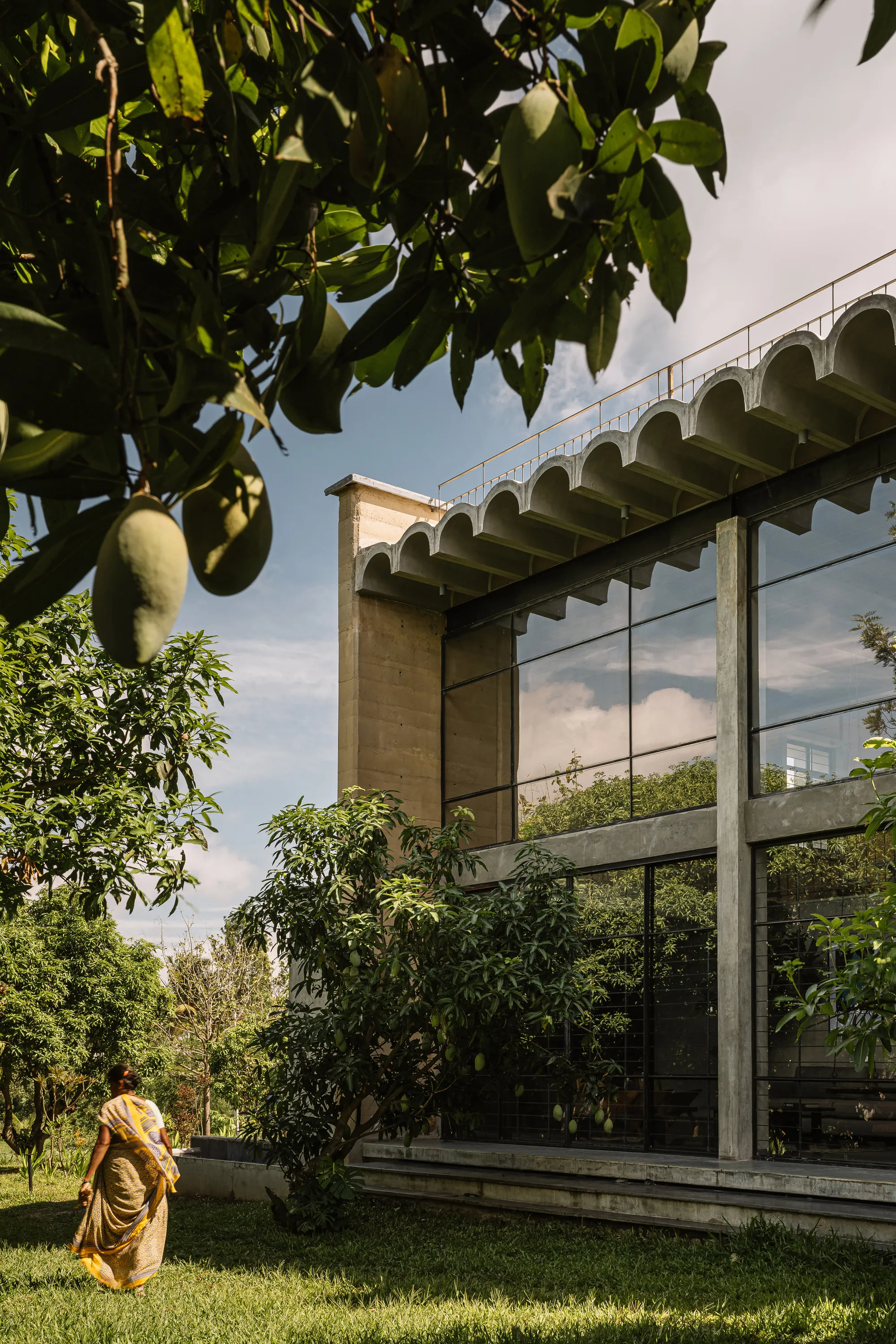
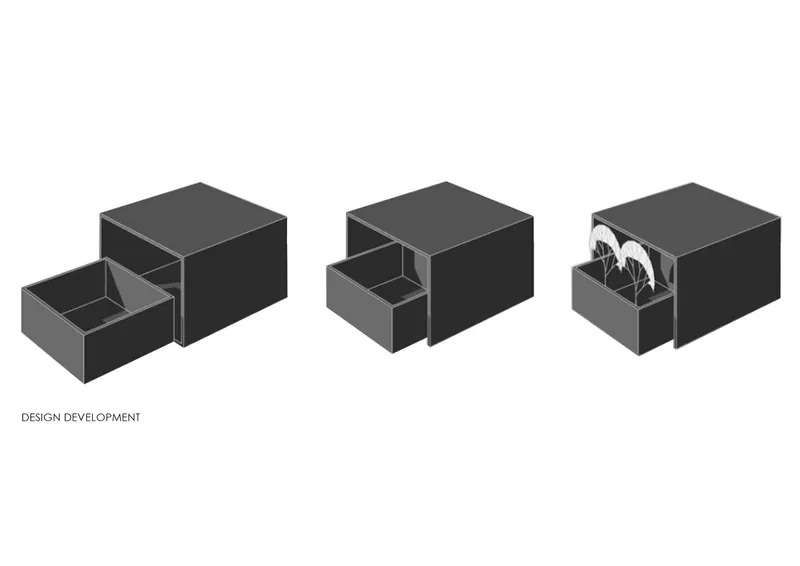
The name is not decorative. The house operates on the literal logic of a matchbox: two interlocking volumes that slide apart to reveal courtyards and vegetation at their seams. One volume is heavy, grounded in rammed earth and stone; the other is light, wrapped in timber cladding and gridded steel-framed glazing. Between them, the architecture breathes. The scalloped concrete canopy that crowns the garden facade provides shade without mass, a signature element that gives the project its visual identity without ever dominating it.
Two Volumes, Two Temperaments
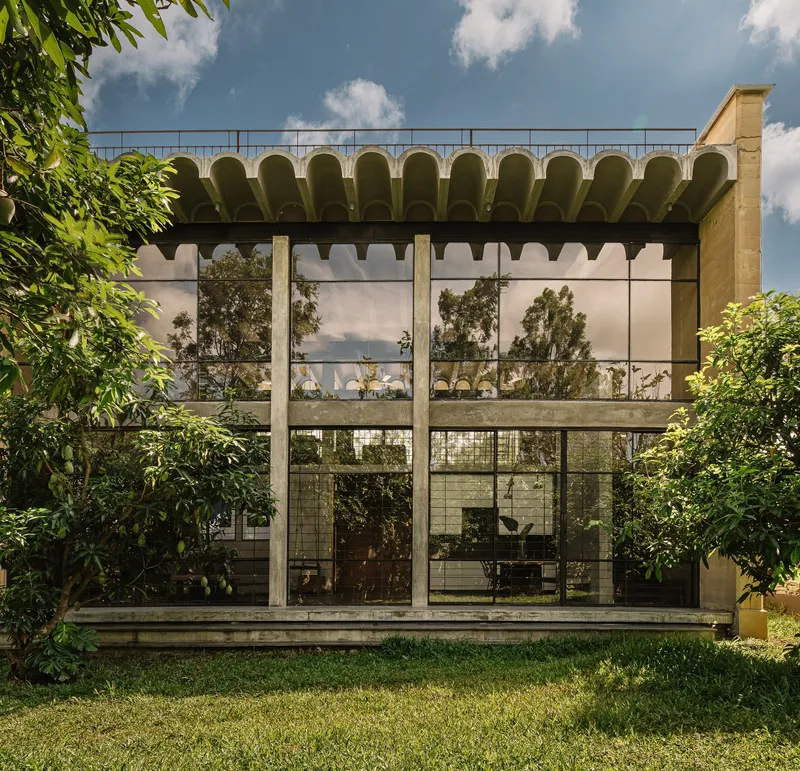
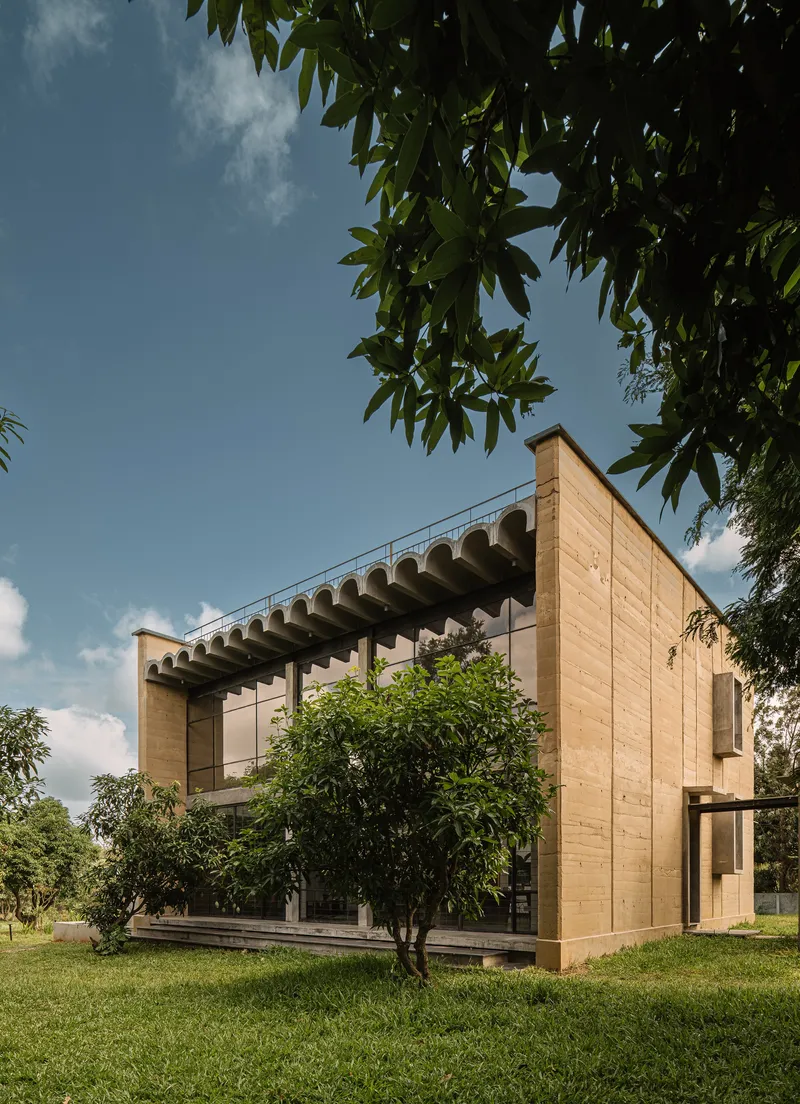
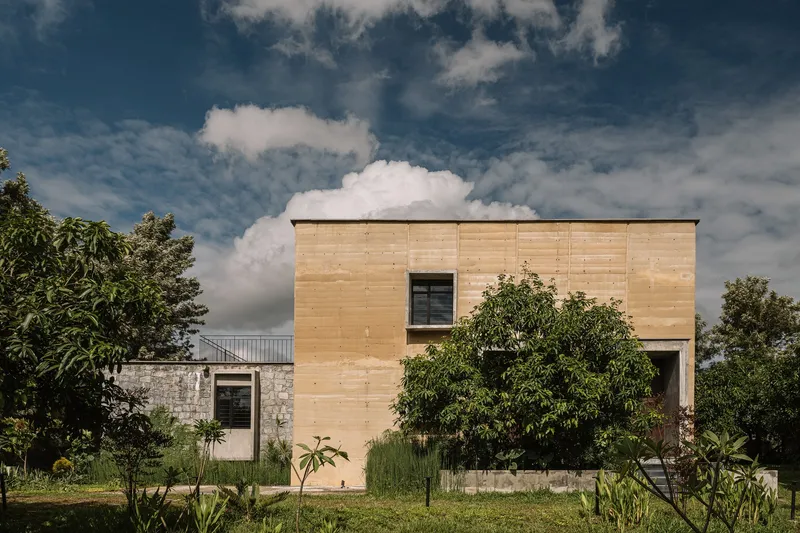
The project's formal proposition is best understood from its corners. One face presents a double-height glass facade set beneath the repeating scalloped arches of a concrete canopy, while the perpendicular elevation reveals raw rammed earth walls rising to meet the same roof structure. A separate timber-clad volume, raised on a stone base, reads almost as a secondary building altogether, its single punched window and dark siding suggesting a barn or workshop more than a bedroom wing.
What holds this composition together is restraint. STAPATI resists the urge to unify every surface, instead letting each material claim its own tectonic logic. Rammed earth compresses; timber cladding wraps; concrete spans. The result is a compound that feels assembled over time, even though it was designed as a single gesture.
The Scalloped Canopy as Threshold
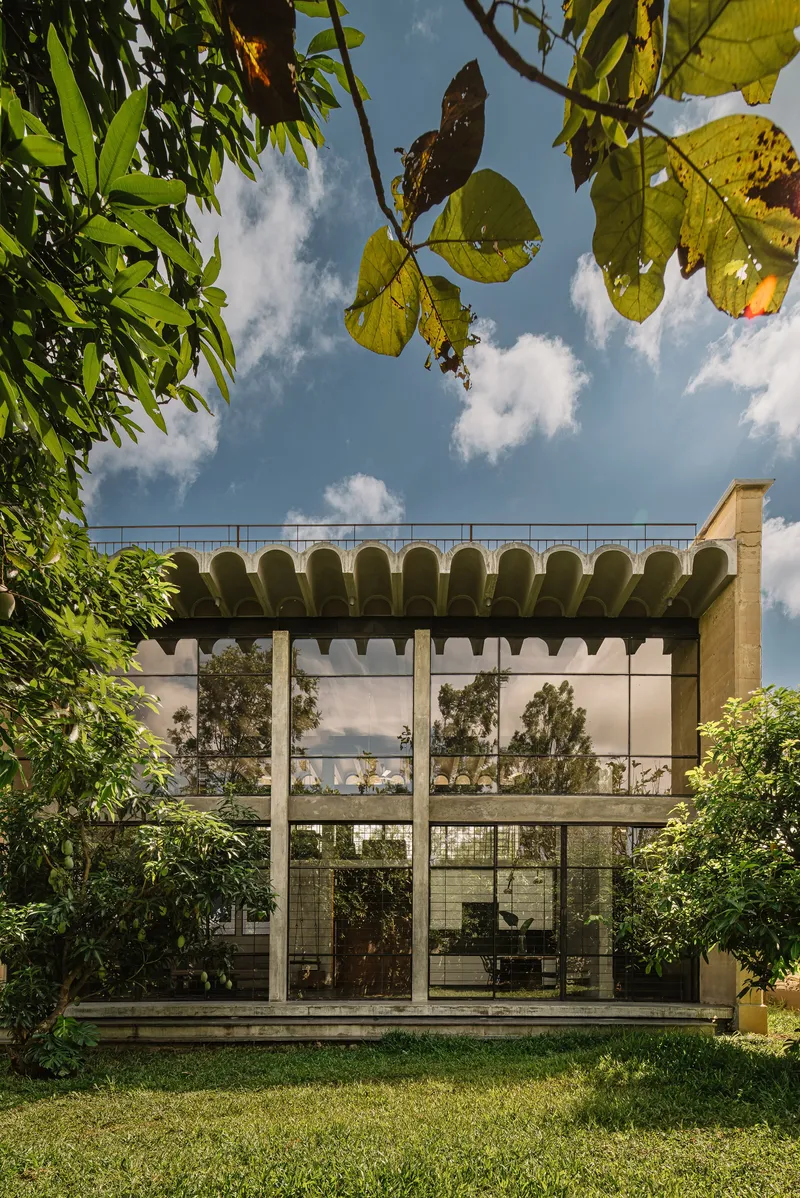
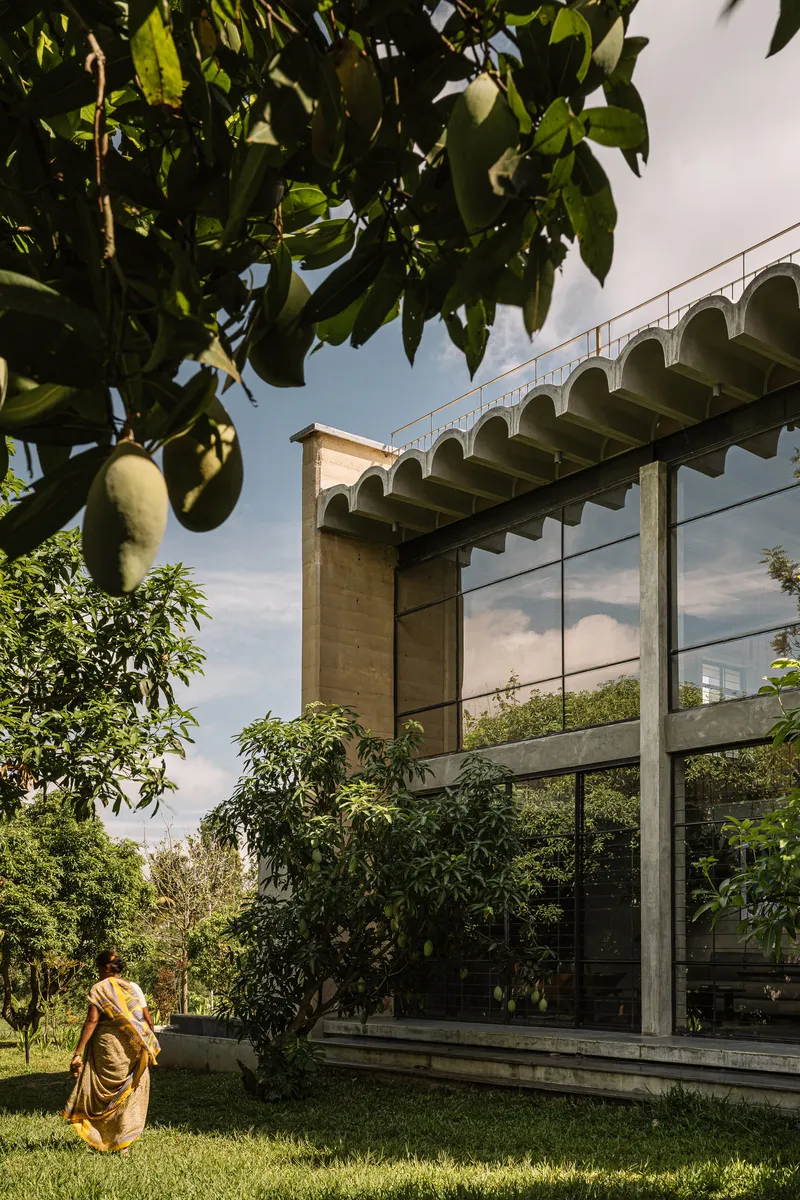
The scalloped concrete canopy is the house's most legible move, and it earns its prominence. Rather than a flat slab or a pitched roof meeting the facade, the canopy introduces a rhythmic undulation that creates pockets of shade and light. Viewed from below, the scallops produce deep shadows even in the harsh midday sun; from across the garden, they lend scale to the glass wall beneath, breaking what could be an imposing two-story surface into a measured, almost textile pattern.
The canopy also mediates between inside and outside. Standing beneath the mango trees that frame the approach, you perceive the house through layers: foliage, then canopy, then glazing, then the exposed structure within. Each layer filters the next. It is a simple device, but it transforms the arrival experience from flat confrontation to gradual discovery.
Living Inside Exposed Structure
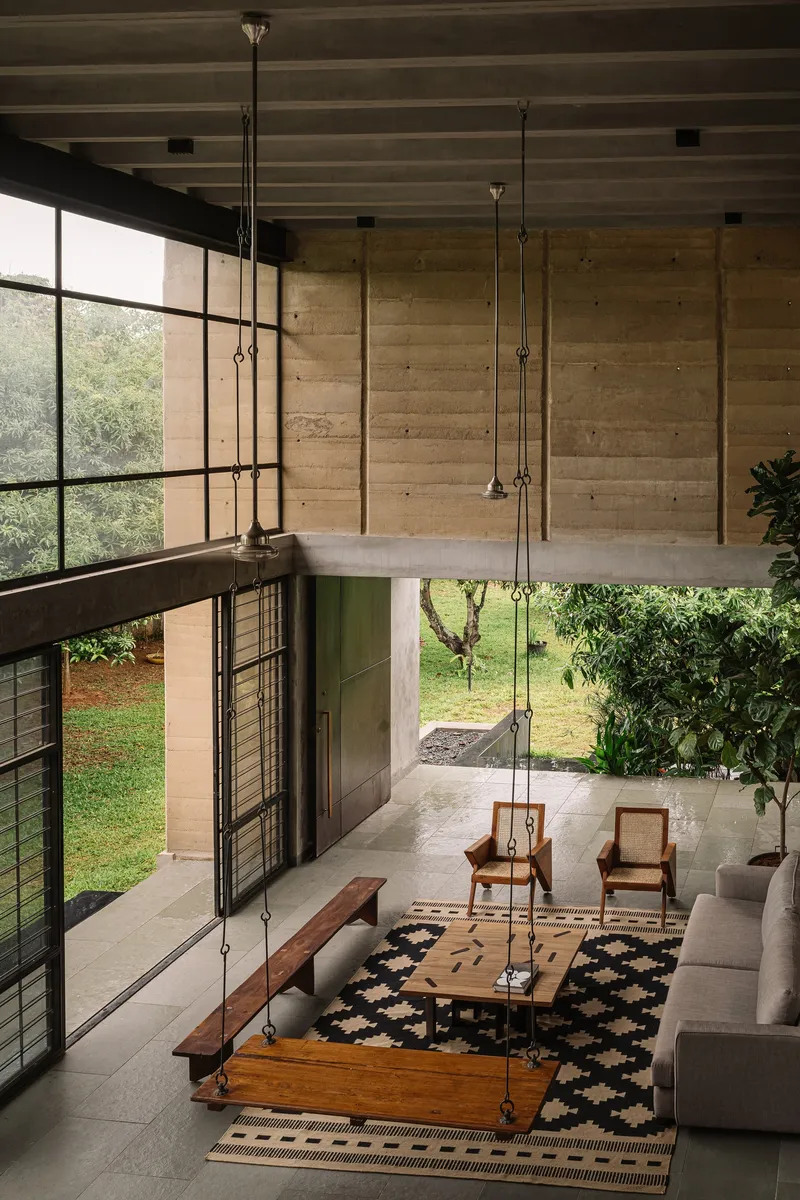

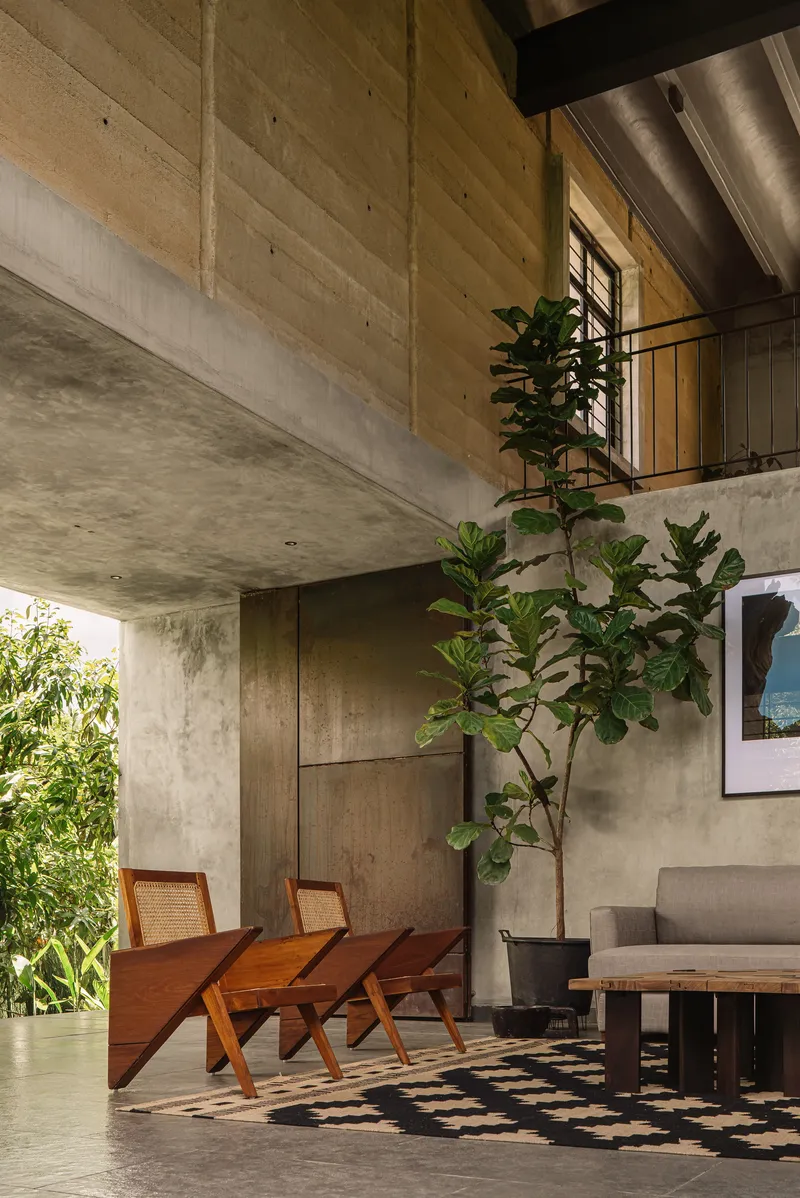
Internally, the house commits to its structural choices. Concrete ceiling joists span the double-height living room in parallel ridges. Diagonal timber roof trusses are left fully exposed above the upper living area. There is no dropped ceiling, no plasterboard to smooth things over. You live with the bones of the building, and that honesty extends to the steel window frames, the raw concrete walls, and the polished floor that reflects it all.
A suspended swing seat hangs in the double-height volume overlooking the garden, a gesture that could tip into preciousness but works here because the surrounding space is so unadorned. The proportions are generous enough that the room absorbs furniture and people without crowding. Timber joists in the more intimate sitting area bring the scale down, sheltering cane chairs and a potted fig tree in a space that feels like a covered veranda rather than a formal room.
Light as a Material
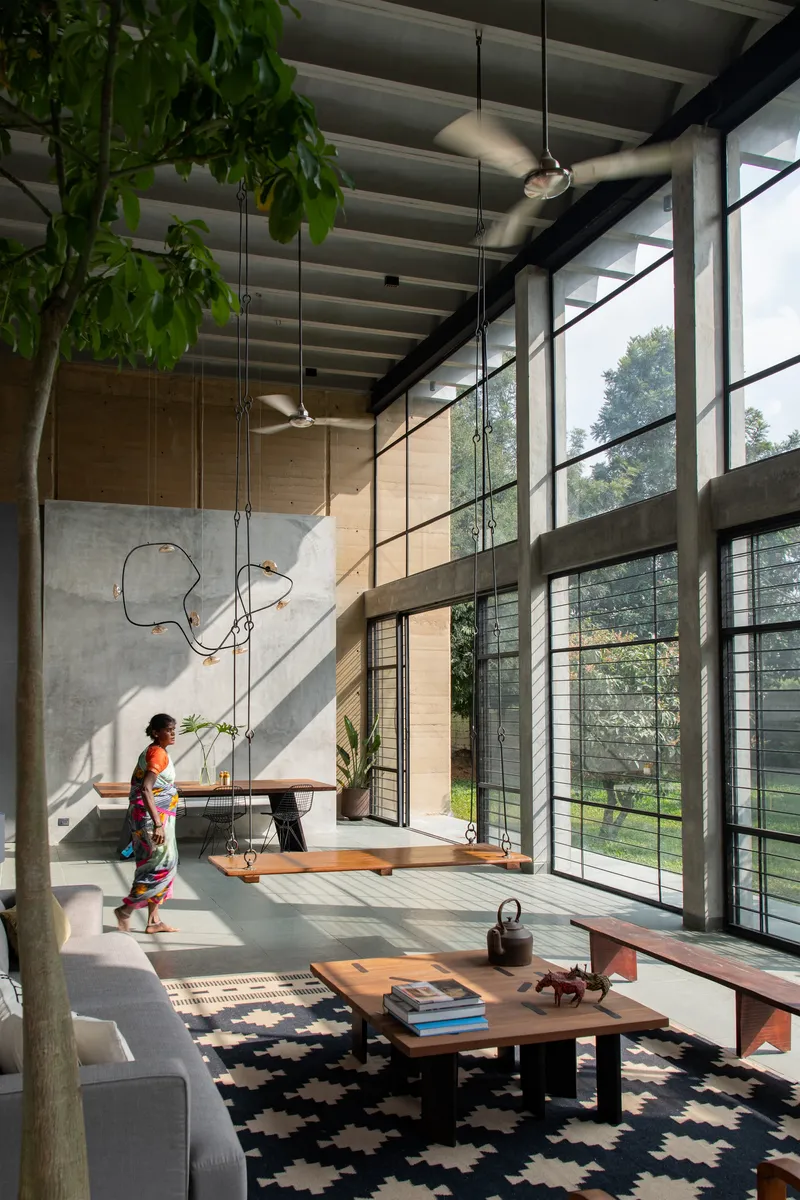
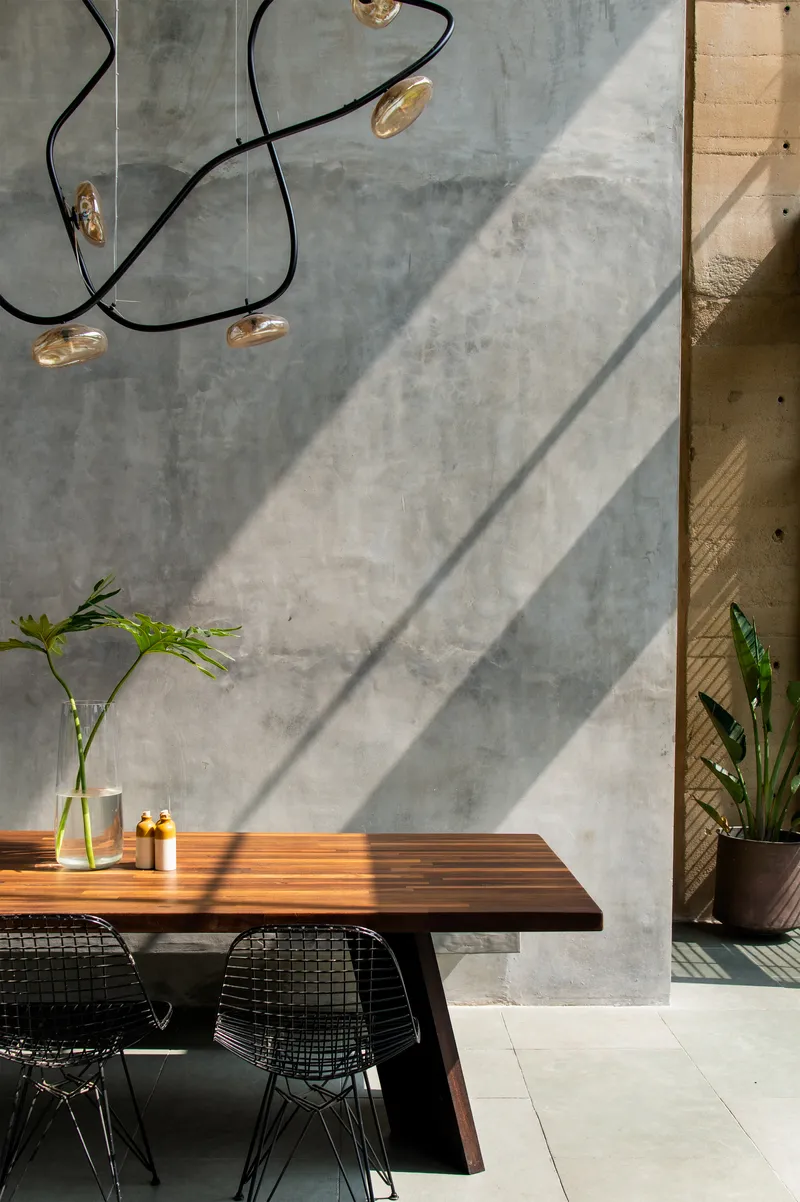
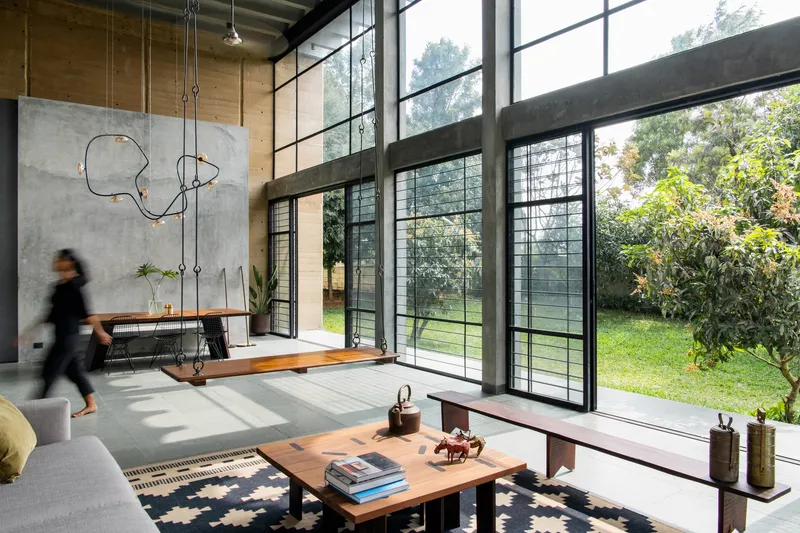
The steel-framed windows do more than frame garden views. Their grid pattern cuts incoming sunlight into diagonal slashes that travel across concrete walls throughout the day. In the dining area, these shadow lines interact with a sculptural pendant light and clusters of potted plants to produce compositions that change by the hour. It is the kind of effect that requires discipline in material selection: the concrete and rammed earth surfaces are matte enough to register shadow without glare, and the absence of competing wall finishes lets the light perform.
The steel-framed doors in the living space open directly to the garden, collapsing the boundary between interior and landscape. A figure walking past the concrete wall in one view could be inside or outside; the threshold is that thin. In a climate where the outdoors is livable for most of the year, this ambiguity is not a luxury but a functional strategy.
Compound in the Fields
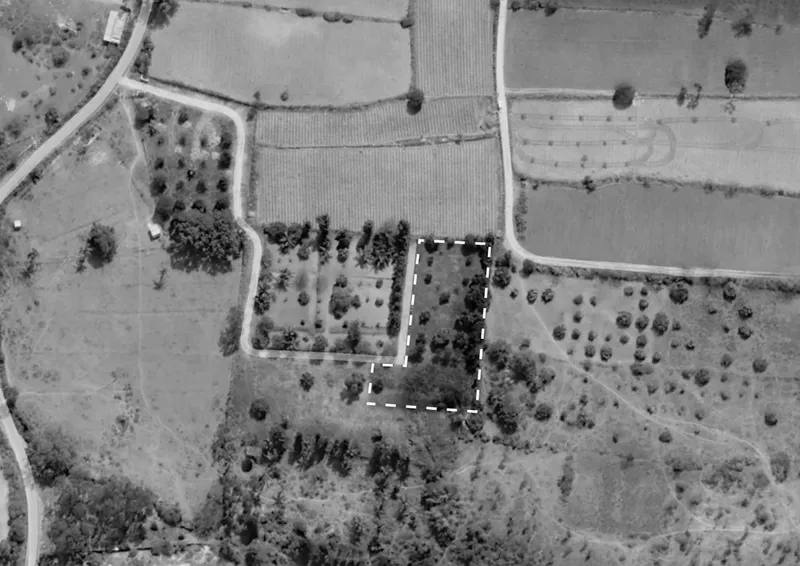
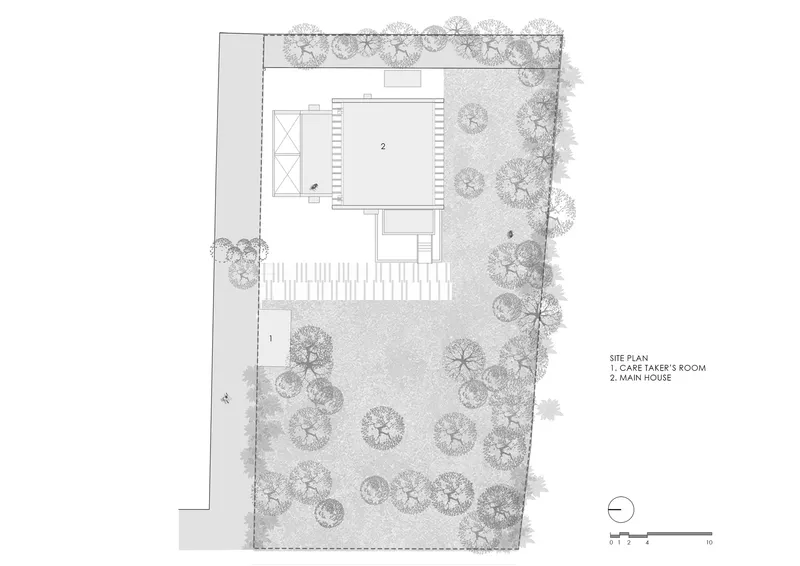
The aerial photograph makes the project's isolation vivid. The compound sits as a white-outlined rectangle amid a patchwork of agricultural fields and scattered tree groves, connected to the wider landscape by dirt tracks rather than roads. The site plan clarifies the internal arrangement: two primary structures and a caretaker's room, loosely organized around clusters of trees that predate the architecture.
This is not a suburban house with a large garden. It is a rural compound, and its spatial logic reflects that distinction. The distance between buildings creates outdoor rooms that are as programmatically important as the interiors. Cooking, gathering, and resting all migrate between inside and out depending on the time of day and the season.
Plans and Drawings

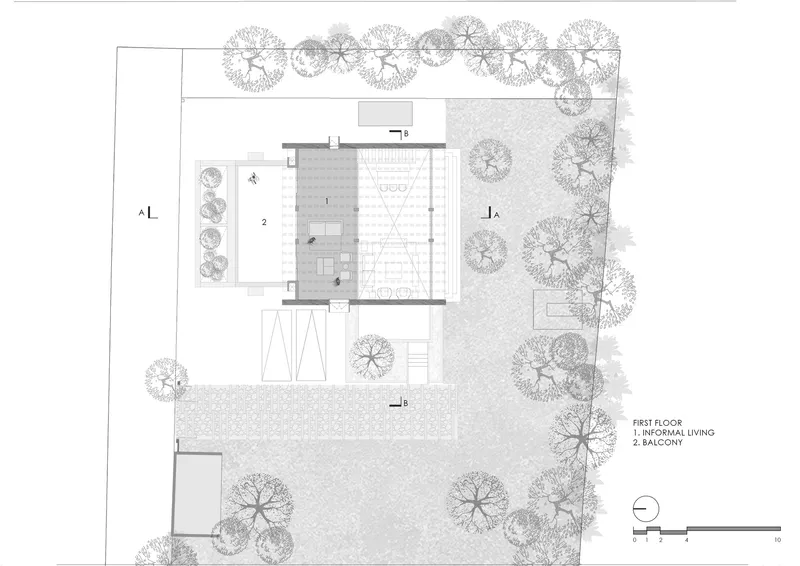
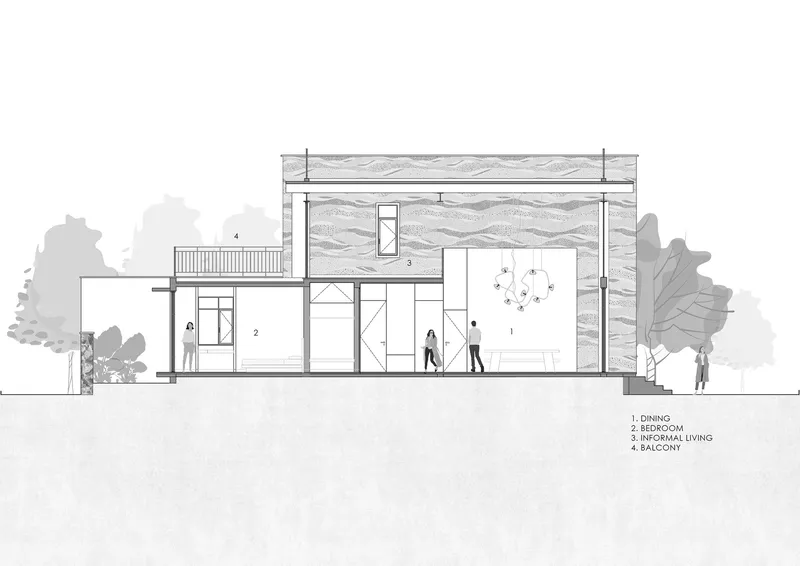

The ground floor plan reveals a sequence of living spaces, bedrooms, and an outdoor kitchen that wrap around the landscape rather than imposing a rigid perimeter. The first floor is leaner: an informal living area with a balcony that surveys the site. Two section drawings expose the double-height dining space and the staircase circulation, showing how the vaulted ceiling and the mezzanine level negotiate the change in scale.
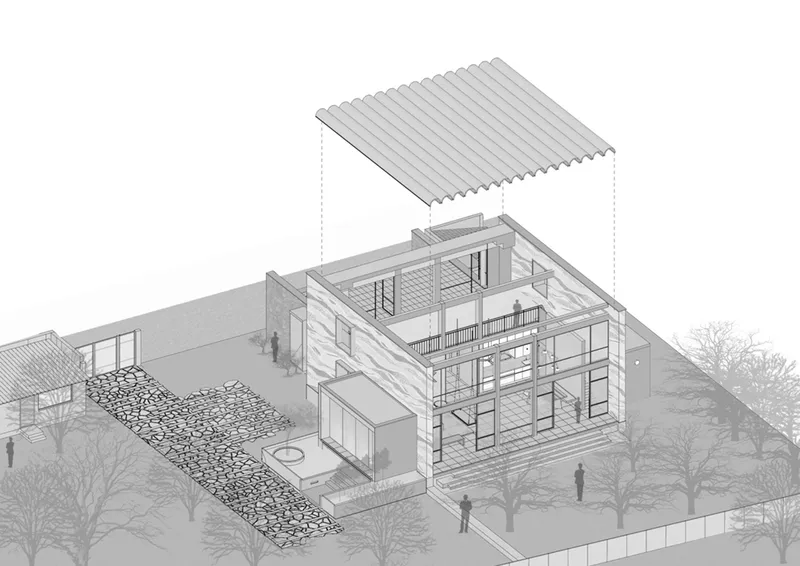
The axonometric drawings are the most revealing. One explodes the corrugated roof to show the internal structural frame and the garden courtyard below, confirming that the house is essentially a steel-and-timber skeleton dressed in earth and concrete. The other illustrates the matchbox concept directly: three stages of sliding volumes pull apart to reveal interior courtyards filled with vegetation. It is a didactic drawing, but it earns its simplicity because the built result delivers on the promise.
Why This Project Matters
The Matchbox House matters because it demonstrates that environmentally conscious construction in rural India does not require a retreat into nostalgia or a reliance on imported vocabularies. STAPATI uses rammed earth, exposed concrete, steel, and timber not as aesthetic tokens but as structural systems, each chosen for what it does well in this specific climate and terrain. The scalloped canopy, the sliding volume strategy, the shadow play on matte surfaces: these are design decisions rooted in performance, not style.
More broadly, the project offers a model for how architects can work in agricultural landscapes without pretending the land is empty. The compound respects existing trees, responds to the horizon line, and invites the outdoors in with a generosity that makes the 2023 completion date feel almost incidental. Buildings like this do not age quickly, and that is perhaps the most responsible thing about them.
The Matchbox House by STAPATI (lead architect: George Seemon), Bagalur, Tamil Nadu, India. Completed 2023. Photography by Ishita Sitwala | The Fishy Project.
About the Studio
Share Your Own Work on uni.xyz
If projects like this are the kind of work you want to make, uni.xyz is a place to publish your own, find collaborators, and enter design competitions.



Popular Articles
Popular articles from the community


EW PARK: Sustainable Architecture Reimagines the Future of Urban Parking
EW PARK reimagines city parking as a modular wooden tower combining automation, solar energy, electric mobility, and adaptable urban design.

The Musturak Paradise: Senior Living Architecture for a Connected Future in Temara, Morocco
The Musturak Paradise reimagines senior living architecture in Temara via private homes, social spaces, culture, community, and shared care.

The Earth Pod: 3D Printed Homes for Resilient Refugee Communities
The Earth Pod reimagines refugee housing through 3D printed homes made from clay, combining resilience, self-sufficiency, and rapid shelter.

Conexión: Biophilic Design Reimagines High-Rise Living in Hong Kong
Conexión reimagines high-rise living in Hong Kong through biophilic design, green facades, shared spaces, daylight, water and nature within.


Similar Reads
You might also enjoy these articles

Bao Huynh Watercolor Atelier: A Serene Art Retreat in Hội An
Bao Huynh Watercolor Atelier in Hội An blends multifunctional art spaces, sustainable design, local materials, and family-friendly living in a serene environment.

Atelier Macri Concept Store Interior Design by CASE-REAL
Atelier Macri store features a "ko" counter, walnut wood details, cork displays, blending retail, gallery, and seamless customer experiences.

Manuel Vargas Izquierdo Stadium and High-Performance Sports Center: Architectural Excellence in Jalpa de Méndez
The Manuel Vargas Izquierdo Stadium blends sustainable design, inclusive sports facilities, and cultural-inspired architecture, revitalizing Jalpa de Méndez’s public spaces.

KAKR Buluh Awar Hall: Revitalizing Community and Ecology Through Bamboo Architecture
Community built bamboo hall revitalizes Buluh Awar village, empowering youth, restoring ecology, celebrating vernacular craftsmanship through sustainable architecture and culture.




Comments (0)
Please login or sign up to add comments
No comments yet. Be the first to comment!